







































AI-Native Networks Are the Future of Networking
AI-Native networks are a brand-new type of networking system in which artificial intelligence is integrated into every component, from top to bottom. Unlike traditional networks, which require manual configuration, static rules, and reactive management. AI-Native networks will be intelligent, adaptable, and autonomous.
They are utilizing machine learning, data analytics, and automation to continuously monitor, optimize, and protect network operations in real time.

AI-Native networks collect and process the enormous amount of information created by all of the devices, applications, and users connected to the network. This information allows the AI-Native network to recognize patterns, anticipate problems, and make decisions to prevent them. An example would be an AI-Native network detecting abnormal traffic flows, recognizing a threat to the network, and rerouting traffic to maintain performance and reliability.
This greatly reduces downtime and increases user satisfaction.
Self-Optimization is another major advantage of AI-Native networks. Unlike traditional networks, which have predetermined configurations, AI-Native networks continuously adjust bandwidth allocations, routing, and resource utilization in response to changing network needs. Therefore, they are highly efficient and scalable, particularly in high-demand areas such as 5G, Cloud Computing, and IoT.
Security has been enhanced within AI-Native networks through continuous learning from network activity. The AI model used in AI-Native networks can quickly recognize anomalous network activity and take action to mitigate threats much more quickly than traditional systems. Organizations utilizing AI-Native networks can rest assured that sensitive data will remain protected while maintaining compliance with various security regulations.
With many businesses moving towards Digital Transformation, AI-Native networks are becoming critical to managing increasingly complex infrastructures. Not only do AI-Native networks reduce operational costs, but they also enable accelerated innovation and improved service delivery.
We will never forget the feeling of frustration when our movie froze up just as it was reaching the final act, only to be told that it was because of ‘bad’ (slow) internet. And we’re not alone. When the vast majority of us experience internet slowdowns, we often look for someone to blame – and usually, it’s a simple, single “weak link” in our internet service provider chain. However, most slowdowns have multiple causes that can be difficult to identify and nearly impossible to manage.
Our daily use of digital technologies has increased exponentially in recent years, driven by the rise of continuous video streaming, the growing popularity of video conferencing, and the increasing number of smart devices. Because of this growth, there is an increasingly greater need for ways to manage the flow of digital information. Typically, engineers work in small teams to manage the massive amounts of data flowing through networks. Think of trying to ask a handful of engineers to individually control each of thousands of traffic signals in a major metropolitan area at the same time – it is almost inconceivable.
Historically, we have managed complex networks reactively. Once a problem occurs or digital traffic congestion begins, and a team of experts is notified of a potential issue, the team can begin identifying possible solutions while continuing to monitor the frozen screens.
What if the networks could anticipate potential problems, like an upcoming online gaming surge, and proactively direct video calls to less congested locations, without us ever experiencing a problem? This is the core concept behind the emerging field of Artificial Intelligence-based Network Optimization: Creating Intelligent Systems that Identify Problems Before They Occur.
#Intelligent Cloud AI: How Robots Use a Powerful Cloud Brain
Summary
Modern networks face challenges from the rapid expansion of streaming services, smart devices, cloud computing, and real-time applications. Networks managed by humans (the way we have always done things) are typically reactive; therefore, when users experience issues such as buffer delays, lost connections, or security breaches, they wait until the problem occurs before reacting. For this reason, the current reactive model is becoming insufficient for today’s increasingly complex digital environments.
Unlike traditionally designed networks, which were not built with AI in mind, AI-native networks are designed from the outset with AI in mind. These networks use continuous traffic monitoring, learning how it will be used, and automatic, real-time adaptation. If an error occurs within the AI-native network, its self-healing mechanisms can redirect traffic immediately, often before the end user even notices the loss of service. In addition to addressing errors as they occur, AI-native networks can also anticipate traffic bottlenecks and take proactive steps to prevent them.
Beyond just addressing real-time problems, AI-native systems also improve their security knowledge. While traditional security models only recognize known threats, AI-native systems continually identify abnormal usage patterns, isolate potential security vulnerabilities, and create self-protecting networks. The combination of machine learning, automation, and adaptive decision making allows AI-native networks to operate without extensive human interaction.
With AI-native networks delivering reliable performance under everyday conditions (such as those found in crowded sports venues, smart homes, etc.) while providing the necessary infrastructure for emerging technologies (such as autonomous vehicles and immersive digital experiences), AI-native networking represents a paradigm shift from the historical reactive infrastructure to the use of intelligent predictive systems to quietly enable a faster, safer, and more seamless digital environment.
The “Human Traffic Controller”: Why Today’s Network Management Is Breaking
To understand how poor connections occur, consider the Internet as a network of roads. Whenever you view a video, send an email, etc., you are sending small cars down those digital highways. Traffic controllers at each location manage their respective highways to keep the traffic flowing. Traffic controllers are notified whenever “digital car wrecks” (server crashes, blocked connections) occur. The traffic controller then manually reroutes traffic to resolve the problem.
Both of these system types are reactive. Reactive systems enable the identification and correction of problems before they result in slowdowns. Since we operate today in faster, far more complex digital environments than in the past, we cannot afford to wait for humans to identify and address problems. In fact, the era of accepting reactive systems has passed. The buffering wheel or the frozen screen are just two examples of the results of using only reactive systems.
AI-Native Networks: Networks Built With Artificial Intelligence at Their Core
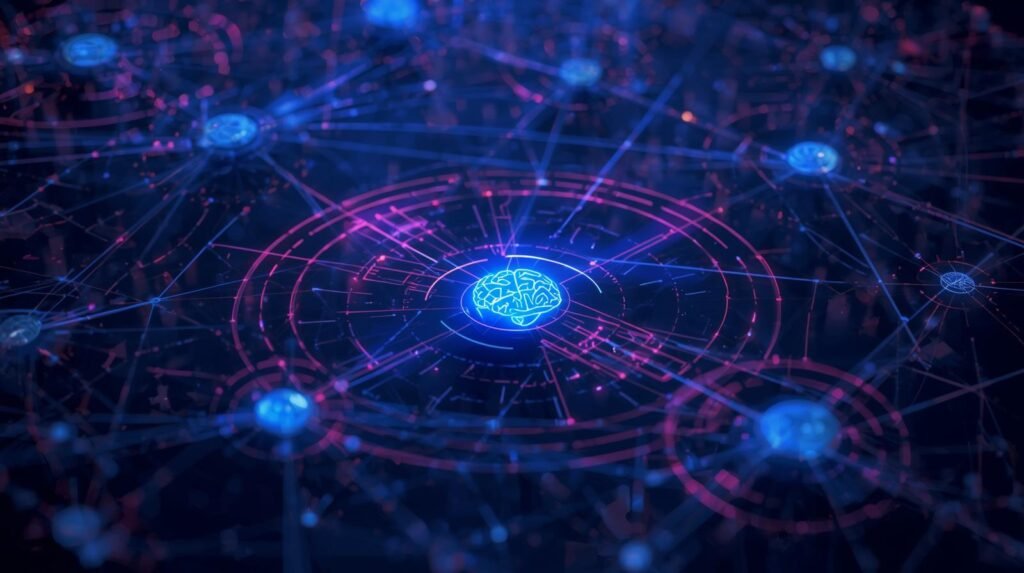
AI Native Network refers to networks built with Artificial Intelligence in mind. In the case of native AI networks, AI is incorporated into the network’s design to assist its decision-making process. The difference between an AI native network and other networks is that while many of today’s networks rely heavily on pre-defined static rules and/or manual adjustments made by engineers to optimize traffic flow based on general usage patterns, AI native networks will continuously monitor and collect data regarding the network and its users, and use this data to continually improve its ability to make optimal traffic flow decisions.
In addition, AI-native networks are designed to provide continuous telemetry (latency, packet loss, jitter, congestion, etc.) to deliver immediate, timely feedback to the network.
The primary goal of closed-loop automation in AI native networks is to provide real-time analysis and response to current network conditions. The process involves monitoring the network, analyzing collected network data, determining the best course of action, implementing it, and verifying its effectiveness.
For example, if an AI native network detects a performance issue with an application being run on the network, the network may be able to determine the probable cause of the performance issue (i.e., configuration error, failure of a link, noise caused by a neighboring network, etc.), and safely implement changes to address the performance issue (i.e., rerouting traffic, adjusting Quality of Service (QoS) policy, etc.).
The integration of real-time monitoring and control through closed-loop automation enables groups to move from a reactive process (responding to incidents as they happen), to a proactive process (anticipating and preventing incidents from becoming problems).
AI-native network systems can be integrated easily with other forms of Intent-Based Networking. The network administrator creates an intention (e.g. “priority to voice and critical apps”, “latency for all branch offices shall be “, “all IoT devices are isolated”), the system will create the proper configuration based on the administrator’s intentions, validate that the configuration complies with the administrator’s intentions, and identify if there are any non-compliance’s. Over time, the AI model will determine the best way to implement the administrator’s intention(s) within their environment by identifying which type of action has the most beneficial effect in each environment.
The most prominent ways for companies to leverage AI-Native Networks include the use of the network to automatically identify anomalies, developing smarter methods of routing traffic, enabling more rapid identification of the source of problems when they occur, improving capacity planning, and using it as an early warning system for identifying potential security breaches based on unusual traffic patterns. In doing so, AI-Native Networks can minimize downtime, reduce mean time to repair, and enable networks to respond to changing requirements without human intervention.
As companies begin to implement AI-Native Networks, they will need to continue to apply appropriate governance practices to ensure that the data being utilized to develop and train models is accurate, that the models themselves are transparent, and that changes to the network through automated processes are executed in a safe manner with controls in place, particularly in highly regulated industries. Companies will need to determine which constraints they want to apply to the network’s autonomous capabilities and require human oversight before implementing any high-impact modifications.
Additionally, companies will need the ability to accurately measure the AI-Native Network’s outcomes and monitor its performance using well-defined Key Performance Indicators (KPIs). Ultimately, if implemented successfully, AI-Native Networks will transform the network into a learning network that is more resilient, more efficient, and more capable of operating autonomously.
The “Tesla vs. GPS” Test: What Makes a Network Truly AI-Native?
The key difference between “intelligent” networks, which are based on AI, and “smart” ones is much like the difference between an old car retrofitted with a GPS system and a new car, such as a Tesla, designed from scratch around AI. Older cars with GPS systems have smart GPS, but they do not interface with the vehicle’s engine or braking system.
Thus, they are merely smart additions to an older legacy system. Self-driving AI-native networks are like Teslas. They have brains and nervous systems that are high-performance computers, and all their sensors, control systems, and execution layers are integrated to enable real-time autonomous driving. So, a self-driving network is one that has embedded AI into its own design. Smart networks are simply legacy systems enhanced by AI.
🔹 1. Traditional vs AI-Native Network Behavior (Decision Intelligence Table)

Example: AI-native networks behave like self-driving cars, adjusting traffic in real time instead of following fixed routes.
Source: Nokia AI-Native Networks
https://www.nokia.com/networks/ai-native/
AI Infrastructure: The Foundation That Enables AI-Native Networking
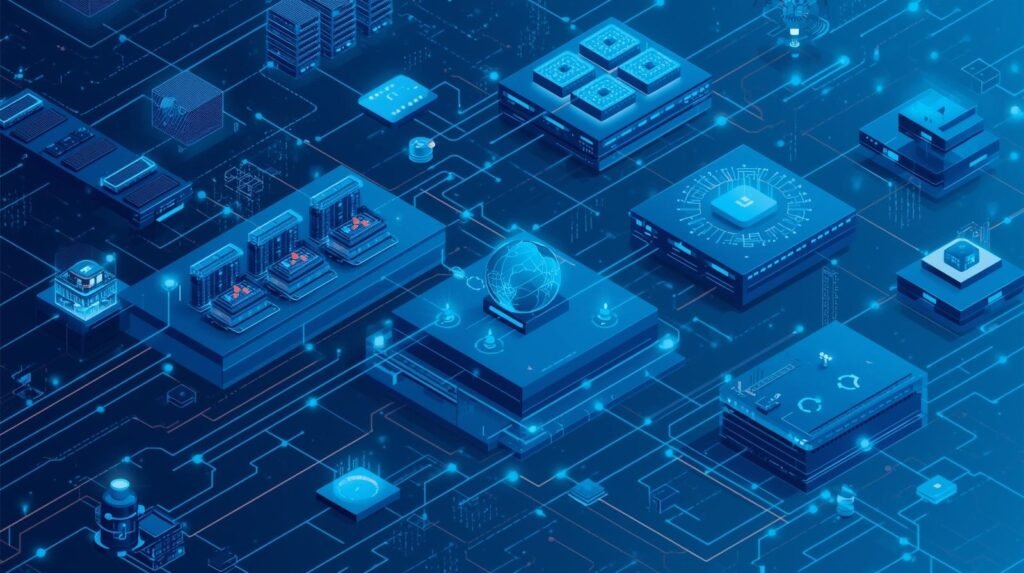
AI Infrastructure is the Technical Foundation for Intelligent Automation at Scale. AI Infrastructure is required to enable Intelligent Automation at Scale. Without a solid AI Infrastructure, even the most well-designed AI-Native Network Designs will not be able to learn from actual Operating Conditions in Real-Time, make timely Decisions, or operate safely.
An AI Infrastructure would consist of Compute Components (GPUs/NPU/CPUs), Data Platforms, Model Tooling, and Operational Boundaries necessary to ensure the reliable operation of AI Systems.
For AI-Native Networks, the AI Infrastructure would require Ingestion of high-volume telemetry (Logs, Flows, Traces, Configuration, Security Events) and Clean/normalize the Telemetry into Features that Models Can Use. Therefore, the AI Infrastructure would Require Robust Stream Processing, Storage, and Governance to ensure that Models See a Consistent, Trusted View of the Input Data. Furthermore, the AI Infrastructure Must Provide Low-Latency Processing So That Detection and decision-making occur in near real time, rather than hours later.
AI-native networks need more than just AI-native devices. They require an AI-native infrastructure to support the entire machine learning process, from development through deployment to ongoing iteration. To do this, the MLOps (machine learning operations) capabilities, such as version control, testing, drift detection, and controlled deployments, are required. This enables safer closed-loop automation.
Models can determine the best course of action, test to ensure it produces the desired results, and then fall back to a previous state if the model does not have enough confidence it will succeed. A strong AI infrastructure also enables policy-based guardrails, human-approval gateways for high-risk actions, and audibility, all of which are key elements of enterprise operations.
How you deploy your architecture will also matter. Most applications will leverage a model running at the edge of the network to enable quicker response times, while large-scale training and global optimization will occur in a centralized location. Therefore, the AI infrastructure needs to support cloud, datacenter, and edge environments with common security controls, identity, and encryption. Furthermore, the AI infrastructure should be able to interact with your existing network management tools to enable the actionable information provided by AI to become actionable, validated actions.
Therefore, AI Infrastructure turns data into operational intelligence and makes that intelligence reliable. When used for scalability, reliability, and compliance, AI infrastructure enables AI-Native Networks to transition from smart features operating independently to real-time, self-driving behavior, enhancing overall network performance, reducing downtime, and enabling continuous evolution.
Core Technologies Powering AI-Native Networks (Stack Table)

Example: SDN + AI enables networks to reroute traffic automatically during congestion.
Source: Cisco AI Networking
https://www.cisco.com
Machine Learning Networks: Networks powered by machine learning for smarter decisions.

Machine Learning Networks use machine learning models to assist with network operations, improving efficiency and enabling quicker autonomous decision-making. This is as opposed to using only static rules or human intervention (tuning).
The machine learning models in Machine Learning Networks learn patterns from telemetry data (traffic flow, latency, packet loss, device health, configuration changes, and user experience signals). This allows the network to detect potential issues sooner and to recommend responses. As networks grow in complexity, Machine Learning Networks will enable operational teams to transition from “reactive firefighting” mode to “proactive” mode.
Another major benefit of Machine Learning Networks is the additional visibility they provide. Rather than having to scan through various dashboards and alerts for an anomaly, Machine Learning Networks can analyze correlated signals across multiple levels and geographies that humans might miss. For instance, a model could determine what “normal” is for an application at a particular location and alert when there are very minor deviations, before the end-user has complained.
Machine Learning Networks help facilitate improved root-cause analysis and troubleshooting. When network performance problems develop, a model can rapidly determine the probable cause(s) (failure interface, congestion, misapplication of policy, etc.) most likely responsible for poor network performance, based on historical data on how the network has performed. This rapid determination of probable causes allows organizations to quickly resolve issues and operational teams to focus on solution development rather than issue discovery.
The third advantage that Machine Learning Networks offer is their ability to optimize better than traditional methods. Models can forecast traffic changes and predict potential bottlenecks within the network; therefore, organizations can proactively adjust their routing and quality of service to prevent outages and improve the overall user experience.
In conjunction with automation and guardrails, Machine Learning Networks represent a practical pathway to achieving AI-native networks. While organizations may eventually develop a completely new network architecture designed specifically to leverage AI, using Machine Learning Networks to lay the foundation for AI-native networks is a viable approach they can pursue immediately.
To effectively utilize Machine Learning Networks, organizations need sufficient high-quality data to train the models and establish effective governance for their use. Organizations also need to continuously monitor the models used within the Machine Learning Network for drift; they need to test all proposed changes to the Machine Learning Network models prior to implementing them on a wide scale. High-impact model changes may additionally require approval from additional levels of management.
Implementing Machine Learning Networks, along with proper governance, will enable organizations to create an intelligent, autonomous, AI-native network that serves as a learning engine. The organization can also create measurable improvements to its existing network infrastructure.
Intelligent Networks: Networks That Learn, Adapt, and Optimize Automatically

Intelligent Networks are designed to recognize events in an environment, adapt to them, and react with as little human involvement as feasible. Unlike the static configurations used in traditional network designs, Intelligent Networks continuously collect telemetry data (real-time data) and evaluate it using the same decision logic to ensure optimal network performance, reliability, and efficiency as the environment evolves.
At maximum potential, Intelligent Networks can greatly minimize the “gap” between when something changes and when the Network reacts.
A key method for reaching this goal is deploying AI-native networks. An AI-native network can integrate AI-based operations into all operational processes from the start. The primary focus of an AI-native network is to treat learning, forecasting, and automated action as part of the network’s operational process, rather than as optional features. This fundamental design methodology enables Intelligent Networks to go beyond simple automation (i.e., templates/scripts) and allow for intelligent, contextually aware decisions.
To be considered successful, Intelligent Networks will need high-quality input data, such as flow data, logs/traces, device health, configuration/state, and UX/behavioral signal data. Additionally, Intelligent Networks will require analytical/modeling capabilities to identify anomalies (what appears unusual), forecast future demand (what may happen next), and provide recommendations or automatically implement changes (what to do).
The integration of native network design AI and native network AI is achieved through closed-loop control and learning: observe, analyze, act, validate – then use the validation data to learn. The validation process is important for providing evidence that the action taken had a positive effect on the desired end state.
Closed-loop systems for network management can provide a number of different capabilities, including: steering traffic around congested areas; modifying QoS to meet the needs of the applications that are running across the network; identifying likely sources of poor network performance; providing recommendations for resolving performance issues; and enhancing an organization’s overall security posture through anomaly detection and prioritization of potential issues.
Ultimately, using an AI-native network to integrate AI-native network design allows organizations to create guardrails (what the system can modify); approve high-risk modification requests; and create rollbacks if they do not feel confident in their results.
This is not about “let’s automate everything”, but rather how you can achieve more consistent, quantifiable improvement in your network operations. Although the organization still defines its intent and policy and sets limits on risk, the network itself manages the vast majority of routine optimizations to continually improve performance.
Network Automation: Automated networks that operate with minimal human intervention.

Network automation is the use of software to implement and monitor network configurations and operations. This technology helps reduce the time it takes engineers to manually configure and manage networks. Network automation eliminates the need for every single engineer to access multiple devices to configure them. Instead, they can use a template, controller, and API to configure multiple devices at once.
The ability to configure so many devices at once minimizes configuration errors and enables much faster deployment of new configurations and operational functions. With the growth of large-scale campuses and data centers in the public cloud, the need for network automation increases to improve the predictability and security of network operations.
Network automation can perform simple, repetitive network functions. Examples include: provisioning VLANs; creating and deploying routing policy, deploying firmware updates; rotating SSL/TLS certificates; and enforcing network configuration standards. In addition, network automation enforces regulatory compliance through automatic identification of “drift” (a change in configuration since the last approved configuration). By automating these repetitive tasks, network automation improves device uptime by eliminating common human error and reducing maintenance time.
AI-Native Networks are developed by adding Network Analytics and Machine Learning to Network Automation. The combination of Network Automation with Network Analytics and Machine Learning enables Real-Time Network Telemetry and Model-Driven Insights to serve as the basis for driving Network Automation and to provide decision-makers with the capability to determine whether a response is warranted and, if so, the optimal way to respond.
Script-Based Networks typically execute a set of predefined commands, whereas AI-Native Networks are able to identify Network Performance Issues, Predict the Potential Impact of Corrective Actions, Select the Least-Risky Course of Action, and Verify that a Correction was Successful.
The implementation of Closed-Loop Operations via Network Automation requires a Four-Step Process: Observe Your Network, Analyze the Signals Observed, Make a Change Based on the Analysis, and Validate the Change.
When the Four Steps outlined above are integrated into AI-Native Networks, They Will Adapt to Changes in the environment and Determine Which Actions Should be taken in specific situations and Which Should be avoided. Overall, This Approach will reduce the Number of Alerts Administrators Receive, Accelerate Root-Cause Investigation, and provide a Consistent User Experience During Heavy Network Traffic, Partial Failures, etc.
As can be seen, there are many typical use cases for which Network Automation is typically used. The most commonly referenced examples include routing all network traffic automatically throughout the network, optimizing Quality of Service (QoS) for business-critical applications, proactively planning for increasing capacity needs, and rapidly mitigating incidents by routing network traffic around failed components (e.g., a link).
To successfully implement Network Automation, guardrails must be in place. Guardrails would include approval workflow for high-risk changes, staged rollout plans, rollback plans, and auditing processes. AI-Native Networks greatly enhance the benefits and value of Network Automation, but they create a greater need for Governance and Testing.
If an organization implements Network Automation properly, it will enable its staff to focus on developing its network architecture and outcomes rather than performing day-to-day, repetitive tasks in managing the organization’s network. Network Automation, when paired with AI-Native Networks, creates a viable way for organizations to develop networks that are more reliable, more responsive to issues, and require less daily human intervention.
Adaptive Networks: Networks that adjust instantly to changing conditions.

Adaptively Responding Networks (ARNs) can sense changes in a network — such as increased traffic volume, a link failure, an application migration, or an unknown security threat — and respond accordingly. ARNs continuously analyze network performance and automatically adjust their behavior to provide consistent service to the end user. In contrast to traditional network management approaches, which require human intervention to detect and correct anomalies, ARNs automatically adjust in response to real-time feedback.
Modern networks are much more dynamic than previous ones. They now contain both on-premises (local) and off-premises (remote edge/cloud) components, with fluctuating service demand. The primary function of Adaptive Network is real-time monitoring of key network performance metrics. These metrics include latency, packet loss, jitter, utilization, and device health. Based on these metrics, Adaptive Networks can dynamically route traffic around congested areas, rebalance workload across available resources, dynamically adjust Quality of Service (QoS) for critical applications, and proactively remove unstable network devices and components to prevent end-user disruptions.
The main benefit of utilizing Adaptive Networks is speed. Unlike traditional network management methods, which typically take hours to implement a safe modification, Adaptive Networks aim to implement safe modifications within seconds or minutes. Organizations have achieved this by implementing AI native networks. AI native networks incorporate machine learning and predictive analytics into network operations. This allows the network to learn patterns of specific behaviors, anticipate future trends, and proactively take action to prevent adverse outcomes.
The typical closed-loop model utilized in the operation of Adaptive Networks includes observing, analyzing, acting, and verifying. The verification of adjustments in Adaptive Networks is key, as it is necessary to confirm whether an action will improve outcomes (e.g., decrease latency or reduce retransmissions) to inform future decisions. In AI-native networks, the verification of each decision can guide future decision-making about which actions carry the least risk and have the greatest positive impact on outcomes. Thus, over time, adaptive actions become part of a continuous cycle of adaptations rather than a series of one-time automations.
There are many common applications of Adaptive Networks, such as dynamic routing through Wide Area Networks (WANs), automatic failover for partial service disruptions, application-based routing, and rapid policy changes to accommodate newly deployed services. Additionally, Adaptive Networks may be applied in security as an incident response mechanism to address unusual traffic patterns by segmenting or rate-limiting suspected malicious traffic while allowing access to critical business traffic. However, there are several factors to consider when implementing Adaptive Networks, including setting guardrails for sensitive environments (change windows); approval steps for high-risk actions; and establishing clear rollback procedures.
Properly implemented, Adaptive Networks help organizations eliminate the user experience issues associated with network performance problems, minimize downtime and operational overhead. When combined with other AI-native networking principles, Adaptive Networks support the development of enterprise networks that remain stable and perform efficiently regardless of changing conditions from one moment to another.
The Self-Healing Network: How Connections Can Fix Themselves Instantly
The alternative to this lack of control over the complex nature of digital highways is to create AI-native networks that have an “immune system.” These AI-Native Networks will identify failures in digital highway networks (for example, when a bridge collapses) nearly instantaneously.
In the event of a failure occurring in a digital highway network, similar to how a driver receives real-time information from their GPS to reroute around an unexpected traffic incident, an AI-Native Network will provide its own reroute data through the network to locate the best possible route for that particular data set in less than a second. Even though the same types of incidents occur continually, the rerouting of data is so rapid that we would never even know an incident occurred; movies do not buffer, and phone calls do not drop.
Self-Healing Network Process (Event-Action Table)

Statistic: AI-driven networks can reduce network downtime by up to 40-50%.
Source: Gartner AI for IT Operations
https://www.gartner.com/en/information-technology/glossary/aiops
Beyond Fixing to Predicting: Preventing Digital Traffic Jams
The strength of reacting rapidly to digital issues cannot be overstated, but preventing them altogether is even more powerful. The strength of native AI networks will come in being able to transition from being self-healing to self-optimizing – as opposed to merely routing traffic around digital “incidents,” the native AI network will actually see when the rush hour is coming.
To accomplish this, native AI systems will learn the patterns of all of a user’s digital traffic and what specific digital highways become congested at certain times.
Once native AI systems know what you need, they can begin to influence your daily life on digital platforms. For example, native AI systems have learned that around 8:00 PM every night, many people in their neighborhoods watch movies online.
Instead of waiting for buffering to start, native AI networks can now anticipate and prepare for increased network usage. In essence, native AI networks are creating “additional lane capacity” (anticipating/preparing) for the expected increase in network use, just as a city might add highway lanes leading into the city for an event. As a result, users experience a “smooth” experience – this is not because the issue was resolved quickly, but because it was completely resolved before it happened.
Predictive vs Reactive Networking (Future Capability Table)
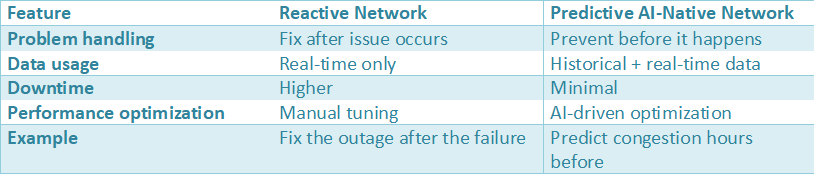
Example: AI can predict traffic spikes ahead of a live event (such as a sports stream) and automatically adjust capacity.
Source: Ericsson AI Networking Report
https://www.ericsson.com/en/reports-and-papers
The Network’s Built-In Security Guard: Stopping Threats Before They Strike
The importance of fast networking will be diminished without a focus on security. The traditional method for securing networks was similar to how a bouncer would verify an individual’s ID as they tried to enter through a door, checking whether the individual’s photograph was in their book of individuals who had previously been involved in some type of conflict.
However, this method of providing network security has many drawbacks in its ability to effectively protect against emerging threats. AI-Native Networks are similar to the bouncers mentioned above but rather than using the photographs in their “book” to determine whether or not to allow someone into the facility, these systems use the typical patterns of behavior associated with people regarding their digital lives (e.g. a laptop sending an email; a smart television streaming a video, etc.) to recognize what normal behavior looks like. When the Smart Thermostat starts sending large amounts of data to remote servers with no prior relationship to the system, the AI can detect this anomaly and flag it for investigation.
How Self-Driving Networks Change Daily Life
All of these are self-driving, self-healing, self-optimizing network technologies — technologies that take the network out of your way as much as possible. Instead of causing you frustration, your networks will become your invisible digital partners, ensuring everything keeps working. AI for Network Complexity aims to deliver the best possible user experience by making the network nearly invisible.
As an example, picture yourself in the middle of a sold-out concert with hundreds of thousands of other people, and wanting to upload those video clips. In the past, this was virtually impossible. With AI-native networks, massive demand (e.g., tens of thousands of people sending video clips) can be anticipated and intelligently handled, enabling easy video clip uploads.
Ultimately, Autonomous Networking gives us the reliability and performance we need to rely on:
- Bufferless streaming, regardless of your resolution (e.g., 4K)
- Lag-free gaming and video calling
- Reliability in areas that are congested (e.g., large crowds at stadiums or airports)
- Homes that smartly have all their devices working well together
AI Network Optimization isn’t intended as a solution to just today’s problems. AI Network Optimization will also be a foundation for future technology.
Real-World Impact of AI-Native Networks (Daily Life Table)

Statistic: AI-powered networks can improve network efficiency by up to 30%
Source: Mckinsey AI infrastructure Insights
https://www.mckinsey.com/capabilities/mckinsey-digital
Beyond Faster Streaming: The Future Powered by AI-Native Networks
The next generation of smart networks will not simply represent an upgrade. It will establish a framework for new technologies, including Metaverse-style Immersive Virtual Environments, and massive autonomous vehicle deployments. The current brittle, manual network infrastructure cannot support emerging technologies. While there are still many barriers to implementing AI in networks, the ultimate vision is to create an environment where digital connections are both seamless and always available.
The long-term goal is to achieve “Zero-Touch” networks – essentially, invisible utility-type networks that operate perfectly and invisibly like electricity at your outlet. The next time you watch a movie on streaming without a single hiccup, appreciate the perfection of that experience. We are no longer simply utilizing the Internet, but starting to see the emergence of networks that can actually think for themselves.
Conclusion
AI-Native Network is transforming how we build and maintain digital networks. As we move forward in this new, increasingly complex network world and our need for network bandwidth grows, it becomes impractical to rely solely on manual methods to address issues as they arise. Examples of infrastructure at max capacity include dropped phone calls, video streaming buffering, and numerous cybersecurity threats.
However, by embedding Artificial Intelligence (AI) into the infrastructure of AI-Native Networks, we will have networks that self-heal when problems occur, mitigate congestion, and proactively shield users from threats as they happen in real-time; thus establishing a silent yet robust operating model compared to current networks, which require constant monitoring and maintenance.
In addition, AI-Native Networks are also building the base for the future. Autonomous Vehicles, Smart Cities, Immersive Digital Experiences, and Large-Scale Edge Computing all depend on high-speed, highly reliable, and highly flexible networks. Thus, these emerging technologies cannot exist without networks that are adaptive, responsive, and not simply reactive.
Therefore, the promise of AI Native Networks goes well beyond improved network speeds, providing a better overall user experience – a world where connections appear seamless and reliable. As AI-Native Networks continue to evolve, they will ultimately become the unseen engines that power the Next Generation of Digital Life, driving innovation while taking the complexity out of daily connectivity.
FAQs
1. What is an AI-native network?
Native to Artificial Intelligence is an AI developed based on its internal design. Unlike previous-generation networks, where artificial intelligence was applied to them after they were developed as tools, AI-native networks continuously evolve through automated decision-making processes to improve their performance, availability, and security.
2. How are AI-native networks different from traditional networks?
When errors occur in traditional networks, humans must manually identify and rectify them. Errors in AI-native networks are identified in advance of occurrence by AI and resolved at the moment of occurrence. Additionally, AI-native networks can dynamically adjust their traffic flow to minimize both user downtime and the need for human error resolution.
3. Can AI-native networks really fix problems on their own?
Yes. AI-native networks use real-time monitoring, automated machine learning, and automation to detect failures and reroute traffic before they disrupt users. AI-native networks’ self-healing characteristics enable them to remain available to users without requiring operator involvement.
4. Are AI-native networks more secure than traditional networks?
AI-native networks provide enhanced security by using a dynamic approach to identify malicious activity, rather than relying on static signature lists (known threats) that may not reflect current threats. Thus, AI-native networks can identify both known and unknown threats, isolate infected devices in real time, and protect uninfected devices from infection.
5. Why are AI-native networks important for future technologies?
Future trends include emerging technologies such as Autonomous Vehicles, Smart Cities, Edge Computing, and Immersive Digital Experiences. These future technologies will all require networks that are highly available, reliable, and adaptable. AI-Native Networks will provide the necessary intelligent, predictive base to rapidly scale innovation.