

















Introduction to Machine Learning
How Machine Learning Is Changing Data and Decision-Making
In today’s world, the rapidly evolving technology of machine learning is changing how we analyze and make decisions with data. Whether you are simply interested in technology as a whole or looking for new and exciting ways to improve your business or career through innovation, learning about the basic principles of machine learning can provide you with unlimited options.
This article provides an introductory overview of some of the core machine learning concepts, introduces you to some common machine learning algorithms, and gives you examples of using machine learning that you can understand easily.
Summary of Machine Learning Concepts and Use Cases
At its simplest, machine learning allows computers to learn from data and create models to make future predictions without requiring constant human interaction. In addition to many wonderful tools such as recommendation systems, chatbots, and self-driving cars, most of these rely heavily on machine learning.
#NLP: Powerful Ways of Effectively Teaching Machines to Truly Understand Us
The three main types of machine learning are supervised, unsupervised, and reinforcement learning. Some common algorithms used in machine learning include linear regression, decision trees, neural networks, and SVMs (support vector machines).
There are also many tools for building machine learning systems, which provide a great opportunity for developers of all skill levels. Machine learning is primarily responsible for converting large amounts of data into usable information, enabling businesses to run more effectively, complete tasks more quickly, increase accuracy, and make more informed business decisions.
What Is Machine Learning and Why It Matters
Definition of Machine Learning as a Subset of Artificial Intelligence
Artificial Intelligence (AI) called Machine Learning, enables computers to learn from data and to find patterns within data to be able to make decisions independently based on those patterns; Machine Learning is utilized by computers to use algorithms to process data, learn from the data processed and then to forecast or predict the future actions/behavior of computers based on what the computer has learned; Machine Learning also learns in a manner similar to humans and improves over time without any additional assistance.
Everyday Examples of Machine Learning in Action
Machine Learning has become an integral part of the numerous technologies we use every day. The recommendation system used by Netflix provides a great example of how Machine Learning can benefit users by analyzing their viewing history to recommend content aligned with their interests.
The self-driving vehicle industry uses machine learning to interpret data collected by sensors to enable safe navigation. Machine Learning is an extremely versatile technology and has shown great promise in revolutionizing the way we use technology.
Machine Learning in Virtual Assistants and User Experience

Siri and Alexa are virtual assistants that use machine learning; as such, the way they understand a user’s input and respond is an example of natural language processing (NLP). In addition to improving their NLP, the systems learn from user interactions and provide better responses over time. One example of machine learning making life easier for individuals via intelligent automation is through virtual assistants.
Machine learning has transformed many industries through automation, improved accuracy, and enhanced the customer experience. Businesses utilize machine learning to optimize their business processes, personalize marketing campaigns, and predict trends in future markets.
For example, retail businesses use machine learning algorithms to analyze each customer’s purchasing history and create a custom campaign based on their purchasing patterns, ultimately increasing customer engagement, conversions, and satisfaction.
#How Image Recognition Works: From Pixels to Intelligent AI Decisions
The ability to efficiently and successfully process large amounts of data is a valuable asset to most organizations. In finance, machine learning models can review millions of transactions to detect fraudulent activity that would previously have posed a high risk to an organization, thereby reducing financial loss.
Additionally, in the healthcare industry, machine learning models help analyze patient data to predict potential future health problems and recommend preventive measures, thereby improving patient care and reducing healthcare costs.
In addition to enabling data-driven decision-making, ML allows companies to create predictive models. The predictive model capability in the supply chain will allow companies to forecast demand fluctuations, monitor inventory levels, and reduce waste. It is the predictive nature of ML systems that is necessary to continue operating at maximum efficiency and to meet customer expectations.
Types of Machine Learning
There are three primary categories of ML, each with unique characteristics and applications.
Supervised Learning Models and Applications
Supervised learning allows you to train a machine-learning model by using a labeled dataset that includes both the input and output as labels. Each label contains information about the output based on the input. Using this approach, the machine-training algorithm can learn to map inputs to the correct outputs.
Spam filtering and image classification are examples of supervised machine learning models. In spam filtering, the model learns to determine whether each incoming email is spam and filters spam from non-spam messages.
Supervised Learning Use Cases in Healthcare and Finance
Medical diagnosis is another type of application of supervised learning because a supervised learning model can learn from the labeled information of prior medical diagnoses to enable a computer to be able to help doctors diagnose and treat diseases sooner by using supervised learning to determine the probability of a specific disease being diagnosed in a patient based upon the data collected from prior cases.
Supervised learning is also applied in financial forecasting, as supervised models are trained on historical economic data to forecast future trends, helping investors and businesses make more informed investment choices and reduce risk by maximizing the likelihood that their investments generate returns.
Unsupervised Learning Models and Pattern Discovery
In contrast to supervised learning, unsupervised learning involves training a model on unlabeled data (i.e., there are no “right” answers). The model will then need to create its own labels or find patterns in the data.
Models created with unsupervised learning can also be applied to a variety of applications, including identifying patterns in your data that may be grouped into clusters (e.g., a customer segment based on their purchase behavior) and detecting anomalies (e.g., errors or outliers in your data).
A common application of unsupervised learning in the business world is to help create customer segments (grouping customers by their purchasing behaviors) so that you can develop marketing campaigns that target each segment.
Unsupervised Learning in Cybersecurity and Retail
Another area where Anomaly Detection is used extensively in Cybersecurity. Using Unsupervised Learning algorithms, Anomalous Patterns in Network Traffic may be identified, indicative of potential Security Threats. By utilizing Unsupervised algorithms to detect anomalies, organizations can proactively protect sensitive information and system integrity.
In addition, Unsupervised Learning is used in Market Basket Analysis. In this application of Unsupervised Learning algorithms, the relationships among products are identified. Using these relationships, retailers can develop strategies to optimize product placement and cross-sell, ultimately increasing sales and improving customer satisfaction.
Reinforcement Learning and Decision-Based Systems
FReinforcement learning uses an algorithm to make a sequence of decisions based on the rewards or penalties it receives for those decisions. The most common use of reinforcement learning is in robotics and video games. Reinforcement learning enables robots to develop complex behaviors (such as navigating a room and manipulating objects) by using feedback from each action they take.
Reinforcement Learning in Robotics, Gaming, and Autonomous Systems
Autonomous vehicles use reinforcement learning. These vehicles receive positive reinforcement (rewards) for performing well and negative reinforcement (penalties) for performing poorly. Therefore, they can adapt to different on-road experiences and improve their performance over time through continued training.
The gaming industry has also created an AI player that utilizes reinforcement learning to compete with humans. After millions of plays, the AI player will have learned the best way to play and will continually improve its abilities to achieve mastery of the game. End Text.
Key Machine Learning Algorithms Explained
Decision Trees for Classification and Interpretability
Linear Regression is the most commonly used machine learning technique and one of the simplest. In other words, it uses a simple mathematical model called a linear equation to make predictions based on the input information given to it (the “input” or “independent variable”) to produce a continuous output (“continuous output” or “dependent variable”). For instance, Linear Regression could be used to predict the price of houses (continuous output) using their sizes (square footage) and/or locations (one or multiple predictors) as input.
Companies can use historical sales data to forecast future sales using Linear Regression. This enables a business to strategically allocate its resources and design effective sales and marketing strategies to generate the highest possible sales. Linear Regression can also be applied to inventory planning and resource allocation.
In addition, Linear Regression has been used in environmental science to model relationships between variables, such as temperature and carbon emissions. The predictive capabilities of these ML & AI models have enabled researchers to have a better understanding of climate change dynamics and develop viable conservation plans.
Decision Trees for Classification and Interpretability
Decision Trees are often used for classification and Regression tasks. A Decision Tree Algorithm will split your dataset into branches and make decisions based on the values of input features. It is also a very easy-to-use algorithm that is good at being interpreted. One common application in healthcare is to diagnose diseases based on a patient’s symptoms and medical history and to provide clear decision paths for practitioners.
Decision Trees help financial lenders with Credit Scoring by analyzing an applicant’s information to determine whether they are creditworthy, and the transparency of the decision tree model enables lenders to explain their decisions to applicants and regulatory agencies.
Decision Trees are also used in customer service applications to guide customer support agents in their problem-solving. By using a structured decision path, customer support agents can quickly identify the root cause of a problem, provide a solution to the customer, and improve overall service delivery.
Neural Networks and Deep Learning Foundations
Neural Networks are a type of Artificial Intelligence that uses the same pattern-processing mechanisms as the human brain. In the architecture of a neural network, each layer of a node, or neuron, is designed to process information across multiple layers.
There are many applications that include Image and Speech Recognition utilizing Neural Networks. As an example, Neural Networks can take in Pixel Data of Images and enable applications such as Facial Recognition and Autonomous Vehicles.
Voice recognition systems use neural networks to enable users to enter data simply by voice. Once the user speaks into the system, the neural network processes the spoken language into text, which allows developers to create voice-activated applications and transcription services. To improve the accuracy of these systems and expand their language capabilities, they will continue to be updated with various datasets.
In addition to Voice Recognition Systems, Neural Networks are used in Natural Language Processing (NLP), enabling computers to comprehend and generate human language. This capability is critical for creating Chatbots and Virtual Assistants that can interact with end-users through a conversational interface.
Support Vector Machines (SVM) for High-Dimensional Data
SVMs are perhaps the most widely employed classifier, as it can be used to find the hyperplane (a line or a plane), that best separates two or more classes within the feature space. SVMs are particularly beneficial when dealing with very large, high-dimensional data sets. SVMs have been used in bioinformatics to classify proteins and genes, which aids drug development and overall understanding of genetic diseases.
#AI Language Models Explained Clearly Without Coding
In Image Classification, SVM algorithms are used to detect features or objects in images, enhancing the capability of computer systems to visually identify them. Image Classification has numerous applications, such as surveillance and autonomous vehicles, that require accurate object identification.
SVMs are also used in Text Classification to categorize documents by content. The benefits of this include improved document searching and sentiment analysis, allowing business organizations to assess how consumers perceive products and brands and assess consumer satisfaction/complaints.
Real-World Applications of Machine Learning Across Industries
Machine Learning in Healthcare and Medical Research
Machine learning models can assist in improving diagnostic accuracy, improving patient outcome prediction, and enhancing treatment plan personalization. Machine learning models can use mammography images to detect tumors more accurately than human radiologists, enabling earlier cancer detection.
Machine learning models and predictive analytics enable healthcare providers to identify patients at high risk of chronic disease and provide preventive care. Additionally, machine learning models can be used by healthcare providers to review individualized patient data and develop a customized treatment plan based on the patient’s unique needs, leading to better patient outcomes and reduced costs for the overall healthcare system.
Additionally, ML is being used in drug discovery to identify chemicals that could become the basis for new drugs. By using ML, an algorithm can compare the compound’s chemical structure and biological data to predict its safety and effectiveness as a drug candidate, thereby reducing the time required to bring a drug to market.
Machine Learning in Finance and Risk Management
Machine Learning in finance has been applied in three areas, including fraud detection, risk management, and Algorithmic Trading. Fraud detection models use Machine Learning Algorithms to analyze large volumes of transactional data for signs of fraud by identifying anomalies or suspicious patterns in transaction activity.
Machine Learning models can identify potentially fraudulent transactions by analyzing customers’ historical transaction activity and overall behavior, helping lower the probability of actual financial fraud.
Machine Learning models can help evaluate credit risk when assessing a borrower based on the borrower’s credit history and other available data, providing lenders with the necessary tools and insights to make lending decisions on loan approval and interest rates. These models provide lenders with the tools needed to effectively manage lending risks while enabling them to operate profitably.
Algorithmic Trading Systems utilize ML Algorithms to continuously monitor real-time activity across various financial markets and inform trade decisions (buy/sell) when favorable price levels are identified. As Machine Learning Algorithms adapt to changes in market conditions, they can continually identify potentially profitable trading opportunities and, in turn, help investors optimize their investment strategy and yield.
Machine Learning in Retail and Customer Experience
Retailers are employing machine learning technology in order to make the shopping process of customers better through providing them with tailored product recommendations as well as improving their inventory management systems.
Using consumer data, retailers can use machine learning to forecast a customer’s future buying habits; thereby, they can create product recommendation systems that use a consumer’s past browsing and purchasing activity; thereby, they have more opportunities to engage with their customers and generate additional sales revenue.
In addition, retail businesses use ML for inventory management. The purpose is to use ML to forecast what customers will want to buy in the future, enabling retailers to maintain optimal inventory levels. In doing so, retailers can reduce inventory holding costs and make their supply chain operations run more efficiently, ultimately providing their customers with quicker service to meet their needs.
Additionally, retailers can analyze customer satisfaction using ML-based “customer sentiment analysis.” Customer sentiment analysis algorithms measure customer satisfaction with a retailer by evaluating opinions expressed on social media, review sites, and other customer feedback channels. This allows retailers to continue improving their products and/or services for customers while also building brand loyalty and reputation.
Machine Learning in Transportation and Logistics
The vehicle provides a very good example of machine learning in transportation. The vehicle’s algorithms will use data from sensors and cameras to evaluate this information in real time, providing a safe means of travel on the roads, making decisions to get around road obstacles, and/or adhering to traffic regulations. The vehicle’s algorithms continuously improve based on large amounts of data collected during operation, therefore continuing to improve its ability to handle a variety of complex traffic situations.
Logistics providers are using ML to determine optimal routes and schedules for deliveries, reducing fuel consumption and transit times. By analyzing traffic patterns and delivery constraints, machine learning algorithms can identify the best routes to enhance operational efficiency and customer satisfaction.
Machine learning is applied to predictive maintenance of vehicles and transportation infrastructure. Based on sensor data from equipment and structures, ML algorithms can predict failures before they occur, reducing downtime and maintenance costs.
Machine Learning Global Comparisons
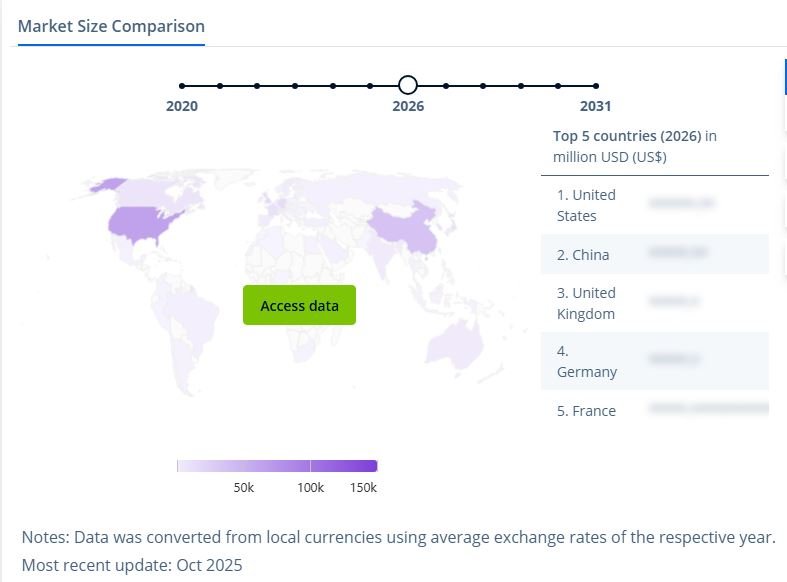
Source: Statista Market Insights
Getting Started with Machine Learning and Future Outlook
Learning Resources for Beginners
You’ll discover many great places to learn about machine learning if you have no prior experience using it. Many web-based sources, including Coursera, edX, and Khan Academy, offer courses where you can learn the fundamentals of ML as well as get a deeper look at some of the many different algorithms used in the field.
The classes offered by each of these sources will be very easy to follow with video lessons, quizzes, and project assignments to help you practice what you learn.
Additionally, books like “Hands-On ML with Scikit-Learn, Keras, and TensorFlow” offer hands-on experience with ML techniques through coding examples tailored for new users.
You will be able to apply ML to real-world problems and gain experience with it. Communities (i.e., Stack Overflow and the ML community on Reddit) will allow you to ask questions, share ideas, and work together with other students on projects, and can provide additional support and networking opportunities throughout your learning process.
Programming Languages and Frameworks for Machine Learning
The use of certain programming languages and libraries can also make applying machine learning easier. Due to the ease of use of Python and the number of strong libraries available for machine learning (TensorFlow, Keras, and Scikit-learn), it is a very popular language. The libraries also include built-in functionality and models that allow users to easily develop and deploy their own ML applications.
A major advantage of using R is the many libraries designed for Statisticians and Machine Learning Professionals (e.g., caret and randomForest). Additionally, due to the size of the R Community, there is a wealth of resources for learning R, including documentation.
Practical Tips for Learning and Applying Machine Learning
For example, when developing or experimenting with Deep Learning, there are many Python-based libraries (PyTorch and MXNet) which allow developers to develop, train, and test complex artificial neural networks. Both are scalable and provide developers a means to experiment with new ideas and test them with state-of-the-art methods.
Get A Foot-Hold On The Basics: By learning basic machine learning (ML) concepts through practice with simple algorithms (e.g., linear regression, decision trees), you will have a solid foundation to understand the inner workings of more advanced algorithms and techniques.
Experiment with Multiple Datasets: Experiment with multiple publicly available datasets (Kaggle) and compete in contests on this platform. This is real-world data where you can try out what you have learned and receive feedback from other members of the community.
Stay Current: The Machine Learning (ML) space is constantly evolving; thus, it is important to stay up to date on the latest advancements. One way to do so is to follow relevant blog postings and/or attend webinars/conferences that feature new research and developments in this field.
Connect & Collaborate: Engage with others through online communities and/or local meetups, and collaborate to develop new ideas and create project(s) that help solve real-world problems by delivering innovative solutions.
Develop Your Own Projects: Using your new skills, take on a project that has some relevance to the real world, or contribute to an open source project. Developing personal projects provides you with hands-on experience with the skills you have developed and allows you to build a portfolio of work.
Conclusion
ML has the ability to greatly affect almost all industries and business entities in terms of giving them the opportunity to use extremely useful tools to learn about and evaluate the fundamental concepts of the discipline, as well as provide the capability to develop a wide array of algorithms for solving complex, real-world problems, utilizing large volumes of real-world data.
Whether you are looking to enhance your company’s operations or develop a new product, machine learning can help you use your data to convert it into usable information that informs your organization’s future decisions. The vast number of problem-solving opportunities you will have available to you to positively influence your industry is a major part of your journey of discovery and understanding of ML.
FAQs
Question: What are the main types of Machine Learning, and how do they differ?
Answer: There are three different types of Machine Learning. The first type is supervised ML
, which is when you train a model using data with already known labels, so that your model will be able to take an input and produce an output for the same thing it learned from before; examples of supervised machine learning include spam filtering, image classification, medical diagnosis, and stock market prediction.
The second type is Unsupervised machine learning, which uses no labeling on the data to determine how the data is related to each other and find patterns; examples of Unsupervised machine learning include segmenting customers into groups that have common characteristics, identifying unusual activity in computer security monitoring systems, and determining which products a customer buys at a store.
Areas where Unsupervised ML is used include, but are not limited to, marketing segmentation, fraud detection, and other Big Data applications. The third type is Reinforcement machine learning, which involves creating an agent that makes decisions by rewarding correct actions and punishing incorrect ones; reinforcement learning is currently used in robotics, autonomous vehicles, and video games.
Question: How do I choose between Linear regression, decision trees, neural networks, and SVM for a problem?
Answer: There are three types of machine learning: supervised, unsupervised, and reinforcement. In supervised ML
, a model is trained on labeled data so it can take an input and produce an output based on what it has learned. Examples include using a model to filter spam messages, classify images, diagnose illnesses, and predict future performance in finance.
In contrast, in unsupervised machine learning, there are no labels for the data being analyzed, and therefore, the task is to identify patterns within the data; for example, identifying how customers’ behavior is grouped together (i.e., marketing segmentation), finding anomalies in computer security monitoring systems, or identifying products a customer purchased at a retail store.
Unsupervised machine learning is also used in many business applications, such as fraud detection and processing large amounts of data. In reinforcement machine learning, a “model” or agent learns by taking action based upon the rewards or penalties associated with those actions; it has been applied to the design of robots, self-driving cars, and video games.
Question: How is Machine Learning used across industries, and what value does it create?
Answer: Machine learning provides automation for many business processes, supports better business decision-making by improving the accuracy of those decisions, and increases our understanding of how consumers behave and interact with businesses. This enables businesses to deliver a more personalized experience across all industries.
Machine learning can be used in the health care industry to enhance medical image diagnosis, predict patient risk, accelerate drug discovery, detect potential fraudulent activity within financial institutions, and assess an individual’s creditworthiness. The retail industry also uses machine learning to recommend products to individual consumers based on their purchasing history and preferences, forecast future demand and supply needs, maximize inventory utilization, and measure consumer sentiment toward the company.
Machine learning is being utilized in transportation to develop autonomous vehicles, optimize logistics delivery routes for companies, and predict when vehicle parts are likely to fail and thus schedule planned maintenance to minimize or eliminate downtime. As such, it translates raw data into actionable information at the right time and at a reduced cost.
Question: I am new to ML – What tools, languages, and resources should I start with?
Answer: Start with Python because it is easy to learn, and there are many libraries for tasks such as TensorFlow, Keras, and scikit-learn. R also has many libraries for statistical analysis, including caret and random forest.
To get started in deep learning, try out PyTorch and MXNet. To develop a foundation, take classes through Coursera, edX, and Khan Academy. The book “Hands-On Machine Learning with Scikit-Learn, Keras, and TensorFlow” is great for getting hands-on with machine learning.
Go through problems that are presented to you on kaggle, participate in communities surrounding machine learning, such as stack overflow and the machine learning community on reddit, and consider the following practical advice when using machine learning: begin simply (e.g., linear regression, decision trees), maintain an experimental mindset, keep continuing to educate yourself, work collaboratively with others, and create a few real-world applications.
Question: How does machine learning turn large datasets into actionable insights for better decisions?
Answer: Machine Learning can look at past trends and patterns in data and predict what might happen next. Data from the past can serve as a “training” set for the model, helping it make smart predictions or classifications based on that data.
Along with the ability to predict how much of a product will be required before an order is submitted to maintain adequate inventory levels, machine learning has many other uses that contain predictive functionality, such as Anomaly Detection (fraudulent transactions), Patient Risk Identification (early intervention), and Routing Optimization (reduced fuel usage/ reduced travel time).
Predictive functionality can also help organizations to automate decision-making, improve operational accuracy, provide personalized experiences to customers/users, and improve their competitive positioning.

Garikapati Bullivenkaiah is a seasoned entrepreneur with a rich multidisciplinary academic foundation—including LL.B., LL.M., M.A., and M.B.A. degrees—that uniquely blend legal insight, managerial acumen, and sociocultural understanding. Driven by vision and integrity, he leads his own enterprise with a strategic mindset informed by rigorous legal training and advanced business education. His strong analytical skills, honed through legal and management disciplines, empower him to navigate complex challenges, mitigate risks, and foster growth in diverse sectors. Committed to delivering value, Garikapati’s entrepreneurial journey is characterized by innovative approaches, ethical leadership, and the ability to convert cross-domain knowledge into practical, client-focused solutions.