


















While it is true that most of us use chatbots like ChatGPT simply as consumers by entering our requests through a user-friendly prompt and then sitting back while “magic” happens, there is a seismic shift happening behind the scenes in which there will be opportunities for many professionals (both working today and those starting their career) to become “creators”, rather than just users. In fact, it’s easy to assume that developing these systems means writing code for some sort of advanced robot. But the daily grind for an AI Engineer is far more down-to-earth.
At its core, the role of an AI Engineer is essentially to act as a translation professional – connecting the complexities of human information with the precision required by computers. Think about what happens when we talk about data being the “gasoline” and the AI Model as the “engine”. Just like a vehicle won’t move without quality gas, so too do these engineers focus primarily on ensuring the integrity of AI Infrastructure – the digital pipeline that provides the safe delivery of that “fuel” to the “engine” to provide solutions to actual world problems.
As stated above, according to LinkedIn’s latest labor market data, there is a historic spike in demand for these types of specialized skill sets. Healthcare, Retail, and Finance companies are all currently looking for talented individuals to help them navigate this changing environment. Learning about the roles and responsibilities of an AI Engineer helps explain why these roles have seen incredible job security and salary increases.
Will you need to be a complete math whiz to get hired as an AI Developer? No. As mentioned before, there will be a learning curve associated with becoming an AI Developer. The Modern Tech Industry, however, desperately needs people who can understand Human Problems just as well as Computer Logic.

Summary
The primary responsibility of an AI Engineer is to take data and algorithms and make them into reliable products for an organization. This will cover the typical role of an AI Engineer throughout the entire AI lifecycle. These will include defining business requirements, preparing and validating data, developing a plan based on the selected model approach, training and evaluating the developed model, and finally deploying the model via API’s or Batch Services.
In addition to these initial activities, there are many responsibilities for AI Engineers post-launch. Some examples include: continuous monitoring of model performance, detection of model drift, improvement in model accuracy, reduction in bias, and management of retraining to ensure models remain effective as new data becomes available.
In this article, we explore the different types of work environments for AI Engineers (Product Teams, Platform/MLOps Teams, Cross-Functional Squads) and the people they collaborate with (Data Engineers, Data Scientists, Software Engineers, Stakeholders). Additionally, we’ll highlight employer expectations for job postings, which often include production-ready code, documentation, testing, and security/privacy considerations.
Lastly, the article identifies key skills required for career advancement: programming (typically Python), knowledge of machine learning basics, experience with Machine Learning frameworks, Data Tools, Cloud Infrastructure, and MLOPS practices (CI/CD and Observability). Along with practical project ideas and a focus on creating measurable impact, you can create a successful long-term career as an AI Engineer.
Top AI Jobs in the USA: Careers, Salaries, and Future Opportunities
AI Engineer Roles and Responsibilities: Understand the core roles and responsibilities of an AI engineer in today’s fast-growing tech industry

I would say that AI Engineers exist at a crossroads within the rapidly growing tech space, where they bridge the gap between software development (engineering), data analysis (data science), and deliverables.
AI Engineers take business issues and turn them into AI-based solutions through developing model-based feature designs and deciding which tools to use. They are also responsible for making sure their system runs well in production.
Typical AI Engineer activities include creating technical plans from functional specifications; preparing the required data; and selecting the most suitable algorithm(s) for the task at hand (e.g., predictive analytics, classification, or personalization). Since AI Engineers typically interact directly with customers/users, they have to weigh innovation against practical constraints such as high latency, cost, and maintainability.
In addition to those mentioned above, typical core AI Engineer responsibilities can include:
Developing and managing training pipelines;
Evaluating models using relevant metrics (e.g., accuracy, precision, recall);
Managing risk (i.e. bias, data leakage, overfitting);
Additionally, in some cases, AI Engineer roles involve working with Data Engineering Teams to improve the quality of available data and/or with MLOps teams to enable automated model deployments, model monitoring, and/or continuous learning/retraining.
A day-in-the-life of an AI Engineer could involve coding in a clean, testable way; documenting all assumptions made during development; conducting A/B testing; and/or continually monitoring model drift to keep models up to date as the real world changes.
Effective communication skills are critical because AI Engineer roles require communicating how/why a particular model works to individuals who do not possess programming knowledge, and aligning with compliance/privacy/security laws/guidelines.
Lastly, AI Engineer responsibilities go far beyond simply developing models. The entire AI lifecycle — debugging errors/failures, optimizing performance, continuously iterating as new product versions emerge — must be maintained. As companies continue to quickly adopt AI technology, AI Engineer Roles are increasingly focused on producing tangible results (better user experience, smart automation, trusted decision support), thus AI Engineer Responsibilities are becoming a key factor for achieving long-term success/career advancement within modern AI teams.
AI Job Descriptions: Learn detailed AI job descriptions to know what skills and tasks employers expect

Understanding the AI Job Descriptions is one of the best ways to find out exactly what employers are looking for in today’s AI jobs. Most postings for an AI Engineer will describe a typical “purpose” of the role, which can vary but generally involves building “smart” aspects of a program or decision-making processes within a company. From there, they’ll list the general tasks you would perform daily based on the entire life-cycle of a model.
When reviewing most AI Job Descriptions, you’ll notice that a common thread among all descriptions is production readiness. The majority of job postings want their new hire (AI Engineer) to produce reliable, maintainable code; create APIs or Services for packaged models; and integrate with MLOps practices such as Continuous Integration/Continuous Delivery, Monitoring, Logging, and Model Retraining.
If the organization is cloud-first, the AI Engineer needs to know how to deploy workloads to AWS, Azure, or Google Cloud and understand the cost, latency, and scalability trade-offs.
Python, SQL, Core Machine Learning Concepts and Frameworks (PyTorch/TensorFlow) are typically listed as skills in the Skills Section of most AI Job Descriptions. Data Pipelines (Apache Spark/Airflow), Containerization (Docker/Kubernetes), and Experimentation Methods (A/B Testing) are examples of additional requirements for some roles. It is possible that an AI Engineer could be asked to collaborate closely with Product, Security, and Legal Teams, especially if issues related to Privacy, Fairness, or Explainability arise.
Reading the signals in AI Job Descriptions regarding Seniority can provide insight into whether a role is entry-level or senior-level. Examples of signals for seniority can include Ownership of Architecture, Mentoring, Cross-Team Communication, and Measurable Impact. By ensuring your Resume and Portfolio align to these expectations, you’ll ensure you’re providing what an employer is hiring for and make yourself stand out in highly competitive hiring pipelines.
AI Engineering Careers: Explore AI engineering careers and discover how to build a successful future in artificial intelligence

AI Engineering Career Opportunities are expanding rapidly as many organizations have begun using machine learning across their product lines, operational processes, and business decision-making. If you’re interested in pursuing an AI Engineering Careers path, there is a wide range of job openings available at both start-ups and large enterprises alike within the fields of health care, finance, retail, manufacturing, and government – wherever automated data-driven predictive analytics add value.
Typically, these careers begin with foundational skills in programming, statistical analysis, and problem-solving before progressing to specific roles such as Machine Learning Engineer, Applied AI Engineer, or MLOps Engineer.
To successfully pursue an AI Engineering career path, it is essential to understand the true responsibilities of an AI Engineer. Most employers expect professionals to be able to transition from demonstrating how AI works to delivering reliable, repeatable systems. Common AI Engineer Responsibilities typically include working directly with stakeholders to define a problem; sourcing and processing relevant data; choosing a specific model approach; training and testing those models; and deploying the trained models as production features.
As your AI Engineer Role progresses, it’s likely you’ll be responsible for making key system design decisions, optimizing system performance, and owning the long-term maintenance of your deployed models.
Ultimately, practical experience is by far the most significant factor separating candidates in AI Engineering Careers paths. Create a project portfolio that demonstrates the full lifecycle of each project: data ingestion/processing; feature engineering; model development/training; deployment (APIs/batch jobs); and monitoring. Highlight AI Engineer Responsibilities, including model drift tracking, edge case management, assumption documentation, and iterative improvement in terms of overall outcome.
While having familiarity with toolsets such as Python, SQL, PyTorch/TensorFlow, Docker, etc., will certainly help you succeed, developing strong communication skills (i.e., explaining results; discussing trade-offs and risk) will be equally important.
Lastly, consider learning as a continuous process. Successful AI Engineering Careers Paths require a consistent effort towards practicing new techniques and building domain knowledge in the industries you wish to serve. With the proper balance of foundation knowledge, completed projects, and collaboration, you will develop the necessary skill set to excel in impactful AI Engineer Roles and establish a sustainable and long-term career in this space.
AI Developer Positions: Explore AI developer positions and the growing demand for AI talent across industries

AI developer positions have grown rapidly as companies seek to incorporate automated processes, personalize customer interactions, and provide decision-making support within their products. AI developer positions can exist in multiple sectors — finance, health care, retail, logistics, education, manufacturing, and mass media — because most businesses currently collect data and seek to use it effectively. The widespread adoption of AI is driving strong demand for AI talent at all levels, from entry-level developers to senior engineers responsible for delivering solutions end-to-end.
While AI Developer Positions often share characteristics with Software Engineering positions, AI Developers are typically involved in creating AI-specific functions, such as developing model-powered features, connecting APIs, and managing systems trained on data.
Some teams, particularly those focused on moving AI models from testing to deployment, may have very similar definitions of the AI Developer Position and the AI Engineer Role. While there are no set qualifications for this role, typical expectations include a good working knowledge of coding languages — usually Python — a general understanding of machine learning concepts, and experience working with data pipelines and cloud-based platforms.
The other key to success in finding AI developer positions is having a clear understanding of how they fit into your company’s development process. For example, in a product-oriented company, developers may focus on embedding AI into a product’s interface while researchers create and test new models. Conversely, in smaller organizations, responsibilities may be distributed among fewer people, and one individual could complete tasks including prototyping models, deploying services, monitoring performance, and evaluating model performance to ensure timely resolution of issues — improving reliability, reducing latency, and meeting privacy/security expectations.
In order to succeed in competing for AI developer position opportunities, develop and publish projects that demonstrate practical value: a recommendation engine, a document classification tool, a chatbot integration, or an anomaly detection system — preferably deployed and continuously monitored. Show that you have been able to collaborate successfully, clearly document what you have done, and provide evidence of results.
As the number of available AI developer positions continues to increase, so too will the types of opportunities, and as the number of candidates possessing both the necessary knowledge of both AI engineer roles and practical experience of real-world AI engineer responsibilities grows, so too will the ability of candidates to transition between various industry positions.
Machine Learning Roles: Discover key machine learning roles and how they contribute to modern AI systems

Modern AI products operate through several roles within machine learning. Each plays their part in developing reliable, scalable data-driven applications. Understanding the different Machine Learning Roles will help you visualize how ideas become models that deliver value in apps, workflows, and/or decision engines.
One common Machine Learning role is the Machine Learning Engineer. The Machine Learning Engineer is responsible for creating, training, and deploying models. Often, this same Machine Learning Engineer role is filled by an AI Engineer who combines traditional software engineering disciplines with real-world machine learning experience. Typically, a Data Scientist conducts initial exploration of the data used to build models, performs hypothesis testing to identify potential relationships and patterns, and designs experiments to test various approaches and determine which approach works best.
Additionally, the Data Scientist provides the first level of documentation by describing the problem, proposing solutions, documenting results (successes and failures), and recommending next steps. An AI Engineer relies on a Data Engineer to develop the necessary pipeline that provides consistent access to clean, trusted data for model training. Finally, an MLOps/Platform Engineer develops the underlying infrastructure required for managing model versions, automated continuous integration & deployment (CI/CD) practices, model monitoring (for drift/bias/failure), and retraining (to enable the safe and timely shipment of new models).
Each of the Machine Learning Roles contributes to different parts of the AI application life cycle. When identifying an opportunity to leverage AI, both Data Scientists and Product Stakeholders agree on a high-level definition of success with measurable objectives. Once agreement has been reached on an objective-based solution space, a Machine Learning Engineer/AI Engineer identifies and applies appropriate algorithms to solve the identified problems.
In addition, during the development phase, the Machine Learning Engineer/AI Engineer also defines the feature sets needed for successful algorithm execution and evaluates the performance of each proposed solution. When ready to deploy a model, an AI Engineer packages the developed model into an API, optimizes latency/cost, and implements monitoring for model drift/bias and failures. Within highly regulated environments, Governance/Security Partners verify regulatory compliance and support audit requirements. While doing so, an AI Engineer maintains documentation describing all model-related decisions.
Since AI systems can be considered “living” due to ongoing updates to data and evolving business requirements; therefore, iteration is an ongoing process. Collaboration among Machine Learning Roles significantly impacts the ability to maintain model accuracy as data evolves and business requirements continue to shift. For individuals considering a future career path in AI teams, understanding how Machine Learning Roles collaborate and developing the skills to contribute effectively across multiple roles will lead to greater effectiveness and increased employability within current AI teams.
AI Software Engineer: Find out what an AI software engineer does and the skills required to excel in this role

AI Software Engineers design the underlying software architecture that enables a company’s machine learning (ML) models to be used by end users. This differs from some AI-focused engineers who focus solely on creating new algorithms; AI Software Engineers work alongside their organization’s product teams to turn newly developed ML models into trusted features for users.
Recommendations, forecasting, search ranking, fraud detection, automation, etc. – all of these use cases have been built successfully with AI Software Engineers. Many organizations also have both an AI Engineer and an AI Software Engineer working together (or even with overlapping responsibilities) on how to move prototypes into full-scale production environments.
The majority of what an AI Software Engineer does each day involves designing the data flow into the model, implementing the training pipeline, and integrating trained models into applications via RESTful API calls or batch processing. The AI Engineer will typically help decide which type of model to train, test the model’s output against expected results, and ensure it performs at its best. As reliability is key to ensuring model consistency as inputs change, an AI Software Engineer will spend considerable time on testing, monitoring, logging, and safely deploying models.
To succeed in this role, you need to have strong fundamentals in both programming and software engineering: writing clean code, utilizing version control systems, developing scalable services, and designing overall systems. There are several common skills required of an AI Software Engineer, including proficiency in writing Python and SQL scripts and knowledge of one or more Machine Learning frameworks, such as PyTorch or TensorFlow.
Having hands-on experience with Data Tooling/MLOps platforms such as Docker, Kubernetes, Continuous Integration/Continuous Deployment (CI/CD), Feature Stores, Experiment Tracking Tools, and Model Monitoring tools will enable an AI Software Engineer to produce production-ready systems.
Communication and Product Thinking are equally important as the technical aspects when becoming an AI Software Engineer. An AI Software Engineer needs to understand how to take requirements and break them down into measurable objectives. They also need to communicate the potential trade-offs associated with various solutions and document the assumptions made. Additionally, an AI Software Engineer should consider ethical implications, privacy concerns, and potential biases in customer-facing applications.
Overall, by combining software development strength with the practical application of machine learning principles, an AI Software Engineer can develop meaningful systems and grow rapidly within today’s fast-paced AI teams.
Breaking & Progressive AI Regulation News in the United States
Architect vs. Builder: How AI Engineers Differ from Data Scientists
Tech companies often create a wide range of machine learning job openings. On the surface, this may seem confusing since they all relate to artificial intelligence. However, there are two key reasons for these different job titles. One reason is that professionals work in two major areas. In the first area, a professional works as a Data Scientist. The second area has another professional working as an Artificial Intelligence (AI) Engineer. Data scientists act as detectives.
Their responsibility is to analyze past events and identify new relationships and trends. These researchers then develop a hypothetical model using that analysis. Although they have created something useful, their development will likely remain within a controlled laboratory.
The next step is to take this delicate product out of the laboratory and transform it into a robust, reliable piece of technology for the general public. This transition is called the bridge between data science and production. It is during this stage of transitioning the model from the lab to the customer that the AI Engineer plays a vital role. As part of the model handoff, the engineer incorporates the scientist’s blueprints into the “production environment.” Think of it as the factory floor where customers actually see the final product.
The AI engineer also guarantees that the system will scale appropriately so it will continue to run properly even when millions of people are trying to access it at once. For example, Netflix demonstrates how well a system can function. If every user tried to logon to Netflix at once (like during Friday night traffic), the site would still provide service to each individual without crashing.
Therefore, choosing which type of role you wish to pursue (Data Scientist vs. AI Engineer) greatly depends upon which role you believe best fits your interests. Each profession offers competitive salaries and benefits; however, AI engineers place great emphasis on practical programming and less emphasis on advancing statistical research. Therefore, those who choose an engineering career should prepare themselves by learning Python and basic mathematical concepts.
AI Roles Comparison
| Role | Primary Focus | Key Skills | Example Task |
|---|---|---|---|
| AI Engineer | Build & Deploy AI systems | Python, ML, APIs | Deploy chatbot |
| Data Scientist | Analyze & interpret data | Statistics, SQL | Predict trends |
| ML Engineer | Train & optimize models | TensorFlow, PyTorch | Improve model accuracy |
| AI Developer | Build AI applications | APIs, backend | Create AI app features |
Source: IBM
https://www.ibm.com
The Logic Toolkit: Mastering Python and Essential Math Without the Fear
Do you get nervous when coding? Good news for anyone who wants to be an AI Software Engineer: Python is the leading programming language used in the industry because it reads almost like plain English. Unlike other programming languages that require dozens of lines of code just to complete some of the simplest tasks, Python allows you to concentrate solely on solving logical problems without having to deal with complex syntax.
You won’t have to develop anything completely from scratch either. When you use Python, there are already several large libraries (toolboxes) available to you. For example, if data is what powers your system, libraries like Pandas will serve as a smart filing cabinet to organize it for you, whereas libraries like NumPy will function as a super-fast calculator to quickly process your data.
If you ever find yourself working with numbers again, don’t worry about those confusing chalkboard formulas from high school. In fact, the mathematical skills necessary for artificial intelligence are extremely practical and simply based on recognizing patterns:
- Statistics: This skill allows your AI to measure its confidence in predictions, such as identifying an unknown email sent from an unknown IP address as possible SPAM.
- Linear Algebra: This skill organizes vast amounts of data into neat little squares or rectangles, allowing computers to process millions of images at once.
- Calculations: This acts as a “steering” mechanism, allowing your AI’s internal guesswork to be adjusted until it reaches the correct solution.
Learning these fundamental tools gives you access to many types of machine learning roles, providing the knowledge needed to move from simple data structures to systems that understand human communication.
AI Skills Demand & Importance
| Skill | Demand Level | Use Case |
|---|---|---|
| Python | Very High | ML model development |
| Machine Learning | Very High | Prediction systems |
| Deep Learning | High | Image & speech recognition |
| NLP | High | Chatbots, GPT models |
| MLOps | Growing Fast | Deployment & scaling |
Source: LinkedIn
https://www.linkedin.com
Teaching Machines to Talk: The Rise of NLP and Generative AI Developers
To understand and interpret what people have written in the past, we need to use both Large Language Models (LLM) and Natural Language Processing (NLP), which are computer algorithms that convert human writing into something that computers can interpret.
We call the way developers train their NLP algorithms “tokenization”, and that’s basically just cutting up all of the words within every sentence into tiny little pieces. When they do that, the algorithm uses mathematical logic to determine the next word based on those small pieces.
A lot of people think that building a smart prompt will get you hired as an AI developer. But developing real-world Generative AIs means doing much more than simply creating chatbots. The process of developing real-world Generative AIs includes securely linking your LLM to private company data so the AI doesn’t guess when answering questions. In order to succeed as one of the top Ai developer positions in the world, professionals develop their work with two main development frameworks — LangChain & LlamaIndex. They function as the digital pipes through which the AI’s “brain” gets connected to your business document.
To master the field of developing Generative AIs in such a rapidly growing industry, you’ll need to develop the following three unique skills:
1. Framework Development: This refers to how you integrate models into your existing applications via LangChain or LlamaIndex.
2. Contextual Memory: In other words, how well does your AI remember things from a previous conversation?
3. Tone Output: How do you make sure that the output tone from your AI is consistent and professional-sounding versus sounding like a robot?
After you’ve successfully developed the AI system, maintaining its reliability and uptime becomes the largest hurdle.
Beyond the Code: What an AI Engineer Actually Does All Day
People generally visualize a software engineer of artificial intelligence, sitting at a computer, entering commands into a glowing terminal to build self-aware robots. The day-to-day work of an actual AI engineer is much closer to that of a “digital” or mechanical engineer than to that of an automobile driver.
While we all understand that AI utilizes data, the raw information from everyday life is very disorganized. Prior to learning, the engineering team spends approximately 60% of its time cleaning the raw data (removing erroneous entries, eliminating duplicate records, and organizing files, etc.). Data can be viewed as fuel for the AI engine. Pouring raw, unprocessed crude oil into your AI engine will destroy it.
After the data has been cleaned, the focus shifts to implementing algorithms (writing code for a specific formula that the computer follows) and model training (the process by which the software trains itself by practicing the formula, with pattern recognition developing over time). A general breakdown of a typical day for an AI engineer includes four main components:
- Cleaning and formatting the filtered and organized datasets, based on real-world information.
- Writing code to create/modify the selected formulas (algorithmic recipes).
- Training models through repeated testing and feedback.
- Monitoring live AI to verify accuracy.
Assembling the knowledge and skills to master these fundamental AI engineer roles and responsibilities enables one to transform abstract ideas into tangible products (e.g., creating custom Spotify playlists), but determining which theories to apply initially requires an entirely separate set of skills.
AI Engineer Daily Workflow
| Stage | Task | Output |
|---|---|---|
| Data Collection | Gather datasets | Raw data |
| Data Processing | Clean & prepare data | Structured data |
| Model Training | Train ML models | Trained model |
| Testing | Evaluate performance | Accuracy metrics |
| Deployment | Integrate into apps | Live AI system |
Source: Google AI
https://ai.google
From Prototype to Production: Why MLOps is the Secret to Career Longevity
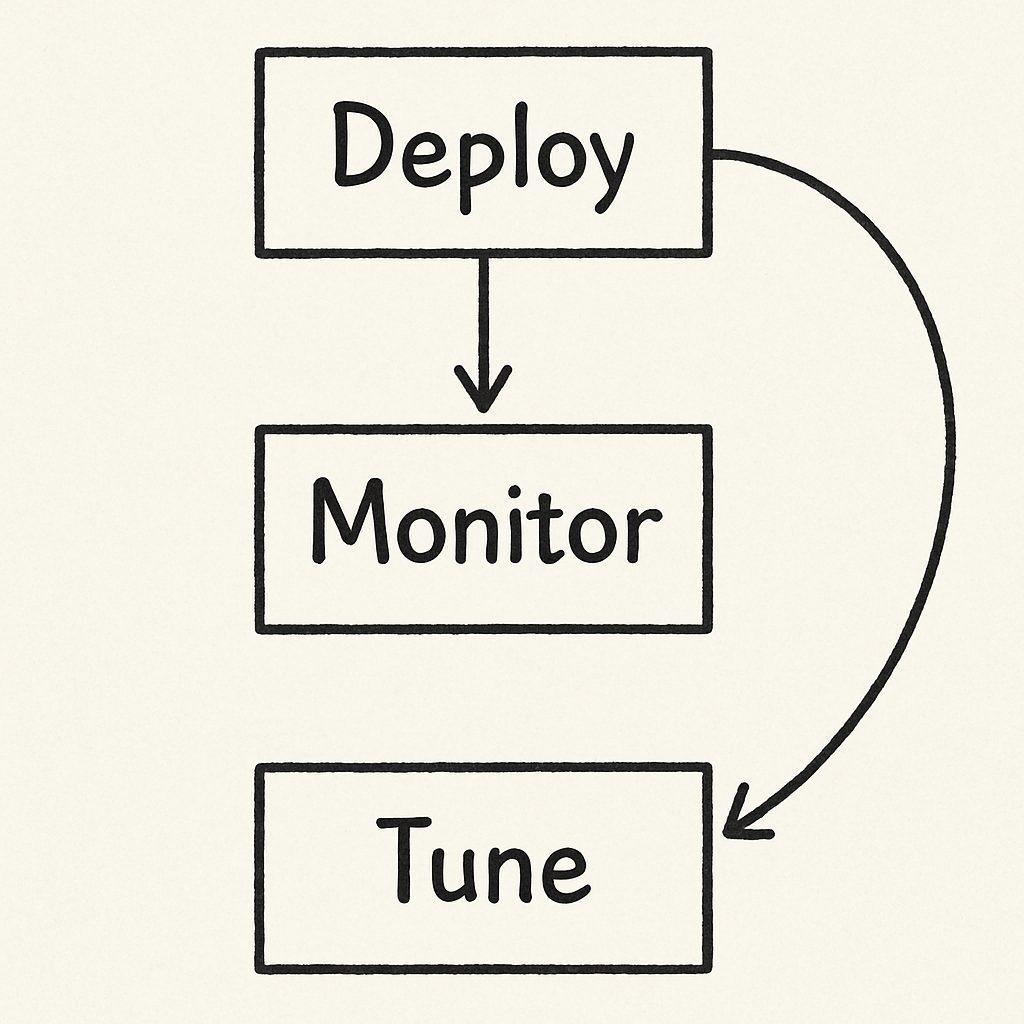
Building an amazing AI is like designing a new game. However, to achieve the same experience for hundreds of thousands of people, you have to build a large-scale manufacturing process. The entire production cycle of deploying a machine learning model into production involves Machine Learning Operations (MLOps), which is one thing that, while beginners are focused solely on programming, companies want developers/engineers who will take those code packages, deploy them onto server environments, and allow everyday consumers to engage with the AI securely.
Production shows us that human behavior continues to evolve over time, creating many problems — including “data drift” — where your AI that was working fine yesterday is now failing you today. Successfully troubleshooting machine learning model performance requires recognizing when a stream of fresh, real-world data does not match the original training set. Rather than panicking when this happens, engineers build continuous deployment pipelines to monitor accuracy and make adjustments as needed, ensuring models continue to work effectively.
To maintain the high level of complexity involved in operating successful systems, you require large amounts of digital space. As a result, professionals who can successfully operate within the top cloud providers for machine learning (such as AWS and Google Cloud) and provide seamless application upgrades (i.e., never bring the AI down during upgrades), have the knowledge required to understand all aspects of the lifecycle of developing and supporting these complex systems.
The Self-Taught Roadmap: How to Build an AI Portfolio That Gets You Hired
There are many who think you have to get a graduate degree in order to get into artificial intelligence, but that is just not the case. What matters most when becoming an AI engineer without getting a degree is showing the hiring manager proof of something you built. In this regard, a solid portfolio is one of the best ways to demonstrate your abilities to a hiring manager.
The steps to creating a roadmap to AI engineering mastery mean moving beyond simply watching tutorial videos and actually solving problems. The first thing you will need to do is develop a foundation in Python programming. Once you have developed a solid foundation in programming, begin experimenting with datasets on Kaggle (a platform used by a large community to complete data challenges). After gaining experience working with datasets, expand on it by contributing to open-source platforms (which let you help improve publicly available software) to showcase your collaboration skills to potential employers.
When developing a portfolio for AI engineering job opportunities, prioritize projects that demonstrate your ability to handle uncleaned, “real-world” data. Clearly document your code on GitHub (a developer repository) so recruiters can quickly understand your logic. There are three key types of projects to include in your portfolio:
- Sentiment Analysis: This project would be an example of an algorithm that could analyze a customer’s review of their product/service and determine whether they were happy or unhappy with it.
- Image Classification: This is an example of a system that identifies objects in photographs, such as damaged products during manufacturing.
- Predictive Analytics: This project would be an example of a predictive model forecasting future events/outcomes based on current statistics.
For instance, if you wanted to predict the price of homes based on their location, the number of bedrooms, etc., a predictive analytics model would be able to provide you with accurate estimates.
AI Learning Roadmap
| Step | Action | Outcome |
|---|---|---|
| Step 1 | Learn Python basics | Programming foundation |
| Step 2 | Study ML concepts | Core AI Knowledge |
| Step 3 | Build projects | Portfolio ready |
| Step 4 | Learn deep learning | Advanced skills |
| Step 5 | Deploy projects | Job-ready experience |
Source: Coursera
https://www.coursera.org
Leading the Charge: Soft Skills and Ethical Implementation for Technical Leads
The ability to write perfect code does not provide much value if the system produces unjust results. When a system’s poor performance (algorithmic bias) stems from learning from bad data, that data can be a resume with no female names or other historical biases built into the system based on previous workforces. The earlier you recognize these “blind spots” in AI, the sooner you will begin to develop ethical AI development practices in the industry to protect both your company and customers from potential major public backlash.
To lead large-scale, high-risk AI projects successfully, you need to develop at least three core non-technical soft skills as a technical AI leader: translation, negotiation, and empathy. As a digital translator, you can explain highly technical concepts to executives; as a negotiator, you can identify realistic project timeframes; and, as someone with empathy, you can better understand how an algorithm could unintentionally affect many people. Professionals who combine the complexity of programming with the importance of human-centered communication quickly advance in their AI engineering careers.
When you create responsible models and are confident in explaining their business value, you become an extremely valuable resource for a corporation. By combining both technology and humanity, you become an invaluable resource to your employer. Developing a unique combination of technical and human-based skills greatly increases the value of your services in the marketplace, ultimately increasing your earning power and career longevity.
The Paycheck Reality: Salary Trends and Future-Proofing Your AI Career
Entering the AI Field May Be the Most Lucrative Career Change Today. When comparing AI Engineer Salaries & Skills to Data Scientist Salaries & Skills, AI Engineers typically earn more because they create the software that companies use daily, whereas Data Scientists simply analyze the data generated by that software. Tech giants offer enormous stock options and other benefits; however, Sectors such as Healthcare & Finance have become aggressive in their offers to purchase and retain top, specialized talent in AI Engineering, even offering salaries that match or exceed those offered by Tech Giants in Silicon Valley.
Reviewing modern AI job descriptions reveals a highly profitable financial roadmap. Major tech hubs follow this type of salary structure annually:
- Entry Level / Junior (0-2 years): $120,000-$150,000 per year
- Middle Management / Mid-Level (3-5 years): $150,000-$200,000 per year
- Executive / Senior (5+ years): $200,000+
However, getting to senior levels more quickly than usual will require moving beyond basic coding and creating real, profit-generating projects that deliver measurable results for corporations.
AI Career Salary & Growth Statistics
| Role | Average Salary (USD) | Growth Trend |
|---|---|---|
| AI Engineer | $120K-$180K | Very High |
| ML Engineer | $110K-$170K | High |
| Data Scientist | $100K-$160K | High |
| AI Researcher | $130K-$200K | Growing |
| AI Developer | $90K-$150K | Increasing |
Source: Glassdoor
https://www.glassdoor.com
Your 30-Day Action Plan: Taking the First Step Toward AI Mastery
Viewing Artificial Intelligence (AI) as nothing more than another ‘magic’ tool you can access online is over. You will now be able to see the process of developing the tools we call “Artificial Intelligence.” The role of an AI Engineer, along with all related responsibilities, is made tangible by presenting what was once a black-boxed world of Algorithms and Data as an easily understandable Career Path.
Do not spend your time questioning how you can become an AI Engineer without a college degree. Use your Monday Morning to follow a concrete Step-By-Step Roadmap to Master AI:
- Week 1: Familiarize yourself with Basic Python skills through Free Resources such as freeCodeCamp, Codecademy, or Coursera’s introductory courses.
- Week 2: Brush up on Math Basics; Focus specifically on Practical Statistics and Probability instead of Calculus.
- Week 3: Sign up for a free Kaggle Account to find out how Data powers Real-World Algorithms.
- Week 4: Start working on your First Simple Portfolio Project. A good place to begin would be a simple Movie Recommendation Script.
We all start somewhere. Once you complete your first project, you move from being a Curious Observer to becoming an Active Creator. Your Journey to becoming an AI Engineer begins today.
Conclusion
The text sounds like an excerpt from a job posting. It may also appear in an online course or job training program. I would guess it came from a blog post or LinkedIn article, but without further information, it’s hard to pinpoint. The author appears to have written it to explain how someone could become a successful AI engineer and why that role is valuable today.
I am going to summarize what I think the author meant in his own words. However, I will do so as if I were writing something completely new rather than rewriting something he said.
The author thinks that being able to design and implement a reliable model is becoming less relevant than being able to deliver working AI to customers. In addition, as many companies use automated tools and predictive analytics to drive decision-making, there will be an increasing need for AI engineers to “translate” business goals into technical solutions that scale and remain stable. Therefore, an AI engineer should have skills that go beyond simply developing algorithms and include programming, testing, deploying, managing, and maintaining them.
FAQs
What does an AI engineer do day-to-day?
An AI engineer turns business problems into model-powered features by preparing data, training and evaluating models, integrating them into apps (APIs/batch), and monitoring performance after release.
What’s the difference between an AI engineer and a data scientist?
Data scientists often focus on analysis, experimentation, and proving what works, while AI engineers focus on building production-ready AI systems—reliable code, deployment, scalability, and ongoing maintenance.
What skills do employers look for in AI engineer job descriptions?
Common requirements include Python, SQL, ML fundamentals, frameworks like PyTorch/TensorFlow, software engineering practices (testing, version control), and MLOps skills such as CI/CD, containers, and monitoring.
Do AI engineers need cloud and DevOps knowledge?
Usually yes. Many roles expect experience deploying and operating models in cloud environments, managing compute costs, and using tooling like Docker/Kubernetes and observability to keep systems stable.
How can I start an AI engineering career without experience?
Build a portfolio of end-to-end projects (data → model → deployment → monitoring), document your decisions, show measurable results, and practice communicating trade-offs and limitations clearly.

Garikapati Bullivenkaiah is a seasoned entrepreneur with a rich multidisciplinary academic foundation—including LL.B., LL.M., M.A., and M.B.A. degrees—that uniquely blend legal insight, managerial acumen, and sociocultural understanding. Driven by vision and integrity, he leads his own enterprise with a strategic mindset informed by rigorous legal training and advanced business education. His strong analytical skills, honed through legal and management disciplines, empower him to navigate complex challenges, mitigate risks, and foster growth in diverse sectors. Committed to delivering value, Garikapati’s entrepreneurial journey is characterized by innovative approaches, ethical leadership, and the ability to convert cross-domain knowledge into practical, client-focused solutions.