

Humanoids & Embodied AI
Humanoids and Embodied AI covers intelligent machines that perceive physical environments, make bounded decisions and perform actions through a robotic body. Humanoid robots are one visible form, but embodied artificial intelligence also includes other autonomous systems that connect perception, reasoning, movement and physical interaction.
This NezzHub subcategory helps technology decision-makers, business owners, IT managers, professionals and students evaluate the engineering and commercial realities behind these systems. It examines enterprise applications, system architecture, implementation costs, human oversight, cybersecurity and physical safety within the broader Robotics and Automation category.
Explore Humanoids and Embodied AI
Embodied AI operates through a continuous relationship among sensing, perception, planning, control and physical action. A successful demonstration does not automatically establish that a robot can perform the same task reliably across different facilities, objects, people and operating conditions.
- Perception: Cameras, depth sensors, force sensors and other systems interpret the surrounding environment.
- Planning: Software selects permitted actions based on goals, constraints and available information.
- Movement and manipulation: Controllers coordinate locomotion, balance, arms, hands or other actuators.
- Human interaction: Interfaces allow workers or operators to instruct, supervise or stop the system.
- Learning and adaptation: Models may improve selected capabilities while remaining subject to testing and change control.
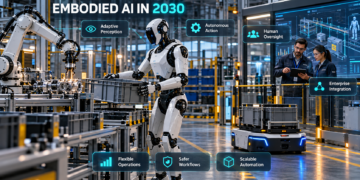
For a strategic view of possible developments, read the enterprise roadmap for embodied AI and autonomous robots in 2030. The guide separates credible deployment pathways from predictions that have not yet been demonstrated at operational scale.
Business and Enterprise Applications
Humanoid form can be useful where equipment, tools and buildings were designed around human dimensions. That advantage does not mean a humanoid is automatically better than an industrial arm, cobot, AMR or purpose-built machine.
- Manufacturing: Material handling, machine tending, inspection support and selected repetitive tasks.
- Logistics: Moving containers, handling packages and supporting warehouse workflows.
- Healthcare operations: Internal logistics, supply movement and non-clinical support under human supervision.
- Research: Testing locomotion, manipulation, perception and human-robot interaction.
- Hazardous environments: Investigating tasks where remote operation may reduce direct human exposure.
The article on humanoid AI in healthcare logistics and manufacturing examines practical use cases across three demanding environments. Buyers should compare humanoids with specialized automation using task success, intervention demand, availability, safety and total lifecycle cost.
Architecture, Integration and Deployment
An enterprise humanoid robotics architecture can include sensors, onboard compute, motion controllers, safety systems, edge infrastructure, cloud services and fleet-management software. It may also require connections with manufacturing, warehouse, maintenance or facility-management systems.
- Define the task, environment and measurable acceptance criteria.
- Identify payload, reach, speed, dexterity and mobility requirements.
- Test perception under representative lighting, clutter and human activity.
- Measure successful tasks, interventions, falls, recovery time and availability.
- Define local operation when network or cloud services are unavailable.
- Plan battery charging, maintenance, spare parts and operator training.
- Use staged software releases with monitoring and rollback procedures.
Implementation costs extend beyond the robot’s purchase or subscription price. Integration, site preparation, networking, cloud computing, safety engineering, maintenance, teleoperation and human supervision can materially affect the business case.
Risks, Security and Governance
Embodied AI can convert software errors into physical movement. Risk management must therefore cover the model, robot, workplace, network, operators and connected enterprise systems.
- Limit robot actions to validated tasks, locations and operating conditions.
- Apply strong device identity and least-privilege access.
- Protect remote-support, fleet-management and teleoperation interfaces.
- Control software, model and configuration updates.
- Record significant commands, interventions and safety-related events.
- Protect images, audio, maps and workplace information collected by sensors.
- Provide clear human override, shutdown and incident-response procedures.
Human-like appearance can create misplaced trust in a machine’s reasoning or reliability. Operators should understand the system’s limitations, supervision requirements and conditions under which a person must take control.
How to Use This Subcategory
Business owners can use the articles to compare humanoids with specialized automation and assess lifecycle cost. IT managers should focus on connectivity, fleet software, identity, cybersecurity, data governance and update control.
Engineers and professionals can examine perception, motion, manipulation and operational validation. Students should begin with embodied AI fundamentals before progressing to enterprise architecture and future deployment scenarios.
Frequently Asked Questions
What is embodied AI?
Embodied AI connects artificial intelligence with a physical system that senses its environment and performs actions. The body may be humanoid or use another robotic form.
Are all embodied AI systems humanoid robots?
No. Autonomous vehicles, mobile robots, robotic arms and other physical agents can use embodied AI without resembling a human.
Are humanoid robots ready for enterprise deployment?
Some systems can perform controlled or supervised tasks. Reliability, intervention rates, safety, maintenance and economic value remain dependent on the application.
How should businesses evaluate humanoid robotics?
Start with a defined workflow and compare the humanoid with specialized alternatives. Measure successful tasks, human intervention, downtime, integration effort and total lifecycle cost.
Latest Humanoids and Embodied AI Articles
Browse the archive below for the latest NezzHub research on Humanoids and Embodied AI, autonomous robots, enterprise applications, technical architecture, deployment economics, safety and governance.

Humanoid AI in Healthcare Logistics and Manufacturing: Task Readiness and Human Oversight
Executive Summary Humanoid AI is moving from staged demonstrations into bounded industrial work, but the evidence is uneven. Manufacturing and...










Recent News





NezzHub is a technology-focused knowledge hub delivering insights on AI, robotics, cybersecurity, biotech, and emerging innovations. Our mission is to simplify complex technologies through research-driven content and analysis.