



USA Robotics & Automation
USA Robotics & Automation examines the machines, software platforms and integration services shaping American manufacturing, logistics, inspection and field operations. This NezzHub subcategory serves business owners, technology decision-makers, IT managers, professionals and students who need practical analysis of enterprise robotics solutions.
The coverage connects robot capability with workflow design, safety engineering, implementation cost, cybersecurity and lifecycle support. Readers can use these resources to distinguish demonstration performance from dependable production operation while comparing suppliers against specific business requirements.
Explore USA Robotics & Automation
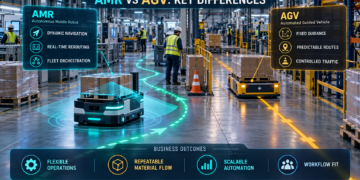
Robotics projects can involve fixed industrial arms, collaborative robots, autonomous mobile robots, machine-vision systems, specialised field machines and emerging humanoid platforms. These systems solve different problems and should not be evaluated through one universal ranking.
Major areas covered within this subcategory include:
- Industrial automation: Robot arms, machine tending, welding, assembly, inspection and material handling.
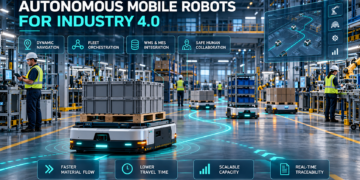
- Mobile robotics: Autonomous transport, warehouse movement, inspection and facility operations.
- Collaborative systems: Applications designed for controlled interaction between people and robots.
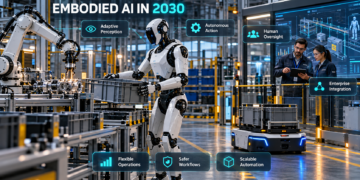
- Humanoid robotics: Emerging platforms intended to operate in environments designed around human movement.
- Robotics software: Perception, navigation, fleet management, simulation, monitoring and enterprise integration.
Start with the guide to leading robotics companies in the USA when comparing suppliers. It evaluates companies by operational fit, integration requirements, safety, service support and total installed cost rather than brand attention alone.
Business and Enterprise Applications
A robotics project should begin with a constrained workflow, not a preferred robot. Buyers should document payload, reach, cycle time, product variation, environmental conditions, safety hazards and exception frequency before requesting proposals.
Common applications include production handling, warehouse transport, infrastructure inspection, quality control and hazardous-task support. Automation creates value only when it produces accepted output reliably without transferring excessive recovery work to operators or technicians.
Commercial evaluation should ask:
- Can the system complete the actual task under representative conditions?
- Which supplier or integrator owns each technical interface?
- What service coverage, spare parts and response commitments are available?
- How will performance, quality, downtime and interventions be measured?
- Can configurations, logs and operational data be exported?
Readers assessing emerging humanoids can review the Tesla Optimus deployment guide. It separates public development evidence from unverified assumptions about commercial availability, pricing, reliability and support.
Architecture, Integration and Deployment
A production robot operates inside a larger system. The deployment may include tooling, sensors, safety controllers, machine vision, edge computing, fleet software, wireless networks and connections to warehouse or manufacturing systems.
The weakest interface can determine overall availability. A capable robot may still underperform when part presentation varies, wireless coverage fails, task data is unreliable or recovery procedures depend on one specialist.
Acceptance tests should use realistic products, operators, lighting, floor conditions, traffic and failure scenarios. Buyers should measure good output, first-pass yield, intervention rate, recovery time, technical availability and changeover performance.
The Boston Dynamics robots deployment guide provides another practical path for evaluating mobile robotics capability, environmental fit and operational boundaries.
Risks, Security and Governance
Robotics combines physical safety with software and network risk. Incorrect motion, failed perception, unsafe recovery or compromised remote access can affect equipment, production and people.
- Complete an application-specific safety assessment.
- Segment robotics and operational-technology networks where appropriate.
- Use individual identities and least-privilege permissions.
- Control remote access, software updates and configuration changes.
- Maintain version-controlled backups and tested recovery procedures.
- Define incident ownership among the buyer, manufacturer and integrator.
Vendor demonstrations do not replace site acceptance testing. Performance claims should identify the environment, task, measurement method and source before they are used in an investment decision.
How to Use This Subcategory
- Business owners: Focus on workflow constraints, installed cost and measurable operational value.
- Technology leaders: Compare system architecture, scalability and vendor dependence.
- IT managers: Review identity, networking, monitoring, backups and software lifecycle requirements.
- Operations teams: Examine throughput, changeovers, recovery and maintenance responsibilities.
- Students: Study the complete automation system rather than robot hardware alone.
For connected American AI, quantum, healthcare and technology-industry coverage, visit the parent USA Tech & Innovation category.
Frequently Asked Questions
Which robotics systems are covered here?
The subcategory covers industrial robots, mobile robots, collaborative systems, humanoids, machine vision and robotics software.
How should a business choose a robotics supplier?
Compare suppliers against one documented workflow using equivalent acceptance, safety, support, integration and lifecycle-cost requirements.
What costs should a robotics budget include?
Include hardware, tooling, guarding, software, integration, network work, validation, training, maintenance, spares and production ramp.
Are humanoid robots ready for commercial deployment?
Readiness varies by platform and task. Buyers should require verified availability, reliability, safety, support and application-specific evidence.
Latest USA Robotics & Automation Articles
Browse the automatic archive below for current NezzHub research on USA Robotics & Automation, supplier evaluation, humanoid development and practical deployment.
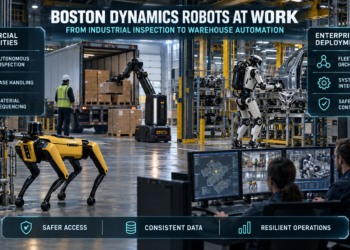
Boston Dynamics Robots: Spot, Stretch and Atlas in Industrial Operations
Executive Summary Boston Dynamics robots have moved beyond viral demonstrations, but they have not become universal labor substitutes. The commercial...
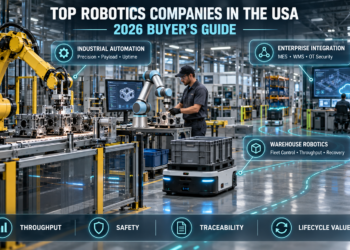
Top Robotics Companies in the USA: Applications, Integration and Support
Executive Summary The Top Robotics Companies in the USA cannot be identified by robot shipments, funding headlines, or demonstration videos...









Recent News





NezzHub is a technology-focused knowledge hub delivering insights on AI, robotics, cybersecurity, biotech, and emerging innovations. Our mission is to simplify complex technologies through research-driven content and analysis.