




Executive Summary
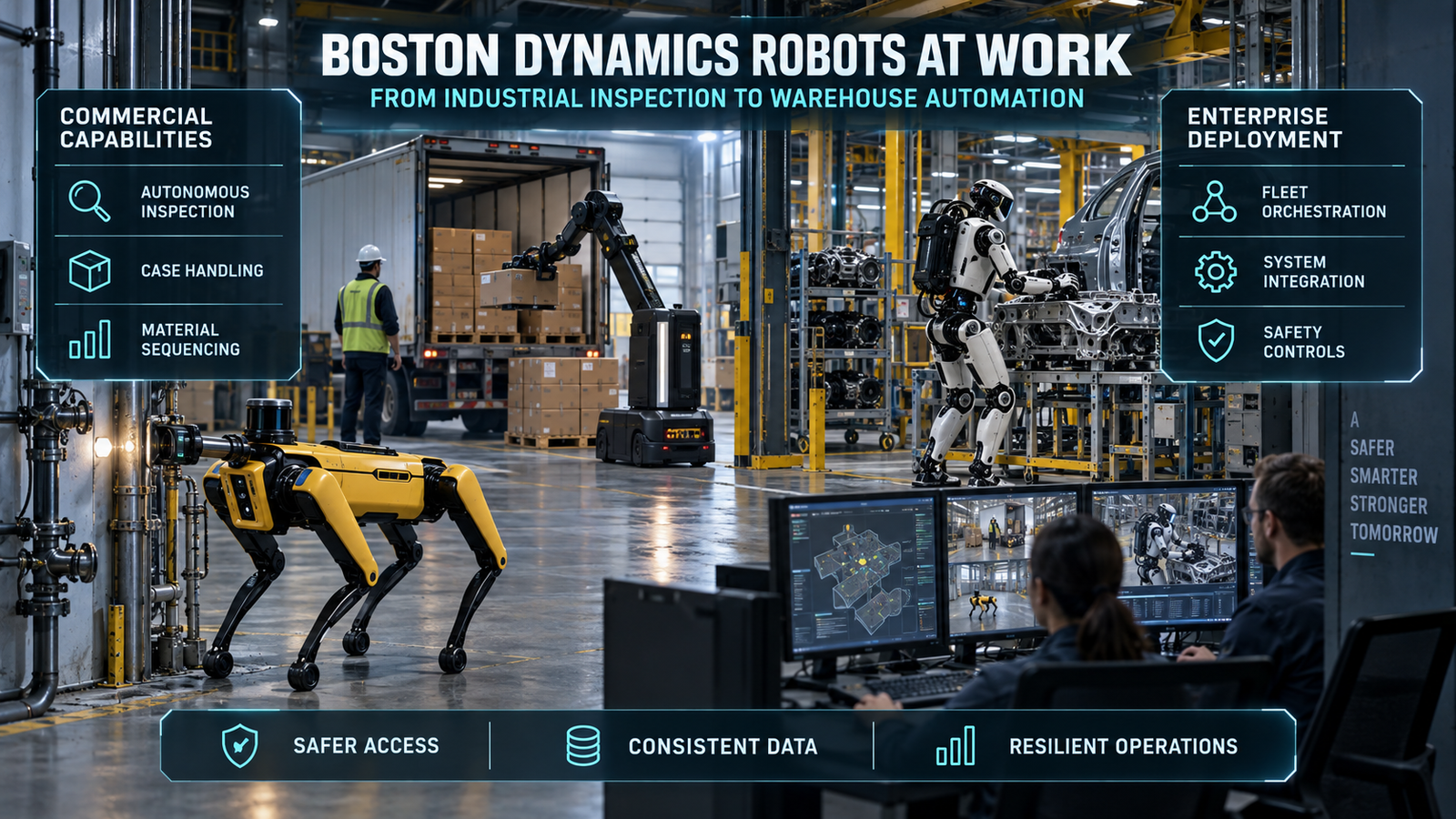
Boston Dynamics robots have moved beyond viral demonstrations, but they have not become universal labor substitutes. The commercial case is narrower and more credible: Spot gathers repeatable inspection data in spaces built for people, Stretch handles cases in trailers and warehouses, Atlas is entering selected industrial deployments, and Orbit connects missions, evidence, and fleet operations.[1][2][3][4]
For buyers, the useful question is not whether these machines can dance, climb stairs, or recover from a disturbance. It is whether a defined workflow produces enough avoided exposure, recovered labor capacity, higher throughput, or earlier fault detection to pay for hardware, integration, support, connectivity, and operational ownership.
That distinction changes procurement. A successful Spot robot deployment starts with an inspection route and an action owner, while successful warehouse automation robots start with the box flow, exception rate, dock constraints, and downstream conveyor capacity.
Boston Dynamics robots deliver the clearest value when buyers define that operating boundary before requesting a demonstration.
The strongest business cases are repetitive, measurable, and physically unpleasant. Weak cases depend on a robot improvising across poorly controlled work, replacing several unrelated jobs, or delivering savings that the buyer cannot verify from baseline data.
This Article separates marketed capability from production evidence. It provides an architecture, integration flow, performance matrix, commercial comparison, ROI model, and risk-control framework for technology leaders evaluating Boston Dynamics robots in 2026.
I. Current Market Landscape and the Cost of Waiting
Mobile robots solve a different automation problem
Traditional industrial automation performs best when parts, paths, lighting, guarding, and cycle timing remain stable. Mobile platforms become attractive when the work occurs across stairs, aisles, trailers, equipment rooms, or changing layouts that are expensive to rebuild around fixed machinery.
That does not make mobile robotics inherently better. It makes mobility valuable only when moving the sensor or manipulator to the work costs less than moving the work to a fixed cell.
Boston Dynamics robots target this boundary. Spot carries sensors through facilities; Stretch brings a perception-guided arm into case-handling areas; Atlas aims to use human-scale workstations and tools while Orbit provides the robotics fleet management and evidence layer.[1][2][3][4]
That portfolio gives Boston Dynamics robots several entry points, but it does not make the products interchangeable.
The Business Benefits of Autonomous Mobile Robots for Industry 4.0
The present product portfolio is not equally mature
Spot is a commercially established quadruped for inspection, remote presence, mapping, and payload-based sensing. Its usefulness depends on the payload, mission design, route reliability, and the system that converts readings into maintenance or safety action.
Stretch is a purpose-built logistics machine. Boston Dynamics states that it handles boxes up to 50 pounds, works through neat or disordered trailer loads, and can move hundreds of cases per hour; the precise rate for a buyer still depends on carton quality, trailer geometry, transfer equipment, and exception handling.[2]
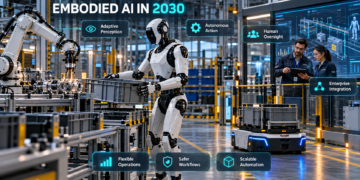
Atlas changed materially in 2026. Boston Dynamics now describes a production-ready enterprise humanoid with initial deployments scheduled at Hyundai and Google DeepMind, but wider availability remains staged through selected early adopters.[3][5]
Orbit is software rather than a robot. It schedules missions, exposes fleet health and inspection data, supports APIs and webhooks, and offers cloud, on-premises appliance, and virtual-machine deployment options.[4]
Cost of inaction must be measured, not dramatized
The cost of waiting is credible when the business already pays for hazardous access, scarce labor, inconsistent readings, delayed fault discovery, or trailer-unloading bottlenecks. It is not credible when a team invents a broad “innovation” benefit with no operational owner.
Quantify the current loss
For industrial robot inspection, establish route hours, permit time, personal protective equipment, travel, missed rounds, reading variability, and the cost of faults detected late. For logistics, record unload labor hours, cases per hour, injury exposure, detention time, seasonal overtime, and the percentage of cases requiring intervention.
If those baselines are unavailable, the first investment should be measurement. Buying Boston Dynamics robots before defining the loss merely automates uncertainty.
II. Deep-Dive Technical Analysis and Evidence
Architecture Overview
Boston Dynamics robots are cyber-physical systems, not standalone mechanical employees. Their value emerges from five connected layers, and a failure in any one can erase the return on the others.
1. Mobility and manipulation layer
Actuators, joints, transmissions, batteries, end effectors, and low-level control execute motion. Spot prioritizes legged mobility, Stretch combines a mobile base with a vacuum gripper and long-reach arm, and Atlas combines whole-body motion with manipulation.[1][2][3]
The control loop continuously compares intended and measured state. This is why balance looks fluid, but stability in a demonstration does not prove that a production route will tolerate every wet floor, loose cable, reflective surface, or blocked doorway.
2. Perception and localization layer
Cameras and other onboard sensors estimate position, detect obstacles, and support navigation. Task payloads can add thermal, acoustic, gas-detection, radiation, zoom, or computation capabilities, depending on the validated configuration.[1]
Perception has operating envelopes. Glare, dust, darkness, feature-poor corridors, moving people, transparent barriers, and changed layouts can reduce confidence or force an intervention.
3. Autonomy and mission layer
Autonomy software converts maps, waypoints, constraints, and task logic into actions. A recorded route can be repeated, but every mission requires recovery rules for closed doors, temporary barriers, low battery, lost communications, unsafe conditions, and failed data capture.
This layer is where deployment teams often underestimate work. A technically traversable route may still be operationally unreliable because the site changes faster than maps, permissions, and exception procedures are maintained.
4. Data and enterprise integration layer
Inspection values become useful only after they are time-stamped, associated with the correct asset, evaluated against a rule, and delivered to a person or system authorized to act. Orbit supports dashboards, alerts, scheduling, APIs, webhooks, and links to systems such as CMMS and WMS.[4]
This is the heart of robotics fleet management. Without asset identifiers, retention policies, work-order logic, and audit trails, a robot can collect impressive data that never changes maintenance behavior.
5. Governance and operations layer
The final layer covers role-based access, change control, charging, maintenance, training, incident response, safe operating zones, and vendor support. It also assigns accountability when a mission stops, a model generates a false alert, or an integration writes bad data.
Integration Flowchart
flowchart TD
flowchart TD
A[“Business workflow and baseline”] –> B[“Site survey and risk assessment”]
B –> C[“Robot, payload, network and route configuration”]
C –> D[“Controlled pilot missions”]
D –> E[“Orbit or local orchestration”]
E –> F[“CMMS, WMS, MES or data platform”]
F –> G[“Human review and authorized action”]
G –> H[“Outcome measurement and change control”]
H –> D
The human review node is deliberate. Automated work-order creation can reduce response time, but a high-consequence shutdown, safety decision, or process change should follow authority rules appropriate to the asset and site.
What Spot can do today
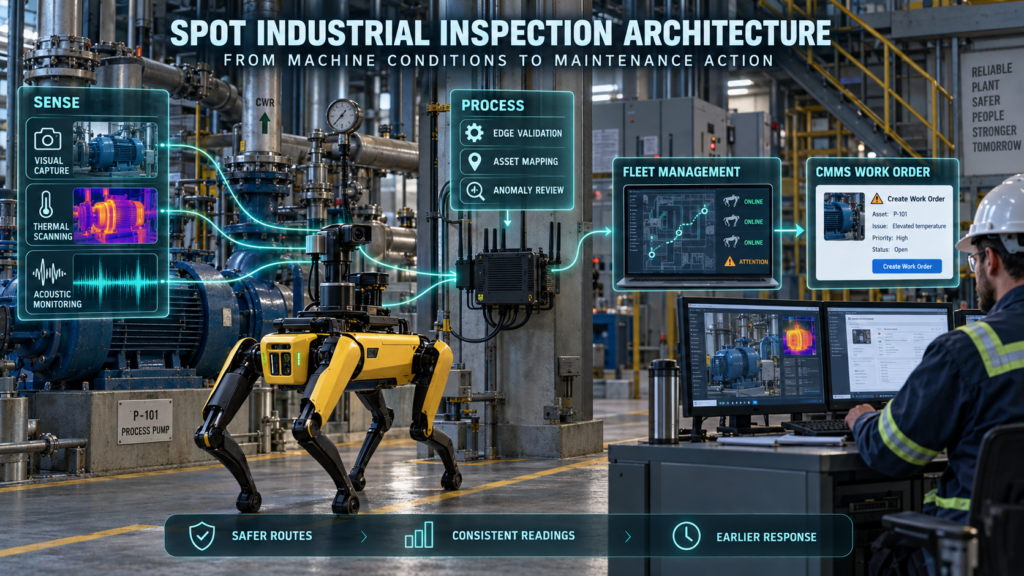
A Spot robot deployment can repeatedly traverse mapped areas, collect visual or payload data, provide remote situational awareness, and extend sensing to locations that are awkward or risky for routine rounds. The Spot Arm adds mobile manipulation, while the payload interface supports additional sensing, communications, and compute.[1]
Among Boston Dynamics robots, Spot has the most direct fit for repeatable facility rounds where mobility and consistent data capture matter more than manipulation speed.
Commercially useful patterns include reading analog gauges, capturing thermal images, monitoring acoustic conditions, documenting construction progress, scanning facility changes, and inspecting equipment from consistent viewpoints. These are industrial robot inspection workflows, not promises that the robot diagnoses every fault autonomously.
The robot’s output should be treated as evidence with confidence and quality controls. A thermal anomaly may justify technician review; it does not by itself establish root cause.
What Stretch can do today
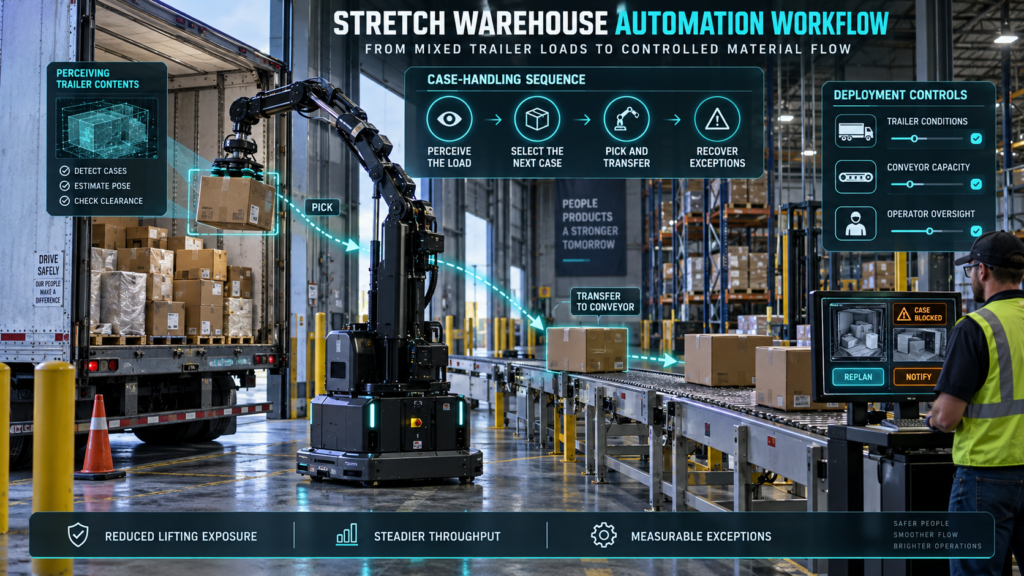
Stretch is optimized for case handling, especially trailer and container unloading. It makes pick decisions from perceived box arrangements, handles varied packaging up to the vendor-stated limit, and places cases into an outbound material flow.[2]
For warehouse automation robots, the acceptance test must cover the actual mix of cartons, trailers, shifts, and handoff equipment.
The commercial attraction is focused automation without rebuilding the whole dock as a fixed robot cell. Yet warehouse automation robots can expose downstream limits: a fast unload is worthless if conveyors saturate, exceptions pile up, or operators cannot clear damaged cartons safely.
Buyers should test representative freight, not a curated trailer. The pilot set must include dark graphics, glossy wrap, crushed cartons, gaps, shifted stacks, mixed sizes, falling cases, and the facility’s actual temperature and lighting ranges.
What Atlas can do today—and what remains early
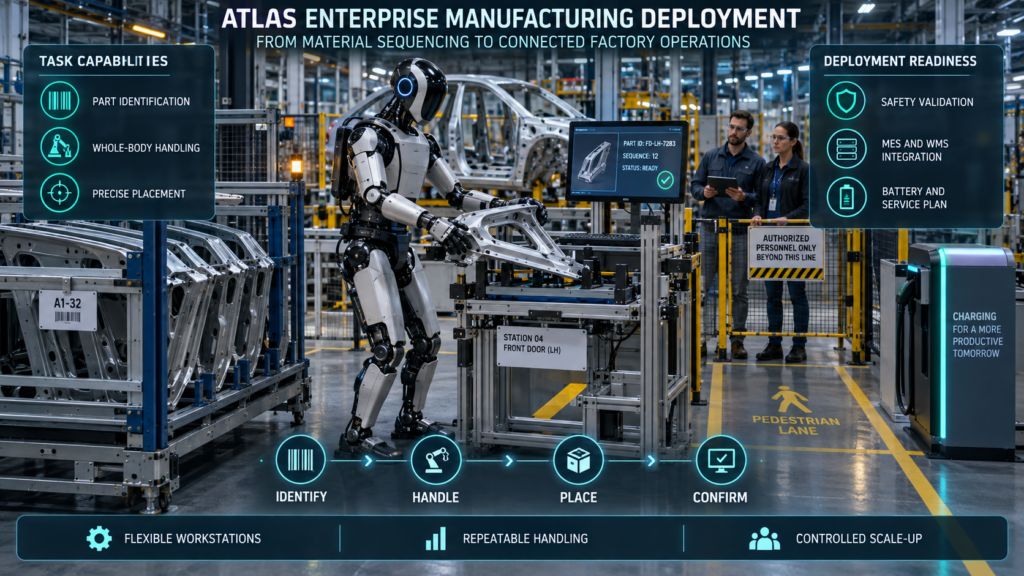
The 2026 Atlas product is specified at 1.9 meters and 90 kilograms, with a four-hour battery, self-swapping capability, a sustained 30-kilogram load rating, and a 50-kilogram instantaneous capacity. Boston Dynamics lists tactile sensing, 360-degree camera coverage, IP67 protection, and an operating range of -20°C to 40°C.[3]
The company positions Atlas for material handling, part sequencing, machine tending, and order building. Initial deployments and selected-customer engagement show commercial intent, but they do not yet establish broad, multi-industry performance at scale.[3][5]
Decision-makers should therefore budget Atlas as an early-adopter program. Acceptance criteria should cover task completion, intervention frequency, safety validation, battery exchange, integration, service response, and skill transfer across the fleet.
This is the largest maturity distinction among Boston Dynamics robots: a product launch and scheduled deployments are important evidence, but they are not the same as years of scaled operating history.
Deployment Challenges That Decide the Result
Physical environment drift
A route validated on Monday may be blocked on Friday by scaffolding, pallets, hoses, or temporary barriers. The owner needs a map-update process and a rule for when a change requires revalidation.
Communications and edge behavior
Remote operation, data uploads, and orchestration depend on Wi-Fi, LTE, or local infrastructure. Define what the robot does when bandwidth drops, authentication expires, cloud services are unreachable, or latency exceeds the operating limit.
Battery and charging logistics
Quoted runtime never equals productive time automatically. Mission duration, travel to charging, payload draw, battery health, temperature, and recovery from failed docks determine effective availability.
Payload calibration and data quality
An industrial robot inspection program inherits the limitations of every sensor it carries. Calibration intervals, field-of-view, mounting position, emissivity assumptions, acoustic background, and environmental contamination must be controlled.
Exception labor
Autonomy changes labor rather than eliminating it. Someone still clears obstructions, reviews alerts, maintains maps, replaces wear items, investigates failures, manages credentials, and coordinates service.
Performance Evaluation Matrix
| Dimension | Pilot metric | Minimum evidence | Common failure signal |
| Mission reliability | Completed missions / scheduled missions | At least four weeks across normal shifts | Repeated stops at the same route feature |
| Data completeness | Valid readings / required readings | Asset-linked, time-stamped records | Images captured but not mapped to assets |
| Intervention load | Human assists per 100 missions or trailers | Logged cause and resolution time | Exceptions hidden as “operator support” |
| Safety | Near misses, protective stops, unsafe entries | Reviewed event logs and observations | Safety zones bypassed to preserve throughput |
| Throughput | Cases/hour or inspection points/hour | Representative workload distribution | Average hides poor peak-period performance |
| Availability | Productive hours / planned hours | Charging and maintenance included | Vendor demo excludes recovery time |
| Integration quality | Successful transactions / attempted events | Reconciled against CMMS, WMS, or MES | Duplicate, delayed, or orphaned records |
| Economics | Verified benefit / fully loaded cost | Finance-approved baseline and assumptions | Savings depend on unremoved labor cost |
The matrix prevents a pilot from becoming a highlight reel. It also makes competing Boston Dynamics robots and conventional alternatives comparable on outcomes rather than novelty.
For industrial robot inspection, the same matrix should be applied to every route and payload configuration before a fleet expansion decision.
III. Commercial Solutions and Best Practices
Feature and Cost Comparison
Public list prices are not a reliable procurement basis for enterprise configurations. The appropriate comparison is a request-for-quote model that includes payloads, software, integration, support, infrastructure, training, spares, and internal labor.
| Solution | Best-fit work | Commercial maturity in 2026 | Integration focus | Cost structure to request | Principal limitation |
| Spot | Inspection, remote sensing, site documentation | Established commercial platform | Payloads, Orbit, CMMS, data lake | Robot, payloads, software, dock, service, network | Does not turn sensor readings into maintenance action alone |
| Stretch | Trailer unloading and case handling | Commercial logistics product | Conveyor flow, dock process, WMS metrics | Robot, site preparation, support, batteries, operator coverage | Freight variability and downstream congestion |
| Atlas | Human-scale material handling and sequencing | Product version; selective early deployments | Orbit, MES/WMS, skill deployment, safety system | Early-adopter program, application engineering, service | Limited public evidence of broad scaled production |
| Fixed robot/cobot plus AMR | Stable, repetitive movement in controlled areas | Mature multi-vendor category | PLC, safety cell, MES/WMS, conveyors | Equipment, guarding, tooling, engineering, floor changes | Less adaptable to stairs and changing human-built spaces |
Evaluate Orbit alongside the selected robot, but confirm which functions are supported for that product and software version. Boston Dynamics describes inspection and mission-management features for Spot, and unloading visibility and performance metrics for Stretch. Its Orbit page describes Atlas fleet support as forthcoming. Do not assume that mission scheduling, remote operation or inspection features apply identically to all three platforms.[4]
Boston Dynamics robots therefore require a software and data decision alongside the physical-platform decision.
A procurement framework that survives production
Gate 1: Select one workflow
Choose one route, trailer class, or material-handling task with a named owner. Reject project charters that list inspection, security, mapping, manipulation, and emergency response as one pilot.
Gate 2: Establish the baseline
Measure current labor, delays, injuries or exposure proxies, error rates, throughput, and downtime. Record distributions and peak conditions, not just averages.
Gate 3: Define the operating envelope
Document floor conditions, slopes, stairs, doors, aisle widths, lighting, temperature, radio coverage, public access, payload mass, carton types, and prohibited zones. Vendor specifications are boundaries, not evidence that the application works inside them.
Gate 4: Design integration before the demo
Create asset IDs, event schemas, alert thresholds, identity roles, data retention, system-of-record ownership, and work-order rules. A Spot robot deployment should produce a closed operational loop, not a folder of images.
Gate 5: Run representative tests
Include normal, peak, degraded, and recovery scenarios. For warehouse automation robots, test damaged freight and handoff failures; for industrial robot inspection, test sensor uncertainty, missed readings, and changed routes.
Gate 6: Require an exit decision
Set pass, remediate, and stop thresholds before the pilot. The steering group should know which outcome leads to expansion and which prevents sunk-cost escalation.
Total cost of ownership checklist
- Hardware, task payloads, end effectors, docks, chargers, batteries, and spare parts.
- Orbit or other robotics fleet management licensing, hosting, storage, and connectivity.
- Systems integration, API work, identity management, cybersecurity assessment, and validation.
- Site changes, guarding, markings, transfer equipment, network expansion, and power.
- Operator, maintainer, safety, engineering, and supervisor training.
- Preventive maintenance, field service, software updates, calibration, and lifecycle replacement.
- Exception handling, monitoring, audit, incident investigation, and vendor management labor.
The checklist reveals whether projected savings are cashable. Reassigning an employee to higher-value work may improve capacity, but finance should not record labor savings unless the budget truly changes or output increases measurably.
Across Boston Dynamics robots, integration and exception labor can be as consequential as the purchase configuration, so both belong in the approved cost model.
IV. Business Outcomes and Strategic ROI Takeaways
Value category 1: reduced hazardous exposure
The strongest Spot robot deployment often removes routine entries rather than eliminating a position. Value can include fewer climbs, reduced time near hot equipment, less exposure to confined or contaminated areas, and better information before a person enters.
Risk reduction requires a defensible proxy. Examples include avoided entries, exposure minutes, permits, escort hours, or protective-equipment events—not a fictional dollar value assigned to “safety.”
Value category 2: earlier and more consistent detection
Industrial robot inspection can capture the same asset from a repeatable viewpoint and schedule. That consistency may improve trending, but it only becomes economic value when an anomaly triggers timely diagnosis and a justified intervention.
Track precision, recall, false alerts, missed detections, technician review time, and confirmed avoided failures. If those measurements are absent, claims of predictive maintenance remain marketing language.
Value category 3: throughput and labor resilience
Stretch can take over physically demanding unloading work and stabilize flow during difficult staffing periods. The measured outcome should combine cases per hour, trailer completion time, intervention minutes, employee rotation, injury exposure, and the constraint immediately downstream.[2]
Warehouse automation robots can improve capacity without removing every manual role. Exception work, damaged freight, staging, maintenance, and flow coordination remain operational requirements.
Annual Net Benefit and Simple Payback
Use annualized cash flow rather than a headline payback claim:
Annual net cash benefit = verified annual cash savings + incremental annual contribution from additional output − incremental annual operating costs.
Simple payback period in years = total upfront deployment investment ÷ positive annual net cash benefit.
Express all annual amounts in the same currency and avoid overlapping benefits. Upfront investment should include hardware, payloads, installation, site preparation, integration and initial training. Annual operating costs should include software, connectivity, maintenance, support and exception handling. Released staff time counts as cash savings only when expenditure actually falls.
This simplified payback calculation assumes a stable annual net cash benefit. If benefits ramp up gradually, calculate cumulative cash flow instead. A zero or negative annual net cash benefit does not produce a finite payback under this formula.
The business case should present low, base, and high scenarios. Vary mission completion, intervention rate, utilization, detected-fault value, labor convertibility, support cost, and production ramp time.
A Spot robot deployment should also separate inspection coverage from confirmed fault-prevention value, because collecting more readings does not guarantee avoided downtime.
Do not count the same benefit twice. Faster inspections and fewer inspection hours may describe one improvement, while avoided downtime requires separate evidence that earlier detection changed a failure outcome.
Executive buying takeaways
- Buy a measurable workflow, not a general-purpose robot narrative.
- Treat mobility, sensing, enterprise integration, and operating ownership as one system.
- Use custom quotes and full lifecycle costs; hardware price alone is not decision-grade.
- Separate proven production capability from vendor roadmap and selective early deployments.
- Scale only after reliability, safety, data quality, and economics survive representative conditions.
V. Risk Mitigation and Regulatory Framework
Boston Dynamics robots operate where mechanical, electrical, software, network, privacy, and workplace risks meet. Compliance is application-specific, so no vendor certification or product feature replaces the integrator’s site risk assessment.
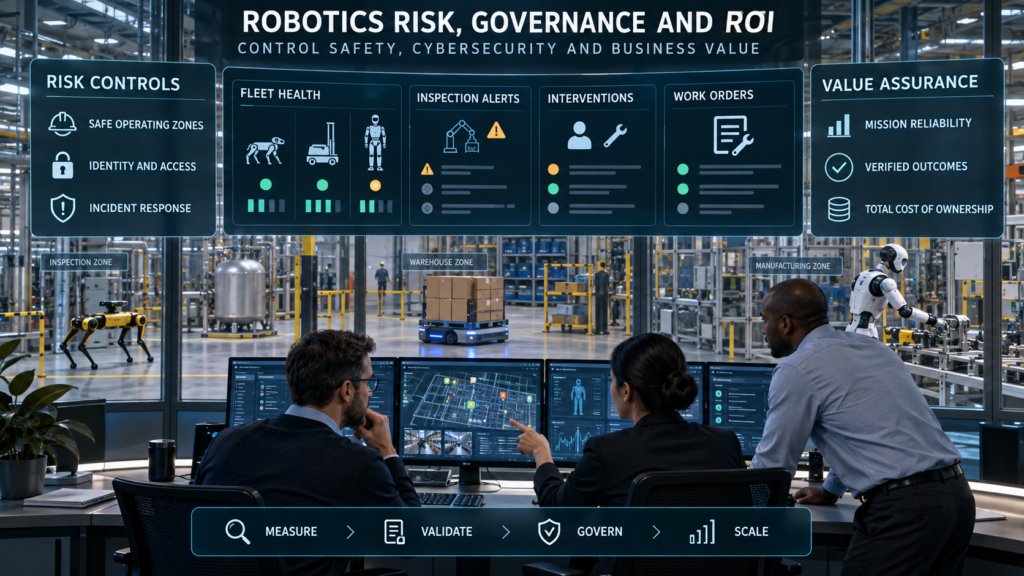
Safety framework
OSHA notes that robots are commonly used for hazardous and repetitive tasks, while its technical guidance highlights risks during programming, testing, setup, and maintenance—not only normal automatic operation.[6][7] Those non-routine states deserve explicit procedures and authorization.
ISO 10218-1:2025 addresses industrial robot design, while ISO 10218-2:2025 addresses integration and applications. The scope has exclusions, so the safety team must confirm applicability instead of adding an ISO number to a checklist without analysis.[8][9]
Safety compliance checklist
- Assign a qualified integrator and document the application boundaries.
- Perform task-based hazard analysis for normal, degraded, recovery, charging, and maintenance states.
- Validate speed, separation, stopping, exclusion zones, and safe restart behavior.
- Control access to teaching, remote operation, maintenance, and override functions.
- Test emergency stops and loss-of-network, low-battery, localization, payload, and docking faults.
- Record near misses, protective stops, collisions, unexpected motion, and human interventions.
- Reassess risk after route, payload, software, layout, or process changes.
Cybersecurity and data governance
Orbit can connect robots, inspection data, APIs, webhooks, identity services, and enterprise systems. That creates operational value and a wider attack surface.[4]
IEC 62443-2-1:2024 specifies security-program requirements for owners of industrial automation and control systems. Its lifecycle approach is useful for connected robotics even where the final applicability decision requires a site-specific architecture review.[10]
Cybersecurity checklist
- Place robots, docks, payload computers, and management services in documented network zones.
- Enforce unique identities, least privilege, SSO where supported, and rapid access revocation.
- Inventory firmware, software, APIs, certificates, payloads, and third-party components.
- Define update testing, patch timing, rollback, backups, and unsupported-component controls.
- Encrypt management and data flows; restrict inbound access and monitor administrative actions.
- Validate cloud, Site Hub, or virtual-machine deployment against data residency and recovery needs.
- Retain mission, alert, configuration, and integration logs for investigations and audits.
- Test incident response for credential theft, remote-operation misuse, unavailable orchestration, and corrupted data.
AI governance
Where perception or vision-language models influence inspection results, use the NIST AI Risk Management Framework to govern, map, measure, and manage risk across the lifecycle.[11] Apply stricter human review when an output can trigger safety, maintenance, employment, or production consequences.
Model-enabled alerts need version tracking, representative validation data, performance thresholds, drift monitoring, and an appeal or override path. The term “AI-powered” is not a control and should never substitute for a tested acceptance criterion.
Planning a Site-Specific Robot Assessment
Start with a two-page opportunity brief: one workflow, one site, one accountable executive, one safety owner, one integration owner, a baseline, a 60- to 90-day test window, and pre-agreed pass or stop criteria. Then ask Boston Dynamics and qualified integrators for a configuration and services proposal tied to that evidence plan.
Compare the proposed deployment with the best practical alternative using the same safety, reliability, throughput and cost criteria. Proceed only when representative testing supports the business case and the site’s responsible safety and engineering owners approve the operating conditions.
VI. Appendix and Research Integrity
Appendix A: Academic and Primary-Source Footnotes
- Boston Dynamics, “Spot.” Official product page covering inspection use, payload integration, Spot Arm, and Orbit connectivity. https://bostondynamics.com/products/spot/ Accessed September 22, 2026.
- Boston Dynamics, “Stretch.” Official product page covering trailer unloading, case picking, representative handling capability, and boxes up to 50 pounds. https://bostondynamics.com/products/stretch/ Accessed September 22, 2026.
- Boston Dynamics, “Atlas.” Official product page covering specifications, enterprise positioning, early-adopter rollout, integrations, and application roadmap. https://bostondynamics.com/products/atlas/ Accessed September 22, 2026.
- Boston Dynamics, “Orbit.” Official product page covering mission management, inspection data, fleet dashboards, integrations, security features, and deployment options. https://bostondynamics.com/products/orbit/ Accessed September 22, 2026.
- Boston Dynamics, “Atlas’ Evolution From Research Robot to Industrial Humanoid.” Company account of the 2026 product transition and scheduled initial deployments. https://bostondynamics.com/blog/atlas-evolution-from-research-robot-to-industrial-humanoid/ Accessed September 22, 2026.
- U.S. Occupational Safety and Health Administration, “Robotics.” Federal overview of robot applications and workplace safety resources. https://www.osha.gov/robotics Accessed September 22, 2026.
- U.S. Occupational Safety and Health Administration, “OSHA Technical Manual, Section IV, Chapter 4: Industrial Robots and Robot System Safety.” Federal technical guidance on robot hazards and controls. https://www.osha.gov/otm/section-4-safety-hazards/chapter-4 Accessed September 22, 2026.
- International Organization for Standardization, ISO 10218-1:2025. Safety requirements for industrial robots. https://www.iso.org/standard/73933.html Accessed September 22, 2026.
- International Organization for Standardization, ISO 10218-2:2025. Safety requirements for industrial robot applications and cells. https://www.iso.org/standard/73934.html Accessed September 22, 2026.
- International Electrotechnical Commission, IEC 62443-2-1:2024. Security-program requirements for industrial automation and control-system asset owners. https://webstore.iec.ch/en/publication/62883 Accessed September 22, 2026.
- National Institute of Standards and Technology, AI Risk Management Framework 1.0. Voluntary framework for governing, mapping, measuring, and managing AI risk. https://www.nist.gov/itl/ai-risk-management-framework Accessed September 22, 2026.
Source-to-Claim Index
| Claim area | Footnotes |
| Spot commercial capabilities and payload model | [1] |
| Stretch case handling and warehouse application | [2] |
| Atlas specifications, product status, and staged availability | [3], [5] |
| Orbit features, integrations, hosting, and security | [4] |
| U.S. workplace robot safety guidance | [6], [7] |
| Industrial robot design and integration standards | [8], [9] |
| OT cybersecurity governance | [10] |
| AI risk governance | [11] |
Research limitations
Most performance statements in public product materials are vendor-reported. This paper therefore treats them as configuration and pilot inputs, not guaranteed outcomes at a buyer’s site.
No public list price was used because enterprise configurations, payloads, software, services, and deployment scope vary.
Corporate Editorial Transparency and AI Usage Disclosure
AI-assisted tools were used to support research organization, drafting and language refinement. NezzHub retains editorial responsibility for the published article. Vendor inclusion does not constitute endorsement.
Author and Editorial Review
Author: Garikapati Bullivenkaiah
Technology research writer with LL.B., LL.M., M.A., and MBA qualifications. He writes about emerging technologies and their business, governance and legal implications. His multidisciplinary academic background informs his analysis of technology adoption, intellectual property, and organizational risk. His articles explain technical concepts and practical considerations for business owners, IT managers and technology decision-makers. LinkedIn Profile
Reviewed by: Chitikineni Ramadevi — Editor
Chitikineni Ramadevi holds an M.Sc. in Computers from Andhra University and has over 10 years of research experience in technology-related subjects. She reviews NezzHub articles for clarity, factual accuracy, source support and practical relevance.
Published by: NezzHub
Research approach: This article draws on primary sources, technical documentation and relevant industry research. References are provided within the article or its sources section.
Last reviewed: 09-22-2026
Corrections: To report a factual error or outdated information, please contact NezzHub.

Garikapati Bullivenkaiah is a seasoned entrepreneur with a rich multidisciplinary academic foundation—including LL.B., LL.M., M.A., and M.B.A. degrees—that uniquely blend legal insight, managerial acumen, and sociocultural understanding. Driven by vision and integrity, he leads his own enterprise with a strategic mindset informed by rigorous legal training and advanced business education. His strong analytical skills, honed through legal and management disciplines, empower him to navigate complex challenges, mitigate risks, and foster growth in diverse sectors. Committed to delivering value, Garikapati’s entrepreneurial journey is characterized by innovative approaches, ethical leadership, and the ability to convert cross-domain knowledge into practical, client-focused solutions.