





Executive Summary
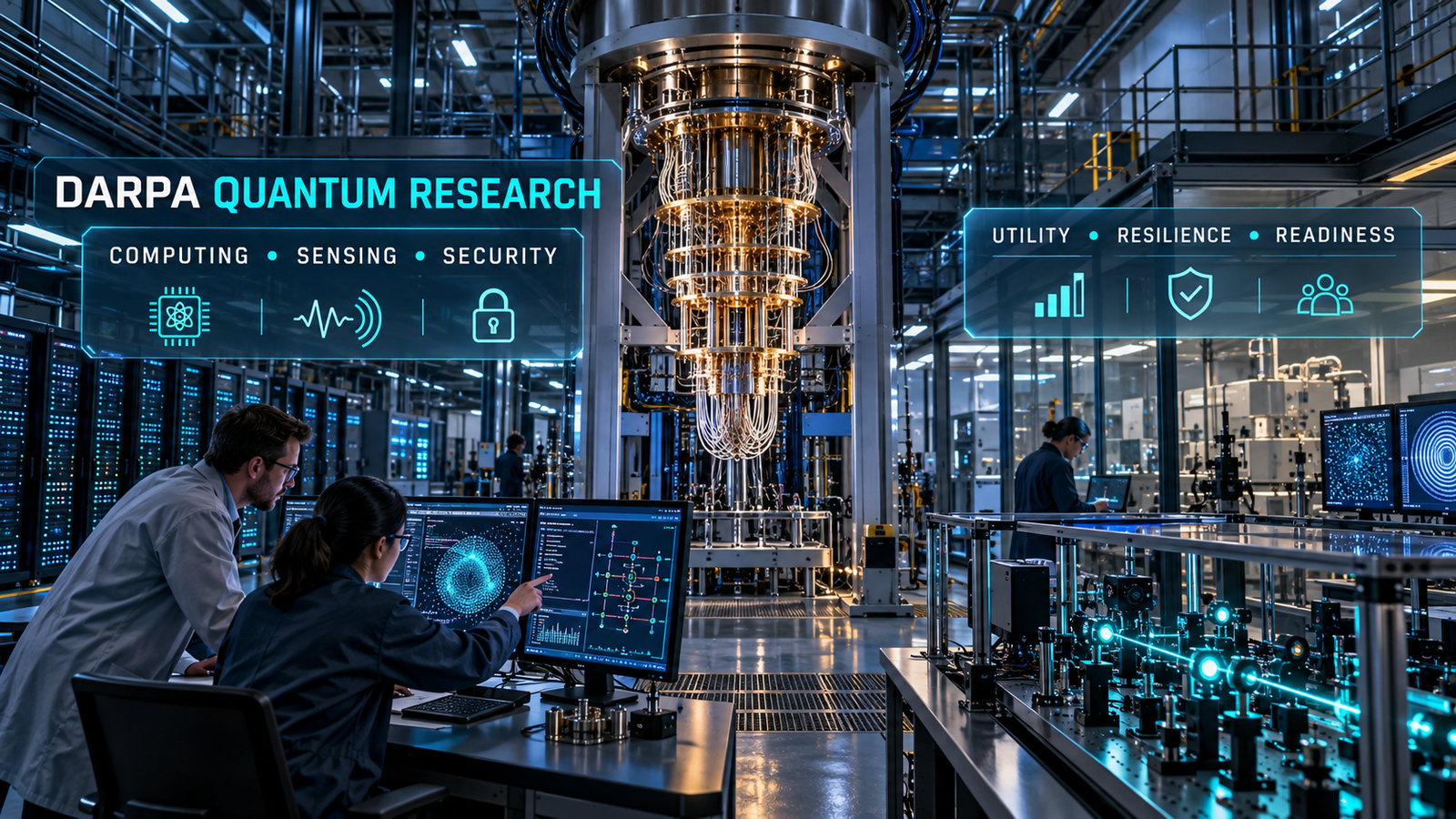
DARPA quantum research matters because it tests claims that private buyers cannot validate cheaply on their own. Its programs probe whether fault-tolerant computers, deployable sensors, and new radio-frequency receivers can deliver measurable operational value—not merely impressive laboratory results.
The agency’s current portfolio also offers a useful discipline for executives. The Quantum Benchmarking Initiative asks whether an industrially useful quantum computer can be built by 2033 and defines utility in economic terms: computational value must exceed cost.[1]
That test is harder than counting physical qubits. A useful system must combine logical qubits, error correction, control electronics, classical compute, software, facilities, skilled operators, and acceptable wall-clock time.
For buyers, the practical message is restrained. DARPA quantum research is not proof that a general-purpose quantum computer is ready for enterprise production, and most organizations should not buy hardware.
They should build measurement capability, identify workloads with defensible value, run low-cost experiments, and begin post-quantum cryptography migration. Quantum sensing may reach specific field applications sooner, but its value depends on calibration, environmental rejection, size, power, and integration—not sensitivity alone.
This article separates verified programs from forecasts. It maps the engineering stack, provides an integration flow, compares commercial access routes, proposes a performance matrix, and turns the evidence into procurement gates and ROI controls.
I. The Current Market Landscape and Strategic Challenge
DARPA’s Role Is Technical De-Risking, Not Product Endorsement
DARPA funds high-risk research where a credible breakthrough could change national capability. DARPA quantum research does not certify that a vendor’s roadmap will ship on time, guarantee commercial advantage, or replace a buyer’s technical due diligence.
That distinction is central to DARPA quantum research. Quantum demonstrations can be scientifically important while remaining uneconomic once error correction, cryogenics, calibration, queue time, data movement, and staffing are included.
Commercial messaging around DARPA quantum research often compresses those layers into one number. Physical-qubit counts, raw coherence times, or a selected benchmark may describe part of a machine while saying little about end-to-end business value.
The stronger question is: what useful problem can the complete system solve, to a required accuracy, within a defined time and total cost? That framing aligns with the Quantum Benchmarking Initiative and discourages procurement by headline.
The Cost of Inaction—and the Cost of Moving Too Early
Doing nothing while DARPA quantum research advances carries a real security cost. Long-lived encrypted data may be exposed to “harvest now, decrypt later” collection, while large organizations can need years to inventory cryptography, replace dependencies, and coordinate vendors.
NIST finalized its first three post-quantum cryptography standards in 2024 and advises organizations to begin migration.[2] The security workstream is therefore an operational program now, not a bet on the exact arrival date of a cryptographically relevant quantum computer.
Premature investment inspired by DARPA quantum research has a different cost. A company can spend heavily on proof-of-concept projects that compare an optimized classical baseline with an immature quantum implementation, then mistake technical activity for advantage.
The correct portfolio has two clocks. Post-quantum cryptography receives near-term funding because migration lead time is long; quantum-computing pilots remain gated by benchmark evidence, reproducibility, and economics.
What Decision-Makers Should Watch
DARPA quantum research creates signals, not purchase orders. Executives should watch independent verification milestones, resource estimates for fault-tolerant algorithms, field performance of sensors, and the gap between laboratory and operational conditions.
They should also monitor whether a claimed result survives four tests:
- The task represents a valuable workload rather than a synthetic puzzle.
- The comparison uses a strong, current classical baseline.
- Accuracy, latency, energy, labor, and infrastructure are counted.
- Independent teams can reproduce or audit the result.
If one test fails, the result may still be good science. It is not yet a bankable business case.
Quantum Computing: The Powerful, Practical Enterprise Guide
II. What DARPA Quantum Research Is Actually Doing
Quantum Benchmarking Initiative: Testing the 2033 Utility Claim
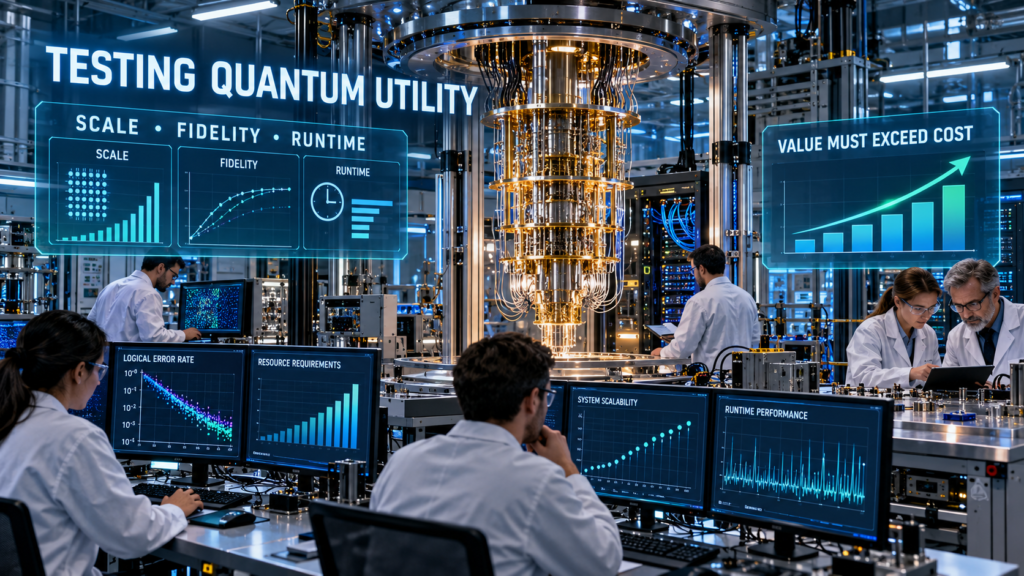
The Quantum Benchmarking Initiative is the clearest expression of current DARPA quantum research in computing. It evaluates whether any approach can produce a utility-scale quantum computer by 2033, using staged technical review rather than accepting roadmaps at face value.[1]
DARPA quantum research defines utility-scale quantum computing as a system whose computational value exceeds its cost. That definition forces teams to address the full machine, including error correction, control, operations, and facilities.
What the Evaluation Must Resolve
The central unknown is not whether quantum mechanics works. It is whether a manufacturable architecture can execute commercially or strategically valuable workloads with sufficient logical fidelity and at acceptable scale.
Reviewers therefore need evidence on logical error rates, code overhead, component yield, interconnect performance, decoding latency, thermal load, and maintenance. A plausible architecture must also show how millions of physical components—if required—can be fabricated, controlled, and serviced.
The initiative grew from earlier DARPA quantum research. Underexplored Systems for Utility-Scale Quantum Computing used independent verification and validation to assess unconventional approaches, while Quantum Benchmarking developed application benchmarks and hardware resource estimates.[3][4]
Together, those programs join two questions that vendors sometimes separate: “Can the hardware scale?” and “Would the scaled machine do enough valuable work to justify itself?”
Quantum Benchmarking: From Algorithm Claims to Resource Bills
In DARPA quantum research, an algorithm’s asymptotic speedup is not a deployment plan. Quantum Benchmarking converts proposed applications into estimates of logical qubits, gate counts, circuit depth, error-correction demands, and runtime.[4]
That conversion exposes hidden cost. A circuit that looks compact at the logical level may require expensive magic-state production, routing, repeated error correction, and large physical-qubit overhead.
Peer-reviewed and preprint studies supporting DARPA quantum research regularly place challenging fault-tolerant workloads in regimes requiring very large machines, with estimates sensitive to hardware error rates and architecture.[5][6] These are scenarios, not forecasts, but they demonstrate why physical-qubit totals cannot stand alone.
For enterprise teams, the method is reusable. Start with the business workload, define the decision-quality threshold, calculate end-to-end resources, and compare the result with the best classical method under identical acceptance criteria.
SAVaNT: Atomic Vapors as Practical Sensor Components
The Science of Atomic Vapors for New Technologies extends DARPA quantum research into room-temperature atomic vapors for electric-field sensing, imaging, magnetic sensing, and quantum-information applications.[7] Its goal is not a magical detector; it is controllable atom-light interaction in a package engineers can use.
Room-temperature operation can avoid some cryogenic burden, but it does not eliminate systems engineering. Vapor-cell uniformity, laser stability, magnetic shielding, readout noise, calibration drift, packaging, and manufacturing repeatability still decide field performance.
This branch of DARPA quantum research matters commercially because sensors can create value without a fault-tolerant computer. Potential markets include navigation aids, spectrum awareness, diagnostics, geophysics, and industrial inspection, subject to application-specific validation.
RoQS: Rejecting the Real World
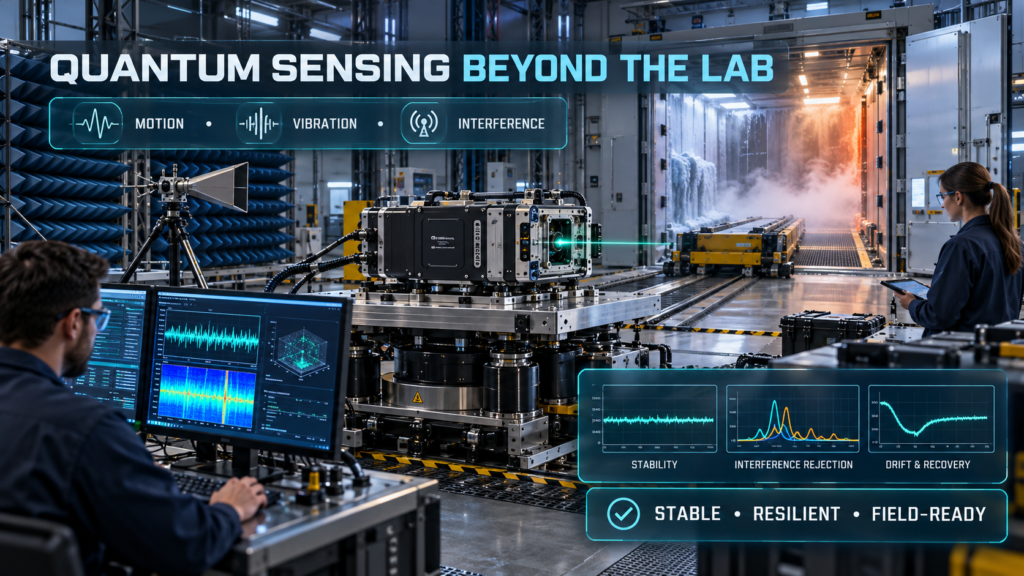
Robust Quantum Sensors extends DARPA quantum research to devices that must maintain performance while moving and while exposed to electromagnetic and environmental interference.[8] Those requirements attack the laboratory-to-field gap directly.
A sensor may show extraordinary sensitivity on an optical table yet fail near motors, vehicles, radios, temperature gradients, or vibration. Field usefulness depends on rejecting common-mode interference, recovering from disturbances, and producing traceable measurements over time.
RoQS therefore highlights a broader rule: report sensitivity together with dynamic range, bandwidth, false-alarm behavior, recalibration time, size, weight, power, and cost. Procurement based on a single sensitivity figure invites failure.
Quantum Apertures, QuASAR, and Perrseus
Quantum Apertures takes DARPA quantum research into quantum-enabled radio-frequency receivers with potential gains in sensitivity and frequency agility.[9] QuASAR has pursued quantum-assisted sensing and readout concepts, while Perrseus targets manufacturable micro-ultra-high-vacuum systems for cold-atom sensors.[10][11]
These programs address different bottlenecks. Receiver concepts must prove usable bandwidth and interference tolerance; quantum-assisted readout must outperform conventional chains; vacuum packages must survive manufacturing, sealing, aging, and field conditions.
The shared theme is transition engineering. DARPA quantum research is valuable to industry when it turns a physics effect into specifications, test methods, and integration knowledge that suppliers can reproduce.
III. Architecture Overview: From Physics to Operational Value
The Quantum-Computing Technology Stack
A quantum processor is one layer in the larger cyber-physical systems examined by DARPA quantum research. An enterprise architecture review should map every layer and identify who owns its performance, security, and cost.
- Application layer: workload definition, economic value, accuracy target, and classical baseline.
- Algorithm layer: circuit design, decomposition, optimization, and error budget.
- Runtime layer: compilation, scheduling, calibration data, job orchestration, and result handling.
- Logical layer: error-correcting code, decoder, logical gates, and magic-state resources.
- Physical layer: qubits, readout, coupling, fabrication yield, and device lifetime.
- Control layer: lasers, microwave electronics, cryogenics, timing, and feedback.
- Facility layer: power, cooling, networking, shielding, maintenance, and physical security.
Weakness in one layer can erase gains elsewhere. A fast logical operation is not useful if decoding stalls the pipeline, calibration consumes availability, or the facility cost overwhelms the value of the result.
Integration Flowchart
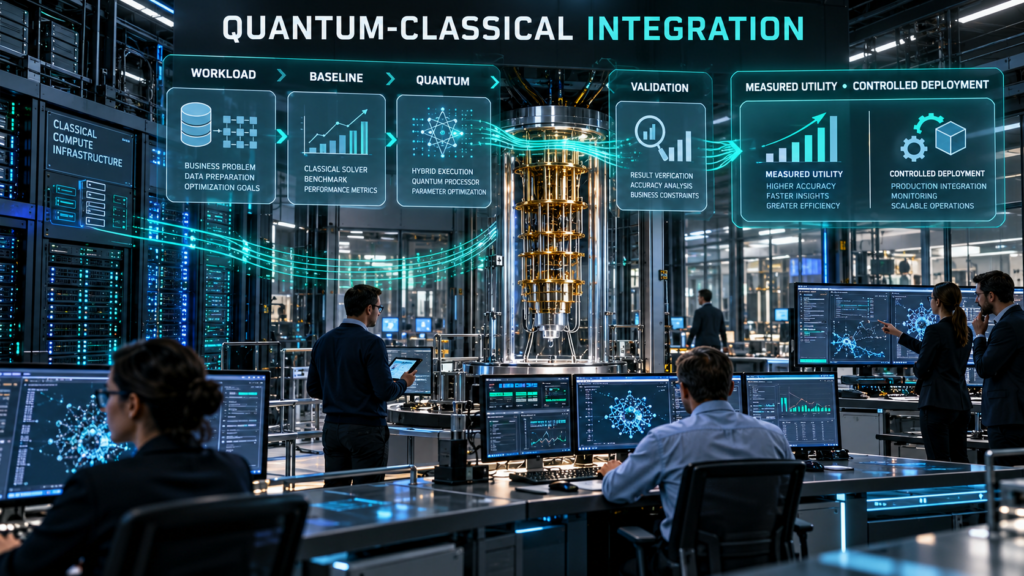
```mermaid
flowchart TD
    A[Business workload] --> B[Classical baseline]
    B --> C[Resource estimate]
    C --> D{Economic gate}
    D -->|Fail| E[Classical production]
    D -->|Pass| F[Quantum pilot]
    F --> G[Independent validation]
    G --> H{Utility proven?}
    H -->|No| C
    H -->|Yes| I[Controlled deployment]
```
The flow prevents a common error: starting with an available device and searching for a problem. A defensible project starts with a costly decision or computation, then checks whether quantum methods have a plausible route to improvement.
Quantum-Classical Integration
Most near-term DARPA quantum research workflows are hybrid. Classical systems prepare data, select parameters, submit jobs, analyze samples, and decide whether another quantum execution is worth the cost.
That design creates integration friction. Data-loading overhead can overwhelm theoretical gains; cloud queues can break latency assumptions; stochastic outputs require repeated shots; and provider-specific compilation can reduce portability.
DARPA quantum research reinforces the need for full-path measurement. Teams should capture queue time, compilation time, execution time, retries, post-processing, data transfer, engineer hours, and failed-job cost.
Quantum-Sensor Architecture
Quantum sensing technology in DARPA quantum research has a different stack: sensing medium, state preparation, interrogation, readout, signal processing, calibration, environmental isolation, and host-platform integration. Each layer contributes uncertainty.
A field unit also needs trusted timing, secure firmware, power conditioning, telemetry, maintainability, and a reference against which drift can be detected. The quantum element may be the differentiator, but the surrounding engineering determines uptime.
Deployment Challenges That Kill Otherwise Good Pilots
The first commercialization failure mode for DARPA quantum research is an unfair baseline. If a pilot compares new hardware with an old classical algorithm or excludes classical tuning time, the result cannot support investment.
The second is metric substitution. Fidelity, qubits, or sensor sensitivity becomes a proxy for customer value even though no causal link has been measured.
The third is operational omission. Staffing, service contracts, cloud egress, cryogenic maintenance, calibration windows, supply-chain concentration, and security review disappear from the prototype budget.
The fourth is lock-in. Code may depend on one compiler, pulse interface, annealing formulation, or provider-specific credit system, making comparative testing expensive.
The fifth is governance debt. Sensitive workloads, export-controlled information, intellectual property, and regulated data may be submitted to external infrastructure before legal and security teams define boundaries.
IV. Performance Evaluation Matrix and Evidence Standards
Performance Evaluation Matrix
| Evaluation dimension | Quantum computing measure | Quantum sensor measure | Procurement evidence |
|---|---|---|---|
| Useful output | Decision-quality accuracy on target workload | Detection/estimation accuracy in mission conditions | Blind test set and acceptance threshold |
| Reliability | Logical error rate, failed-job rate, reproducibility | Drift, false alarms, missed detections | Repeated trials across days and operators |
| Time | Queue-to-result and total wall-clock time | Response time and recalibration time | Timestamped end-to-end logs |
| Scale | Logical qubits, circuit depth, decoder throughput | Coverage, bandwidth, dynamic range | Scaling model validated at multiple sizes |
| Cost | Cost per accepted result | Cost per trusted measurement-hour | Fully loaded cost model |
| Availability | Scheduled access, calibration downtime | Uptime and recovery after disturbance | Service records and SLA terms |
| Integration | API stability, portability, data overhead | Power, telemetry, mounting, host interface | Reference architecture and test report |
| Security | Identity, encryption, tenant isolation, logs | Firmware integrity, secure update, tamper evidence | Control mapping and penetration results |
| Field readiness | Facility burden and operator skill | Size, weight, power, temperature, vibration | Environmental qualification report |
No single score should collapse DARPA quantum research dimensions too early. A weighted decision model is useful only after executives approve the weights and technical teams show the raw evidence.
A Minimal Utility Equation
Annual net operating benefit = additional contribution margin + avoidable annual costs + supported reduction in expected annual losses − incremental annual operating costs.
Express every term in the same currency and annual reporting period. Use additional contribution margin rather than gross revenue, and avoid counting the same saving or risk reduction twice. Record upfront platform acquisition and integration costs separately. Evaluate the complete investment using a cash-flow model that includes implementation timing, deployment probability and recurring costs.
The DARPA quantum research model must use ranges, not a single optimistic estimate. If net value becomes negative under a modest change in utilization, accuracy, or staffing, the case is too fragile for production.
Evidence Grades
For DARPA quantum research, Grade A evidence is independently reproduced on a representative workload with complete cost and operational data. Grade B is a transparent third-party evaluation with some environmental or scale limitations.
Grade C is a vendor-controlled demonstration with disclosed methods. Grade D is a roadmap, simulation, press statement, or result without enough detail to reproduce.
Most long-range claims about utility-scale quantum computing remain below Grade A. That is not a criticism of research; it is a warning against financing forecasts as though they were deployed results.
V. Commercial Solutions and Best Practices
Feature and Cost Comparison Table
| Platform | Best fit | Access and features | Cost model | Main limitation |
|---|---|---|---|---|
| IBM Quantum Platform | Gate-model development aligned with Qiskit | IBM systems, runtime services, composer, learning resources | Open plan with limited free QPU time; pay-as-you-go and contracted access[12] | Single-vendor hardware ecosystem and usage-dependent spend |
| Amazon Braket | Multi-provider experiments inside AWS | Gate, annealing, and analog devices; simulators; hybrid jobs | Per task and per shot, or hourly reservation; related cloud charges may apply[13] | Cross-device comparisons still require careful normalization |
| Azure Quantum | Organizations standardized on Microsoft cloud | Multiple provider targets, workspace controls, Q#, and partner tools | Provider-controlled pricing and credit units; rates vary by offer and region[14] | Billing units and hardware availability differ by provider |
| D-Wave Leap | Optimization experiments suited to annealing or hybrid solvers | Annealing systems, hybrid solvers, Ocean SDK, cloud access | Developer access plus enterprise arrangements; confirm current quote[15] | Not a drop-in substitute for universal gate-model computing |
This DARPA quantum research comparison is not a ranking. The cheapest useful experiment is the one that answers a defined technical question with controlled spend.
Prices and device rosters change. A buyer should verify the live console or contract, cap usage, and record the device, compiler, software version, and calibration state for every material result.
Procurement Framework
Gate 1: Workload Qualification
Choose DARPA quantum research workloads with high value, measurable outputs, and expensive classical bottlenecks. Reject projects whose only justification is executive interest or a vendor demonstration.
Gate 2: Baseline Discipline
Assign an independent classical team. Give it a fair optimization budget and document hardware, software, energy assumptions, accuracy, and engineer time.
Gate 3: Portable Experiment Design
Use intermediate representations, containerized classical components, versioned datasets, and provider-neutral metrics where possible. Portability creates negotiating leverage and makes failures informative.
Gate 4: Spend and Data Controls
Set per-project limits, role-based access, logging, approved datasets, and deletion rules. Cloud quantum access is still cloud computing and belongs inside normal security governance.
Gate 5: Independent Review
Require someone outside the project team to reproduce the comparison and inspect exclusions. A pilot should not graduate because its sponsor also designed the success criteria.
VI. Business Outcomes and Strategic ROI
Where Value Could Appear
The most credible DARPA quantum research opportunities involve chemistry, materials, optimization, and selected numerical problems, but “could” is doing important work. Each use case needs an explicit pathway from computed output to cash flow, resilience, or mission performance.
A chemistry result creates business value only if it improves a decision that survives laboratory validation, manufacturability, regulation, and market demand. A faster optimizer matters only if its solution quality and runtime beat the deployed alternative after data preparation and integration.
DARPA quantum research can lower uncertainty by publishing evaluation methods, surfacing engineering bottlenecks, and forcing architectures through review. It cannot supply a company’s product-market fit.
Near-Term Outcomes That Do Not Require Quantum Advantage
Organizations can capture useful outcomes from DARPA quantum research before a quantum computer wins a production benchmark. They can improve cryptographic inventory, strengthen workload measurement, train technical reviewers, and create vendor-neutral experiment harnesses.
Quantum-inspired classical methods may also improve an optimization pipeline. Credit the actual method used; do not label a classical improvement as quantum value merely because the project began in a quantum program.
Sensor pilots may produce earlier operational learning. Even when a quantum sensor fails its final threshold, the project can reveal environmental noise, calibration requirements, and integration costs that improve future procurement.
ROI Scenario Model
Consider an illustrative workflow costing $4 million annually. A verified 25% reduction would represent $1 million in gross annual savings after successful deployment, before incremental operating costs. That potential saving does not by itself justify a $1 million upfront investment.
If the assumed probability of successful deployment is 30%, the probability-weighted gross annual saving would be $300,000 once deployment is possible, assuming the unsuccessful outcome produces no savings. This is a scenario calculation, not a forecast. Model the timing of benefits, pilot expenditure, implementation costs, recurring charges and success and failure outcomes separately before estimating expected investment value.
The same discipline applies to risk reduction. If a sensor can reduce unplanned downtime, multiply the avoided loss by demonstrated detection improvement and deployment reliability—not the best laboratory sensitivity.
Portfolio Allocation
A sensible DARPA quantum research program separates mandatory, exploratory, and contingent spending. Mandatory funding covers post-quantum cryptography discovery and migration planning.
Exploratory funding covers small, time-boxed computing and sensing experiments. Contingent funding is released only after evidence gates are met.
This approach keeps strategic options open without treating DARPA quantum research as a market-timing signal. It also gives finance leaders a transparent way to stop projects that do not improve evidence.
VII. Cybersecurity and Transition Planning
Post-Quantum Cryptography Is Not Quantum Computing Procurement
Post-quantum cryptography uses classical algorithms designed to resist attacks by both classical and quantum computers.
NIST’s finalized FIPS 203, FIPS 204, and FIPS 205 cover a key-encapsulation mechanism and digital-signature schemes.[2] Organizations should follow applicable government and sector guidance, test interoperability, and avoid inventing proprietary replacements.
A Practical Migration Sequence
- Build a cryptographic inventory covering applications, libraries, certificates, protocols, hardware, data retention, and third parties.
- Classify data by sensitivity and required confidentiality lifetime.
- Identify hard-coded algorithms, long-lived devices, unsupported software, and contractual dependencies.
- Require cryptographic agility in new purchases and renewals.
- Test standardized post-quantum algorithms in representative systems.
- Plan phased migration, rollback, monitoring, and incident response.
The inventory is usually the hard part. Cryptography is buried in identity platforms, VPNs, firmware, code signing, backups, industrial devices, and vendor services.
Do Not Conflate PQC, QKD, and Quantum Networks
PQC is standardized software-oriented cryptography. Quantum key distribution uses quantum states and specialized links to establish keys, while quantum networking research aims at more general quantum-state distribution.
These approaches have different threat models, infrastructure needs, and failure modes. QKD does not secure endpoints, fix identity failures, or eliminate implementation vulnerabilities.
DARPA quantum research in communications or networking should therefore be evaluated as a system. Fiber or free-space links, trusted nodes, authentication, key management, availability, distance, and denial-of-service exposure all matter.
VIII. Risk Mitigation and Regulatory Framework
Quantum projects can involve export controls, sensitive research, cloud security, privacy, safety, procurement rules and sector-specific obligations. Define the applicable requirements, accountable owners and approval gates before submitting sensitive workloads or moving a pilot into production.
Governance Checklist
- Name an accountable executive and an independent technical reviewer.
- Define the workload, accuracy threshold, classical baseline, and stop conditions.
- Classify data before using external quantum or simulator services.
- Map identity, encryption, logging, retention, and incident-response controls.
- Verify contractual rights to results, telemetry, models, and intellectual property.
- Screen applicable export-control and research-security obligations with counsel.
- Record hardware, software, calibration, compiler, and dataset versions.
- Require reproducibility and disclose negative results internally.
- Include full cost, environmental burden, and specialist labor in ROI.
- Maintain vendor exit and workload-portability plans.
- Track NIST post-quantum cryptography migration dependencies.
- Reassess claims after material hardware or benchmark changes.
NIST, EU AI Act, and Sector Rules
NIST post-quantum standards and the NIST Cybersecurity Framework are directly relevant to cryptographic migration and program controls. They do not certify a quantum platform or prove quantum advantage.
The EU AI Act is not a general quantum-computing law. It may become relevant when a quantum-enabled product includes an AI system within the Act’s scope, so teams should assess the deployed function rather than attach an AI label to every quantum project.
Healthcare, finance, critical infrastructure, and government environments add sector obligations. Buyers must map the actual data, decision, location, and operator to applicable rules instead of copying a generic compliance checklist.
Principal Failure Vectors
DARPA quantum research can fail technically through insufficient logical fidelity, unstable calibration, decoder bottlenecks, sensor drift, interference, and poor manufacturing yield. Economic failure includes low utilization, unpredictable cloud spend, integration labor, and benefits that disappear against a better classical baseline.
Governance failure includes leaking sensitive workloads, accepting non-reproducible claims, locking into opaque metrics, or using research results as unqualified marketing. Supply-chain failure includes single-source components, long replacement times, and specialist scarcity.
Each risk needs an owner, trigger, response, and residual-risk decision. A colorful risk register without those four fields is documentation, not control.
IX. Planning a Quantum Technology Evaluation

Begin with an evidence review of the quantum technologies relevant to your organization. A 90-day window can structure initial investigation, but larger cryptographic inventories and technical evaluations may require longer. Select a priority security-migration task, a measurable computing workload and, where operationally relevant, a sensing use case.
For security, complete a cryptographic inventory and prioritize systems by confidentiality lifetime and replacement difficulty. For computing, establish a strong classical baseline and produce a resource estimate before purchasing extensive QPU time.
For sensing, test in the intended environment and measure drift, interference, recovery, maintenance, and total ownership cost. Make continuation funding conditional on predefined thresholds.
DARPA quantum research should inform the questions your organization asks: Is the workload valuable, is the comparison fair, is the system scalable, and does utility exceed cost? If the evidence cannot answer those questions, the correct decision is to keep learning without pretending deployment is ready.
Frequently Asked Questions
What is the Quantum Benchmarking Initiative trying to prove?
It is testing whether any approach can produce an industrially useful quantum computer by 2033, with value greater than cost. It evaluates technical roadmaps through staged review rather than assuming vendor projections are correct.[1]
Has DARPA proved quantum advantage for ordinary businesses?
No. DARPA quantum research has created programs, benchmarks, component advances, and rigorous evaluations, but that is not equivalent to a repeatable economic advantage for a typical enterprise workload.
Should a business buy a quantum computer now?
Usually not. Most organizations gain more from cloud experiments, classical benchmarking, cryptographic migration, and skills development than from owning specialized hardware.
Which area may deliver value first?
The answer depends on the use case. Post-quantum cryptography migration delivers risk reduction now, while quantum sensing technology may reach narrow operational niches before fault-tolerant general-purpose computing.
How should vendor claims be assessed?
Require a representative workload, strong classical comparison, total wall-clock time, full cost, repeatability, and versioned technical records. Treat simulations, roadmaps, and press releases as lower-grade evidence.
Appendix A: Sources and Research Integrity Index
- DARPA, Quantum Benchmarking Initiative. Program objective and utility-scale evaluation.
- NIST, NIST Releases First 3 Finalized Post-Quantum Encryption Standards, 13 August 2024.
- DARPA, “Underexplored Systems for Utility-Scale Quantum Computing,” program overview and independent verification approach.
- DARPA, “Quantum Benchmarking,” program overview covering application benchmarks and hardware resource estimation.
- Beverland et al., “Assessing Requirements to Scale to Practical Quantum Advantage,” arXiv:2211.07629 and related resource-estimation literature.
- Recent industry-relevant fault-tolerant resource analyses, including arXiv:2408.02587 and arXiv:2411.10406; estimates are scenario-dependent and not delivery forecasts.
- DARPA, “Science of Atomic Vapors for New Technologies,” official program description.
- DARPA, Robust Quantum Sensors (RoQS). Program objectives and operational sensing constraints.
- DARPA, “Quantum Apertures,” official program description.
- DARPA, Quantum-Assisted Sensing and Readout (QuASAR).
- DARPA, “Perrseus,” official program description for manufacturable micro-ultra-high-vacuum systems.
- IBM Quantum Documentation, “Plans overview” and cost-management guidance; accessed September 2026.
- Amazon Web Services, “Amazon Braket Pricing” and Developer Guide; accessed September 2026.
- Microsoft Learn, “Pricing Plans for Azure Quantum Providers”; accessed September 2026.
- D-Wave, “Leap Quantum Cloud Service”; accessed September 2026.
Appendix B: Editorial Transparency and AI Usage Disclosure
AI-assisted tools were used to support research organization, drafting, and language refinement. NezzHub retains editorial responsibility for the published article. Vendor inclusion does not constitute endorsement.
Pricing, device availability, service terms, and regional access can change. Readers should confirm current details with the relevant provider before purchasing services.
Author and Editorial Review
Author: Garikapati Bullivenkaiah
Technology research writer with LL.B., LL.M., M.A., and MBA qualifications. He writes about emerging technologies and their business, governance and legal implications. His multidisciplinary academic background informs his analysis of technology adoption, intellectual property, and organizational risk. His articles explain technical concepts and practical considerations for business owners, IT managers and technology decision-makers. LinkedIn Profile
Reviewed by: Chitikineni Ramadevi — Editor
Chitikineni Ramadevi holds an M.Sc. in Computers from Andhra University and has over 10 years of research experience in technology-related subjects. She reviews NezzHub articles for clarity, factual accuracy, source support and practical relevance.
Published by: NezzHub
Research approach: This article draws on primary sources, technical documentation and relevant industry research. References are provided within the article or its sources section.
Last reviewed: 09-27-2026
Corrections: To report a factual error or outdated information, please contact NezzHub.

Garikapati Bullivenkaiah is a seasoned entrepreneur with a rich multidisciplinary academic foundation—including LL.B., LL.M., M.A., and M.B.A. degrees—that uniquely blend legal insight, managerial acumen, and sociocultural understanding. Driven by vision and integrity, he leads his own enterprise with a strategic mindset informed by rigorous legal training and advanced business education. His strong analytical skills, honed through legal and management disciplines, empower him to navigate complex challenges, mitigate risks, and foster growth in diverse sectors. Committed to delivering value, Garikapati’s entrepreneurial journey is characterized by innovative approaches, ethical leadership, and the ability to convert cross-domain knowledge into practical, client-focused solutions.