
















Executive Summary
Sentiment analysis in NLP turns customer comments, reviews, tickets, transcripts, and survey responses into structured signals that an organization can route, aggregate, and audit. The commercial challenge is not assigning a positive or negative label; it is producing a dependable signal across products, languages, channels, and changing vocabulary without exposing personal data or automating a harmful decision.
The best production systems separate ingestion, privacy filtering, language detection, aspect extraction, classification, calibration, human review, storage, and business action. That separation lets an IT team replace a model, adjust a threshold, or stop an automated workflow without rebuilding the entire NLP text analytics platform.
This article gives decision-makers an implementation framework rather than a dictionary definition. It covers architecture, integration flow, evaluation, cloud-vendor cost mechanics, deployment friction, governance, and a defensible return-on-investment model.
The central buying rule is simple: select the least complex system that meets the documented business threshold. A low-cost sentiment analysis API may be enough for weekly trend reporting, while regulated or high-impact workflows need domain validation, traceability, access controls, and human review.
I. The Current Market Challenge: Turning Opinion Into an Operational Signal
Organizations already possess the raw material for customer feedback analytics and sentiment analysis in NLP. It sits in call transcripts, CRM notes, app reviews, chat sessions, product surveys, complaint emails, and social posts.
The problem for sentiment analysis in NLP is fragmentation. Different channels use different identifiers, retention rules, languages, rating scales, and sampling methods, so a single dashboard can create false precision from incomparable inputs.
Sentiment analysis in NLP adds value only when the output connects to a defined decision. Useful examples include routing an angry support message, finding a sudden product-quality issue, comparing delivery complaints by carrier, or measuring whether a service fix changed a specific aspect score.
Why Simple Polarity Scores Fail
A document-level label collapses multiple opinions. “The camera is excellent, but the battery and returns process are awful” is not one coherent sentiment; it contains positive product sentiment and negative operational sentiment.
Negation, scope, slang, quotation, irony, emoji, and domain vocabulary also alter meaning. Removing punctuation or stop words indiscriminately can destroy the difference between “good,” “not good,” and “not only good—it is excellent.”
Sentiment analysis in NLP therefore needs an explicit unit of analysis. Teams must decide whether the model scores a document, sentence, utterance, entity, product feature, conversation turn, or time window.
The Cost of Inaction
Manual reading does not scale predictably, but sentiment analysis in NLP without validation can be worse. A missed complaint creates service risk; a false escalation consumes agent time; a biased employee-survey model can create employment and privacy exposure.
The cost of inaction should be calculated from existing operational data, not vendor promises. Measure analyst hours spent coding comments, average delay to detect a recurring issue, ticket-reopen rates, escalation volumes, and revenue or retention associated with affected accounts.
A credible business case for sentiment analysis in NLP links one model output to one controllable workflow. “Improve customer experience” is not a measurable objective; “reduce median time to detect a recurring delivery complaint from seven days to one day” is.
Decision-Grade Use-Case Test
Approve a sentiment analysis in NLP use case only if its owner can state the input, decision, action, error cost, review path, and success metric. If any one of those is missing, keep the work in discovery.
| Question | Minimum acceptable answer |
|---|---|
| What enters the system? | Named channels, fields, languages, expected volume, and retention period |
| What leaves the system? | Label, aspect, confidence, model version, and timestamp |
| Who acts on it? | Named business team and escalation owner |
| What error is expensive? | False positive, false negative, or both, with estimated cost |
| How is it checked? | Labeled holdout set, drift sample, and human-review procedure |
| When is automation stopped? | Threshold breach, incident, schema failure, or model rollback trigger |
How NLP Helps Machines Understand Human Language
II. Deep-Dive Technical Analysis and Evidence
Architecture Overview for Sentiment Analysis in NLP

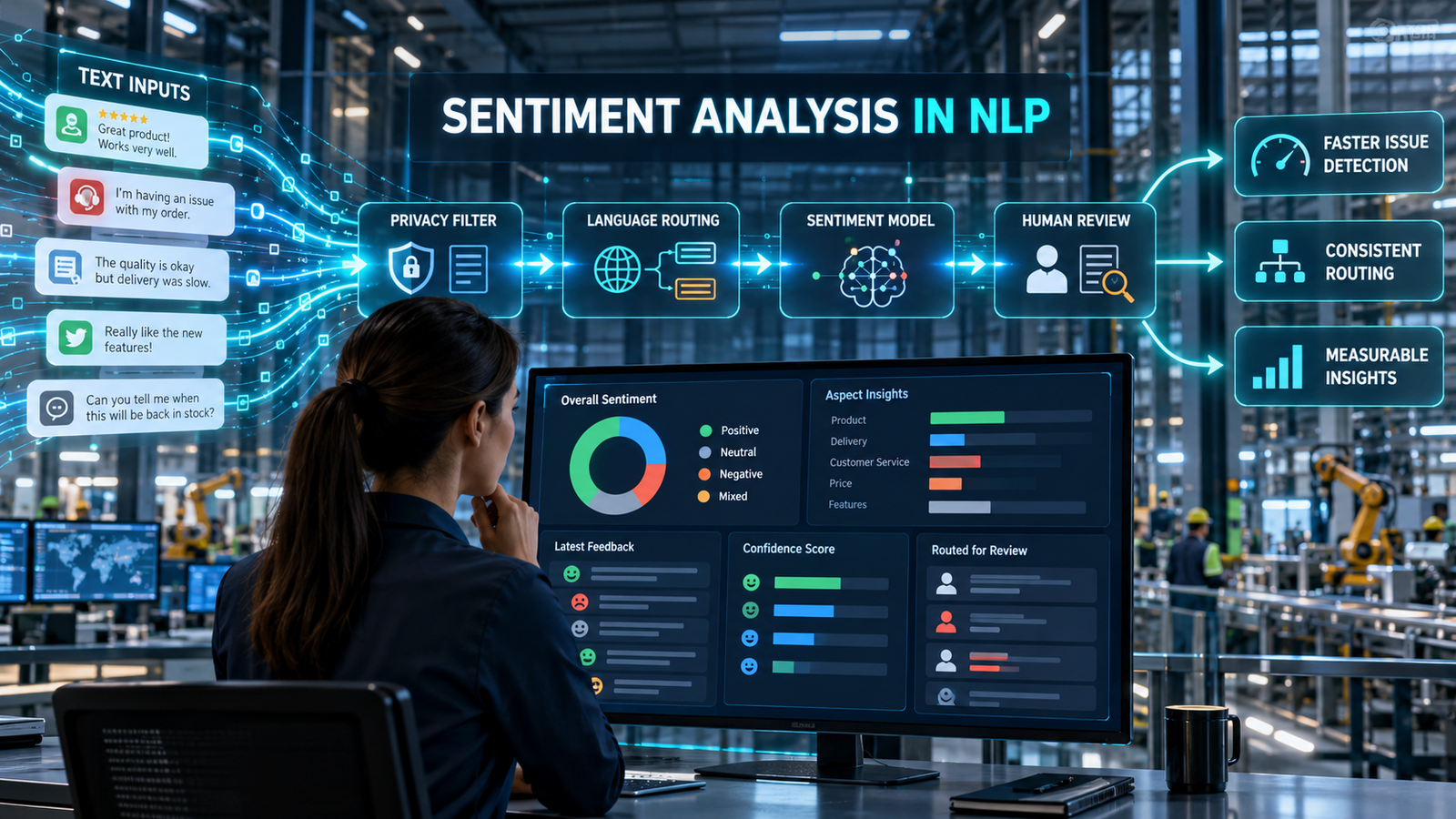
Production architecture for sentiment analysis in NLP should keep raw text away from downstream users wherever possible. Privacy filtering and access policy belong before durable feature storage, not as cleanup after analysts have copied sensitive text into notebooks.
The following layers form a practical reference design:
- Source connectors: CRM, ticketing, survey, review, transcript, and approved social-data interfaces.
- Ingestion contract: schema validation, source timestamp, tenant, consent or lawful-use marker, and immutable event ID.
- Privacy gateway: data minimization, PII detection, redaction or tokenization, encryption, and retention tagging.
- Language router: language and locale detection, code-switch handling, and unsupported-language quarantine.
- Inference service: rules, classical classifier, transformer, or managed sentiment analysis API behind a versioned endpoint.
- Aspect layer: entity resolution plus product, service, or journey taxonomy mapping.
- Decision policy: confidence threshold, abstention rule, routing logic, and human-review queue.
- Observability: latency, throughput, class balance, calibration, drift, subgroup results, and error samples.
- Analytics store: aggregated outputs with lineage, model version, and role-based access.
Sentiment analysis in NLP should return more than a label. A decision-grade record includes class probabilities, calibrated confidence, aspect or entity, language, source, model version, preprocessing version, and review status.
Integration Flowchart
flowchart TD
    A[Approved text sources] --> B[Schema and privacy gateway]
    B --> C[Language and aspect routing]
    C --> D[Versioned sentiment model]
    D --> E{Confidence and policy gate}
    E -->|High confidence, low impact| F[Aggregate or route]
    E -->|Low confidence or high impact| G[Human review]
    F --> H[BI, CRM, and alerts]
    G --> H
    H --> I[Outcome and drift monitoring]
    I --> C
The feedback arrow supports investigation and controlled improvement. Monitoring results must not automatically change production routing, thresholds or model versions. Validate proposed changes and approve them through change control before release.
This sentiment analysis in NLP design prevents a score from becoming an action without policy. It also captures reviewer outcomes, which become valuable error-analysis data rather than disappearing in an email queue.
Model Choices and Their Trade-Offs
Lexicon systems for sentiment analysis in NLP are transparent and cheap. They work well for narrow vocabularies and real-time baselines, but struggle with word sense, negation scope, sarcasm, and product-specific language.
Classical supervised models such as logistic regression or support-vector machines can remain strong baselines when labels are limited and latency matters. Pang, Lee, and Vaithyanathan’s early machine-learning comparison established sentiment classification as empirically distinct from simple topic classification.[1]
Transformer encoders for sentiment analysis in NLP model surrounding context and can be fine-tuned with a task-specific output layer. BERT reported gains across multiple language-understanding benchmarks, but those benchmark results do not guarantee accuracy on a company’s support tickets.[2]
Large generative models can perform zero-shot or few-shot sentiment analysis in NLP, explain a label, and extract aspects in one request. Their variable outputs, token-based cost, latency, prompt sensitivity, and broader attack surface require a stricter evaluation and logging plan.
Sentiment analysis in NLP does not become trustworthy merely because the underlying model is large. A smaller domain-tuned classifier may be cheaper, faster, easier to calibrate, and easier to reproduce.
Architecture Selection Matrix
| Approach | Best fit | Main strength | Main limitation | Cost driver |
|---|---|---|---|---|
| Lexicon/rules | Stable vocabulary and explainable triage | Inspectable logic | Brittle context handling | Rule maintenance |
| Linear classifier | High-volume, narrow domain | Low latency and low inference cost | Needs labeled features and retraining | Labeling and MLOps |
| Fine-tuned transformer | Nuanced, domain-specific text | Strong contextual representation | Compute, calibration, and drift burden | Training plus serving |
| Managed API | Fast deployment and variable volume | Minimal infrastructure | Data residency, customization, and vendor lock-in | Records, characters, or analysis units |
| Generative model | Multi-task extraction and rapid prototyping | Flexible schema and reasoning | Non-determinism, token cost, and prompt risk | Input/output tokens and guardrails |
Aspect-Based Sentiment and Entity Resolution
Aspect-based sentiment analysis in NLP attaches sentiment to a target such as battery, onboarding, delivery, price, or support. The SemEval-2014 shared task formalized aspect term extraction and aspect-category polarity on restaurant and laptop data, illustrating why one document label is insufficient.[3]
Entity resolution must precede aggregation when names vary. “Pro Max,” “PM,” and a product code may refer to the same device, while “Apple” may name a company, product ecosystem, or fruit depending on context.
Sentiment analysis in NLP can also confuse quoted speech with the writer’s view. Conversation systems should preserve speaker, turn order, reply relationships, and channel metadata rather than concatenate an entire thread into one string.
Data Preparation Without Destroying Meaning
Removing stop words or punctuation indiscriminately can damage sentiment signals. Negation, question marks, repeated exclamation points, capitalization and emoji may affect interpretation, so preprocessing should be selected and tested for the specific model.
Keep preprocessing model-specific and versioned. Retain original text only where necessary and permitted by the approved purpose, access controls and retention policy. Record transformation settings and software versions so predictions can be investigated using appropriately retained evidence.
For multilingual sentiment analysis in NLP, do not assume translation preserves tone. Test original-language inference against translation-plus-inference, and report results separately by language and region.
Labeling Protocol
A useful sentiment analysis in NLP annotation guide defines target, polarity scale, mixed sentiment, factual statements, sarcasm, uncertainty, quoted speech, profanity, and when annotators should abstain. Double-label a statistically meaningful sample and adjudicate disagreements before training.
Agreement is not the same as model accuracy. Low inter-annotator agreement may reveal an ambiguous business concept that no classifier can solve reliably.
Performance Evaluation Matrix

Accuracy alone hides minority-class failure in sentiment analysis in NLP. A model that predicts “neutral” for nearly everything can look acceptable in a neutral-heavy dataset while missing the complaints the business cares about.
| Measure | What it answers | Recommended use | Failure signal |
|---|---|---|---|
| Precision by class | When the model flags a class, how often is it right? | Control false escalations | Negative precision falls below workflow threshold |
| Recall by class | How much of the class did the model find? | Control missed complaints | High-severity negative recall declines |
| Macro F1 | Are classes treated evenly? | Imbalanced multiclass comparison | Aggregate accuracy rises while macro F1 falls |
| Confusion matrix | Which labels are exchanged? | Error diagnosis | Mixed and neutral collapse into one class |
| Expected calibration error | Does confidence match observed correctness? | Threshold setting | “90% confidence” cases are correct far less often |
| Slice results | Does performance vary by language, channel, region, or product? | Fairness and robustness | A slice materially trails the approved baseline |
| Abstention rate | How often does the system decline to decide? | Human-capacity planning | Review queue exceeds staffing capacity |
| P95 latency | How slow are the longest normal requests? | Real-time routing | Service objective breach |
| Cost per 1,000 documents | What does production usage cost? | Vendor and architecture comparison | Cost rises with text length or retries |
No universal accuracy percentage qualifies sentiment analysis in NLP for production. Set thresholds from the business loss associated with each error and validate them on recent, representative, separately held-out data.
Evaluation Design That Survives Production
For sentiment analysis in NLP, split data by time, customer, or conversation rather than random sentence alone. Otherwise, near-duplicate phrases from one thread can leak into train and test sets and overstate generalization.
Create challenge sets for negation, mixed sentiment, sarcasm, code-switching, product aliases, new releases, and quoted text. Add a “cannot determine” option so the model and reviewer are not forced to invent certainty.
Sentiment analysis in NLP also needs outcome validation. If negative-ticket routing does not improve response time, resolution, or satisfaction, a higher offline F1 score may have no commercial value.
Deployment Challenges
Domain shift in sentiment analysis in NLP arrives when products, policies, or customer language change. Monitor input distributions, prediction distributions, reviewer overturns, unknown terms, and outcome deltas rather than relying on one generic drift score.
Class thresholds should be configurable by workflow. A dashboard can tolerate uncertainty, but an account-cancellation intervention or employee decision needs more evidence and human control.
Batch and online sentiment analysis in NLP paths often diverge. If the nightly warehouse job uses one preprocessing library while the live sentiment analysis API uses another, the same comment can receive different labels.
Vendor outages and rate limits need explicit fallbacks. Queue safely, degrade to a baseline model, or pause automation; silently dropping text creates an incomplete trend line that can mislead executives.
Security testing should include prompt injection when generative models are used, malformed Unicode, oversized payloads, HTML or script content, data exfiltration attempts, and poisoned feedback designed to shift retraining data.
III. Commercial Solutions and Best Practices
Feature and Cost Comparison Table

The sentiment analysis in NLP comparison below uses vendor documentation checked on September 26, 2026. Prices, regions, free allowances, minimum billable units, and feature names change, so procurement teams must rerun the cost model against the selected region and contract before purchase.
| Service | Sentiment output | Granularity/customization | Published charging basis | Commercial fit and constraint |
|---|---|---|---|---|
| Amazon Comprehend | Positive, negative, neutral, or mixed with confidence; targeted sentiment is available | Document-level plus targeted entity sentiment | Text units; AWS states one unit is 100 characters and publishes a 50,000-unit monthly free tier for eligible APIs for new customers[4] | Strong AWS integration; calculate cost from characters, not document count |
| Google Cloud Natural Language | Document and sentence score/magnitude; entity sentiment | Managed general model; entity sentiment is a separate feature | Unicode characters, with separate monthly prices and free allowances by feature[5] | Useful for Google Cloud workloads; score semantics differ from categorical APIs |
| Azure Language in Foundry Tools | Positive, neutral, negative plus opinion mining | Sentence and target/opinion assessment | Text records, where each 1,000-character block is billed as a record; 5,000 free records per month are listed[6] | Attractive Microsoft integration; long documents create multiple billable records |
| IBM Watson Natural Language Understanding | Sentiment and emotion among NLU features | Document/targeted features and custom options by plan | NLU items; IBM publishes tiered pay-as-you-go item pricing[7] | Broad NLU bundle; one request can consume several billable items |
This is a feature-and-cost framework, not an endorsement or affiliate ranking. A fair proof of concept sends the same labeled sample through each candidate, measures quality and latency, and calculates the bill from actual text-length distribution.
Build, Buy, or Combine
Buy a managed sentiment analysis API for sentiment analysis in NLP when speed, elastic scale, and low platform-operations effort matter more than deep customization. Confirm data residency, retention, subprocessor, encryption, private networking, and deletion terms before uploading customer text.
Build a domain model when vocabulary is specialized, errors are expensive, volume is stable enough to justify MLOps, or policy requires control over weights and hosting. Include labeling, retraining, monitoring, GPU or CPU capacity, incident response, and on-call ownership in total cost.
A hybrid architecture is often practical. Use enterprise sentiment analysis software for low-risk general traffic, then route sensitive domains, unsupported languages, and ambiguous records to a controlled model or human reviewer.
Procurement Scorecard
Weight sentiment analysis in NLP requirements before the demonstration. A polished dashboard should not outweigh performance on the organization’s own language, or the ability to export predictions with model and configuration versions.
| Category | Suggested weight | Evidence to request |
|---|---|---|
| Domain quality | 25% | Blind evaluation on a customer-owned holdout set |
| Privacy and security | 20% | Data-flow diagram, retention terms, encryption, access logs, certifications |
| Integration | 15% | API limits, SDKs, private connectivity, event and batch support |
| Governance | 15% | Version history, audit logs, model card, incident notification |
| Cost predictability | 15% | Unit definition, minimum billing, retries, long-text behavior, support fees |
| Operations | 10% | Availability target, latency, regional coverage, rollback and support process |
Best-Practice Deployment Framework
Start with a shadow deployment. Sentiment analysis in NLP can produce predictions without changing customer treatment while the team measures errors, capacity, and subgroup performance.
Promote one low-impact workflow after acceptance tests pass. Keep a kill switch, version pinning, rollback package, and documented owner before expanding automation.
Review error samples weekly during launch, then set a risk-based cadence. Random samples find ordinary degradation, while targeted samples reveal rare but costly failures.
Do not present aggregate sentiment as a survey of the population. Reviews and social posts are self-selected; changes in channel mix or campaign activity can move the score without any underlying change in customer opinion.
IV. Business Outcomes and Strategic ROI Takeaways
Translate Predictions Into Unit Economics
ROI for sentiment analysis in NLP should compare the current process with the new process over the same volume and time period. Separate one-time costs from recurring costs, then discount benefits that have not been observed in a controlled rollout.
Use this model:
First-year net benefit = verified first-year benefit − first-year operating cost − implementation cost.
First-year ROI percentage = first-year net benefit ÷ (implementation cost + first-year operating cost) × 100.
Use the same currency and reporting period throughout. Count each benefit and expense once. Report released labour capacity separately from realized cash savings, and label assumptions where benefits have not yet been observed.
Implementation cost includes discovery, data engineering, annotation, security review, integration, testing, training, and change management. Operating cost includes API or compute usage, storage, monitoring, human review, support, retraining, audits, and incident handling.
Sentiment analysis in NLP should not claim revenue attribution merely because sentiment and sales moved together. Use randomized rollout, matched cohorts, interrupted time-series analysis, or another defensible design where the commercial stakes justify it.
Example ROI Scenario With Explicit Assumptions
Assume a support organization receives 200,000 comments per month and manually codes a 10% sample: 20,000 comments. At 45 seconds per comment and a fully loaded labour rate of $40 per hour, this represents 250 hours and $10,000 of labour capacity per month, or $120,000 annually.
If machine triage covers all comments while human review falls to 5%, reviewers handle 10,000 comments per month. Assuming review still takes 45 seconds per comment, annual review labour capacity is valued at $60,000—a reduction of $60,000 from the baseline.
If validated thresholds later reduce human review to 6,000 comments per month, annual review labour capacity is valued at $36,000. This is a further reduction of $24,000 from the 5% review stage, or $84,000 from the original baseline. These are capacity values, not automatic cash savings, and must be assessed alongside platform, integration, monitoring and governance costs.
This example shows why vendor cost alone is a poor business case. The largest expense may be the human-review design, not the inference request.
Outcome Scorecard
Track business and sentiment analysis in NLP measures together:
- Median time from first complaint to verified issue alert.
- Resolution time and reopen rate for model-routed tickets.
- Reviewer overturn rate by class, language, product, and channel.
- Number of distinct issues found and confirmed.
- Cost per processed record and cost per confirmed actionable issue.
- Customer or operational outcome after intervention.
- Privacy incidents, access exceptions, and retention-policy breaches.
Sentiment analysis in NLP earns expansion when it improves an outcome without unacceptable error, privacy, security, or workload costs. A colorful trend chart alone is not a return.
V. Risk Mitigation and Regulatory Framework

NIST AI RMF 1.0 organizes voluntary AI risk work around Govern, Map, Measure, and Manage.[8] That structure fits sentiment analysis in NLP because it connects ownership and context to testing and treatment rather than treating model accuracy as the entire control program.
The EU AI Act uses risk-based obligations, and employment or worker-management uses can be high risk depending on intended purpose.[9] GDPR Article 22 also restricts certain solely automated decisions with legal or similarly significant effects.[10]
Sentiment analysis in NLP is therefore much safer as a prioritization or aggregate-insight tool than as an unreviewed basis for hiring, discipline, credit, insurance, healthcare, or access decisions. Legal classification depends on the exact deployment, data, jurisdiction, and effect, so counsel must assess the use case.
Compliance and Control Checklist
NIST AI RMF Alignment
- Govern: Name an accountable owner, approve policies, record third parties, and train users.
- Map: Document intended use, affected people, data sources, foreseeable misuse, and error costs.
- Measure: Test validity, calibration, robustness, privacy, security, explainability, and slices.
- Manage: Prioritize risks, set thresholds, monitor incidents, retain rollback capability, and reassess changes.
Privacy and Data Protection
- Establish purpose, lawful basis, notice, retention, deletion, and data-subject handling with counsel.
- Minimize raw text, redact sensitive fields, encrypt transit and storage, and restrict access.
- Complete a data-protection impact assessment when required.
- Prevent secondary use of employee or customer text beyond the approved purpose.
- Review cross-border transfers and vendor subprocessors.
EU AI Act and High-Impact Use
- Determine provider, deployer, importer, or distributor role and document intended purpose.
- Assess whether the system falls into a prohibited, high-risk, transparency, or minimal-risk category.
- Maintain human oversight that can understand, disregard, override, or stop the system.
- Preserve logs, technical documentation, quality controls, and post-deployment monitoring where applicable.
- Do not infer workplace emotion or make significant decisions without a specific legal and risk review.
Security and Operations
- Authenticate every service call and apply least-privilege authorization.
- Separate raw text, labels, aggregates, and reviewer identity.
- Test prompt injection, adversarial text, malformed input, poisoning, and exfiltration paths.
- Set rate limits, payload limits, retry rules, outage behavior, and incident notifications.
- Pin model and preprocessing versions; maintain tested rollback artifacts.
Testing Sentiment Signals Before Operational Use
Begin with a shadow pilot on one decision-linked task. Use 30 days as an initial planning window, extending it if volume or seasonal variation prevents representative evaluation. Baseline current cost and delay, label a held-out sample, compare suitable approaches, and complete the required privacy, security and model-risk review before enabling automated action.
The right first deployment of sentiment analysis in NLP is narrow, observable, reversible, and tied to a measurable operational outcome. Scale only after the evidence supports it.
VI. Appendix and Research Integrity
Appendix A: Academic and Primary-Source Footnotes
- Bo Pang, Lillian Lee, and Shivakumar Vaithyanathan, “Thumbs up? Sentiment Classification using Machine Learning Techniques,” EMNLP 2002, pp. 79–86, DOI: 10.3115/1118693.1118704. https://aclanthology.org/W02-1011/
- Jacob Devlin, Ming-Wei Chang, Kenton Lee, and Kristina Toutanova, “BERT: Pre-training of Deep Bidirectional Transformers for Language Understanding,” arXiv:1810.04805, 2018/2019. https://arxiv.org/abs/1810.04805
- Maria Pontiki et al., “SemEval-2014 Task 4: Aspect Based Sentiment Analysis,” SemEval 2014, pp. 27–35. https://aclanthology.org/S14-2004/
- Amazon Web Services, “Amazon Comprehend Pricing” and “DetectSentiment API.” https://aws.amazon.com/comprehend/pricing/ and https://docs.aws.amazon.com/comprehend/latest/APIReference/API_DetectSentiment.html
- Google Cloud, “Cloud Natural Language Pricing” and “Analyzing Sentiment.” https://cloud.google.com/natural-language/pricing and https://docs.cloud.google.com/natural-language/docs/analyzing-sentiment
- Microsoft Azure, “Azure Language in Foundry Tools Pricing.” https://azure.microsoft.com/en-us/pricing/details/language/
- IBM Cloud, “Natural Language Understanding Pricing.” https://cloud.ibm.com/docs/natural-language-understanding?topic=natural-language-understanding-pricing
- Elham Tabassi, Artificial Intelligence Risk Management Framework (AI RMF 1.0), NIST AI 100-1, January 2023. https://doi.org/10.6028/NIST.AI.100-1
- European Parliament and Council, Regulation (EU) 2024/1689, Artificial Intelligence Act, Official Journal of the European Union, 12 July 2024. https://eur-lex.europa.eu/eli/reg/2024/1689/oj/eng
- European Parliament and Council, Regulation (EU) 2016/679, General Data Protection Regulation, Article 22. https://eur-lex.europa.eu/legal-content/EN/TXT/HTML/?uri=CELEX:32016R0679
- Richard Socher et al., “Recursive Deep Models for Semantic Compositionality Over a Sentiment Treebank,” EMNLP 2013, pp. 1631–1642. https://aclanthology.org/D13-1170/
Source and Citation Index
| Citation | Evidence used in this Article | Source type |
|---|---|---|
| [1] | Classical machine-learning foundation for sentiment classification | Peer-reviewed ACL proceedings |
| [2] | Bidirectional transformer pretraining and benchmark evidence | Primary research paper |
| [3] | Aspect-based sentiment task design and datasets | Peer-reviewed ACL proceedings |
| [4] | AWS outputs, units, and free-tier structure | Official vendor pricing/API documentation |
| [5] | Google scoring behavior and billing basis | Official vendor documentation |
| [6] | Azure opinion-mining packaging and text-record billing | Official vendor pricing documentation |
| [7] | IBM NLU item-based tiers | Official vendor documentation |
| [8] | Govern, Map, Measure, Manage risk framework | U.S. government standard |
| [9] | EU AI risk categories and obligations | Primary legislation |
| [10] | Automated decision-making rights | Primary legislation |
| [11] | Compositional sentiment and Stanford Sentiment Treebank | Peer-reviewed ACL proceedings |
Research Limitations
Vendor pricing for sentiment analysis in NLP is region-, contract-, tier-, and volume-dependent. The table records public charging mechanics checked on September 26, 2026, but procurement must verify a current quote and billable-unit definition.
Academic sentiment analysis in NLP benchmark results are not transferred to commercial claims. No accuracy, savings, revenue, or customer-rating improvement is asserted without a cited source or an explicitly labeled hypothetical calculation.
This Article is technical and commercial guidance, not legal advice. Regulatory duties depend on intended purpose, deployment context, jurisdiction, data, affected people, and system role.
Corporate Editorial Transparency and AI Usage Disclosure
AI-assisted tools were used to support research organization, drafting and language refinement. NezzHub retains editorial responsibility for the published article. Vendor inclusion does not constitute endorsement.
Author and Editorial Review
Author: Garikapati Bullivenkaiah
Technology research writer with LL.B., LL.M., M.A., and MBA qualifications. He writes about emerging technologies and their business, governance and legal implications. His multidisciplinary academic background informs his analysis of technology adoption, intellectual property, and organizational risk. His articles explain technical concepts and practical considerations for business owners, IT managers and technology decision-makers. LinkedIn Profile
Reviewed by: Chitikineni Ramadevi — Editor
Chitikineni Ramadevi holds an M.Sc. in Computers from Andhra University and has over 10 years of research experience in technology-related subjects. She reviews NezzHub articles for clarity, factual accuracy, source support and practical relevance.
Published by: NezzHub
Research approach: This article draws on primary sources, technical documentation and relevant industry research. References are provided within the article or its sources section.
Last reviewed: 09-26-2026
Corrections: To report a factual error or outdated information, please contact NezzHub.

Garikapati Bullivenkaiah is a seasoned entrepreneur with a rich multidisciplinary academic foundation—including LL.B., LL.M., M.A., and M.B.A. degrees—that uniquely blend legal insight, managerial acumen, and sociocultural understanding. Driven by vision and integrity, he leads his own enterprise with a strategic mindset informed by rigorous legal training and advanced business education. His strong analytical skills, honed through legal and management disciplines, empower him to navigate complex challenges, mitigate risks, and foster growth in diverse sectors. Committed to delivering value, Garikapati’s entrepreneurial journey is characterized by innovative approaches, ethical leadership, and the ability to convert cross-domain knowledge into practical, client-focused solutions.