













Executive Summary
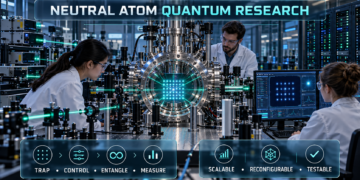
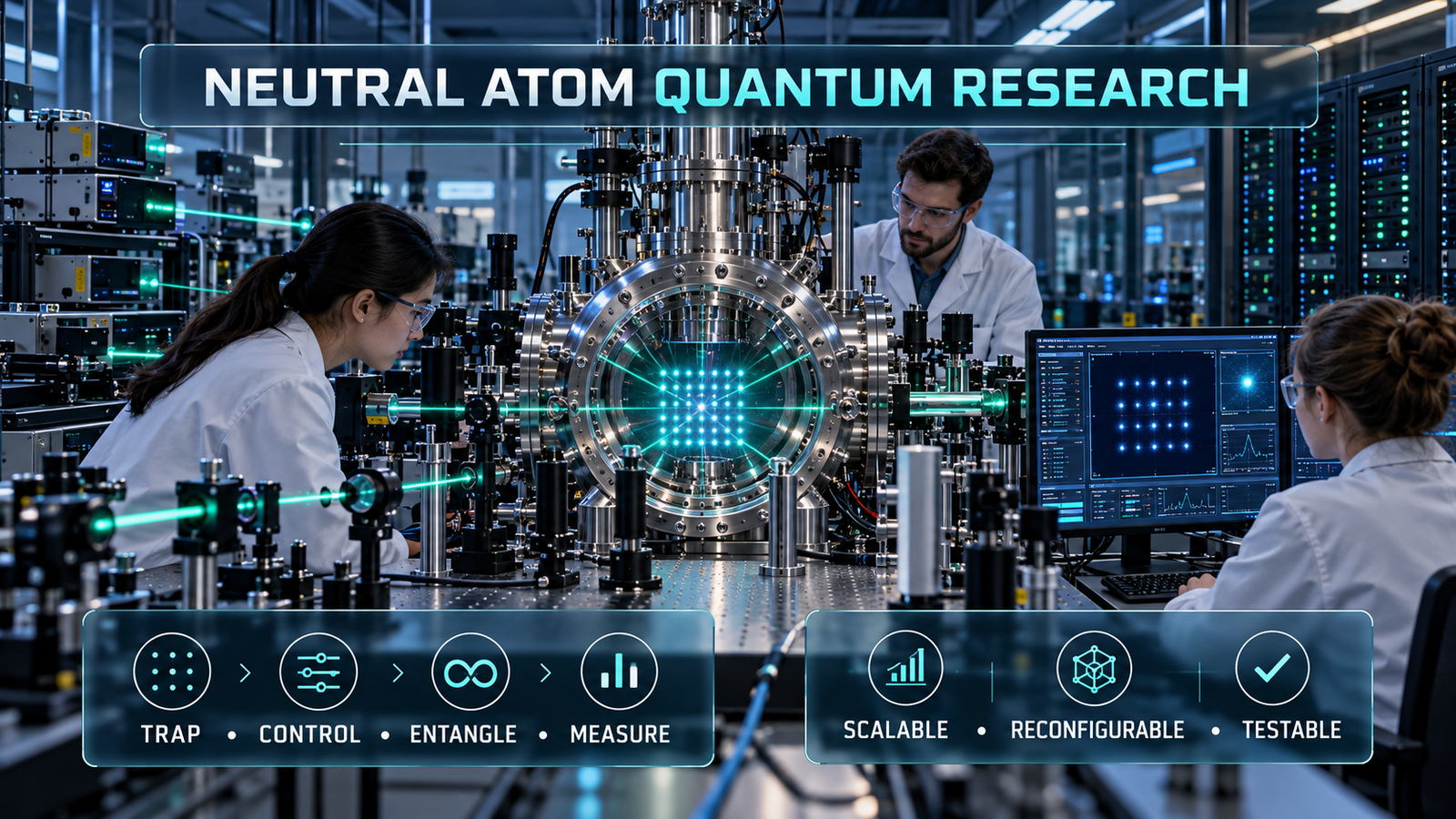
Neutral atom quantum research uses individually controlled atoms as physical qubits, usually inside an ultra-high-vacuum chamber and held by focused laser traps. The architecture is promising because atoms of the same isotope are naturally uniform, arrays can be rearranged, and short-lived Rydberg excitation can switch strong interactions on demand.
The useful engineering story is harder than the popular version. A processor must cool and load atoms, detect vacancies, rearrange a defect-free register, prepare internal states, execute calibrated pulses, create entanglement, measure every site, and repeat the experiment enough times to estimate an answer.
Every stage can fail. Atoms are lost, laser phase drifts, beams move, Rydberg states decay, neighbouring sites receive unwanted light, and fluorescence readout can misclassify a state or confuse atom loss with a logical outcome.
Neutral atom quantum research has nevertheless produced material progress. Peer-reviewed experiments have demonstrated high-fidelity parallel entangling operations, programmable analogue simulation, logical-qubit processors, repeated error-detection workflows, and arrays containing thousands of atoms.[1][2][3][4]
Those achievements are not proof of economical advantage for routine enterprise workloads. Physical atom count, logical-qubit count, gate fidelity, algorithmic depth, uptime, queue time, calibration burden, and total cost must be evaluated together.
For technology leaders, the correct strategy is measured experimentation. Use cloud access where possible, benchmark against optimized classical methods, protect sensitive data, cap consumption, record every hardware and software version, and fund production only when an independently reviewable result crosses a business threshold.
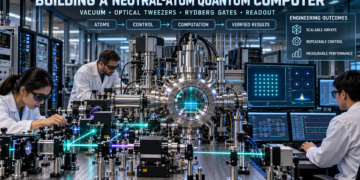
How Is Neutral Atom Quantum Technology Designed and Built?
I. Current Market Landscape and the Real Engineering Challenge
Neutral Atoms Have Moved Beyond Tabletop Curiosity
Neutral atom quantum research now spans university laboratories, national programs, cloud-accessible machines, and commercial hardware roadmaps. The platform supports two related modes: analogue simulation of a programmable Hamiltonian and digital, gate-based computation.
In analogue neutral atom quantum research, researchers configure atom positions and tune laser-driven interactions so the array evolves according to a target many-body model. In digital operation, calibrated single- and multi-qubit gates approximate an algorithm as a sequence of operations.
These modes should not be treated as interchangeable. An analogue machine can be valuable for a narrow simulation problem while lacking the instruction model required for a general gate-based application.
The commercial market reflects that split. QuEra’s Aquila is presented as a 256-atom analogue system available through Amazon Braket, while Pasqal offers neutral-atom QPU and emulator access through its cloud stack.[5][6]
Atom Computing markets an on-premises AC1000 platform with more than 1,200 nuclear-spin qubits, and Infleqtion markets cloud access to its Sqale gate-based platform.[7][8] These specifications come from vendors and require workload-level validation.
The Cost of Inaction Is Skills and Measurement Debt
Most businesses studying neutral atom quantum research do not face an immediate need to own a quantum computer. They do face a growing risk of being unable to distinguish a meaningful benchmark from a marketing milestone.
Waiting without building measurement capability creates skills debt. Teams may later lack clean problem formulations, classical baselines, resource estimates, procurement controls, or staff capable of interpreting hardware limitations.
The remedy is not a large hardware contract. A modest neutral atom quantum research program can build evaluation skills through simulation, cloud trials, literature review, and reproducible benchmark notebooks.
The Cost of Moving Too Early
Premature investment in neutral atom quantum research creates a different failure. An organization may compare an immature quantum workflow against an outdated classical solver, exclude data preparation and queue time, then call a laboratory result a business advantage.
Hardware ownership magnifies the risk. Neutral atom quantum computing requires vacuum engineering, stabilized lasers, optical alignment, control electronics, calibration software, safety procedures, and specialist staff.
An on-premises system can be strategically justified for a national laboratory, hardware developer, or research-intensive enterprise. It is rarely the first rational step for an ordinary IT organization.
II. Deep-Dive Technical Analysis: How the System Works
Architecture Overview
Neutral atom quantum research combines atomic physics with a demanding classical control stack. The quantum register may be microscopic, but the supporting system occupies racks, optical tables, vacuum hardware, compute nodes, timing electronics, and environmental controls.
The principal layers are:
- Vacuum and atomic source: supplies atoms while suppressing collisions with background gas.
- Cooling stage: reduces atomic motion through laser and evaporative or sub-Doppler techniques, depending on the design.
- Trap generation: creates optical tweezers or lattices with spatial light modulators, acousto-optic deflectors, or related beam-control hardware.
- Imaging and rearrangement: detects occupied sites and moves atoms to fill vacancies.
- Qubit control: drives selected internal-state transitions with microwave or optical pulses.
- Interaction control: temporarily excites atoms to Rydberg states for strong conditional interactions.
- Readout: infers qubit states through site-resolved fluorescence or state-selective loss.
- Classical orchestration: compiles programs, schedules pulses, calibrates devices, decodes errors, and stores results.
This architecture explains why “atoms are identical” does not mean the machine is simple. The atom is repeatable; the optical path, control field, local environment, and measurement chain are not automatically identical.
Processor Execution Sequence

The physical workflow in neutral atom quantum research is sequential but highly iterative. A failure at loading, preparation, control, or measurement can force part or all of the cycle to restart.
Step 1: Create and Cool an Atomic Ensemble
Neutral atom quantum research begins with an atomic species such as rubidium, cesium, strontium, or ytterbium. Different species and isotopes offer different nuclear-spin, optical-transition, clock-state, and cooling properties.
Lasers slow and cool the atoms so their thermal motion is small enough for stable trapping and coherent control. The process does not “freeze” atoms in an everyday sense; it narrows their motional distribution and confines them in a carefully engineered potential.
Collisions with residual gas can eject atoms or destroy coherence, so neutral atom quantum research depends on ultra-high vacuum. Vacuum quality, chamber materials, pumping, bakeout, contamination control, and optical access are system-level constraints.
Step 2: Load Optical Tweezer Arrays
Optical tweezer arrays in neutral atom quantum research use tightly focused laser beams to create microscopic trapping potentials. A single trap is commonly loaded probabilistically, so the first image of an array contains vacancies.
That randomness makes rearrangement essential. The controller detects occupied sites, computes moves, and steers mobile tweezers to assemble a denser target geometry.
Software-defined geometry is a major advantage. Neutral atom quantum research can place qubits in lines, square grids, triangular patterns, rings, or problem-specific graphs without fabricating a new chip for every connectivity pattern.
Movement is not free. Rearrangement adds latency, can heat atoms, and may cause loss; the planner must avoid collisions and preserve coherence when motion occurs during a computation.
Step 3: Encode a Qubit in Internal Atomic States
In neutral atom quantum research, a qubit is encoded in two selected atomic states, often hyperfine ground states or nuclear-spin states. These states are labelled \(|0\rangle\) and \(|1\rangle\), but they are physical energy levels—not tiny classical switches.
A resonant microwave or optical pulse rotates the state on the Bloch sphere. A nominal \(\pi/2\) pulse can prepare an equal-amplitude superposition, while other pulse phases and durations produce different rotations.
Superposition does not mean the system exposes both classical answers at measurement. It means the state has complex amplitudes whose phases can interfere during later operations.
Superposition alone does not guarantee faster computation. A quantum algorithm must use interference to increase the probability of obtaining useful measurement outcomes; whether it offers an advantage over classical computing depends on the problem and the algorithm.
Step 4: Turn Interactions On with Rydberg Excitation
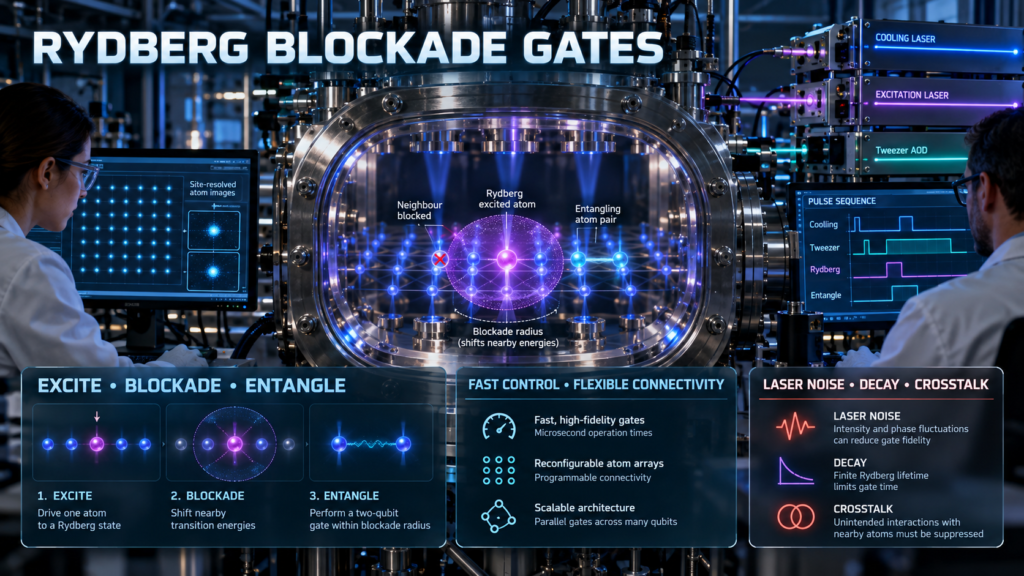
Ground-state neutral atoms interact weakly at typical array spacing. Neutral atom quantum research addresses that control problem by temporarily exciting selected atoms into high principal-quantum-number Rydberg states.
Rydberg atoms have strong, distance-dependent interactions. When one atom is excited, it shifts the energy of nearby Rydberg transitions, potentially preventing a neighbour from being excited by the same pulse.
This is the Rydberg blockade. Inside the blockade radius, carefully designed pulse sequences can implement conditional phases, entangling gates, or collective multi-atom operations.
In many neutral-atom processor experiments, interacting atoms are separated by a few micrometres. The blockade radius depends on the chosen Rydberg states and excitation conditions, so it is not a fixed distance shared by all systems.
Rydberg blockade gates carry a trade-off. Strong excitation makes operations fast, but finite Rydberg lifetime, spontaneous emission, Doppler effects, laser noise, blockade leakage, and state mixing produce errors.
Step 5: Build Entanglement Without Violating Causality
Entanglement in neutral atom quantum research creates correlations that cannot be represented by independent classical states. It does not allow one atom to transmit usable information instantaneously to another.
Neutral atom quantum research verifies entanglement through measurements across repeated experimental runs. Bell-state fidelity, parity oscillations, stabilizer measurements, and related tests quantify whether the prepared correlations match the target state.
Entanglement is a resource for algorithms, simulation, sensing, and quantum error correction. It is not synonymous with useful computation; a noisy entangled state may be scientifically interesting yet commercially worthless.
Step 6: Measure, Reset, and Repeat
At the end of a neutral atom quantum research circuit, the system maps atomic states to detectable fluorescence or state-dependent survival. A camera then resolves the sites and converts photons into classical bits.
Measurement must separate state-preparation error, atom loss, detector noise, and classification error. If loss is recorded as a logical state, the resulting statistics can be biased.
Quantum results are probabilistic, so a circuit is repeated for many shots. Total time therefore includes preparation, rearrangement, calibration, queueing, execution, imaging, classical post-processing, and retries—not just pulse duration.
III. Integration Flowchart and Control Architecture
End-to-End Execution Flow

This flow reveals the classical workload hidden behind neutral atom quantum research. Image processing, motion planning, waveform generation, calibration, compilation, error decoding, and statistical analysis all run on conventional compute.
The Classical Control Plane
Neutral atom quantum research timing must remain synchronized across lasers, microwave sources, modulators, cameras, and trigger electronics. Small phase or amplitude errors can accumulate into coherent gate errors that are harder to average away than random noise.
Calibration is therefore continuous rather than occasional. A production control plane should version pulse parameters, environmental readings, hardware configuration, compiler output, and calibration validity windows.
Enterprise integration adds identity, access control, secrets management, workload queues, cost attribution, audit logs, data retention, and incident response. A research API without these controls is not an enterprise service.
Compilation for Moving Qubits
Neutral atom quantum research offers a distinctive option: move atoms instead of routing every interaction through fixed nearest-neighbour gates. Compilers can co-design placement, motion, parallel gate layers, and error-correction schedules.
Movement can reduce logical routing overhead but introduces transport time and motional error. The correct compiler objective is not minimum gate count alone; it may include loss probability, movement distance, parallelism, calibration zones, and decoder latency.
IV. Performance Evaluation Matrix and Academic Evidence

Performance Evaluation Matrix
| Dimension | What to measure | Why it matters | Common reporting trap |
|---|---|---|---|
| Register scale | Loaded, detected, and usable atoms | Empty or lost sites reduce effective capacity | Quoting trap count as working qubits |
| Single-qubit control | Average and worst-site fidelity | Local outliers can dominate logical performance | Reporting only an array average |
| Entangling operations | Fidelity by pair, distance, and parallel layer | Rydberg gates often set circuit depth limits | Quoting isolated best-pair fidelity |
| Coherence | Ramsey/echo decay under operating conditions | Calibration and motion can change coherence | Using idle coherence as circuit lifetime |
| Atom survival | Loss per cycle, move, gate, and readout | Loss is both an erasure and availability cost | Folding loss into another metric |
| State preparation and measurement | Confusion matrix and loss discrimination | Readout bias corrupts benchmark results | Reporting a single accuracy number |
| Throughput | Accepted shots per hour | Business experiments need enough samples | Reporting only microsecond gate time |
| Availability | Scheduled uptime and calibration downtime | Determines delivery predictability | Excluding maintenance windows |
| Logical performance | Logical error per cycle and circuit success | Physical scale does not equal useful scale | Counting encoded qubits without suppression |
| Economics | Fully loaded cost per accepted result | Enables classical comparison | Ignoring engineering and queue costs |
What Peer-Reviewed Results Actually Establish
A 2023 Nature experiment in neutral atom quantum research reported parallel high-fidelity entangling operations across a neutral-atom array, an important control milestone for scalable logical operations.[1] It did not establish general business advantage.
A 2024 Nature paper demonstrated a reconfigurable logical processor with up to 48 logical qubits and error-detected logical operations.[2] The result showed how atom movement and parallel control can support encoded computation, not that a universal fault-tolerant commercial system had arrived.
In 2025, peer-reviewed work reported continuous operation of a coherent 3,000-qubit neutral-atom system, while another experiment demonstrated a 6,100-site coherent tweezer array.[3][4] Scale at the register level is significant, but it must be joined with gate quality, readout, survival, logical cycles, and workload throughput.
Recent work has also reported logical operations whose error rates improve over selected physical operations and architectures designed for repeated quantum error correction.[9][10] These are credible advances toward fault tolerance, but the overhead and application-level economics remain active research questions.
Evidence Grades for Commercial Claims
Neutral atom quantum research should be assessed using evidence grades. Grade A is independently reproducible application performance with complete classical comparison and total cost.
Grade B is a peer-reviewed hardware or logical milestone with disclosed methods but limited workload scope. Grade C is a vendor demonstration or customer pilot with partial technical disclosure.
Grade D is a roadmap, simulation, press release, memorandum of understanding, or unexplained “qubit” number. Procurement should never treat Grade D as realized capability.
V. Commercial Solutions and Best Practices
Feature and Cost Comparison Table
| Platform | Current positioning | Access model | Cost structure | Buyer caution |
|---|---|---|---|---|
| QuEra Aquila | 256-atom analogue Rydberg processor | Public access through Amazon Braket | AWS task/shot pricing and reservation options; verify live rate[5] | Analogue Hamiltonian model is not a universal gate computer |
| Pasqal Cloud / Orion | 100-plus-qubit neutral-atom QPU plus emulators | Pasqal Cloud and selected cloud channels | Vendor states pay-as-you-go; enterprise access varies by region[6] | Confirm hardware target, queue, pulse controls, and SLA |
| Atom Computing AC1000 | Vendor-reported 1,200-plus nuclear-spin qubits | Primarily on-premises or strategic partnership | Contract pricing and facility integration[7] | Atom count does not disclose application throughput |
| Infleqtion Sqale | Gate-based neutral-atom platform and cloud service | Private/cloud access and partnerships | Contract or service pricing; request current quote[8] | Recent logical-qubit and fidelity figures are company-reported |
This neutral atom quantum research table compares access routes, not winners. Device models, regions, quotas, and prices can change faster than an annual article review cycle.
Procurement Framework
Commercial evaluation should advance through explicit gates. Each gate requires evidence before the project receives more budget or broader data access.
Procurement Gate 1: Define the Workload
Begin a neutral atom quantum research procurement with a decision or computation whose value can be quantified. Specify the instance distribution, output quality, latency ceiling, confidentiality, and classical budget before selecting hardware.
A neutral atom quantum research pilot without a representative workload becomes a tutorial. Tutorials are useful for training but should not be reported as ROI evidence.
Procurement Gate 2: Build the Strongest Classical Baseline
For neutral atom quantum research, use current solvers, hardware accelerators, tuned heuristics, and domain constraints. Give the classical team enough time to optimize rather than freezing an obsolete comparison.
Record solution quality, runtime distribution, energy, compute cost, engineering hours, and failure behaviour. Quantum results must use the same acceptance threshold.
Procurement Gate 3: Match the Machine Model
An analogue neutral atom quantum research device may map naturally to graph and many-body Hamiltonians. A gate-based system may support broader circuits but incur compilation and error-correction overhead.
Do not force a workload onto a machine because cloud access is convenient. Architecture fit is a hypothesis to test, not a sales statement.
Procurement Gate 4: Control Spend and Data
For neutral atom quantum research, create separate cloud identities, least-privilege roles, usage alerts, project tags, and spending limits. Prohibit regulated or export-controlled inputs until legal and security teams approve the service boundary.
Store circuits, parameters, device calibration metadata, results, and classical baselines in a reproducible experiment registry. Screenshots are not an audit trail.
Procurement Gate 5: Demand Reproducibility
Repeat every neutral atom quantum research experiment across dates and calibration cycles. If possible, compare two devices or emulate the same Hamiltonian and circuit with an independent toolchain.
Neutral atom quantum research should advance only when the result survives a reviewer who did not design the pilot. Independence is more valuable than a polished demonstration.
VI. Deployment Challenges and Failure Vectors
Atom Loss and Defect Management
Atoms in neutral atom quantum research can be lost during loading, movement, Rydberg excitation, background-gas collisions, and readout. Rearrangement repairs initial vacancies, but mid-circuit loss demands detection, replacement, erasure decoding, or circuit adaptation.
A large initial array can therefore deliver a smaller usable logical resource. Buyers should request survival curves across complete cycles, not a photograph of a well-filled register.
Laser Stability and Optical Complexity
Neutral atom quantum research shifts fabrication variability away from the atom and into lasers, optics, modulators, alignment, and calibration. Frequency, phase, intensity, polarization, wavefront, and pointing errors all matter.
Scaling channels can increase crosstalk and calibration time. Optical power budgets, component lifetime, spare availability, and service procedures belong in total cost of ownership.
Rydberg-State Error Budget
Rydberg blockade gates in neutral atom quantum research trade interaction strength against finite lifetime and sensitivity. Spontaneous emission, imperfect blockade, Doppler detuning, electric-field shifts, leakage, and pulse errors reduce fidelity.
Parallel gates can add correlated errors. An average two-qubit figure may hide spatial hotspots, distance dependence, or degradation when many gates run simultaneously.
Readout and Mid-Circuit Measurement
Fluorescence imaging in neutral atom quantum research can be accurate but may be slow or destructive depending on the architecture. Fault-tolerant workflows need repeated syndrome extraction, ancilla reuse, feed-forward, and low-latency decoding.
These operations stress the full control loop. A device that prepares impressive states may still lack the measurement cadence needed for deep logical computation.
Software and Portability
Programming models in neutral atom quantum research differ across analogue Hamiltonians, pulse control, gate-based circuits, and logical instruction sets. Provider-specific features can improve performance while creating lock-in.
Use portable workload descriptions where possible, and preserve a classical reference implementation. Contractual exit terms should cover code, results, logs, and reproducibility data.
VII. Business Outcomes and Strategic ROI
What Businesses Can Gain Now
The near-term return from neutral atom quantum research is often organizational capability rather than production speedup. A disciplined neutral atom quantum research team learns to formulate quantum-relevant problems, measure probabilistic systems, build classical baselines, and evaluate vendor evidence.
Research-intensive companies may also use analogue simulators to explore many-body models. Any claimed value must connect the quantum observable to a laboratory, engineering, or product decision.
Where Future Value Could Emerge
Potential applications include materials modelling, chemistry, optimization, and simulation of strongly correlated systems. These remain conditional on accuracy, scale, runtime, data-loading cost, and classical competition.
Neutral-atom geometry may be particularly relevant when a problem maps naturally onto controllable interactions. A favourable mapping is not enough; the measured output must improve a real decision.
A Practical ROI Model
Use expected value rather than a headline saving:\[ \text{Expected annual value}=P_d(B_r+C_a+R_a)-(C_p+C_i+C_o+C_g) \]
Here, \(P_d\) is the probability of reaching deployment, \(B_r\) is revenue benefit, \(C_a\) is avoidable classical cost, and \(R_a\) is risk-adjusted loss avoided. Platform, integration, operations, and governance costs are \(C_p\), \(C_i\), \(C_o\), and \(C_g\).
If a pilot promises $1 million in annual benefit but has a 20% deployment probability, its initial expected gross benefit is $200,000 before cost. Neutral atom quantum research budgets should reflect that uncertainty.
Portfolio Allocation
Divide spending into education, experiments, and contingent scale-up. Education builds literacy and baselines; experiments answer narrow questions; scale-up funding unlocks only after predefined thresholds are met.
This structure prevents sunk-cost escalation. A failed pilot can still be valuable when it produces a reusable benchmark, documented limitation, or stronger classical solution.
VIII. Risk Mitigation and Regulatory Framework
This section appears immediately before the final call to action because governance must shape the experiment. Neutral atom quantum research can involve sensitive algorithms, cloud services, export controls, research security, laser safety, and vendor concentration.

Technical and Commercial Governance Checklist
- Define the workload, acceptance threshold, classical baseline, and stop condition.
- Separate vendor-reported, peer-reviewed, and independently reproduced evidence.
- Record atom count, usable qubits, loss, fidelity, shots, queue time, and full cost.
- Test performance across multiple calibration windows.
- Classify data before submitting workloads to an external service.
- Apply identity controls, logging, encryption, retention, and incident response.
- Review export-control, research-security, and contract obligations with counsel.
- Require versioned circuits, compiler settings, device metadata, and results.
- Document laser, electrical, cryogenic, and laboratory safety responsibilities.
- Establish portability, vendor-exit, and service-disruption plans.
- Prevent marketing teams from presenting experiments as production advantage.
- Reapprove the business case after every material architecture change.
NIST and Cybersecurity Controls
NIST’s Cybersecurity Framework can organize governance, identity, protection, detection, response, and recovery for quantum cloud experiments. It does not certify quantum performance.
Post-quantum cryptography migration is a separate security program. Neutral atom quantum research does not need to produce a cryptographically relevant computer before organizations begin inventorying vulnerable cryptography and adopting applicable NIST standards.
EU AI Act and Sector Regulation
The EU AI Act does not generally regulate a quantum processor merely because it is advanced technology. It may apply when a quantum-enabled product includes an AI system within scope, particularly in regulated or high-risk uses.
Privacy, financial, healthcare, defence, and critical-infrastructure rules depend on the data and deployed function. Compliance must map the actual workflow, not the marketing category.
Balanced Risk Register
The principal technical risks are atom loss, correlated gate error, calibration drift, optical failure, limited logical depth, and slow measurement. Commercial risks include uncertain advantage, low utilization, specialist scarcity, lock-in, and roadmap delay.
Governance risks include sensitive-data exposure, weak reproducibility, misleading claims, and unreviewed cross-border access. Each risk needs an owner, measurable trigger, mitigation, and residual-risk decision.
IX. Final Call to Action: Run a 90-Day Evidence Sprint
Start with one high-value workload and one strong classical baseline. Select cloud or emulator access that matches the computation model, then cap spend and define an acceptance threshold before the first run.
During the sprint, record the entire path from input preparation to accepted result. Include queue time, calibration, shots, post-processing, engineer hours, failures, and reruns.
At day 90, choose among three outcomes: stop with documented learning, continue a bounded experiment, or prepare a controlled deployment case. Do not move forward because the atom count is large or the demonstration looks sophisticated.
Neutral atom quantum research deserves serious attention because its reconfigurable arrays, strong Rydberg interactions, and recent logical demonstrations address genuine scaling problems. It deserves equal scrutiny because useful, economical fault-tolerant computation has not yet been broadly demonstrated.
Frequently Asked Questions
How does neutral atom quantum research work?
It cools neutral atoms, traps them in focused laser arrays, rearranges them into a target geometry, encodes qubits in internal states, uses calibrated pulses and Rydberg interactions for gates, and measures the result through site-resolved detection.
Why are Rydberg states important?
Ground-state neutral atoms interact weakly at processor spacing. Temporary Rydberg excitation creates strong, controllable interactions that support entanglement and conditional gates.
Does entanglement transmit information instantly?
No. Entanglement produces non-classical correlations, but usable communication still obeys relativistic causality and requires classical information exchange.
Are thousands of atoms the same as thousands of useful qubits?
No. Useful capacity depends on loading, survival, controllability, gate fidelity, readout, logical encoding, circuit depth, throughput, and application accuracy.
Is neutral atom quantum computing commercially useful today?
It is commercially accessible for research, training, simulation, and application experiments. Broad production advantage over optimized classical computing has not been established.
Should an enterprise buy hardware?
Most enterprises should begin with simulation and cloud access. Hardware ownership requires a research mandate, facilities, specialist staff, a long time horizon, and a workload that justifies the cost.
Appendix A: Academic and Primary-Source References
- Evered, S. J. et al., “High-fidelity parallel entangling gates on a neutral-atom quantum computer,” Nature 622, 268–272 (2023), doi:10.1038/s41586-023-06481-y.
- Bluvstein, D. et al., “Logical quantum processor based on reconfigurable atom arrays,” Nature 626, 58–65 (2024), doi:10.1038/s41586-023-06927-3.
- Chiu, N. C. et al., “Continuous operation of a coherent 3,000-qubit system,” Nature (2025), doi:10.1038/s41586-025-09596-6.
- Manetsch, H. J. et al., “A tweezer array with 6,100 highly coherent atomic qubits,” Nature (2025), doi:10.1038/s41586-025-09641-4.
- QuEra, “Aquila: 256-Qubit Analog Neutral-Atom Quantum Computer,” and Amazon Braket access documentation; accessed September 2026.
- Pasqal Documentation, “Pasqal Cloud Services” and cloud access materials; accessed September 2026.
- Atom Computing, “AC1000” and neutral-atom technology documentation; accessed September 2026.
- Infleqtion, public filings and Sqale platform materials; vendor-reported metrics; accessed September 2026.
- Chung, W. C. et al., “Fault-tolerant operation and materials science with neutral atom logical qubits,” npj Quantum Information (2025), doi:10.1038/s41534-025-01095-w.
- Bluvstein, D. et al., “A fault-tolerant neutral-atom architecture for universal quantum computation,” Nature (2025), doi:10.1038/s41586-025-09848-5.
- Wintersperger, K. et al., “Neutral Atom Quantum Computing Hardware: Performance and End-User Perspective,” arXiv:2304.14360 (2023).
- U.S. National Quantum Initiative, Annual Report FY2025 and DOE Quantum Information Science Applications Roadmap (2024–2025).
Appendix B: Editorial Disclosure
AI-assisted tools were used to support research organization, drafting and language refinement. NezzHub retains editorial responsibility for the published article.
Vendor inclusion does not constitute endorsement. Hardware specifications, access options, pricing and roadmaps may change; readers should confirm current details through the linked official sources.
Author and Editorial Review
Author: Garikapati Bullivenkaiah
Technology research writer with LL.B., LL.M., M.A., and MBA qualifications. He writes about emerging technologies and their business, governance and legal implications. His multidisciplinary academic background informs his analysis of technology adoption, intellectual property, and organizational risk. His articles explain technical concepts and practical considerations for business owners, IT managers and technology decision-makers. LinkedIn Profile
Reviewed by: Chitikineni Ramadevi — Editor
Chitikineni Ramadevi holds an M.Sc. in Computers from Andhra University and has over 10 years of research experience in technology-related subjects. She reviews NezzHub articles for clarity, factual accuracy, source support and practical relevance.
Published by: NezzHub
Research approach: This article draws on primary sources, technical documentation and relevant industry research. References are provided within the article or its sources section.
Last reviewed: 09-27-2026
Corrections: To report a factual error or outdated information, please contact NezzHub.