













Executive Summary
Humanoid AI is moving from staged demonstrations into bounded industrial work, but the evidence is uneven. Manufacturing and warehouse logistics now have credible pilots and early commercial deployments; direct clinical care remains experimental and carries a much higher safety, privacy and regulatory burden.
BMW reports that Figure 02 moved more than 90,000 components during approximately 1,250 operating hours in a 2025 deployment at Plant Spartanburg.[1] GXO and Agility Robotics announced a multi-year Robots-as-a-Service agreement after testing Digit on repetitive tote-transfer work in a live logistics operation.[2]
Healthcare presents a different maturity curve. Mobile manipulator Moxi—robotic but not a full bipedal humanoid—has accumulated more than one million hospital deliveries, providing stronger operational evidence for medication, laboratory-sample and supply transport than current general-purpose humanoids.[3]
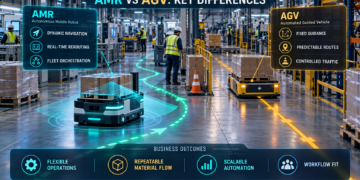
The business case therefore depends on task geometry, intervention rate, duty cycle, safety validation, systems integration and the cost of exceptions. A human-shaped machine is commercially useful only when human-compatible reach, tools, stairs, carts or workstations create more value than a simpler AMR, cobot or fixed automation cell.
This white paper gives technology leaders a procurement-grade framework. It covers architecture, integration flow, deployment friction, performance testing, commercial options, total cost of ownership, cybersecurity, AI governance and staged return-on-investment validation.
I. Current Market Landscape and the Cost of Waiting
Commercial Reality Versus Demonstration Theater
The strongest humanoid AI evidence comes from narrow, repetitive assignments. Figure’s BMW work involved positioning sheet-metal components, while Digit’s GXO workflow transferred totes from autonomous mobile robots to conveyors.[1][4]
These are meaningful results because they occurred in operational facilities, but they do not establish general human-level capability. Each task still depends on engineered containers, defined handoffs, controlled recovery and extensive data collection.
Apptronik and Mercedes-Benz began with pilots that explored parts movement and repetitive manufacturing work.[5] Reuters reported in 2025 that only a small number of Apollo robots were being tested and that broader deployment remained sensitive to unit cost.[6]
The market is therefore best described as early commercialization. Claims about universal labor replacement, unrestricted autonomy or immediate hospital bedside work should be excluded from capital planning.
Why the Human Form Is Sometimes Valuable
Factories and hospitals were designed around human height, reach, doors, elevators, carts, shelves and hand tools. A humanoid can potentially use that installed environment without rebuilding every interface.
That argument weakens when wheels, conveyors, lifts or purpose-built grippers solve the same mission more safely and cheaply. Legs and dexterous hands add actuators, controls, energy demand and failure points that must earn their place in the architecture.
The Cost of Inaction
Organizations that delay all experimentation may miss an opportunity to collect task data, redesign work and build integration skills before the hardware matures. The near-term cost is not lost robot labor; it is lost organizational learning about which workflows can be standardized.
Hospitals face internal transport demands for medication, laboratory specimens, telemetry equipment, linen and supplies. Manufacturers face repetitive walking, cart movement, machine loading, kitting and inspection work that can pull skilled employees away from higher-value activity.
The Cost of Premature Deployment
Buying before the task and support model are ready can create a high-cost technical exhibit. A robot that works for 40 minutes but needs a specialist for every recovery may increase rather than reduce operating expense.
Premature deployment also creates safety, privacy and reputational exposure. A fall, uncontrolled restart, incorrect delivery or misleading patient-facing response can produce consequences far beyond missed throughput.
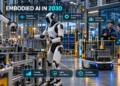
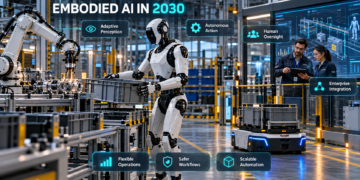
The Future of Embodied AI and Autonomous Robots in 2030
II. Humanoid AI Technical Architecture and Evidence
Architecture Overview
A production humanoid AI stack is not a single model. Each humanoid AI platform is a layered cyber-physical system in which probabilistic perception and planning must operate inside deterministic safety constraints.
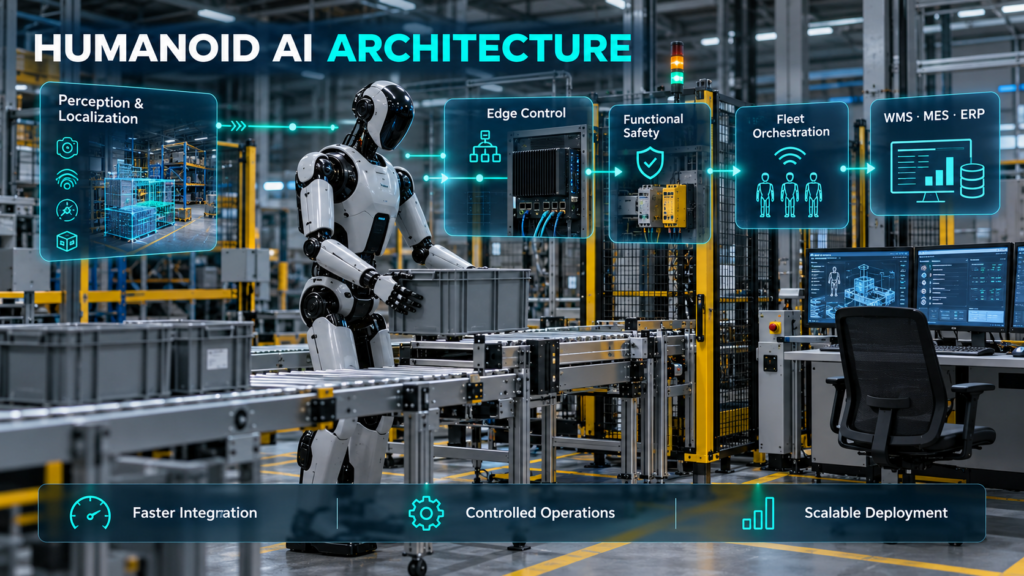
Physical and Safety Layer
- Electric actuators create movement at the arms, hands, torso and legs or wheeled base.
- Encoders, force-torque sensors and battery telemetry measure joint and system state.
- Safety-rated controls enforce speed, torque, workspace and emergency-stop behavior.
- Mechanical design limits pinch, crush, impact, thermal and battery hazards.
- End effectors provide task-specific grip rather than relying on appearance alone.
Perception and Localization Layer
- Cameras and depth sensors identify objects, people and workspaces.
- LiDAR, inertial sensing and visual odometry support localization and navigation.
- Tactile and force feedback confirm grasp, insertion and contact state.
- Sensor fusion estimates conditions when any single input is noisy or occluded.
Planning and Control Layer
- Task planning converts an approved work order into bounded action sequences.
- Motion planning checks reachability, balance, collision and joint constraints.
- Whole-body control coordinates manipulation with stepping or base movement.
- Recovery policies stop, retry, request help or return to a known safe state.
- Teleoperation provides supervised recovery and training-data collection where permitted.
Enterprise and Operations Layer
- Enterprise robotics software dispatches work and manages humanoid AI state.
- WMS, MES, ERP, CMMS or hospital systems supply authoritative task context.
- Identity and access controls limit users, robots, integrations and remote support.
- Event logs support traceability, incident review and performance analysis.
- Device management controls approved maps, models, firmware and configurations.
Large language or vision-language-action models can improve humanoid AI instruction interpretation and skill transfer, but they should not directly override safety controls. Natural-language convenience is not a substitute for validated task boundaries.
Integration Flowchart
```mermaid
flowchart TD
    A[Approved work request] --> B[Workflow validation]
    B --> C[Robot or fleet orchestration]
    C --> D[Perception, planning and control]
    D --> E[Safety controller and physical action]
    E --> F[Task confirmation or exception]
    F --> A
```
This diagram summarizes the operational information flow. Safety monitoring and interlocks apply throughout planning and execution; they are not a single check performed after planning. Completion events close the existing work request, while exceptions trigger controlled recovery or escalation. Neither event automatically authorizes a new task.
Manufacturing Workflow: From Demonstration to Production
The BMW humanoid AI deployment provides a useful operating pattern. Figure 02 inserted sheet-metal parts into fixtures, a physically demanding task requiring repeatable grasping, positioning and motion within an existing body shop.[7]
BMW later reported 90,000-plus components, around 1.2 million steps and approximately 1,250 operating hours across ten months.[1] Those are manufacturer-reported deployment metrics, not an independent comparative trial, but they are more decision-useful than a choreographed video.
Figure 03 has since demonstrated humanoid AI on a BMW sequencing workflow that combines part handling with pulling a wheeled cart.[8] The harder engineering question is whether that skill maintains acceptable intervention rate, cycle-time distribution and availability over full production demand.
Logistics Workflow: Container Handling
Digit’s live warehouse humanoid AI task removed totes from AMRs and placed them on conveyors.[4] The workflow is commercially relevant because it connects two automation islands without redesigning every handoff for a fixed industrial arm.
GXO describes the subsequent agreement as the first formal commercial and Robots-as-a-Service deployment of humanoid robots.[2] Procurement teams should still distinguish contracted deployment from fleet-wide scale and request site-level availability, intervention and cost data.
Healthcare Workflow: Internal Delivery, Not Clinical Judgment
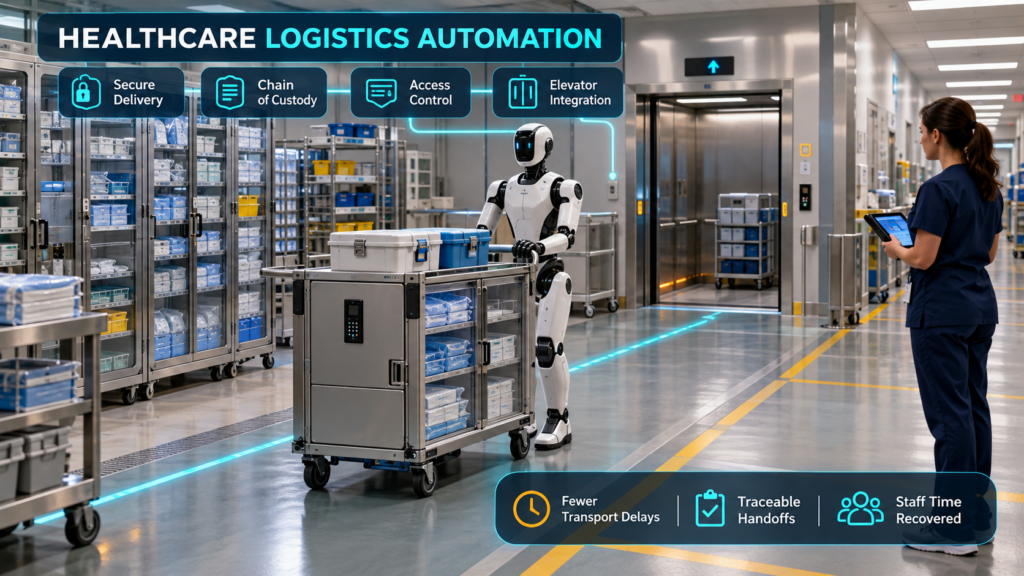
The most defensible initial use of humanoid AI in healthcare is non-patient-facing logistics. Candidate missions include secured medication delivery, laboratory-sample movement, equipment retrieval and supply transport.
Moxi demonstrates this market need with a mobile base, single manipulator, social signaling and hospital integration. Diligent Robotics reports deployments across more than 25 U.S. hospitals and more than 1.25 million deliveries in busy clinical environments.[9]
Moxi should not be presented as evidence that bipedal humanoid AI is ready for direct care. It is an adjacent mobile-manipulation benchmark showing that hospital value comes from workflow integration, elevator access, secure custody and reliable mission completion.
Direct Clinical Tasks Remain Research-Stage
A 2025 research study teleoperated a Unitree G1 humanoid AI system through seven medical procedures and reported promising feasibility, while identifying force-output and sensor-sensitivity limitations.[10] This is experimental evidence, not authorization for autonomous diagnosis, treatment or bedside deployment.
Robotic surgery is also a separate category. FDA describes computer-assisted surgical systems as devices through which a surgeon controls instruments; they are not evidence that general-purpose humanoids can independently perform surgery.[11]
III. Performance Evaluation Matrix

Metrics That Matter More Than a Demo
| Metric | Definition | Collection Method | Commercial Consequence |
|---|---|---|---|
| Mission completion | Correct tasks completed without disqualifying failure | Orchestrator and human audit logs | Determines usable capacity |
| Human intervention rate | Remote and on-floor recoveries per mission | Support tickets plus robot events | Converts autonomy into labor cost |
| P50/P95 cycle time | Median and tail completion time | Dispatch-to-confirmation timestamps | Shows whether takt or service levels hold |
| First-attempt grasp rate | Successful verified grasps on first attempt | Vision, force and task logs | Predicts delay and object damage |
| Availability | Ready time divided by scheduled time | Robot, charger and maintenance logs | Drives effective fleet size |
| Energy per completed mission | Charging energy divided by accepted tasks | Metering and task records | Exposes compute and locomotion overhead |
| Safe-stop frequency | Protective stops by location and cause | Safety logs and incident review | Reveals layout and sensing friction |
| Wrong-item or wrong-destination rate | Wrong-item or wrong-destination delivery attempts ÷ all delivery attempts, including failures | Barcode/RFID and receiving confirmation | Critical for hospital and manufacturing traceability |
| Mean recovery time | Time from fault to controlled restoration | Incident timeline | Determines support coverage |
| Model-change regression | Performance before and after an update | Locked benchmark set | Prevents silent capability degradation |
Pilot Acceptance Principles
Humanoid AI acceptance thresholds must be fixed before testing. If a vendor can redefine success after observing failures, the pilot becomes marketing rather than evidence.
Test the complete humanoid AI workflow at peak demand, including doors, elevators, radio roaming, clutter, shift changes, damaged containers and realistic lighting. Include planned loss of cloud service, fleet manager, network, perception input and upstream business system.
A Practical Capacity Model
Use the following formula as an initial average-capacity estimate:
Estimated robot count = missions per hour × average mission cycle time in minutes ÷ (60 × availability × planned utilization).
Enter availability and utilization as decimals, such as 0.90 and 0.80, and round the result up to a whole robot. Mission cycle time includes task receipt, travel, perception, manipulation, confirmation, repositioning and routine mission-related waiting. Availability represents the proportion of scheduled time available after charging, maintenance and outages; planned utilization reserves operating capacity for variability.
Count each delay once. If charging or recovery time is already included in the measured cycle time, do not deduct the same time again through availability. Validate the final fleet against peak demand, congestion, shared stations, charger capacity and the availability of human support.
IV. Humanoid AI Commercial Solutions and Feature-Cost Comparison
Representative Platforms
The humanoid AI table uses current vendor information and deployment status as of 26 September 2026. Specifications, availability and commercial terms require reconfirmation during procurement.
| Platform | Form and Reported Capability | Evidence Level | Strongest Current Fit | Main Cost and Risk Drivers |
|---|---|---|---|---|
| Agility Digit | Bipedal mobile manipulator; Digit 5 is announced with preliminary specifications | Commercial logistics agreement exists; new generation remains in development | Tote handling and repetitive intralogistics | RaaS fees, charging, workcell engineering, support and maturity |
| Figure 03 | Bipedal humanoid; vendor lists 20 kg payload and five-hour runtime | Manufacturing demonstration follows Figure 02 production deployment | Sequencing, part handling and cart movement | Integration, compute, uptime, model updates and task validation |
| Apptronik Apollo 2 | Bipedal and wheeled-base variants; enterprise development programs | Manufacturing and logistics pilots; deployment scale remains limited | Material movement, kitting and machine-side work | Hardware availability, teleoperation, support and application engineering |
| Diligent Moxi 2.0 | Mobile manipulator designed for hospitals; not a full bipedal humanoid | Multi-hospital operational fleet with large delivery history | Medication, lab and supply logistics | Hospital integration, elevators, secure custody, subscription and workflow redesign |
Digit 5 specifications are explicitly described by Agility as preliminary.[12] Figure’s specifications and Apptronik’s capabilities are vendor-reported, while Moxi deployment counts also originate from its manufacturer.[9][13][14]
Feature and Cost Comparison Framework
| Procurement Dimension | Bipedal Humanoid | Wheeled Humanoid/Mobile Manipulator | AMR With Attachment | Fixed Robot Cell |
|---|---|---|---|---|
| Human-space compatibility | Highest potential | High on level floors | Moderate to high | Low outside designed cell |
| Energy efficiency | Generally weakest due to legged locomotion | Better for long corridors | Usually strongest for transport | Efficient within fixed task |
| Dexterity | Potentially high | Depends on arm and end effector | Usually task-specific | High repeatability with tooling |
| Stairs and uneven access | Potential advantage | Limited | Limited | Not mobile |
| Safety-validation scope | Broad whole-body interaction | Mobile base plus manipulation | Mature mobile-robot patterns | Mature guarded/collaborative patterns |
| Change flexibility | High if skills transfer reliably | High for logistics | High for transport missions | Low without re-engineering |
| Commercial maturity | Early | Stronger in bounded niches | Established | Established |
| Cost predictability | Low | Medium | Medium to high | High after scope freeze |
The right comparison is not humanoid versus human. It is humanoid AI versus the least complex automation architecture that meets the service level, with humanoid AI selected only when its form creates measurable value.
Total Cost of Ownership
Calculate cost over a common period:\[ \text{TCO}=C_{platform}+C_{integration}+C_{site}+C_{software}+C_{compute}+C_{support}+C_{energy}+C_{change}+C_{downtime}-V_{residual} \]
Humanoid AI platform cost includes the robot, end effectors, batteries, chargers and spares. Integration includes enterprise connectors, identity, network changes, workstations, elevators, doors, PLCs and acceptance testing.
Humanoid AI software and compute deserve separate line items. Vision-language-action training, simulation, telemetry retention, remote operations and model evaluation can create recurring cloud or accelerator costs that do not appear in a hardware quotation.
Commercial Questions for Vendors
- Is the offer a purchase, lease, subscription or Robots-as-a-Service contract?
- Which capabilities are autonomous, supervised, teleoperated or still developmental?
- What intervention rate was achieved on a comparable live workflow?
- Are fleet software, APIs, remote support and model updates included?
- Who owns task data, video, telemetry, derived models and annotations?
- What happens when connectivity, cloud inference or a vendor service fails?
- Which safety standard and application boundaries were used for validation?
- How are updates tested, approved, rolled back and documented?
- What service-level agreement covers parts, field support and cybersecurity incidents?
- What is the exit plan if the platform or supplier is discontinued?
V. Deployment Challenges
Dexterity Without Reliability Is Not Capacity
A five-finger humanoid AI hand can manipulate varied objects, but production value depends on repeatable grasps across packaging variation, glare, occlusion and wear. A simpler gripper may outperform a human-like hand when the object family is stable.
Locomotion Consumes Energy and Risk Budget
Bipedal humanoid AI supports human-designed spaces, but walking consumes energy and introduces fall dynamics. Facilities should quantify whether stairs or narrow human pathways genuinely require legs before accepting the added complexity.
Teleoperation Can Hide the True Labor Model
Remote assistance is valuable for humanoid AI recovery and data collection, but it must be measured as labor. Vendors should disclose how often a human selects actions, approves plans, resolves faults or annotates data.
Model Updates Can Change Physical Behavior
An enterprise software update may change a screen; a humanoid AI update can change motion around people and equipment. Every material model, perception or controller update needs regression tests against approved tasks and hazards.
Brownfield Integration Is the Real Project
Production sites contain undocumented workarounds, temporary storage, damaged flooring and variable containers. Hospitals add elevators, fire doors, infection-control procedures, secure medication custody and vulnerable occupants.
The humanoid AI system must fit these operations without creating shadow workflows. If staff must manually repackage every load or escort every mission, the apparent flexibility has shifted cost rather than removed it.
Hospital Privacy and Human Factors
Humanoid AI cameras and microphones can collect protected, sensitive or incidental data. Healthcare deployments need data minimization, restricted retention, access logging and clear rules for patient-facing interaction.
A friendly face or conversational model can cause patients to overtrust a system. The interface must disclose capability limits and route clinical questions to qualified personnel rather than improvise advice.
VI. Humanoid AI Business Outcomes and Strategic ROI
Manufacturing Value
Humanoid AI can add manufacturing value where work is physically demanding, labor-intensive and distributed across human-designed stations. Candidate tasks include machine tending, kitting, line-side replenishment, component sequencing and inspection.
Humanoid AI value increases when one platform can be redeployed across several validated tasks. It falls when each new job needs months of custom programming, new tooling and continuous specialist oversight.
Healthcare Logistics Value
Healthcare logistics automation can return transport time to nurses, pharmacy staff and technicians, but the benefit must be measured as changed work rather than theoretical minutes. Diligent reports that Moxi’s average task lasts 20–26 minutes, illustrating the scale of trips being transferred, but the financial effect remains hospital-specific.[3]
Hospitals should measure humanoid AI on-time delivery, custody accuracy, staff walking time, elevator delay, failed mission recovery and program enablement. Medication delivery is only valuable when the receiving workflow reliably closes the chain of custody.
ROI Model
Calculate cash payback separately from operational benefits such as employee time released:
Annual net cash benefit = verified annual cash savings + additional annual contribution margin − incremental annual operating costs.
Simple payback in years = deployed capital and implementation cost ÷ positive annual net cash benefit.
Employee reallocation is not automatically a cash saving. Count it financially only where it changes expenditure or produces verified additional contribution margin. Report capacity released separately, avoid counting the same benefit twice, and include remote assistance, internal support, software, compute and maintenance in operating costs. Simple payback assumes a reasonably stable annual net cash benefit.
For major humanoid AI deployments, use net present value with scenarios for availability, intervention, volume, software fees, compute, residual value and vendor continuity. Do not apply a generic industry savings percentage to local operations.
Executive Decision Gates
- Task gate: Is the mission stable enough to measure but variable enough to justify humanoid form?
- Architecture gate: Can a simpler AMR, cobot or fixed cell meet the requirement?
- Safety gate: Has the complete application been validated in the live environment?
- Operations gate: Can local teams recover predictable failures without vendor engineers?
- Economic gate: Does verified capacity or labor reallocation exceed lifecycle cost under conservative assumptions?
- Scale gate: Does performance remain stable when traffic, missions and fleet size increase?
VII. Risk Mitigation and Regulatory Framework
Standards and Regulatory Scope
ISO 10218-1:2025 addresses safe design and risk reduction for industrial robots, while ISO 10218-2:2025 addresses industrial robot applications and cells.[15][16] ISO 13482:2014 covers personal-care robots, and a broader service-robot revision is under development as of September 2026.[17]
No single humanoid AI label determines the correct standard. Classification depends on intended use, environment, mobility, human contact, manipulation and the complete application.
The EU Machinery Regulation 2023/1230 and AI Act 2024/1689 may both matter for European deployments, depending on product role and AI-system classification.[18][19] Organizations should obtain jurisdiction-specific conformity and legal advice rather than relying on vendor marketing.
In the United States, humanoid AI used solely for logistics is not automatically a medical device. If intended to diagnose, treat, monitor or perform a regulated medical function, FDA classification and total-product-lifecycle controls may apply.[11][20]
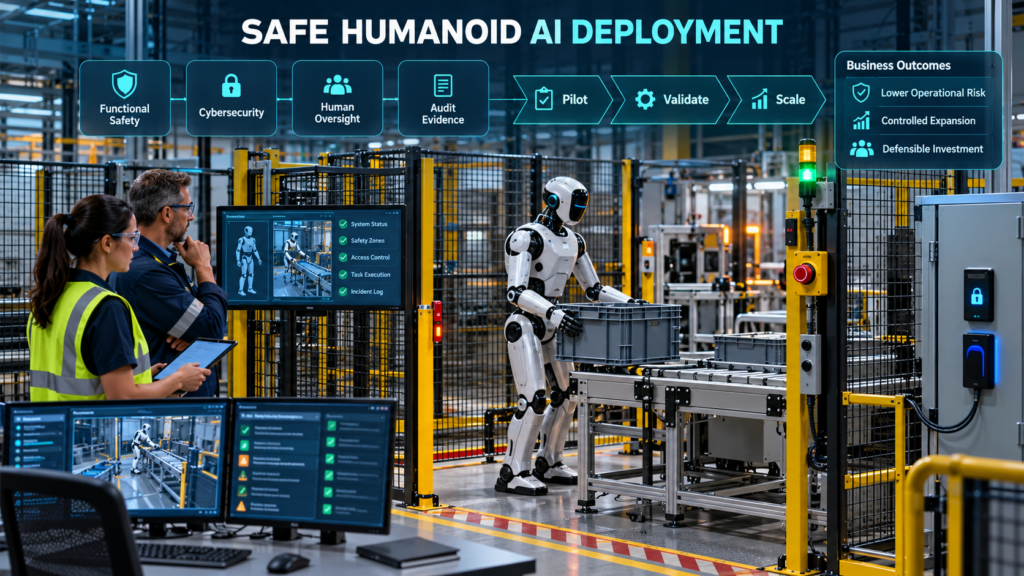
Safety Checklist
- Define intended use, prohibited use and operating boundaries.
- Complete application-specific hazard and task risk assessments.
- Validate speed, force, balance, stopping and restart behavior.
- Test falls, dropped loads, pinch points, battery faults and sensor occlusion.
- Separate training experiments from production-authorized skills.
- Validate doors, elevators, conveyors, carts, tools and workstations.
- Establish emergency response, maintenance isolation and recovery procedures.
- Train employees, contractors, clinical staff and emergency teams.
- Record near misses, protective stops and manual interventions.
- Revalidate after material hardware, model, map or workflow changes.
NIST AI RMF Governance Checklist
NIST describes its AI Risk Management Framework as voluntary guidance for incorporating trustworthiness into the design, development, use and evaluation of AI systems.[21] Apply its Govern, Map, Measure and Manage functions to humanoid AI physical behavior, not only model output.
- Assign accountable owners for safety, AI performance, security and operations.
- Document training data, demonstrations, simulation and evaluation sets.
- Map affected workers, patients, visitors and third parties.
- Measure performance across lighting, people, objects and facility conditions.
- Set confidence thresholds and human-escalation rules.
- Monitor drift, recurring recovery and failure by scenario.
- Require change approval, regression testing and rollback.
- Retain audit evidence without collecting unnecessary personal data.
Cybersecurity and Privacy Checklist
- Inventory robots, chargers, controllers, gateways, models and software versions.
- Segment robot traffic from guest, clinical and general corporate networks.
- Enforce unique identity, least privilege and strong administrator authentication.
- Encrypt supported command, telemetry, video and integration channels.
- Restrict remote operation and require recorded, approved support sessions.
- Validate signed updates and maintain patch and vulnerability-response procedures.
- Minimize video, audio and patient-data capture and retention.
- Back up configurations, maps, certificates and approved skill packages.
- Test ransomware, network loss, cloud outage and compromised credentials.
- Contractually define breach notification, forensics and vendor cooperation.
Risk Register
| Risk | Failure Vector | Business Impact | Control |
|---|---|---|---|
| Fall or dropped load | Balance, grip, perception or floor condition | Injury, damage and shutdown | Mechanical limits, task validation and exclusion zones |
| Wrong action | Model ambiguity or bad task context | Quality, custody or safety event | Deterministic workflow checks and confirmation |
| Hidden teleoperation | Frequent remote recovery | Unplanned labor and privacy exposure | Intervention logging and commercial disclosure |
| Model regression | Update changes physical behavior | New unsafe or unreliable motion | Locked tests, approval and rollback |
| Data leakage | Camera, microphone or telemetry exposure | Privacy, IP and regulatory harm | Minimization, segmentation, encryption and access audit |
| Vendor failure | Product, cloud or support discontinuity | Stranded fleet | Data rights, export, spares and exit terms |
| Fleet congestion | Uncoordinated robots and human traffic | Throughput loss | Simulation, orchestration and peak-load testing |
VIII. Selecting a First Deployment
Start humanoid AI with one bounded task where the human form has a measurable advantage. Do not begin with “general-purpose assistance,” because undefined scope makes safety, acceptance and ROI impossible to prove.
Manufacturers can justify humanoid AI pilots for component handling, sequencing and repetitive intralogistics when existing human-oriented stations would be expensive to rebuild. Healthcare organizations should prioritize non-clinical logistics and compare humanoid platforms against proven mobile manipulators and AMRs.
Illustrative Twelve-Week Evaluation Plan
This schedule is illustrative. Extend each stage where necessary to complete equipment procurement, integration, safety validation and testing across representative operating conditions.
- Weeks 1–2 — Baseline: Measure task volume, cycle distribution, travel, interventions, ergonomic exposure and exceptions.
- Weeks 3–4 — Architecture: Define interfaces, data flows, safety boundaries, recovery and acceptance thresholds.
- Weeks 5–8 — Pilot: Test representative loads, traffic, shifts, failures, charging, updates and support response.
- Weeks 9–10 — Validate: Reconcile robot logs with human observation and calculate conservative TCO.
- Weeks 11–12 — Decide: Scale, redesign or stop based on predetermined evidence rather than sunk cost.
Before requesting supplier proposals, document the target task, alternative automation options, system interfaces, safety requirements, cybersecurity controls, pilot acceptance metrics and five-year TCO assumptions. Require every shortlisted supplier to price and test the same mission catalogue.
Frequently Asked Questions
Are Humanoid Robots Already Working in Factories?
Yes, but humanoid AI remains concentrated in bounded tasks and limited deployments. BMW has published substantial operating data from Figure 02, while Mercedes-Benz and others have conducted pilots with different platforms.
Are Humanoid Robots Ready for Direct Patient Care?
Direct-care humanoid AI evidence remains experimental. Non-clinical hospital logistics has a stronger operating record, while diagnosis, treatment and physical patient handling require much higher clinical and regulatory assurance.
Why Not Use an AMR or Cobot Instead?
Often that is the correct choice. Humanoid AI is justified only when mobility plus human-compatible reach, tools or workstations creates enough additional value to offset complexity.
What Is the Biggest Hidden Cost?
Integration and exception handling are frequent surprises. Remote intervention, model evaluation, workcell changes, support and repeated safety validation can exceed the apparent hardware cost.
How Should Buyers Compare Vendors?
Use identical tasks, loads, shifts and failure tests. Compare mission completion, interventions, cycle-time distribution, availability, energy, safety events, integration scope and five-year TCO.
Appendix A: Academic and Primary-Source Footnotes
- BMW Group, BMW Group to Deploy Humanoid Robots in Production in Germany for the First Time, 2026. https://www.bmwgroup.com/en/news/general/2026/humanoid-robot-in-leipzig.html
- GXO Logistics, GXO Signs Industry-First Multi-Year Agreement with Agility Robotics, 27 June 2024. https://investors.gxo.com/news-releases/news-release-details/gxo-signs-industry-first-multi-year-agreement-agility-robotics
- Diligent Robotics, Moxi Fleet Surpasses One Million Hospital Deliveries, 17 February 2025. https://www.diligentrobots.com/blog/not-a-pilot-not-a-prototypediligent-robotics-hits-1-million-humanoid-deliveriesnbspacross-fleetnbspsupportingnbsphealthcare-customers
- GXO Logistics, Top Supply Chain Projects Award for Humanoid Robotics Pilot, 2024. https://investors.gxo.com/news-releases/news-release-details/gxo-receives-sdce-2024-supply-chain-projects-award-industry/
- Apptronik, Apptronik and Mercedes-Benz Enter Commercial Agreement, 15 March 2024. https://apptronik.com/news-collection/apptronik-and-mercedes-benz-enter-commercial-agreement
- Reuters, Mercedes-Benz Takes Stake in Apptronik and Tests Robots in Factories, 18 March 2025. https://www.reuters.com/business/autos-transportation/mercedes-benz-takes-stake-robotics-maker-apptronik-tests-robots-factories-2025-03-18/
- BMW Group, Successful Test of Humanoid Robots at Plant Spartanburg, 6 August 2024. https://www.press.bmwgroup.com/canada/article/detail/T0444425EN/successful-test-of-humanoid-robots-at-bmw-group-plant-spartanburg
- Figure, Figure 03 Arrives at BMW, 30 June 2026. https://www.figure.ai/news/f-03-at-bmw
- Diligent Robotics, Moxi 2.0 and Hospital Deployment Data, 28 October 2025. https://www.diligentrobots.com/blog/moxi2-0
- Soofiyan Atar et al., Humanoids in Hospitals: A Technical Study of Humanoid Surrogates for Dexterous Medical Interventions, arXiv:2503.12725, 2025. https://arxiv.org/abs/2503.12725
- U.S. Food and Drug Administration, Computer-Assisted Surgical Systems. https://www.fda.gov/medical-devices/surgery-devices/computer-assisted-surgical-systems
- Agility Robotics, Digit 5 Product Information and Preliminary Specifications, 2026. https://www.agilityrobotics.com/solutions/digit-5
- Figure, Figure 03 Product Specifications. https://www.figure.ai/figure
- Apptronik, Apollo 2 Platform. https://apptronik.com/apollo/apollo-2
- International Organization for Standardization, ISO 10218-1:2025—Industrial Robots. https://www.iso.org/standard/73933.html
- International Organization for Standardization, ISO 10218-2:2025—Industrial Robot Applications and Robot Cells. https://www.iso.org/standard/73934.html
- International Organization for Standardization, ISO/TC 299 Robotics Standards Catalogue. https://www.iso.org/committee/5915511/x/catalogue/
- European Union, Regulation (EU) 2023/1230 on Machinery. https://eur-lex.europa.eu/eli/reg/2023/1230/oj/eng
- European Union, Regulation (EU) 2024/1689—Artificial Intelligence Act. https://eur-lex.europa.eu/legal-content/EN/TXT/PDF/?uri=OJ:L_202401689
- U.S. Food and Drug Administration and IMDRF, Good Machine Learning Practice for Medical Device Development, updated 2025. https://www.fda.gov/medical-devices/software-medical-device-samd/good-machine-learning-practice-medical-device-development-guiding-principles
- National Institute of Standards and Technology, AI Risk Management Framework and Playbook. https://www.nist.gov/itl/ai-risk-management-framework
- Laurel D. Riek, Healthcare Robotics, arXiv:1704.03931, 2017. https://arxiv.org/abs/1704.03931
- Longbing Cao, AI Robots and Humanoid AI: Review, Perspectives and Directions, arXiv:2405.15775, 2024. https://arxiv.org/abs/2405.15775
Appendix B: Research Integrity and Editorial Transparency
Corporate Editorial Transparency and AI Usage Disclosure
This white paper was restructured and language-edited with AI assistance under human editorial direction. Deployment, standards, market and product claims were checked against the primary, regulatory or academic sources listed in Appendix A.
AI output does not replace engineering, clinical, safety, cybersecurity, procurement, financial or legal review. Time-sensitive vendor specifications, deployment status and regulatory obligations must be reverified before publication and purchasing decisions.
Author and Editorial Review
Author: Garikapati Bullivenkaiah
Technology research writer with LL.B., LL.M., M.A., and MBA qualifications. He writes about emerging technologies and their business, governance and legal implications. His multidisciplinary academic background informs his analysis of technology adoption, intellectual property, and organizational risk. His articles explain technical concepts and practical considerations for business owners, IT managers and technology decision-makers. LinkedIn Profile
Reviewed by: Chitikineni Ramadevi — Editor
Chitikineni Ramadevi holds an M.Sc. in Computers from Andhra University and has over 10 years of research experience in technology-related subjects. She reviews NezzHub articles for clarity, factual accuracy, source support and practical relevance.
Published by: NezzHub
Research approach: This article draws on primary sources, technical documentation and relevant industry research. References are provided within the article or its sources section.
Last reviewed: 09-26-2026
Corrections: To report a factual error or outdated information, please contact NezzHub.