



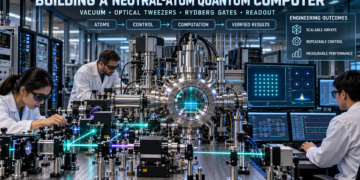



Industrial Robots & Cobots
Industrial Robots and Cobots combine programmable motion, tooling, sensors, control systems and safety engineering to perform repeatable production work. Industrial robots commonly operate inside controlled cells, while collaborative robots can support carefully designed tasks in which people and robots share a workspace or workflow.
This NezzHub subcategory helps business owners, technology leaders, IT managers, engineers, professionals and students evaluate robot arms, cobot applications, AI quality inspection and manufacturing automation. It focuses on complete robotic cells, integration requirements, lifecycle cost and operational risk within the broader Robotics and Automation category.
Explore Industrial Robots and Cobots
An industrial robot arm creates useful output only when its motion is connected to suitable tooling, fixtures, sensors, process equipment and production controls. The arm may repeat a programmed path accurately while the complete process still fails because of part variation, weak gripping, poor calibration or incomplete PLC coordination.
- Industrial robot arms: High-speed or high-payload systems used in controlled production cells.
- Collaborative robots: Robot systems designed for validated collaborative applications.
- End-of-arm tooling: Grippers, weld guns, dispensers, inspection sensors and process tools.
- Machine vision: Cameras and software used for guidance, measurement or inspection.
- Safety engineering: Guards, scanners, interlocks, safe-speed functions and risk controls.
The industrial robot arms deployment guide explains how robot controllers, servo systems, tooling, PLCs, sensing and enterprise production software work together. It also covers practical applications such as machine tending, welding, dispensing, assembly and vision-guided picking.
Business and Enterprise Applications
Industrial robots and cobots are most useful where the process is stable, measurable and repeated often enough to justify engineering and maintenance costs. Automation should solve a defined production constraint rather than serve as a general replacement for human work.
- Machine tending: Loading and unloading CNC machines, presses or other production equipment.
- Assembly: Repeating controlled fastening, insertion or component-handling tasks.
- Welding and dispensing: Coordinating robot motion with process parameters.
- Packaging and palletizing: Handling products, cartons or containers at defined rates.
- Quality inspection: Connecting imaging, inference and industrial controls to product disposition.
The guide to AI quality inspection in manufacturing explains why reliable inspection depends on controlled imaging, defensible labels, edge inference, PLC integration and traceable results. It also addresses false accepts, false rejects and continuing human review.
Smaller manufacturers can use the cobots for small businesses ROI guide to evaluate machine tending, packaging, inspection and light assembly. The business case should include tooling, fixtures, integration, training, safety validation, maintenance and expected production changes.
Architecture, Integration and Deployment
A production robotic cell can include the manipulator, robot controller, tooling, PLC, safety controller, sensors, conveyors, machines and enterprise data systems. Weakness at any interface can reduce availability or create difficult-to-diagnose failures.
- Define payload, reach, cycle time, repeatability and process requirements.
- Test parts, tooling and fixtures across realistic production variation.
- Map PLC signals, machine states, alarms and recovery sequences.
- Validate robot, tooling and workpiece hazards as one application.
- Connect production orders, recipes and quality records where required.
- Plan calibration, preventive maintenance, spare parts and technical support.
- Measure throughput, downtime, intervention, defects and recovery time.
Robot selection should follow application design rather than precede it. A smaller collaborative robot may suit flexible light-duty work, while a guarded industrial system may provide higher speed, payload or process capability for stable high-volume production.
Risks, Security and Governance
A cobot is not automatically safe because it includes force or speed limitations. The complete application—including tooling, workpiece, fixtures, motion, environment and human interaction—requires a documented risk assessment and validated protective measures.
The collaborative robots and safer automation guide explains how robot functions must be combined with application-level safety engineering. Collaborative operation may still require separation, monitoring or restricted access during selected process stages.
- Restrict controller, engineering and remote-support access.
- Segment robot networks from unrelated business systems.
- Control software, program and configuration changes.
- Protect backups, credentials and production recipes.
- Test safe responses to network, sensor and controller failures.
- Record overrides, safety events and significant program changes.
- Review connected cameras and production data for privacy exposure.
Cybersecurity failures can create downtime, product-quality problems or unsafe machine states. Responsibility should be assigned across operations, engineering, IT, cybersecurity, maintenance and safety teams.
How to Use This Subcategory
Business owners should begin with the small-business cobot guide and compare lifecycle cost with measurable labour, quality or machine-utilization constraints. IT managers should focus on networks, access controls, data integration, software updates and recovery.
Engineers and operations teams can use the industrial robot, collaborative robot and AI inspection guides to develop requirements and acceptance tests. Students should begin with robot-cell architecture before moving into safety engineering and ROI evaluation.
Frequently Asked Questions
What is the difference between an industrial robot and a cobot?
Industrial robots commonly operate inside separated cells at higher speeds or payloads. Cobots provide functions intended for collaborative applications, but their suitability depends on the complete task and risk assessment.
Are collaborative robots automatically safe?
No. Tooling, workpieces, speed, force, fixtures and process hazards must be evaluated as part of the complete robotic application.
What should a robot automation budget include?
Include the robot, controller, tooling, fixtures, safety equipment, integration, software, training, maintenance, infrastructure and expected downtime during commissioning.
Are cobots suitable for small manufacturers?
They can be suitable when a stable, measurable process has enough volume to justify integration and operating costs. Flexibility does not eliminate engineering or safety requirements.
Latest Industrial Robots and Cobots Articles
Browse the archive below for the latest NezzHub research on Industrial Robots and Cobots, manufacturing automation, industrial robot arms, collaborative safety, AI inspection, deployment cost and operational ROI.

Industrial Robot Arms: Motion Control and Manufacturing Applications
Executive Briefing Industrial robot arms create value when controlled motion produces acceptable parts reliably. The working asset includes tooling, fixtures,...

Cobots for Small Businesses: Choosing a First Project and Calculating Payback
Executive Briefing Cobots for Small Businesses work best when they address one measurable production constraint. That might be a CNC...
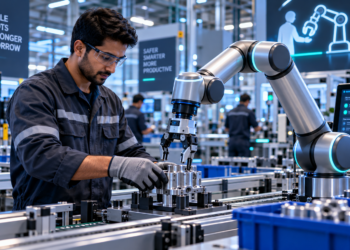
Collaborative Robots: Workcell Design, Safety and Production Costs
Executive Briefing Collaborative Robots create value when the complete workcell produces acceptable parts at a competitive cost. The arm is...













Recent News







NezzHub is a technology-focused knowledge hub delivering insights on AI, robotics, cybersecurity, biotech, and emerging innovations. Our mission is to simplify complex technologies through research-driven content and analysis.