












Executive Summary
Cobots for small businesses are useful when one stable production constraint is consuming paid hours, creating ergonomic exposure, or limiting machine utilization. Their value comes from repeatable execution inside a well-engineered cell—not from the robot arm alone.
The commercial case is strongest in machine tending, packaging, palletizing, dispensing, inspection and light assembly. These jobs have measurable cycles, consistent inputs and enough annual volume to absorb engineering, tooling, training and maintenance costs.
The market signal is real, but it should not be exaggerated. The International Federation of Robotics reported 541,302 industrial robot installations in 2023; collaborative robots represented 10.5% of that total. That makes cobots an established segment, not a universal replacement for conventional automation.
Safety is also application-specific. ISO/TS 15066 supplements ISO 10218 for collaborative industrial robot systems and their work environments; it does not declare every cobot application safe by default. A sharp gripper, heavy workpiece, hot tool or crushing point can require scanners, guarding, restricted speed or a redesigned process.
For buyers, the practical decision is simple. Build a baseline, price the complete cell, test the cycle under production conditions and approve expansion only when measured net benefits clear the company’s investment hurdle.
Powerful Collaborative Robots: Safer Human-Robot Automation for 2026
I. Cobots for Small Businesses: Market Landscape and Challenge
Small Firms Need Capacity Without a Fixed Production Line
Small manufacturers live with a difficult mix: short production runs, changing parts, experienced operators who cover several processes and customers who still expect stable lead times. Cobots for small businesses can address that mix, while a dedicated high-speed robot can solve one problem but create a capital-allocation problem if the product changes.
Cobots for small businesses occupy the space between manual work and a fully engineered high-speed cell. They can be reassigned, but only when the mounting, tooling, safety validation and programs have been designed for reuse.
This is why flexibility in cobots for small businesses must be measured in changeover hours, not described as a product feature. A cell that takes three days of engineering to move is not flexible merely because the arm sits on a mobile pedestal.
Small business automation also fails when owners start with the robot rather than the constraint. A slow upstream fixture, inconsistent part presentation or machine that requires manual door changes can starve the cobot and destroy the expected utilization.
The Cost of Inaction Is Hidden in the Constraint
The most visible cost is direct labor assigned to repetitive motion. The case for cobots for small businesses may instead sit in idle CNC time, overtime, missed shipments, scrap, repetitive-strain exposure and skilled employees performing low-value handling.
Cobots for small businesses can convert some of that loss into usable capacity. The conversion is not one-for-one: operators still replenish material, clear faults, inspect exceptions, perform changeovers and maintain the cell.
A buyer should therefore establish a twelve-week baseline before requesting quotes. Record good units per hour, labor touch time, blocked and starved time, changeover minutes, first-pass yield, scrap, unplanned stops and overtime attributable to the process.
Cost-of-Inaction Baseline
| Measure | Baseline calculation | Why it changes the decision |
| Lost contribution margin | Unfilled good units × contribution per unit | Values constrained capacity without confusing revenue with profit |
| Direct touch cost | Touch hours × fully burdened hourly rate | Shows labor that automation can realistically release |
| Scrap and rework | Defective units × material and recovery cost | Captures quality leakage rather than claiming zero defects |
| Machine starvation | Available machine minutes − cutting/process minutes | Identifies whether tending, not machining, is the constraint |
| Overtime premium | Overtime hours × premium portion of wage | Isolates an avoidable incremental expense |
| Ergonomic exposure | Reaches, lifts or force events per shift | Supports job redesign and safety review |
Labor Relief Is Not Automatic Headcount Reduction
A cobot automates defined tasks rather than performing an employee’s full role. The complete cell still requires supervision, utilities, maintenance and engineering support.
Cobots for small businesses create value when released operator time is converted into more output, better quality, faster changeovers or avoided overtime. If the employee remains idle, the spreadsheet records a saving that the income statement never receives.
Assign that work before including released operator time in the ROI calculation
II. Cobots for Small Businesses: Technical Analysis and Evidence
Architecture Overview: The Arm Is Only One Layer
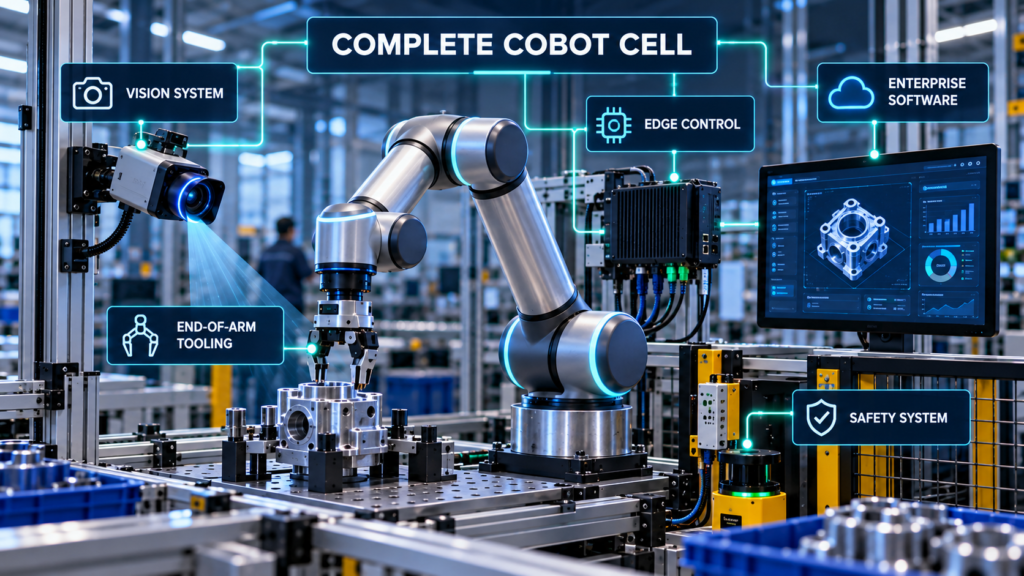
A reliable robotic automation deployment includes mechanical, control, safety and business-system layers. Omitting any layer turns a simple demonstration into an unstable production asset.
Cobots for small businesses should be specified as complete cells with clear responsibility at every interface:
- Robot and controller: payload, reach, repeatability, speed limits, safety functions and program execution.
- End-of-arm tooling: gripper, vacuum circuit, welder, screwdriver, dispenser or inspection sensor.
- Part presentation: trays, conveyors, fixtures, bowl feeders, pallets or machine-side buffers.
- Safety system: risk assessment, safe zones, scanners, interlocks, emergency stops and validated stop behavior.
- Cell control: PLC or robot I/O, machine handshake, fault states, recovery logic and recipe control.
- Operational data: cycle counters, reason codes, alarms, quality results and maintenance events.
- Enterprise integration: manufacturing execution system, enterprise software, inventory records or work-order status where the business case requires it.
A robot advertised with 12.5 kg payload cannot necessarily carry a 12.5 kg product. For cobots for small businesses, gripper mass, cables, hoses, center of gravity, acceleration and wrist torque consume part of the rated envelope.
Reach deserves the same scrutiny. Catalogue reach is not usable reach after singularities, fixtures, safe approach paths, door geometry and collision clearance are considered.
Integration Flowchart: From Order to Verified Cycle
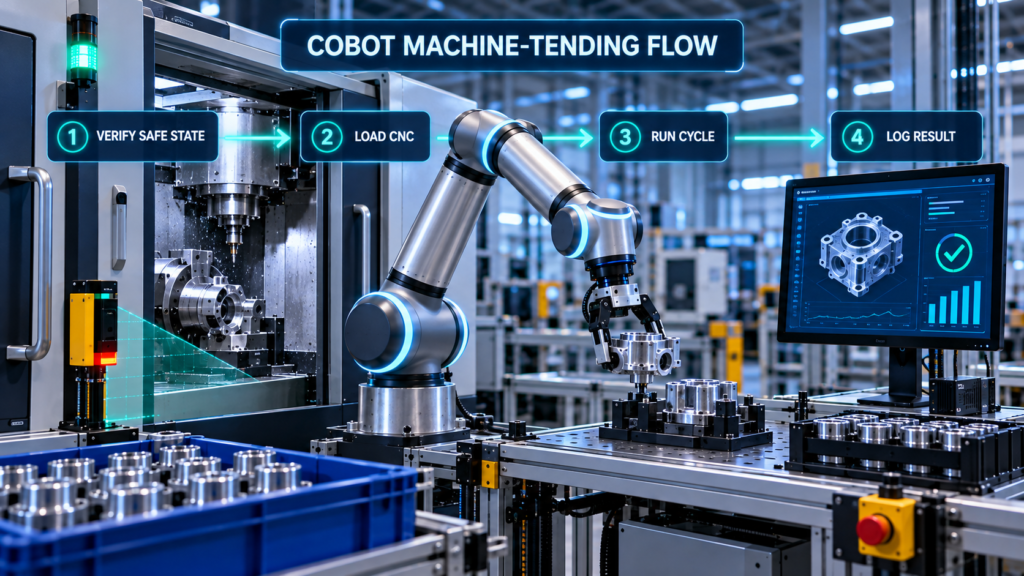
The control flow for cobots for small businesses should remain deterministic even when an AI vision model is added. The robot must move only after the cell has received a valid job, verified a safe state and confirmed that the next destination is ready.
- Receive and validate the work order.
- Verify the recipe, fixture and tooling.
- Confirm that the required safety conditions are satisfied.
- Detect the part and check its condition.
- Execute the approved robot cycle.
- Confirm the machine or inspection result.
- Record completion and route exceptions to the approved recovery procedure.
For machine tending, the handshake must cover more than “cycle complete.” Cobots for small businesses need logic that checks door position, fixture state, part presence, machine-ready status, robot-clear status and the recovery path after a power or air interruption.
A cheap integration can become expensive when fault recovery requires an engineer. Operators need guided recovery states that prevent a half-loaded fixture, duplicated cycle or collision after restart.
Four Collaboration Modes and Their Trade-Offs
ISO guidance recognizes several ways to control human–robot interaction. The right mode depends on hazards created by the robot, tool, workpiece and surrounding equipment.
Safety-Rated Monitored Stop
The robot stops before a person enters the collaborative workspace and resumes only after safe conditions return. This mode can preserve automated speed for cobots for small businesses when the space is clear but requires reliable presence detection and restart logic.
Hand Guiding
An operator directly guides the robot through a controlled interface. Hand guiding is useful for teaching or positioning, but it does not remove the need to control pinch points and unexpected movement.
Speed and Separation Monitoring
Safety sensors track the distance between a person and the moving system. In cobots for small businesses, the controller reduces speed or stops as separation closes, trading cycle time for shared-space access.
Power and Force Limiting
The system limits contact energy and force within the validated application. A compliant arm does not neutralize a pointed tool, heavy payload, trapping geometry or workpiece edge.
Cobots for small businesses often lose projected throughput after conservative safety settings are applied. Run the acceptance test at validated production speed, not at an unsafe demonstration speed.
Deployment Challenges That Decide the Business Case
Variable Inputs
People compensate instantly for a rotated carton, warped blank or oily part. Cobots for small businesses need fixtures, sensing or vision, and each added tolerance increases engineering effort and fault probability.
End-of-Arm Tooling
Grippers determine whether the robot can hold the part through acceleration, surface variation and loss of power. Cobots for small businesses need grip verification, safe failure behavior and a maintenance plan for fingers, cups, seals and cables.
Cycle-Time Mismatch
Collaborative operation may require slower motion than a guarded industrial cell. Cobots for small businesses are the wrong choice when required takt time makes conventional guarded automation safer, faster and cheaper per unit.
Changeover Discipline
Cobots for small businesses support high-mix production only when recipes, fixtures and tool offsets are controlled. Informal edits at the teach pendant create version drift and unpredictable recovery.
Network and Software Risk
Remote support, fleet dashboards and enterprise software connectors widen the attack surface. Segment the robot network, restrict remote access, inventory firmware, back up programs and define who can approve updates.
What Research Actually Shows
Evaluate productivity, quality and ergonomics separately during the pilot. A cell may reduce manual handling or defects while increasing cycle time. Compare the complete workflow with the manual baseline under representative operators, shifts and product variants before using the results in an investment decision.
Performance Evaluation Matrix
| Dimension | Required baseline | Pilot acceptance test | Evidence standard |
| Throughput | Good units/hour by shift | Median and worst-hour output | At least 10 representative production shifts |
| Quality | First-pass yield and rework | Same gauge and sampling plan | No change in inspection method during test |
| Availability | Run, blocked, starved and fault time | Availability by reason code | Automated timestamps plus operator notes |
| Labor | Direct touch minutes/unit | Touch time including replenishment | Observe normal operators, not integrator staff |
| Changeover | Minutes and people required | Recipe-to-first-good-piece time | Test two real product variants |
| Safety | Documented hazards and exposure | Residual-risk sign-off | Qualified risk assessment and validation |
| Recovery | Mean time to restore production | Common-fault recovery drill | Operators recover without program editing |
III. Cobots for Small Businesses: Solutions and Best Practices
Feature and Cost Comparison Table
Robot prices vary by country, distributor, controller, warranty and configuration. Public list prices are often absent, so any honest collaborative robot cost comparison must use quote-only labels and require an all-in proposal.
The table below compares published arm specifications for a useful mid-payload shortlist of cobots for small businesses. It does not claim that the models are equivalent or that their maximum payload is available across the full workspace.
| Platform | Published payload | Published reach | Published positioning data | Commercial fit | Price treatment |
| Universal Robots UR12e | 12.5 kg | 1,300 mm | Manufacturer markets repeatability down to ±0.03 mm across its line | Broad partner ecosystem; compact machine tending and assembly | Request arm and complete-cell quotes |
| FANUC CRX-10iA/L | 10 kg | 1,418 mm | Verify on current regional datasheet | Long reach; machine tending, packing, dispensing and welding | Request arm and complete-cell quotes |
| ABB GoFa 10 | 10 kg | 1,620 mm | Verify on current regional datasheet | Long-reach handling and tending where layout drives selection | Request arm and complete-cell quotes |
| Techman TM12 | 12 kg | 1,300 mm | Verify on current regional datasheet | Integrated-vision workflows where the vision stack fits the part | Request arm and complete-cell quotes |
Universal Robots currently publishes 12.5 kg payload and 1,300 mm reach for the UR12e, while FANUC publishes 10 kg payload and 1,418 mm reach for the CRX-10iA/L. Buyers should freeze datasheet revisions in the purchase specification because product families change.
Cobots for small businesses should be compared at system level. A lower arm quote can produce a higher project total if it needs custom PLC work, third-party safety hardware or a difficult vision integration.
Total Cost of Ownership: Budget the Cell, Not the Arm
Installed-cell costs vary by application, country and integration scope. Obtain dated, itemized quotations that include tooling, safety equipment, commissioning and support
For cobots for small businesses, use a vendor-neutral cost model instead:
| Cost layer | Typical contents | Quote requirement |
| Robot platform | Arm, controller, teach device, base software | Model, payload/reach option, warranty and lead time |
| Tooling | Gripper, fingers, vacuum, welder or dispenser | Part range, grip sensing, consumables and safe failure mode |
| Cell hardware | Pedestal, cart, fixtures, trays, guarding and scanners | Layout drawing and included fabrication |
| Controls | PLC, I/O, safety controller and machine interface | Signal list, fault states and recovery sequence |
| Engineering | Simulation, programming, risk assessment and validation | Fixed scope, assumptions and change-order rates |
| Operations | Training, spare parts, preventive maintenance and support | Response time, travel fees and annual service |
| Data layer | Dashboard, connectors, licences and storage | Subscription term, export rights and cybersecurity controls |
Cobots for small businesses can reduce cost when a standard application kit replaces custom engineering. That saving is real only if the kit covers the actual box sizes, machine interface, payload, reach and required safety functions.
A Six-Gate Deployment Framework
Gate 1: Select the Constraint
Choose one process with stable volume, observable waste and a named owner. Cobots for small businesses should never be piloted mainly because they look impressive in a demonstration.
Gate 2: Prove Technical Feasibility
Test the worst-case part, payload, surface, lighting and cycle. Cobots for small businesses should complete normal and exception flows before the purchase order is released.
Gate 3: Complete the Safety Concept
Identify crushing, impact, cutting, thermal, electrical, pneumatic and unexpected-start hazards. Cobots for small businesses require a decision on which hazards can be designed out and which need safety-rated controls.
Gate 4: Freeze Commercial Scope
Demand a line-item quote, acceptance criteria, documentation set, training hours and responsibility matrix. State who supplies fixtures, network drops, air, power, consumables and machine modifications.
Gate 5: Run a Production Pilot
Test representative shifts and product variants. Record micro-stops, replenishment time and recovery work that a showroom cycle hides.
Gate 6: Approve or Stop
Compare measured annual benefit with operating cost and required return. Scale cobots for small businesses only after the owner, operator, safety lead and finance reviewer accept the evidence.
Build-versus-Buy Decision
A technically capable shop may self-integrate a simple pick-and-place cell, but it also becomes responsible for system-level risk assessment, validation, documentation and production support. “Easy to program” does not mean “easy to engineer.”
Cobots for small businesses with limited controls expertise are often better served by a fixed-price application kit or qualified integrator. The premium can be cheaper than months of internal trial, production disruption and undocumented safety logic.
IV. Cobots for Small Businesses: ROI and Business Outcomes
Calculate Cobot ROI From Incremental Cash Flow
Estimate payback using realized benefits after deducting ongoing operating costs:
Annual net benefit = released labor value + incremental contribution margin + scrap savings + avoided overtime − annual operating cost.
Simple payback = initial all-in investment ÷ annual net benefit.
The result is in years. Use this screening calculation only when annual net benefit is positive and reasonably stable. Where commissioning, ramp-up or benefits vary substantially, calculate payback using cumulative cash flows.
This is a screening calculation, not a complete capital budget for cobots for small businesses. Finance teams should also model tax, depreciation, working capital, residual value, ramp-up and the company’s discount rate.
Illustrative ROI Scenario—Not a Market Benchmark
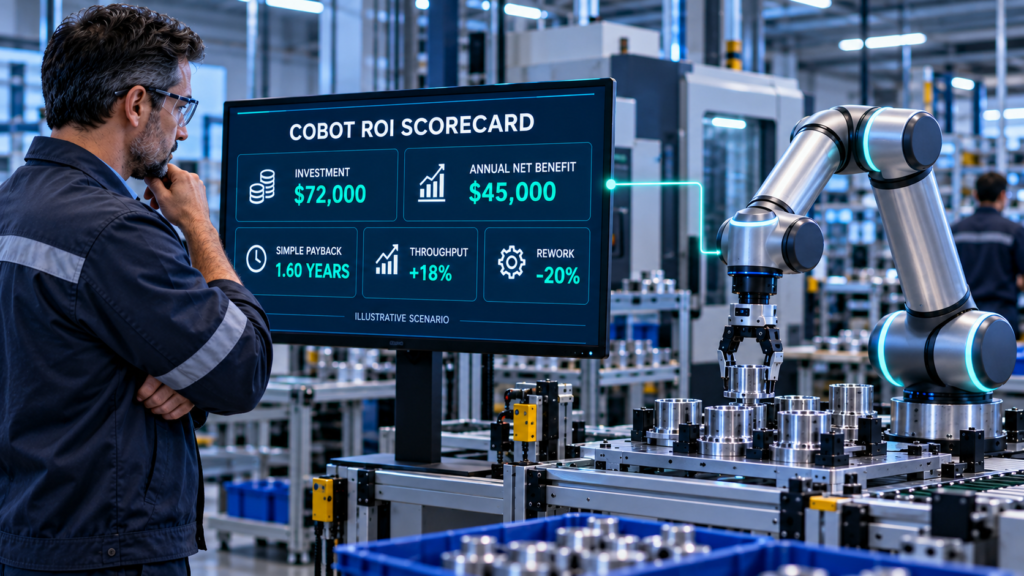
Assume one deployment of cobots for small businesses costs $72,000, including tooling, integration, safety equipment and training. The figures below are transparent assumptions for replacement with local data.
| Annual benefit or cost | Assumption | Value |
| Released operator capacity | 1,200 hours × $24/hour realized value | $28,800 |
| Avoided overtime premium | 350 hours × $12/hour premium | $4,200 |
| Scrap and rework reduction | Baseline $18,000 × 20% | $3,600 |
| Incremental contribution | 6,000 added units × $2.50/unit | $15,000 |
| Support, tooling and energy | Annual estimate | −$6,600 |
| Annual net benefit | Sum of above | $45,000 |
| Simple payback | $72,000 ÷ $45,000 | 1.60 years |
This example assumes that the $28,800 labor benefit is a separately realized saving or benefit that is not already included in the $15,000 incremental contribution. The overtime premium is also separate from the labor benefit. Count each benefit once and include all additional operating costs.
The result collapses if released hours do not become productive capacity. With only half the labor value realized and no incremental contribution, annual net benefit falls sharply and the investment may miss the approval threshold.
Cobots for small businesses should therefore have a downside case. Reduce volume, add changeover time, include expected stoppages and extend commissioning; if the project survives those assumptions, the decision is more resilient.
Strategic Outcomes Beyond Labor
More Productive Constraint Hours
Cobots for small businesses can load during breaks or support a longer operating window, but only if material, downstream capacity and supervision are available. Measure good output from the constrained resource, not robot motion time.
Lower Variation
Repeatable placement, torque or dispensing can reduce process variation. Cobots for small businesses do not guarantee quality because fixture wear, bad input material, sensor drift and incorrect recipes still create defects.
Better Ergonomics
Removing high-frequency lifts, awkward reaches or forceful repetition can improve the job design. The risk assessment must also examine new hazards created by loading stations, mobile bases and shared access.
Faster Operational Learning
Cycle and fault data expose blocked time that was previously anecdotal. Connecting those data to small business automation dashboards can support cost optimization, preventive maintenance and better scheduling.
When a Cobot Is the Wrong Investment
Cobots for small businesses are a poor fit when the process changes every few units, parts arrive unpredictably, payloads are near the arm limit, hazards demand full enclosure, or required speed exceeds collaborative operation.
A fixture redesign, conveyor, lift assist, poka-yoke device or software workflow may remove the constraint for less money. Conventional industrial robotics can also deliver better economics when volume is stable and speed dominates flexibility.
The correct decision may be “not yet.” Standardize the process, repair the machine, improve part presentation and collect a clean baseline before funding robotic automation deployment.
V. Cobots for Small Businesses: Deployment Playbook
First 30 Days: Baseline and Concept
Create a cross-functional team for cobots for small businesses with an operator, process owner, maintenance lead and safety reviewer. Map every handoff, exception and restart state, not only the normal cycle.
Ask vendors to test actual parts. Cobots for small businesses should be evaluated with the heaviest product, poorest surface, narrowest tolerance and most difficult changeover expected in the next two years.
Days 31–60: Design and Procurement
Freeze the user requirement specification for cobots for small businesses. Include takt time, payload at tool center point, reach envelope, quality checks, uptime reporting, utilities, cybersecurity, training and site-acceptance criteria.
Request a bill of materials and responsibility matrix. Collaborative robot cost disputes usually come from exclusions: fixtures, machine I/O, safety validation, shipping, installation, operator time or post-launch support.
Days 61–90: Commissioning and Acceptance
Run factory acceptance before shipment where practical, then repeat tests at the site. Cobots for small businesses must demonstrate normal production, planned changeover, loss of part, loss of air, emergency stop, network loss and controlled restart.
Do not sign acceptance on a single successful cycle. Use a timed run with an agreed sample size, good-unit target, maximum fault count, recovery-time limit and quality threshold.
Operator Ownership
Train operators to start, stop, change recipes, replenish parts and recover approved faults. Restrict safety configuration and structural program changes to authorized roles.
Operator feedback is production data. A cell that meets throughput but forces awkward replenishment or confusing recovery will accumulate workarounds and lose control.
VI. Cobots for Small Businesses: Performance Validation
Evidence Hierarchy for Commercial Claims
Use standards and regulations for requirements, peer-reviewed or clearly described experiments for technical evidence, and vendor datasheets for product specifications. Treat vendor case studies as examples with commercial interest, not neutral benchmarks.
Cobots for small businesses need local validation because task design drives results. A percentage reported for one assembly workstation cannot predict performance in welding, food handling or CNC tending.
Minimum Measurement Protocol
- Freeze the baseline definition and data window before commissioning.
- Run the pilot across representative operators, shifts and product variants.
- Record good units, defects, stops, recovery minutes, touch time and changeover.
- Separate planned downtime from technical failure and material starvation.
- Compare median performance and the worst production hour, not only the best cycle.
- Document process changes that occurred during the test.
- Have operations and finance approve the realized-benefit assumptions.
This protocol prevents a common error: attributing every improvement made during cell redesign to the robot. Better fixtures, work instructions and material flow may generate part of the gain and should be recognized separately.
Performance Scorecard
| Metric | Approval question | Stop condition |
| Good-unit throughput | Does the cell relieve the named constraint? | No improvement under representative mix |
| First-pass yield | Is quality equal or better under the same inspection? | New defect mode or unstable gauge result |
| Operator touch time | Is released time actually usable elsewhere? | Frequent intervention consumes projected saving |
| Fault recovery | Can trained operators restore the cell safely? | Engineer required for routine faults |
| Changeover | Does flexibility survive real product changes? | Changeover erases batch economics |
| Residual risk | Are controls validated and documented? | Uncontrolled severe hazard |
| Annual net benefit | Does downside ROI clear the hurdle rate? | Benefit depends on unapproved headcount assumptions |
VII. Risk Mitigation and Regulatory Framework
Mandatory Risk and Compliance Checklist
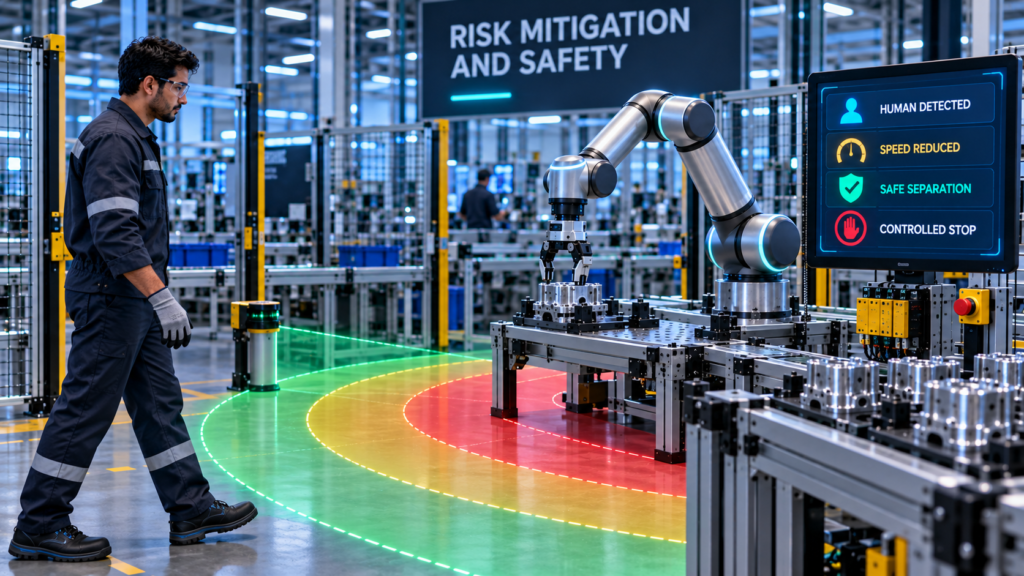
- Define the intended use, foreseeable misuse and operating environment.
- Assess the complete application, including tool, workpiece, fixture and adjacent machine.
- Select and validate collaborative operating mode and safety functions.
- Measure stopping behavior and protective separation where applicable.
- Control sharp, hot, heavy, pressurized and electrically energized hazards.
- Validate emergency stops, interlocks, restart prevention and loss-of-utility states.
- Document residual risks, operator training and maintenance procedures.
- Segment networks; control remote access, accounts, backups and firmware changes.
- Maintain change control so a new tool, payload or program triggers safety review.
- Confirm local machinery, electrical, occupational safety and sector-specific obligations.
ISO, NIST and EU Governance
ISO/TS 15066:2016 specifies safety requirements for collaborative industrial robot systems and the work environment while supplementing ISO 10218-1 and ISO 10218-2. A buyer should require the integrator to state which standards and validation methods were applied.
NIST’s AI Risk Management Framework is voluntary guidance for managing risks to people, organizations and society across AI design, development, deployment and use. It becomes relevant when cobots for small businesses use adaptive perception, AI inspection or data-driven decision logic rather than deterministic sensing alone.
The EU AI Act does not make every cobot an AI system or automatically classify every installation as high risk. High-risk obligations can apply where an AI system is a safety component of a product covered by listed Union harmonization legislation and requires third-party conformity assessment, so legal classification must examine the actual system and intended purpose.
The EU Machinery Regulation 2023/1230 applies from 20 January 2027 and explicitly addresses machinery incorporating systems with fully or partially self-evolving behaviour using machine-learning approaches. Suppliers serving the EU should align technical files, change control and conformity planning before that date.
Failure Vectors to Test
The risk file should cover dropped parts, vacuum loss, double picks, sensor contamination, reflective surfaces, occluded vision targets, fixture wear, network loss, program drift, unauthorized edits and incorrect recipe selection.
Cobots for small businesses also need human-factors testing. Operators may enter the workspace early, bypass inconvenient sensors or stand in an unanticipated trapping zone if the cell design fights the job.
Cybersecurity Controls
Keep robot controllers off the general office network where possible. Use named accounts, least privilege, approved remote-service windows, configuration backups and an inventory of controllers, cameras, gateways and software versions.
If cloud analytics or enterprise software integration is purchased, define data ownership, retention, export, support access and end-of-contract deletion. Availability must not depend on an undocumented personal account.
VIII. Final Decision and Call to Action
Cobots for small businesses are useful because they let a lean operation automate one measurable physical constraint without committing to a fixed, plant-wide architecture. That advantage survives only when the process is standardized, the complete cell is priced and the application is validated for safety and production.
Do not begin with a catalogue. Begin with twelve weeks of process evidence and a one-page problem statement covering volume, cycle, quality, labor touch time, variants, hazards and desired payback.
Then invite qualified vendors to prove the hardest cycle with real parts. Approve the project only when the production test, downside cobot ROI and risk file all support the same decision.
Request three comparable, line-item proposals for the same user requirement specification. Score each on complete-cell cost, validated throughput, recovery, support, cybersecurity and compliance—not on arm price or demonstration speed.
IX. Frequently Asked Questions
Are cobots automatically safe without guarding?
No. Safety belongs to the complete application, and a risk assessment may require scanners, separation, limited speed, guarding or process redesign despite the use of a collaborative arm.
Which first applications usually produce the clearest evidence?
Machine tending, packaging, palletizing, dispensing and repeatable pick-and-place are strong candidates when inputs are consistent. The best first project is the stable task attached to a measured business constraint.
What does a collaborative robot cost?
The arm price is not the investment figure. Buyers must add tooling, fixtures, safety hardware, controls, engineering, training, commissioning, support, software and internal project time to calculate collaborative robot cost.
How quickly do cobots for small businesses pay back?
There is no credible universal period. Payback depends on utilization, realized labor value, incremental contribution, scrap, overtime, operating cost and initial system cost; a production pilot should supply those inputs.
Can one cobot move between several jobs?
Yes, when reach, payload, tools, fixtures, programs and safety validation have been planned for each station. Redeployment still consumes changeover and engineering time, which belongs in the ROI model.
Do cobots replace skilled workers?
They automate defined motions, not the full scope of a skilled role. The business benefit appears when employees use released time for setup, inspection, maintenance, troubleshooting or other productive work.
Is AI required for a cobot cell?
No. Many successful cells use deterministic programs, sensors and PLC handshakes; AI vision is justified only when it improves perception enough to offset compute, validation, drift and governance overhead.
Appendix A: Sources and Research Integrity
Research Limitations
Vendor specifications can change by region and product revision. Prices are intentionally not represented as market benchmarks because comparable public, installed-cell pricing was not available for all shortlisted platforms.
Academic studies cited here validate specific experimental configurations. The commercial conclusions are reasoned implementation guidance, not a claim that those results will reproduce in every factory.
Corporate Editorial Transparency and AI Usage Disclosure
AI-assisted tools were used to support research organization, drafting and language refinement. NezzHub retains editorial responsibility for the published article. Vendor inclusion does not constitute endorsement.
Author and Editorial Review
Author: Garikapati Bullivenkaiah
Technology research writer with LL.B., LL.M., M.A., and MBA qualifications. He writes about emerging technologies and their business, governance and legal implications. His multidisciplinary academic background informs his analysis of technology adoption, intellectual property, and organizational risk. His articles explain technical concepts and practical considerations for business owners, IT managers and technology decision-makers. LinkedIn Profile
Reviewed by: Chitikineni Ramadevi — Editor
Chitikineni Ramadevi holds an M.Sc. in Computers from Andhra University and has over 10 years of research experience in technology-related subjects. She reviews NezzHub articles for clarity, factual accuracy, source support and practical relevance.
Published by: NezzHub
Research approach: This article draws on primary sources, technical documentation and relevant industry research. References are provided within the article or its sources section.
Last reviewed: 09-11-2026
Corrections: To report a factual error or outdated information, please contact NezzHub.

Garikapati Bullivenkaiah is a seasoned entrepreneur with a rich multidisciplinary academic foundation—including LL.B., LL.M., M.A., and M.B.A. degrees—that uniquely blend legal insight, managerial acumen, and sociocultural understanding. Driven by vision and integrity, he leads his own enterprise with a strategic mindset informed by rigorous legal training and advanced business education. His strong analytical skills, honed through legal and management disciplines, empower him to navigate complex challenges, mitigate risks, and foster growth in diverse sectors. Committed to delivering value, Garikapati’s entrepreneurial journey is characterized by innovative approaches, ethical leadership, and the ability to convert cross-domain knowledge into practical, client-focused solutions.