

















Executive Summary
Quantum computing has crossed an important engineering threshold, but not the one suggested by most vendor headlines. Enterprises can access real processors through the cloud, test hybrid workflows and measure hardware performance today; they cannot yet assume a fault-tolerant machine will beat a well-tuned classical system on a valuable production workload.
That distinction changes the investment case. A credible programme starts with a mathematically suitable problem, establishes the best classical baseline, estimates logical-qubit and circuit-depth requirements, and treats hardware access as experimental infrastructure rather than a replacement for conventional enterprise software.
The strongest near-term business action may not involve running a quantum circuit at all. NIST finalized its first three post-quantum cryptography standards in August 2024 and urged administrators to begin transitioning, making cryptographic discovery, dependency mapping and migration planning board-level work.[1]
Quantum computing procurement therefore has two tracks. The first builds application readiness through simulators, cloud quantum processing units and small controlled experiments; the second reduces “harvest now, decrypt later” exposure by moving long-lived sensitive data toward quantum-resistant cryptography.
This Article explains the architecture, integration flow, performance evidence, platform choices, deployment failure modes and finance controls required for enterprise quantum computing. It also provides an auditable decision framework that separates measured results from vendor roadmaps.
I. The Current Market Landscape and Challenge
The Market Has Hardware, but Not a General-Purpose Quantum Advantage
Commercial access is real. IBM exposes superconducting processors, Amazon Braket aggregates superconducting, trapped-ion and neutral-atom systems, Microsoft Azure Quantum connects several hardware providers, and D-Wave offers annealing and hybrid optimization services.[2][3][4][5]
The quantum computing economic question is harder: can a selected workload produce a better business outcome after queue time, sampling, error mitigation, classical preprocessing, network latency, specialist labour and validation are included? A faster-looking circuit is irrelevant if end-to-end time, accuracy or cost loses to a classical solver.
Physical-qubit counts are also poor quantum computing procurement shorthand. Two processors with the same nominal count can differ materially in connectivity, two-qubit gate fidelity, measurement error, coherence, calibration stability, throughput and compiler efficiency.
IBM, for example, reports its Heron family with 133 or 156 programmable qubits and publishes operational quality and throughput metrics.[2] Those specifications are more useful than qubit count alone, yet they still do not predict performance for every customer circuit.
Quantum Computing Noise Compounds Faster Than Marketing Slides Admit
A quantum computing programme applies calibrated control pulses or equivalent operations to fragile physical systems. Every preparation, gate, idle interval and measurement introduces some probability of error, while crosstalk and drift make those errors correlated or time-dependent.
Quantum computing circuit depth therefore matters. A workload may fit the processor’s qubit count but fail because too many sequential operations accumulate noise before the final measurement.
Useful output usually requires repeated circuit execution, called shots. Sampling improves statistical confidence, but it raises cloud charges and does not repair systematic bias caused by a poor circuit, unstable calibration or incorrect problem encoding.
Quantum computing error mitigation can estimate a cleaner result without fully correcting errors. It may also multiply circuit executions, classical processing and cost, so its overhead belongs in the pilot budget rather than in a footnote.
The Cost of Inaction Has Two Very Different Forms
Ignoring quantum computing application readiness creates a capability gap. Competitors may build scarce skills, reusable encodings, benchmark libraries and supplier knowledge while a late entrant is still trying to identify which business problems are quantum-compatible.
Ignoring cryptographic migration creates a security gap. Data encrypted today can be collected and retained until a capable cryptanalytic machine exists, which matters for health records, state information, intellectual property and other assets with long confidentiality lives.
The wrong quantum computing response is uncontrolled spending. An enterprise can lose money by funding demonstrations with no classical benchmark, no decision threshold and no production owner.
The practical quantum computing response is a staged portfolio. Fund security migration as risk reduction, fund application experiments as option creation, and require separate evidence for each investment.
Market Claims That Procurement Teams Should Reject
“A qubit is both zero and one” is an incomplete quantum computing explanation. A qubit is represented by a quantum state whose measurement probabilities are shaped through gates, interference and entanglement; measurement still produces classical outcomes.
“Quantum computers test every answer simultaneously” is also misleading. A useful algorithm must amplify information associated with desired answers and suppress unwanted paths, otherwise measurement produces no exploitable shortcut.
Entanglement does not send usable information faster than light. It creates correlations between measurements, but ordinary communication is still required to compare or use those results.
No quantum computing buyer should accept “exponential speedup” without the problem definition, algorithmic assumptions, input model, precision target and classical comparator. Advantage belongs to a specific workload under specific conditions, not to a machine in the abstract.
What is Quantum Computing and Why It Matters for Business
II. Deep-Dive Technical Analysis and Evidence
Architecture Overview: The Quantum Processor Is Only One Layer
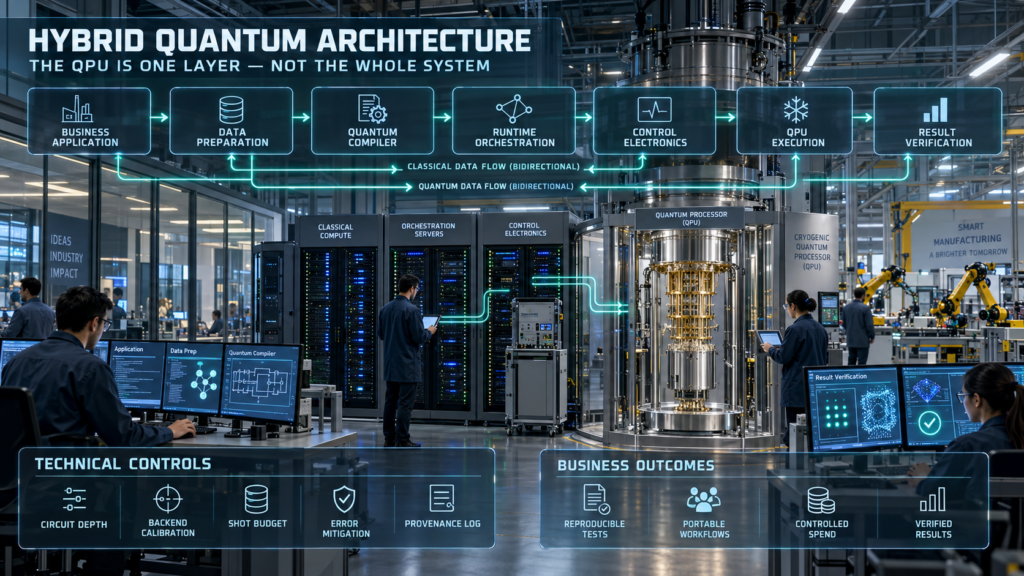
Enterprise quantum computing is a hybrid distributed system. Most of the workflow remains classical because data preparation, optimization loops, scheduling, error decoding, result aggregation and business-system integration run on CPUs, GPUs or other conventional accelerators.
The production-relevant quantum computing stack contains these layers:
- Business application layer: Defines the decision, constraints, acceptable error, deadline and financial value.
- Classical data layer: Cleans inputs, reduces dimensionality, protects sensitive data and creates a compact mathematical representation.
- Algorithm and SDK layer: Builds circuits or annealing models using frameworks such as Qiskit, Cirq, Q#, Braket SDK or Ocean.
- Compiler layer: Maps logical operations to native gates and physical connectivity while minimizing swaps, depth and expected error.
- Runtime orchestration layer: Batches jobs, selects a backend, controls retries, tracks calibration context and coordinates classical feedback.
- Control layer: Converts instructions into microwave, laser or optical signals and performs fast measurement and feedback.
- Quantum processing layer: Executes operations on superconducting, trapped-ion, neutral-atom, photonic or annealing hardware.
- Verification layer: Aggregates samples, estimates uncertainty, compares the result with classical baselines and records provenance.
The interfaces between those quantum computing layers often dominate delivery risk. A circuit that works in a noiseless simulator may become too deep after transpilation for a device with restricted connectivity.
Physical Qubits, Logical Qubits and the Error-Correction Tax
A physical quantum computing qubit is the hardware element exposed to noise. A logical qubit distributes encoded information across multiple physical qubits so that errors can be detected and, eventually, corrected without directly reading the protected quantum state.
This quantum computing redundancy is not free. Fault-tolerant algorithms may require large numbers of physical qubits, repeated syndrome measurements, real-time decoding and substantial classical control for every useful logical qubit.
The key threshold principle is measurable: when physical operations are good enough, increasing a code’s distance should reduce the logical error rate. Google’s Willow work reported below-threshold surface-code memories using distance-5 and distance-7 codes, an important error-correction result rather than proof of general commercial advantage.[6]
That evidence should shape quantum computing procurement language. Ask vendors for logical error per cycle, code distance, decoder latency, leakage handling and the resource estimate for the target algorithm—not merely the largest physical-qubit number.
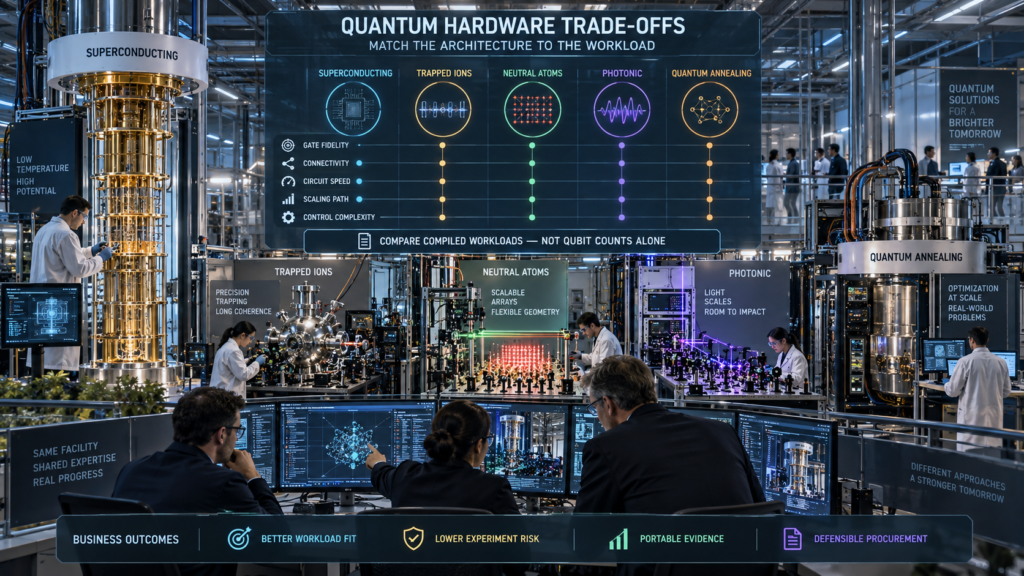
Hardware Modalities and Their Engineering Trade-Offs
Superconducting Circuits
Superconducting systems use fabricated circuits operated at millikelvin temperatures. They typically offer fast gates and benefit from semiconductor-style manufacturing methods, but refrigeration, wiring, calibration, frequency crowding and crosstalk become serious scaling constraints.
This quantum computing modality suits teams that need broad ecosystem support and fast experimental iteration. It does not eliminate the need to benchmark topology, native gates and queue behaviour on the specific backend.
Trapped Ions
Trapped-ion processors store information in ions controlled by lasers. They can provide high-fidelity operations and flexible connectivity, while gate speeds, optical complexity and scaling of control systems introduce different bottlenecks.
A lower qubit count can still outperform a larger quantum computing machine on some circuits when connectivity reduces swap operations. Procurement must compare compiled workloads rather than raw device specifications.
Neutral Atoms
Neutral-atom systems arrange atoms with optical tweezers and apply operations using laser excitation. Their reconfigurable geometry and scaling prospects are attractive for simulation and optimization research, although compilation, control fidelity and workload maturity remain active engineering areas.
Quantum cloud computing aggregators now expose this modality alongside others, making architecture comparison easier without buying laboratory infrastructure.[3]
Photonic Systems
Photonic approaches encode information in light and may operate without dilution refrigerators. Source quality, loss, detector performance, switching and fault-tolerant resource overhead remain central constraints.
Their networking characteristics are strategically interesting, but an enterprise quantum computing pilot still needs the same test: a reproducible result against the strongest classical alternative.
Quantum Annealing
Annealers minimize energy functions rather than executing the universal gate model in the same way. They map naturally to certain quadratic optimization formulations, yet embedding overhead and comparison with modern classical heuristics must be measured carefully.
D-Wave’s Leap service provides access to annealing systems and hybrid solvers.[5] Buyers should not treat an annealing benchmark as proof that a gate-model algorithm will perform similarly.
Integration Flowchart: From Business Problem to Controlled Decision
flowchart TD
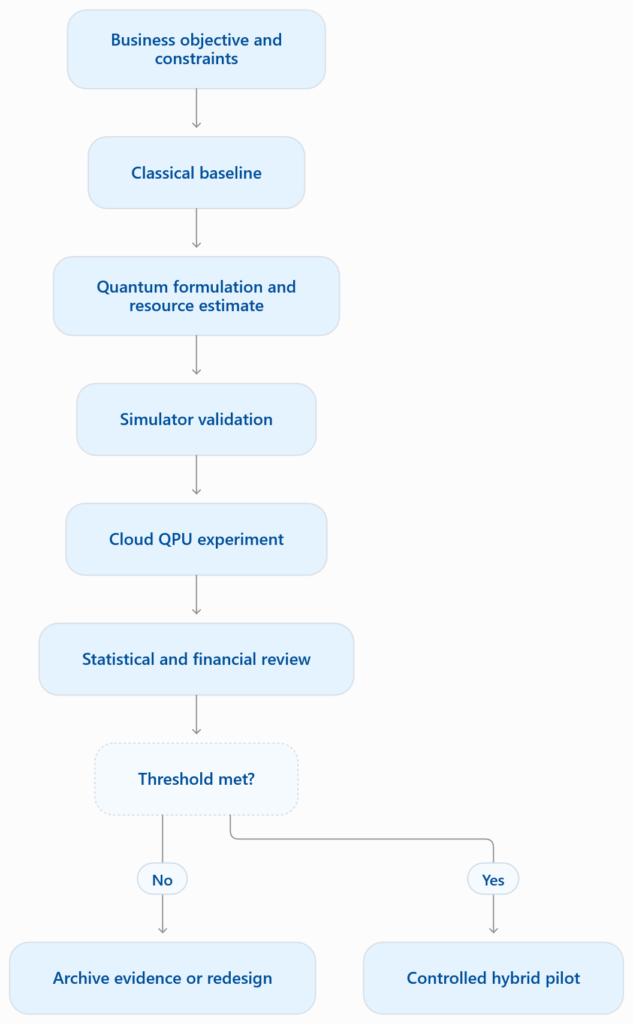
The quantum computing flow deliberately begins with a business objective rather than a favoured algorithm. Teams that begin with hardware often reverse-engineer a weak use case to justify access fees.
Simulator validation catches logic errors and supports deterministic tests for small instances. It does not reproduce every device effect, and classical simulation cost grows rapidly as qubit count, entanglement and circuit complexity increase.
Quantum computing hardware execution must capture backend identity, calibration timestamp, compiler version, random seeds, shot count, mitigation method and raw results. Without that lineage, a favourable run may be impossible to reproduce or audit.
Algorithms: Where Speedup Is Real, Conditional or Unproven
Shor’s quantum computing algorithm offers polynomial-time factoring and threatens widely deployed public-key schemes when a sufficiently large fault-tolerant computer exists.[7] Current processors do not have the logical qubits and error budget required to break operational RSA keys at scale.
Grover’s algorithm provides a quadratic query advantage for unstructured search under an oracle model.[8] It is not a blanket database accelerator because data loading, oracle construction, error correction and repeated execution affect the full system cost.
Hamiltonian simulation and quantum chemistry are scientifically aligned with quantum hardware because molecules are quantum systems. Useful industrial calculations may still demand precision and logical resources far beyond present noisy devices.
Variational algorithms divide work between a parameterized quantum circuit and a classical optimizer. They are accessible on current hardware, but barren plateaus, optimizer instability, shot noise and weak classical comparisons can erase the expected benefit.
Claims about quantum computing for machine learning require special discipline. Encoding a large classical dataset can cost more than the alleged speedup, and many studies demonstrate small synthetic tasks rather than production-scale learning with end-to-end cost accounting.
Performance Evaluation Matrix
| Evaluation dimension | Required measurement | Why it matters | Reject the pilot when |
| Solution quality | Objective value, error or fidelity against ground truth | A fast wrong answer has no business value | Accuracy misses the operational tolerance |
| End-to-end latency | Preparation, queue, compile, QPU, mitigation and post-processing time | Circuit time alone hides most delay | The classical baseline meets the SLA at lower cost |
| Cost | Tasks, shots, reservations, simulators, engineering and review | Cloud invoices are only part of total cost | Marginal value does not exceed fully loaded cost |
| Reproducibility | Variation across dates, calibrations and seeds | Noise and drift can create unstable wins | Results cannot survive repeated blinded runs |
| Scalability | Performance across increasing instance sizes | Small demonstrations may conceal adverse scaling | Advantage disappears as realistic constraints are added |
| Security | Data classification, access, logs and retention | External services may process sensitive models or metadata | Controls fail enterprise policy or contractual requirements |
| Portability | Recompile effort across providers and modalities | Hardware evolves quickly | The solution is locked to an unjustified proprietary path |
Quantum Computing Deployment Challenges After the Demonstration
Quantum computing queue latency can make interactive workflows impractical. Reserved capacity may improve predictability but raises utilization risk when experiments or staff are not ready.
Calibration changes can invalidate yesterday’s circuit mapping. Production-minded teams need automated backend selection, transpilation tests and acceptance thresholds rather than one manually chosen “best run.”
Quantum computing vendor SDKs use different abstractions, native gates, result formats and pricing units. An internal intermediate representation, portable test suite and clean service boundary reduce migration cost.
Sensitive input data should be minimized before it reaches a quantum cloud computing service. Tokenization, aggregation or synthetic inputs may preserve the research objective while reducing contractual and privacy exposure.
Specialist scarcity creates key-person risk. Every experiment should include documented assumptions, infrastructure-as-code, versioned notebooks or packages, and a second reviewer able to reproduce the result.
III. Commercial Solutions and Best Practices
Feature and Cost Comparison Table
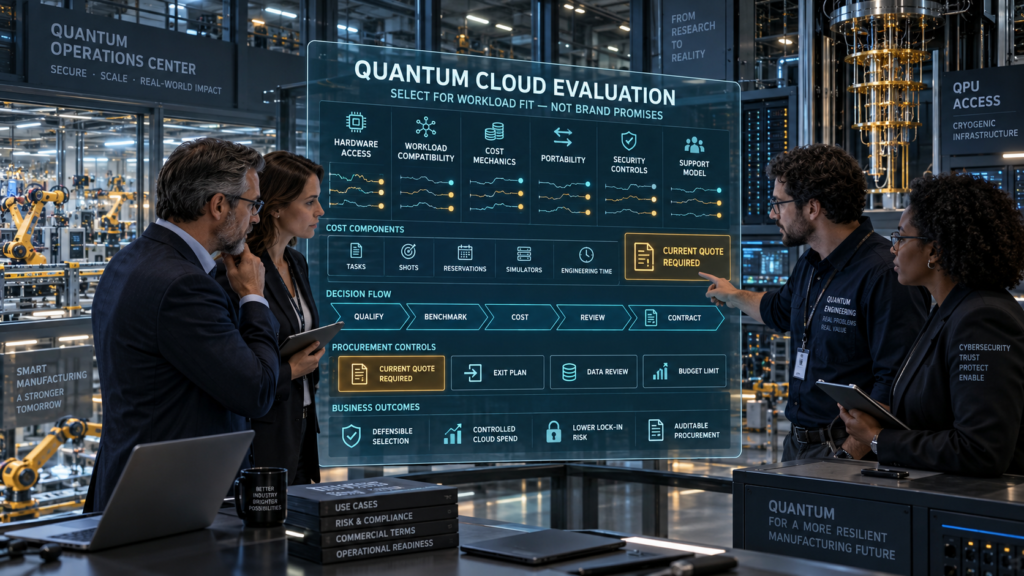
The quantum computing table reflects publicly documented service models as of 23 September 2026. Prices and available backends change; obtain a current quote and run a costed proof before contracting.
| Platform | Access and differentiator | Cost mechanics | Best procurement fit | Material limitation |
| IBM Quantum | Direct access to IBM superconducting systems, Qiskit and managed runtime; Heron hardware publishes system-level metrics | Plan- and capacity-based access; premium or dedicated arrangements may require commercial terms | Teams standardizing on Qiskit or evaluating IBM’s roadmap | Primarily one hardware family, increasing ecosystem concentration |
| Amazon Braket | One AWS interface to superconducting, trapped-ion and neutral-atom quantum hardware, alongside quantum circuit simulators. | On-demand QPUs generally combine per-task and per-shot fees; reservations use hourly pricing; simulators and hybrid jobs add charges[3] | Multi-hardware experiments within existing AWS governance | Provider pricing and regional availability complicate forecasting |
| Azure Quantum | Azure workspace, QDK/Q# and access to providers including Quantinuum, IonQ, Pasqal and Rigetti | Providers control plans and prices; Microsoft warns pricing may change and should be checked in the active workspace[4] | Organizations using Azure identity, billing and resource governance | Provider-specific units and quotas reduce direct cost comparability |
| D-Wave Leap | Direct access to quantum annealing and hybrid solvers through the Ocean toolchain | Developer access and commercial service arrangements; enterprise terms require current confirmation | Optimization problems that map credibly to binary quadratic models | Results do not generalize automatically to universal gate-model computing |
No quantum computing row is an affiliate recommendation. Selection should follow workload fit, security review, portability, total cost and evidence quality.
A Six-Gate Enterprise Deployment Framework
Gate 1: Problem Qualification
Select quantum computing problems with expensive combinatorics, quantum-system structure or a defensible algorithmic reason for quantum processing. Exclude workloads already solved within cost and service targets by mature classical software.
Define the decision owner, value unit, data class, maximum tolerated error and time-to-answer. If those fields are missing, the project is research exploration rather than a business pilot.
Gate 2: Classical Baseline
Benchmark commercial solvers, open-source methods, GPUs and problem-specific heuristics. Record hardware, software versions, tuning budget and solution quality so the baseline cannot be weakened after results arrive.
The correct comparator is the best affordable method available to the enterprise, not a deliberately simple algorithm. This single control removes a large share of exaggerated quantum computing claims.
Gate 3: Resource Estimation
Estimate physical and logical qubits, native gate counts, circuit depth, shots, error-correction assumptions and runtime. Microsoft’s resource-estimation tools are designed to evaluate future scaled algorithms without pretending today’s hardware can execute them.[9]
Run sensitivity analysis around target precision. An extra decimal place can radically increase logical operations and change a plausible roadmap into an uneconomic one.
Gate 4: Simulator and Hardware Validation
Use noiseless quantum computing simulation for correctness, noisy models for robustness testing and at least one real backend for hardware behaviour. Separate tuning data from final evaluation data to reduce cherry-picking.
Where possible, test more than one modality or provider. Portability evidence is a negotiating asset even when the first production path remains with one vendor.
Gate 5: Finance and Risk Review
Calculate total cost from cloud execution, reservations, simulators, classical compute, data engineering, specialist labour, security assessment, vendor support and rework. Compare that amount with verified incremental value, not with a speculative total-addressable-market number.
Apply an option-value lens to early research, but cap it explicitly. A small readiness programme can be rational without claiming immediate operating savings.
Gate 6: Scale, Pause or Retire
Scale only when the pilot meets predefined thresholds across quality, latency, cost, stability and compliance. Pause when a roadmap dependency is credible but not delivered, and retire when classical progress removes the economic gap.
Every outcome should create an asset: benchmark code, a resource estimate, cryptographic inventory, supplier scorecard or documented negative result. Learning is valuable only when it is reusable.
IV. Business Outcomes and Strategic ROI Takeaways
Where Enterprise Quantum Computing Can Create Option Value
Chemistry and materials teams can use small experiments to validate encodings, active spaces and error budgets while classical high-performance computing handles production analysis. The near-term output is often a validated workflow and resource model rather than a discovered drug or material.
Financial-services teams can test sampling, risk and optimization formulations, but must compare them with highly optimized classical libraries. Regulatory model-risk obligations still apply when a quantum subroutine sits inside a decision system.
Manufacturing and logistics teams can evaluate constrained scheduling or routing through annealing and hybrid solvers. Real constraints, repair rules and integration time must remain in the benchmark; removing them may create an impressive but unusable result.
Cybersecurity teams have the clearest immediate mandate. They can inventory public-key dependencies, classify data by confidentiality life, test hybrid key exchange, update certificates and procurement clauses, and plan transition around finalized NIST standards.[1]
Finance-Grade ROI Model
Use a transparent model:
Annual modeled net value = verified annual incremental benefit − total annual operating cost − annual allocation of implementation cost.
Compare benefits with the same classical baseline and reporting period. Annual operating cost includes quantum execution, classical compute, specialist labour, security controls, support and ongoing maintenance, with each expense counted once. Show upfront implementation spending separately and state how it is allocated in the annual model. Report cash savings, released capacity and risk reduction separately; a laboratory improvement does not automatically become a financial benefit.
For readiness programmes, track option value through measurable assets: trained staff retained, priority use cases qualified, portable components built, supplier concentration reduced and post-quantum migration completed. Avoid assigning fictional revenue to “being ready.”
Strategic Takeaways for Decision Makers
- Treat quantum computing as a workload-specific accelerator, not a universal replacement for cloud or high-performance computing.
- Separate noisy-device experiments from fault-tolerant resource estimates; they answer different questions.
- Fund post-quantum cryptography now where confidentiality life exceeds the expected migration window.
- Require strong classical baselines, repeated trials and complete cost accounting before accepting an advantage claim.
- Prefer portable skills, data models and test harnesses over code coupled tightly to one processor.
- Use milestones tied to evidence, not vendor delivery dates, investment headlines or qubit counts.
V. Risk Mitigation and Regulatory Framework
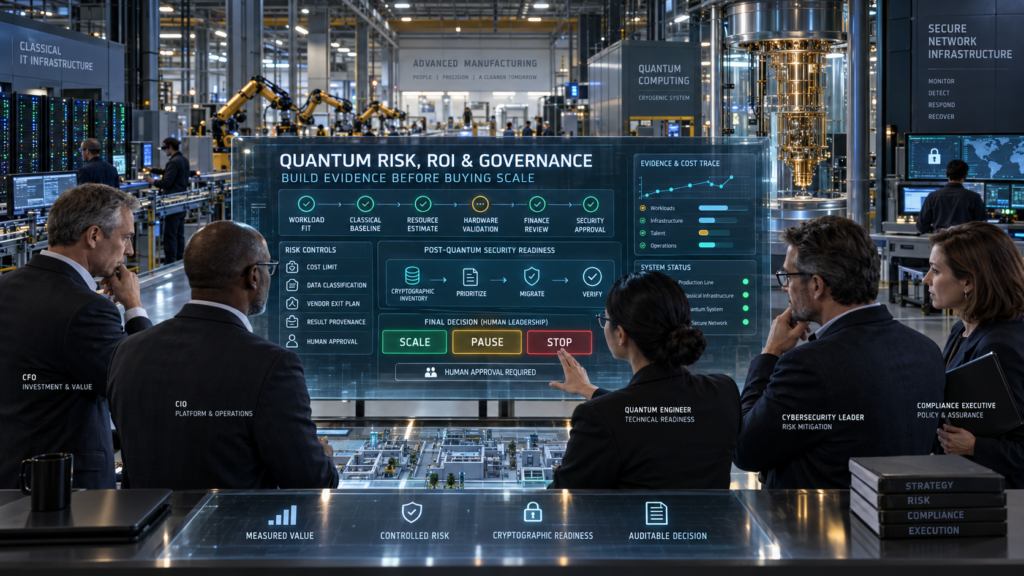
Quantum Risk Register
| Risk | Failure vector | Control | Evidence required |
| Technical overclaim | Benchmark excludes preparation, queue or classical optimization | Pre-registered evaluation protocol | Complete timing and cost trace |
| Vendor concentration | SDK, compiler and contract couple the workload to one platform | Portable interfaces and exit clauses | Recompiled reference circuit or documented migration test |
| Cost overrun | Shots, mitigation and retries expand after noisy results | Per-project budgets, alerts and kill switches | Cost report by user, backend and experiment |
| Data exposure | Sensitive inputs or job metadata enter external infrastructure | Minimization, encryption, access control and retention terms | Data-flow diagram and contractual control mapping |
| Irreproducibility | Calibration drift or selective reporting creates a false win | Repeated blinded runs across dates | Raw results, seeds, backend and calibration records |
| Cryptographic delay | Legacy dependencies remain unknown until migration begins | Crypto-agility inventory and prioritized remediation | Algorithm, key, certificate, library and owner register |
| Skills dependency | One specialist controls the full workflow | Pair review and documented automation | Reproduction by an independent team member |
Compliance Checklist
- Classify all input, output, telemetry and derived data before cloud submission.
- Map processor access to least-privilege identity roles and segregated billing accounts.
- Log code version, compiler settings, backend, calibration context, shots and mitigation.
- Review provider subprocessors, regions, retention, deletion and incident-notification terms.
- Apply applicable privacy, sector, export-control and intellectual-property requirements.
- Align security governance with NIST Cybersecurity Framework 2.0 and internal risk policy.[10]
- Maintain a cryptographic inventory covering certificates, libraries, protocols, devices and third parties.
- Plan migration to NIST FIPS 203, 204 and 205 according to risk and interoperability needs.[1]
- Require human approval before a quantum-derived result changes a high-impact operational decision.
- Retest after major SDK, compiler, backend, calibration or error-mitigation changes.
Regulatory Boundaries
Quantum computing is not governed by one universal “quantum regulation.” Obligations arise from the data, sector, geography, export status and decision that the system supports.
The EU AI Act may apply when a quantum component supports an AI system within its scope; it does not apply merely because a circuit uses quantum mechanics. The same separation is necessary for medical-device, financial-model, privacy and critical-infrastructure rules.
NIST post-quantum standards address cryptographic algorithms, not quantum processor safety. NIST CSF 2.0 is a voluntary cybersecurity risk framework unless a contract, regulator or policy makes particular practices binding.[10]
Legal counsel and security architects should therefore map obligations to the complete hybrid service. A processor label cannot replace a data-flow analysis, threat model or jurisdictional review.
Deciding Whether to Pilot, Wait or Stop
Begin with a bounded qualification program. Select one or two candidate workloads, establish classical baselines, complete resource estimates and run cloud experiments where current hardware can meaningfully test the proposal. Choose the duration according to workload complexity, hardware access and the evidence required by finance, security and the business owner.
In parallel, launch cryptographic discovery for long-lived sensitive data. That work reduces a present governance risk even if fault-tolerant quantum computing arrives later than expected.
At the review milestone, decide whether to advance a controlled hybrid pilot, retain a limited research program or stop. Record the evidence, unresolved dependencies and conditions for reconsideration so the decision remains useful as hardware and classical methods improve.
Appendix A: Academic and Primary-Source Footnotes
- National Institute of Standards and Technology, “NIST Releases First 3 Finalized Post-Quantum Encryption Standards,” 13 August 2024; FIPS 203, FIPS 204 and FIPS 205. https://www.nist.gov/news-events/news/2024/08/nist-releases-first-3-finalized-post-quantum-encryption-standards
- IBM Quantum, “Quantum Computing Hardware and Roadmap,” current product documentation, accessed 23 September 2026. https://www.ibm.com/quantum/hardware
- Amazon Web Services, “Amazon Braket Pricing” and “Amazon Braket Quantum Computers,” accessed 23 September 2026. https://aws.amazon.com/braket/pricing/ and https://aws.amazon.com/braket/quantum-computers/
- Microsoft Learn, “Pricing Plans for Azure Quantum Providers,” updated 23 December 2025, accessed 23 September 2026. https://learn.microsoft.com/en-us/azure/quantum/pricing
- D-Wave, “Leap Quantum Cloud Service,” accessed 23 September 2026. https://www.dwavesys.com/solutions-and-products/cloud-platform/
- Google Quantum AI and Collaborators, “Quantum Error Correction Below the Surface Code Threshold,” Nature 638, 920–926 (2025), DOI: 10.1038/s41586-024-08449-y. https://www.nature.com/articles/s41586-024-08449-y
- Peter W. Shor, “Algorithms for Quantum Computation: Discrete Logarithms and Factoring,” Proceedings of the 35th Annual Symposium on Foundations of Computer Science, IEEE, 1994, pp. 124–134, DOI: 10.1109/SFCS.1994.365700.
- Lov K. Grover, “A Fast Quantum Mechanical Algorithm for Database Search,” Proceedings of the 28th Annual ACM Symposium on Theory of Computing, 1996, pp. 212–219, DOI: 10.1145/237814.237866.
- Microsoft Learn, “Azure Quantum Resource Estimator,” current technical documentation, accessed 23 September 2026. https://learn.microsoft.com/en-us/azure/quantum/intro-to-resource-estimation
- National Institute of Standards and Technology, “The NIST Cybersecurity Framework (CSF) 2.0,” NIST CSWP 29, 26 February 2024, DOI: 10.6028/NIST.CSWP.29. https://www.nist.gov/cyberframework
- John Preskill, “Quantum Computing in the NISQ Era and Beyond,” Quantum 2, 79 (2018), DOI: 10.22331/q-2018-08-06-79.
- Frank Arute et al., “Quantum Supremacy Using a Programmable Superconducting Processor,” Nature 574, 505–510 (2019), DOI: 10.1038/s41586-019-1666-5.
- Sergio Boixo et al., “Characterizing Quantum Supremacy in Near-Term Devices,” Nature Physics 14, 595–600 (2018), DOI: 10.1038/s41567-018-0124-x.
- M. Cerezo et al., “Variational Quantum Algorithms,” Nature Reviews Physics 3, 625–644 (2021), DOI: 10.1038/s42254-021-00348-9.
- Edward Farhi, Jeffrey Goldstone and Sam Gutmann, “A Quantum Approximate Optimization Algorithm,” arXiv:1411.4028 (2014). https://arxiv.org/abs/1411.4028
- National Institute of Standards and Technology, FIPS 203, “Module-Lattice-Based Key-Encapsulation Mechanism Standard,” 13 August 2024. https://csrc.nist.gov/pubs/fips/203/final
- National Institute of Standards and Technology, FIPS 204, “Module-Lattice-Based Digital Signature Standard,” 13 August 2024. https://csrc.nist.gov/pubs/fips/204/final
- National Institute of Standards and Technology, FIPS 205, “Stateless Hash-Based Digital Signature Standard,” 13 August 2024. https://csrc.nist.gov/pubs/fips/205/final
Appendix B: Sources and Citation Index
| Article claim area | Footnotes |
| Post-quantum standards and migration | 1, 16, 17, 18 |
| Commercial hardware and platform access | 2, 3, 4, 5 |
| Error correction and below-threshold evidence | 6 |
| Foundational algorithms | 7, 8, 15 |
| Resource estimation | 9 |
| Cybersecurity governance | 10 |
| NISQ limitations and benchmark context | 11, 12, 13, 14 |
Appendix C: Corporate Editorial Transparency and AI Usage Disclosure
AI-assisted tools were used to support research organization, drafting and language refinement. NezzHub retains editorial responsibility for the published article. Vendor inclusion does not constitute endorsement.
Hardware specifications, platform availability, pricing and roadmaps can change. Readers should confirm current vendor documentation and commercial terms before making procurement decisions.
No benchmark in this article should be interpreted as a guaranteed business result. Organizations must validate performance, cost, security and compliance against their own workload and contractual environment.
Author and Editorial Review
Author: Garikapati Bullivenkaiah
Technology research writer with LL.B., LL.M., M.A., and MBA qualifications. He writes about emerging technologies and their business, governance and legal implications. His multidisciplinary academic background informs his analysis of technology adoption, intellectual property, and organizational risk. His articles explain technical concepts and practical considerations for business owners, IT managers and technology decision-makers. LinkedIn Profile
Reviewed by: Chitikineni Ramadevi — Editor
Chitikineni Ramadevi holds an M.Sc. in Computers from Andhra University and has over 10 years of research experience in technology-related subjects. She reviews NezzHub articles for clarity, factual accuracy, source support and practical relevance.
Published by: NezzHub
Research approach: This article draws on primary sources, technical documentation and relevant industry research. References are provided within the article or its sources section.
Last reviewed: 09-23-2026
Corrections: To report a factual error or outdated information, please contact NezzHub.

Garikapati Bullivenkaiah is a seasoned entrepreneur with a rich multidisciplinary academic foundation—including LL.B., LL.M., M.A., and M.B.A. degrees—that uniquely blend legal insight, managerial acumen, and sociocultural understanding. Driven by vision and integrity, he leads his own enterprise with a strategic mindset informed by rigorous legal training and advanced business education. His strong analytical skills, honed through legal and management disciplines, empower him to navigate complex challenges, mitigate risks, and foster growth in diverse sectors. Committed to delivering value, Garikapati’s entrepreneurial journey is characterized by innovative approaches, ethical leadership, and the ability to convert cross-domain knowledge into practical, client-focused solutions.