




Executive Summary
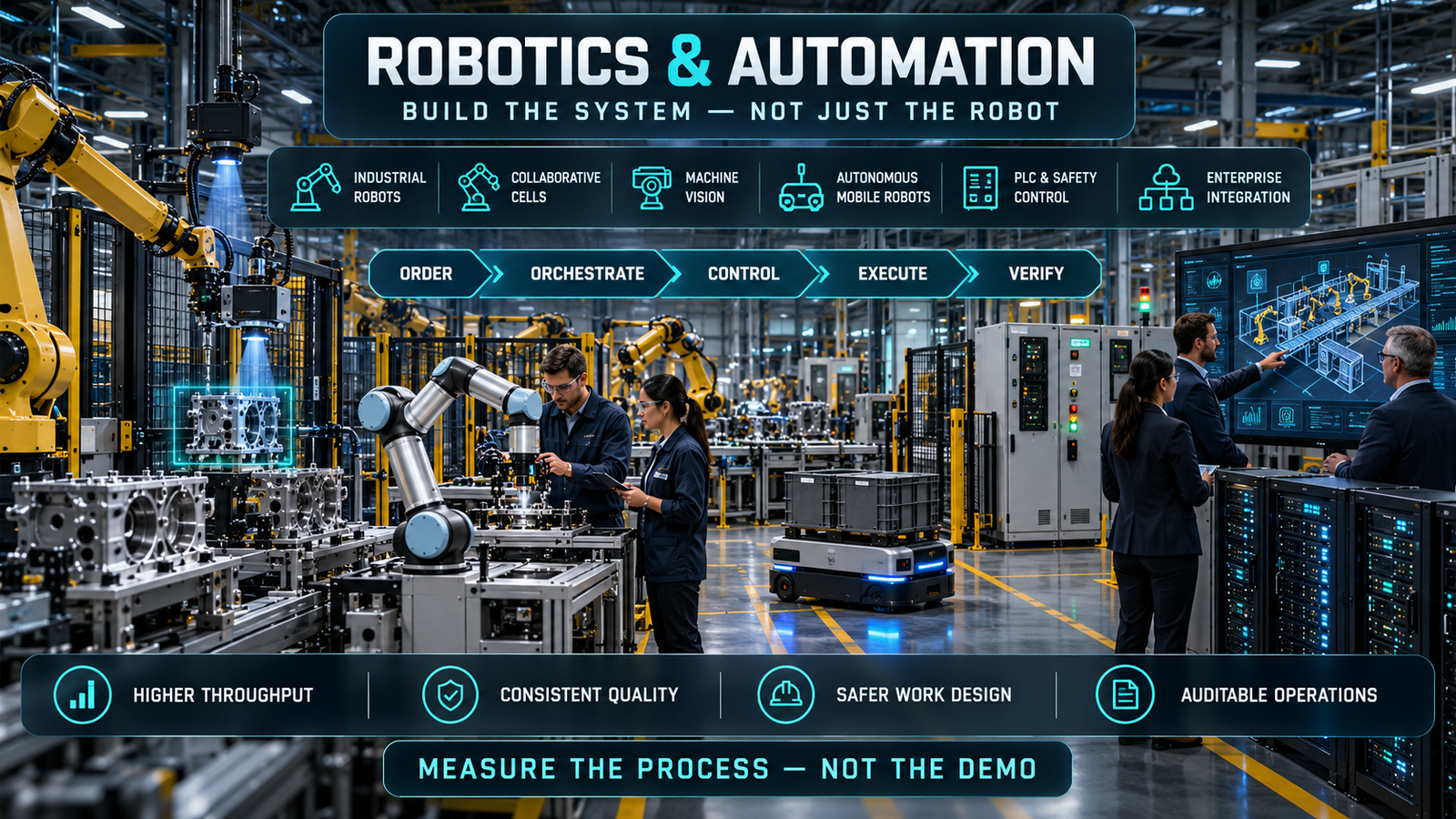
Robotics and automation can improve throughput, consistency and worker ergonomics, but the robot arm is rarely the hardest or most expensive part of a deployment. Tooling, machine interfaces, product variation, safety validation, networking, operator recovery and production support determine whether a cell creates value or becomes an underused capital asset.
Global robotics and automation adoption is substantial: the International Federation of Robotics reported 542,076 industrial robot installations during 2024 and an operational stock of 4,663,773 units.[1] Those figures establish market maturity, not a guaranteed return for any factory, warehouse, laboratory or healthcare operation.
A credible robotics and automation investment case begins with a stable process and a measured baseline. It then defines the required cycle time, payload, reach, accuracy, uptime, changeover, safe-state behaviour, cybersecurity boundary and human work design before selecting hardware.
Robotics and automation programmes also need two independent acceptance tracks. Functional acceptance proves that the system makes the right part or completes the right movement; safety acceptance proves that foreseeable faults, misuse, maintenance and recovery do not expose people to unacceptable risk.
This robotics and automation article replaces promotional claims with a deployment architecture, integration flowchart, performance matrix, vendor comparison, finance model and governance checklist. The goal is a repeatable decision: scale a verified use case, redesign a weak one or stop before sunk cost dictates the answer.
What Is Robotic Process Automation and How It Works
I. The Current Market Landscape and Challenge
Robotics and Automation Adoption Is High, but Utilization Decides Value
Robotics and automation installations exceeded 500,000 industrial units globally for four consecutive years through 2024, with Asia accounting for 74% of new deployments.[1] The installed base confirms supplier depth, integrator experience and a large service ecosystem.
Yet robotics and automation adoption statistics do not reveal utilization, unplanned downtime or profitable output. A robot scheduled for three shifts can still deliver poor economics when gripper faults, part presentation and manual recovery keep it idle.
The real unit of robotics and automation procurement is the automated process, not the manipulator. Buyers must cost the arm, end effector, vision, guarding, fixtures, safety devices, controls, software, installation, training, validation, spares and production disruption as one system.
The Root Cause of Failure Is Usually at the Interfaces
A six-axis arm can repeat a programmed path precisely while the robotics and automation application fails around it. Parts arrive in unstable orientations, tolerances drift, reflective surfaces defeat vision, machine tools expose inconsistent signals and upstream queues starve the cell.
Robotics and automation therefore behave like systems integration projects. Mechanical, electrical, controls, safety, IT, cybersecurity and operations teams must agree on states, ownership, timing and recovery before commissioning.
A nominal robotics and automation cycle-time target is not enough. The design must account for tool changes, rejected parts, replenishment, planned cleaning, safety stops, restart checks and the slowest connected machine.
The Cost of Inaction and the Cost of Premature Automation
The cost of robotics and automation inaction can include capacity constraints, ergonomic exposure, inconsistent quality, labour scarcity and inability to trace production events. It should be quantified against actual demand, overtime, scrap, incidents and missed orders.
Premature robotics and automation deployment has its own cost. Automating a volatile or poorly controlled process can hard-code waste, multiply change requests and move skilled operators into constant exception handling.
The correct robotics and automation question is not whether a competitor owns robots. It is whether a defined task has enough volume, stability, risk reduction and economic value to justify a controlled system.
Four Claims Procurement Teams Should Reject
“Collaborative robot” does not mean “safe without guarding.” Collaboration is an application-level result established through risk assessment, validated safety functions, tooling design, speed and separation, power and force limits or other protective measures.
“Autonomous” does not mean unconstrained. Autonomous mobile robots operate inside mapped, sensed and governed environments with traffic rules, localization assumptions, charging plans and defined behaviour when confidence falls.
“Digital twin” does not mean a perfect live copy. The model is useful only when geometry, kinematics, controls, process physics and production data remain sufficiently aligned with the physical system.
“AI-enabled” does not remove deterministic safety requirements. A perception model can improve classification or planning while a separate safety-rated control architecture remains responsible for hazardous motion.
II. Deep-Dive Technical Analysis and Evidence
Architecture Overview: Robotics and Automation as a Layered System
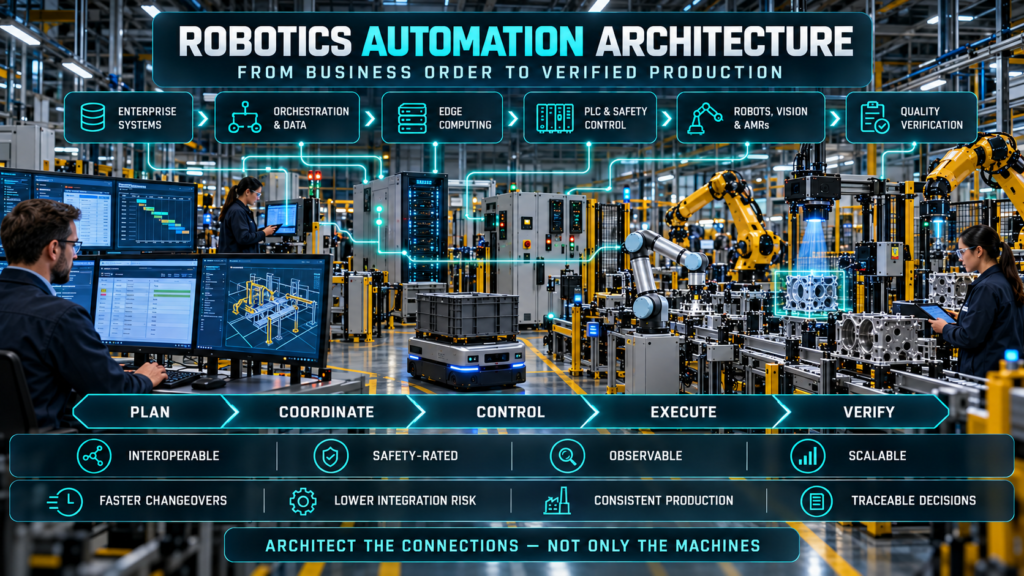
An enterprise robotics architecture is a cyber-physical stack. Physical motion, real-time control, safety logic, perception, fleet orchestration, enterprise software and human procedures exchange data across boundaries with very different timing and assurance requirements.
The main robotics and automation layers are:
- Business and production layer: ERP, MES, WMS, quality systems, order priorities and maintenance planning.
- Orchestration layer: Cell scheduling, recipe management, fleet management, work queues and exception routing.
- Application layer: Robot programmes, motion planning, inspection logic, task sequencing and recovery workflows.
- Perception layer: Cameras, force-torque sensors, encoders, scanners, localization and condition monitoring.
- Control layer: Robot controller, PLC, motion controller, drives, remote I/O and industrial networks.
- Safety layer: Safety PLC, interlocks, emergency stops, safe speed, safe position, protective stops and access control.
- Physical layer: Manipulator, AMR, end effector, fixture, conveyor, machine tool and handled product.
- Operations layer: Operators, technicians, supervisors, integrators, change control and incident response.
These robotics and automation layers should not share trust by default. A production dashboard may request work, but it should not bypass safety logic or directly command hazardous motion.
Deterministic Control, AI and Safety Have Different Jobs
Low-level robotics and automation motion loops require predictable timing. PLC and robot-controller logic coordinate states, handshakes and safe recovery, while AI components may interpret images, estimate poses or optimize higher-level plans.
The robotics and automation architecture must define what happens when an AI model is unavailable, uncertain or wrong. The safe response may be to stop, slow, reject a part or request human review rather than guess.
Robotics and automation projects should separate operational confidence from safety integrity. A high-performing neural network is not automatically a safety-rated protective device.
Integration Flowchart: From Order to Verified Production
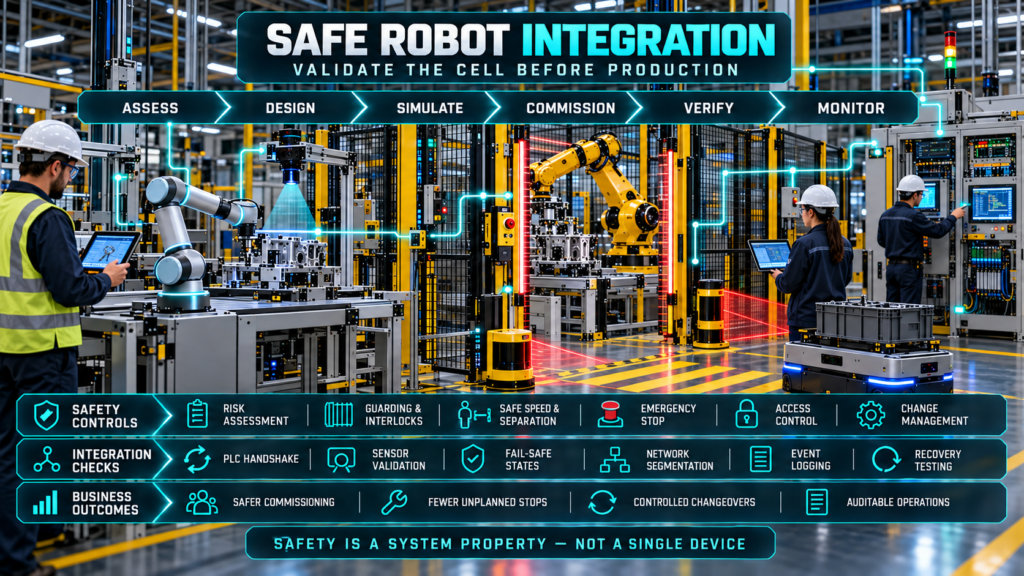
flowchart
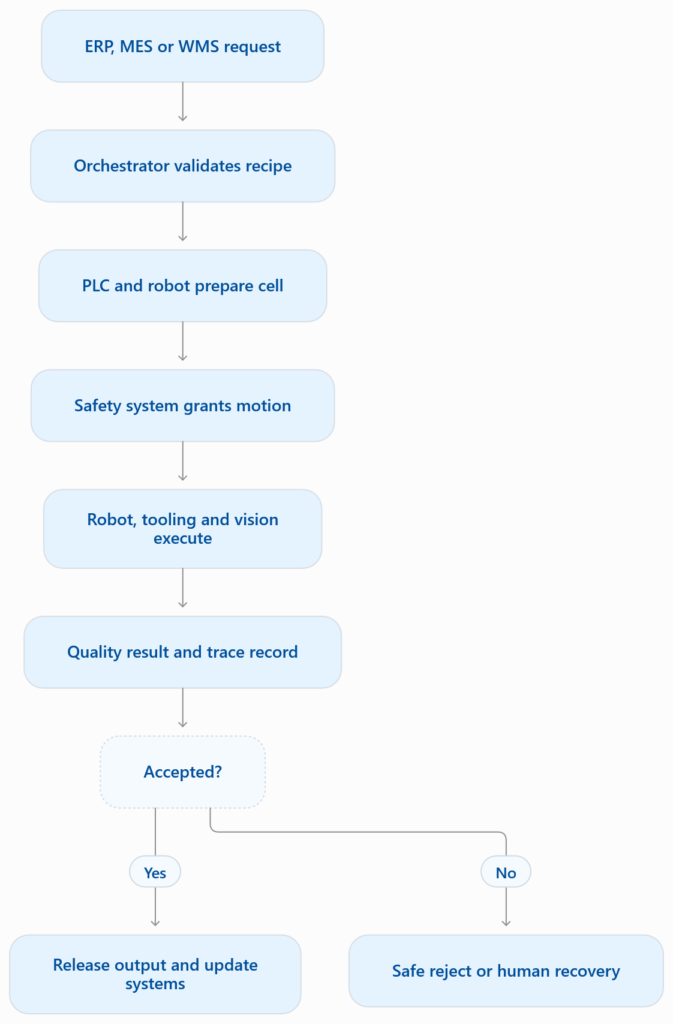
This diagram summarizes the production sequence. Safety functions remain active throughout execution and recovery; the motion-permission step is not a one-time safety approval. Human recovery must follow the validated access, energy-control and restart procedures for the application.
Every arrow in a robotics and automation flow is an interface contract. It needs signal definitions, timeouts, permitted states, ownership, retry behaviour and a safe outcome when the expected response never arrives.
Robotics and automation integration testing should deliberately break those contracts. Disconnect a sensor, delay a PLC acknowledgment, present a malformed recipe, block an AMR route and restart a controller mid-cycle to observe whether the system fails predictably.
Top Robotics Companies in the USA: Proven 2026 Buyer’s Guide
Industrial Robots, Cobots and Application Boundaries
Traditional robotics and automation equipment is commonly placed inside safeguarded cells because its speed, mass, tooling or task creates hazardous energy. Higher performance can be the right choice when people do not need regular access during automatic operation.
Collaborative applications support defined forms of human-robot interaction, but the entire application must be assessed. A rounded cobot fitted with a sharp gripper, hot workpiece or powerful spindle can still present serious hazards.
ISO 10218-1:2025 covers safety requirements for industrial robots, while ISO 10218-2:2025 addresses industrial robot applications and robot cells.[2][3] ISO/TS 15066 provides additional guidance for collaborative robot applications.[4]
Robotics and automation payload calculations must include the tool, adapters, hoses and carried part, including their centre of gravity and inertia. Incorrect payload data can cause faults, poor motion and unsafe operation; FANUC explicitly warns that accurate payload data is critical to collaborative safety configuration.[5]
Autonomous Mobile Robots and Fleet-Level Constraints
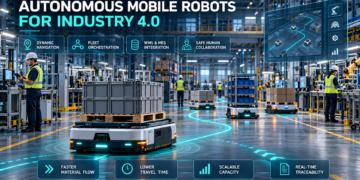
A robotics and automation AMR combines localization, mapping, obstacle detection, planning and drive control. Its performance depends on floor condition, aisle width, traffic density, reflective surfaces, dynamic obstacles, wireless coverage and map maintenance.
Robotics and automation fleet throughput differs from single-robot speed. Congestion, elevator access, charging, pickup dwell and blocked stations can make additional robots reduce rather than increase system performance.
Warehouse automation systems need traffic rules and operational fallbacks. A failed localization update or closed aisle should create a bounded state, not uncontrolled rerouting through pedestrian work areas.
Digital Twins and Simulation: Useful Within a Validation Envelope
Robotics and automation simulation can detect reach problems, singularities, collisions, cycle-time bottlenecks and PLC sequence errors before equipment arrives. It also supports operator training and controlled regression tests after software changes.
NIST research identifies geometry, kinematics, control and lifecycle data as components of a comprehensive robot-system digital twin.[6] The engineering task is model validation: teams must document which physical behaviours are represented, calibrated and excluded.
Robotics and automation simulation should never be the only acceptance evidence. Cable routing, gripper compliance, vibration, contamination, lighting and real controller timing frequently differ from the virtual model.
ROS 2, Middleware and Production Hardening
ROS 2 supplies libraries, tools and message-oriented middleware for robotics and automation applications. It is not a complete real-time operating system, safety controller, patch programme or production support contract.
ROS 2 can use DDS Security for authentication, encryption and access control through security enclaves.[7] Those protections must be configured, deployed, rotated and monitored; installing ROS 2 alone does not enable a secure posture.
Known vulnerabilities demonstrate the need for software governance. CVE-2019-19625 and CVE-2019-19627 affected SROS 2 security behaviour, while CVE-2024-30963 concerns a buffer overflow in ROS 2 Navigation2.[8][9][10]
Robotics and automation production teams should maintain a software bill of materials, supported-distribution policy, signed artifacts, dependency scanning, network segmentation and an emergency patch process. Community packages require the same code review and test controls as internally written motion software.
Performance Evaluation Matrix
| Dimension | Required measurement | Test method | Failure threshold |
| Throughput | Good units per hour at normal product mix | Multi-shift production trial | Below validated demand rate |
| Cycle time | Median, 95th percentile and worst credible cycle | Include replenishment and recovery | Tail time breaks takt requirement |
| Quality | First-pass yield, false reject and escaped defect | Blind comparison with approved inspection | Quality is worse than baseline |
| Availability | Planned and unplanned operating time | Automated event logs with reason codes | Downtime erases capacity benefit |
| Recovery | Mean time to diagnose and restore | Inject common faults with trained operators | Recovery needs specialist intervention too often |
| Safety | Validated safety functions and stopping behaviour | Application risk assessment and validation | Residual risk remains unacceptable |
| Cybersecurity | Identity, segmentation, logging and update behaviour | Threat model and controlled security testing | Unsafe command path or unsupported component remains |
| Economics | Fully loaded cost per good unit | Finance-approved baseline and pilot | Net value fails investment hurdle |
Deployment Challenges That Appear After the Demonstration
A robotics and automation trade-show demo normally uses clean parts, stable lighting and expert operators. Production introduces oil, dust, worn fixtures, mixed lots, hurried recovery and people who were not part of the development team.
End-of-arm tooling is a frequent robotics and automation constraint. Grip force, jaw wear, vacuum loss, part deformation, hose drag and tool-change repeatability can dominate uptime even when the arm performs correctly.
Vision-model performance can degrade when lighting, camera position or products change. Camera movement can also invalidate calibration, so both model performance and calibration accuracy require separate checks.
Robotics integration services should include source-code ownership, backups, acceptance tests, spare parts, response times and exit rights. A cell is not maintainable when only the original integrator understands its state machine.
III. Commercial Solutions and Best Practices
Feature and Cost Comparison Table
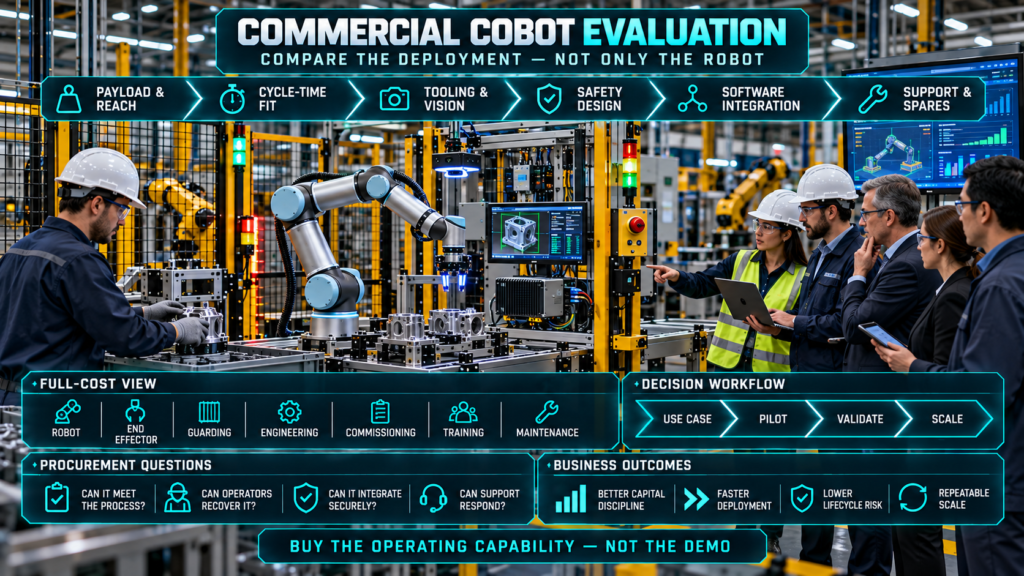
The following robotics and automation cobot comparison uses current manufacturer specifications available on 23 September 2026. Hardware price alone is not comparable because tooling, vision, guarding, controls, installation, training and service can exceed the arm’s quoted price.
| Platform family | Published capability snapshot | Strong procurement fit | Cost model | Important qualification |
| Universal Robots UR20 | 20 kg standard payload, 25 kg extended payload, 1,750 mm reach[11] | Palletizing, machine tending and applications needing broad integrator or accessory availability | Arm quote plus controller, tooling, safety, integration and support | Extended payload and speed must be validated for the exact tool, pose and software configuration |
| FANUC CRX series | Family spans multiple payload classes; CRX-30iA lists 25–30 kg payload and 1,756 mm reach[12] | Plants prioritizing broad industrial service coverage and controller integration | Quote-based system with tooling, software options and integrator cost | Model naming, controller choice and application safety configuration require careful verification |
| ABB GoFa family | Published variants support 5 kg, 10 kg and 12 kg payload classes, with joint torque sensing[13] | Machine tending, handling, inspection and customers using ABB automation ecosystems | Quote-based hardware, peripherals, engineering and service | Marketing speed or repeatability claims do not replace task-level safety and cycle validation |
| KUKA LBR iisy family | Published 3 kg, 11 kg and 15 kg variants; 11 kg version lists 1,300 mm reach[14] | Flexible handling and plants standardizing on KUKA control and service infrastructure | Quote-based arm, controller, integration, tooling and lifecycle support | Select the specific payload-reach variant; family-level comparisons can conceal application limits |
This is an editorial robotics and automation comparison, not an affiliate ranking. Procurement should issue one common user-requirement specification and require every supplier to run the same representative parts and failure scenarios.
A Seven-Gate Deployment Framework
Gate 1: Process Qualification
Map current work using robotics and automation time studies, defect records, ergonomic assessment and demand history. Stabilize obvious upstream variation before automating it.
Reject tasks with undefined inputs, constantly changing products or no accountable process owner. Research may continue, but it should not be disguised as a production business case.
Gate 2: User Requirements Specification
Define payload, reach, takt, product mix, quality criteria, environment, interfaces, safe access, changeover and recovery. State which requirements are mandatory and which create optional value.
The specification should include production data retention, remote-access rules, patch responsibility and required export formats. These details prevent commercial lock-in later.
Gate 3: Concept and Simulation
Compare robot, fixed automation and process-redesign alternatives. Run reach and cycle simulation, but record assumptions about acceleration, tool behaviour, part supply and operator tasks.
Review maintainability in the model. A theoretically compact cell can become expensive when technicians cannot reach sensors, valves or gripper fasteners safely.
Gate 4: Safety and Cybersecurity Design
Complete the application risk assessment before finalizing layout and controls. Safety must cover automatic production, teaching, cleaning, jams, maintenance, tooling failure and foreseeable misuse.
Create a zone-and-conduit network design, asset inventory, remote-access workflow and patch policy. Separate safety-rated functions from non-safety AI and enterprise-network services.
Gate 5: Factory and Site Acceptance
Factory acceptance testing verifies functions before shipment using representative products and documented cases. Site acceptance repeats critical tests after installation because foundations, utilities, networks and upstream equipment have changed.
Acceptance should cover normal production, every defined fault, power loss, communication failure, emergency stop, protective stop and controlled restart. Video evidence and event logs reduce later disputes.
Gate 6: Controlled Production Ramp
Ramp product variety and operating hours gradually. Track downtime by reason and keep integrator engineers available long enough to transfer recovery knowledge to plant personnel.
Do not declare success after a short perfect run. The system must survive shift changes, replenishment, tool wear and routine disturbances without constant expert support.
Gate 7: Scale, Redesign or Retire
Scale only after the cell meets throughput, quality, availability, safety and cost thresholds for an agreed period. Reuse the architecture and tests, but repeat task-specific risk assessment at every new site.
Redesign when evidence shows a fixable constraint. Retire the concept when product variation, integration cost or recovery burden prevents a finance-grade return.
IV. Business Outcomes and Strategic ROI Takeaways
Where Robotics and Automation Produce Defensible Value
High-value candidates combine repeatable work, measurable demand and a clear operational constraint. Examples include machine tending, palletizing, welding, dispensing, inspection and internal material movement where inputs can be controlled.
Ergonomic benefit is strongest when the design actually removes hazardous exposure rather than shifting lifting, awkward postures or repetitive intervention to a different point. Safety and human-factors teams should measure the redesigned job.
Quality gains require a closed loop. The system must identify defects, preserve traceability and prevent rejected output from silently re-entering production.
Finance-Grade ROI Model
Use the following structure:
Annual modeled economic value = verified capacity value + avoided scrap + avoided overtime + quantified risk reduction − incremental annual operating cost.
Total investment = robot + tooling + fixtures + vision + controls + safety + integration + infrastructure + training + validation + launch disruption.
Simple payback in years = total upfront investment ÷ annual net incremental cash benefit.
Use this calculation only when the annual cash benefit is positive and reasonably stable. If benefits vary substantially over time, calculate payback from cumulative cash flows.
Calculate cash benefit against the measured baseline. Include realized cost savings and additional contribution margin from saleable output, then subtract incremental operating costs. Report released labour capacity and modeled risk reduction separately unless they produce evidenced cash effects. Avoid counting the same benefit under capacity, overtime and additional output.
Robotics and automation rarely remove every labour hour in a task. Include replenishment, exception handling, quality review, preventive maintenance, software support and supervision in the future-state labour model.
Cost Categories Commonly Missing From Vendor Quotes
- Part-presenting equipment, custom grippers and tool changers.
- Safety scanners, fencing, doors, safety PLCs and validation.
- Electrical distribution, compressed air, foundations and network upgrades.
- PLC, MES, WMS, ERP and quality-system interfaces.
- Offline programming, simulation assets and software subscriptions.
- Spare tooling, sensors, cables, batteries and preventive maintenance.
- Operator and maintenance training across every shift.
- Production downtime during installation, debugging and ramp.
- Cybersecurity assessment, logging, backup and patch operations.
- Product-change engineering and revalidation over the asset life.
Strategic ROI Takeaways
The best early project is not always the one with the largest theoretical saving. A bounded task with stable inputs, a strong local owner and easy measurement can build reusable capability with lower execution risk.
Standardize interface templates, safety patterns, telemetry, naming and acceptance tests. Reuse reduces robotics integration services cost more reliably than negotiating a small discount on the arm.
Track good units, downtime reasons and recovery effort after launch. A cell that meets cycle time during operation but stops frequently will not deliver the forecast annual value.
V. Risk Mitigation and Regulatory Framework
Robotics and Automation Risk Register
| Risk | Failure vector | Required control | Evidence |
| Personnel injury | Unexpected motion, trapping, ejected part or unsafe recovery | Application risk assessment, validated safeguards and trained procedures | Signed validation with test results |
| Cyber-physical compromise | Unauthenticated command, vulnerable service or unsafe remote access | Segmentation, identity, allowlisting, monitoring and managed updates | Architecture, logs and penetration-test scope |
| Production interruption | Tool wear, sensor drift, network fault or unavailable specialist | Condition monitoring, spares, backups and trained local recovery | Downtime Pareto and recovery drills |
| Quality escape | Calibration drift, model error or incorrect recipe | Golden samples, traceability, version control and reject containment | Measurement-system and capability evidence |
| Vendor lock-in | Proprietary logic, inaccessible backups or closed data | Source and backup rights, documented interfaces and exit clauses | Independent restore and export test |
| AI model drift | New products, lighting or environment alter performance | Monitored confidence, controlled updates and fallback state | Versioned validation dataset and thresholds |
| Financial underperformance | Inflated uptime or omitted integration cost | Finance-owned baseline and total-cost model | Approved assumptions and post-launch review |
Safety and Compliance Checklist
- Define the complete robot application, including tool, part, fixture and connected machines.
- Perform and document task-based risk assessment for production and non-routine work.
- Apply ISO 10218-1:2025 and ISO 10218-2:2025 where relevant to industrial robot systems.[2][3]
- Use ISO/TS 15066 when designing collaborative applications, without assuming that the robot alone makes the task collaborative.[4]
- Validate stopping time and distance under credible payload, speed and tool conditions.
- Control hazardous energy during maintenance through applicable lockout/tagout procedures.
- Train operators, programmers, maintenance staff and contractors for their actual access level.
- Record approved safety configurations, checksums, software versions and change history. Store credentials in an access-controlled credential manager rather than in configuration records, reports or logs.
- Reassess risk after tooling, speed, payload, layout, product or software changes.
- Maintain incident response and evidence preservation for cyber-physical events.
OSHA notes that many robot accidents occur during programming, maintenance, testing, setup or adjustment rather than normal operation.[15] Commissioning and recovery procedures therefore deserve the same design attention as the automatic cycle.
Cybersecurity Checklist
- Inventory controllers, PLCs, robots, AMRs, sensors, engineering stations and cloud connections.
- Remove default credentials and assign named, least-privilege accounts.
- Segment robot cells from office networks and restrict permitted communication paths.
- Protect engineering workstations, backups and programme-transfer mechanisms.
- Enable authenticated and encrypted middleware communication where supported.
- Track ROS, operating-system, firmware and third-party component vulnerabilities.
- Require time-limited, approved and logged remote vendor access.
- Test safe behaviour during denial of service, loss of communication and corrupted input.
- Maintain offline, tested backups of controller, PLC, safety and orchestration configurations.
- Measure the production impact of cybersecurity controls; NIST IR 8177 provides a robotic manufacturing testbed approach for such metrics.[16]
Regulatory Boundaries
There is no single global robotics law. Obligations depend on the machine, workplace, sector, data, geography and whether AI affects a regulated or high-impact decision.
The EU Machinery Regulation 2023/1230 applies from 20 January 2027, subject to specific transitional provisions and amendments.[17] Organizations placing machinery on the EU market should review conformity, documentation, substantial modification and software-related obligations with qualified counsel.
The EU AI Act may apply when an AI component or system falls within its scope; it does not apply merely because a machine is called a robot. Machinery safety, workplace safety, product liability, privacy and sector rules may apply independently.
In the United States, OSHA states that there is no robotics-specific OSHA standard, while existing machine guarding, control of hazardous energy and other requirements remain relevant.[18] Consensus standards and a documented hazard analysis still provide essential engineering evidence.
Ownership and Change Control
Assign one accountable business owner, one engineering authority and one safety authority. Cybersecurity, operations, maintenance, quality and workforce representatives should have defined approval rights rather than advisory participation only.
Every material change should enter configuration control. New tooling, product geometry, robot speed, payload, model version or network path can invalidate earlier safety, quality or cybersecurity evidence.
Choosing the First Automation Project
Begin with a bounded qualification programme. Select one or two candidate tasks, measure the current process, issue a common requirements specification, test representative and difficult parts, and prepare a total-cost model. Set the review milestone according to task complexity, equipment access and the evidence needed for a procurement decision.
Choose the project that produces auditable operational value with manageable integration and safety risk. Robotics and automation should earn scale through evidence, not through a persuasive demonstration.
At the end of the sprint, make one explicit decision: advance to a controlled pilot, redesign the process or stop. A disciplined stop protects capital and gives the next project a cleaner baseline.
VI. Appendix and Sources
Appendix A: Academic and Primary-Source Footnotes
- International Federation of Robotics, “World Robotics 2025—Industrial Robots,” reporting 542,076 installations in 2024 and an operational stock of 4,663,773 units. https://ifr.org/img/worldrobotics/Executive_Summary_WR_2025_Industrial_Robots.pdf
- International Organization for Standardization, ISO 10218-1:2025, Robotics—Safety Requirements—Part 1: Industrial Robots. https://www.iso.org/standard/73933.html
- International Organization for Standardization, ISO 10218-2:2025, Robotics—Safety Requirements—Part 2: Industrial Robot Applications and Robot Cells. https://www.iso.org/sectors/engineering/robotics
- International Organization for Standardization, ISO/TS 15066:2016, Robots and Robotic Devices—Collaborative Robots. https://www.iso.org/standard/62996.html
- FANUC America, “Handling Unknown Payload with CRX,” 7 August 2025. https://techtransfer.fanucamerica.com/tech-transfer/handling-unknown-payload
- A. Malik and R. Madhavan, “Digital Twins for Robot Systems in Manufacturing,” NIST publication, 2024. https://www.nist.gov/publications/digital-twins-robot-systems-manufacturing
- Open Robotics, “ROS 2 Security,” Humble documentation. https://docs.ros.org/en/humble/Concepts/Intermediate/About-Security.html
- National Vulnerability Database, CVE-2019-19625, SROS 2 key and security-plugin issue. https://nvd.nist.gov/vuln/detail/CVE-2019-19625
- National Vulnerability Database, CVE-2019-19627, SROS 2 information disclosure issue. https://nvd.nist.gov/vuln/detail/CVE-2019-19627
- National Vulnerability Database, CVE-2024-30963, ROS 2 Navigation2 buffer-overflow vulnerability. https://nvd.nist.gov/vuln/detail/CVE-2024-30963
- Universal Robots, “UR20 Collaborative Robot,” product specifications accessed 23 September 2026. https://www.universal-robots.com/products/ur20/
- FANUC America, “CRX-30iA,” product specifications accessed 23 September 2026. https://crx.fanucamerica.com/crx-30ia
- ABB, “GoFa Collaborative Robot,” product specifications accessed 23 September 2026. https://www.abb.com/global/en/areas/robotics/products/robots/collaborative-robots/gofa
- KUKA, “LBR iisy Cobot,” product specifications accessed 23 September 2026. https://www.kuka.com/en-us/products/robotics-systems/industrial-robots/lbr-iisy-cobot
- Occupational Safety and Health Administration, “OSHA Technical Manual, Section IV, Chapter 4: Industrial Robot Systems and Robot System Safety.” https://www.osha.gov/otm/section-4-safety-hazards/chapter-4
- T. Zimmerman et al., NIST IR 8177, Metrics and Key Performance Indicators for Robotic Cybersecurity Performance Analysis, 2019. https://csrc.nist.gov/pubs/ir/8177/final
- European Union, Regulation (EU) 2023/1230 on machinery; application summary and dates. https://eur-lex.europa.eu/EN/legal-content/summary/machinery-safety-requirements.html
- Occupational Safety and Health Administration, “Robotics—Standards,” accessed 23 September 2026. https://www.osha.gov/robotics/standards
- National Institute of Standards and Technology, “Performance of Collaborative Robot Systems.” https://www.nist.gov/programs-projects/performance-collaborative-robot-systems
- Steven Macenski et al., “Robot Operating System 2: Design, Architecture, and Uses in the Wild,” Science Robotics 7, no. 66 (2022), DOI: 10.1126/scirobotics.abm6074.
Appendix B: Sources and Citation Index
| Claim area | Footnotes |
| Global installations and operational stock | 1 |
| Industrial robot and collaborative application safety | 2, 3, 4, 15, 18, 19 |
| Digital twins and simulation | 6 |
| ROS 2 architecture, security and vulnerabilities | 7, 8, 9, 10, 20 |
| Vendor comparison specifications | 5, 11, 12, 13, 14 |
| Cybersecurity measurement | 16 |
| EU machinery regulation | 17 |
Appendix C: Corporate Editorial Transparency and AI Usage Disclosure
AI-assisted tools were used to support research organization, drafting and language refinement. NezzHub retains editorial responsibility for the published article. Vendor inclusion does not constitute endorsement.
Robot specifications, software support, pricing and regulations can change. Readers should confirm current manufacturer documentation, supplier terms and applicable requirements before procurement or deployment.
No performance or ROI statement in this article is a guarantee. Every organization must validate its own process, environment, workforce, safety obligations, supplier terms and financial assumptions.
Author and Editorial Review
Author: Garikapati Bullivenkaiah
Technology research writer with LL.B., LL.M., M.A., and MBA qualifications. He writes about emerging technologies and their business, governance and legal implications. His multidisciplinary academic background informs his analysis of technology adoption, intellectual property, and organizational risk. His articles explain technical concepts and practical considerations for business owners, IT managers and technology decision-makers. LinkedIn Profile
Reviewed by: Chitikineni Ramadevi — Editor
Chitikineni Ramadevi holds an M.Sc. in Computers from Andhra University and has over 10 years of research experience in technology-related subjects. She reviews NezzHub articles for clarity, factual accuracy, source support and practical relevance.
Published by: NezzHub
Research approach: This article draws on primary sources, technical documentation and relevant industry research. References are provided within the article or its sources section.
Last reviewed: 09-25-2026
Corrections: To report a factual error or outdated information, please contact NezzHub.

Garikapati Bullivenkaiah is a seasoned entrepreneur with a rich multidisciplinary academic foundation—including LL.B., LL.M., M.A., and M.B.A. degrees—that uniquely blend legal insight, managerial acumen, and sociocultural understanding. Driven by vision and integrity, he leads his own enterprise with a strategic mindset informed by rigorous legal training and advanced business education. His strong analytical skills, honed through legal and management disciplines, empower him to navigate complex challenges, mitigate risks, and foster growth in diverse sectors. Committed to delivering value, Garikapati’s entrepreneurial journey is characterized by innovative approaches, ethical leadership, and the ability to convert cross-domain knowledge into practical, client-focused solutions.