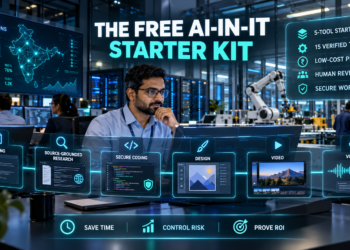
















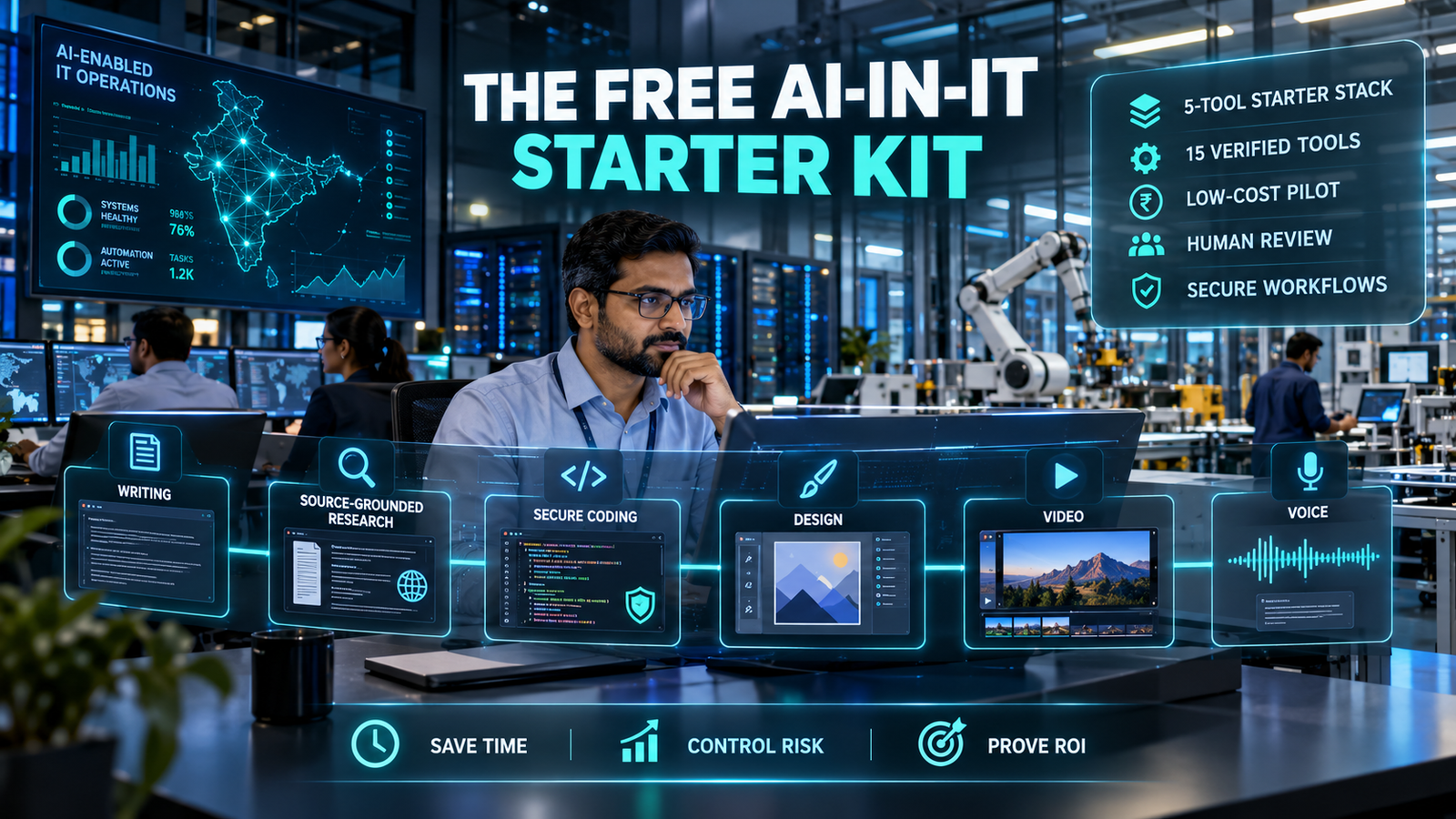
Executive Summary
A free AI toolkit can reduce drafting, research, coding, design, and media-production friction without creating an immediate software bill. It can also create shadow AI, data leakage, duplicated subscriptions, weak audit trails, and unreliable output when employees adopt tools without an operating model.
This article turns 15 free services into a controlled AI-in-IT starter kit for Indian founders, IT managers, and technical teams. It identifies what each tool is suitable for, what “free” actually means, where the limits appear, which data should never be uploaded, and when a paid enterprise plan becomes commercially rational.
The free AI toolkit is therefore presented as an operating model, not a download bundle. Every recommendation is tied to a task, control, limitation, and commercial upgrade trigger.
The strongest starting configuration uses five tools, not fifteen: one general assistant, one source-grounded research service, one coding assistant, one design tool, and one approved media tool. The remaining products should be activated only when a real workflow requires them.
Free access is not the same as production readiness. A free AI toolkit is valuable for discovery and low-risk internal work, while customer data, proprietary source code, regulated records, automated decisions, and public-facing outputs require stronger controls, licenses, testing, and human accountability.
Used this way, the free AI toolkit becomes a disciplined bridge between experimentation and enterprise procurement. It does not pretend that consumer access is a substitute for production controls.
The Current Market Challenge: Free Access Creates Unmanaged Complexity
The original draft treated every zero-cost offer as equivalent. That is commercially unsafe because “free” can mean a permanent plan, a variable quota, a one-time credit grant, an evaluation trial, limited export rights, or a consumer service without enterprise administration.
A free AI toolkit must therefore be designed around workflows and risk classes. Tool count is not a success metric; validated time saved, acceptable output quality, and controlled data handling are.
Why Tool Lists Fail Inside Real IT Teams
Most lists describe features but ignore integration effort. Employees still need sign-in controls, browser permissions, file-handling rules, prompt templates, review steps, output storage, cost monitoring, and an escalation route when a model gives a wrong answer.
The result is often tool sprawl. Five people may use five assistants for the same task, create separate work histories, paste confidential information into consumer accounts, and produce outputs that cannot be reproduced later.
“No Credit Card” Does Not Mean “No Cost”
The cash price may be zero while the workflow still consumes staff time, network capacity, review effort, and security attention. Rework is especially expensive when an attractive answer contains a fabricated source, vulnerable code, an incorrect calculation, or unlicensed media.
Runway, for example, describes its Free plan as a one-time allocation of 125 credits rather than a renewable monthly allowance.[1] Murf describes its Studio offer as a free trial with ten minutes of generation and no downloads, which makes it suitable for evaluation rather than a permanent production tool.[2]
Cost of Inaction
Ignoring AI adoption does not prevent it. Staff can access consumer tools from browsers and personal accounts, creating shadow AI without formal procurement or IT visibility.
IBM reported that organizations with high shadow-AI use experienced an average of US$670,000 more in breach costs than organizations with low or no shadow AI in its 2025 study.[3] That figure is not a forecast for every company, but it shows why a governed free AI toolkit is safer than an informal ban that employees bypass.
Cost of Over-Adoption
Activating all 15 tools at once raises training and governance costs. It also prevents managers from identifying which product created a measurable gain.
Start with a five-tool stack and a 30-day test. Add another tool only when it removes a defined bottleneck that the existing free AI toolkit cannot handle.
This staged approach keeps the free AI toolkit understandable for users and observable for IT. It also gives management a clean baseline before any paid procurement begins.
Best AI Tools for Small Businesses in 2026: A Powerful, Practical Guide for Student Founders
Architecture Overview: Designing a Governed Free AI Toolkit
The technical architecture should separate user access, approved data, AI services, validation, and business systems. No free consumer tool should receive automatic access to email, source repositories, ticketing systems, CRM records, or cloud storage simply because a connector exists.

Layer 1: Identity and Access
Use company-managed email accounts where possible. Record who owns each account, whether multi-factor authentication is available, which browser extensions are installed, and how access is removed when a user changes role.
A free AI toolkit rarely provides complete enterprise identity management. That limitation is an upgrade trigger when the team needs single sign-on, centralized policy, user lifecycle controls, audit logs, or legal hold.
Layer 2: Data Classification
Create three simple data classes before launch. Green data is public or synthetic; amber data is internal but non-sensitive; red data includes credentials, customer records, personal data, unreleased financials, production logs, secrets, proprietary code, health information, and privileged legal material.
The free AI toolkit should accept only green data by default. Amber data requires an approved tool and purpose, while red data stays out unless a reviewed contract, security assessment, and technical control explicitly permit it.
The Minimum Prompt-Safety Rule
Never paste API keys, passwords, private keys, access tokens, production database extracts, or personally identifiable information into a public AI chat. Redact identifiers and reproduce defects with synthetic data.
For code, provide the smallest relevant function rather than an entire proprietary repository. Require a developer to review security, dependencies, licenses, and tests before merging AI-assisted code.
Layer 3: Task Routing
Each task should have one primary tool and one fallback. Writing may start in ChatGPT or Gemini, source-based research in Perplexity or NotebookLM, code assistance in GitHub Copilot, and design in Canva or Adobe Express.
This routing prevents the free AI toolkit from becoming a collection of interchangeable tabs. It also creates measurable categories for time, quality, rework, and upgrade decisions.
Layer 4: Human Validation
AI output is a draft, suggestion, or candidate—not an approval. Humans remain accountable for facts, calculations, security, legal conclusions, employment decisions, financial recommendations, and published claims.
Validation should match impact. A low-risk email needs a quick read; infrastructure code needs testing and review; a public business claim needs primary-source verification; regulated decisions may require formal documentation and specialist approval.
Layer 5: Logging and Measurement
Track task type, tool, time before AI, time with AI, review time, error count, accepted output, and any incident. Do not store confidential prompts in an uncontrolled spreadsheet.
A lightweight free AI toolkit register should also record account owner, approved use, plan type, review date, and current data restrictions. That register becomes the evidence base for consolidation and licensing decisions.
The free AI toolkit succeeds only when total verified work improves. Faster drafting followed by longer correction is not productivity.
Integration Flowchart: From Request to Approved Output
Business task
    ↓
Classify data and risk
    ↓
Select approved tool and prompt template
    ↓
Generate draft or recommendation
    ↓
Verify facts, code, calculations, rights, and policy
    ↓
Human approval
    ↓
Store final output in the system of record
    ↓
Measure time, quality, rework, and incidents
The free AI toolkit should stop at the draft stage during the pilot. Automatic publishing, unattended code deployment, customer messaging, and irreversible actions belong in a later enterprise AI deployment phase with authentication, monitoring, rollback, and accountable owners.
Deployment Challenges
Consumer interfaces change quickly, and quotas may vary with demand, prompt complexity, model choice, or region. Google states that Gemini usage is compute-based and can depend on prompt complexity, model, feature, and conversation length rather than one universal number.[4]
Anthropic similarly describes usage as a conversation budget with session and other limits rather than unrestricted use.[5] A free AI toolkit must therefore include fallback workflows instead of promising “unlimited” access.
Integration Edge Cases
- A browser assistant summarizes an outdated page rather than the current source.
- A file upload contains hidden personal data or tracked changes.
- An IDE assistant sends more workspace context than the developer expected.
- A design tool uses an asset whose license does not cover the intended campaign.
- A voice service permits testing but not commercial use on the free tier.
- A free plan changes quota during a deadline-sensitive project.
- A shared account destroys user attribution and violates service terms.
The Five-Tool Starter Stack
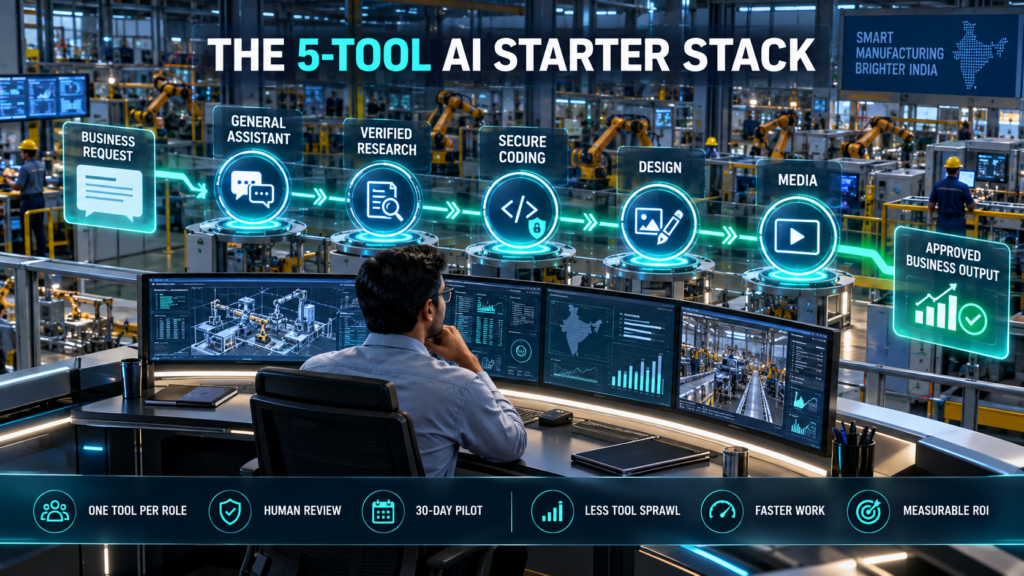
The recommended free AI toolkit begins with five roles. Choose one product per role, issue a written use policy, and test a small set of repetitive tasks.
This free AI toolkit configuration covers the most common knowledge-work bottlenecks without forcing every employee to learn 15 interfaces. Specialists can request additional tools after the core workflow is stable.
1. General Assistant: ChatGPT Free or Google Gemini
Use a general assistant for email drafts, meeting-note cleanup, requirement outlines, test-case ideas, explanations, spreadsheet formulas, and first-pass summaries. Do not describe any consumer plan as unlimited because model, file, image, and advanced-feature limits can vary.
ChatGPT Free is a broad starting point for mixed text, analysis, file, and ideation tasks, subject to current usage limits. Gemini is attractive for teams already using Google accounts and for workflows that benefit from Google’s ecosystem, but access and limits still need verification at the time of use.
2. Source-Grounded Research: Perplexity Free or NotebookLM
Use Perplexity when the task begins with an open-web question and requires visible source links. Use NotebookLM when the answer should remain grounded in a selected collection of documents supplied by the team.
Neither product eliminates source review. The employee should open the cited page, confirm that it supports the sentence, check its date, and prefer primary documentation over summaries.
Within the free AI toolkit, research tools should produce an evidence trail rather than a final verdict. The decision owner remains responsible for interpreting the source and its commercial relevance.
3. Coding Assistant: GitHub Copilot Free
GitHub currently states that Copilot Free includes 2,000 completions and 50 chat or Copilot Edits requests.[6] That is enough to test autocomplete, unit-test suggestions, code explanation, documentation, and small refactors without presenting it as unlimited development capacity.
GitHub’s controlled research reported task completion up to 55% faster in a specific experiment.[7] Treat that as vendor research under defined conditions, not a guaranteed productivity rate for every team, language, or codebase.
4. Design Tool: Canva Free
Canva states that a range of AI functions is available on its Free plan with higher usage on paid tiers.[8] Use it for internal diagrams, presentation drafts, social graphics, simple documents, and reusable layout templates.
The free AI toolkit should not assume every template, stock item, brand feature, background-removal function, or AI allowance is free. Confirm the license and export result for each final asset.
5. Media Tool: Adobe Express Free or ElevenLabs Free
Adobe Express provides a no-cost plan with core design and video tools, limited generative access, and MP4 export for free video projects.[9] It is a practical choice for teams that need basic editing and media assembly rather than experimental text-to-video generation.
For most small teams, that makes the free AI toolkit more dependable for routine media work than a workflow built entirely around expiring generation credits.
ElevenLabs lists a Free plan with 10,000 monthly credits.[10] Before publishing a commercial voiceover, verify the current license, attribution, cloning permissions, consent, and language quality; the existence of free credits does not establish commercial rights.
The Complete 15-Tool Free AI Toolkit
The table classifies each offer by practical role and free-access model. The free AI toolkit deliberately qualifies “free” because limits and rights differ.
| Tool | Best free use | Free-access model | Main limitation | Recommended status |
|---|---|---|---|---|
| ChatGPT | Drafting, summaries, analysis, formulas | Ongoing free plan with usage limits | Advanced models and tools are capped | Starter stack candidate |
| Google Gemini | General assistance and Google-oriented work | Ongoing free access with compute-based limits | Limits vary by model, feature, and complexity | Starter stack candidate |
| Microsoft Copilot | Browser-based questions, drafting, image creation | Consumer free access | Not the same as paid Microsoft 365 Copilot integration | Optional |
| Claude | Long-form analysis, writing, structured reasoning | Ongoing free plan with usage budgets | Limits vary with context and demand | Optional fallback |
| Perplexity | Web research with visible citations | Free search and limited advanced use | Citations still require verification | Starter research choice |
| NotebookLM | Research grounded in selected documents | Free consumer access, subject to limits | Output quality depends on source set | Starter research choice |
| GitHub Copilot Free | IDE completion, chat, tests, code explanation | 2,000 completions and 50 chat/Edits requests | Monthly quota and no enterprise controls | Starter coding choice |
| Windsurf Free | AI-assisted IDE experimentation | US$0 plan with quota-based usage | Quotas and model access can change | Coding alternative |
| Canva Free | Presentations, social graphics, simple design | Ongoing free plan with shared AI allowance | Premium assets and higher AI limits excluded | Starter design choice |
| Adobe Express Free | Graphics and basic video editing | Ongoing free plan, limited generative access | Premium content and credits excluded | Media alternative |
| Leonardo AI | Image ideation and creative variants | Daily free-token quota | Public/default asset settings and rights require review | Controlled creative use |
| Runway Free | Testing generative video workflows | One-time 125-credit allocation | Not a renewable free production allowance | Evaluation only |
| Microsoft Clipchamp Free | Browser video editing and caption workflow | Ongoing free editor, features vary | Some stock and advanced features are paid | Practical video editor |
| ElevenLabs Free | Voice-quality testing and limited narration | 10,000 monthly credits | Commercial rights and advanced features need checking | Controlled voice use |
| Murf Free Trial | Voice and language evaluation | Ten-minute trial; no downloads | Not a permanent production plan | Test, then remove or license |
Chat and Writing Tools
ChatGPT, Gemini, Microsoft Copilot, and Claude overlap heavily. A five-person business does not need all four in active daily use.
Select one primary assistant based on account ecosystem, output quality on real tasks, data terms, and administration needs. Keep one fallback in the free AI toolkit for quota interruptions and cross-checking difficult answers.
What to Test
Use the same five prompts across candidates: rewrite a customer email, summarize a non-sensitive policy, produce acceptance criteria, explain a technical incident, and extract action items. Score factual accuracy, instruction following, tone, review time, and failure rate.
Do not score eloquence alone. A polished wrong answer is more dangerous than a visibly incomplete answer.
Research and Knowledge Tools
Perplexity and NotebookLM solve different problems. Perplexity discovers sources on the open web, while NotebookLM is better suited to interrogating a controlled source pack.
For procurement, compliance, cybersecurity, pricing, and news, the researcher must open the primary page and record the access date. The free AI toolkit should never cite an AI-generated summary as the source.
Coding Tools
GitHub Copilot Free is the clearest entry point because its published free quotas are explicit. Windsurf Free is useful for evaluating an AI-native development environment, but its March 2026 move to quota-based plans means teams must verify current allowances before standardizing.[11]
Do not use personal free accounts for proprietary repositories without security approval. Disable the tool for secrets, configuration files, regulated code, or repositories whose terms prohibit external processing.
Secure Coding Gate
Every AI-assisted change should pass tests, linting, dependency scanning, secret scanning, peer review, and the normal deployment pipeline. The free AI toolkit must never become a path around change management.
Design and Image Tools
Canva Free and Adobe Express Free cover most presentations, social assets, and simple graphics. Leonardo AI is useful when the requirement is image generation and variant exploration; its official pricing page describes a daily free-token allocation.[12]
Check whether generated assets are private, reusable, and commercially permitted. Retain prompts and source assets when provenance matters.
Video Tools
Adobe Express and Clipchamp are practical editors because they assemble owned media and allow human control. Runway is better treated as an experiment because the Free plan’s 125 credits are deposited once, not monthly.[1]
The original recommendation of CapCut is removed from the core India stack because availability and lawful access in India have been uncertain since the government’s earlier app restrictions. Do not advise employees to bypass regional controls with VPNs or unofficial application packages.
Voice Tools
ElevenLabs Free can test text-to-speech quality within a monthly credit allowance. Murf’s no-card trial can test voices and languages, but its stated trial has no downloads, so it should not be described as a sustainable free production service.[2]
Voice cloning requires explicit consent and identity safeguards. Never clone an employee, customer, celebrity, or public official without documented authority and a legitimate use.
Feature and Cost Comparison: Four General Assistants
The comparison focuses on free entry, not model rankings. Models and limits change too frequently for static “best AI” claims.
| Solution | Free entry | Strongest starter use | Key friction | Paid-enterprise trigger |
|---|---|---|---|---|
| ChatGPT Free | Yes; usage-limited | Broad drafting, analysis, files, ideation | Feature and model caps | Central administration, stronger controls, higher usage |
| Google Gemini | Yes; compute-based limits | Google-oriented work and multimodal assistance | Limits vary with complexity and feature | Workspace integration, governance, higher capacity |
| Microsoft Copilot | Yes for consumer chat | Browser assistance and Microsoft-oriented users | Consumer Copilot is not full Microsoft 365 Copilot | Grounding in organizational Microsoft 365 data |
| Claude Free | Yes; usage budgets | Long documents, structured writing, careful analysis | Context-heavy work consumes quota | Team controls, higher limits, organizational administration |
No row claims that one tool is universally superior. The correct free AI toolkit choice depends on task accuracy, ecosystem fit, data rules, administration, and verified total effort.
Commercial Upgrade Decision
Upgrade when free-plan constraints create measurable cost or risk. Examples include employees waiting for quota resets, recreating work across accounts, losing auditability, exposing data, or spending more time on manual integration than a licensed product would cost.
Do not upgrade because a vendor advertises a newer model. Require a documented workload, baseline, expected gain, owner, monthly ceiling, security approval, and 30-day evaluation.
The free AI toolkit should therefore function as a procurement filter. It reveals whether the business needs a better model, more capacity, tighter governance, deeper integration, or no additional software at all.
Performance Evaluation Matrix
Use the matrix during the pilot to compare the free AI toolkit against the existing workflow.

Apply the same measures to every free AI toolkit category so that attractive demonstrations do not outrank verified operational value.
| Measure | Formula | Minimum evidence | Failure signal |
|---|---|---|---|
| Verified time saving | Baseline minutes − AI workflow minutes including review | At least 20 comparable tasks | Draft is faster but review erases the gain |
| First-pass acceptance | Accepted outputs ÷ total outputs | Reviewer decision log | Employees accept outputs without review |
| Factual error rate | Material errors ÷ checked claims | Source-linked fact check | Confident unsupported claims recur |
| Code rework rate | AI changes requiring correction ÷ AI changes reviewed | Pull-request data | More defects or security findings |
| Cost avoidance | Avoided license cost − added labor and controls | Documented market price and time | “Free” workflow consumes excessive staff time |
| Quota interruption | Tasks blocked by limits ÷ planned tasks | Usage log | Deadlines depend on unpredictable access |
| Security exceptions | Unauthorized data/tool events | Incident and access logs | Shadow accounts or sensitive uploads |
ROI Formula
\[ \text{Monthly Net Value} = (\text{Verified Hours Saved} \times \text{Loaded Hourly Cost}) – \text{Review Cost} – \text{Integration Cost} – \text{Incident Cost} \]
The free AI toolkit should be retained only when the calculation remains positive after review and governance time. Do not assign monetary value to unverified hours claimed by users.
Evidence Interpretation
GitHub’s research found developers completed a defined coding task up to 55% faster with Copilot.[7] That is useful evidence for designing a local pilot, but it is not a universal ROI guarantee.
Measure your own repository, language, developer experience, test coverage, and defect rate. A smaller verified improvement is more valuable than a copied benchmark.
Business Outcomes and Strategic ROI Takeaways
A controlled free AI toolkit can reduce the cost of learning before procurement. It lets a business identify high-frequency tasks, build prompt and review practices, and learn which integrations justify a paid plan.
The main outcome is not “using AI.” It is a repeatable workflow that produces acceptable work faster without weakening security, compliance, or accountability.
A successful free AI toolkit also creates reusable assets: approved prompts, review checklists, task baselines, incident records, and evidence for future vendor negotiations.
Practical 30-Day Pilot
Week 1: approve five tools, define prohibited data, select ten recurring tasks, and record baseline time and quality. Train users with task-specific examples rather than generic prompting theory.
Week 2: run low-risk tasks through the free AI toolkit and record generation plus review time. Stop any workflow that requires sensitive data or automatic action.
Week 3: compare results, remove redundant tools, and test one fallback for quota interruptions. Review security events, incorrect claims, code defects, and licensing questions.
Week 4: calculate verified value, approve permanent workflows, document upgrade triggers, and close unused accounts. Present results to the business owner and IT manager with evidence, not screenshots of impressive outputs.
When Free Is Enough
Free access is often enough for individual learning, public-data research, drafting non-sensitive content, prototype code, internal design drafts, occasional image ideation, and low-volume voice testing. The free AI toolkit is especially useful when output remains human-reviewed and no system integration is required.
It is not enough when work requires uptime guarantees, large context, high volume, team administration, data isolation, contractual protection, audit logs, private connectors, automated actions, or vendor support.
What to Skip
Skip duplicate general assistants, tools with unclear ownership or privacy terms, unofficial APKs, “unlimited free” offers that require circumvention, and trials that cannot export usable work. Skip any product whose value cannot be measured on a real task.
Also skip automatic publishing and agentic access during the first pilot. The free AI toolkit should earn trust before it receives permissions.
Keep the free AI toolkit read-only wherever possible during evaluation. Write access to repositories, mailboxes, ticket queues, and production systems should require a separate risk review.
Risk Mitigation and Regulatory Framework
NIST’s Generative AI Profile extends the AI Risk Management Framework with actions for risks specific to generative AI.[13] Its Govern, Map, Measure, and Manage approach is a practical structure for a small-business policy even when the products are free.

Map each free AI toolkit workflow to an accountable owner, permitted data class, validation step, and shutdown procedure. A tool without an owner should not remain approved.
Governance Checklist
- Maintain an approved-tool register with owner, purpose, plan, and review date.
- Prohibit credentials, secrets, customer data, regulated records, and privileged material.
- Use managed identities and multi-factor authentication where available.
- Define human reviewers for facts, code, media, and customer communication.
- Record source links and access dates for commercial claims.
- Scan AI-assisted code for vulnerabilities, secrets, dependencies, and license issues.
- Confirm asset, voice, model, and commercial-use rights before publication.
- Monitor quota changes, pricing changes, regional availability, and product renames.
- Close unused accounts and revoke departed-user access.
- Create an incident path for sensitive uploads, impersonation, or harmful output.
EU AI Act Relevance
The EU AI Act uses role- and risk-based obligations, including transparency duties for providers of general-purpose AI models and requirements affecting certain providers and deployers.[14] A company outside the EU may still need legal analysis when its AI system, users, customers, or outputs fall within the regulation’s territorial scope.
Using a free AI toolkit does not transfer compliance responsibility to the vendor. The business must still determine its role, intended purpose, data use, human oversight, documentation, and whether a downstream use is prohibited or high risk.
India-Focused Controls
Indian teams should align the free AI toolkit with contractual confidentiality, the Information Technology Act and applicable rules, sector requirements, and the Digital Personal Data Protection framework as brought into force and implemented. Obtain Indian legal advice for personal-data processing, cross-border transfers, employee monitoring, and regulated sectors.
Do not claim that a tool is “India compliant” merely because its website is accessible in India. Availability is not a certification.
Security and Shadow AI
IBM defines shadow AI as employee or user adoption without IT approval or oversight.[15] The practical control is an approved low-risk route, not a policy document that offers no usable alternative.
Publish the five-tool free AI toolkit, explain prohibited data in plain language, and provide a fast approval process for new use cases. Employees are more likely to follow a policy that helps them finish work.
Review the free AI toolkit quarterly because plan limits, model behavior, licenses, and regional availability can change faster than annual procurement cycles.
Final CTA: Build the Stack, Then Prove the Value
Do not open 15 accounts today. Start with one general assistant, one research tool, GitHub Copilot Free for eligible developers, one design tool, and one approved media tool.
Run the five-tool free AI toolkit for 30 days, measure verified time and quality, remove redundant products, and upgrade only where usage, integration, governance, or support creates a documented business case.
The final free AI toolkit should be smaller, safer, and easier to measure than the list that started the evaluation.
Assign one manager to maintain the free AI toolkit and report its verified value each quarter.
Appendix: Research Integrity
Sources and Citations Index
- Runway, “How do credits work?” Free plan: one-time 125-credit allocation. https://help.runwayml.com/hc/en-us/articles/15124877443219-How-do-credits-work
- Murf Help Center, “Free Trial Features.” Ten minutes of voice generation; no downloads. https://help.murf.ai/is-murf-free-to-use
- IBM, “Cost of a Data Breach Report 2025” and shadow-AI findings. https://newsroom.ibm.com/2025-07-30-ibm-report-13-of-organizations-reported-breaches-of-ai-models-or-applications%2C-97-of-which-reported-lacking-proper-ai-access-controls
- Google, “Gemini Apps limits and upgrades.” https://support.google.com/gemini/answer/16275805
- Anthropic Help Center, “Understanding usage and length limits.” https://support.anthropic.com/en/articles/11647753-understanding-usage-and-length-limits
- GitHub, “Copilot plans and pricing.” https://github.com/features/copilot/plans
- GitHub Research, “The economic impact of the AI-powered developer lifecycle.” https://github.blog/news-insights/research/the-economic-impact-of-the-ai-powered-developer-lifecycle-and-lessons-from-github-copilot/
- Canva India, “Canva AI.” https://www.canva.com/en_in/canva-ai/
- Adobe Express, “Free plan” and “Free video maker.” https://helpx.adobe.com/express/web/adobe-express-subscription/free.html
- ElevenLabs, “Pricing.” https://elevenlabs.io/pricing
- Windsurf, “Plans and usage.” https://docs.windsurf.com/windsurf/accounts/usage
- Leonardo AI, “Pricing.” https://leonardo.ai/pricing
- NIST, “Artificial Intelligence Risk Management Framework: Generative Artificial Intelligence Profile,” NIST AI 600-1. https://www.nist.gov/publications/artificial-intelligence-risk-management-framework-generative-artificial-intelligence
- European Union, Regulation (EU) 2024/1689 and official summary. https://eur-lex.europa.eu/eli/reg/2024/1689/oj
- IBM, “What Is Shadow AI?” https://www.ibm.com/think/topics/shadow-ai
Academic and IEEE-Style Reference Note
The numbered references follow an IEEE-style index for on-page readability. Plan limits and features are vendor claims and should be checked again immediately before publication; vendor pages, not secondary tool-review sites, control the factual description of current offers.
Corporate Editorial Transparency and AI Usage Disclosure
This article was reconstructed from the supplied draft using AI-assisted editorial analysis. A human editor should verify plan limits, India availability, legal statements, product names, links, and commercial-use rights before publication.
No vendor paid for inclusion. The comparison is editorial and does not constitute an endorsement, affiliate ranking, security certification, or promise that a free tier will remain available.
Author Credentials and Corporate E-E-A-T Verification
Author: Garikapati Bullivenkaiah
Technology related: Artificial Intelligence, Regulation, Robotics and Industrial Automation, Quantum Computing and Quantum AI, Cybersecurity & Data Protection, Intellectual Property Rights, Digital Innovation & Future Technologies, Generative AI and Neural Networks, Future and Emerging Technologies
Reviewed by: Chitikineni Ramadevi (Editor)
Role: Chitikineni Rama Devi holds an M.Sc. in Computers from Andhra University and brings over 10 years of research experience in technology-related subjects. Her work focuses on researching, analyzing, and presenting complex technology topics in a clear and accessible manner for NezzHub readers. As an Editorial Contributor at NezzHub, she contributes research-driven technology content with an emphasis on accuracy, clarity, and practical relevance.
Fact-checked: 27-09-2026
Last updated: 27-09-2026
Published by: NezzHub
Author Role: Author and Technology Research Writer, with LL.B., LL.M., M.A., and MBA qualifications and a multidisciplinary focus spanning AI regulation, technology, intellectual property, cybersecurity, robotics, and emerging technologies. Linkedin Profile
Editorial methodology: Primary-source research, authoritative industry research, technical documentation review and editorial fact-checking.
Corrections: NezzHub should clearly correct substantive factual errors discovered after publication.generate im
Editorial Standard: Technical, financial, cybersecurity and vendor claims should be supported by authoritative sources. Credentials must never be invented or exaggerated for E-E-A-T purposes.
Commercial Disclosure: Vendor comparisons are editorial and should be updated whenever pricing, product availability or commercial relationships change.

Garikapati Bullivenkaiah is a seasoned entrepreneur with a rich multidisciplinary academic foundation—including LL.B., LL.M., M.A., and M.B.A. degrees—that uniquely blend legal insight, managerial acumen, and sociocultural understanding. Driven by vision and integrity, he leads his own enterprise with a strategic mindset informed by rigorous legal training and advanced business education. His strong analytical skills, honed through legal and management disciplines, empower him to navigate complex challenges, mitigate risks, and foster growth in diverse sectors. Committed to delivering value, Garikapati’s entrepreneurial journey is characterized by innovative approaches, ethical leadership, and the ability to convert cross-domain knowledge into practical, client-focused solutions.