











USA Quantum Computing
USA Quantum Computing examines the companies, research programs, hardware architectures and cloud platforms shaping American quantum technology. This NezzHub subcategory serves technology decision-makers, business owners, IT managers, professionals and students who need practical analysis without assuming that every experimental result represents commercial readiness.
The coverage connects quantum capability with classical infrastructure, software development, implementation cost, cybersecurity and vendor evaluation. Readers can use these resources to distinguish research access, pilot projects and production-grade services while identifying where quantum computing may eventually support scientific or business workloads.
Explore USA Quantum Computing
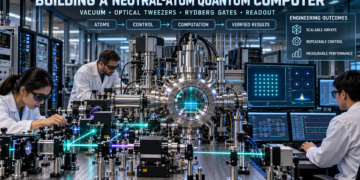
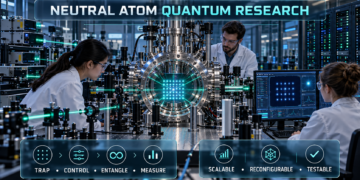
The American quantum ecosystem includes hardware developers, cloud providers, universities, national laboratories, software companies and specialist suppliers. These organizations pursue different technical approaches, development timelines and commercial models.
Major subjects covered within this subcategory include:
- Quantum hardware: Qubit technologies, control systems, error rates, coherence and scaling constraints.
- Quantum software: Algorithms, developer frameworks, compilers, simulators and hybrid orchestration.
- Cloud quantum access: Remote access to quantum processors, simulators and managed development environments.
- Commercial applications: Research into chemistry, materials, optimization, finance and machine learning.
- Quantum security: Cryptographic risk, migration planning and post-quantum readiness.
NezzHub’s guide to leading quantum computing companies in the USA helps readers compare providers through technology maturity, developer access, business fit and commercial limitations rather than publicity alone.
Business and Enterprise Applications
Quantum computing should be evaluated against a specific computational problem. A business case becomes weak when a company begins with a vendor or hardware preference before establishing whether the workload is difficult, valuable and unsuitable for efficient classical methods.
Potential application areas include molecular modelling, materials research, complex optimization and selected financial-analysis problems. These remain workload-dependent opportunities, not guaranteed performance improvements.
Commercial evaluation should ask:
- What business or research problem is being tested?
- Which classical baseline will be used for comparison?
- Is the workload running on real hardware, a simulator or both?
- Which costs apply to access, consulting, software and data preparation?
- Can the experiment be reproduced if the provider or hardware changes?
Organizations should treat quantum projects as evidence-building programs. Budget approval should depend on measurable learning, reusable skills or validated technical progress rather than an unsupported claim of future quantum advantage.
Architecture, Integration and Deployment
Most enterprise quantum workflows are hybrid. Classical systems prepare data, select parameters and manage business logic, while a quantum processor or simulator performs a limited computational step before results return to classical infrastructure.
The architecture can include user applications, identity controls, cloud APIs, quantum software development kits, simulators, job queues, vendor hardware and result-validation services. Each layer introduces performance, security, portability and cost considerations.
Teams should record the processor type, software version, circuit structure, compilation settings, queue time, execution results and classical comparison method. Without reproducibility, an isolated experiment provides little procurement value.
A sensible deployment begins with simulation and small hardware experiments. Expansion should occur only when the team can explain the workload, measurement method, error behaviour, classical baseline and operational cost.
Risks, Security and Governance
Quantum computing remains technically demanding, and hardware limitations can restrict useful circuit depth and repeatability. Marketing language may also confuse qubit counts, research milestones and narrow experimental results with broadly usable computing performance.
- Require evidence that matches the intended workload.
- Separate vendor projections from demonstrated capabilities.
- Track cloud usage, queue times and specialist consulting costs.
- Protect credentials, proprietary algorithms and research data.
- Document dependencies on vendor-specific tools and formats.
- Maintain an exit path for code, data and experimental records.
Quantum computing also creates a long-term security planning issue because sufficiently capable future systems could affect widely used public-key cryptography. Organizations should inventory cryptographic dependencies and manage migration planning through qualified security teams instead of waiting for an emergency replacement project.
How to Use This Subcategory
- Business owners: Focus on specific workloads, cost boundaries and evidence of practical value.
- Technology leaders: Compare hardware approaches, software ecosystems and provider roadmaps.
- IT managers: Review identity, APIs, cloud integration, monitoring and vendor dependence.
- Security professionals: Examine cryptographic inventories and quantum-safe migration planning.
- Students: Begin with hardware principles and classical baselines before studying advanced algorithms.
For connected American AI, robotics, healthcare and industry coverage, visit the parent USA Tech & Innovation category.
Frequently Asked Questions
Is quantum computing ready for enterprise production?
Readiness depends on the workload. Many current programs focus on research, experimentation and hybrid workflows rather than replacing general-purpose enterprise computing.
How can businesses access quantum computers?
Organizations can use cloud-accessible processors, simulators, research partnerships or specialist service providers without owning quantum hardware.
What should buyers compare between quantum providers?
Compare hardware approach, error behaviour, software compatibility, access model, support, pricing, documentation, portability and workload evidence.
Why should organizations consider quantum-safe security?
Cryptographic migration can take years. Early inventory and planning help organizations identify systems that may require future replacement or upgraded protection.
Latest USA Quantum Computing Articles
Browse the automatic archive below for current NezzHub research on USA Quantum Computing, commercial providers, enterprise applications, technical limitations and security planning.
No Content Available
















Recent News










NezzHub is a technology-focused knowledge hub delivering insights on AI, robotics, cybersecurity, biotech, and emerging innovations. Our mission is to simplify complex technologies through research-driven content and analysis.