















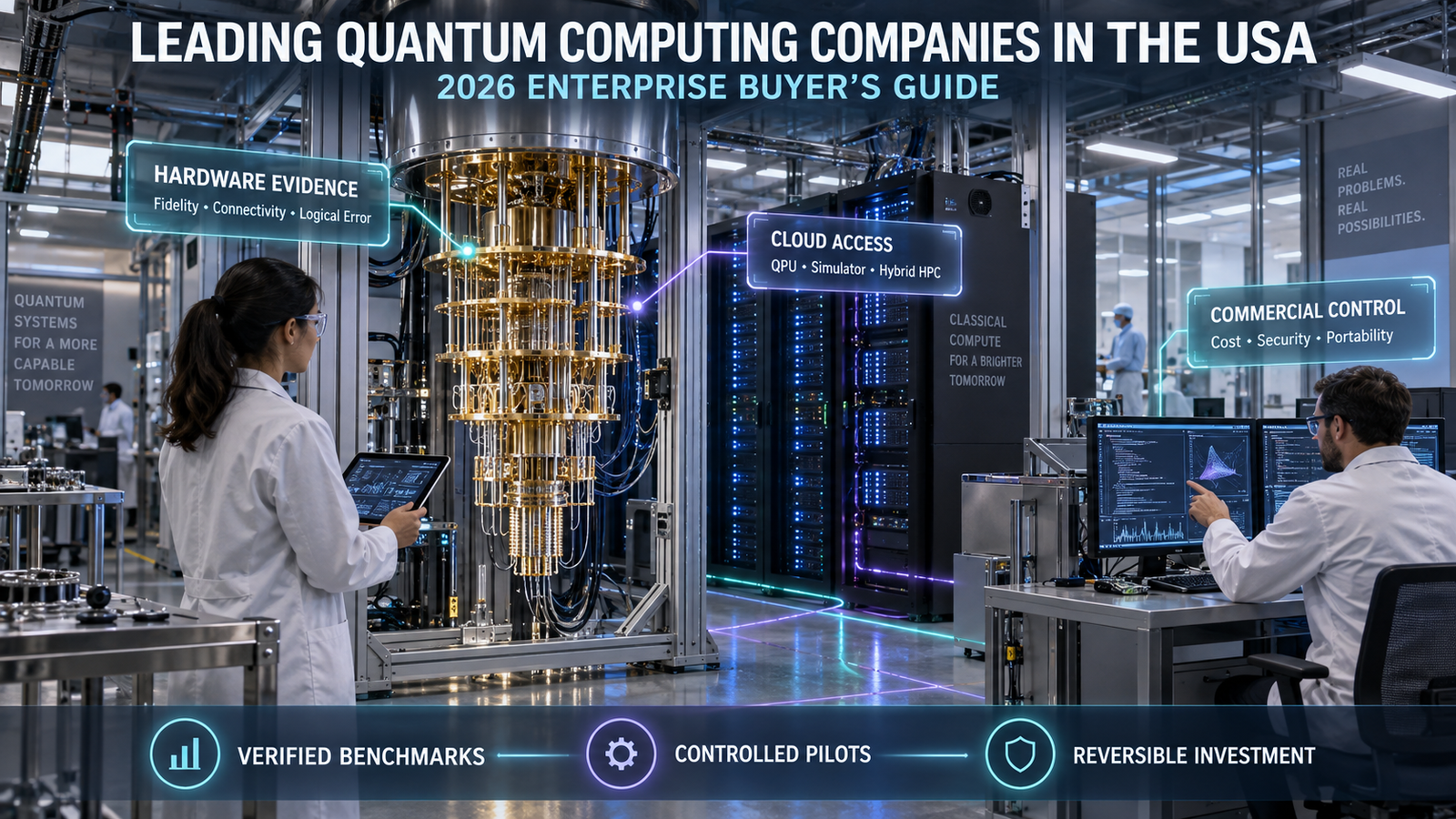
Executive Summary
The Leading Quantum Computing Companies in the USA are selling access, research capacity, software, engineering services and long-term platform options—not a general replacement for enterprise servers. A credible 2026 buying decision must separate published experiments from useful production workloads and vendor roadmaps from contracted capability.
This Article evaluates IBM [2] , Google, Microsoft, Amazon Web Services, IonQ, Rigetti, Quantinuum, Atom Computing, PsiQuantum and other commercially relevant providers. It compares hardware modality, cloud access, developer tooling, benchmark quality, cost visibility, security, procurement risk and integration with classical high-performance computing.
The central finding is uncomfortable but useful. Most organizations should not purchase hardware; they should build a small, reversible program using quantum computing cloud platforms, classical baselines and explicit stop criteria.
Google’s Willow work demonstrated below-threshold error correction and a demanding random-circuit-sampling result, but Google also states that this benchmark has no known commercial application. IBM’s roadmap targets early advantage demonstrations in 2026 and a fault-tolerant system later, while explicitly warning that roadmap information represents current intent and may change.
The near-term business case is therefore capability building, algorithm and resource estimation, post-quantum security migration, and tightly scoped experiments. Any proposal promising broad operational savings from current quantum computing hardware should carry the burden of proof. [1]
I. The Current Market Landscape and Challenge
A Market of Non-Comparable Machines
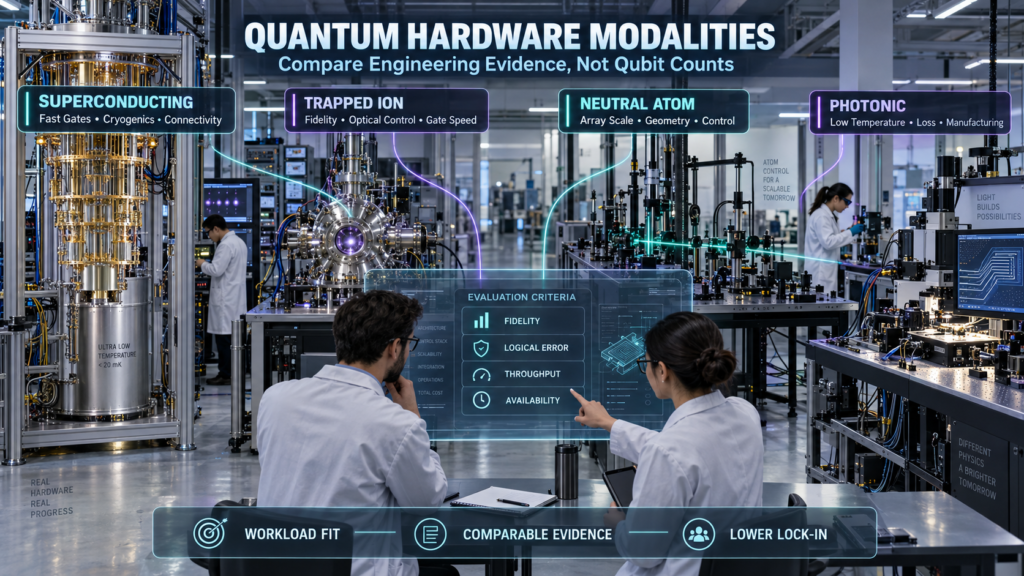
The Leading Quantum Computing Companies in the USA do not build one standardized product. Superconducting circuits, trapped ions, neutral atoms, photonics, silicon spins and quantum annealers impose different constraints on connectivity, speed, fidelity, cooling, control and error correction.
A raw physical-qubit count therefore cannot rank the market. One vendor may expose many noisy qubits with restricted connectivity, while another exposes fewer qubits with higher all-to-all connectivity or reports an application-oriented metric.
The useful comparison unit is a workload executed under disclosed conditions. Buyers need circuit width, depth, gate set, two-qubit fidelity, sampling volume, queue time, compilation behavior, error mitigation, classical preprocessing and total cost.
Who Counts as a U.S. Company?
The phrase Leading Quantum Computing Companies in the USA needs geographic discipline. IBM, Google, Microsoft, AWS, IonQ, Rigetti, Atom Computing and PsiQuantum are U.S.-headquartered or have central U.S. operations.
Quantinuum combines substantial U.S. operations with a global corporate structure. D-Wave has Canadian origins and operations, but its corporate headquarters is listed in Palo Alto, California. The company announced plans to move its headquarters to Boca Raton, Florida before the end of 2026.
This paper labels headquarters and commercial role separately. It does not turn every supplier accessible from a U.S. cloud region into a U.S. company.
What Changed by 2026
Hardware work is shifting from isolated physical-qubit records toward logical error suppression, modularity and hybrid execution. Google reported that Willow’s encoded error decreased as code size increased, a prerequisite for scalable error correction rather than proof of a profitable application.
IBM’s published roadmap describes 2026 targets involving Nighthawk circuits, modular systems and a real-time error-correction decoder. These are vendor objectives, not warranties available to procurement teams.
Cloud access has also matured. Developers can submit jobs through IBM Quantum, Amazon Braket, Microsoft Azure Quantum, vendor clouds and open-source SDKs without installing cryogenic or laser systems on site.
Top AI Jobs in the USA: Roles, Salaries, and Trends
The Cost of Inaction
Waiting carries two different costs. The first is a skills gap: teams that postpone all experimentation will struggle to evaluate algorithms, resource estimates, hardware claims and hybrid architecture when useful systems emerge.
The second is cryptographic exposure. NIST [3] finalized its first three post-quantum cryptography standards in 2024 and urged administrators to begin migration because inventory, testing and replacement take years.
That migration is not the same as buying quantum computing services. It is a classical cybersecurity program designed to resist future attacks, and it can begin before a cryptographically relevant quantum computer exists.
The Cost of Moving Too Early
Premature scale creates cloud spending, specialist payroll and vendor dependency without a production outcome. A team can optimize a small demonstration while ignoring data-loading cost, classical alternatives or the logical resources needed at useful problem size.
Intellectual property can also leak through careless experiments. Source data, molecular structures, portfolio constraints, compiler output and job metadata may reveal commercial strategy even when the computation is exploratory.
The best enterprise quantum computing program is therefore staged. Each phase must produce evidence that justifies the next phase, and every experiment should remain portable enough to retest against a classical baseline or another backend.
II. Deep-Dive Technical Analysis and Evidence
Architecture Overview
A production-oriented quantum stack is mostly classical. The quantum processor is one accelerator behind identity, networking, orchestration, compilers, simulators, data services and high-performance computing.
- Business layer: a bounded scientific, optimization or sampling problem with a defined economic value.
- Data layer: approved, minimized and transformed input rather than raw production data sent directly to a provider.
- Algorithm layer: circuit, annealing formulation or hybrid workflow plus a classical comparator.
- Compilation layer: transpilation, routing, pulse or native-gate mapping, optimization and resource estimation.
- Execution layer: simulator, quantum processing unit, job queue, shots, calibration window and error-management settings.
- Classical layer: CPU, GPU or HPC resources for preprocessing, optimization loops, decoding and validation.
- Control layer: identity, secrets, quotas, logging, encryption, approval and cost allocation.
- Evidence layer: experiment registry, code version, backend configuration, seeds, raw results and statistical analysis.
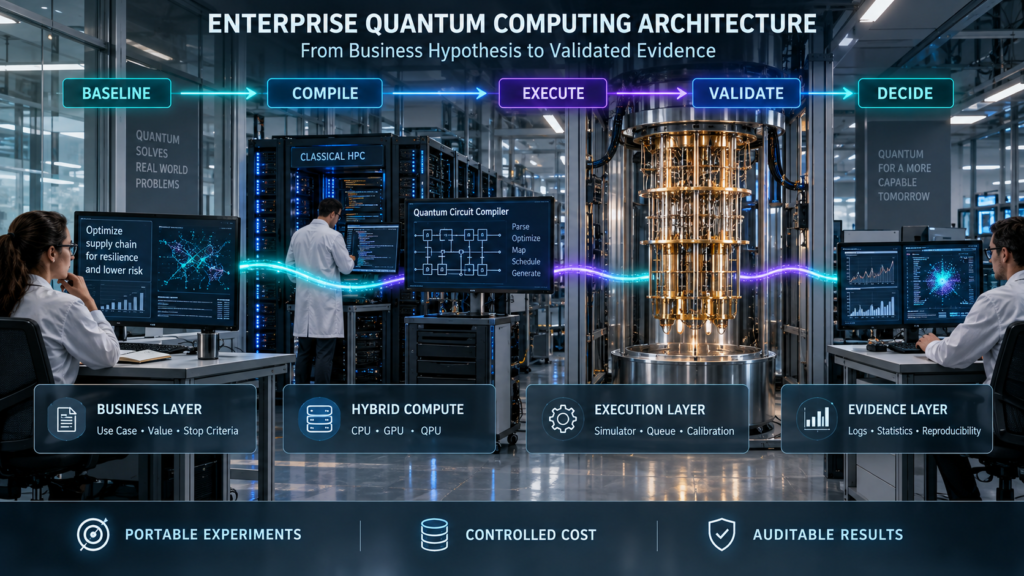
Quantum computing cloud platforms abstract hardware operations, but they do not remove architectural responsibility. The customer still owns data classification, experimental design, baseline selection, result interpretation and financial control.
Integration Flowchart
- Business hypothesis: Define the problem, required result and evidence needed to justify further spending.
- Classical baseline: Measure the strongest suitable classical method before testing a quantum approach.
- Algorithm and resource estimate: Specify the circuit or problem formulation, resource requirements and expected limitations.
- Simulator and hardware selection: Choose suitable simulators and quantum processors for the proposed experiment.
- Hybrid execution: Run the workflow and record quantum execution, classical processing, queue time and costs.
- Statistical validation: Repeat tests and compare results against the agreed baseline and quality requirements.
- Decision gate: Continue to a controlled pilot when the evidence meets the predefined threshold. Otherwise stop, revise or archive the experiment.
The decision gate is the most important component. Without it, experimentation becomes an indefinite research subscription rather than a managed technology deployment.
Hardware Modalities and Engineering Trade-Offs
Superconducting processors use fabricated circuits operated at extremely low temperatures. They support fast gates and semiconductor-style manufacturing methods, but require cryogenic infrastructure and must manage connectivity, crosstalk, leakage and calibration drift.
Trapped-ion systems encode information in atomic ions manipulated with electromagnetic fields and lasers. They can offer strong connectivity and high-quality operations, while gate speed, optical control and scaling architecture remain key engineering constraints.
Neutral-atom systems arrange atoms in optical traps and use laser-driven interactions. Their appeal includes flexible geometry and potentially large arrays, but reliable control, movement, measurement and error-corrected operation remain active engineering problems.
Photonic approaches encode information in particles of light. They can draw on optical networking and semiconductor manufacturing, but deterministic sources, loss management, switching, detection and fault-tolerant resource overhead are decisive.
Quantum annealers solve a narrower optimization formulation than universal gate-model machines. They may support useful experimentation today, but results and scaling claims must be compared with strong classical heuristics rather than presented as interchangeable with universal quantum computing.
Why Logical Qubits Matter
Physical qubits are fragile. Fault-tolerant operation requires encoding useful information across multiple physical components and repeatedly detecting errors without destroying the computation.
The ratio of physical to logical resources depends on hardware error rates, code choice, target logical error, circuit depth and decoding assumptions. A vendor’s “logical qubit” claim is incomplete without the code, distance, operations, lifetime and failure probability.
Google’s published Willow result is important because it reports error suppression as surface-code distance grows. It does not establish that a commercial chemistry or optimization workload is now cheaper or faster than its best classical implementation.
Performance Evaluation Matrix
| Measure | What it answers | Required disclosure | Common misuse |
| Physical qubits | How many controlled elements exist? | Active qubits, yield and topology | Treating count as useful capacity |
| Two-qubit fidelity | How often does a key operation succeed? | Method, distribution and calibration time | Publishing only a best pair |
| Connectivity | Which qubits interact directly? | Native topology and routing cost | Ignoring swap overhead |
| Circuit depth | How much work survives noise? | Native gates, width and success criterion | Counting compiled gates inconsistently |
| Logical error rate | Does encoding suppress errors? | Code, distance, cycles and decoder | Saying “logical” without failure probability |
| Throughput | How much experiment volume is delivered? | Shots, queue, reset and runtime | Excluding wait time and failed jobs |
| Availability | Can teams execute predictably? | SLA, maintenance and calibration windows | Confusing cloud uptime with QPU availability |
| Cost per validated result | What does useful evidence cost? | Jobs, shots, classical compute and labor | Reporting only QPU execution fees |
No single number ranks the Leading Quantum Computing Companies in the USA. The buyer should use an application-specific scorecard and reproduce results across calibration periods.
Deployment Challenges
Data Loading and Output Bottlenecks
Many proposed algorithms assume efficient preparation of a quantum state from classical data. If encoding a large enterprise dataset dominates runtime, the theoretical speedup can disappear before the core circuit begins.
Measurement also returns samples rather than a complete view of the state. Statistical confidence may require many repetitions, increasing queue time and quantum computing services cost.
Classical Baselines Keep Improving
GPU libraries, tensor networks, specialized solvers and approximation algorithms improve while quantum hardware develops. A benchmark must therefore lock the comparator version, hardware, tolerance and energy or cost boundary.
Google explicitly notes that random circuit sampling is a hardware benchmark without a known commercial application. That disclosure is a useful model for separating scientific progress from enterprise value.
Reproducibility Is Expensive
Calibration changes can alter results between runs. Teams must capture backend identifiers, calibration data, compiler versions, optimization settings, shot counts and mitigation parameters.
Reproducibility also requires budget. Retesting across hardware backends, dates and classical solvers is not overhead to remove; it is the evidence needed to reject false advantage.
Talent and Operating Model
Quantum specialists alone cannot select a production use case. Domain scientists, numerical-method experts, HPC engineers, security teams, finance and procurement must share ownership.
The scarce role is often the translator who can challenge both a vendor’s physics claim and a business sponsor’s value assumption. Without that role, pilots become technically interesting but commercially ungoverned.
III. Commercial Solutions and Best Practices
Leading Quantum Computing Companies in the USA by Commercial Role
| Company | Headquarters/role | Primary approach | Enterprise access | Buyer caution |
| IBM [8] | U.S.; full-stack hardware, software and services | Superconducting gate model | IBM Quantum and Qiskit | Roadmap targets can change; validate available system, queue and contract |
| Google Quantum AI | U.S.; research-led hardware program | Superconducting gate model | Research tools and selected access rather than a broad general catalog | Strong experiments do not equal a purchasable enterprise service |
| Microsoft | U.S.; cloud, software, research and hardware program | Azure aggregation plus topological-hardware research | Azure Quantum [7] | Separate available provider backends from Microsoft hardware research claims |
| AWS [6] | U.S.; cloud aggregator | Multiple third-party modalities plus simulators | Amazon Braket | Provider, region, pricing and data terms vary by backend |
| IonQ [9] | U.S.; hardware and cloud services | Trapped ions | Direct cloud and major cloud marketplaces | Compare algorithmic metrics with raw fidelity and workload evidence |
| Rigetti [10] | U.S.; hardware and cloud services | Superconducting gate model | QCS and cloud channels | Assess cash runway, roadmap execution, uptime and support capacity |
| Atom Computing | U.S.; hardware developer and partner ecosystem | Neutral atoms | Partnership and platform arrangements | Large physical arrays are not equivalent to useful logical capacity |
| PsiQuantum | U.S.-headquartered; hardware developer | Photonic, fault-tolerance-first architecture | Strategic partnerships rather than routine public jobs | Long-horizon infrastructure and manufacturing execution risk |
| Quantinuum | Global company with major U.S. operations | Trapped-ion hardware and software | Direct services and cloud channels | Verify corporate location, availability, contract and benchmark scope |
| D-Wave | U.S.-headquartered company with Canadian origins and operations | Quantum annealing and hybrid solvers | Leap cloud service | Do not compare annealing qubits directly with gate-model qubits |
The table is a vendor map, not an investment recommendation. Public-company valuation, cash balance and bookings are different questions from technical fit and should be analyzed from current audited filings.
Feature and Cost Comparison Table
| Commercial solution | Best use | Hardware choice | Cost visibility | Integration strength | Principal limitation |
| IBM Quantum | Qiskit-centered research, execution and enterprise programs | IBM superconducting systems | Plan and contract dependent | Cohesive hardware/software roadmap | Ecosystem concentration and roadmap dependency |
| Amazon Braket | Cross-provider experiments and cloud-native teams | Multiple QPUs and simulators | Backend-specific task, shot or reservation pricing | AWS identity, storage and workflow integration | Cross-provider results remain difficult to compare |
| Microsoft Azure Quantum | Azure-centered research and provider access | Partner hardware and Microsoft tools | Provider and agreement dependent | Azure governance and resource-estimation tooling | Available partner services differ from hardware research milestones |
| D-Wave Leap | Annealing and hybrid optimization experiments | D-Wave annealers and hybrid solvers | Subscription, usage or enterprise agreement dependent | Purpose-built optimization workflow | Not a universal gate-model service |
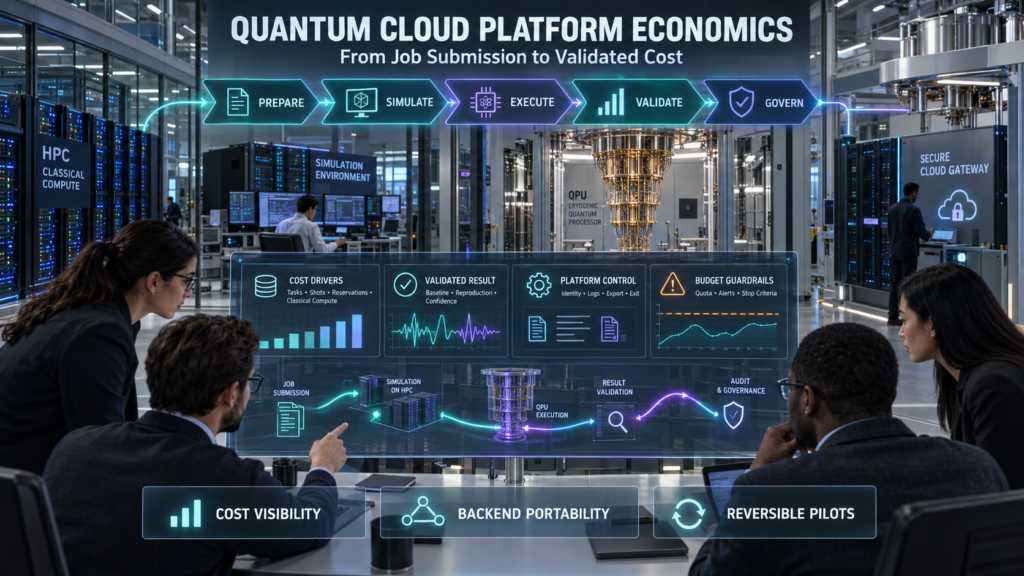
Pricing changes too frequently for a durable article to quote a single number. Buyers should capture the date, region, backend, shots, task fee, reservation minimum, support, egress, simulator and classical-compute charges in every estimate.
Procurement Framework
1. Start With a Falsifiable Hypothesis
“Explore quantum” is not a use case. A valid hypothesis states the problem size, classical method, quality target, time or cost boundary, and evidence that would justify continuing.
2. Build the Classical Baseline First
Run the best available solver with qualified specialists. Record hardware, software, parameters, runtime, accuracy, energy where relevant and full engineering effort.
3. Estimate Fault-Tolerant Resources
Translate the target algorithm into logical qubits, logical operations, error budget and runtime assumptions. Then test sensitivity to physical error rate, code overhead, magic-state production and decoding.
4. Use More Than One Backend
Portable code and neutral experiment records reduce lock-in. Recompile and rerun when the workload and modality allow, but do not pretend that different native gates produce perfectly equivalent tests.
5. Contract for Evidence
Require job logs, backend identity, calibration context, availability definitions, support response, data treatment, deletion, subcontractors, incident notification and exportable results. Marketing slides are not acceptance evidence.
6. Put a Ceiling on Discovery Spending
Create stage budgets for education, simulation, QPU trials and controlled pilots. Stop when the evidence threshold fails rather than extending a program to protect sunk cost.
Proof-of-Concept Acceptance Criteria
Ten Questions to Ask Before Funding a Pilot
- Which capabilities are available under contract today, and which remain roadmap targets?
- Which benchmark represents our workload, and what classical method provides the comparison?
- What resources are required at our target problem size and error tolerance?
- Which processing steps run on quantum hardware, CPUs, GPUs or external HPC systems?
- How are calibration, queue time, failed jobs and maintenance recorded?
- What is the complete cost, including compilation, simulation, classical processing, labor and support?
- Can we export the code, configurations and results and reproduce the experiment?
- What data and metadata are retained, and what security and deletion controls apply?
- Which material claims have independent or peer-reviewed support?
- What evidence will justify continuing, revising or stopping the pilot?
A useful pilot reproduces a result across multiple runs and compares it with a credible classical baseline. It also explains every excluded cost and identifies what must improve before production value is possible.
Acceptance should include statistical confidence, sensitivity analysis, portability, security review, documented failure cases and a finance-approved cost model. A visually impressive circuit is not a business outcome.
IV. Business Outcomes and Strategic ROI Takeaways
What Near-Term Value Looks Like
Near-term enterprise quantum computing value often comes from workforce capability, algorithm triage, resource estimation, vendor intelligence and cryptographic migration. These outcomes are less dramatic than a production speedup but easier to audit.
Teams can also improve classical models while formulating a quantum problem. That value should be recorded separately so the organization does not attribute every improvement to the QPU.
Total Cost of Experimentation
The financial model must include cloud tasks, shots, reservations, simulators, CPU/GPU compute, storage, egress, software, specialist labor, vendor services, security review, legal review and opportunity cost.
Cost per validated result = total experiment cost ÷ the number of results meeting predefined acceptance and reproducibility criteria.
Measure costs and accepted results over the same period. If no result meets the criteria, report the expenditure and zero accepted results; the ratio is undefined. Failed experiments can still provide useful learning when they rule out a hypothesis or identify a documented limitation.
Illustrative Portfolio—Not a Vendor Quote
| Stage | Illustrative scope | Continue when | Stop when |
| Discovery | Training, use-case screening and classical baseline | A bounded problem and sponsor exist | No measurable business constraint is identified |
| Simulation | Circuit design and resource estimation | Resource needs show a plausible future path | Loading or fault-tolerant overhead destroys the hypothesis |
| QPU trial | Small runs across selected backends | Results reproduce and teach something unavailable from simulation | Noise or cost makes conclusions unstable |
| Controlled pilot | Domain data, governance and financial model | Evidence beats the agreed baseline or creates strategic option value | No credible path to the next threshold exists |
The table intentionally omits dollar amounts. Labor rates, cloud contracts, problem complexity and governance obligations vary too widely for an honest universal budget.
Strategic ROI Scorecard
| Outcome | Metric | Finance treatment |
| Skills readiness | Staff who can independently reproduce experiments | Capability investment, not operating savings |
| Algorithm triage | Candidate workloads rejected or advanced with evidence | Avoided research spend and option value |
| Platform portability | Backends supported with reproducible results | Reduced switching cost |
| Security readiness | Cryptographic inventory and migration completion | Risk reduction, not quantum revenue |
| Scientific evidence | Peer-reviewed or independently reproduced result | R&D asset subject to validation |
| Production advantage | Cost, quality or time improvement over best classical method | Recognize only after controlled validation |
The Leading Quantum Computing Companies in the USA should be asked to support this scorecard with evidence. Vendor-reported bookings, partnerships or qubit counts do not substitute for customer-level economics.
V. Risk Mitigation and Regulatory Framework
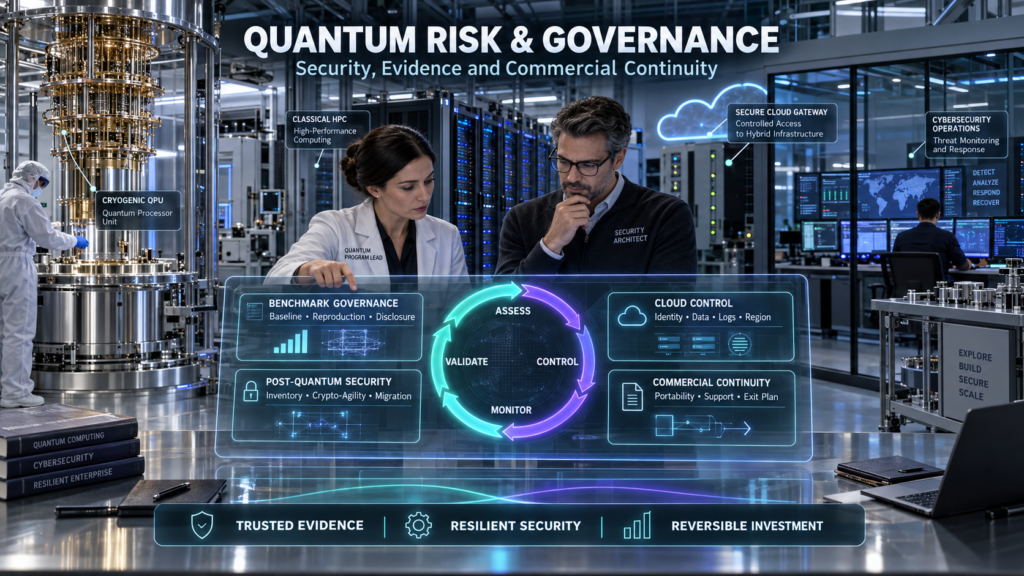
Technical and Benchmark Governance Checklist
- Define the workload, baseline, error tolerance and stop condition before vendor selection.
- Record compiler, backend, calibration, shots, seeds and mitigation settings.
- Separate physical-qubit, logical-qubit and application-level claims.
- Reproduce material results across dates and, where valid, backends.
- Include data loading, measurement, queue and classical processing in performance claims.
- Require independent or peer-reviewed support for scientific claims used in investment approval.
- Label every vendor roadmap milestone as a target unless contractually guaranteed.
Security and Post-Quantum Cryptography Checklist
- Inventory public-key cryptography, certificates, libraries, hardware security modules and long-lived protected data.
- Map dependencies on RSA, elliptic-curve cryptography and vulnerable key exchange.
- Prioritize “harvest now, decrypt later” exposure using data-retention horizons.
- Test NIST-standardized post-quantum algorithms in controlled environments.
- Build crypto-agility so algorithms and parameters can change without redesigning every application.
- Protect QPU credentials with named identities, least privilege, rotation and monitored secrets management.
- Review provider logging, retention, training-use restrictions, deletion and incident-notification terms.
Post-quantum migration should not wait for a vendor to announce a cryptographically relevant machine. NIST’s standards are available now, while enterprise discovery and remediation can take several budget cycles.
Cloud, Privacy and Export-Control Checklist
- Classify every dataset and derived problem formulation before upload.
- Confirm processing region, subprocessors, support access and cross-border transfer terms.
- Minimize data and use synthetic inputs during early experiments.
- Prohibit regulated or export-controlled workloads until legal review is complete.
- Capture billing tags, quotas and anomaly alerts for every project.
- Verify export-control classifications for hardware, software, technical data and deemed exports.
- Maintain an offline archive of code, dependency locks, job records and results.
Quantum technology is subject to evolving national-security and export-control attention. Procurement teams should obtain current specialist advice rather than relying on an article’s static summary.
AI and EU Regulatory Boundary
The EU AI Act does not regulate a service merely because its infrastructure uses quantum computing. It can become relevant when the delivered system is an AI system within the Act’s scope, especially when the use case or role triggers additional obligations.
Keep the analysis layered: quantum infrastructure, AI model, business use, personal data and sector regulation. Combining them under a vague “advanced technology” assessment produces either over-compliance or dangerous gaps.
Commercial Continuity Checklist
- Review audited finances, funding dependence and concentration risk for smaller suppliers.
- Separate research partnership, paid pilot, reservation and production-service terms.
- Require exportable source code, intermediate representations and experiment records.
- Document API deprecation, SDK support, service credits and end-of-life policy.
- Avoid exclusivity before the workload demonstrates modality-specific value.
- Price migration to a simulator, alternate QPU or classical solver.
- Reassess the vendor shortlist at least annually because capabilities and corporate status change quickly.
The Leading Quantum Computing Companies in the USA deserve attention because they are advancing distinct engineering paths. They do not deserve exemption from ordinary vendor risk, financial discipline or evidence standards.
Building a Controlled Quantum Evaluation
Choose one bounded problem, establish its best classical baseline and obtain fault-tolerant resource estimates before paying for a large pilot. Then compare at least two relevant quantum computing cloud platforms using the same evidence template.
Fund the next stage only when the experiment produces reproducible technical learning, credible strategic option value or a measurable improvement over the agreed baseline. That is how a company turns quantum interest into a governed technology portfolio instead of an open-ended research expense.
VI. Appendix and Research Integrity
Research Evidence and Technical References
Google’s Willow work should be read through both the peer-reviewed error-correction result and the company’s commercial caveat. IBM’s roadmap is useful for planning scenarios only because IBM labels it as current intent that may change.
NIST’s finalized post-quantum standards create an actionable security program independent of QPU procurement. The National Quantum Initiative [5] provides the federal coordination context for U.S. research and workforce policy.
Sources and Citation Index
- Google – Willow Quantum Chip
Supports the 105-qubit figure, below-threshold error correction, random-circuit-sampling result and Google’s statement that RCS has no known commercial application. Google Willow announcement - IBM Quantum Roadmap
Supports IBM’s 2026 Nighthawk and modular-system targets and its warning that roadmap information represents current intent and can change or be withdrawn. IBM Quantum Roadmap - NIST Post-Quantum Cryptography Standards
Supports the discussion of FIPS 203, FIPS 204 and FIPS 205 and NIST’s recommendation to begin migration. NIST finalized post-quantum standards - Acharya et al., Nature, 2025
Peer-reviewed evidence supporting Google’s below-threshold surface-code error-correction result. Quantum error correction below the surface code threshold - U.S. National Quantum Initiative
Supports federal research coordination, workforce development and national quantum policy context. National Quantum Initiative - Amazon Braket Pricing Documentation
Supports the statement that costs vary by provider, task, shot, simulator and reservation structure. Amazon Braket pricing - Microsoft Azure Quantum Documentation
supports the description of development tools, cloud workflows and access to participating quantum hardware providers. Azure Quantum documentation - IBM Qiskit Documentation
Supports IBM’s developer ecosystem, SDK and quantum-execution workflow. IBM Quantum and Qiskit documentation - IonQ Quantum Cloud Documentation
Supports IonQ’s direct cloud access, API, SDK integrations and developer capabilities. IonQ Quantum Cloud documentation - Rigetti Quantum Cloud Services Documentation
Supports Rigetti’s QCS platform and cloud-access description. Rigetti QCS documentation
Corporate Editorial Transparency and AI Usage Disclosure
This Article was produced with AI-assisted drafting, restructuring and quality control. Company classifications, roadmap claims, standards and benchmark limitations were checked against primary sources available on September 18, 2026.
No vendor paid for placement in this version. AI assistance does not replace physics, cybersecurity, legal, financial or procurement review.
Author and Editorial Review
Author: Garikapati Bullivenkaiah
Technology research writer with LL.B., LL.M., M.A., and MBA qualifications. He writes about emerging technologies and their business, governance and legal implications. His multidisciplinary academic background informs his analysis of technology adoption, intellectual property, and organizational risk. His articles explain technical concepts and practical considerations for business owners, IT managers and technology decision-makers. LinkedIn Profile
Reviewed by: Chitikineni Ramadevi — Editor
Chitikineni Ramadevi holds an M.Sc. in Computers from Andhra University and has over 10 years of research experience in technology-related subjects. She reviews NezzHub articles for clarity, factual accuracy, source support and practical relevance.
Published by: NezzHub
Research approach: This article draws on primary sources, technical documentation and relevant industry research. References are provided within the article or its sources section.
Last reviewed: 09-18-2026
Corrections: To report a factual error or outdated information, please contact NezzHub.

Garikapati Bullivenkaiah is a seasoned entrepreneur with a rich multidisciplinary academic foundation—including LL.B., LL.M., M.A., and M.B.A. degrees—that uniquely blend legal insight, managerial acumen, and sociocultural understanding. Driven by vision and integrity, he leads his own enterprise with a strategic mindset informed by rigorous legal training and advanced business education. His strong analytical skills, honed through legal and management disciplines, empower him to navigate complex challenges, mitigate risks, and foster growth in diverse sectors. Committed to delivering value, Garikapati’s entrepreneurial journey is characterized by innovative approaches, ethical leadership, and the ability to convert cross-domain knowledge into practical, client-focused solutions.