





USA Artificial Intelligence
USA Artificial Intelligence examines how AI systems are researched, purchased, integrated and governed across American businesses, government agencies and public services. This NezzHub subcategory is intended for technology decision-makers, business owners, IT managers, professionals and students who need practical analysis of enterprise AI deployment.
The coverage connects model capability with infrastructure, data quality, cybersecurity, implementation cost and accountable human oversight. Readers can use these resources to understand operational applications without treating vendor demonstrations, laboratory results or future projections as guaranteed business outcomes.
Explore USA Artificial Intelligence
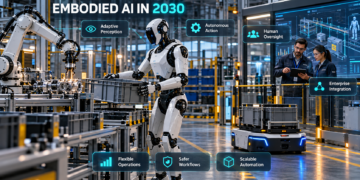
Artificial intelligence in the USA includes generative AI, predictive analytics, computer vision, natural language processing, autonomous systems and decision-support software. These technologies can support many workflows, but each application has different accuracy, privacy, security and integration requirements.
Major areas covered within this subcategory include:
- Enterprise AI: Assistants, search systems, workflow automation, analytics and decision-support applications.
- Public-sector AI: Government operations, infrastructure planning, emergency response and administrative services.
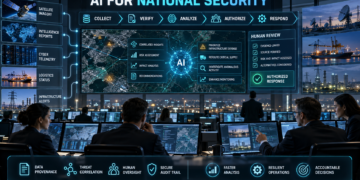
- National-security applications: Intelligence analysis, logistics, cyber defence and human-supervised operational support.
- Responsible AI: Testing, documentation, risk classification, human review and accountability.
- AI infrastructure: Cloud platforms, computing resources, data pipelines, APIs and monitoring systems.
NezzHub’s guide to how AI for national security works today examines a high-consequence use case where technical performance must be evaluated alongside security, reliability and responsible deployment.
Business and Enterprise Applications
American organizations use AI to assist with document analysis, customer operations, forecasting, software development, fraud detection, quality inspection and internal knowledge retrieval. Business value depends on whether the system improves a defined workflow after review time, integration work and operating costs are included.
Procurement should begin with the business constraint rather than a preferred model or vendor. Teams should document the workflow, data sources, current cost, error tolerance, decision owner and measurable acceptance criteria before requesting proposals.
Useful commercial questions include:
- Does the system integrate with existing enterprise software?
- Which product tier contains the required security controls?
- How are usage, cloud-computing and support costs calculated?
- Can data, prompts, logs and configurations be exported?
- What evidence demonstrates improvement over the current process?
Architecture, Integration and Deployment
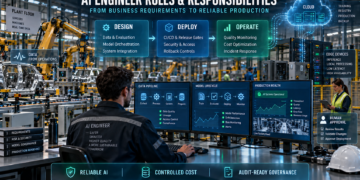
An enterprise AI application is not only a model. It normally includes identity controls, approved data sources, retrieval services, APIs, business rules, human approvals, operational systems and monitoring.
Integration design should preserve the permissions of source applications. Connecting an AI assistant to company files without permission-aware retrieval can expose restricted information across teams or create answers based on obsolete documents.
A controlled deployment should begin with a limited and reversible workflow. The pilot should use representative inputs, difficult cases, missing information and adversarial instructions rather than relying on a polished demonstration.
Teams should measure output acceptance, unsupported claims, latency, human review, security incidents and cost per accepted outcome. Expansion should occur only after the application meets documented quality and governance thresholds.
Risks, Security and Governance
AI systems can produce inaccurate outputs, reveal sensitive information or behave unpredictably when connected to external content and business applications. Model capability does not remove the need for cybersecurity, access control and incident response.
- Use single sign-on, multifactor authentication and least-privilege access.
- Classify data before allowing it to enter an AI service.
- Test for unsupported claims, bias and performance variation.
- Restrict autonomous actions through confirmation and approval gates.
- Record model versions, prompts, source access and material decisions.
- Maintain rollback, export and vendor-exit procedures.
Governance obligations depend on the organization, sector, location and use case. Legal, security, privacy and subject-matter specialists should review high-impact deployments instead of transferring final accountability to a model or technical team.
How to Use This Subcategory
- Business owners: Focus on workflow value, total implementation cost and vendor accountability.
- Technology leaders: Review architecture, data access, evaluation and integration requirements.
- IT managers: Examine identity, monitoring, cloud cost, resilience and incident-response controls.
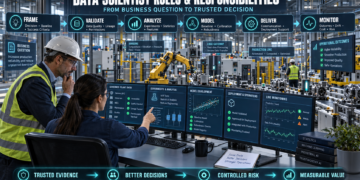
- Professionals: Study how production AI combines data, software, security and governance skills.
- Students: Begin with practical applications before progressing to architecture and regulatory questions.
For connected coverage of American robotics, quantum technology, healthcare AI, careers and industry developments, visit the parent USA Tech & Innovation category.
Frequently Asked Questions
What topics does this subcategory cover?
It covers enterprise AI, public-sector applications, national security, infrastructure, implementation, cybersecurity and responsible governance.
How should a business begin an AI deployment?
Select one measurable workflow, establish a baseline, classify its data and test competing approaches against the same acceptance criteria.
What creates the largest enterprise AI costs?
Costs can include licensing, cloud usage, integration, data preparation, security, employee training, human review, monitoring and ongoing support.
Why does human oversight remain necessary?
AI outputs may be incomplete or incorrect. Accountable professionals must review high-impact recommendations and retain authority over consequential decisions.
Latest USA Artificial Intelligence Articles
Browse the automatic archive below for current NezzHub research on USA Artificial Intelligence, enterprise deployment, public-sector applications, cybersecurity and responsible AI governance.
No Content Available














Recent News









NezzHub is a technology-focused knowledge hub delivering insights on AI, robotics, cybersecurity, biotech, and emerging innovations. Our mission is to simplify complex technologies through research-driven content and analysis.