














Executive Summary
Neutral atom quantum technology is not built by placing a large number of atoms in a chamber and pointing lasers at them. A working system must repeatedly load atoms, cool them, trap one atom per site, remove array defects, preserve qubit states, execute calibrated gates, read every site, and return trustworthy results through a classical control stack.
The investment case for neutral atom quantum technology therefore rests on an integrated machine, not a headline qubit count. Optical stability, vacuum quality, atom survival, gate fidelity, readout fidelity, calibration time, shot throughput, software access, uptime, and logical performance jointly determine whether a neutral atom quantum computer can support useful research or enterprise experimentation.
Peer-reviewed results show genuine progress in neutral atom quantum technology. Researchers have reported 99.5% two-qubit controlled-phase gate fidelity while operating on as many as 60 neutral-atom qubits in parallel, a programmable logical processor using up to 280 physical qubits, and a tweezer array containing more than 6,100 highly coherent atomic qubits.[1][2][3]
Those neutral atom quantum technology achievements do not establish broad commercial quantum advantage. They demonstrate that the underlying engineering can scale, while exposing the next bottlenecks: atom loss, laser drift, control bandwidth, error correction, mid-circuit operations, validation cost, and the conversion of physical scale into reliable logical computation.
For buyers, the sensible route is staged. Use cloud access to validate a workload, establish classical baselines, define measurable success criteria, and examine full workflow cost before considering reserved capacity or on-premises deployment.
The Definitive Guide to Neutral Atom Quantum Research: How a Promising Architecture Really Works
The Market Challenge: Turning Laboratory Scale into Operational Value
Neutral atom quantum technology attracts attention because atoms of the same isotope are naturally uniform and can be rearranged with light. That avoids the device-to-device fabrication variation found in manufactured solid-state qubits, but it does not remove systems-engineering complexity.
The hard problem in neutral atom quantum technology moves into optics, vacuum engineering, real-time control, calibration software, and fault management. A laboratory may demonstrate an impressive array while still lacking the availability, repeatability, compiler support, security controls, and service processes required for an enterprise platform.
Physical Qubit Count Is Not a Procurement Metric
A physical-qubit figure for neutral atom quantum technology says how many atomic sites a system can potentially control. It does not state how many atoms are simultaneously loaded, how many survive a circuit, what gate set is available, how accurate the operations are, or how many logical qubits can execute a useful workload.
A 6,100-atom array is an important scientific scaling result, not evidence that 6,100 fault-tolerant application qubits are available. Likewise, a 256-qubit analog machine and a 1,200-plus-qubit gate-based platform serve different computational models and should not be ranked by qubit count alone.[3][4][5]
The Metrics That Belong in a Buying Brief
- Preparation yield: the fraction of requested sites occupied after rearrangement.
- Atom survival: the probability that qubits remain available through a circuit or experimental sequence.
- Single- and two-qubit fidelity: measured accuracy under stated benchmarking conditions.
- Readout fidelity: the reliability of converting atomic states into classical outcomes.
- Cycle time: loading, rearrangement, calibration, execution, imaging, and reset time per job.
- Useful throughput: completed, valid shots per hour after rejected runs and downtime.
- Logical performance: error rates and algorithm results after encoding and error correction.
- Availability: scheduled access, queue time, maintenance windows, and recovery performance.
The Cost of Inaction—and the Cost of Premature Action
Waiting indefinitely on neutral atom quantum technology can leave a company without internal quantum skills, validated problem formulations, or post-quantum security readiness. The opportunity cost is highest for organizations in materials, chemistry, optimization, and scientific computing that already maintain strong classical simulation teams.
Buying too early creates a different loss. Teams may pay for scarce hardware time, specialist labor, cloud infrastructure, data preparation, and repeated experiments without a workload whose output can be validated against a credible classical baseline.
Neutral atom quantum technology should therefore be treated as an R&D portfolio decision. The goal of an early program is evidence acquisition, not an assumed production return.
Architecture Overview: How Neutral Atom Quantum Technology Is Built
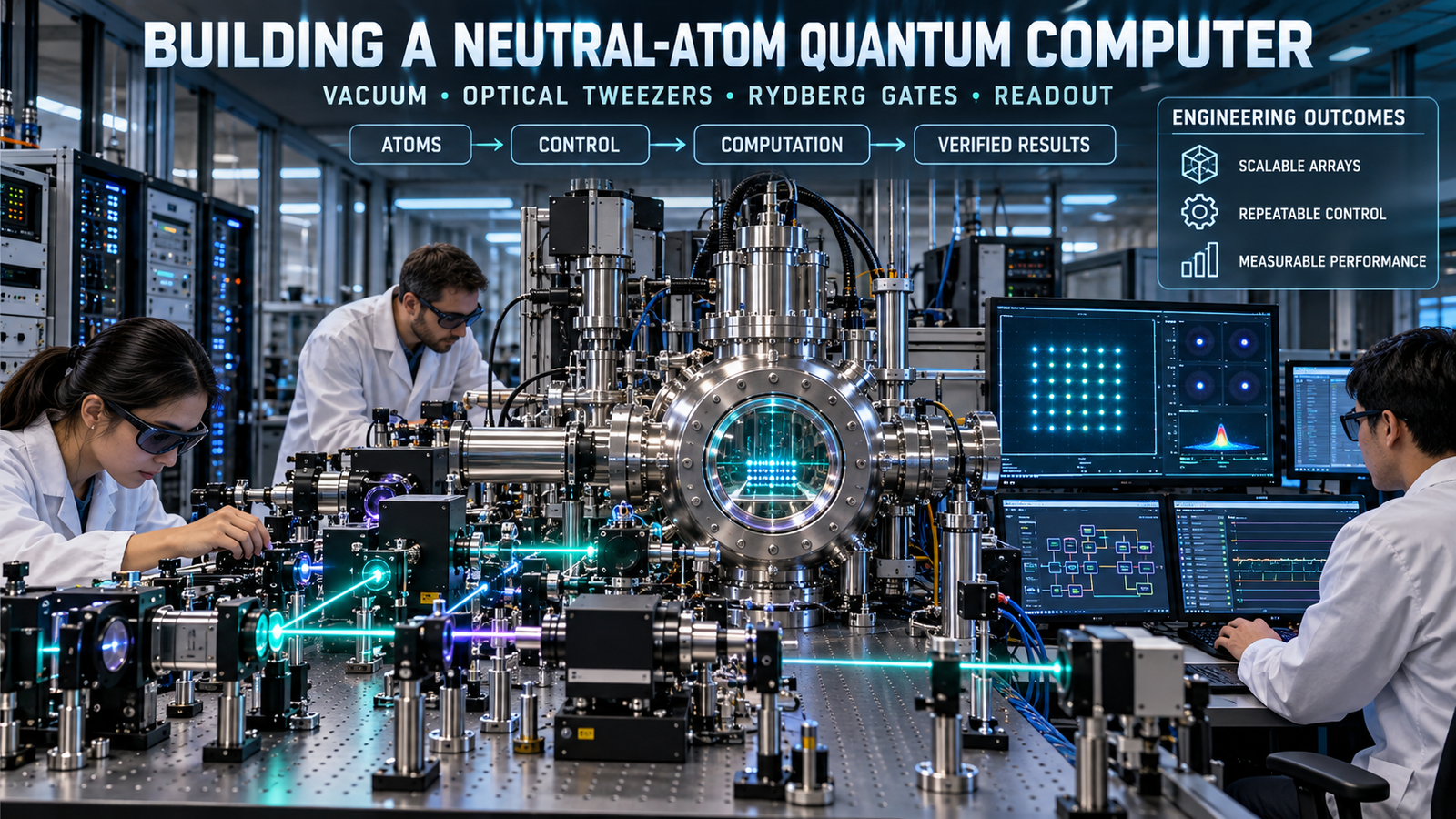
A neutral-atom quantum system combines vacuum engineering, cooling and trapping, qubit preparation, controlled interactions, readout and classical control software. These functions are coupled, so component specifications must be evaluated within the complete system.
Layer 1: Vacuum, Atom Source, and Environmental Control
Neutral atom quantum technology begins with an ultra-high-vacuum chamber, an atom source, magnetic-field coils, optical access, pumps, sensors, and low-outgassing materials. The chamber must sustain conditions in which background-gas collisions are rare enough for atoms to remain trapped during preparation and computation.
The enclosure is also a mechanical system. Vibration moves beam positions, temperature changes optical paths, magnetic fluctuations shift transition frequencies, and contamination can reduce vacuum performance over time.
Build Decisions That Affect Serviceability
Neutral atom quantum technology engineers must trade compact packaging against optical access and repairability. A tightly integrated instrument can reduce drift and footprint, while making alignment, component replacement, and root-cause analysis harder.
Enterprise buyers should ask which subsystems are field replaceable, how vacuum health is monitored, how long recovery takes after a fault, and which failures require vendor intervention. Mean time to recovery can matter more than peak laboratory performance.
Layer 2: Cooling, Trapping, and Optical Tweezers
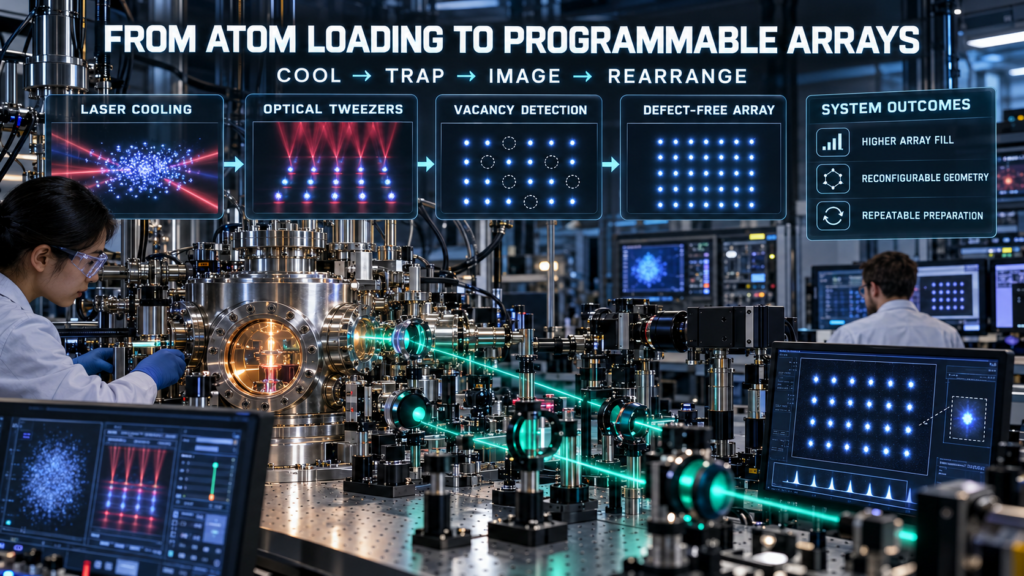
In neutral atom quantum technology, atoms from the source are slowed and cooled before focused laser beams confine individual atoms. In optical tweezer quantum computing, each focused trap is a programmable site whose depth and position depend on laser power, wavefront quality, focusing optics, and beam-steering hardware.
Spatial light modulators, acousto-optic deflectors, or related beam-shaping devices can create and move many traps. High-numerical-aperture objectives focus the trapping light and collect fluorescence for site-resolved detection.
Why an Initially Loaded Array Contains Vacancies
Single-atom loading in neutral atom quantum technology is probabilistic, so the first image usually reveals empty sites. The control system identifies occupied traps and computes moves that rearrange available atoms into the requested defect-free geometry.
This step is a defining advantage of neutral atom quantum technology. It also creates latency, heating, collision-avoidance, and scheduling constraints that must be included in system benchmarks.
Layer 3: Qubit Encoding and State Preparation
Neutral atom quantum technology encodes qubits in long-lived internal atomic states, often hyperfine or nuclear-spin states depending on the chosen species. Rubidium, cesium, strontium, and ytterbium offer different transitions, cooling methods, readout options, and control trade-offs.
Species choice affects the entire bill of materials. Laser wavelengths, optical coatings, frequency references, magnetic control, Rydberg excitation paths, and state-detection methods must be designed around the selected atom.
Uniform Atoms Do Not Produce a Uniform Machine Automatically
The atoms used in neutral atom quantum technology may be identical, but the fields acting on them are not. Beam intensity varies across the field of view, optical aberrations shift trap properties, magnetic gradients alter resonance conditions, and local heating changes motional states.
Neutral atom quantum technology therefore depends on a calibration map for every relevant site and operation. The machine must measure drift, update parameters, and decide when results are outside an acceptable envelope.
Layer 4: Rydberg Quantum Gates
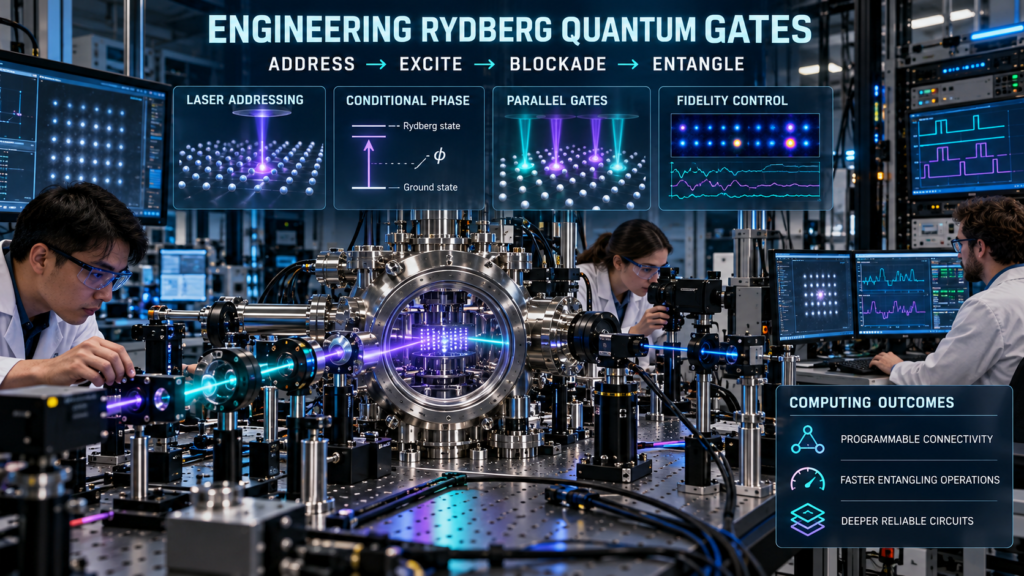
In digital neutral-atom processors, single-qubit operations commonly use microwave or Raman control, while entangling gates can use Rydberg interactions. Analog processors instead program the evolution of interacting atoms through array geometry, driving fields and detuning. Both approaches can use Rydberg interactions, but they have different programming models and workload requirements.
Rydberg quantum gates provide fast, programmable interactions without fabricating a permanent wire between every qubit pair. Connectivity is still constrained by interaction range, geometry, addressing, pulse scheduling, crosstalk, and the need to keep atoms cold and stable.
The Fidelity Budget
The neutral atom quantum technology fidelity budget includes laser phase noise, intensity noise, spontaneous emission, Doppler shifts, imperfect cooling, atomic motion, state leakage, magnetic-field variation, crosstalk, and calibration drift. Readout and atom loss add separate failure channels.
The 99.5% parallel CZ result is significant because it combined high fidelity with operations on up to 60 atoms. It should not be copied into a procurement specification without matching the experiment’s conditions, sequence, atom species, benchmarking method, and system configuration.[1]
Layer 5: Fluorescence Readout and Reset
At the end of a neutral atom quantum technology circuit, resonant light causes atoms in selected states to fluoresce. A camera records site-resolved photons, and classification software converts the image into bit strings.
Readout is not free. Imaging can heat or eject atoms, bright and dark states can be confused, optical collection varies across the array, and a missing atom can resemble a valid logical state unless the protocol distinguishes loss from computational error.
Mid-Circuit Measurement Changes the Architecture
Fault-tolerant neutral atom quantum technology workflows require more than final measurement. They may need mid-circuit measurement, qubit reset, conditional branching, data movement, and rapid classical decisions before coherence is lost.
Vendors now advertise such capabilities on newer systems, but buyers must verify whether they are generally available, experimentally limited, or restricted to selected workflows. A feature on a roadmap is not equivalent to a supported service-level capability.[5]
Layer 6: Classical Control, Firmware, and Calibration Software
The visible optical hardware is only half of neutral atom quantum technology. Frequency references, RF chains, arbitrary waveform generators, FPGAs, timing distribution, camera pipelines, interlocks, control services, compilers, schedulers, and observability systems form the operational backbone.
Sub-microsecond synchronization may be required across laser pulses and measurements. At the same time, slower feedback loops track temperature, power, vacuum, beam position, trap depth, magnetic offsets, and component aging.
Calibration Is a Production Workload
Neutral atom quantum technology calibration consumes machine time and engineering labor. Site-by-site corrections, gate tuning, imaging thresholds, drift compensation, and acceptance tests compete with customer jobs for access to the same hardware.
Commercial evaluation should therefore measure post-calibration throughput, not only raw pulse rate. The correct unit is valid work delivered within a time and cost envelope.
Integration Flowchart: From Enterprise Job to Verified Result
Business problem and classical baseline
            ↓
Problem mapping and resource estimate
            ↓
Compiler, pulse schedule, and array geometry
            ↓
Atom loading, imaging, and defect repair
            ↓
State preparation and programmed quantum evolution            ↓
Readout, loss detection, and quality filters
            ↓
Statistical aggregation and error analysis
            ↓
Classical verification and business decision
The flow exposes where enterprise software connects to neutral atom quantum technology. Identity management, job authorization, data lineage, cost controls, experiment tracking, audit logs, and reproducibility metadata sit around the quantum runtime rather than inside a physics diagram.
Hybrid Cloud and HPC Integration
Most organizations should begin neutral atom quantum technology work through cloud or hosted access. That keeps vacuum, optics, calibration, and maintenance with the operator while the buyer focuses on algorithms, workflow integration, and validation.
On-premises installation becomes rational when utilization, data constraints, latency, research control, or strategic capability justify facility and staffing costs. Pasqal’s reported integration of a 140-qubit system with the Leonardo pre-exascale supercomputer illustrates the direction of tightly coupled quantum-HPC deployment, but it does not make that architecture necessary for every buyer.[6]
Data and API Controls
Neutral atom quantum technology procurement teams should document where source data, circuit descriptions, pulse parameters, results, logs, and support artifacts are stored. They should also test API versioning, SDK dependencies, regional availability, export formats, retention rules, and incident notification.
Vendor lock-in can arise above the hardware. A workload tied to one analog Hamiltonian model, proprietary pulse interface, compiler, or calibration assumption may require substantial redevelopment on another platform.
Deployment Challenges That Determine Real Performance
Neutral atom quantum technology scales by adding traps and expanding optical control, but every added site increases the calibration, data, and scheduling burden. The main constraint may shift from physics to automation.
Atom Loss and Reload Strategy
Atoms in neutral atom quantum technology can be lost during transport, gates, imaging, or background-gas collisions. A system may reload the entire array, repair selected vacancies, reserve spare atoms, or use loss-aware error-correction methods.
Each strategy changes cycle time and circuit design. Buyers should request survival data over representative circuit depth, not a single preparation image.
Optical Drift and Control Bandwidth
Scaling neutral atom quantum technology to more sites requires more controlled beams, higher-resolution wavefront correction, faster steering, and larger calibration maps. Control channels, camera bandwidth, memory, and real-time processing can become scaling limits.
An array that can be displayed is not necessarily an array that can be independently addressed at useful speed. Parallel operation must be demonstrated under the intended gate pattern.
Error Correction Overhead
Logical qubits in neutral atom quantum technology encode information across multiple physical qubits and require repeated syndrome extraction, decoding, and correction. The overhead depends on physical error rates, loss behavior, code choice, connectivity, measurement, and target algorithm reliability.
A 2024 Nature report demonstrated a programmable logical processor using up to 280 physical qubits, while later work described a fault-tolerant architecture using movable atoms and repeated error-correction cycles.[2][7] These are critical milestones, not proof that arbitrary enterprise applications are fault tolerant today.
Facility and Workforce Requirements
An installed neutral atom quantum technology system may need vibration control, electrical capacity, cooling, network segmentation, laser safety, controlled access, spare-parts planning, remote support, and trained operators. Requirements differ widely by vendor and deployment model.
Atom Computing states that its AC1000 occupies about 600 square feet or 56 square metres and has moderate power requirements.[5] A buyer still needs a vendor-certified site survey and a full facilities schedule before estimating total cost.
Performance Evaluation Matrix
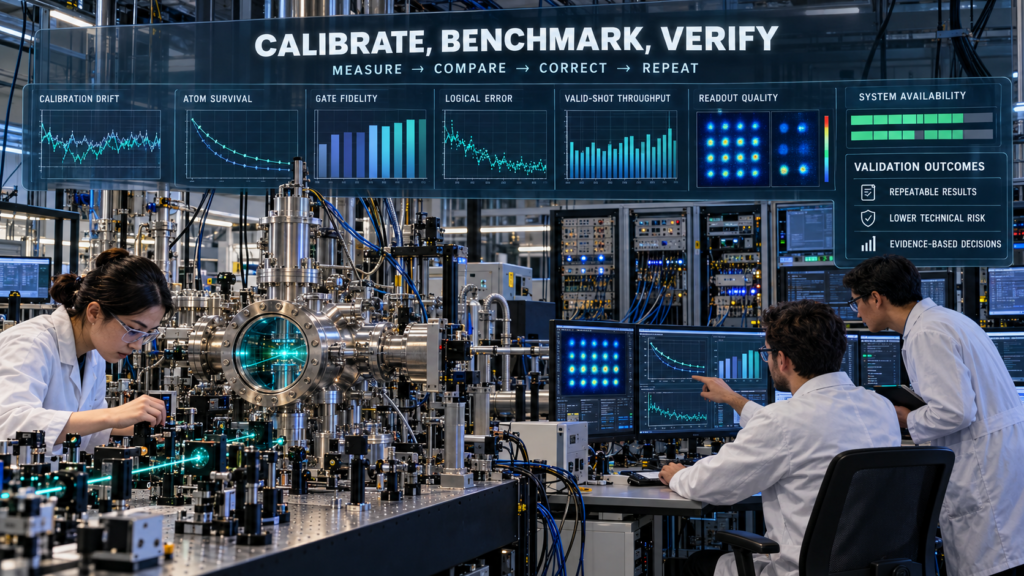
The matrix below separates attractive specifications from evidence that supports an investment decision.
| Evaluation area | Minimum evidence | Red flag | Business consequence |
|---|---|---|---|
| Array scale | Occupied and controllable sites under workload conditions | Maximum trap count presented as usable qubits | Overstated capacity |
| Gate quality | Benchmark method, uncertainty, parallelism, drift window | Best-case fidelity without conditions | Unreliable workload estimates |
| Atom survival | Loss per stage and circuit-depth curve | Only initial fill rate disclosed | Hidden rerun cost |
| Readout | State and loss discrimination data | Missing atoms treated as valid results | Corrupted output |
| Throughput | Valid shots per hour including reload and calibration | Pulse rate used as throughput | Underestimated cloud cost |
| Logical performance | Encoded-versus-physical comparison on relevant circuits | Physical qubit count used as a proxy | Weak fault-tolerance case |
| Availability | Queue, maintenance, recovery, and service history | Uptime claim without measurement window | Missed project schedules |
| Integration | SDK, APIs, authentication, logs, export, support | Demo notebook is the complete toolchain | High integration labor |
A Practical Validation Formula
Compare costs over the same evaluation period and workload:
Cost per validated result = total attributable evaluation cost ÷ number of results passing predefined quality checks.
This calculation prevents a low per-shot price from hiding queue delays, failed tasks, calibration overhead, data processing, or specialist labor. It also enables a fair comparison with classical HPC and alternative quantum platforms.
Include QPU charges, cloud services, specialist labor, data processing and validation. Count failed runs and retries in total expenditure, but count each expense only once. Define a validated result before testing, including its accuracy and confidence requirements. For installed systems, include an appropriate allocation of hardware, facilities and maintenance costs. If no result passes the quality checks, report total expenditure and the unsuccessful outcome.
This calculation prevents a low per-shot price from hiding queue delays, failed tasks, calibration overhead, data processing, or specialist labor. It also enables a fair comparison with classical HPC and alternative quantum platforms.
Commercial Solutions and Feature-and-Cost Comparison
The neutral atom quantum technology market includes analog, digital gate-based, cloud-access, and installed-system models. Product maturity and availability change quickly, so every commercial claim requires confirmation during procurement.
| Solution | Publicly stated configuration | Access and cost model | Best fit | Due-diligence questions |
|---|---|---|---|---|
| QuEra Aquila | 256-qubit reconfigurable analog neutral-atom array | Available through Amazon Braket; usage-based task/shot model, with current price shown by AWS | Analog Hamiltonian simulation, education, early workload tests | Queue time, supported geometries, shot limits, regional access, experimental constraints |
| QuEra Gemini class | Gate-based neutral-atom system; deployed commercially in Japan | Direct commercial engagement; pricing not publicly standardized | Gate-based research and institutional deployment | Gate set, logical roadmap, service model, acceptance benchmarks |
| Pasqal Orion/SOL | Pasqal reported a 140-qubit QPU integrated with Leonardo HPC | Direct purchase or hosted/cloud arrangements; quote-based | Hybrid HPC research, analog and digital programs | Upgrade path, compiler maturity, facility scope, support coverage |
| Atom Computing AC1000 | 1,200+ physical qubits; gate-based platform with mid-circuit features advertised | Direct enterprise engagement; quote-based | Error-correction research and strategic installations | Generally available capabilities, logical benchmarks, footprint, staffing, delivery terms |
QuEra describes Aquila as a field-programmable analog processor with a reconfigurable 256-qubit array, while AWS documents a maximum of 1,000 shots per Aquila task.[4][8] Atom Computing describes AC1000 as a 1,200-plus-physical-qubit system with mid-circuit measurement, reset, and conditional branching.[5]
These entries are not an endorsement or affiliate ranking. They compare publicly described deployment models; contractual specifications, performance, prices, and availability must be independently verified.
Vendor Selection Framework
Start with the computational model. An analog simulator may be the right tool for quantum many-body research but the wrong choice for a team that needs arbitrary digital circuits and error-correction experiments.
Then match the access model to the learning objective. On-demand cloud access reduces capital exposure, reservations improve scheduling, and installed systems increase control while transferring facility and operational responsibilities to the buyer.
Contract Terms Worth Negotiating
- Acceptance tests based on representative workloads, not a vendor-only benchmark.
- Defined measurement windows for fidelity, availability, and throughput.
- Data ownership, retention, deletion, locality, and support-access rules.
- SDK and API change notice, export formats, and migration assistance.
- Service response, spare-part availability, recovery targets, and escalation paths.
- Upgrade rights, obsolescence protection, and roadmap disclaimers.
- Publication rights and restrictions on benchmark disclosure.
Business Outcomes and Strategic ROI Takeaways
The near-term return from neutral atom quantum technology is usually organizational learning. A disciplined pilot can identify whether a problem maps efficiently, whether results withstand classical verification, and which data, talent, and integration gaps block progress.
That evidence can prevent a larger misallocation of capital. A negative result is valuable when it closes an unsuitable use case early and documents why the classical alternative remains superior.
Where Business Value Can Emerge
Potential value is strongest where the organization owns difficult scientific or optimization problems, high-quality data, domain experts, and costly classical baselines. Materials simulation, quantum chemistry, many-body physics, and selected optimization research are reasonable exploration areas, but each requires workload-specific proof.
Neutral atom quantum technology may also create strategic value through intellectual property, staff capability, supplier relationships, and integration experience. Those benefits should be tracked separately from claims of computational speedup.
ROI Gate for a Pilot
A pilot should proceed only when four conditions are met: a precise business problem, a strong classical baseline, a measurable quantum hypothesis, and a capped experimental budget. “Learning quantum” is too broad to govern spending.
Decision-makers should define stop conditions before execution. Examples include failure to reach a specified accuracy, excessive cost per validated sample, unstable results across runs, or no credible scaling path.
A Three-Stage Deployment Model
- Explore: use simulators and cloud hardware to confirm problem mapping and data requirements.
- Validate: run controlled experiments, repeat them, quantify uncertainty, and compare against classical methods.
- Scale: reserve capacity or evaluate installation only after the workflow demonstrates measurable technical or strategic value.
This model aligns spending with evidence. It also keeps hardware excitement from bypassing finance, security, architecture, and legal review.
Risk Mitigation and Regulatory Framework
Quantum hardware does not sit outside enterprise governance. The system processes code, credentials, logs, research data, and intellectual property through conventional networks and cloud services.
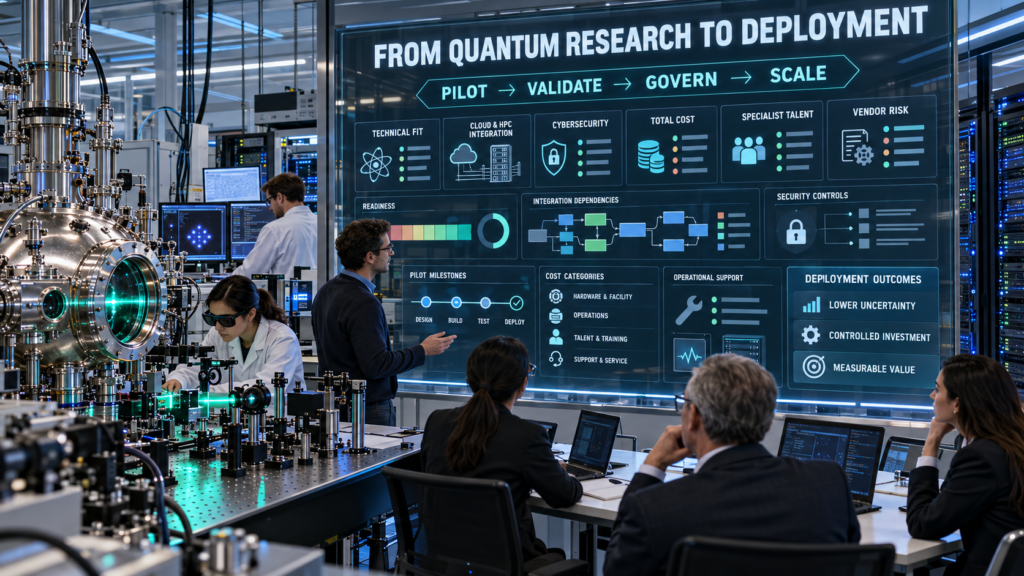
Technical and Commercial Risk Checklist
- Separate physical-qubit, logical-qubit, and application-performance claims.
- Reproduce key benchmarks over multiple dates and calibration cycles.
- Record atom loss, rejected runs, queue time, and recalibration overhead.
- Maintain a classical baseline and independent statistical review.
- Threat-model APIs, notebooks, credentials, support access, and result storage.
- Review vendor continuity, component supply, export controls, and roadmap dependency.
- Define data residency, retention, deletion, and incident-response obligations.
- Test portability of circuits, data, and experiment metadata.
- Require human approval for high-cost jobs and automated spending limits.
- Document environmental, laser-safety, and facility controls for installed systems.
NIST, Post-Quantum Security, and the EU AI Act
NIST finalized its first three post-quantum cryptography standards in 2024 and urged organizations to begin migration.[9] That security program should continue independently of whether a company purchases neutral atom quantum technology; experimental access does not itself create a cryptographically relevant quantum computer.
The NIST Cybersecurity Framework and ISO/IEC 27001 can structure access control, asset management, logging, supplier risk, and incident response around quantum services. Post-quantum migration requires its own cryptographic inventory, dependency analysis, and transition plan.
The EU AI Act does not generally regulate a quantum processor merely because it is quantum hardware. It may become relevant when an AI system built, trained, or operated with quantum resources falls within the Act’s scope; legal review should focus on the resulting AI use case, provider role, data, and risk classification.
Independent Verification
DARPA’s Quantum Benchmarking Initiative defines utility-scale operation as computational value exceeding cost and is using staged verification to test whether candidate approaches can reach that objective by 2033.[10] The framing is useful for enterprise governance because it treats cost and validation as part of performance.
Neutral atom quantum technology vendors should be willing to support reproducible testing, disclose benchmark conditions, and distinguish measured capability from roadmap targets. Independent evidence is the strongest control against both technical overreach and marketing bias.
Final Decision: Build Capability Before Buying Capacity
Neutral atom quantum technology is progressing quickly, but the engineering case is more compelling than the immediate revenue case. Reconfigurable arrays, high-fidelity parallel gates, large registers, and early logical processors show a credible route forward while leaving substantial work in error correction, automation, availability, and application validation.
Begin with a scoped workload assessment. A 60- to 90-day window can structure initial investigation, but hardware access and validation requirements may require longer. Select one workload, establish its classical cost and accuracy, run a limited hardware experiment where appropriate, and record cost per validated result, integration effort and governance requirements.
If the evidence supports expansion, negotiate a larger pilot with acceptance criteria. If it does not, preserve the code, benchmarks, and lessons while continuing post-quantum security work and monitoring verified hardware progress.
Appendix: Research Integrity and Source Index
References and Source Links
- Evered, S. J. et al., “High-fidelity parallel entangling gates on a neutral-atom quantum computer,” Nature 622, 268–272 (2023). https://www.nature.com/articles/s41586-023-06481-y
- Bluvstein, D. et al., “Logical quantum processor based on reconfigurable atom arrays,” Nature 626, 58–65 (2024). https://www.nature.com/articles/s41586-023-06927-3
- Manetsch, H. J. et al., “A tweezer array with 6,100 highly coherent atomic qubits,” Nature (2025). https://www.nature.com/articles/s41586-025-09641-4
- QuEra, “Aquila: 256-qubit quantum computer.” https://www.quera.com/aquila
- Atom Computing, “AC1000 product details.” https://atom-computing.com/ac1000/
- Pasqal, “Italy’s first neutral-atom quantum computer integrated with Leonardo.” https://www.pasqal.com/newsroom/pasqal-inaugurates-italys-first-neutral-atom-quantum-computer-third-pasqal-system-in-europe/
- Bluvstein, D. et al., “A fault-tolerant neutral-atom architecture for universal quantum computation,” Nature (2025). https://www.nature.com/articles/s41586-025-09848-5
- AWS, “Amazon Braket quotas” and Aquila documentation. https://docs.aws.amazon.com/braket/latest/developerguide/braket-quotas.html
- NIST, “NIST Releases First 3 Finalized Post-Quantum Encryption Standards,” 13 August 2024. https://www.nist.gov/news-events/news/2024/08/nist-releases-first-3-finalized-post-quantum-encryption-standards
- DARPA, “Quantum Benchmarking Initiative.” https://www.darpa.mil/research/programs/quantum-benchmarking-initiative
Source Notes and Limitations
The numbered references use an IEEE-style index for readability. Vendor specifications are identified as vendor claims unless independently reproduced in a cited peer-reviewed study; product availability and commercial terms should be rechecked before publication or purchase.
Editorial Responsibility and AI Disclosure
AI-assisted tools were used to support research organization, drafting and language refinement. NezzHub retains editorial responsibility for the published article. Vendor inclusion does not constitute endorsement.
No vendor paid for inclusion in the comparison table. Pricing is described only at the level supported by public information because enterprise contracts, reserved access, installation, support, and integration costs are commonly quote-based and can change.
Author and Editorial Review
Author: Garikapati Bullivenkaiah
Technology research writer with LL.B., LL.M., M.A., and MBA qualifications. He writes about emerging technologies and their business, governance and legal implications. His multidisciplinary academic background informs his analysis of technology adoption, intellectual property, and organizational risk. His articles explain technical concepts and practical considerations for business owners, IT managers and technology decision-makers. LinkedIn Profile
Reviewed by: Chitikineni Ramadevi — Editor
Chitikineni Ramadevi holds an M.Sc. in Computers from Andhra University and has over 10 years of research experience in technology-related subjects. She reviews NezzHub articles for clarity, factual accuracy, source support and practical relevance.
Published by: NezzHub
Research approach: This article draws on primary sources, technical documentation and relevant industry research. References are provided within the article or its sources section.
Last reviewed: 09-27-2026
Corrections: To report a factual error or outdated information, please contact NezzHub.

Garikapati Bullivenkaiah is a seasoned entrepreneur with a rich multidisciplinary academic foundation—including LL.B., LL.M., M.A., and M.B.A. degrees—that uniquely blend legal insight, managerial acumen, and sociocultural understanding. Driven by vision and integrity, he leads his own enterprise with a strategic mindset informed by rigorous legal training and advanced business education. His strong analytical skills, honed through legal and management disciplines, empower him to navigate complex challenges, mitigate risks, and foster growth in diverse sectors. Committed to delivering value, Garikapati’s entrepreneurial journey is characterized by innovative approaches, ethical leadership, and the ability to convert cross-domain knowledge into practical, client-focused solutions.