















Data Security & Compliance
Data Security and Compliance connects the technical protection of information with the policies, evidence and governance needed to demonstrate that controls operate as intended. The work can include data classification, identity management, encryption, retention, monitoring, incident response, third-party oversight and audit preparation.
This NezzHub subcategory helps technology decision-makers, business owners, IT managers, professionals and students understand how security controls support regulatory, contractual and customer requirements. It presents compliance as an operating discipline within the broader Cybersecurity category, not as a collection of documents or a guarantee that incidents will never occur.
Explore Data Security and Compliance
Data security protects information against unauthorized access, disclosure, alteration, loss and disruption. Compliance evaluates whether an organization satisfies defined legal, contractual, regulatory or assurance requirements that apply to its circumstances.
These subjects overlap, but they are not identical. A technically strong control may not satisfy every evidence requirement, while a completed checklist may fail to prove that the control operates effectively.
- Data classification: Identifying information according to sensitivity, value and handling requirements.
- Access governance: Controlling who or what can reach protected information.
- Encryption and key management: Protecting data while stored and transmitted.
- Evidence management: Retaining traceable records of control operation, exceptions and remediation.
- Third-party oversight: Evaluating service providers that store, process or access business data.
- Incident governance: Documenting detection, escalation, recovery and required reporting decisions.
The guide to practical cybersecurity compliance trends explains why modern programmes need evidence connected to real systems. It also examines continuous monitoring, executive accountability, supplier risk and the limitations of automated compliance checks.
Business and Enterprise Applications
Data security and compliance influence enterprise sales, cloud adoption, vendor selection, customer assurance and operational resilience. Buyers increasingly expect suppliers to explain what data they process, how access is controlled and how incidents are handled.
- SaaS providers: Demonstrating security controls to enterprise customers and independent assessors.
- Cloud operations: Connecting configuration, identity, logging and change evidence across dynamic infrastructure.
- Healthcare organizations: Protecting sensitive information under applicable privacy and sector requirements.
- Financial operations: Supporting access control, resilience, monitoring and audit obligations.
- Vendor management: Assessing whether third parties maintain appropriate controls throughout the contract.
A compliance budget should include scoping, legal or specialist review, technical implementation, evidence collection, internal testing, remediation, audit fees and ongoing control operation. Purchasing a compliance platform does not transfer accountability or determine which obligations apply.
Architecture, Integration and Deployment
A practical compliance architecture connects obligations, assets, risks, controls, owners, evidence, exceptions and remediation. Each control should identify what risk it addresses, how often it operates, who owns it and which authoritative system proves its performance.
- Define the legal entities, services, systems, data and locations in scope.
- Maintain inventories for assets, identities, vendors and sensitive information.
- Map obligations to controls without treating every framework as identical.
- Collect timestamped evidence from authoritative systems.
- Validate evidence completeness, scope, source and retention.
- Assign owners and deadlines for exceptions and remediation.
- Test backups, incident procedures and business-recovery dependencies.
The SOC 2 compliance checklist for data security provides a practical example of this structure. It connects service commitments, system boundaries, risks, control ownership, evidence and independent examination rather than treating audit preparation as policy-file collection.
Risks, Security and Governance
Compliance programmes can create false assurance when dashboards show passing controls without verifying scope, context or data quality. An encrypted system may still expose information if keys are poorly controlled, access is excessive or retention rules are ignored.
- Do not treat automated evidence collection as automatic legal interpretation.
- Confirm that every control covers the intended systems and population.
- Protect compliance platforms because they contain sensitive infrastructure details.
- Separate control failures from evidence-collection failures.
- Document risk acceptance, compensating controls and approval authority.
- Review vendor access, data location, subcontractors and contract obligations.
- Update mappings when systems, services or applicable requirements change.
Framework applicability depends on jurisdiction, sector, data, contracts and organizational role. References to GDPR, HIPAA, India’s digital personal-data framework or other requirements require fact-specific legal and professional review.
How to Use This Subcategory
Business owners should begin with compliance trends and identify customer, contractual and operational drivers. IT managers can focus on asset inventories, identity controls, evidence sources, logging and recovery testing.
Security and compliance professionals can use the SOC 2 checklist to structure control ownership and evidence validation. Students should begin with the difference between security, privacy, risk and compliance before studying individual frameworks.
Frequently Asked Questions
What is the difference between data security and compliance?
Data security protects information through technical and organizational controls. Compliance assesses whether defined obligations or criteria have been satisfied and supported by evidence.
Does compliance prove that an organization is secure?
No. Compliance can provide structured assurance within a defined scope and period, but it cannot guarantee that every weakness has been found or that no incident will occur.
What evidence should a compliance programme retain?
Evidence should identify the source, scope, collection time, control, owner and relevant period. Records should also show exceptions, remediation and approval decisions.
Is SOC 2 a certification?
No. A qualified CPA firm performs a SOC 2 examination and issues a report on controls against applicable Trust Services Criteria.
Latest Data Security and Compliance Articles
Browse the archive below for the latest NezzHub guides on Data Security and Compliance, control evidence, SOC 2 readiness, data protection, governance and enterprise compliance risk.
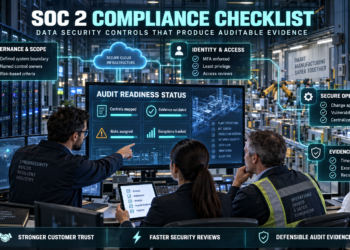
SOC 2 Compliance Checklist for Data Security
Executive Summary A SOC 2 compliance checklist should do more than produce policy files and green dashboard icons. It must...
















Recent News











NezzHub is a technology-focused knowledge hub delivering insights on AI, robotics, cybersecurity, biotech, and emerging innovations. Our mission is to simplify complex technologies through research-driven content and analysis.