













AI in Healthcare & Biotech
AI in Healthcare & Biotech covers the systems used to support clinical operations, disease detection, medical research, genomics and drug development. This NezzHub subcategory helps healthcare leaders, technology teams, researchers, professionals and students assess where artificial intelligence can provide value and where stronger evidence, security and human oversight are required.
The coverage examines healthcare AI applications from both technical and operational perspectives. It addresses data quality, integration, clinical validation, privacy, implementation cost and accountability without presenting automated systems as replacements for qualified healthcare professionals.
Explore AI in Healthcare & Biotech
Healthcare and biotechnology systems process complex information from medical images, clinical records, laboratory results, wearable devices and genomic datasets. AI can help identify patterns or prioritize information, but the usefulness of an output depends on the quality and relevance of the underlying data.
Readers who need a broader foundation can visit the AI and Machine Learning category. It explains the models, platforms, architectures and governance questions that also influence healthcare deployments.
Major areas covered in this subcategory include:
- Clinical workflow and hospital operations
- Medical imaging and disease-detection support
- Wearable health-data analysis
- Genomics and precision-health research
- Drug discovery and development workflows
- Healthcare data security and responsible deployment
Business and Clinical Applications
Hospitals may use AI-supported systems for scheduling, patient-flow analysis, documentation, resource planning and clinical decision support. The guide to healthcare AI tools for hospital operations examines how these systems connect with practical administrative and care-delivery workflows.
AI medical diagnostics can help professionals prioritize images, flag patterns or identify cases that may require closer examination. The article on AI in disease detection explains why performance must be evaluated using representative patient populations and appropriate clinical evidence.
Biotechnology applications include molecular analysis, candidate identification and research-data processing. The AI drug-development guide examines how computational systems may support research while preserving the need for laboratory testing, clinical trials and regulatory review.
Commercial evaluation should include software licensing, infrastructure, data preparation, system integration, staff training, cybersecurity and ongoing performance monitoring. A successful demonstration does not automatically prove that a system is ready for routine clinical use.
Architecture, Integration and Deployment
A healthcare AI system may connect electronic health records, medical devices, laboratory systems, cloud infrastructure and clinician-facing applications. Each integration must preserve data accuracy, access control and traceability across the complete workflow.
Deployment teams should evaluate:
- The origin, quality and permitted use of training and operational data
- Compatibility with existing hospital or research systems
- Identity, access and authorization controls
- Data encryption, retention and geographic processing locations
- Model evaluation across relevant patient groups
- Human review and escalation procedures
- System monitoring, incident response and rollback plans
- Vendor support, service continuity and migration options
Genomic systems require particular attention because genomic data can remain sensitive and personally significant over long periods. The guide explaining why AI needs genomic data in healthcare examines its research value alongside privacy, consent and governance responsibilities.
Risks, Security and Clinical Governance
Healthcare AI can fail through biased datasets, incomplete records, model drift, workflow mismatch or inappropriate reliance on automated output. Errors may remain hidden when users receive a prediction without enough information about its uncertainty or limitations.
Clinical AI governance should define who approves the system, who reviews its outputs and who responds when its performance changes. Procurement, medical, legal, cybersecurity and data-protection teams may all need to participate when a system influences patient care or regulated research.
Security reviews should consider unauthorized access, data leakage, insecure interfaces, manipulated inputs and dependence on external service providers. Healthcare organizations should not send identifiable or confidential information to an AI service unless its use is authorized and supported by appropriate technical and contractual controls.
How to Use This Subcategory
Select articles according to your role and purpose:
- Healthcare leaders: Examine operational value, implementation cost and organizational readiness.
- IT managers: Focus on interoperability, infrastructure, access control, monitoring and cybersecurity.
- Clinicians: Review evidence, workflow fit, limitations and human-oversight requirements.
- Biotechnology professionals: Explore genomics, research data and drug-development applications.
- Students: Begin with healthcare use cases before studying specialized models and data pipelines.
Frequently Asked Questions
How is AI used in healthcare?
AI can support medical-image analysis, documentation, workflow planning, health monitoring and research. Its role should be defined according to the evidence available and the consequences of an incorrect output.
Can AI diagnose a disease without a doctor?
AI may assist with detection or clinical decision support, but it should not automatically be treated as an independent replacement for qualified medical judgment. The required oversight depends on the intended use and applicable regulation.
Why is genomic data important for healthcare AI?
Genomic data can help researchers examine biological variation and disease mechanisms. Its sensitivity, complexity and long-term significance require strong consent, privacy and access controls.
What should hospitals evaluate before adopting AI?
Hospitals should assess clinical evidence, data quality, system integration, cybersecurity, usability, total cost and accountability. A controlled pilot should test the system under realistic operating conditions.
Latest AI in Healthcare & Biotech Articles
Explore the latest NezzHub articles below for evidence-led explanations of AI in Healthcare & Biotech, including hospital operations, disease detection, genomics, wearables and pharmaceutical research.
This content is educational and does not constitute medical advice or clinical certification. Important healthcare decisions should be made with appropriately qualified professionals and current regulatory guidance.
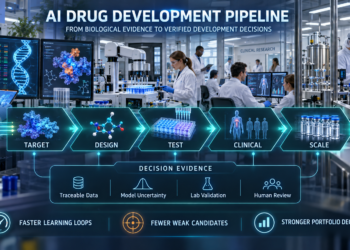
AI Drug Development: Applications, Validation and Risks
Executive Summary AI drug development is changing how pharmaceutical teams select targets, design molecules, run experiments, recruit trial participants, and...

How Smart Wearable Devices Use AI to Track Health Data
Executive Briefing Smart wearable devices turn imperfect body signals into estimates, trends and alerts. Optical sensors, electrodes and motion sensors...

Genomic Data in Healthcare: How It Supports AI
Executive Briefing Genomic data in healthcare gives AI a biological layer that clinical records alone cannot provide. Combined with reliable...

AI in Disease Detection: How It Supports Earlier Diagnosis
Executive Briefing The opportunity: AI in disease detection can help identify defined abnormalities, prioritize examinations, quantify findings, and connect patients...

How Healthcare AI Tools Are Improving Hospital Operations
Executive summary The opportunity: Healthcare AI tools can reduce documentation work, support scheduling, forecast capacity, and improve selected revenue-cycle processes....
















Recent News










NezzHub is a technology-focused knowledge hub delivering insights on AI, robotics, cybersecurity, biotech, and emerging innovations. Our mission is to simplify complex technologies through research-driven content and analysis.