
















Executive Summary
AI drug development is changing how pharmaceutical teams select targets, design molecules, run experiments, recruit trial participants, and assemble regulatory evidence. The commercial opportunity is real, but the popular claim that an algorithm can simply make medicines “faster and cheaper” hides the expensive part: predictions must survive wet-lab validation, clinical testing, quality controls, and regulatory review.
The useful question is therefore not whether a model can generate a molecule. It is whether an AI drug development system can improve a defined decision, under a declared context of use, with evidence strong enough for scientists, quality teams, auditors, and regulators to trust.
This Article maps that operating model. It examines architecture, integration, model validation, deployment costs, platform selection, measurable business outcomes, and the controls required by FDA and European regulatory thinking.
The central finding is practical. AI creates value when it compresses a verified decision loop—design, test, learn, and decide—not when it produces the largest number of predictions.
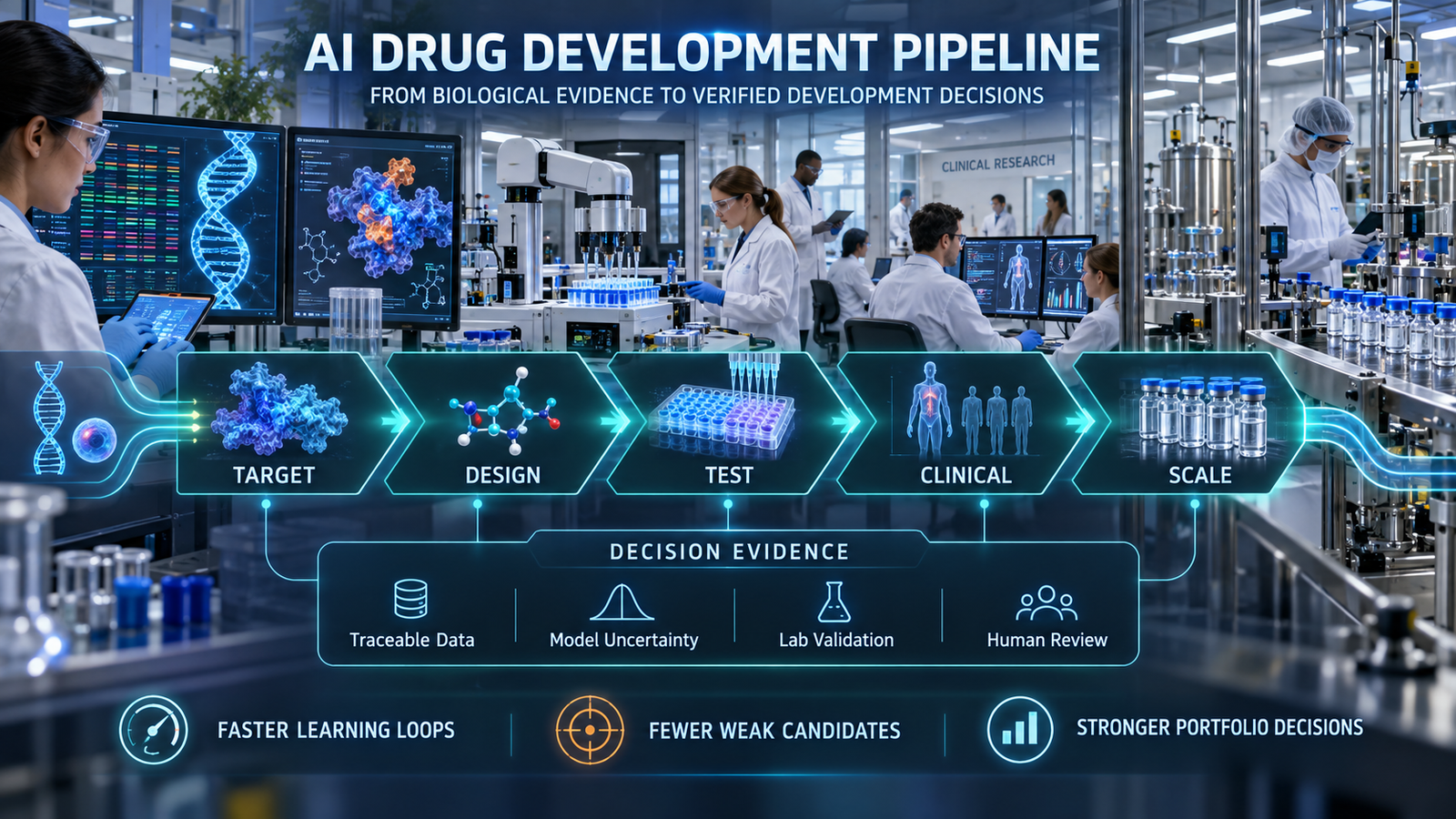
AI drug development helps pharmaceutical teams prioritize promising targets, design candidate molecules, and improve evidence-based decisions.
I. The Current Market Landscape and Challenge
Drug R&D Still Fails at the Handoffs
AI drug development programs do not move through one clean software pipeline. Biology, chemistry, toxicology, clinical operations, biostatistics, manufacturing, quality, and regulatory affairs each use different data structures, acceptance criteria, and systems of record.
That fragmentation is the first constraint on AI drug development. A model trained on assay data may not know that a protocol changed, a plate failed quality control, a chemical structure was stored in a different salt form, or a clinical endpoint was redefined.
The second AI drug development constraint is attrition. A candidate can bind strongly in a computational model and still fail because of selectivity, solubility, metabolism, toxicity, manufacturability, dosing, or lack of clinical efficacy.
The third constraint is evidence. A ranking score is not regulatory evidence unless the sponsor can reconstruct the data lineage, model version, validation design, operating threshold, human review, and downstream decision.
AI in drug discovery is therefore an information-quality problem before it is a model-selection problem. Teams that buy pharmaceutical AI software before fixing identifiers, metadata, assay provenance, and access controls usually automate inconsistency.
The Cost of Inaction Is Not Just Slower Discovery
The most visible AI drug development cost is laboratory capacity spent on weak candidates. The quieter costs include repeated data cleaning, duplicated experiments, untraceable spreadsheet decisions, slow protocol feasibility reviews, and delayed responses to quality or safety signals.
There is also a portfolio cost. When executives cannot compare model confidence, experimental evidence, remaining uncertainty, and expected validation expense on the same decision surface, capital allocation becomes vulnerable to advocacy rather than evidence.
Doing nothing does not preserve a stable baseline. Competitors are building reusable data products, automated assay pipelines, and governed model registries that shorten each subsequent program even when the first project has modest returns.
Yet premature AI drug development deployment has its own cost. A weak model can concentrate experiments around familiar chemistry, exclude underrepresented patient groups, create false confidence, and generate a documentation burden larger than the task it replaced.
The correct commercial objective is controlled decision compression. An AI drug development investment should reduce the time, labor, or experimental spend required to reach a reliable decision while keeping scientific and regulatory uncertainty visible.
Where AI Creates Defensible Value
The strongest AI drug development use cases sit at high-volume decision points with measurable outcomes. Examples include compound prioritization, image-based phenotyping, reaction prediction, protocol-to-patient matching, site feasibility, safety case processing, and manufacturing deviation triage.
These use cases share four properties:
- The input and outcome can be defined without ambiguous labels.
- Historical data is sufficiently representative of the intended use.
- A prospective or time-split test can measure performance.
- A human or experimental control can catch high-consequence errors.
AI drug development becomes commercially fragile when these properties are absent. Generative chemistry may create attractive structures, but a model score cannot substitute for synthesis, analytical confirmation, biochemical assays, cellular studies, and appropriate in-vivo or alternative-method validation.
II. Deep-Dive Technical Analysis and Evidence
Architecture Overview: Build Around Decisions, Not Models
An AI drug development architecture should begin with a decision contract. This document states the user, candidate population, output, threshold, action, prohibited use, expected failure modes, and evidence needed before the output can change a program.
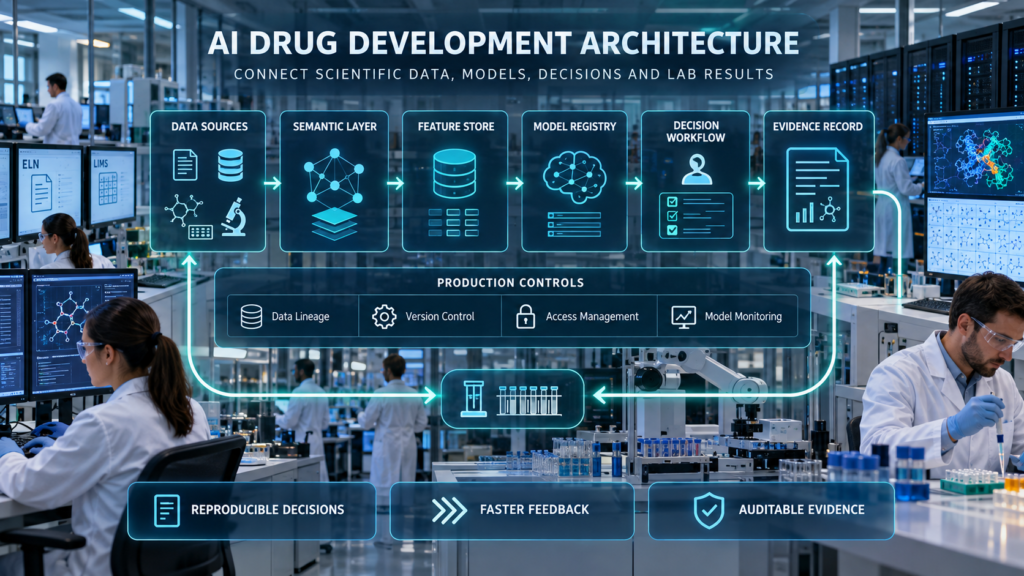
The technical stack then supports that contract through six layers:
- Source layer: ELN, LIMS, compound registry, omics repositories, imaging stores, EHR-derived research datasets, CTMS, eTMF, safety databases, and manufacturing systems.
- Semantic layer: stable identifiers, ontologies, units, assay metadata, protocol versions, patient-event timelines, and lineage relationships.
- Feature layer: versioned molecular descriptors, embeddings, image features, cohort definitions, and transformation code.
- Model layer: training pipelines, hyperparameters, checkpoints, calibration, uncertainty estimates, validation reports, and approved model versions.
- Decision layer: ranked candidates, alerts, explanations, human approvals, overrides, and links to confirmatory work.
- Evidence layer: immutable audit records, electronic signatures where required, change control, monitoring results, and submission-ready documentation.
This design separates exploratory research from regulated execution. Researchers need freedom to test hypotheses, while a validated workflow needs controlled code, frozen data, approved thresholds, and repeatable outputs.
Integration Flowchart: From Hypothesis to Verified Decision
The AI drug development integration flow should be explicit:
Scientific question → governed dataset → model inference → uncertainty check → expert review → confirmatory experiment → result capture → model and portfolio update
Each arrow is an integration boundary. The model is only one component; most deployment failures occur when ownership at those boundaries is unclear.
For example, a molecular design service may send structures to a synthesis planner. Before a chemistry team acts, the workflow must standardize stereochemistry, flag reactive groups, check intellectual-property constraints, assess route plausibility, and preserve the exact model and prompt configuration.
After synthesis, observed yield, purity, potency, selectivity, and ADME results must return to the governed dataset. Without that feedback loop, AI in drug discovery remains a demonstration rather than a learning system.
Target Identification and Biological Validation
AI drug development target models combine genetics, transcriptomics, proteomics, pathways, literature, and disease phenotypes to rank biological hypotheses. Knowledge graphs are useful because they preserve relationships and supporting evidence instead of collapsing everything into one opaque score.
The failure vector is correlation without causal relevance. Publication bias, popular targets, duplicated databases, and disease-stage differences can make a target look well supported while adding little therapeutic leverage.
A credible AI drug development program therefore separates evidence types. Human genetics, perturbation experiments, pathway biology, disease models, and clinical observations should retain distinct provenance and confidence.
The validation plan should test whether the target changes disease-relevant biology, whether modulation is tolerated, whether a tractable modality exists, and whether biomarkers can demonstrate target engagement. A higher model score does not remove any of these gates.
AI in Disease Detection: How Doctors Detect Disease Earlier with AI
Molecular Design and Virtual Screening
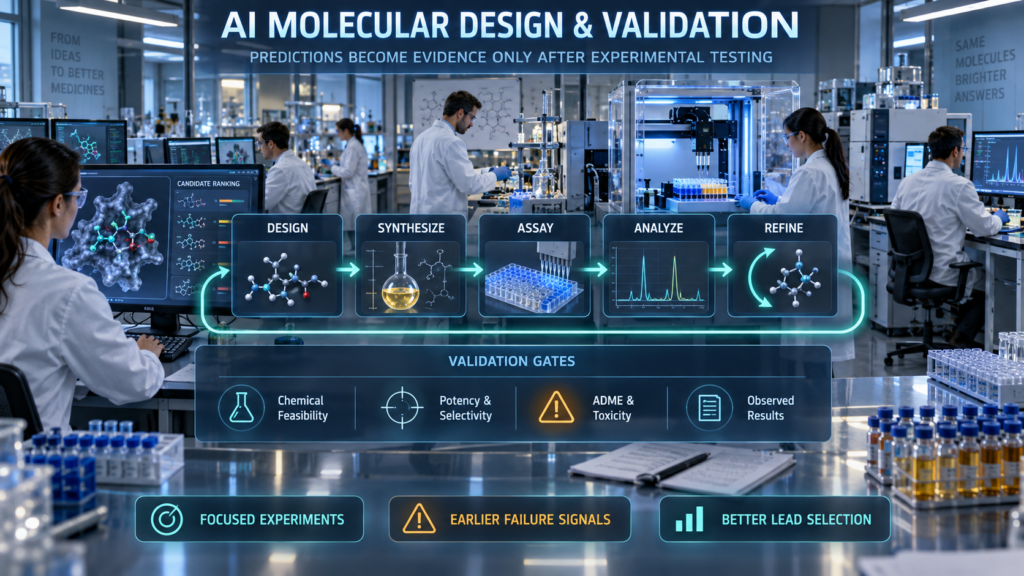
AI in drug discovery uses property predictors to estimate binding, permeability, solubility, metabolism, toxicity, and synthetic accessibility. Generative models propose structures under multiple constraints, while docking and physics-based methods test plausible interactions.
The architecture trade-off is speed versus fidelity. Fast surrogate models can rank huge libraries but may perform poorly outside their training domain; slower physics-based calculations may improve mechanistic grounding but increase compute cost and still depend on structural assumptions.
AlphaFold demonstrated a major advance in protein-structure prediction, yet a predicted structure is not automatically a drug-ready receptor model [1]. Conformational state, cofactors, protein dynamics, binding-site water, mutations, and experimental conditions remain material.
AI drug development teams should use cascades rather than one universal model. A published DDR1 case demonstrated rapid deep-learning-supported molecule identification and initial experimental validation, but it did not establish an equally short path through complete clinical development [2].
Cheap filters remove obvious failures, calibrated machine-learning models rank the survivors, physics-based methods examine a narrower set, and experiments settle the question.
Machine Learning in Pharmaceuticals Requires Prospective Tests
Random train-test splits often exaggerate performance because close chemical analogues or related samples appear on both sides. Scaffold splits, temporal splits, external datasets, and prospective predictions better resemble actual use [8].
Machine learning in pharmaceuticals must match performance to the decision. A high area under the ROC curve may be commercially useless if precision is poor among the top compounds that the laboratory can afford to test.
For imbalanced outcomes, teams should report precision, recall, precision-recall area, calibration, enrichment at a defined budget, uncertainty coverage, and subgroup results. For regression, error distributions and decision thresholds matter more than one average score.
Machine learning in pharmaceuticals also needs applicability-domain controls. The system should identify unfamiliar chemistry, sparse patient segments, changed assays, and missing inputs instead of returning confident-looking predictions [7].
AI Clinical Trials: Useful Narrowly, Risky Broadly
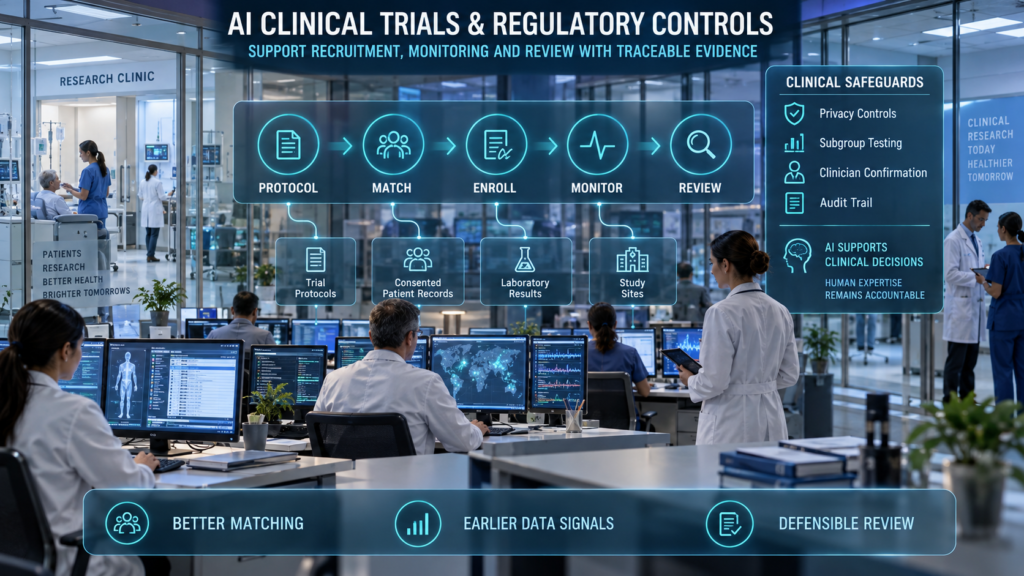
AI clinical trials applications include protocol feasibility, eligibility parsing, patient matching, site selection, endpoint extraction, image interpretation, data-quality surveillance, and safety-signal prioritization [9]. Their risk depends on whether the output assists operations or directly affects a participant’s treatment, dose, or eligibility.
AI clinical trials patient matching illustrates the challenge. Electronic health records contain missing values, local coding practices, copied text, time-dependent diagnoses, and protected information that cannot be moved casually into a vendor platform.
A production workflow needs a computable eligibility specification, terminology mapping, date-aware logic, source traceability, privacy controls and clinician confirmation. Measure recall to identify missed eligible patients and precision to assess how many suggested matches are genuinely eligible. Evaluate both measures across relevant patient groups, because an overall score can hide unequal exclusion rates.
For late-stage inference, EMA states that AI/ML used to transform, analyze, or interpret clinical-trial data should follow applicable statistical principles; it also describes frozen and documented models and pre-specified curation pipelines for relevant late-stage uses [4].
AI-supported trial workflows also remain subject to applicable Good Clinical Practice and participant-protection requirements [10].
The Performance Evaluation Matrix
| Use case | Primary metric | Required stress test | Human or experimental control | Business measure |
| Target ranking | Prospective validated hit rate | Novel disease area and sparse evidence | Biology review plus perturbation study | Cost per validated hypothesis |
| Compound prioritization | Top-budget enrichment and calibration | Scaffold and temporal split | Synthesis and assay confirmation | Experiments per qualified lead |
| Toxicity prediction | Sensitivity at approved threshold | External chemical space | Toxicology review and confirmatory tests | Avoided low-value advancement |
| Patient matching | Recall, precision, subgroup performance | Site and demographic shift | Clinician confirmation | Screen-failure rate and enrollment cycle time |
| Safety triage | Sensitivity, workload reduction, override rate | New products and vocabulary drift | Pharmacovigilance review | Cases processed per qualified reviewer |
| Manufacturing monitoring | Detection lead time and false-alarm burden | Batch, equipment, and site shift | Quality-unit disposition | Investigation time and recurrence |
No row should be approved on retrospective accuracy alone. The minimum commercial proof is a prospective shadow deployment in which outputs are recorded but do not yet control the process.
Compute Cost and Platform Economics
AI drug development compute cost is workload-specific. Molecular pretraining, protein models, graph networks, docking, molecular dynamics, image analysis, and clinical language models have different GPU, storage, network, and latency profiles.
The largest hidden expense is often not inference. Data curation, assay harmonization, validation, security review, integration, retraining, and expert adjudication can exceed the model bill.
An AI drug development business case should calculate fully loaded cost per decision:
Annual platform and labor cost ÷ number of qualified decisions delivered
That denominator must exclude unreviewed model outputs. A million generated molecules have no business value if the team can synthesize and test only fifty.
III. Commercial Solutions and Best Practices
Feature and Cost Comparison Table
The pharmaceutical AI software table compares deployment patterns, not guaranteed outcomes. Pricing changes by contract, region, compute, storage, support, data volume, and regulated-service requirements; buyers should request a workload-specific total-cost model.
| Solution | Strongest fit | Architecture advantage | Cost structure | Principal diligence question |
| NVIDIA BioNeMo platform and services | Foundation models and accelerated molecular workflows | GPU-optimized model services and development tooling | Infrastructure, consumption, software, and support; quote required | Can your validation package reproduce every model, container, and dataset version? |
| Schrödinger software platform | Physics-informed molecular design and computational chemistry | Integrated modelling and enterprise discovery workflows | Commercial license and cloud/compute components; quote required | Which claimed gains were prospectively validated on chemistry similar to yours? |
| AWS HealthOmics plus SageMaker services | Governed omics processing and custom ML deployment | Scalable workflow orchestration, storage, security, and model operations | Usage-based services plus engineering and support | What is the egress, orchestration, validation, and 24/7 operations cost? |
| Google Cloud Vertex AI with life-sciences data services | Multimodal analytics and enterprise ML operations | Managed model development, deployment, monitoring, and data integration | Usage-based services plus integration and support | How will sensitive data, residency, lineage, and model changes be controlled? |
This is not a ranking. The right pharmaceutical AI software depends on the scientific decision, existing cloud commitments, validation boundary, internal skills, data sensitivity, and exit plan.
A Seven-Gate Procurement Framework
Gate 1: Define the Context of Use
State exactly what an AI drug development output informs and what it cannot decide. “Improve discovery” is not a context of use; “rank up to 2,000 qualified compounds for assay selection within a defined target family” is.
Gate 2: Establish the Baseline
Measure the current AI drug development cycle time, labor, hit rate, experimental cost, failure rate, and decision quality. Without a baseline, every vendor demonstration can look successful.
Gate 3: Audit Data Rights and Provenance
Confirm the organization can lawfully use each dataset for training, validation, inference, and cross-border processing. Record lineage, consent or authorization basis, licenses, transformations, retention, and deletion rules.
Gate 4: Test on a Locked Evaluation Set
The AI drug development buyer—not only the vendor—should control an unseen test. Use temporal and external data, define acceptance thresholds in advance, and prevent tuning against the final evaluation set.
Gate 5: Run a Prospective Shadow Pilot
Capture model outputs, expert decisions, actual experimental or operational outcomes, overrides, and failure reasons. The model should not control a high-consequence decision during this phase.
Gate 6: Validate Operations and Controls
Test identity and access management, encryption, logging, backup, disaster recovery, incident response, change approval, vendor access, model rollback, and evidence export. Pharmaceutical AI software is part of a larger regulated system.
Gate 7: Contract for Evidence and Exit
Secure audit rights, breach notification, subcontractor transparency, service levels, data portability, model-version notice, deletion evidence, and transition assistance. A proprietary model without reproducible evidence creates dependency, not resilience.
Deployment Challenges That Break Otherwise Good Models
Assay drift changes AI drug development inputs and outcomes. A new reagent lot, instrument, laboratory, image pipeline, or protocol can move the data distribution without producing an obvious software error.
Label leakage is another common failure. Post-decision information can accidentally enter training data, creating impressive retrospective performance that disappears in live use.
Entity resolution is equally dangerous. Compound identifiers, stereoisomers, formulations, patient identities, specimen identifiers, and protocol amendments must remain distinct but linked.
Human factors matter. If the interface hides uncertainty, offers no reason code, or makes disagreement difficult, users may over-rely on the system or bypass it entirely.
Finally, retraining is a controlled change. New data may improve average accuracy while degrading a critical subgroup, invalidating earlier documentation, or shifting decision thresholds.
IV. Business Outcomes and Strategic ROI Takeaways
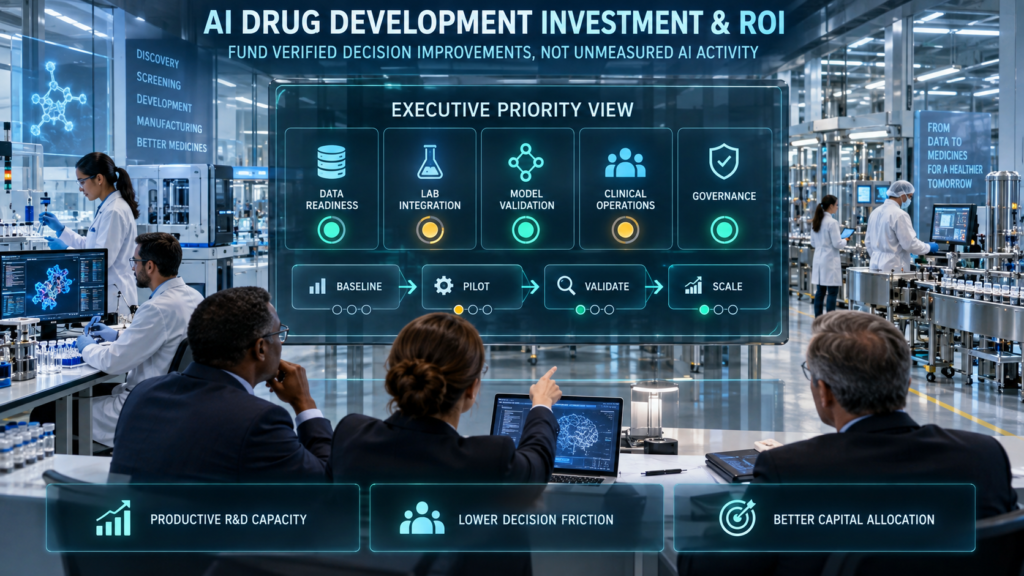
Measure Decision Economics, Not AI Activity
Useful AI drug development metrics connect technical performance to a controlled business result. Model calls, generated structures, and dashboard views are operating statistics, not ROI.
For discovery, measure experiments per validated hit, cycle time per design-make-test-learn loop, qualified leads per chemistry budget, and downstream attrition. For clinical operations, measure manual review time, confirmed eligible patients, screen failures, enrollment duration, and subgroup representation.
For safety and quality, measure qualified-reviewer throughput, false-negative risk, alert burden, investigation time, recurrence, and closure quality. Every efficiency metric needs a paired risk metric so teams cannot “improve” speed by lowering scrutiny.
A Finance-Ready ROI Model
Calculate benefits and costs over the same defined period:
Net financial value = realized labor savings + verified avoided experimental costs + separately justified cycle-time benefit − platform, integration, validation and operating costs − contingency allowance.
Report released staff or laboratory capacity separately unless it produces a measurable financial benefit. Avoid counting the same hours or experiments under multiple benefit categories. Include implementation costs in the first-year calculation and assess recurring costs separately.
Do not count projected revenue from an unapproved medicine as near-term savings. Treat schedule value probabilistically and document the assumptions.
Budget a contingency allowance for unplanned remediation, additional validation, service interruption, model replacement, migration and study rework. Separate this allowance from expenses already included in the cost model to avoid double counting.
A stage-gated funding model is safer than a large platform commitment. Fund data readiness first, then retrospective evaluation, prospective shadow use, bounded production, and finally scale.
Strategic Takeaways for Decision Makers
- Buy a measurable decision improvement, not a general AI capability.
- Keep experimental confirmation inside every discovery value claim.
- Separate exploratory environments from validated production workflows.
- Require uncertainty, abstention, and applicability-domain controls.
- Make data lineage and model versions exportable from day one.
- Pair every productivity measure with a safety or quality measure.
- Treat vendor exit, retraining, and decommissioning as design requirements.
AI drug development should make a portfolio more selective, not merely more active. The best system helps teams stop weak work earlier and advance strong work with clearer evidence.
V. Risk Mitigation and Regulatory Framework
FDA-Aligned Credibility Controls
FDA’s January 2025 draft guidance proposes a risk-based framework for assessing the credibility of AI models that produce information supporting regulatory decisions about drug safety, effectiveness or quality. The document contains non-binding recommendations and is marked “Not for implementation.” It should be distinguished from applicable legal requirements.[3]
Why: The draft status is correct; “the article must not present…” is an instruction to the writer. FDA still identifies this document as draft guidance.
B. Placement: “Corporate Editorial Transparency and AI Usage Disclosure,” first paragraph.
Replace the paragraph beginning “This Article was reconstructed from a supplied draft…” with:
AI-assisted tools were used to support research organization, drafting and language refinement. NezzHub retains editorial responsibility for the published article. Vendor inclusion does not constitute endorsement.
C. Make these exact heading changes:
| Current heading | Replacement |
|---|---|
| V. Appendix and Research Integrity | VI. Appendix and Research Integrity |
| Appendix A: Academic and Primary-Source Footnotes | Appendix A: Research Papers and Primary Sources |
| Corporate Editorial Transparency and AI Usage Disclosure | Editorial and Commercial Disclosure |
| Author Credentials and Corporate E-E-A-T Verification | Author and Editorial Review |
Why: Section V already identifies the risk framework, so the appendix should be VI. The other replacements remove internal publishing terminology.
Remove “Editorial methodology” and “Editorial Standard” from the author block, following your preference.
5. Closing section: give a clearer next step
Placement: Immediately before the appendix.
Current heading:
Final CTA: Commission a Decision-Level Pilot
Replace with:
Selecting and Validating Your First AI Use Case
Replace both paragraphs beneath it with:
Select one decision with adequate data, measurable friction and an observable outcome. Define the existing baseline, intended users, acceptance thresholds and human or experimental safeguards before choosing a platform.
Test the workflow on a locked evaluation set, then assess it prospectively under appropriate oversight. Expand only when the results demonstrate repeatable decision improvement, manageable costs and acceptable scientific, safety and quality risks.
Why: This removes the internal “Final CTA” label and states what readers should do.
Flowchart: retain it. Under “Integration Flowchart: From Hypothesis to Verified Decision,” keep the existing stages. In the rendered diagram, add a return arrow from “Model and portfolio update” to “Governed dataset,” labelled “Validated results and approved updates.” Your following paragraph already describes that feedback loop; the diagram should show it explicitly.
Operationally, sponsors should define the model’s context of use, assess the consequence of an incorrect output, establish credibility goals, document data and model limitations, and provide evidence proportionate to risk.
EMA Lifecycle Expectations
EMA’s 2024 reflection paper places responsibility on sponsors, applicants, authorization holders, and manufacturers to ensure algorithms, datasets, and processing pipelines are fit for purpose [4]. It also emphasizes bias, generalizability, data integrity, deployment monitoring, and early regulatory interaction for consequential uses.
For high-impact clinical uses, teams should expect detailed scrutiny of architecture, development logs, training data, validation, testing, and processing pipelines. “Proprietary” is not a substitute for assessable evidence.
EU AI Act and NIST AI RMF
The EU AI Act uses a risk-based structure and applies alongside sectoral medicines, medical-device, privacy, and cybersecurity law [5]. Classification depends on the system’s intended purpose and deployment context, so organizations should obtain product-specific legal analysis rather than label all pharmaceutical models identically.
The NIST AI Risk Management Framework offers four functions—Govern, Map, Measure, and Manage—for voluntary AI risk management [6]. It is useful for organizing controls, but it does not replace GxP, privacy, clinical-trial, or product-specific regulatory obligations.
Compliance Checklist
- Approved context of use, intended users, prohibited uses, and decision authority
- Named business owner, scientific owner, data owner, quality owner, and security owner
- Traceable datasets, labels, transformations, licenses, and retention rules
- Representative training, validation, test, temporal, and external datasets
- Pre-specified performance, calibration, subgroup, and robustness thresholds
- Applicability-domain detection, uncertainty estimates, and abstention behavior
- Independent validation and prospective shadow testing
- Human review, override capture, escalation, and periodic competency checks
- Model registry, version control, change assessment, approval, and rollback
- Production drift, data-quality, security, and outcome monitoring
- Privacy impact assessment and least-privilege access
- Supplier due diligence, incident notification, audit rights, and exit provisions
- GxP assessment, electronic-record controls, and evidence retention where applicable
- Regulatory engagement plan tied to risk and context of use
- Decommissioning plan covering data, interfaces, records, and replacement workflow
Selecting and Validating Your First AI Use Case
Select one decision with adequate data, measurable friction and an observable outcome. Define the existing baseline, intended users, acceptance thresholds and human or experimental safeguards before choosing a platform.
Test the workflow on a locked evaluation set, then assess it prospectively under appropriate oversight. Expand only when the results demonstrate repeatable decision improvement, manageable costs and acceptable scientific, safety and quality risks.
VI. Appendix and Research Integrity
Appendix A: Research Papers and Primary Sources
- Jumper, J. et al. “Highly accurate protein structure prediction with AlphaFold.” Nature 596, 583–589 (2021). Nature primary research article.
- Zhavoronkov, A. et al. “Deep learning enables rapid identification of potent DDR1 kinase inhibitors.” Nature Biotechnology 37, 1038–1040 (2019). This study reported a compressed computational-design and initial validation workflow; it did not prove that complete clinical development can be compressed to the same schedule. Nature Biotechnology primary research article.
- U.S. Food and Drug Administration. “Considerations for the Use of Artificial Intelligence To Support Regulatory Decision-Making for Drug and Biological Products,” Draft Guidance, January 2025. The page explicitly identifies the guidance as draft and non-binding. FDA guidance page.
- European Medicines Agency. “Reflection paper on the use of Artificial Intelligence (AI) in the medicinal product lifecycle,” final adopted version, September 2024. EMA primary regulatory document.
- European Union. Regulation (EU) 2024/1689 and the European Commission’s official AI Act policy overview. European Commission AI Act portal.
- National Institute of Standards and Technology. “Artificial Intelligence Risk Management Framework (AI RMF 1.0),” NIST AI 100-1, January 2023. NIST AI RMF.
- Vamathevan, J. et al. “Applications of machine learning in drug discovery and development.” Nature Reviews Drug Discovery 18, 463–477 (2019). Peer-reviewed review.
- Bender, A. and Cortés-Ciriano, I. “Artificial intelligence in drug discovery: what is realistic, what are illusions?” Drug Discovery Today 26, 511–524 (2021). PubMed record.
- U.S. Food and Drug Administration. “Artificial Intelligence and Medical Products,” official resource hub covering drugs, biologics, devices, and cross-center publications. FDA primary resource.
- International Council for Harmonisation. ICH E6 Good Clinical Practice resources. AI used in clinical trials remains subject to applicable clinical-trial quality and participant-protection requirements. ICH efficacy guidelines.
Sources and Citations Index
| Source | Type | Claims supported in this paper |
| FDA AI credibility draft guidance (2025) | Primary regulator | Context of use, risk-based credibility, regulatory decision support |
| EMA AI lifecycle reflection paper (2024) | Primary regulator | Lifecycle governance, GxP, data integrity, clinical use, monitoring |
| EU AI Act official portal | Primary government source | Risk-based legal framework and cross-regulatory context |
| NIST AI RMF 1.0 | Primary standards source | Govern, Map, Measure, Manage control structure |
| Jumper et al., Nature (2021) | Primary academic research | Protein-structure prediction capability and its proper boundary |
| Zhavoronkov et al., Nature Biotechnology (2019) | Primary academic research | AI-supported molecule design and experimental validation example |
| Vamathevan et al. (2019) | Peer-reviewed synthesis | Machine-learning applications across the development lifecycle |
| Bender and Cortés-Ciriano (2021) | Peer-reviewed critical analysis | Validation limits, domain shift, and realism in AI discovery claims |
| ICH E6 resources | Primary harmonization guidance | Good Clinical Practice context for AI-supported trials |
Editorial and Commercial Disclosure
AI-assisted tools were used to support research organization, drafting and language refinement. NezzHub retains editorial responsibility for the published article. Vendor inclusion does not constitute endorsement.
Product descriptions are editorial comparisons, not endorsements. No vendor payment, affiliate consideration, or hands-on benchmark is claimed in this paper; pricing and capabilities should be confirmed directly during procurement.
Author and Editorial Review
Author: Garikapati Bullivenkaiah
Technology research writer with LL.B., LL.M., M.A., and MBA qualifications. He writes about emerging technologies and their business, governance and legal implications. His multidisciplinary academic background informs his analysis of technology adoption, intellectual property, and organizational risk. His articles explain technical concepts and practical considerations for business owners, IT managers and technology decision-makers. LinkedIn Profile
Reviewed by: Chitikineni Ramadevi — Editor
Chitikineni Ramadevi holds an M.Sc. in Computers from Andhra University and has over 10 years of research experience in technology-related subjects. She reviews NezzHub articles for clarity, factual accuracy, source support and practical relevance.
Published by: NezzHub
Research approach: This article draws on primary sources, technical documentation and relevant industry research. References are provided within the article or its sources section.
Last reviewed: 09-19-2026
Corrections: To report a factual error or outdated information, please contact NezzHub.

Garikapati Bullivenkaiah is a seasoned entrepreneur with a rich multidisciplinary academic foundation—including LL.B., LL.M., M.A., and M.B.A. degrees—that uniquely blend legal insight, managerial acumen, and sociocultural understanding. Driven by vision and integrity, he leads his own enterprise with a strategic mindset informed by rigorous legal training and advanced business education. His strong analytical skills, honed through legal and management disciplines, empower him to navigate complex challenges, mitigate risks, and foster growth in diverse sectors. Committed to delivering value, Garikapati’s entrepreneurial journey is characterized by innovative approaches, ethical leadership, and the ability to convert cross-domain knowledge into practical, client-focused solutions.