

















Executive Summary
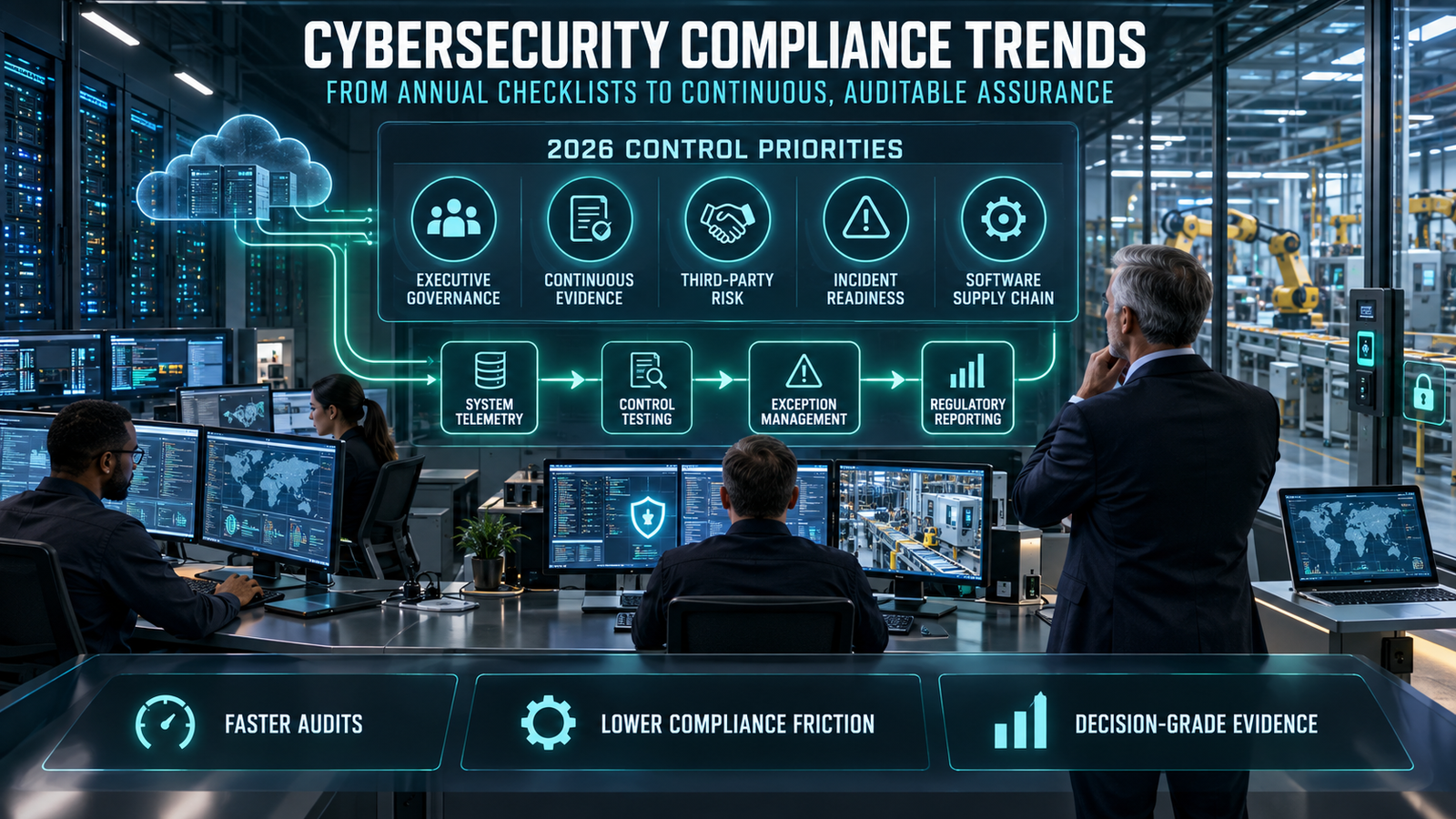
Cybersecurity compliance trends now converge on one operational demand: prove that security controls work continuously, not merely that policies exist. Boards, regulators, customers, insurers, and auditors increasingly expect traceable evidence connecting risk decisions to live systems, third parties, incidents, and accountable executives.
The pressure is no longer confined to privacy teams. NIS2 reaches management bodies and supply chains, DORA imposes operational-resilience duties on covered EU financial entities, SEC rules require material cyber-incident and governance disclosures, and PCI DSS v4.0.1 has moved future-dated controls into the active assessment environment.[2–6]
These cybersecurity compliance trends do not create one universal checklist. Scope still depends on legal entity, sector, geography, data, listing status, contracts, product type, and the services an organization supplies.
The correct response is an evidence architecture. Assets, obligations, controls, tests, exceptions, owners, incidents, vendors, and remediation records must connect through stable identifiers and reliable timestamps.
Automation helps, but it can also manufacture false assurance. A passing cloud-configuration check does not prove that a business process is lawful, that an incident is immaterial, or that a compensating control is adequate.
This Article converts cybersecurity compliance trends into an implementation model for decision makers. It includes a regulatory horizon, technical architecture, integration flow, product comparison, performance matrix, cost model, risk controls, and a populated primary-source appendix.
I. The Current Market Landscape and Compliance Challenge
The cybersecurity compliance trends problem is not a shortage of frameworks. It is the collision of overlapping obligations with fragmented infrastructure, incomplete asset inventories, inconsistent evidence, and unclear ownership.
A multinational SaaS provider may face customer SOC 2 demands, ISO 27001 certification, state privacy statutes, SEC disclosure duties, NIS2 exposure through an EU entity or customer, and contractual security schedules. These cybersecurity compliance trends use different terminology, but many depend on the same identity, logging, change, vulnerability, incident, and supplier controls.
Trend 1: Governance Is Becoming an Operating Control
NIST Cybersecurity Framework 2.0 added Govern as a core function, elevating strategy, policy, roles, supply-chain risk, and oversight.[1] That change reflects cybersecurity compliance trends that push accountability above the security operations center.
The SEC requires covered registrants to disclose cybersecurity risk-management processes, board oversight and management responsibilities. Domestic registrants generally file material incident disclosures under Form 8-K Item 1.05 within four business days after determining materiality, subject to permitted delays. Foreign private issuers follow the applicable Form 6-K incident-disclosure requirements and Form 20-F annual requirements.[2]
Management reporting therefore needs more than a heat map. Executives need control exceptions, risk acceptance dates, incident materiality inputs, recovery evidence, vendor concentration, and unresolved dependencies tied to business services.
Trend 2: Evidence Must Survive Audit and Incident Pressure
Annual screenshots are weak evidence when cloud resources change hourly. Cybersecurity compliance trends favor machine-collected evidence, but the record must still show source, collection time, scope, transformation, owner, and retention status.
Cybersecurity compliance trends also demand evidence context. An encrypted database may pass a technical check while the key is broadly accessible, the backup is untested, or the data should have been deleted under a retention schedule.
The practical standard is repeatability. Another qualified reviewer should be able to reconstruct what was tested, which population was covered, why exceptions were accepted, and whether remediation was completed.
The Cost of Inaction
The cost of ignoring cybersecurity compliance trends includes duplicated audits, delayed enterprise sales, contract concessions, regulatory exposure, and incident-response confusion. It also includes engineering time spent answering questionnaires with evidence that already exists somewhere else.
Poor evidence increases legal risk during an incident. If asset scope, materiality inputs, containment actions, and decision records cannot be assembled quickly, disclosure and notification deadlines become harder to manage.
Buying a platform without process redesign creates a different cost. Teams may pay for hundreds of integrations while control owners ignore alerts, mappings remain inaccurate, and exceptions age without escalation.
Regulatory Horizon: Obligations Businesses Must Separate
Cybersecurity compliance trends are easiest to manage when requirements are classified correctly. A law, supervisory rule, industry standard, customer contract, and voluntary framework do not carry identical legal force.
2026 Applicability and Evidence Map
| Instrument | Who should assess scope | Operational significance as of September 19, 2026 | Evidence implication |
| SEC cyber-disclosure rules | U.S. public companies and foreign private issuers | Material incident and annual governance disclosures are active | Preserve materiality analysis, incident chronology, board reporting, and disclosure approvals |
| NIS2 Directive | Entities in covered EU sectors, subject to national transposition and scope rules | Member-state implementation and enforcement require country-specific review | Map management oversight, risk measures, supply chain, incident reporting, and training |
| DORA | Covered EU financial entities and relevant ICT relationships | Applied from January 17, 2025 | Maintain ICT risk governance, incident handling, resilience testing, and third-party registers |
| PCI DSS v4.0.1 | Entities handling cardholder data under payment-brand and acquirer arrangements | Future-dated requirements became effective March 31, 2025 | Retain scoped system inventories, control tests, targeted risk analyses, and assessor evidence |
| EU AI Act | Providers, deployers, importers, and others within defined scope | Phased obligations apply on different dates; cybersecurity duties depend on system classification | Link AI inventory, role, classification, technical documentation, and security controls |
| Cyber Resilience Act | Manufacturers and economic operators for covered products with digital elements | Reporting duties begin before most substantive product obligations | Build coordinated vulnerability disclosure, secure-development, SBOM, and reporting workflows |
| FTC Safeguards Rule | Covered financial institutions under U.S. FTC jurisdiction | Article 14 reporting obligations have applied since September 11, 2026. Most substantive product obligations apply from December 11, 2027. | Document risk assessment, qualified oversight, safeguards, testing, service-provider controls, and reporting |
| HIPAA Security Rule NPRM | U.S. regulated healthcare organizations and partners monitoring rulemaking | Proposed changes are not the same as final law | Track gap hypotheses separately from currently binding Security Rule obligations |
This cybersecurity compliance trends table is a scoping aid, not legal advice. Each organization should obtain jurisdiction-specific counsel before treating a requirement as applicable or complete.
II. Deep-Dive Technical Analysis and Evidence
The technical challenge behind cybersecurity compliance trends is to turn prose obligations into control objectives without flattening legal nuance. A single identity control may support several regimes, but the evidence period, population, reviewer, and exception rule can differ.
Architecture Overview: The Compliance Evidence Graph
A mature cybersecurity compliance trends design treats assurance as a graph rather than a document repository. The central objects are obligations, risks, controls, assets, identities, vendors, tests, evidence, findings, and accountable owners.

Key architecture layers include:
- Regulatory layer: Versioned obligations, effective dates, jurisdictions, interpretations, and counsel-approved applicability decisions.
- Control layer: Normalized control objectives mapped to each requirement without deleting requirement-specific qualifiers.
- Asset layer: Cloud resources, applications, endpoints, repositories, data stores, AI systems, products, identities, and business services.
- Telemetry layer: Configuration state, identity events, vulnerabilities, endpoint status, code-signing results, backup tests, and incident records.
- Evidence layer: Immutable source records, normalized observations, sampling logic, test results, exceptions, and reviewer approvals.
- Workflow layer: Ownership, tickets, service levels, risk acceptance, escalation, remediation, and closure validation.
- Reporting layer: Auditor packages, customer responses, regulator submissions, board dashboards, and executive risk decisions.
Cybersecurity compliance software should preserve links among these layers. Exporting a green PDF while losing source identifiers and transformation logic weakens assurance.
Integration Flowchart
flowchart TD
A[“Obligation and scope”] –> B[“Normalized control objective”]
B –> C[“Assets, identities, vendors”]
C –> D[“Telemetry and evidence collection”]
D –> E[“Test controls and identify exceptions”]
E –> F[“Retest after remediation”]
F –> G[“Audit, board, and regulatory reporting”]
G –> A
The loop matters because cybersecurity compliance trends change scope and evidence expectations. A new business service, acquisition, AI deployment, or supplier can invalidate yesterday’s population.
Powerful, Practical HIPAA Cybersecurity Requirements for Healthcare Organizations
Control Mapping Without “One Control, One Answer”
Cybersecurity compliance trends encourage common control libraries, but mappings are not proof. An MFA policy mapped to five frameworks does not establish enrollment coverage, phishing resistance, break-glass monitoring, service-account handling, or access-review quality.
Use atomic control statements. “Privileged interactive access requires phishing-resistant MFA” is more testable than “the organization uses strong authentication.”
Each control should specify owner, population, test method, frequency, evidence source, failure threshold, exception authority, and retention period. That structure supports regulatory compliance automation without letting the platform invent legal conclusions.
Trend 3: Continuous Monitoring Replaces Calendar Compliance
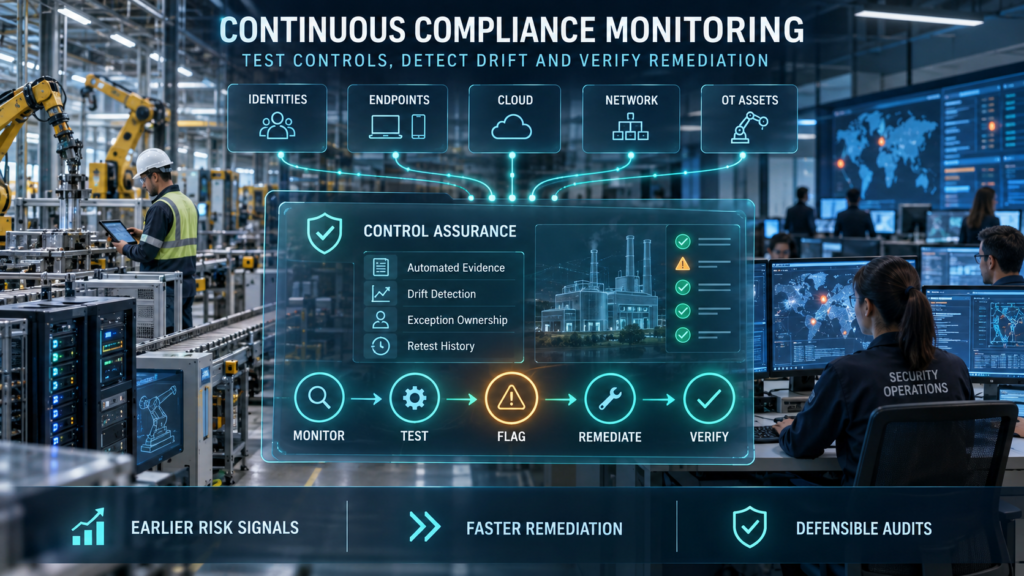
Continuous compliance monitoring detects control drift between audits. Useful checks include public storage, disabled logging, excessive privileges, unencrypted resources, stale endpoints, unsigned artifacts, and overdue high-risk vulnerabilities.
Not every cybersecurity compliance trends control can be monitored continuously. Board oversight, incident materiality, supplier negotiations, tabletop quality, and lawful processing require judgment and documentary evidence.
The correct architecture mixes event-driven checks, scheduled tests, manual attestations, and independent review. Cybersecurity compliance trends reward timely evidence, not indiscriminate automation.
Vulnerability Evidence Must Reflect Exploitation
Cybersecurity compliance trends have exposed the weakness of using CVSS scores alone as a remediation strategy. CISA’s Known Exploited Vulnerabilities catalog identifies vulnerabilities with evidence of exploitation and gives federal agencies due dates under Binding Operational Directive 22-01, while private organizations can use the catalog as a prioritization input.[9]
For cybersecurity compliance trends, CVE-2024-3400 illustrates why external-facing appliance inventory and emergency change paths matter. CVE-2023-34362, associated with MOVEit Transfer exploitation, illustrates third-party software and data-transfer concentration risk.[9][10]
A defensible record links the CVE to affected assets, exposure, exploitability, compensating controls, business owner, patch decision, validation scan, and closure time. A scanner export without asset ownership is not adequate evidence.
Identity and Non-Human Access
Cybersecurity compliance trends now encompass non-human identities created by cloud workloads, CI/CD systems, robotic processes, integrations, and AI agents. Their credentials often outlive projects, bypass interactive MFA, and cross environments.
Cybersecurity compliance trends therefore push identity governance beyond employee joiner-mover-leaver workflows. Organizations need workload identity, secret rotation, permission boundaries, ownership, inactivity detection, and revocation evidence.
The engineering trade-off is reliability. Aggressive credential rotation can break production systems, so teams need staged rollout, dual credentials, health checks, and rollback procedures.
Performance Evaluation Matrix
The cybersecurity compliance trends matrix below prevents a program from measuring document volume instead of control performance. Targets must be calibrated to legal obligations, business criticality, and risk appetite.
| Control domain | Decision-grade metric | Required evidence | Failure signal |
| Asset inventory | Percentage of observed resources linked to owner and service | Cloud, endpoint, network, repository, and procurement reconciliation | Orphan assets or unexplained source variance |
| Privileged access | Coverage, review completion, toxic combinations, revocation time | Identity provider, PAM, HR, ticket, and application records | Shared accounts, stale privilege, unreviewed exceptions |
| Vulnerability management | Exploited-vulnerability exposure and validated remediation time | Scanner, KEV, CMDB, owner, patch, and validation records | Internet-exposed KEV item beyond approved SLA |
| Logging | Critical-source coverage and searchable retention | Source inventory, ingestion health, retention settings, query tests | Silent source, parsing loss, or inaccessible archive |
| Backups | Restore success and recovery-objective achievement | Immutable backup configuration and timed restore tests | Successful backup job without proven restoration |
| Third-party risk | Critical supplier coverage and overdue treatment | Service inventory, contract controls, assessments, issues | Unassessed critical dependency or expired evidence |
| Incident response | Detection-to-triage, decision latency, notification readiness | Timeline, communications, materiality inputs, exercise results | Missing decision owner or unreconciled timestamps |
| Software supply chain | Release provenance, SBOM coverage, signature verification | Build logs, attestations, artifact registry, exception tickets | Unsigned release or unknown dependency lineage |
Cybersecurity compliance trends require metrics with denominators. “Ninety findings closed” is meaningless unless leaders know the total population, severity, age, recurrence, and risk left open.
Evidence Quality Score
A simple cybersecurity compliance trends evidence-quality score can help triage reviews:
Evidence quality score = coverage × freshness × traceability × reproducibility.
This score is an internal management device, not a regulatory safe harbor. Teams must document scoring rules and prevent owners from gaming thresholds.
Deployment Challenges and Engineering Edge Cases
The hardest cybersecurity compliance trends problems appear after connectors are enabled. API limits, eventual consistency, regional partitions, duplicate assets, ephemeral workloads, unsupported systems, and schema changes can silently reduce evidence coverage.
Connector Failure and False Green Dashboards
A cybersecurity compliance trends connector may authenticate successfully while retrieving only part of a tenant. Pagination errors, revoked scopes, renamed accounts, throttling, and vendor API changes can leave dashboards green using stale data.
Continuous compliance monitoring therefore needs connector health, last-success timestamps, expected-versus-observed populations, collection-lag alerts, and independent reconciliation. Evidence freshness must be visible beside every control result.
Ephemeral and Serverless Assets
Cybersecurity compliance trends must account for short-lived containers and functions that disappear before a daily collector runs. Snapshot-based evidence can miss the exact workload that processed regulated data.
Event streams, deployment attestations, policy-as-code results, and immutable build provenance are better sources for ephemeral systems. Runtime detection should complement, not replace, pre-deployment controls.
Exceptions Become Permanent Architecture
Under current cybersecurity compliance trends, risk exceptions cannot remain undocumented design dependencies. A valid exception needs a named owner, rationale, compensating control, residual risk, expiry date, and retest condition.
Regulatory compliance automation should escalate approaching expiries but should never renew acceptance automatically. Reauthorization requires a human with delegated authority and current evidence.
AI-Assisted Compliance Failure Modes
AI can accelerate cybersecurity compliance trends analysis by summarizing regulations, mapping controls, drafting questionnaires, and clustering evidence. It can also hallucinate requirements, use superseded text, expose confidential data, and produce plausible explanations unsupported by the source record.
Every AI-assisted conclusion should retain the source passage, version, jurisdiction, prompt or task context, model/version metadata where feasible, reviewer, and approval. High-impact scope or disclosure decisions require qualified human judgment.
The EU AI Act may add obligations where an AI system falls within its scope and classification rules.[7] It should not be cited as a blanket cybersecurity law for every automation script.
III. Commercial Solutions and Best Practices
Cybersecurity compliance trends should shape the evidence architecture before tool selection begins. Buyers must distinguish enterprise GRC suites, security-compliance automation products, privacy platforms, audit-management tools, and custom data pipelines.
The cybersecurity compliance trends comparison below uses public product information reviewed on September 19, 2026. Pricing is generally quote-based and must be validated through a scoped proposal.
Feature and Cost Comparison Table
| Platform | Strongest fit | Evidence and workflow profile | Cost model and hidden overhead | Material limitation |
| ServiceNow GRC/IRM | Large enterprise already operating ServiceNow workflows | Broad integrated risk, policy, business continuity, third-party, and continuous-assurance workflows | Quote-based subscription plus implementation, configuration, data, partner, and administration costs | Powerful scope can create long deployments and platform dependency |
| OneTrust Technology Risk & Compliance | Enterprise combining privacy, third-party, technology risk, and compliance | Cross-domain assessments, control mapping, evidence, risk, and reporting | Quote-based modules plus integration and operating-model work | Module boundaries and data ownership need careful design |
| Drata | Cloud-native company pursuing recurring assurance and customer trust | Automated evidence integrations, framework readiness, risk, third-party, and trust-center workflows | Quote-based tiers; connector, framework, audit, and support scope affect total cost | Automation coverage is strongest where supported SaaS/cloud integrations match the stack |
| Vanta | SMB and mid-market organization seeking faster assurance operations | Evidence collection, framework programs, risk, vendor management, questionnaires, and trust workflows | Quote-based subscription; audit fees and remediation engineering remain separate | Passing automated checks does not establish full legal compliance or control effectiveness |
No product removes accountability for cybersecurity compliance trends. Cybersecurity compliance software can organize evidence and workflow, but counsel, auditors, control owners, and risk authorities still decide scope and sufficiency.
Procurement Questions That Expose Weak Platforms
- Can the platform export raw evidence, normalized records, mappings, approvals, and history without proprietary loss?
- How does it detect partial connector failure, stale data, pagination gaps, and authorization changes?
- Can one control have different tests, populations, and evidence periods for different obligations?
- Does the system preserve legal text version, effective date, jurisdiction, and interpretation notes?
- Can administrators alter evidence or mappings without an immutable audit trail?
- How are data residency, subprocessor access, retention, deletion, and encryption handled?
- What happens to evidence and workflows when a subscription ends?
- Which costs exclude external audit, implementation, premium connectors, API volume, and support?
Build Versus Buy
Building a custom evidence lake for cybersecurity compliance trends offers flexibility and lower license dependence. It also requires data engineering, connector maintenance, control semantics, workflow design, security, and long-term ownership.
Buying accelerates common integrations and audit workflows. It may impose data models that do not reflect the company’s services, legal entities, or risk authorities.
A hybrid pattern often works best: retain authoritative telemetry in security and business systems, use an enterprise risk management platform for control and decision workflow, and export evidence packages through governed pipelines.
IV. Business Outcomes and Strategic ROI Takeaways
Cybersecurity compliance trends create commercial value when assurance reduces sales friction, duplicated testing, incident uncertainty, or engineering rework. A high audit score without better decisions is not sufficient.
Cost Model for Compliance Technology Deployment
Calculate total annual cost as:
First-year cost = licensing + implementation and integration + operating labor + audit and advisory fees + remediation engineering.
Calculate subsequent-year costs separately, including recurring licensing, operations, audits, connector maintenance and continuing remediation. Record each expense once and distinguish initial implementation from ongoing costs.
For cybersecurity compliance trends, regulatory compliance automation can reduce repetitive collection and evidence formatting. Savings should be measured through hours avoided, audit-cycle duration, questionnaire turnaround, finding recurrence, and control-owner workload.
Decision Model for Each Automation
Automate cybersecurity compliance trends checks when the control has a reliable source, stable population, testable rule, and actionable owner. Retain human review when legal interpretation, business context, materiality, or compensating-control judgment drives the conclusion.
One useful equation is:
Expected annual net value = realized labor savings + estimated financial benefit from reduced delays + estimated reduction in expected incident losses − annual automation cost.
Express every term in money over the same period. Report released staff capacity separately when it does not generate a financial saving, and avoid counting overlapping benefits twice.
Risk reduction should not be invented as a convenient dollar figure. Use scenario ranges, documented assumptions, and sensitivity analysis.

Strategic ROI Takeaways
- Consolidate control evidence before buying another framework module.
- Measure connector coverage and freshness, not the number of enabled integrations.
- Fund remediation engineering separately from compliance-platform licensing.
- Reuse controls where evidence genuinely overlaps, but preserve requirement-specific tests.
- Treat faster enterprise sales as a measurable outcome only when CRM data confirms reduced assurance delay.
- Count negative results: an automation that reveals poor source quality prevents false assurance.
- Require export and exit testing before multi-year renewal.
Risk Mitigation & Regulatory Framework
Translate applicable obligations into named owners, control tests, evidence requirements and escalation procedures. Review legal scope and unresolved exceptions before presenting a program as ready for audit or regulatory reporting. Cybersecurity compliance trends must be translated into assigned decisions, evidence, tests, and escalation—not copied into a policy document.

NIST CSF 2.0 Governance Checklist
- Establish organizational context, stakeholder expectations, and legal or contractual requirements.
- Assign cybersecurity risk roles, authorities, escalation paths, and board reporting.
- Connect strategy and risk appetite to funded control objectives.
- Govern cybersecurity supply-chain risk through service criticality and lifecycle controls.
- Maintain policies that are implemented, communicated, reviewed, and enforced.
- Review outcomes and adjust the profile as threats, technology, and business scope change.
NIST CSF 2.0 is a voluntary risk framework unless adopted through contract, policy, or another authority.[1] Mapping to it does not certify compliance with a statute.
EU and U.S. Regulatory Readiness Checklist
- Determine legal-entity and service scope separately for NIS2, DORA, SEC rules, the EU AI Act, and the Cyber Resilience Act.
- Maintain a country-level NIS2 transposition matrix rather than relying only on the directive text.
- Document DORA ICT risk, incident, testing, resilience, and third-party information registers where applicable.
- Preserve SEC materiality inputs and disclosure decisions with legal privilege handled appropriately.
- For products within CRA scope, operate the applicable Article 14 reporting process now, including intake and escalation for actively exploited vulnerabilities and severe security incidents. Prepare separately for the broader product obligations applying from December 11, 2027.
- Separate the current HIPAA Security Rule from the proposed-rule gap analysis until final requirements take effect.
Technical Evidence Checklist
- Reconcile asset inventories across cloud, endpoint, network, code, procurement, and identity sources.
- Require phishing-resistant MFA for privileged interactive access where feasible and document exceptions.
- Track non-human identities, secrets, ownership, rotation, and last use.
- Prioritize known exploitation and external exposure alongside severity.
- Test restoration, not only backup completion.
- Validate log ingestion, parsing, time synchronization, retention, and searchability.
- Generate SBOMs and release attestations, then test whether consumers can use them.
- Retain immutable evidence of changes, approvals, tests, exceptions, and closure.
Failure Conditions That Should Stop Deployment
Stop or rework the program when asset populations cannot be reconciled, connector failures are invisible, evidence can be edited without trace, or control owners lack authority. A dashboard should never move into executive reporting while those conditions remain.
Also stop when the business cannot explain which obligations are binding. Regulatory names used as marketing labels are not a defensible scope analysis.
Building an Evidence Program Around a Critical Service
Start with one critical business service and assess privileged access, vulnerability response and incident readiness. Confirm applicable obligations, reconcile the asset inventory, assign control owners and test whether the evidence accurately represents operating conditions.
Set review milestones according to the service’s complexity and reporting obligations. Expand when evidence is current, tests are reproducible, exceptions have accountable owners and remediation has been verified. Address immediate legal deadlines independently of the pilot schedule.
V. Appendix and Research Integrity
Appendix A: Sources and Reference Links
- National Institute of Standards and Technology, The NIST Cybersecurity Framework (CSF) 2.0, NIST CSWP 29 (2024), https://doi.org/10.6028/NIST.CSWP.29.
- U.S. Securities and Exchange Commission, “Cybersecurity Risk Management, Strategy, Governance, and Incident Disclosure,” Release No. 33-11216 (2023), https://www.sec.gov/files/rules/final/2023/33-11216.pdf.
- European Union, Directive (EU) 2022/2555, NIS2 Directive, https://eur-lex.europa.eu/eli/dir/2022/2555/oj.
- European Union, Regulation (EU) 2022/2554, Digital Operational Resilience Act, https://eur-lex.europa.eu/eli/reg/2022/2554/oj.
- PCI Security Standards Council, Payment Card Industry Data Security Standard: Requirements and Testing Procedures, Version 4.0.1, https://www.pcisecuritystandards.org/document_library/.
- European Union, Regulation (EU) 2024/2847, Cyber Resilience Act, https://eur-lex.europa.eu/eli/reg/2024/2847/oj.
- European Union, Regulation (EU) 2024/1689, Artificial Intelligence Act, https://eur-lex.europa.eu/eli/reg/2024/1689/oj.
- U.S. Federal Trade Commission, “FTC Safeguards Rule: What Your Business Needs to Know,” https://www.ftc.gov/business-guidance/resources/ftc-safeguards-rule-what-your-business-needs-know.
- Cybersecurity and Infrastructure Security Agency, “Known Exploited Vulnerabilities Catalog,” https://www.cisa.gov/known-exploited-vulnerabilities-catalog.
- National Vulnerability Database, “CVE-2024-3400” and “CVE-2023-34362,” https://nvd.nist.gov/vuln/detail/CVE-2024-3400 and https://nvd.nist.gov/vuln/detail/CVE-2023-34362.
- U.S. Department of Health and Human Services, “HIPAA Security Rule Notice of Proposed Rulemaking,” https://www.hhs.gov/hipaa/for-professionals/security/hipaa-security-rule-nprm/index.html.
Commercial Platform Primary Sources
- ServiceNow, “Governance, Risk, and Compliance,” official product information, https://www.servicenow.com/products/governance-risk-and-compliance.html.
- Drata, “Trust Management Platform,” official product information, https://drata.com/products.
- Vanta, “Security and Compliance Products,” official product information, https://www.vanta.com/products.
- OneTrust, “Technology Risk and Compliance,” official product information, https://www.onetrust.com/products/technology-risk-and-compliance/.
- Serge Egelman, Marian Harbach, and Eyal Peer, “Behavior Ever Follows Intention? A Validation of the Security Behavior Intentions Scale,” CHI Conference on Human Factors in Computing Systems (2016), https://doi.org/10.1145/2858036.2858265.
Reference Integrity Note
Primary legal and regulatory texts control over this summary. Product pages support feature descriptions only and do not independently prove product effectiveness, legal compliance, or return on investment.
Appendix B: Claim-to-Evidence Citation Index
| Claim used in the Article | Footnote | Boundary of support |
| NIST CSF 2.0 includes the Govern function | [1] | Voluntary framework unless separately adopted or required |
| SEC rules require material incident and governance disclosures | [2] | Applies to covered registrants under the final rules |
| NIS2 expands EU cybersecurity governance and risk duties | [3] | National transposition and entity scope must be checked |
| DORA governs ICT operational resilience for covered financial entities | [4] | Sector and entity exclusions require legal analysis |
| PCI DSS v4.0.1 future-dated requirements became effective in 2025 | [5] | Contractual ecosystem and validation method determine applicability |
| CRA introduces lifecycle cybersecurity duties for covered digital products | [6] | Product and economic-operator scope must be analyzed |
| EU AI Act creates phased duties for in-scope AI actors | [7] | Requirements vary by role and classification |
| FTC Safeguards Rule specifies security-program elements | [8] | Applies only to covered financial institutions under FTC jurisdiction |
| KEV data can inform exploited-vulnerability prioritization | [9], [10] | Catalog inclusion does not replace organization-specific risk analysis |
| HIPAA Security Rule changes were proposed | [11] | Proposed requirements are not final obligations |
| Compared GRC products advertise workflow and evidence capabilities | [12]–[15] | Vendor claims require proof through scoped demonstrations and contracts |
Appendix C: Editorial and Commercial Disclosure
AI-assisted tools were used to support research organization, drafting and language refinement. NezzHub retains editorial responsibility for the published article. Vendor inclusion does not constitute endorsement.
Regulatory and product information was checked on September 19, 2026. Laws, national transposition, guidance, enforcement positions, product features, and pricing can change after publication.
No vendor paid for inclusion or received preferential ranking. The comparison contains no affiliate pricing or guaranteed outcome claim.
Appendix D: Author and Editorial Review
Author and Editorial Review
Author: Garikapati Bullivenkaiah
Technology research writer with LL.B., LL.M., M.A., and MBA qualifications. He writes about emerging technologies and their business, governance and legal implications. His multidisciplinary academic background informs his analysis of technology adoption, intellectual property, and organizational risk. His articles explain technical concepts and practical considerations for business owners, IT managers and technology decision-makers. LinkedIn Profile
Reviewed by: Chitikineni Ramadevi — Editor
Chitikineni Ramadevi holds an M.Sc. in Computers from Andhra University and has over 10 years of research experience in technology-related subjects. She reviews NezzHub articles for clarity, factual accuracy, source support and practical relevance.
Published by: NezzHub
Research approach: This article draws on primary sources, technical documentation and relevant industry research. References are provided within the article or its sources section.
Last reviewed: 09-19-2026
Corrections: To report a factual error or outdated information, please contact NezzHub.

Garikapati Bullivenkaiah is a seasoned entrepreneur with a rich multidisciplinary academic foundation—including LL.B., LL.M., M.A., and M.B.A. degrees—that uniquely blend legal insight, managerial acumen, and sociocultural understanding. Driven by vision and integrity, he leads his own enterprise with a strategic mindset informed by rigorous legal training and advanced business education. His strong analytical skills, honed through legal and management disciplines, empower him to navigate complex challenges, mitigate risks, and foster growth in diverse sectors. Committed to delivering value, Garikapati’s entrepreneurial journey is characterized by innovative approaches, ethical leadership, and the ability to convert cross-domain knowledge into practical, client-focused solutions.