

















Executive Summary
HIPAA cybersecurity requirements do not begin with buying antivirus software. They begin with an accurate, documented view of every system that creates, receives, maintains or transmits electronic protected health information, followed by risk decisions that an organization can defend with evidence.
The commercial problem is equally concrete. A hospital can own premium security tools and still fail if unmanaged medical devices, dormant vendor accounts, incomplete asset records or untested backups sit outside the operating model.
This Article translates HIPAA cybersecurity requirements into an engineering and governance program for healthcare executives, IT managers and security leaders. It distinguishes current law from HHS proposals, maps the architecture, tests common technology claims and provides a procurement framework for HIPAA compliance software and managed security services for healthcare.
HHS currently identifies the January 6, 2025 Security Rule overhaul as a proposed rule. Covered entities and business associates must comply with the existing Security Rule while monitoring rulemaking; they should not describe proposed MFA, encryption, annual audit or scanning provisions as final mandates.
The best operating target is therefore dual-track. Meet the present rule with documented, risk-based safeguards, then use NIST SP 800-66 Revision 2 and the voluntary HHS Healthcare and Public Health Cybersecurity Performance Goals to build toward a more prescriptive control baseline.
Editorial legal notice: This publication provides technical and commercial analysis, not legal advice. Counsel should validate duties under HIPAA, HITECH, 42 CFR Part 2, state breach laws, contractual obligations and sector-specific rules.
Proven, High-Impact AI in Healthcare in the USA: 2026 Buyer’s Guide
I. The Current Market Landscape and Challenge
Healthcare Security Fails at the Boundaries
Security gaps often occur between connected systems. An EHR may be well protected while a radiology workstation, laboratory interface, claims clearinghouse, telehealth platform or cloud backup exposes the same ePHI through weaker access or transfer controls. Assess the complete data path rather than each application in isolation.
Healthcare networks also contain technology that cannot be patched on ordinary enterprise schedules. Clinical validation, device warranties, FDA-regulated configurations and continuous-care demands can turn a simple update into a controlled change requiring compensating safeguards.
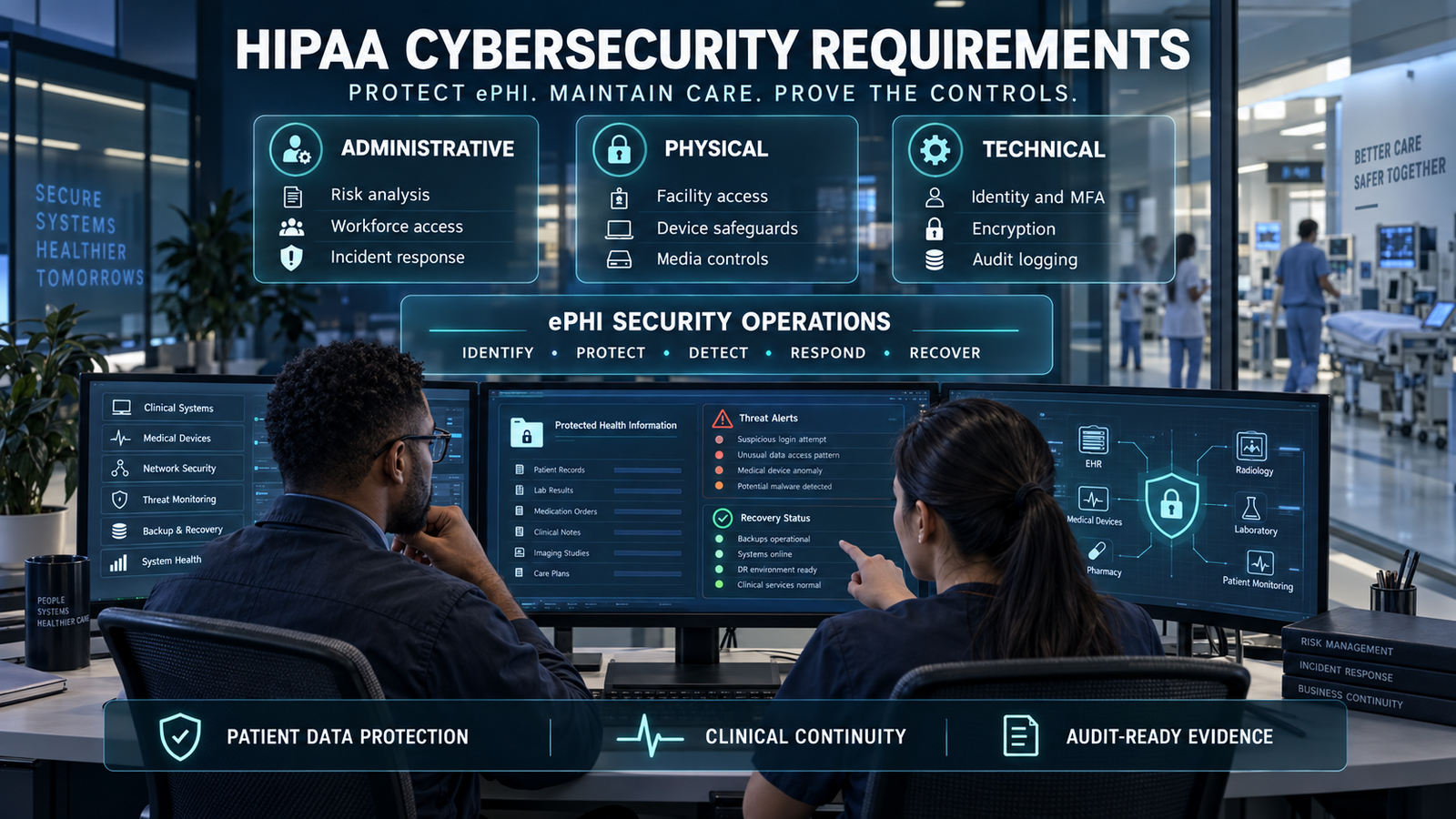
That friction is why a checklist is insufficient. HIPAA cybersecurity requirements call for covered entities and business associates to protect the confidentiality, integrity and availability of ePHI through reasonable and appropriate administrative, physical and technical safeguards.[1]
The Cost of Inaction Is Operational
A ransomware event is not only a privacy incident. It can remove access to medication histories, diagnostic images, scheduling, identity services and interfaces required for safe care.
HHS reported that large breaches attributed to hacking or IT incidents increased 89% from 2019 through 2023. The same OCR guidance cites a cross-industry finding that 68% of breaches involved a human element, which supports layered controls rather than the misleading claim that every incident is an employee’s fault.[4]
The cost of inaction therefore includes downtime, diversion procedures, manual documentation, claims delays, forensic services, legal review, notification, identity protection, remediation and lost clinical capacity. A defensible ROI model for HIPAA cybersecurity requirements measures avoided disruption and recovery capability, not an imaginary promise that a tool will eliminate breaches.
A 2023 cohort study examined 19,857 visits at two unaffected emergency departments near four hospitals experiencing a month-long ransomware attack. During the attack period, the neighboring departments recorded an associated 15.1% increase in daily patient volume, 47.6% longer median waiting-room time and a 127.8% increase in visits where patients left without being seen; the observational design establishes association, not causation or a universal forecast.[12]
Current Rule Versus Proposed Rule
As of the currency date above, the operative HIPAA cybersecurity requirements remain risk-based. Several HIPAA cybersecurity requirements, including encryption specifications, are labelled addressable, but addressable does not mean optional; the organization must implement the specification when reasonable and appropriate or document why it is not and implement an equivalent measure when reasonable and appropriate.[5]
The 2025 NPRM proposed more prescriptive HIPAA cybersecurity requirements, including written technology asset inventories and network maps, annual compliance audits, MFA, encryption, vulnerability scanning, penetration testing, network segmentation and more detailed recovery planning. Those are prudent roadmap items, but proposed HIPAA cybersecurity requirements do not create a present legal deadline.[6]
| Control area | Current Security Rule posture | 2025 NPRM direction | Executive treatment now |
| Risk analysis | Required and organization-wide | More explicit scope and documentation | Complete now; maintain continuously |
| Encryption | Addressable under the current rule | Generally required with limited exceptions | Implement broadly or document a defensible alternative |
| MFA | Strong authentication selected through risk analysis | Generally required with limited exceptions | Prioritize remote, privileged, email and ePHI access |
| Asset inventory and network map | Practical evidence needed to scope risk | Express written requirements | Build and reconcile now |
| Vulnerability scanning and penetration testing | Selected through risk management | Defined recurring frequencies proposed | Establish risk-based cadence now |
| Annual compliance audit | Not stated as a universal annual audit mandate | Annual verification proposed | Run evidence-based internal reviews |
A Useful Compliance Boundary
HIPAA cybersecurity requirements apply to ePHI handled by covered entities and business associates, not every data element or every company that touches health information. Correctly scoping HIPAA cybersecurity requirements prevents consumer health applications outside HIPAA from being confused with entities that may instead face the FTC Health Breach Notification Rule and state privacy laws.
The EU AI Act is not a substitute for HIPAA and is not a default U.S. healthcare security standard. It becomes relevant only when an organization’s AI activities fall within its territorial and product scope, so it should appear in a multinational AI governance register rather than being forced into every HIPAA control map.
II. Deep-Dive Technical Analysis and Evidence
Architecture Overview: Start With ePHI Flows
A useful architecture for HIPAA cybersecurity requirements does not draw a box labelled “HIPAA compliant cloud.” It records where ePHI enters, which identities and workloads process it, where copies persist, which vendors receive it and how the organization restores clinical service.
The HIPAA risk assessment must cover all ePHI that the organization creates, receives, maintains or transmits. HHS specifically says the entity must identify and document where ePHI is stored, received, maintained or transmitted, including external sources such as vendors and consultants.[5]

The minimum architecture register should connect these objects:
- Business process and clinical owner.
- Application, database, interface and endpoint.
- ePHI category and minimum-necessary access purpose.
- Workforce, service and privileged identities.
- Network zone, cloud account and data-transfer route.
- Vendor, subcontractor, BAA and exit dependency.
- Logging source, detection owner and retention period.
- Backup copy, recovery dependency and tested recovery objective.
An asset inventory without data relationships misses shadow repositories. For HIPAA cybersecurity requirements, a data-flow map without accountable owners becomes a diagram that no one updates.
Integration Flowchart
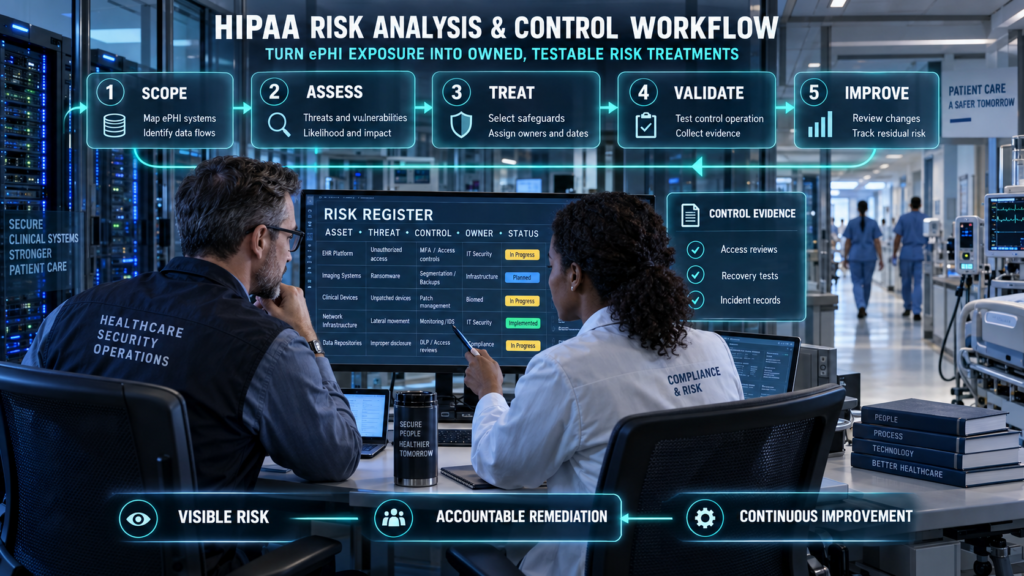
- Identify workflows: Record the clinical and business processes that handle ePHI.
- Map information flows: Identify systems, interfaces, vendors, storage locations and backup copies.
- Assess risks: Evaluate threats, vulnerabilities, existing safeguards, likelihood and potential impact.
- Plan treatment: Assign risk owners, corrective actions, priorities and review dates.
- Implement safeguards: Configure appropriate identity, endpoint, network, data and operational controls.
- Test and collect evidence: Verify access restrictions, logging, incident response and recovery procedures.
- Review and update: Reassess the inventory and risk decisions after material changes or incidents.
Each safeguard should connect to a documented risk, an accountable owner, an operating procedure and evidence of effectiveness. Review the assessment when systems, vendors, workflows or threats materially change.
Risk Analysis Must Be More Than a Scan
A vulnerability scan identifies certain technical weaknesses at a point in time. It does not establish the complete scope, likelihood, impact, existing controls or residual risk demanded by HIPAA cybersecurity requirements and a HIPAA risk assessment.
HHS calls risk analysis foundational and requires an accurate and thorough assessment of potential risks and vulnerabilities to the confidentiality, integrity and availability of ePHI. The agency does not prescribe one methodology or universal frequency, but it expects an ongoing process that responds to technology and business changes.[5]
For each threat-vulnerability pair, record the affected workflow, likelihood basis, clinical and privacy impact, current safeguard, evidence source, residual risk, treatment owner and due date. Under HIPAA cybersecurity requirements, “accepted” risks need an accountable decision-maker and an expiration or review trigger.
Identity Is the Primary Control Plane
The most expensive endpoint platform cannot compensate for shared clinical credentials or a terminated contractor account that remains active. Identity-focused HIPAA cybersecurity requirements should establish unique users, role-based permissions, privileged separation, rapid deprovisioning and emergency-access procedures.
MFA is not explicitly named as a universal requirement in the current Security Rule. It is nevertheless a strong response to credential risk, and OCR’s authentication guidance directs regulated entities to select reasonable and appropriate authentication controls based on risk.[7]
Deploy phishing-resistant MFA first for administrators, remote access, email, cloud consoles and systems containing large ePHI stores. This risk-based sequencing supports HIPAA cybersecurity requirements while higher-risk use cases move beyond SMS toward FIDO2 security keys or passkeys.
Encryption Is Powerful, Not Magical
Encryption at rest and in transit reduces disclosure risk, but poor key management can collapse that protection. Keys stored beside encrypted data, broadly shared service accounts, exposed recovery keys and unmonitored decrypt operations are architecture failures.
HHS breach guidance says properly encrypted ePHI can be rendered unusable, unreadable or indecipherable when the confidential key or process has not also been compromised. That can remove federal breach-notification duties for the secured data, but it does not transform the entire incident into a “non-event.”[8]
Organizations must still investigate scope, operational impact, credential exposure, integrity loss and obligations under HIPAA cybersecurity requirements, contracts or other laws. The precise claim is “potential breach-notification safe harbor for qualifying encrypted data,” not blanket immunity.
Endpoint Detection Needs Isolation Authority
Legacy antivirus remains useful for known malicious artifacts, but healthcare cybersecurity solutions should also detect suspicious behavior, collect telemetry and support rapid containment. EDR coverage must include workstations, servers and supported clinical endpoints without disrupting care.
Medical devices that cannot accept an agent need compensating controls such as network segmentation, passive discovery, allow-listing, restricted management paths and vendor-supported monitoring. HIPAA cybersecurity requirements should connect every exception to a device owner, clinical risk, compensating safeguard and retirement plan.
Network Segmentation Must Follow Clinical Dependency
Segmentation is not successful because a firewall exists between VLANs. It succeeds when unauthorized paths are denied, permitted flows are documented and emergency clinical dependencies still operate during containment.
Separate user workstations, biomedical devices, guest networks, administrative systems, privileged management, backups and internet-facing services. Validation against compromised credentials and lateral movement turns segmentation into evidence for HIPAA cybersecurity requirements.
Logging Must Produce Investigative Evidence
HIPAA cybersecurity requirements include mechanisms to record and examine activity in information systems that contain or use ePHI. Logs are commercially valuable only if they are complete enough to reconstruct identity, access, administrative changes, data movement and security decisions.
Centralize identity-provider, EHR, operating-system, cloud-control-plane, email, VPN, firewall, endpoint and backup events. These HIPAA cybersecurity requirements need synchronized time, protected log integrity, restricted deletion and alerts mapped to an on-call response procedure.
Retention should follow regulatory, litigation, contractual and investigative needs rather than an arbitrary vendor default. Excessive retention also creates cost and privacy exposure, so the decision belongs in the risk and records-management process.
Backups Are a Recovery System
A backup job showing “success” does not prove recoverability. Ransomware can encrypt connected repositories, steal backup credentials or corrupt data long before an incident is detected.
Use isolated or immutable copies, separate administrative identities, monitored deletion controls and restoration tests. Recovery evidence supports HIPAA cybersecurity requirements only when tests restore representative applications and interfaces, validate integrity and measure clinically meaningful objectives.
Deployment Challenges and Edge Cases
Unsupported Clinical Technology
If a vendor no longer patches a system, HIPAA cybersecurity requirements still demand a reasonable response. The risk record should include segmentation, application allow-listing, hardened jump access, monitoring, backup validation and a funded replacement date.
Emergency Access
Emergency access must support urgent care while preserving accountability. Define an authorized break-glass procedure with appropriate authentication, access limits, logging and post-event review. Test it with clinical staff so routine safeguards do not prevent necessary emergency access.
Cloud Shared Responsibility
A cloud provider’s BAA or certification does not configure customer identities, storage permissions, logging or retention. HIPAA cybersecurity requirements remain with the healthcare organization’s workloads and require verification of exactly which services fall within the provider’s eligible HIPAA scope.
Exploited Edge Devices
Internet-facing appliances can bypass endpoint controls. The Citrix NetScaler vulnerability CVE-2023-4966, commonly called CitrixBleed, became a known-exploited weakness and illustrates why inventories must include firmware, externally exposed services, session invalidation and credential rotation—not just Windows patching.
Performance Evaluation Matrix
The matrix below avoids invented “compliance scores.” It defines tests that a buyer can reproduce during a proof of concept.
| Capability | Test method | Pass evidence | Failure signal | Business metric |
| Identity control | Attempt privileged and remote access without approved MFA | Denial event plus attributable alert | Password-only exception with no owner | Protected high-risk accounts |
| ePHI discovery | Reconcile EHR interfaces, cloud stores and vendor transfers | Owned flow map with documented gaps | Unknown repositories or orphaned accounts | Percentage of scoped flows owned |
| Endpoint containment | Run an authorized benign isolation exercise | Endpoint isolated within target time | Clinical network disruption or no isolation | Median containment time |
| Recovery | Restore a representative clinical service from protected backup | Integrity validation and timed runbook | Backup exists but application fails | Recovery time and recovery point achieved |
| Logging | Trace a test user from authentication to record access | Correlated identity and application evidence | Missing timestamps or shared account | Investigations completed with sufficient evidence |
| Vendor oversight | Sample critical business associates | BAA, service scope, control evidence and incident contacts | Contract-only assurance | Critical vendors reviewed on schedule |
No single product establishes compliance. Evaluate whether the organization’s people, procedures and configured technology collectively protect ePHI, and retain evidence showing that the safeguards operate as intended.
III. Commercial Solutions and Best Practices
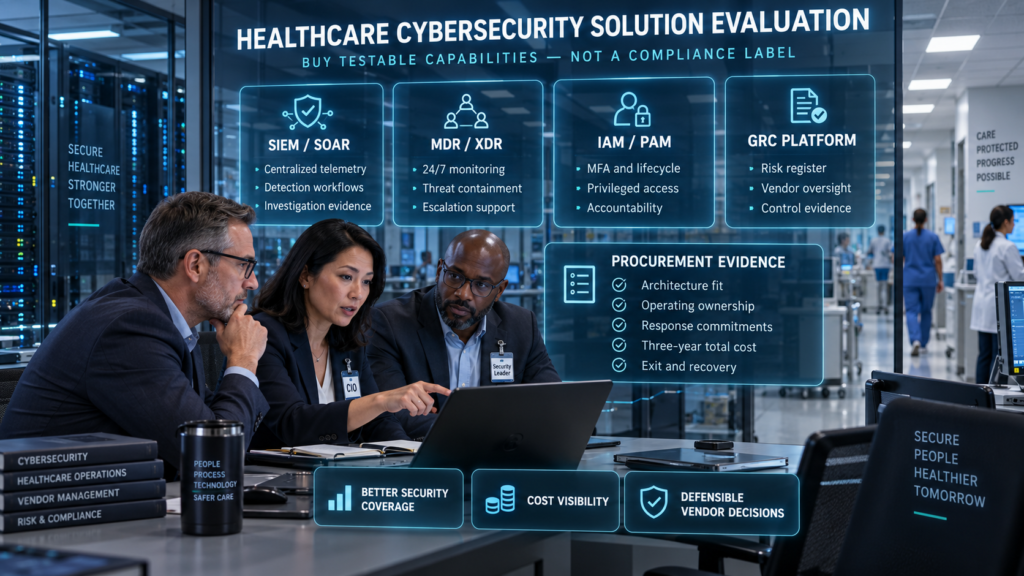
Buy Capabilities, Not a Compliance Label
“HIPAA compliant” is often used as a marketing shortcut for software. HHS does not certify commercial products as HIPAA compliant, and a vendor’s BAA does not make the customer’s deployment compliant by default.
Procurement should translate HIPAA cybersecurity requirements and each identified risk into a testable capability. The contract should then define eligible services, data location, subcontractors, notification duties, log access, deletion, portability, support response and termination assistance.
Feature and Cost Comparison Table
Pricing is usually quote-based and depends on users, endpoints, data ingestion, retention, response scope and implementation. Buyers should compare a normalized three-year total cost rather than an attractive entry price.
| Market solution | Primary value | Key HIPAA evidence | Hidden cost driver | Best fit |
| SIEM/SOAR platform | Central detection, correlation and response orchestration | Log coverage, alert disposition, access records and retention controls | Data ingestion, long retention and engineering time | Organizations with a staffed security function or MSSP |
| MDR/XDR service | 24/7 monitoring, triage and containment support | Case records, response timelines, endpoint coverage and escalation logs | Endpoint count, server tiers, response exclusions and onboarding | Lean teams needing managed detection and response |
| IAM/PAM platform | MFA, lifecycle management and privileged controls | Access approvals, authentication events, deprovisioning and privileged sessions | Integrations, premium MFA, service accounts and administration | Multi-site providers and cloud-heavy environments |
| GRC/HIPAA compliance software | Risk, policy, vendor and evidence workflow | Risk register, control owners, review history and remediation status | Consulting, content maintenance and workflow configuration | Organizations replacing spreadsheets and scattered evidence |
Healthcare cybersecurity solutions often fail commercially when the buyer licenses overlapping products but leaves ownership unfunded. HIPAA cybersecurity requirements cannot be met by a SIEM without tuning, PAM without service-account migration or GRC software without evidence owners.
Eight-Gate Procurement Framework
Gate 1: Scope the Data
List the exact ePHI processed, service components used, geographic storage, backup locations and subcontractors. Reject contracts that treat “the platform” as a single undifferentiated service.
Gate 2: Map the Legal Roles
Confirm whether the provider is a business associate, subcontractor or another party, and execute the required BAA before ePHI is handled. These HIPAA cybersecurity requirements include permitted uses, safeguards, breach reporting, subcontractor obligations and return or destruction terms.[10]
Gate 3: Test the Architecture
Review identity federation, administrative roles, encryption, key ownership, API exposure, network paths, logging and recovery. HIPAA cybersecurity requirements demand understanding of the configured service, not blind reliance on a certification report.
Gate 4: Validate Operations
Ask who monitors alerts, who can isolate assets, how clinical leaders are contacted and what happens after hours. Managed security services for healthcare should map HIPAA cybersecurity requirements to named escalation paths and measurable response commitments.
Gate 5: Examine Evidence
Request current independent assurance reports where appropriate, penetration-test summaries, vulnerability-management procedures, incident history representations and remediation status. Evidence must match the service and region being purchased.
Gate 6: Price the Entire Control
Include implementation, integration, telemetry, retention, training, tuning, testing, incident support and exit costs. HIPAA cybersecurity requirements make HIPAA compliance software licenses only one line in the operating model.
Gate 7: Negotiate Failure Terms
Define security-event notification, forensic cooperation, log preservation, subcontractor responsibility, cyber-insurance expectations and liability allocation. HIPAA cybersecurity requirements should be aligned across the BAA and master services agreement so conflicting terms do not create response delays.
Gate 8: Prove Exit and Recovery
Test data export, credential revocation, secure deletion and business continuity before dependence becomes irreversible. A vendor exit plan is a security control and a commercial leverage point.
Vendor Questions That Expose Weakness
- Which exact service components are covered by your BAA?
- Can our team export identity, administrative and data-access logs without opening a support ticket?
- How quickly will you notify us of a security incident involving our ePHI, and when does the clock start?
- Which subcontractors can access or maintain our ePHI?
- Who controls encryption keys, rotations and emergency recovery?
- How are terminated workforce and service accounts removed?
- What evidence demonstrates restoration of the service and customer data?
- What happens to backups and derived data after contract termination?
IV. Business Outcomes and Strategic ROI Takeaways
Build the Business Case Around Care Delivery
The strongest case for HIPAA cybersecurity requirements is continuity of care. Each investment in HIPAA cybersecurity requirements should link to a clinical or revenue workflow such as medication administration, image retrieval, patient scheduling, claims submission or remote access.
For each workflow, quantify downtime tolerance, manual operating capacity, daily transaction volume, recovery dependency and regulatory exposure. This produces a decision model that finance and clinical leadership can challenge.
Use a Transparent ROI Model
Annualized loss expectancy can support prioritization when assumptions are visible: estimated incident frequency multiplied by plausible impact. It should not be presented as actuarial certainty.
Compare control cost with expected loss reduction, operational efficiency and evidence value. Include recurring compute, telemetry and managed-service charges because cloud security costs can grow sharply with data volume and retention.
The practical formula is:
Estimated annual net risk-reduction value = expected annual loss before the control − expected annual loss after the control − annual control cost.
Use the same time period and loss categories throughout. Allocate implementation costs explicitly, and avoid counting the same downtime or recovery benefit twice. These estimates support prioritization; they do not guarantee avoided losses or replace required safeguards.
Use scenario ranges instead of one impressive number. Document which assumptions came from internal incident data, insurer input, vendor tests or public reports.
Measure Outcomes That Executives Can Govern
- Percentage of known ePHI systems with an accountable owner.
- Percentage of privileged and remote accounts protected by strong MFA.
- Time to disable a terminated user across critical systems.
- Critical vulnerabilities past their approved remediation date.
- Percentage of critical services restored successfully in the latest test.
- Time from high-confidence detection to containment decision.
- Percentage of critical business associates with current review evidence.
- Percentage of risk treatments completed by the committed date.
These measures show whether HIPAA cybersecurity requirements operate in practice. Executives should fund HIPAA cybersecurity requirements based on risk reduction rather than counts of policies or training completions.
Strategic ROI Takeaways
First, fund identity, inventory and recovery before purchasing exotic controls. These foundations make HIPAA cybersecurity requirements observable across nearly every breach scenario and multiple regulatory obligations.
Second, treat compliance documentation as operational telemetry. A live risk register, access-review record and tested recovery report are more valuable than a policy binder assembled before an audit.
Third, assign business ownership for HIPAA cybersecurity requirements. Security teams can implement safeguards, but clinical and operational leaders must decide downtime tolerance, emergency access, device replacement and residual risk.
V. Risk Mitigation and Regulatory Framework
Current Security Rule Implementation Checklist
Use this checklist of HIPAA cybersecurity requirements as a governance index, not a substitute for legal analysis:
- Identify every environment that creates, receives, maintains or transmits ePHI.
- Complete and document an accurate and thorough enterprise HIPAA risk assessment.
- Maintain a risk-management plan with owners, priorities, due dates and residual-risk decisions.
- Designate security responsibility and maintain approved policies and procedures.
- Apply workforce authorization, supervision, termination and sanction procedures.
- Operate security awareness and training with periodic security reminders.
- Maintain incident procedures and evidence-preservation workflows.
- Operate contingency plans, data backup, disaster recovery and emergency-mode procedures.
- Control facility and device access, workstation use, media reuse and disposal.
- Use unique identification, access controls, audit controls, integrity safeguards and transmission protection.
- Execute and govern BAAs with business associates and applicable subcontractors.
- Retain required documentation and update it when environmental or operational changes demand it.
- Assess breach-notification duties promptly after suspected impermissible use or disclosure.
NIST and HHS Crosswalk Checklist
NIST SP 800-66 Revision 2 maps HIPAA cybersecurity requirements to NIST cybersecurity resources but does not replace the regulation or provide a certification. It is especially useful for translating HIPAA cybersecurity requirements into control questions and evidence requests.[2]
- Govern: accountable security leadership, policies, risk appetite, vendor governance and improvement plan.
- Identify: ePHI inventory, asset relationships, threats, vulnerabilities and business impact.
- Protect: identity, least privilege, encryption, endpoint hardening, training and secure configuration.
- Detect: centralized logging, monitored alerts, anomaly detection and validated coverage.
- Respond: clinical escalation, containment authority, communications, forensics and notification analysis.
- Recover: isolated backups, prioritized restoration, integrity testing and after-action improvement.
HHS Healthcare and Public Health Cybersecurity Performance Goals are voluntary high-impact practices, not new HIPAA regulations. They are useful for sequencing safeguards such as email security, MFA, vulnerability management, incident planning and network segmentation.[3]
Proposed-Rule Readiness Checklist
The following items are forward-looking readiness targets drawn from the 2025 NPRM. Label them “proposed-rule readiness” in governance reports until HHS finalizes, changes or withdraws them.[6]
- Written technology asset inventory and network map reviewed after material change.
- Strong MFA across relevant access paths, with documented exceptions.
- Encryption of ePHI at rest and in transit, with controlled exceptions and key governance.
- Recurring vulnerability scanning and independent penetration testing.
- Network segmentation designed and tested against lateral movement.
- Written incident-response and contingency procedures tested on a defined schedule.
- Recovery analysis tied to criticality and restoration targets.
- Annual compliance verification with accountable executive sign-off.
Failure Vectors the Board Should See
Residual risk should not disappear inside a technical dashboard. Report unsupported clinical systems, missing ePHI flows, stale privileged accounts, untested recovery, vendor notification gaps and overdue high-risk findings in plain business language.
Also report control side effects. Aggressive EDR can disrupt clinical software, segmentation can block interfaces, MFA can slow emergency workflows, long log retention raises cost and privacy risk, and encryption can create availability failures if keys are lost.
Transparent reporting is not an argument against the control. It is how leadership funds safe deployment, exception handling and rollback.
Prioritizing the Next Security Improvements
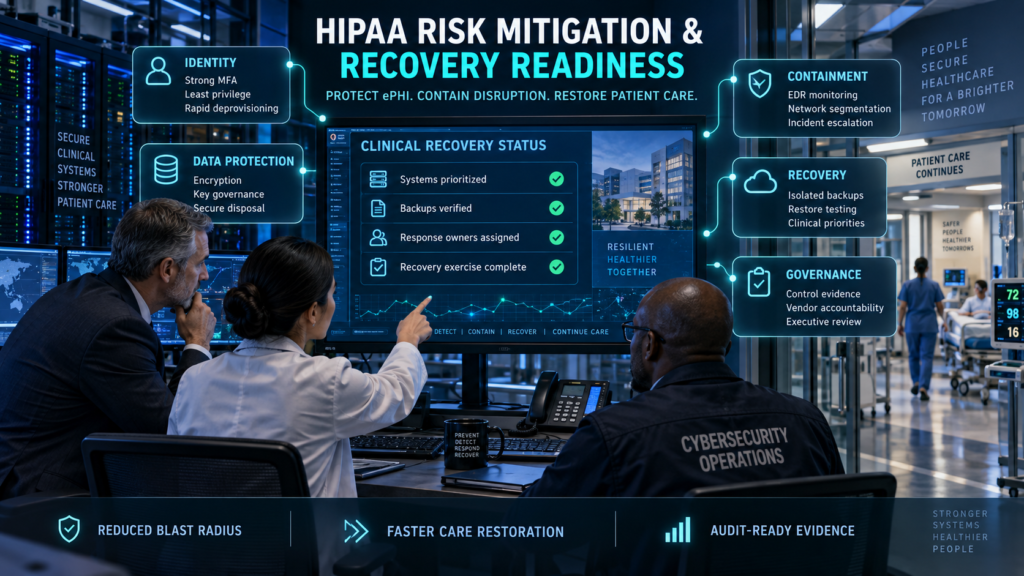
Start with a verified ePHI flow map, a current risk analysis and a representative recovery test. Use the findings to identify gaps that could expose patient information or interrupt essential clinical services.
Assign each priority an owner, budget, target date and verification method. Purchase additional tools or services when they address a documented gap, and define who will operate, test and maintain the safeguard after implementation.
VI. Appendix and Research Integrity
Appendix A: Academic and Primary-Source Footnotes
- U.S. Department of Health and Human Services, Office for Civil Rights, The Security Rule. HHS’s history page lists the January 6, 2025 cybersecurity update as a proposed rule as of this publication’s currency date.
- National Institute of Standards and Technology, SP 800-66 Rev. 2: Implementing the HIPAA Security Rule—A Cybersecurity Resource Guide, February 2024.
- U.S. Department of Health and Human Services, HHS Cyber Gateway: Healthcare and Public Health Cybersecurity Performance Goals. HHS describes the sector CPGs as voluntary, high-impact practices.
- HHS Office for Civil Rights, October 2024 OCR Cybersecurity Newsletter: Social Engineering. OCR reports an 89% increase in large hacking/IT breaches from 2019 to 2023 and cites a 68% human-element figure from the Verizon DBIR.
- HHS Office for Civil Rights, Guidance on Risk Analysis. See also 45 CFR §§ 164.306 and 164.308.
- U.S. Department of Health and Human Services, HIPAA Security Rule to Strengthen the Cybersecurity of Electronic Protected Health Information, 90 FR 898, January 6, 2025. This is a Notice of Proposed Rulemaking, not the operative final rule.
- HHS Office for Civil Rights, June 2023 OCR Cybersecurity Newsletter: HIPAA and Cybersecurity Authentication.
- HHS Office for Civil Rights, Guidance to Render Unsecured PHI Unusable, Unreadable, or Indecipherable. The protection depends on qualifying encryption and on the decryption key or process not being compromised.
- Cybersecurity and Infrastructure Security Agency, Known Exploited Vulnerabilities Catalog. Search for CVE-2023-4966 and apply current vendor guidance to affected NetScaler ADC and Gateway assets.
- HHS Office for Civil Rights, Business Associate Contracts.
- HHS Office for Civil Rights, Submitting Notice of a Breach to the Secretary, reviewed February 13, 2026. Breaches affecting 500 or more individuals must be reported without unreasonable delay and no later than 60 calendar days after discovery; smaller breaches are reportable within 60 days after the end of the calendar year.
- Dameff C, Tully J, Chan TC, et al., “Ransomware Attack Associated With Disruptions at Adjacent Emergency Departments in the US”, JAMA Network Open, 2023;6(5), doi:10.1001/jamanetworkopen.2023.12270. The authors report associations and identify limits to generalizability and causal inference.
Evidence Interpretation and Limitations
The JAMA Network Open cohort study in footnote 12 supplies the article’s peer-reviewed operational benchmark. Its findings support regional incident planning, but the paper’s observational design and local setting mean the percentages should not be projected as universal breach outcomes.
NIST SP 800-66 Revision 2 in footnote 2 is the principal technical crosswalk used here. No IEEE paper was used to establish a legal duty because the controlling authorities for HIPAA cybersecurity requirements are statutes, regulations and HHS interpretations; engineering literature can inform control design but cannot create a HIPAA mandate.
Corporate Editorial Transparency and AI Usage Disclosure
AI-assisted tools were used to support research organization, drafting and language refinement. NezzHub retains editorial responsibility for the published article. Vendor inclusion does not constitute endorsement.
Author and Editorial Review
Author: Garikapati Bullivenkaiah
Technology research writer with LL.B., LL.M., M.A., and MBA qualifications. He writes about emerging technologies and their business, governance and legal implications. His multidisciplinary academic background informs his analysis of technology adoption, intellectual property, and organizational risk. His articles explain technical concepts and practical considerations for business owners, IT managers and technology decision-makers. LinkedIn Profile
Reviewed by: Chitikineni Ramadevi — Editor
Chitikineni Ramadevi holds an M.Sc. in Computers from Andhra University and has over 10 years of research experience in technology-related subjects. She reviews NezzHub articles for clarity, factual accuracy, source support and practical relevance.
Published by: NezzHub
Research approach: This article draws on primary sources, technical documentation and relevant industry research. References are provided within the article or its sources section.
Last reviewed: 09-18-2026
Corrections: To report a factual error or outdated information, please contact NezzHub.
Frequently Asked Questions
Are MFA and encryption mandatory under HIPAA today?
The current rule does not state a universal MFA mandate, while encryption specifications are addressable rather than automatically optional. Each organization must use its risk analysis to implement reasonable and appropriate safeguards and document alternatives where an addressable specification is not reasonable and appropriate.
Does a BAA make a software platform HIPAA compliant?
No. A BAA establishes contractual duties, but the customer must still configure access, logging, retention, encryption, incident handling and other safeguards correctly.
How often must a HIPAA risk assessment be performed?
The current Security Rule does not prescribe a universal annual frequency. HHS describes risk analysis as ongoing and expects updates when technology, operations, ownership, staffing, incidents or threats materially change.
Does encryption eliminate every breach-notification duty?
No. Qualifying encryption may render ePHI secured for the federal HIPAA Breach Notification Rule if the key or confidential process was not compromised, but the organization must still investigate and evaluate other applicable duties.
Can NIST certification prove HIPAA compliance?
NIST SP 800-66 provides a resource guide and control mappings; it does not certify that an organization complies with HIPAA. Compliance depends on the entity’s documented risk analysis, safeguards, operations and evidence.

Garikapati Bullivenkaiah is a seasoned entrepreneur with a rich multidisciplinary academic foundation—including LL.B., LL.M., M.A., and M.B.A. degrees—that uniquely blend legal insight, managerial acumen, and sociocultural understanding. Driven by vision and integrity, he leads his own enterprise with a strategic mindset informed by rigorous legal training and advanced business education. His strong analytical skills, honed through legal and management disciplines, empower him to navigate complex challenges, mitigate risks, and foster growth in diverse sectors. Committed to delivering value, Garikapati’s entrepreneurial journey is characterized by innovative approaches, ethical leadership, and the ability to convert cross-domain knowledge into practical, client-focused solutions.