

















Executive Summary
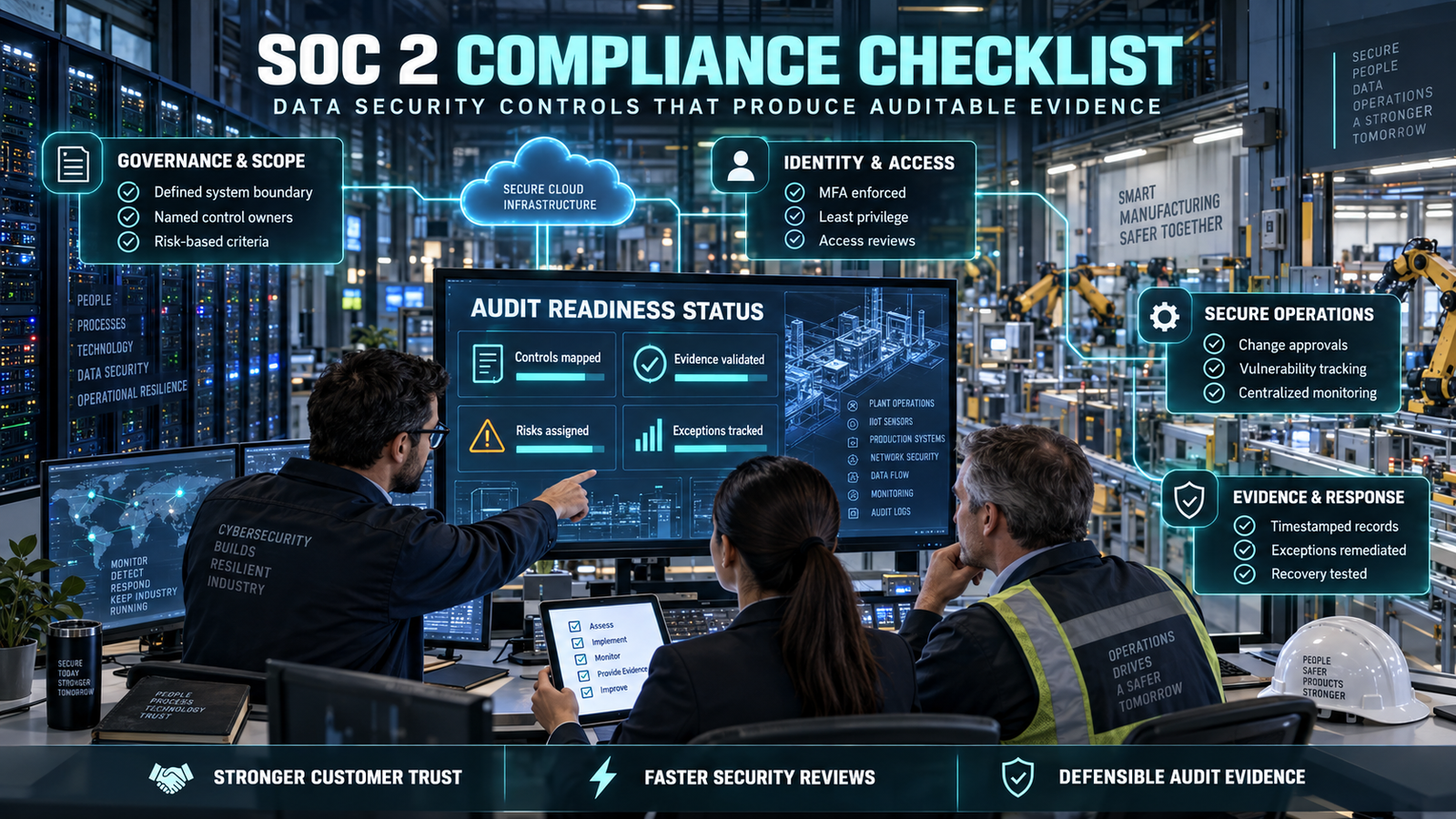
A SOC 2 compliance checklist should do more than produce policy files and green dashboard icons. It must connect the service organization’s commitments, system boundaries, risks, controls, evidence and exceptions into a record that an independent CPA can test.
SOC 2 compliance is not a government license, a product certification or a guarantee that no breach will occur. It is an AICPA-defined attestation reporting service through which a CPA reports on controls relevant to security, availability, processing integrity, confidentiality or privacy.[1][2]
The commercial problem is straightforward. Enterprise buyers need defensible assurance, while engineering teams cannot afford a parallel SOC 2 compliance system that collapses after the examination period.
The right SOC 2 compliance response is a control operating model. Scope the actual service, make control ownership explicit, generate evidence from authoritative systems and treat exceptions as managed risk rather than cosmetic dashboard failures.
This Article supplies that model. It includes an architecture overview, integration flow, deployment challenges, control matrix, performance evaluation matrix, platform comparison, ROI method, governance framework and a populated primary-source appendix.
Important terminology: Organizations commonly say “SOC 2 certified” or “SOC 2 compliant.” More precisely, a qualified CPA firm performs a SOC 2 examination and issues a report; management remains responsible for its system description, assertions and controls.[1]
I. The Current Market Landscape and Challenge
SOC 2 Compliance Turns Enterprise Trust Into an Evidence Problem
A buyer’s security questionnaire rarely asks whether a vendor values security. It asks who approved production access, whether terminated accounts were disabled on time, how critical vulnerabilities were handled and when recovery was last tested.
That difference matters to SOC 2 compliance. Intent lives in policy; assurance depends on evidence showing that a control was suitably designed and, for a Type 2 engagement, operated through the specified period.
The SOC 2 compliance checklist therefore begins with claims the company makes to customers. Availability promises, encryption commitments, retention terms, incident-notification clauses and privacy statements can all change the control population.
Teams create audit debt when marketing language outruns operations. A “24/7 monitoring” claim needs monitored telemetry, alert routing, on-call coverage, investigation records and retained evidence—not a purchased security tool.
The Cost of SOC 2 Compliance Inaction
The immediate cost is usually procurement friction. Deals stall while security, legal and engineering teams answer duplicate questions and assemble one-off screenshots.
The deeper SOC 2 compliance cost is operational uncertainty. Unknown assets, orphaned accounts, untested backups and undocumented emergency changes create risk whether an examination is planned or not.
A weak SOC 2 compliance checklist can make that uncertainty worse. It may reward document volume while ignoring whether controls cover the production environment and operate at the promised frequency.
The defensible business case is not “a SOC 2 report prevents incidents.” It is that disciplined scoping, ownership, testing and remediation reduce avoidable uncertainty and give customers a standardized assurance artifact.[1]
SOC 2 Compliance Is Voluntary, but Commitments Still Matter
SOC 2 compliance is not a U.S. cybersecurity statute of general application. A company may still face contractual duties, state breach-notification laws, sector rules, privacy obligations or Federal Trade Commission scrutiny independent of its SOC 2 report.
The FTC’s business guidance emphasizes collecting only needed data, restricting access, using secure authentication, protecting data in transit and at rest, segmenting networks and disposing of data securely.[7] Those practices can support controls, but FTC guidance and SOC 2 serve different purposes.
Likewise, NIST Cybersecurity Framework 2.0 is a voluntary risk-management framework organized around Govern, Identify, Protect, Detect, Respond and Recover.[3] It can strengthen a control library, but a NIST CSF profile is not a substitute for a SOC 2 examination.
Cybersecurity Compliance Trends Businesses Should Know
SOC 2 Compliance Type 1 and Type 2: The Precise Distinction
A Type 1 report addresses the suitability of control design and implementation as of a specified date. A Type 2 report also addresses operating effectiveness throughout a specified period.
The period is defined for the engagement; it is not universally fixed at three, six or twelve months. Customer expectations and auditor judgment often influence the chosen window, so management should confirm timing with its CPA firm before promising a delivery date.
| Decision point | Type 1 | Type 2 |
| Time basis | Specified date | Specified period |
| Core question | Are controls suitably designed and implemented? | Were controls suitably designed and operating effectively? |
| Evidence pattern | Point-in-time configuration and implementation evidence | Repeated, dated evidence plus samples across the period |
| Commercial use | Early assurance or first examination | Often requested by mature procurement teams |
| Main risk | Controls may not have an operating history | Exceptions can emerge across recurring control events |
A bridge letter is generally a management communication about material changes after a report period. It is not an auditor opinion, does not extend the examination period and should never be represented as a replacement for a current report.
II. Deep-Dive Technical Analysis and Evidence
SOC 2 Compliance Architecture Overview: Build Around the System Boundary
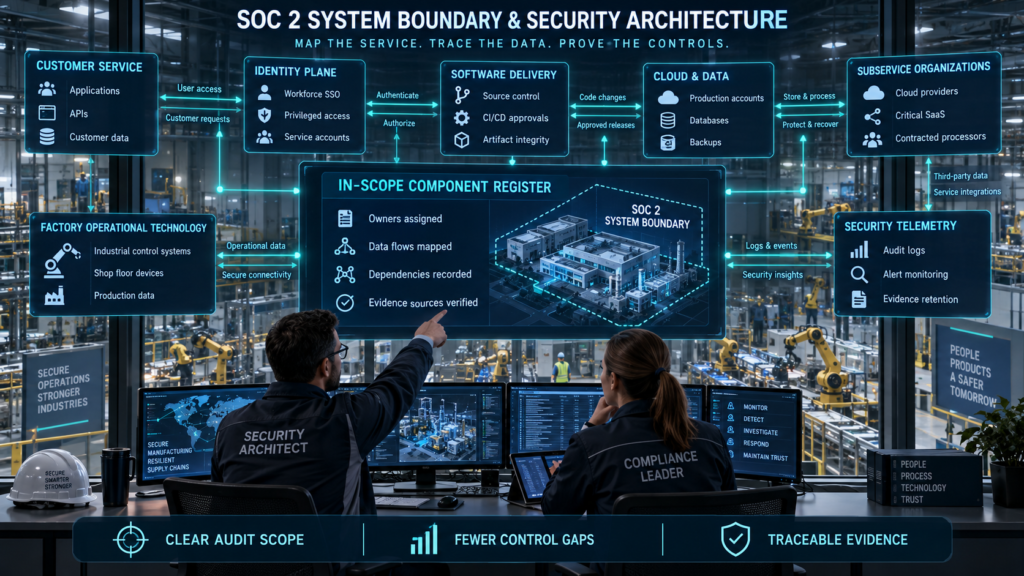
The most consequential line in a SOC 2 compliance checklist is the boundary. A vague boundary produces an incomplete asset inventory, disputed control ownership and unreliable evidence.
Start the SOC 2 compliance boundary with the customer-facing service and trace every component needed to deliver it. Include production cloud accounts, identity providers, source repositories, CI/CD services, observability platforms, support tooling, corporate endpoints and material subservice organizations.
Minimum Architecture Register
- Services and data: customer data classes, secrets, logs, backups, derived datasets and deletion paths.
- Infrastructure: cloud accounts, regions, networks, clusters, databases, object stores, endpoints and administrative planes.
- Identity: workforce identities, service accounts, privileged roles, break-glass accounts and authentication factors.
- Software delivery: repositories, artifact registries, build runners, deployment gates and rollback mechanisms.
- Telemetry: audit logs, security alerts, retention settings, time synchronization and investigation workflow.
- Dependencies: cloud, payroll, support, monitoring, authentication and other subservice organizations.
The system description must match reality. If engineers deploy through infrastructure-as-code but the narrative describes manual approval, evidence and design will conflict.
SOC 2 Compliance Integration Flowchart: From Commitment to Auditor Evidence
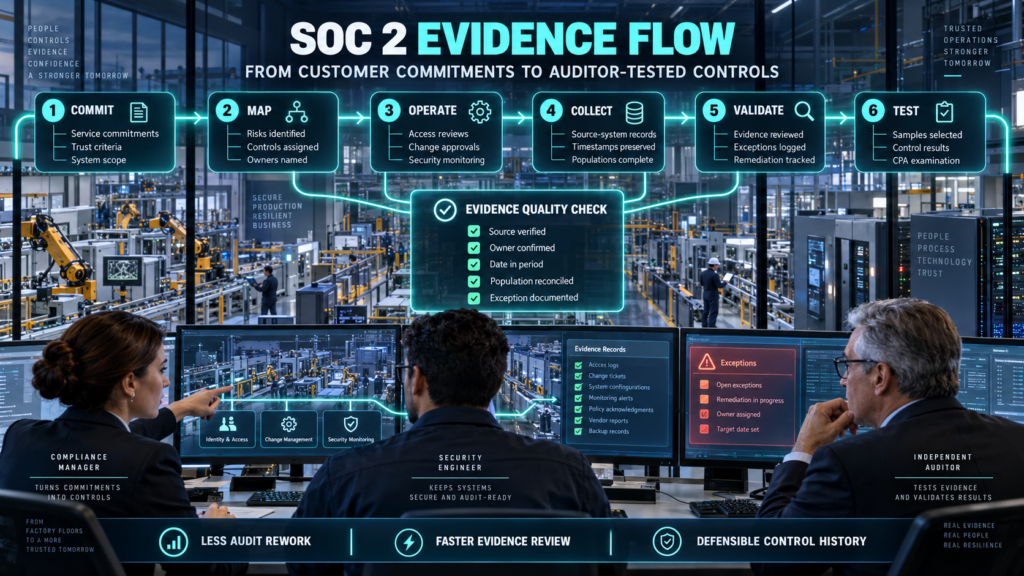
Customer commitments and TSC scope
↓
System boundary and risk register
↓
Control objective → control owner → operating frequency
↓
Authoritative systems generate timestamped evidence
↓
Evidence validation → exception review → remediation
↓
Management assertion → CPA testing → SOC 2 report
The flowchart shows the main stages of evidence preparation and examination. Evidence gaps and control failures require remediation and retesting before readiness can be confirmed. Controls should continue operating after the report is issued, with reassessment when services, risks or commitments change.
Every line in the SOC 2 compliance checklist should answer six questions: what risk is treated, what the control does, who owns it, when it runs, what system proves it and what happens when it fails.
SOC 2 Compliance Criteria Without the “Five Pillars” Shortcut
The AICPA Trust Services Criteria cover security, availability, processing integrity, confidentiality and privacy.[2] Security contains the common criteria; the additional categories are selected when relevant to the service commitments and engagement scope.
Calling them five equal mandatory pillars is misleading. Scope should follow customer commitments, system characteristics and risk—not keyword coverage or a software vendor’s default template.
| Category | Operational question | Typical evidence |
| Security | Are systems and information protected against unauthorized access and related damage? | IAM settings, access reviews, vulnerability records, alerts, incident tests |
| Availability | Are systems available as committed? | SLO reports, capacity review, backup restoration, continuity exercises |
| Processing integrity | Is processing complete, valid, accurate, timely and authorized? | Reconciliations, validation rules, failed-job handling, release tests |
| Confidentiality | Is designated confidential information protected? | Classification, encryption, key controls, retention and disposal evidence |
| Privacy | Is personal information handled against stated privacy commitments and criteria? | Notices, consent records, rights handling, retention, disclosure controls |
SOC 2 Compliance Control Engineering: Design for Repeatability
A control statement such as “access is reviewed periodically” is difficult to test. “The application owner reviews production role assignments quarterly, records approval or removal for every identity and tracks exceptions to closure” is much stronger.
Good SOC 2 compliance control language specifies population, owner, action, frequency, evidence and exception path. It avoids product names unless a specific technology is essential to the control.
The SOC 2 compliance checklist should distinguish preventive, detective and corrective controls. MFA may prevent unauthorized login; anomaly detection may identify misuse; account revocation and incident response may contain harm.
Identity and Access Management for SOC 2 Compliance
Identity evidence often breaks because HR, identity providers, cloud consoles and application roles disagree. The reliable design uses a defined source of truth, automated provisioning where feasible and explicit review of privileged and non-federated accounts.
Checklist controls should cover MFA, least privilege, role approval, joiner-mover-leaver events, service accounts, periodic access recertification and emergency access. NIST SP 800-53 provides a customizable catalog that includes access control, audit, incident response, configuration and system-integrity families.[4]
Do not treat MFA as a universal cure. Recovery channels, session tokens, legacy protocols, service credentials and help-desk reset procedures can bypass the strongest primary login.
SOC 2 Compliance for Change Management and Software Delivery
The audit question is not whether every deployment had a ceremonial ticket. It is whether changes were authorized, tested, traceable, segregated where risk requires it and recoverable when they failed.
Map pull requests, branch protection, build identity, test results, artifacts and deployments into one chain. Emergency changes need an expedited route, a named approver, retrospective review and evidence that the exception did not become routine.
A practical SOC 2 compliance checklist also covers infrastructure changes, database migrations, feature flags, secrets rotation and direct production actions. These paths often sit outside the main application pipeline.
SOC 2 Compliance for Vulnerability, Patch and Configuration Management
A scanner finding is not remediation. Teams need asset ownership, severity logic, exploitability context, remediation targets, exception approval, compensating controls and closure evidence.
CISA’s Known Exploited Vulnerabilities catalog is an authoritative input for prioritizing vulnerabilities known to be exploited in the wild.[6] It should inform urgency, but it does not replace an organization-specific risk assessment.
Avoid promising one patch deadline for every asset. Internet exposure, privilege, reachable data, exploit maturity, operational constraints and compensating controls all affect risk.
SOC 2 Compliance for Logging, Detection and Incident Response
Logs must be useful before they can be evidence. Verify that relevant sources are enabled, timestamps are reliable, access is restricted, retention supports commitments and alert rules reach an accountable responder.
Incident controls should define severity, triage, communication, legal escalation, evidence preservation, containment, recovery and post-incident action. Tabletop exercises need scenarios tied to the actual architecture, not a generic ransomware script.
The SOC 2 compliance checklist should sample the full alert lifecycle. An alert screenshot proves generation; it does not prove investigation, disposition, escalation or resolution.
SOC 2 Compliance for Resilience, Backup and Recovery
Backup success messages prove that a job ran. Recovery evidence requires restoring representative data or systems, checking integrity, recording duration and comparing results with stated recovery objectives.
Immutable or isolated copies can reduce destructive-attack risk, but they introduce storage cost, key-management duties and restore complexity. A recovery design that has never been exercised is an assumption.
Availability criteria apply only when included in scope, yet recovery risk remains commercially important. A security-only report should not be presented as assurance over an availability commitment that was excluded.
SOC 2 Compliance for Vendor and Subservice-Organization Risk
Third-party risk begins with dependency discovery. Security teams routinely miss SaaS tools purchased by departments, embedded APIs, support processors and infrastructure inherited through acquisitions.
For each material provider, record service, data access, criticality, contract owner, assurance reviewed, exceptions found and next review date. Decide whether the SOC 2 system description uses the inclusive or carve-out method for relevant subservice organizations with the CPA firm.
Collecting a vendor’s report is only the first step. Review period coverage, scope, opinion, exceptions, complementary user-entity controls and subservice dependencies before accepting it.
SOC 2 Compliance Performance Evaluation Matrix
The following matrix measures program health; it does not claim that any single score guarantees a favorable opinion.
| Measure | Formula | Useful threshold | Failure signal | Management response |
| Control execution rate | Completed control events ÷ scheduled events | Set by management risk tolerance | Repeated missed events | Fix ownership, cadence or automation |
| Evidence acceptance rate | Accepted items ÷ submitted items | Trend upward before fieldwork | Screenshots lack source, time or population | Define evidence standard and validator |
| Access-removal latency | Time from termination event to revocation | Match policy and risk | Orphaned or delayed accounts | Integrate HRIS, IdP and application paths |
| Critical-remediation aging | Open critical items beyond approved target | Zero unless formally excepted | Unowned or repeatedly extended findings | Escalate, compensate and time-bound exceptions |
| Restore-test success | Successful validated restores ÷ attempted restores | 100% for scheduled tests, with documented retest | Backup exists but restore fails | Repair runbook, dependencies and integrity checks |
| Vendor-review coverage | Reviewed material vendors ÷ identified material vendors | 100% by review due date | Shadow vendors or stale reviews | Improve discovery and procurement gates |
| Exception closure time | Median days from exception to validated closure | Risk-tiered internal target | Exceptions age without owners | Assign executive risk acceptance or remediation |
An effective SOC 2 compliance checklist links each measure to underlying records. A summary percentage without traceable populations can hide excluded assets or manually suppressed failures.
SOC 2 Compliance Deployment Challenges and Edge Cases
Ephemeral Infrastructure
Containers, serverless functions and short-lived build runners may disappear before a manual screenshot is taken. Preserve deployment manifests, configuration-state exports, cloud audit events and policy-evaluation results instead.
Evidence collection should be event-driven where possible. A quarterly screenshot cannot reconstruct every privileged change made during the previous three months.
Multi-Cloud and Acquired Environments
One identity policy rarely covers every inherited tenant and cloud account. Map local accounts, root users, emergency access, logging gaps and region-specific data flows before declaring a global control implemented.
The SOC 2 compliance checklist should permit scoped exceptions with owners and deadlines. Hiding a newly acquired environment creates a description problem; documenting the boundary and remediation creates a governable problem.
AI Systems and Model Providers
AI features add training data, prompts, outputs, embeddings, evaluation datasets and model-provider telemetry to the data map. Teams must determine what leaves the boundary, what providers retain and how unsafe or unauthorized outputs are detected.
The EU AI Act is not a generic SOC 2 requirement. It becomes relevant only where the organization, system and territorial facts trigger it; applicable legal duties should be mapped separately from the attestation criteria.[8]
SOC 2 Compliance Evidence Automation Failure
API collectors can lose authorization, map the wrong account or mark a test green against an incomplete population. Monitor collector health and reconcile source-system inventories to the compliance platform.
Automation reduces repetitive collection; it does not transfer management responsibility to the vendor. Auditor independence and the CPA firm’s professional obligations must also be protected when commercial relationships exist around tooling and examination services.[1]
III. Commercial Solutions and Best Practices
SOC 2 Compliance Feature and Cost Comparison Table
Platform capabilities change frequently. The table reflects public product information reviewed for this paper; buyers should obtain a written scope, data-processing terms, implementation assumptions and current quote before purchase.[9][10][11][12]
| Solution | Publicly emphasized capabilities | Best-fit buying context | Cost visibility | Due-diligence questions |
| Vanta | Framework automation, integrations, continuous monitoring, trust center and vendor risk options | Teams seeking a broad trust-management platform | Quote-based packages on public pricing page | Which integrations and frameworks are included; limits on users, vendors and trust-center functions? |
| Drata | Automated evidence, continuous control monitoring, risk and third-party workflows | Organizations wanting a centralized GRC operating layer | Contact-sales pricing | How are failed tests validated; what implementation and auditor coordination are included? |
| Secureframe | Compliance automation, personnel workflows, vendor management, risk and trust features | Teams prioritizing guided readiness and framework expansion | Packages shown; pricing generally quote-based | Which features sit in higher packages; how are custom controls and multiple entities handled? |
| Sprinto | Continuous control monitoring, evidence collection, risk workflows and framework support | Cloud companies comparing automation-led deployment | Contact-sales pricing | What is native versus partner-delivered; how are integrations, support and additional frameworks priced? |
No platform issues the SOC 2 report. A licensed CPA firm performs the examination, while software can support readiness, collection and monitoring.[1]
SOC 2 Compliance Total Cost Model
Do not compare subscription price alone. Calculate first-year cost as:
Platform subscription + readiness support + CPA examination fee + remediation + engineering time + legal/privacy review + penetration testing + internal control operation.
Then calculate renewal cost separately. Initial policy creation may decline, while recurring evidence, vendor review, access certification, testing, monitoring and examination work remain.
A spreadsheet may be sufficient for a small, stable scope. SOC 2 compliance software becomes more valuable when asset counts, integrations, frameworks, entities and recurring evidence volumes grow.
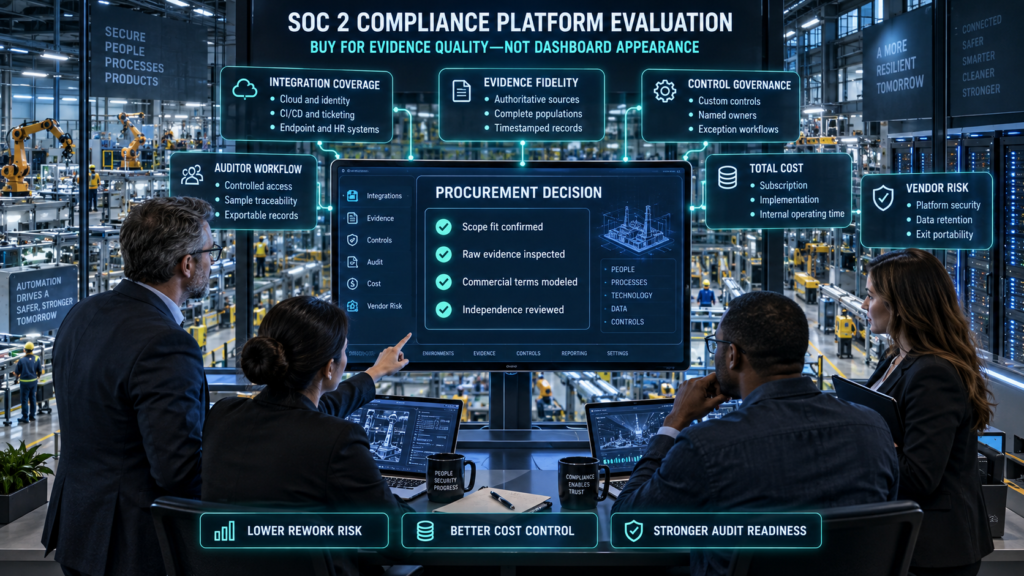
Eight-Gate Procurement Framework
- Scope fit: Confirm cloud accounts, identity systems, repositories, HR systems, tickets and endpoint tooling.
- Evidence fidelity: Inspect the raw record behind a “passing” control and verify population completeness.
- Customization: Test whether controls, frequencies, owners and evidence rules can match actual operations.
- Security: Review the platform’s own access controls, encryption, retention, subprocessors and assurance reports.
- Data portability: Require exportable controls, evidence indexes, risks, policies and exception histories.
- Auditor workflow: Confirm how the CPA firm receives evidence and whether repeated uploads create version confusion.
- Commercial terms: Model implementation fees, add-ons, framework expansion, renewal uplifts and exit costs.
- Independence: Understand commercial relationships among the platform, consultant and CPA firm.
The cheapest tool can be expensive if engineers must repair integrations and repackage evidence. The most feature-rich tool can also waste money when the organization has not assigned control owners.
Ninety-Day SOC 2 Compliance Plan—Without a Ninety-Day Guarantee
Ninety days can structure a readiness sprint, but it cannot guarantee report issuance. Scope complexity, remediation, observation period, CPA availability and evidence quality determine the real schedule.
Days 1–30: Scope and Ownership
- Confirm report users, service commitments and candidate Trust Services Criteria.
- Define system boundary, data flows, components and subservice organizations.
- Build risk register and map risks to controls.
- Assign executive sponsor, program lead and control owners.
- Select the CPA firm early and confirm examination assumptions.
Days 31–60: Remediate and Instrument
- Close material IAM, logging, vulnerability, change and backup gaps.
- Rewrite vague controls with population, frequency, owner and evidence.
- Integrate authoritative systems and validate collector coverage.
- Complete vendor tiering and obtain assurance for material providers.
- Run incident and recovery exercises against realistic scenarios.
Days 61–90: Dry Run and Stabilize
- Execute each recurring control at least once where timing permits.
- Sample evidence for completeness, timestamp, approval and traceability.
- Log exceptions instead of deleting or recreating failed evidence.
- Reconcile policies, customer commitments and actual configurations.
- Review readiness with management and the CPA firm.
This SOC 2 compliance checklist is a readiness framework, not an auditor’s testing plan. The practitioner determines procedures, samples and conclusions under applicable professional standards.
Audit-Ready SOC 2 Compliance Checklist
Governance and Scope
- Name the executive sponsor, program manager and control owners.
- Identify intended report users and procurement requirements.
- Define services, legal entities, locations and infrastructure in scope.
- Document principal service commitments and system requirements.
- Select applicable Trust Services Criteria with written rationale.
- Identify subservice organizations and boundary treatment.
- Approve a risk-assessment method and risk-acceptance authority.
Asset, Data and Configuration Management
- Maintain inventories for cloud, endpoints, applications, repositories and material SaaS.
- Classify customer, confidential, personal and operational data.
- Map collection, processing, storage, transmission, backup and deletion.
- Establish secure configuration baselines and detect drift.
- Record ownership and lifecycle state for in-scope assets.
Identity and Access
- Enforce MFA for workforce and administrative access where supported and risk-appropriate.
- Approve role assignment and privileged escalation.
- Integrate joiner, mover and leaver workflows.
- Review privileged, production and non-federated accounts at defined intervals.
- Inventory service accounts, keys and non-human identities.
- Test emergency-access procedures and review every use.
Secure Development and Change
- Protect branches and require independent review according to risk.
- Retain test, approval, build and deployment records.
- Restrict production deployment rights.
- Track infrastructure, schema, secret and configuration changes.
- Define emergency-change approval and retrospective review.
- Maintain rollback or recovery procedures for material releases.
Vulnerability and Security Operations
- Scan applicable code, dependencies, images, endpoints and infrastructure.
- Prioritize with severity, exposure, exploitability and asset context.
- Track remediation targets, exceptions and compensating controls.
- Reconcile high-risk findings with the CISA KEV catalog where applicable.[6]
- Centralize relevant logs and monitor ingestion health.
- Retain alert investigation, disposition and escalation evidence.
Incident Response and Resilience
- Define incident roles, severity, escalation and communications.
- Exercise scenarios against the actual system architecture.
- Record decisions, evidence preservation and lessons learned.
- Monitor backup jobs and access to backup infrastructure.
- Test representative restorations and validate integrity.
- Compare recovery performance with customer commitments.
Vendor Risk and Privacy
- Discover vendors through procurement, SSO, finance and network data.
- Tier vendors by access, data, criticality and substitutability.
- Review relevant assurance reports, contracts and subprocessors.
- Track complementary user-entity controls and vendor exceptions.
- Align notices, retention, deletion and rights workflows with actual processing.
- Escalate legal or regulatory questions to qualified counsel.
Evidence and Examination Management
- Define acceptable evidence types and naming conventions.
- Preserve source, timestamp, population, reviewer and outcome.
- Restrict evidence-repository access and apply retention rules.
- Record exceptions, root cause, remediation and retest result.
- Reconcile every control with policies and system description.
- Validate the SOC 2 compliance checklist before fieldwork begins.
IV. Business Outcomes and Strategic ROI Takeaways
Calculate SOC 2 Compliance ROI Without Invented Savings
SOC 2 does not produce a universal revenue uplift or fixed sales-cycle reduction. Results depend on customer mix, deal size, prior security maturity and whether prospects actually require the report.
Use a documented model with benefits and costs measured over the same annual period:
Annual gross benefit = realized questionnaire-labor savings + realized evidence-preparation savings + probability-adjusted incremental deal contribution + retired-tool savings.
Annual net benefit = annual gross benefit − annual program cost.
Annual ROI (%) = (annual net benefit ÷ annual program cost) × 100.
Record the source, baseline, assumptions and confidence range for each estimate. Treat time released for other work as capacity value unless it produces an actual financial saving. Avoid counting the same hours under both questionnaire and evidence-preparation savings. For deals, estimate incremental contribution rather than total contract revenue, and explain the assumed effect of SOC 2 readiness on the probability of closing.
SOC 2 Compliance Cost Optimization Levers
Narrowing scope to the real service boundary can reduce irrelevant control work. It cannot exclude systems that materially support the service merely to lower the examination fee.
Reusable evidence can support customer reviews, internal risk oversight and other frameworks, but mappings are rarely one-to-one. NIST explicitly warns that crosswalks indicate relationships and should not be assumed equivalent.[4]
Automation is most valuable for frequent, high-volume, machine-verifiable controls. Human review remains necessary for risk acceptance, vendor judgment, incident decisions, privacy analysis and management assertions.
Executive Dashboard
Track a small set of decision-ready measures:
- In-scope assets without owners.
- Overdue high-risk remediation.
- Failed or late control events.
- Privileged-access review exceptions.
- Evidence rejected during internal validation.
- Material vendors with expired assurance.
- Recovery tests missed or unsuccessful.
- Open findings by age and accountable executive.
The dashboard should expose failure, not decorate it. A trustworthy SOC 2 compliance checklist makes overdue items visible and forces a documented decision.
Risk Mitigation and Regulatory Framework
SOC 2 Compliance Risk Register
| Failure vector | Business impact | Mitigation | Evidence |
| Boundary excludes supporting system | Incomplete report description and control population | Architecture and data-flow review; CPA scoping confirmation | Approved boundary, diagrams, component inventory |
| Automated test checks wrong tenant | False assurance | Account reconciliation and collector-health monitoring | Tenant inventory, connection logs, validation samples |
| Terminated user retains local access | Unauthorized access | HR trigger, centralized identity, local-account review | Termination record, revocation logs, review evidence |
| Critical alert lacks responder | Delayed containment | On-call ownership, escalation timers, exercise | Alert record, page, investigation and closure |
| Backup cannot be restored | Extended outage or data loss | Isolated copies and scheduled restore validation | Restore logs, integrity result, corrective actions |
| Vendor report contains exceptions | Inherited control weakness | Exception analysis, compensating control, risk acceptance | Review memo, action owner, decision record |
| Tool marks incomplete control “pass” | Misleading readiness status | Source-level validation and internal sampling | Raw export, population check, validator approval |
NIST and Legal Alignment Checklist
- Use NIST CSF 2.0 to organize governance and lifecycle outcomes where useful, without claiming it is the SOC 2 criteria.[3]
- Use NIST SP 800-53 controls as engineering references where proportional to risk, without assuming one-to-one equivalence.[4]
- Apply current NIST digital-identity guidance when designing authentication and lifecycle controls.[5]
- Review FTC security guidance and applicable enforcement risk for U.S. consumer-data practices.[7]
- Determine sector, state, contractual and breach-notification duties separately.
- Assess EU AI Act or GDPR applicability only when facts establish territorial and processing scope.[8]
- Obtain legal advice for regulatory interpretation and a qualified CPA firm for the SOC 2 examination.
Management Readiness Review
Management should be able to explain every material exception, not merely show a green dashboard. The final readiness decision belongs to accountable executives working with control owners, counsel where needed and the independent CPA firm.
The strongest SOC 2 compliance checklist is the one the company can operate after the report is delivered. If controls stop when the evidence request closes, the program was staged rather than embedded.
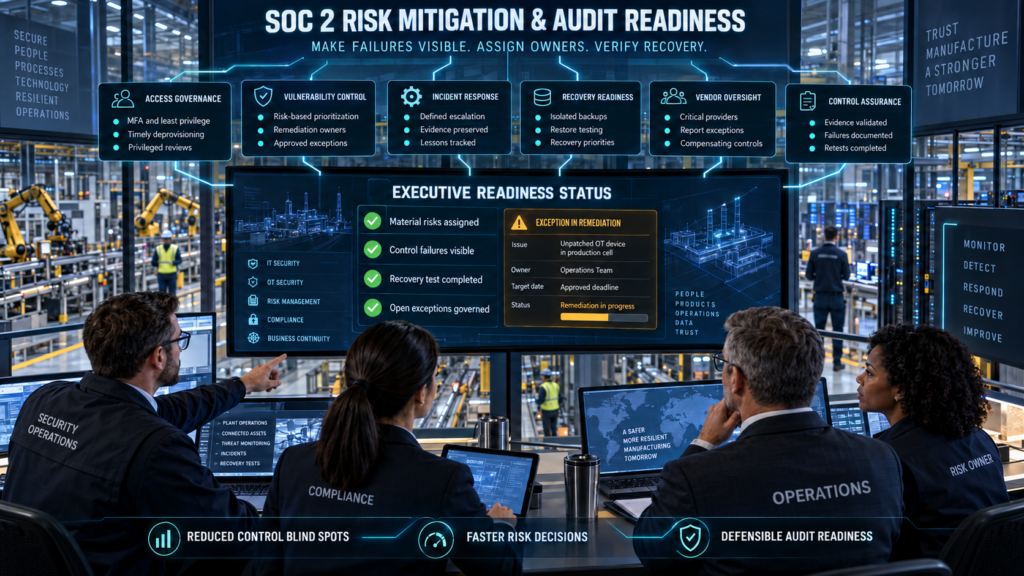
Preparing for Your SOC 2 Examination
Begin by reviewing your service boundary, customer commitments and available control evidence. Identify missing records, overdue control activities and unresolved exceptions before committing to an examination date. Discuss the proposed scope, report type and examination period with your independent CPA firm.
Turn the review findings into a prioritized action list with named owners, deadlines and evidence required for closure. Choose software according to the collection and monitoring gaps it needs to address, and continue operating controls after the report is issued.
V. Appendix and Research Integrity
Appendix A: Sources and Reference Links
- AICPA & CIMA, “System and Organization Controls: SOC Suite of Services.” Defines SOC as a suite of CPA services and explains that assurance reports help users assess outsourcing risk. Accessed September 19, 2026. https://www.aicpa-cima.com/resources/landing/system-and-organization-controls-soc-suite-of-services
- AICPA Assurance Services Executive Committee, “2017 Trust Services Criteria for Security, Availability, Processing Integrity, Confidentiality, and Privacy—with Revised Points of Focus (2022).” Primary criteria source for the five Trust Services categories and their use in attestation or consulting engagements. Published resource page September 30, 2023. https://www.aicpa-cima.com/resources/download/2017-trust-services-criteria-with-revised-points-of-focus-2022
- National Institute of Standards and Technology, “The NIST Cybersecurity Framework (CSF) 2.0,” NIST CSWP 29. Primary framework source for Govern, Identify, Protect, Detect, Respond and Recover cybersecurity outcomes. February 26, 2024. https://doi.org/10.6028/NIST.CSWP.29
- National Institute of Standards and Technology, “Security and Privacy Controls for Information Systems and Organizations,” SP 800-53 Rev. 5, Release 5.2.0. Primary control catalog and crosswalk caution; the 2025 minor release added and revised specified controls. August 27, 2025 release notice. https://csrc.nist.gov/pubs/sp/800/53/r5/upd1/final
- National Institute of Standards and Technology, “Digital Identity Guidelines,” SP 800-63-4. Primary technical guidance for identity proofing, authentication and federation; use the current final edition rather than hard-coded legacy password folklore. July 2025. https://doi.org/10.6028/NIST.SP.800-63-4
- Cybersecurity and Infrastructure Security Agency, “Known Exploited Vulnerabilities Catalog.” Authoritative U.S. government catalog of vulnerabilities with evidence of exploitation, used here as a prioritization input rather than a complete vulnerability program. Continuously updated. https://www.cisa.gov/known-exploited-vulnerabilities-catalog
Regulatory and Commercial Primary Sources
- U.S. Federal Trade Commission, “Start with Security: A Guide for Business.” Primary federal business guidance supporting data minimization, access restriction, secure authentication, encryption, segmentation, monitoring and secure disposal. June 2015. https://www.ftc.gov/business-guidance/resources/start-security-guide-business
- European Union, Regulation (EU) 2024/1689—the Artificial Intelligence Act. Primary legal text used only to qualify the article’s discussion of potential AI-system obligations; applicability requires fact-specific analysis. Official Journal, July 12, 2024. https://eur-lex.europa.eu/eli/reg/2024/1689/oj
- Vanta, “Plans and Pricing.” Vendor primary source for package positioning and quote-based procurement review; no independent performance claim is inferred. Accessed September 19, 2026. https://www.vanta.com/pricing
- Drata, “Plans and Pricing.” Vendor primary source for platform packaging and capabilities; buyers should obtain current written pricing and scope. Accessed September 19, 2026. https://drata.com/pricing
- Secureframe, “Packages.” Vendor primary source for public package descriptions and feature positioning. Accessed September 19, 2026. https://secureframe.com/pricing
- Sprinto, “Pricing.” Vendor primary source for platform positioning and sales-led pricing inquiry. Accessed September 19, 2026. https://sprinto.com/pricing/
Source and Citation Index
| Citation | Claims supported | Article location |
| [1] | Nature and purpose of SOC services; CPA role; independence caution | Executive Summary; Type discussion; software comparison |
| [2] | Trust Services Criteria categories and use | Executive Summary; TSC analysis |
| [3] | NIST CSF 2.0 purpose and functions | Market landscape; regulatory checklist |
| [4] | NIST control catalog; crosswalk limitations | IAM; ROI; regulatory checklist |
| [5] | Current digital-identity guidance | Regulatory checklist |
| [6] | Known-exploited vulnerability prioritization | Vulnerability management; checklist |
| [7] | FTC business security practices | Market landscape; legal alignment |
| [8] | EU AI Act qualification | AI edge case; regulatory checklist |
| [9]–[12] | Vendor-described platform features and pricing routes | Feature and Cost Comparison Table |
Editorial and Commercial Disclosure
AI-assisted tools were used to support research organization, drafting and language refinement. NezzHub retains editorial responsibility for the published article. Vendor inclusion does not constitute endorsement.
No vendor paid for inclusion in the comparison. Product descriptions come from vendor-owned pages and should not be treated as independent performance validation.
The article does not guarantee a favorable auditor opinion, certification, regulatory compliance, deal acceleration or security outcome. Dates, vendor capabilities, prices, professional standards and laws can change.
Author and Editorial Review
Author: Garikapati Bullivenkaiah
Technology research writer with LL.B., LL.M., M.A., and MBA qualifications. He writes about emerging technologies and their business, governance and legal implications. His multidisciplinary academic background informs his analysis of technology adoption, intellectual property, and organizational risk. His articles explain technical concepts and practical considerations for business owners, IT managers and technology decision-makers. LinkedIn Profile
Reviewed by: Chitikineni Ramadevi — Editor
Chitikineni Ramadevi holds an M.Sc. in Computers from Andhra University and has over 10 years of research experience in technology-related subjects. She reviews NezzHub articles for clarity, factual accuracy, source support and practical relevance.
Published by: NezzHub
Research approach: This article draws on primary sources, technical documentation and relevant industry research. References are provided within the article or its sources section.
Last reviewed: 09-19-2026
Corrections: To report a factual error or outdated information, please contact NezzHub.

Garikapati Bullivenkaiah is a seasoned entrepreneur with a rich multidisciplinary academic foundation—including LL.B., LL.M., M.A., and M.B.A. degrees—that uniquely blend legal insight, managerial acumen, and sociocultural understanding. Driven by vision and integrity, he leads his own enterprise with a strategic mindset informed by rigorous legal training and advanced business education. His strong analytical skills, honed through legal and management disciplines, empower him to navigate complex challenges, mitigate risks, and foster growth in diverse sectors. Committed to delivering value, Garikapati’s entrepreneurial journey is characterized by innovative approaches, ethical leadership, and the ability to convert cross-domain knowledge into practical, client-focused solutions.