









Executive Summary
Autonomous mobile robots can remove recurring travel, queueing, and material-transfer work from factories and warehouses, but a robot purchase alone does not create an operational return. Value appears only when missions, handoffs, traffic, charging, safety, wireless coverage, WMS or MES integration, exception recovery, and workforce design operate as one production system.
Demand is real. The International Federation of Robotics reported 102,900 transportation-and-logistics service robots sold in 2024, up 14%, representing more than half of professional service-robot sales; robotics-as-a-service deployments grew 42% in the same reporting period.[1]
This article gives technology and operations leaders a deployment framework covering architecture, integration, performance testing, commercial models, ROI calculations, safety, cybersecurity and operational limitations.
I. Current Market Landscape and the Cost of Inaction
Factories still move parts through a mix of lift trucks, tugger trains, carts, conveyors, and walking operators. Warehouses considering autonomous mobile robots add order carts, pallet movers, put walls, sortation, and person-to-goods picking, creating a transport network whose delays are rarely captured in one system.
Autonomous mobile robots target that movement layer. The stronger business cases are not “replace labor,” but reduce non-value-added travel, stabilize line feeding, shorten replenishment response, limit work-in-process, and make every mission measurable.
Where the Economics Usually Break
A site evaluating autonomous mobile robots may count twenty minutes of walking as twenty minutes of recoverable labor even when the employee must remain in the zone for inspection, packing, or machine tending. That error inflates the savings before autonomous mobile robots reach the floor.
Utilization assumptions fail in the other direction too. A vehicle advertised for a nominal payload may slow on gradients, require wider clearance with a top module, stop more often in mixed traffic, or spend a material share of the shift charging and waiting for doors, lifts, PLC signals, or human handoffs.
The bottleneck can migrate rather than disappear. Faster transport may create queues at pick stations, stretch-wrap machines, inspection cells, elevators, or outbound docks, so the system’s throughput stays flat while robot utilization looks impressive.
Cost of Inaction Baseline
Before requesting an autonomous mobile robots quote, measure the existing process for at least one representative demand cycle. The baseline should include travel time, wait time, touch time, equipment time, shortages, late missions, safety events, overtime, damaged material, and peak labor.
| Baseline measure | Why it matters | Collection method |
|---|---|---|
| Loaded and empty travel minutes | Separates useful transport from repositioning | Time study plus location events |
| Missions per hour by route | Reveals demand distribution and peaks | WMS/MES orders or manual mission log |
| Pickup and drop-off dwell | Exposes handoff bottlenecks | Timestamp at station boundaries |
| Shortage or line-stop minutes | Quantifies service failure | Andon/MES event history |
| Forklift or cart cost | Establishes avoidable operating cost | Lease, energy, maintenance, and labor records |
| Walking distance and ergonomic exposure | Supports workforce redesign | Wearable study or sampled observation |
| Damage and near-miss events | Identifies safety and quality opportunity | EHS and claims records |
The cost of inaction is not simply current labor expense. It includes demand that cannot be served, overtime caused by transport variability, line starvation, avoidable inventory buffers, injury exposure, and the opportunity cost of operators leaving skilled work to push carts.
Which Workflows Merit a Pilot
Good candidates for autonomous mobile robots have repeatable origins and destinations but enough route variability to make fixed conveyors unattractive. Examples include line-side replenishment, empty-container return, work-in-process transfer, pallet movement, kitting, finished-goods transport, and zone-to-zone order movement.
Poor first candidates for autonomous mobile robots include unstable processes with no system owner, irregular loads, uncontrolled floor storage, frequent manual detours, poor Wi-Fi, narrow blind intersections, or elevators and doors that cannot expose reliable machine interfaces.
A pilot should represent the intended production environment. A quiet demonstration lane proves navigation; it does not prove congestion handling, peak throughput, charging capacity, exception recovery, or safe coexistence with people and powered industrial trucks.
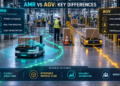
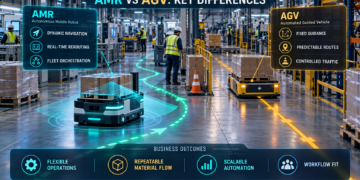
Autonomous Mobile Robots vs Automated Guided Vehicles: Key Differences
II. Deep-Dive Technical Analysis and Evidence
Architecture Overview for Autonomous Mobile Robots
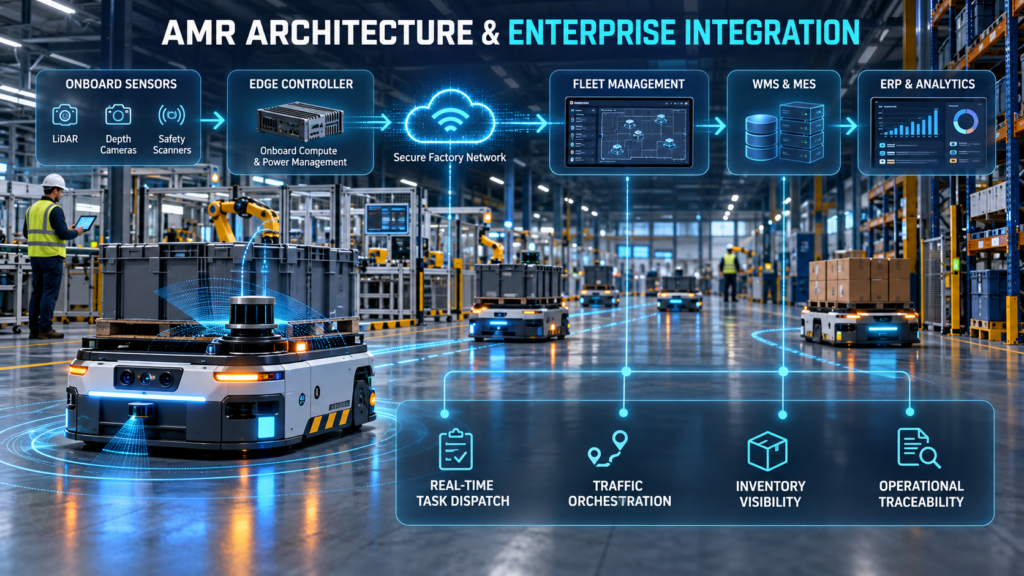
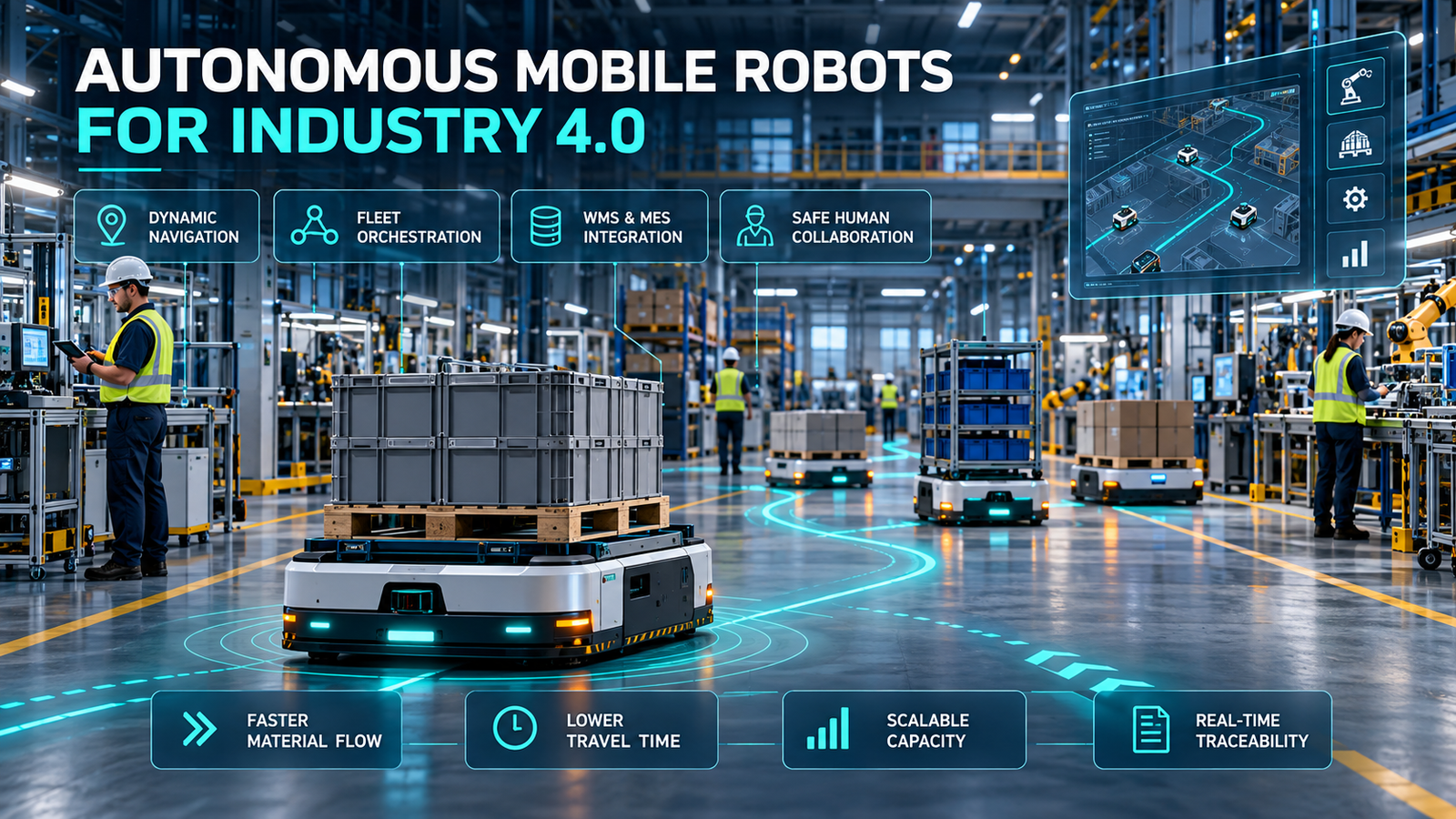
An enterprise autonomous mobile robots deployment has four distinct control planes: business demand, fleet orchestration, vehicle autonomy, and physical process control. Blurring those boundaries creates brittle integrations and unclear incident ownership.
- Business layer: ERP, WMS, WES, MES, inventory, order, and production-schedule systems create transport demand.
- Orchestration layer: AMR fleet management software converts demand into missions, assigns vehicles, manages traffic, schedules charging, and records execution.
- Vehicle layer: onboard localization, mapping, perception, planning, motion control, safety-rated devices, battery management, and top-module control execute the mission.
- Physical interface layer: PLCs, conveyors, doors, elevators, docks, sensors, call buttons, scanners, and machine interlocks coordinate transfer.
- Data layer: event streaming, time-series telemetry, audit logs, maintenance records, and business-intelligence outputs support diagnosis and optimization.
- Security layer: identity, certificates, network segmentation, privileged access, patch control, backups, logging, and incident response protect the environment.
Autonomous mobile robots must fail predictably across those layers. When the WMS is unavailable, the fleet should finish or safely hold active work according to policy; when wireless service degrades, each vehicle should enter a documented safe state rather than improvise a business decision.
Integration Flowchart
```mermaid
flowchart TD
    A[ERP, WMS, WES, or MES] --> B[Integration and mission API]
    B --> C[Fleet orchestration]
    C --> D[Traffic and charge scheduler]
    D --> E[AMR autonomy and safety]
    E --> F[Pickup, transport, and handoff]
    F --> G[PLC and station confirmation]
    G --> H[Mission event and business update]
    H --> B
```
Every autonomous mobile robots integration arrow needs a contract. Define request IDs, load IDs, source and destination, priority, expiration, acknowledgement, retry behavior, idempotency, cancellation, completion evidence, and the owner of each error state.
Autonomous mobile robots often expose REST, message-broker, or industrial interfaces, but API availability is not integration completion. The system must reconcile inventory, mission state, physical load presence, and operator action after timeouts, duplicate requests, emergency stops, or manual recovery.
Navigation, Localization, and Map Governance
Most autonomous mobile robots combine wheel odometry, inertial sensing, safety laser scanners, cameras, or 3D sensors with simultaneous localization and mapping. Performance depends on the facility: repetitive aisles, glass, dust, reflective surfaces, changing racks, temporary staging, and moving crowds can all degrade perception or localization.
Map governance deserves change control. A fire door, temporary rack, safety fence, parked trailer, or construction zone may change the traversable space without any software release, so operations needs a controlled process for map edits, validation, approval, and rollback.
Autonomous mobile robots can route around obstacles, but that feature is not unlimited. Narrow aisles, two-way traffic, blocked escape paths, blind corners, and human hesitation can produce deadlocks or low-speed oscillation that technically avoids collision while destroying throughput.
Fleet Orchestration and Congestion
Fleet software for autonomous mobile robots is the operational core, not an optional dashboard. It must allocate work, prioritize urgent missions, reserve shared resources, prevent gridlock, balance battery state, and recover from vehicles or stations that become unavailable.
The 2008 Kiva system described facilities with 500 or more coordinated vehicles and reported worker-productivity gains of two times or more for its goods-to-person design.[2] That is evidence for a specific system architecture, not a transferable promise for a brownfield tugger route.
Research on robotic mobile fulfillment systems also shows that decision rules matter. Simulation work found pick-order assignment had a strong effect on unit throughput, while warehouse SKU count changed the robot quantity needed to sustain throughput.[3]
These findings explain why adding vehicles can produce diminishing returns. Beyond a point, aisle conflicts, station queues, charger contention, and empty repositioning consume the capacity purchased.
Battery and Charging Strategy
Battery design for autonomous mobile robots must be based on mission energy, not brochure runtime. Model loaded and empty distance, acceleration, floor condition, ambient temperature, top-module power, wireless consumption, queueing, battery aging, and reserve policy.
Opportunity charging reduces manual intervention but may create charger queues at shift peaks. Battery swaps add labor and inventory, while automated charging adds floor space, electrical work, traffic rules, and another failure point.
Autonomous mobile robots should not share one charger without a recovery plan. A charger outage can strand an entire fleet if the scheduler discovers the constraint after vehicles have crossed the minimum reserve.
Safety Engineering Is a System Property
ISO 3691-4:2023 specifies safety requirements and verification methods for driverless industrial trucks, explicitly including automated guided vehicles and autonomous mobile robots.[4] Compliance assessment must cover the complete application, including loads, top modules, transfer stations, operating zones, and reasonably foreseeable misuse.
Safety scanners, emergency stops, speed limits, audible or visual warnings, protective fields, and braking performance are only part of an autonomous mobile robots design. Floor markings, pedestrian routes, intersections, training, maintenance, load stability, evacuation, fire response, and change management remain site responsibilities.
A vehicle stopping before contact is not proof of a safe system. Test detection around overhanging loads, low objects, fork pockets, reflective materials, crouching people, occlusion, cross traffic, and the maximum stopping distance under actual payload and floor conditions.
Interoperability and Vendor Lock-In
VDA 5050 standardizes communication between a master control and mobile robots, and version 3.0 was released in April 2026 with structures that account for freely navigating robots.[5] Support must be tested against the exact version, optional fields, actions, error codes, and traffic-control scope used at the site.
The MassRobotics AMR Interoperability Standard lets different fleets share location, speed, direction, health, and availability information, but it does not require vendors to share proprietary maps.[6] Observation and coexistence are not the same as unified mission orchestration.
Autonomous mobile robots from multiple vendors can still disagree about map frames, right-of-way, elevator reservations, zone locks, load semantics, or emergency behavior. Procurement should demand a witnessed interoperability test, not a checkbox.
Performance Evaluation Matrix
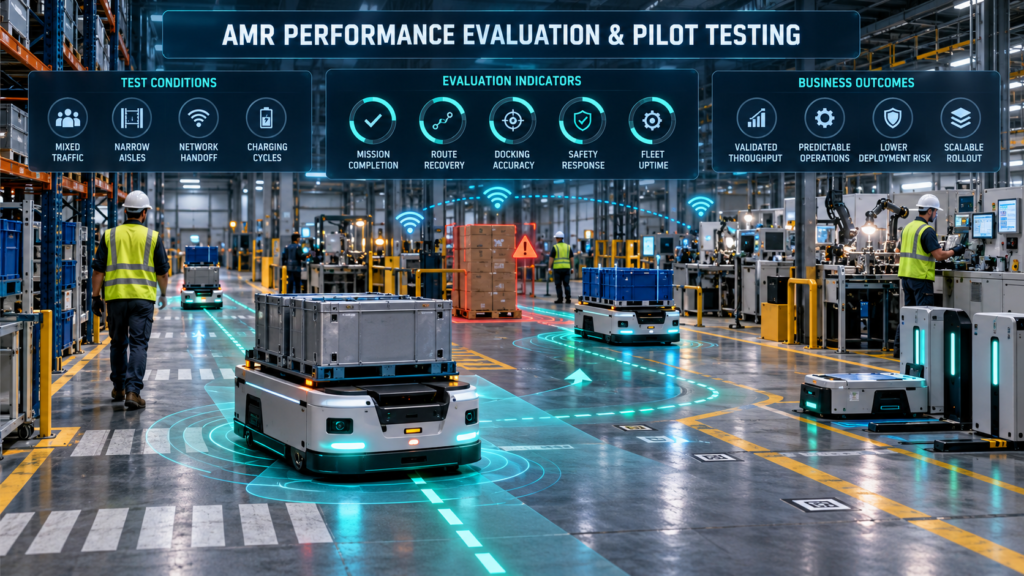
The acceptance plan for autonomous mobile robots must compare the proposed fleet with the measured baseline under normal, peak, degraded, and recovery conditions. Average mission time alone hides tails that trigger shortages and line stops.
| Metric | Formula or definition | Acceptance use | Common distortion |
|---|---|---|---|
| Mission throughput | Completed valid missions per operating hour | Capacity and fleet sizing | Counting empty or cancelled missions |
| On-time mission rate | Missions completed before required time ÷ due missions | Service-level control | Loose due times |
| P95 cycle time | 95th-percentile request-to-confirmation time | Tail-delay visibility | Excluding exceptions |
| Vehicle availability | Ready time ÷ scheduled time | Reliability | Treating blocked or charging vehicles as ready |
| Loaded utilization | Loaded-motion time ÷ scheduled time | Productive use | Ignoring handoff wait |
| Empty-travel ratio | Empty distance ÷ total distance | Dispatch efficiency | Missing manual moves |
| Queue time | Time waiting for aisle, station, lift, door, or charger | Bottleneck diagnosis | Aggregating all waits |
| Intervention rate | Operator recoveries per 100 missions | Support burden | Unlogged resets |
| Energy per mission | Charger energy ÷ valid missions | Operating-cost tracking | Ignoring charger losses |
| Safety stop rate | Protective stops by cause and exposure hour | Layout and behavior review | Treating every stop as a defect |
| Recovery time | Median and P95 incident-to-service time | Resilience | Closing tickets before validation |
| Cost per valid move | Annualized system cost ÷ valid moves | Financial comparison | Omitting integration and support |
Test Scenarios That Expose Weak Designs
Run peak-order bursts with blocked aisles, low batteries, unavailable stations, and mixed priorities. Then remove a charger, access point, vehicle, door controller, and fleet server one at a time and record safe behavior, business continuity, alarm quality, and recovery time.
Test autonomous mobile robots with real pallets, carts, totes, packaging, people, forklifts, cleaning equipment, reflective PPE, and temporary staging. Validate every supported load orientation and the worst permissible center of gravity.
The test dataset should include at least one complete operating cycle and the known demand peaks. Averages from a one-hour vendor demonstration cannot validate shift changes, break surges, replenishment waves, battery decay, or software memory leaks.
Deployment Challenges
Wireless Coverage and Roaming
Industrial Wi-Fi for autonomous mobile robots must account for moving clients, metal racks, machinery, multipath, channel contention, roaming behavior, VLANs, authentication, and interference. A static laptop survey does not replicate an antenna mounted low on a moving vehicle beneath a load.
Autonomous mobile robots should continue safe local navigation during brief communication gaps, but business behavior during longer loss must be defined. Stopping every vehicle may be safe yet operationally catastrophic; continuing indefinitely may create unreconciled missions.
Handoff Reliability
AMR transfers can fail when the vehicle, load and station report inconsistent states. Use independent presence sensing, positive location confirmation, mechanical guides, PLC handshakes, timeout states, and a recovery path that prevents duplicate inventory movement.
An operator placing the wrong cart on the correct vehicle is not a navigation failure. Barcode, RFID, vision, weight, or fixture-level poka-yoke may be needed when traceability or product risk justifies it.
Brownfield Traffic and Floor Reality
Uneven floors, thresholds, drains, ramps, expansion joints, contamination, tight turns, and lift transitions affect traction and load stability. Measure them before choosing a vehicle and top module.
Autonomous mobile robots also change human behavior. Workers may step closer after learning the robot will stop, park equipment in mapped clearances, or use the vehicle as an informal work surface, so post-deployment observation is part of safety validation.
Software Lifecycle and Support
Autonomous mobile robots fleet software, vehicle firmware, safety configuration, PLC logic, middleware, WMS/MES adapters, certificates, and network rules evolve on different schedules. Treat upgrades as production changes with staging, compatibility matrices, rollback, and validated backups.
Support responsibility must be explicit across robot vendor, integrator, top-module builder, network team, WMS provider, facilities team, and site operations. A twenty-minute argument about ownership can exceed the technical repair time.
III. Commercial Solutions and Best Practices
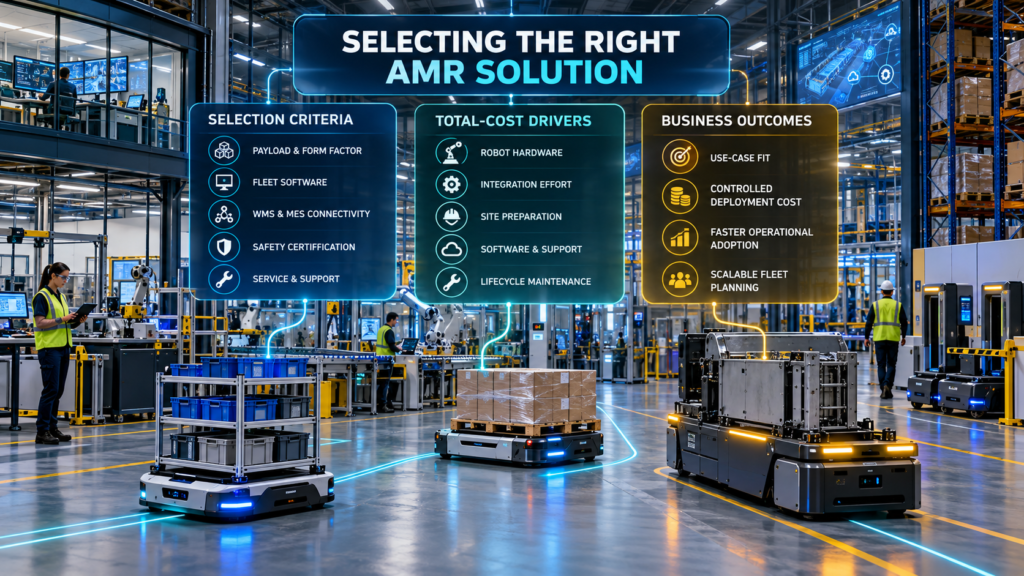
Feature and Cost Comparison Table
Public list prices for enterprise autonomous mobile robots are rarely complete. An autonomous mobile robots quote may include hardware, fleet licenses, top modules, chargers, safety engineering, mapping, integration, training, commissioning, spares, travel, and support.
| Solution | Publicly documented strengths | Commercial model | Cost and diligence warning |
|---|---|---|---|
| MiR Fleet Enterprise | Central mission planning, traffic control, fleet insight, event-driven integration, and enterprise deployment options[7] | Hardware plus software and integration quote | Verify fleet-size licensing, server or virtualization needs, VDA 5050 scope, top modules, and support |
| OTTO Fleet Manager | Mapping, points of interest, traffic rules, workflow definition, and published support for fleets from five to 100 vehicles[8] | Project quote, generally industrial CapEx plus software/services | Validate payload-specific cycle time, integration API, chargers, commissioning, and recovery support |
| LocusONE with Locus Robotics | Coordinated people-and-robot fulfillment and subscription-oriented robotics-as-a-service[9] | Recurring service agreement | Model minimum term, peak scaling, implementation, connectivity, exit costs, data export, and productivity assumptions |
| OMRON FLOW Core | Central job assignment, map creation, dynamic traffic, charge management, system integration, and fleet coordination[10] | Hardware, software, engineering, and support quote | Confirm supported robot mix, version compatibility, server hardware, training, safety services, and lifecycle policy |
This autonomous mobile robots table is not a performance ranking. Each vendor statement comes from its own documentation and must be verified through a site-specific proof of value, contractual acceptance criteria, reference checks, and total-cost model.
CapEx, Lease, or Robotics-as-a-Service
CapEx can lower long-run unit cost when demand is stable and the owner can operate the stack. It also concentrates technology, residual-value, maintenance, and utilization risk with the buyer.
Robotics-as-a-service converts part of the investment to operating expense and can make seasonal scaling easier. The contract may still include minimum fleet, term, integration, site-readiness, travel, support, or early-termination obligations that weaken the apparent flexibility.
Leasing sits between those models but does not automatically transfer performance risk. Autonomous mobile robots should be purchased against an output and availability model, not a monthly payment alone.
Total Cost of Ownership Template
One-Time Costs
- Workflow engineering, simulation, and site survey.
- Vehicles, top modules, carts, racks, fixtures, and chargers.
- Server, edge, wireless, electrical, doors, lifts, and floor work.
- WMS, WES, MES, ERP, PLC, identity, and analytics integration.
- Safety assessment, guarding, signage, validation, and documentation.
- Testing, commissioning, training, change management, and launch support.
Recurring Costs
- Fleet software, subscriptions, cloud, monitoring, and connectivity.
- Vendor support, spare parts, tires, sensors, batteries, and preventive maintenance.
- Energy, inspections, cleaning, cybersecurity, backups, and certificate management.
- Internal product owner, controls, IT, OT, EHS, maintenance, and analyst time.
- Retraining, remapping, layout changes, upgrades, incident response, and insurance.
Autonomous mobile robots may reduce transport labor while increasing controls, IT, and maintenance demand. A serious model moves those costs rather than erasing them.
Procurement Scorecard
| Decision category | Suggested weight | Required evidence |
|---|---|---|
| Throughput and recovery | 25% | Witnessed test on representative routes, loads, peaks, and failures |
| Safety and application engineering | 20% | Risk assessment, stopping tests, safety documentation, change process |
| Integration and interoperability | 15% | API contract, PLC handshakes, VDA 5050 scope, event export, test environment |
| Cybersecurity and lifecycle | 15% | Architecture, hardening, identity, patching, logging, SBOM policy, support term |
| Total cost and contract | 15% | Five-year cash flow, unit definitions, exclusions, SLA, escalation, exit rights |
| Operations and maintainability | 10% | Diagnostics, spares, training, local support, recovery tools, upgrade procedure |
Require autonomous mobile robots bidders to price the same bill of materials, mission volume, shift pattern, interfaces, acceptance tests, and support coverage. Otherwise, the cheapest quote may simply exclude the most expensive engineering.
IV. Business Outcomes and Strategic ROI Takeaways
Business Benefits That Can Be Measured
Autonomous mobile robots can improve throughput when travel is the binding constraint and the receiving process can absorb the additional flow. They can improve labor utilization when workers spend meaningful time walking, driving, waiting, or searching rather than performing skilled tasks.
They can also reduce process variability. A timestamped mission queue makes late requests, shortages, station dwell, route congestion, and intervention visible in a way that informal cart movement does not.
Safety value must be phrased carefully. Autonomous mobile robots may reduce manual driving or pushing exposure, but they introduce new human-machine interaction, software, battery, and cyber risks that require engineered controls.
ROI Model
Calculate the financial return using incremental cash benefits and costs:
Annual net cash benefit = realized annual operating-cost savings + verified additional contribution margin − incremental annual operating costs.
Simple payback in months = initial investment ÷ positive annual net cash benefit × 12.
Express all annual amounts in the same currency and reporting period. Count each saving once, including overtime reductions. Include upfront infrastructure and implementation expenses in the initial investment, and ongoing energy, software, maintenance and internal support expenses in annual operating costs. Report released employee capacity separately unless it produces a verified cash saving or additional contribution margin. Simple payback assumes a positive, reasonably stable annual net cash benefit.
Only count autonomous mobile robots labor savings as cash savings when staffing, overtime, agency spend, or planned hiring actually changes. If employees are reassigned, report capacity released and the measured value of the new work separately.
Worked Scenario With Transparent Assumptions
Assume a two-shift operation records 96 aggregate human transport-work hours per weekday. If 60% of that work falls within the proposed AMR application, the addressable workload is 57.6 human work hours per day, or 14,400 hours over 250 operating days. These figures describe potentially addressable work; they do not establish cash savings or robot operating hours.
Determine fleet size from mission volume and validated robot cycle times, including loaded travel, empty repositioning, pickup, handoff, waiting and charging. Human transport-work hours cannot be divided directly by robot availability to determine the required vehicle count.
For illustration, if a separate mission analysis establishes 57.6 robot-hours of daily work and each vehicle provides 12.8 usable hours during the scheduled operating period, the average capacity requirement is 4.5 vehicles, rounded up to five. This is an initial capacity estimate. Validate peak demand, congestion, charger capacity and outage coverage before selecting the production fleet.
If verified annual cash benefit is $280,000 and recurring software, service, energy, and governance cost is $95,000, annual net cash benefit is $185,000. A $555,000 initial investment would have a simple payback of 36 months before financing, tax, residual value, and risk adjustments.
This is an illustrative model, not an industry benchmark. Replace every assumption with local data and run downside cases for 20% lower volume, slower cycle time, higher intervention, battery replacement, integration delay, and a lost production week.
Strategic ROI Takeaways
- Buy a material-flow outcome, not a vehicle count.
- Size from peak demand and tail latency, not daily averages.
- Price stations, carts, chargers, wireless, integration, safety, support, and internal labor.
- Measure cost per valid move and business service level after launch.
- Expand only when the pilot’s outcome survives a controlled comparison with baseline.
Autonomous mobile robots are most valuable as a configurable transport platform. Their flexibility creates a real option to add routes and missions, but only if maps, interfaces, traffic rules, carts, and safety changes remain governed.
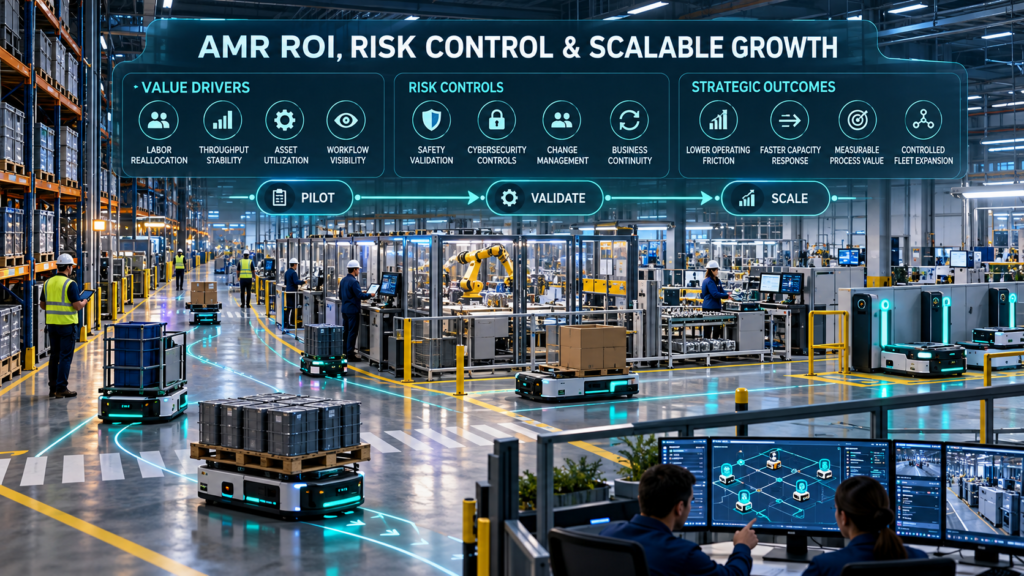
V. Risk Mitigation and Regulatory Framework
NIST SP 800-82 Revision 3 treats operational technology as systems that interact with the physical environment and stresses security controls that respect performance, reliability, and safety requirements.[11] Autonomous mobile robots belong inside the OT security program, not on an unmanaged wireless island.
NIST AI RMF 1.0 offers Govern, Map, Measure, and Manage functions for AI risk.[12] The framework is voluntary, but its structure is useful for documenting intended use, affected people, performance evidence, monitoring, and risk treatment.
The EU AI Act’s classification depends on intended purpose and context. A material-transport system is not automatically high risk, but AI used for worker management, access, evaluation, or other Annex III purposes may create different duties; legal review must follow the actual deployment rather than the robot label.[13]
Safety and Compliance Checklist
Machinery and Application Safety
- Complete a site-specific risk assessment covering vehicle, top module, load, station, traffic, and foreseeable misuse.
- Validate the applicable edition of ISO 3691-4 and relevant national requirements with qualified safety professionals.
- Measure protective-field behavior and stopping distance under maximum permitted load and speed.
- Control intersections, blind corners, doors, lifts, ramps, fire routes, pedestrian crossings, and mixed forklift traffic.
- Revalidate after map, firmware, payload, top-module, route, speed, or facility changes.
NIST OT and Cybersecurity Controls
- Inventory every vehicle, server, controller, access point, interface, account, certificate, and software version.
- Segment fleet, safety, control, enterprise, vendor-access, and guest networks according to risk.
- Use unique identities, least privilege, multifactor access where feasible, signed updates, and controlled remote support.
- Centralize logs and alert on authentication failures, configuration changes, disabled safety functions, and unusual traffic.
- Maintain tested offline backups for maps, fleet configuration, PLC logic, certificates, and integration services.
- Define vulnerability intake, patch qualification, maintenance windows, compensating controls, and end-of-support plans.
AI and Operational Governance
- Govern: Assign accountable owners across operations, engineering, EHS, IT, OT, security, and procurement.
- Map: Document intended missions, people exposed, environmental constraints, misuse, dependencies, and harm scenarios.
- Measure: Test navigation, stopping, congestion, recovery, cybersecurity, human factors, and subgroup or shift differences.
- Manage: Prioritize controls, approve residual risk, monitor incidents, preserve manual recovery, and stop unsafe automation.
Commercial and Continuity Controls
- Contract availability, response, spares, escalation, data ownership, security notification, and exit assistance.
- Test operation during WMS, fleet server, wireless, charger, door, lift, vehicle, and cloud outage.
- Preserve a safe manual process for critical material movement.
- Prevent proprietary mission data or maps from becoming unrecoverable at contract end.
- Review robotics-as-a-service commitments against peak, seasonal, and closure scenarios.
Preparing a Site Acceptance Pilot
Select one high-volume material flow, measure its baseline and define acceptance thresholds before testing the complete AMR system. Use 30 to 60 days as an initial planning window, extending the evaluation where necessary to cover representative demand cycles, peaks and recovery conditions. Include real loads, peak traffic, charging, wireless roaming, handoffs, recovery, safety, cybersecurity, and operator behavior.
Proceed only if autonomous mobile robots improve the agreed business outcome under normal and degraded conditions, the safety case is approved, the operating model is staffed, and the downside scenario still clears the investment threshold.
VI. Appendix and Research Integrity
Appendix A: Academic and Primary-Source Footnotes
- International Federation of Robotics, “Service Robots See Global Growth Boom,” reporting 102,900 transportation and logistics robots sold in 2024, 14% annual growth, and 42% growth in RaaS. https://ifr.org/news/service-robots-see-global-growth-boom/1
- Peter R. Wurman, Raffaello D’Andrea, and Mick Mountz, “Coordinating Hundreds of Cooperative, Autonomous Vehicles in Warehouses,” AI Magazine, 29(1), 2008. https://ojs.aaai.org/aimagazine/index.php/aimagazine/article/view/2082
- Marius Merschformann, Tim Lamballais, René de Koster, and Leena Suhl, “Decision Rules for Robotic Mobile Fulfillment Systems,” arXiv:1801.06703, 2018. https://arxiv.org/abs/1801.06703
- International Organization for Standardization, ISO 3691-4:2023, “Industrial trucks—Safety requirements and verification—Part 4: Driverless industrial trucks and their systems.” https://www.iso.org/standard/83545.html
- German Association of the Automotive Industry, “Version 3.0 of VDA 5050 released,” April 21, 2026. https://www.vda.de/en/press/press-releases/2026/260421_PM_VDA_5050_EN
- MassRobotics, “What Is the MassRobotics AMR Interoperability Standard?” June 19, 2023. https://www.massrobotics.org/what-is-the-massrobotics-amr-interoperability-standard/
- Mobile Industrial Robots, “MiR Fleet Enterprise.” https://mobile-industrial-robots.com/products/software/mir-fleet
- OTTO Motors, “AMR Fleet Management Software.” https://ottomotors.com/fleet-manager/
- Locus Robotics, “Robots-as-a-Service” and “LocusONE.” https://locusrobotics.com/why-locus/robots-as-a-service and https://locusrobotics.com/
- OMRON Robotics, “FLOW Core Software AMR Fleet Management.” https://robotics.omron.com/products/mobile-robots/software/
- Keith Stouffer et al., Guide to Operational Technology Security, NIST SP 800-82 Rev. 3, September 2023. https://doi.org/10.6028/NIST.SP.800-82r3
- Elham Tabassi, Artificial Intelligence Risk Management Framework (AI RMF 1.0), NIST AI 100-1, January 2023. https://doi.org/10.6028/NIST.AI.100-1
- European Parliament and Council, Regulation (EU) 2024/1689, Artificial Intelligence Act. https://eur-lex.europa.eu/eli/reg/2024/1689/oj/eng
- Russell Keith and Hung Manh La, “Review of Autonomous Mobile Robots for the Warehouse Environment,” arXiv:2406.08333, 2024. https://arxiv.org/abs/2406.08333
- Paulo H. C. Morais et al., “A Review of Robot Fleet Management,” IEEE Access, 2025. https://ieeexplore.ieee.org/document/11072173
Source and Citation Index
| References | Evidence category | Editorial use |
|---|---|---|
| [1] | International market data | Adoption and commercial-model context |
| [2], [3], [14], [15] | Peer-reviewed or academic research | Fleet scale, productivity, scheduling, architecture, and research limitations |
| [4] | International safety standard | Application safety and verification |
| [5], [6] | Industry interoperability specifications | Mixed-fleet communication limits |
| [7]–[10] | Official vendor documentation | Feature comparison only; not independent performance proof |
| [11] | U.S. government OT security guidance | Cybersecurity and resilience controls |
| [12] | U.S. government AI risk framework | Governance structure |
| [13] | Primary EU legislation | Risk-classification and legal-review context |
Research Limitations
Vendor feature descriptions are first-party statements. No vendor is ranked by unsupported accuracy, throughput, ROI, or safety claims, and public pricing is not presented where a complete, current enterprise price was unavailable.
The Kiva productivity result concerns a particular goods-to-person system and facility design. It is not treated as a general benchmark for all autonomous mobile robots, applications, brownfield sites, or labor models.
The financial scenario is illustrative and mathematically transparent. It does not claim a typical robot price, universal payback, guaranteed saving, or expected productivity rate.
Corporate Editorial Transparency and AI Usage Disclosure
AI-assisted tools were used to support research organization, drafting and language refinement. NezzHub retains editorial responsibility for the published article. Vendor inclusion does not constitute endorsement.
Author and Editorial Review
Author: Garikapati Bullivenkaiah
Technology research writer with LL.B., LL.M., M.A., and MBA qualifications. He writes about emerging technologies and their business, governance and legal implications. His multidisciplinary academic background informs his analysis of technology adoption, intellectual property, and organizational risk. His articles explain technical concepts and practical considerations for business owners, IT managers and technology decision-makers. LinkedIn Profile
Reviewed by: Chitikineni Ramadevi — Editor
Chitikineni Ramadevi holds an M.Sc. in Computers from Andhra University and has over 10 years of research experience in technology-related subjects. She reviews NezzHub articles for clarity, factual accuracy, source support and practical relevance.
Published by: NezzHub
Research approach: This article draws on primary sources, technical documentation and relevant industry research. References are provided within the article or its sources section.
Last reviewed: 09-26-2026
Corrections: To report a factual error or outdated information, please contact NezzHub.

Garikapati Bullivenkaiah is a seasoned entrepreneur with a rich multidisciplinary academic foundation—including LL.B., LL.M., M.A., and M.B.A. degrees—that uniquely blend legal insight, managerial acumen, and sociocultural understanding. Driven by vision and integrity, he leads his own enterprise with a strategic mindset informed by rigorous legal training and advanced business education. His strong analytical skills, honed through legal and management disciplines, empower him to navigate complex challenges, mitigate risks, and foster growth in diverse sectors. Committed to delivering value, Garikapati’s entrepreneurial journey is characterized by innovative approaches, ethical leadership, and the ability to convert cross-domain knowledge into practical, client-focused solutions.