












Executive Summary
AI engineer roles and responsibilities now extend far beyond model training. A capable AI engineering team must turn data, models, prompts, retrieval systems, APIs, security controls, and operational telemetry into a dependable business service.
That distinction matters because many organizations still recruit for a fashionable title instead of an accountable outcome. The result is predictable: impressive prototypes, fragile integrations, uncontrolled cloud spending, and no owner when model behavior changes in production.
This Article gives technology leaders an operating model for enterprise AI deployment. It separates AI engineering from data science, software engineering, MLOps, security, product management, and legal accountability without pretending those boundaries are absolute.
It also explains how to evaluate an MLOps platform, build a production architecture, set service-level objectives, estimate total cost, and apply an AI governance framework. The central recommendation is simple: define the production obligation first, then hire or assign the people capable of owning it.
I. The Current Market Landscape and Challenge
The title is expanding faster than the operating model
“AI engineer” can describe a classical machine-learning production engineer, a generative-AI application developer, a retrieval specialist, or a software engineer integrating a managed model API. Treating those jobs as interchangeable creates a faulty requisition before the first interview begins.
The U.S. Bureau of Labor Statistics does not publish a universal “AI engineer” occupation or median salary. It tracks adjacent categories, including data scientists, software developers, and computer and information research scientists, so compensation claims must be tied to an actual job family rather than a marketing title.[1][2][3]
BLS reports a May 2025 median wage of $120,230 for data scientists and projects 35% employment growth from 2025 to 2035. Software development is a separate occupation with different production obligations, which is why a single blended salary benchmark can misprice the role.[1][2]
Demand data does not remove the need for role design. It makes precise AI engineer roles and responsibilities more important because a scarce candidate should not be hired into an undefined accountability gap.
Where role ambiguity becomes expensive
An AI engineering team usually fails at the seams. Data scientists may optimize offline accuracy, application engineers may optimize latency, security teams may block unreviewed data flows, and finance teams may discover variable inference charges only after launch.
No individual failure is required. A product can miss its target simply because nobody owns the complete path from approved data to monitored decision and controlled rollback.
The cost appears in five places:
- Rework when a prototype cannot pass security, privacy, or reliability review.
- Idle accelerator capacity and oversized endpoints that inflate unit economics.
- Manual evaluation that slows releases and makes results difficult to reproduce.
- Production incidents caused by drift, prompt injection, data leakage, or dependency changes.
- Lost adoption when users cannot understand, contest, or trust system behavior.
The cost of inaction is not merely slower experimentation. It is the accumulation of unsupported models, unowned data pipelines, shadow AI services, and contracts that cannot be exited without rebuilding the application.
Definitive, High-Growth AI Jobs in the USA: Roles, Salaries and 2026 Trends
A decision-grade definition of the job
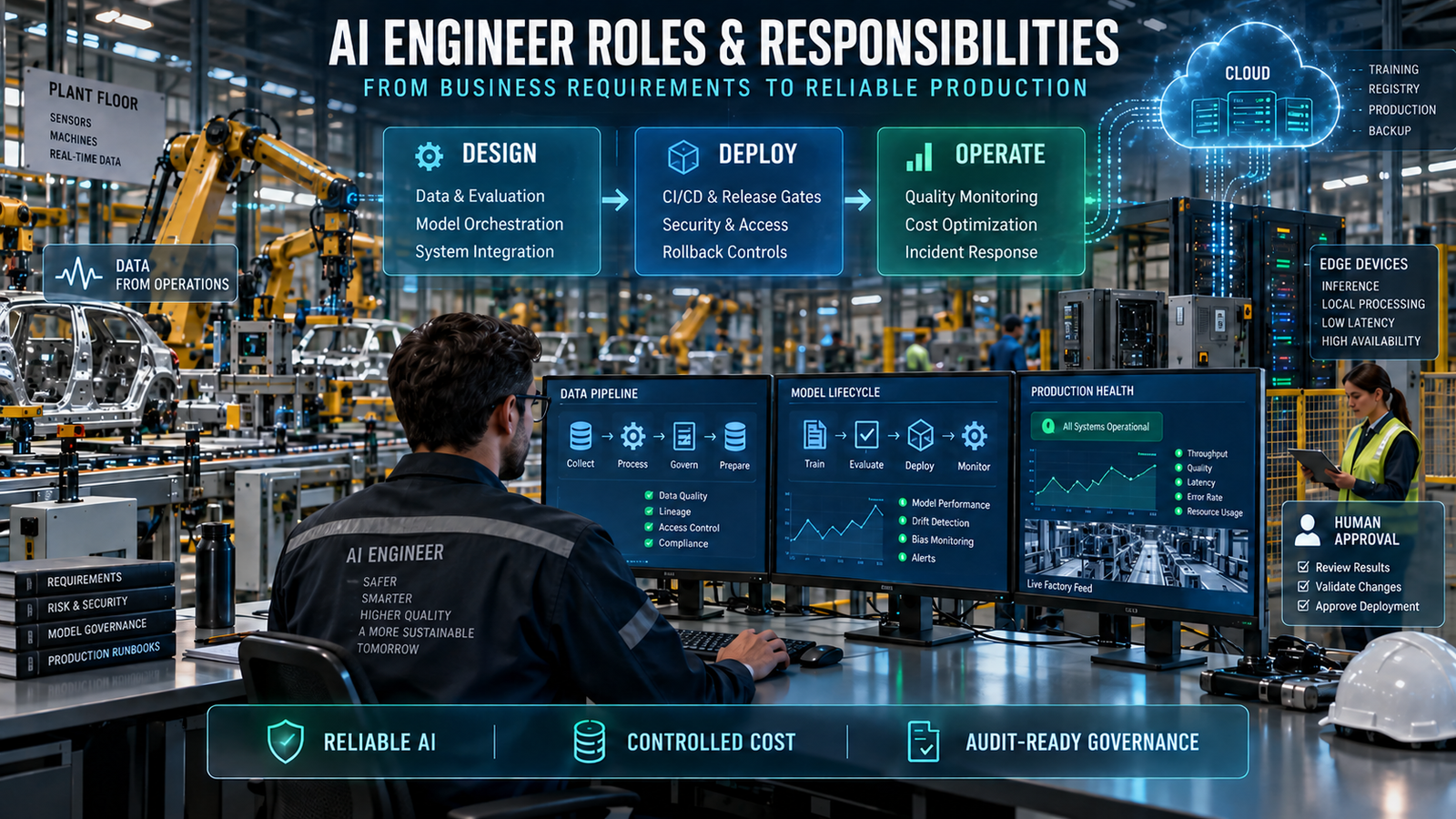
AI engineer roles and responsibilities should be defined as production accountabilities. The engineer converts a validated use case into an observable, secure, cost-controlled system that can be tested, released, operated, and retired.
That work may include models, but the model is only one dependency. The commercial outcome depends on data contracts, identity, orchestration, evaluation, application behavior, human review, and incident response.
The role should therefore carry explicit decision rights. An AI engineer may approve a model version for a staging environment, but risk acceptance for a high-impact use case should remain with the designated business and compliance owners.
Written AI engineer roles and responsibilities turn those decision rights into an auditable operating agreement. They also prevent the AI engineering team from becoming the default owner of every unresolved product, data, and compliance question.
II. Deep-Dive Technical Analysis and Evidence
Architecture Overview: the production system an AI engineer actually owns
A credible enterprise AI deployment is a layered system, not a notebook attached to an endpoint. The AI engineering team must know which layer it owns, which platform team supplies it, and which control owner approves it.
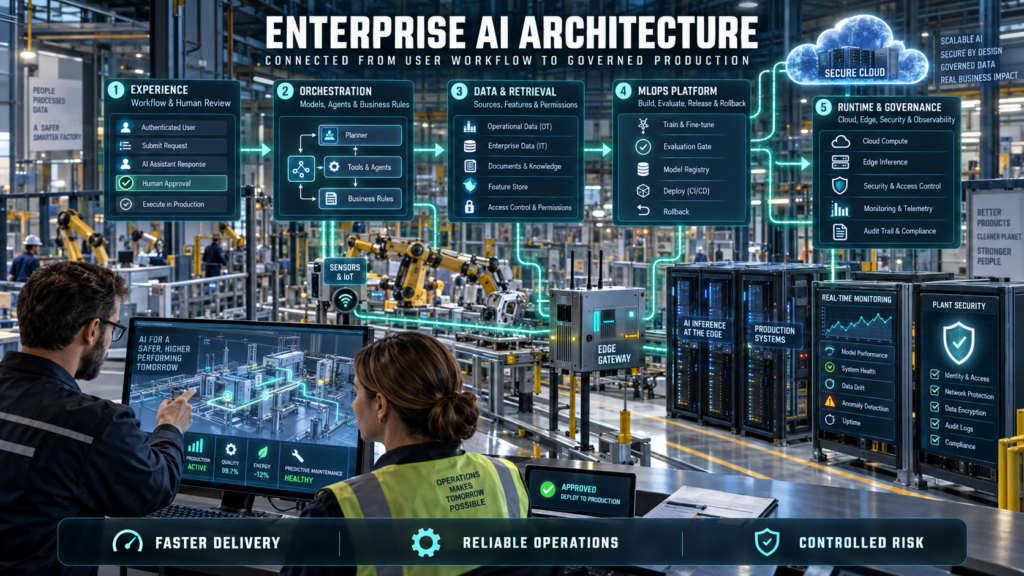
1. Experience and business-process layer
This layer includes the user interface, workflow, API contract, escalation path, and human decision point. It defines what happens when the system abstains, times out, produces an unsafe answer, or encounters incomplete evidence.
The AI engineer works with product and domain owners to translate business harm into testable acceptance criteria. “Helpful” is not measurable; a maximum false-negative rate, response-time target, escalation threshold, and prohibited action are.
2. Orchestration and model layer
This layer routes requests among predictive models, foundation models, tools, rules, and human reviewers. AI engineer roles and responsibilities include versioning prompts and models, enforcing structured outputs, applying timeouts, limiting tool permissions, and preventing uncontrolled recursion.
For generative systems, the engineer must assume that model output is untrusted input. Schema validation, output encoding, content controls, tool authorization, and downstream business rules remain necessary even when a provider advertises safety tuning.
3. Data and retrieval layer
The data layer includes sources, feature pipelines, embeddings, indexes, lineage, retention rules, and access policies. Retrieval quality depends on document parsing, chunking, metadata filters, freshness, authorization, and ranking—not only the embedding model.
The engineer must enforce data contracts and test permission trimming. A retrieval system that returns a relevant but unauthorized document is a security failure, not a minor relevance defect.
4. Platform and runtime layer
This layer supplies containers, accelerators, serverless endpoints, secrets, networking, CI/CD, observability, and the MLOps platform. AI engineers contribute deployment definitions and operational requirements while platform engineers typically own shared infrastructure and tenancy controls.
Capacity design must account for tail latency, burst behavior, token or feature volume, batch windows, cold starts, and regional availability. Average response time alone hides the conditions that create user-visible failure.
5. Governance and assurance layer
The AI governance framework connects inventory, risk classification, approvals, evaluation evidence, incident records, vendor documentation, and retirement decisions. NIST AI RMF organizes voluntary risk-management activity around Govern, Map, Measure, and Manage.[4]
Governance is not a PDF created after development. It is a set of release gates and retained evidence embedded in the engineering workflow.
Integration Flowchart
flowchart TD
flowchart TD
A[“Approved use case”] –> B[“Data and threat assessment”]
B –> C[“Build and evaluate”]
C –> D{“Release gates passed?”}
D –>|No| C
D –>|Yes| E[“Controlled deployment”]
E –> F[“Monitor cost, quality, safety”]
F –> G{“Material drift or incident?”}
G –>|Yes| H[“Rollback, contain, review”]
H –> C
G –>|No| F
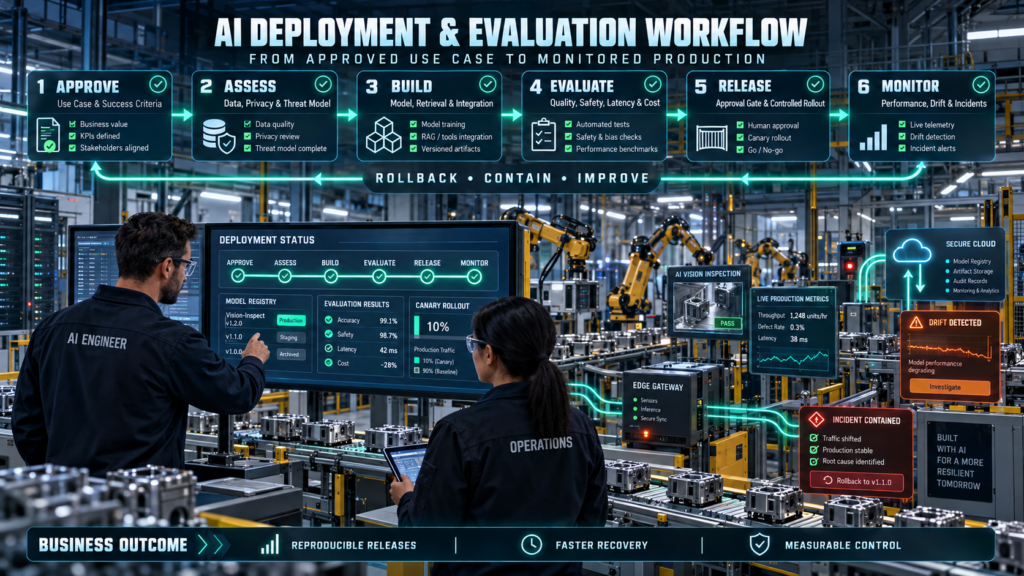
This flow is intentionally circular. Enterprise AI deployment is a continuing operating obligation because data, user behavior, model providers, and attack techniques change after release.
AI engineer roles and responsibilities across the lifecycle
Discovery and feasibility
The AI engineer converts a business proposal into a falsifiable technical hypothesis. That means defining the baseline process, eligible data, expected decision volume, latency tolerance, failure cost, and minimum improvement required to justify deployment.
The engineer should also identify a non-AI baseline. If rules, search, or conventional software meet the requirement more cheaply and transparently, selecting AI adds cost without adding defensible value.
Data and evaluation design
The role includes validating provenance, representativeness, labeling policy, leakage controls, and permitted use. Dataset size is less informative than coverage of the difficult cases that determine business risk.
Evaluation design must precede model selection. The AI engineering team needs a frozen test set, task-specific measures, slice analysis, adversarial tests, and a process for adjudicating ambiguous results.
System implementation
Implementation covers reproducible builds, dependency pinning, infrastructure definitions, API contracts, authentication, rate limits, caching, and safe failure behavior. For retrieval-augmented generation, it also covers ingestion, indexing, citations, permission checks, and retrieval evaluation.
AI engineer roles and responsibilities also include creating automated tests for deterministic components and statistical tests for probabilistic behavior. A prompt change can be a production change even when no application code changes.
Release engineering
The engineer packages artifacts, records lineage, promotes approved versions, and uses canary, shadow, or staged deployment where appropriate. Rollback must include models, prompts, indexes, feature definitions, and application configuration.
A release is incomplete without an owner, change record, evaluation report, cost estimate, monitoring configuration, and rollback trigger. The MLOps platform can automate evidence capture, but automation does not decide whether the evidence is sufficient.
Production operations
Production ownership includes service health, data quality, model quality, abuse signals, cost, and user-impact monitoring. The correct alert is tied to a decision or action, not merely a dashboard threshold.
The engineer participates in incident response and post-incident review. Serious events may require containment, provider escalation, affected-user analysis, legal review, and temporary reversion to a manual process.
Retirement and replacement
Models and agents require a retirement path. The engineer must identify dependent services, preserve required records, revoke credentials, remove endpoints, archive evaluation evidence, and confirm that retained data follows policy.
Without retirement criteria, an enterprise accumulates unknown endpoints and recurring charges. Lifecycle ownership is therefore part of AI engineer roles and responsibilities, not administrative cleanup.
Responsibility boundaries inside the AI engineering team
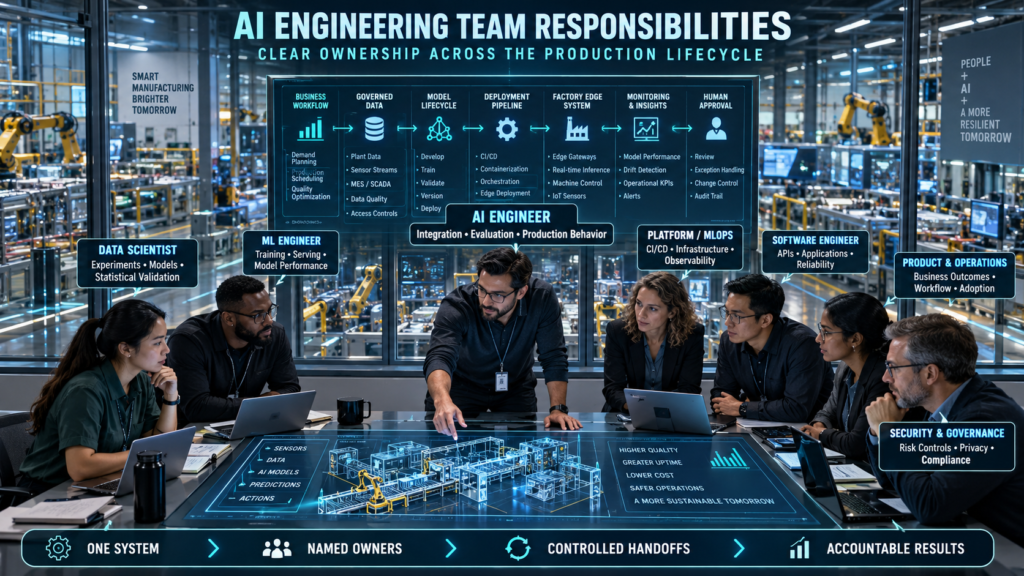
| Role | Primary accountability | Usually contributes | Should not own alone |
| AI engineer | End-to-end AI application behavior in production | Evaluation, orchestration, integration, deployment | Enterprise risk acceptance |
| Data scientist | Statistical method, experimentation, offline validation | Features, labels, model analysis | Production service reliability |
| ML engineer | Training and serving pipelines for learned models | Optimization, packaging, monitoring | Product-value definition |
| MLOps/platform engineer | Shared delivery, runtime, observability, tenancy | CI/CD, registries, infrastructure | Use-case outcome quality |
| Software engineer | Application services and user workflow | APIs, tests, resilience, interfaces | Model-risk methodology |
| Product/domain owner | Business value and workflow adoption | Acceptance criteria, escalation policy | Technical security controls |
| Security/privacy/legal | Control requirements and independent challenge | Threat models, privacy review, compliance | Day-to-day model tuning |
These boundaries are contextual rather than rigid. A small company may combine roles, but it must not erase accountabilities.
Deployment Challenges
Offline success can fail online
A model can score well on a historical test set and still fail because live data arrives late, schemas change, users adapt, or the decision threshold is wrong. Training-serving skew remains a systems problem even when the algorithm is sound.
The remedy is contract testing, live shadow evaluation, feature parity checks, and slice-level monitoring. The AI engineer should define the conditions that stop rollout before traffic increases.
Generative outputs are variable and attackable
Prompt injection, insecure tool use, sensitive-information disclosure and excessive agency require explicit controls. NIST’s Generative AI Profile provides risk-management guidance, while OWASP identifies application-security risks for systems using language models. Use these sources to inform a deployment-specific threat model and security tests.[5][6]
The safe design constrains authority. A model may recommend an action while a deterministic service validates identity, amount, destination, and policy before execution.
Cost curves can reverse the business case
Token charges, vector search, accelerator hours, observability retention, evaluation runs, network egress, and human review all belong in unit economics. A cheap proof of concept can become expensive when context length and concurrency rise together.
Cost should be measured per completed business outcome, not per API call. The AI engineering team should track retries, cache hit rate, tokens, retrieval calls, reviewer minutes, and abandoned sessions.
Vendor abstraction is never free
A thin adapter can reduce switching effort, but platform-specific safety, batching, fine-tuning, identity, and monitoring features still create coupling. Designing for theoretical portability can also discard capabilities that make the system reliable.
The practical answer is selective portability. Keep data contracts, evaluation suites, business rules, and audit records portable while documenting provider-specific dependencies and exit costs.
Performance Evaluation Matrix
| Dimension | Example metric | Release evidence | Production trigger |
| Task quality | Precision, recall, pass rate, groundedness | Frozen test set and slice results | Material decline against baseline |
| Safety | Harmful completion or policy-violation rate | Red-team and adversarial suite | Severe event or sustained increase |
| Reliability | Availability, timeout rate, successful fallback | Load and failure-injection test | SLO breach or fallback exhaustion |
| Latency | p50, p95, and p99 response time | Representative load profile | Tail latency above workflow limit |
| Cost | Cost per accepted outcome | Volume-based forecast | Unit cost exceeds approved range |
| Fairness | Error rates across relevant groups | Documented slice analysis | Statistically meaningful disparity |
| Security | Unauthorized retrieval or tool execution rate | Threat-model test cases | Any confirmed privilege bypass |
| Operations | Mean time to detect and restore | Incident exercise | Failure to meet response objective |
No universal pass score exists. Thresholds must reflect the harm, reversibility, and human oversight of the specific use case.
III. Commercial Solutions and Best Practices
Feature and Cost Comparison Table
| Platform | Strong fit | Commercial cost model | Engineering advantage | Material trade-off |
| Amazon SageMaker AI | AWS-centered predictive and generative workloads | Charges can include compute, storage, processing, deployment, and MLOps services | Broad integration with AWS data, identity, and operations | Service combinations complicate forecasting and deepen AWS coupling |
| Microsoft Foundry and Azure Machine Learning | Microsoft estates and managed-model catalogs | Component, compute, token, marketplace, or provisioned-throughput charges vary by service | Enterprise identity and governance integration | Multiple product surfaces and billing models require architecture discipline |
| Google Vertex AI | Google Cloud data and model workloads | Pay-as-you-go resources plus model-specific or provisioned throughput | Integrated MLOps and access to Google models | Quotas, region support, and model-specific economics need validation |
| Databricks Mosaic AI | Lakehouse-centered data, ML, and retrieval programs | Workspace, compute, serving, and feature-specific consumption | Close relationship between governed data, MLflow, and serving | Best value often assumes significant Databricks standardization |
This is a procurement screen, not a price quote. AWS explicitly lists compute, storage, processing, deployment, and MLOps as cost dimensions; Microsoft and Google also vary billing by model and deployment mode.[7][8][9]
An MLOps platform should be selected against the operating model, not a feature checklist. The decisive questions concern identity boundaries, evidence retention, deployment controls, workload portability, observability, support, and committed-spend exposure.
The preferred MLOps platform must also fit the organization’s incident process and AI governance framework. A technically rich service adds little value if its evidence cannot support the approval and assurance workflow.
A practical build, buy, and staff framework
Buy managed capability when it reduces undifferentiated operational work without surrendering required control. Build when the workflow, data advantage, latency envelope, or regulatory evidence is genuinely differentiating.
Staffing should follow the bottleneck. A company with strong models but unreliable delivery needs platform and software depth; a company with stable infrastructure but weak evaluation needs domain and measurement expertise.
Use this sequence:
- Define the business decision, baseline, harm, and accountable executive.
- Map the full system and regulated data before choosing a model.
- Establish evaluation and release evidence before scaling development.
- Assign each production obligation to a named role or team.
- Select the narrowest MLOps platform footprint that satisfies controls.
- Pilot with a rollback path and a manually operable fallback.
- Scale only when quality, reliability, adoption, and unit cost remain inside limits.
Hiring scorecard for AI engineer roles and responsibilities
A useful interview tests decisions, not trivia. Give the candidate an incomplete production scenario and ask how they would expose assumptions, select measures, constrain authority, investigate failure, and communicate trade-offs.
| Competency | Evidence to request | Warning sign |
| System design | Architecture with failure modes and ownership | Model diagram without data, identity, or fallback |
| Evaluation | Metrics tied to business harm and slices | One aggregate benchmark score |
| Software quality | Tests, versioning, interfaces, and reviews | Notebook-only delivery history |
| Operations | SLOs, telemetry, rollout, rollback, incidents | “The platform handles it” |
| Security | Threat model, least privilege, secret handling | Safety filter treated as the full control set |
| Economics | Workload assumptions and unit-cost model | Focus on training cost alone |
| Governance | Evidence, approvals, limitations, traceability | Compliance deferred until launch |
| Communication | Clear alternatives and decision record | Unqualified certainty or jargon substitution |
Credentials can support a hiring decision, but a portfolio should show production reasoning. The strongest candidate can explain what was not automated, why a simpler method lost, and which residual risks the business accepted.
IV. Business Outcomes and Strategic ROI Takeaways
Measure outcomes, not model activity
Model calls, experiments, and generated tokens are consumption measures. The business needs completed cases, cycle-time reduction, avoided loss, revenue lift, service quality, and control effectiveness.
A defensible annual-value model is:
Net annual value = verified annual financial benefits − total annual costs for people, platforms, inference, data, assurance and change management.
Express every term in the same currency and annual period. Include only benefits supported by the baseline and measured results. Count each cost once; for example, exclude inference charges already included in the platform total. Report released staff capacity separately unless its financial value can be demonstrated.
The denominator for unit economics should be an accepted outcome. If a system generates three drafts before one is used, all three belong in the cost of the accepted result.
The value of clear ownership
Clear AI engineer roles and responsibilities reduce coordination loss. Teams know who owns evaluation regressions, runtime incidents, model-provider changes, data-contract failures, and rollback execution.
This clarity also improves procurement. A buyer can distinguish platform capability from the engineering and governance work that the subscription does not supply.
Compensation and workforce planning
Because the federal taxonomy does not isolate AI engineers, leaders should benchmark the role against its dominant work. A research-heavy position may resemble computer and information research science, while a production-heavy position may align more closely with software development or data science.[1][2][3]
Adjust for geography, seniority, management scope, on-call duties, regulated-domain experience, and scarcity. Do not publish a single “AI engineer salary” internally unless the job architecture underneath it is equally specific.
The total labor plan must include adjacent roles. Hiring one senior AI engineer cannot replace product ownership, security review, data stewardship, platform operations, or independent risk oversight.
Executive decision checklist
- Is the proposed outcome measurable against a current baseline?
- Are AI engineer roles and responsibilities written as production obligations?
- Does the AI engineering team have named partners in data, platform, security, product, and compliance?
- Can the organization reproduce the evaluation and release evidence?
- Does the enterprise AI deployment have rollback and manual fallback paths?
- Is unit cost measured at realistic volume and context size?
- Can leaders identify and exit material vendor dependencies?
- Is the AI governance framework connected to release gates and incidents?
If several answers are “no,” additional model experimentation is unlikely to resolve the program risk. The missing investment is operating design.
V. Risk Mitigation and Regulatory Framework
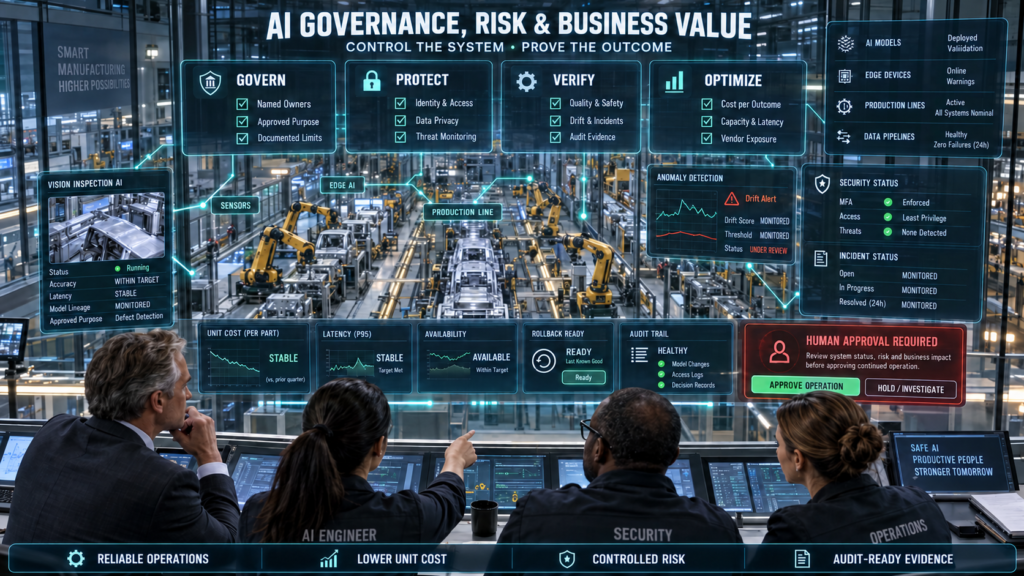
Governance aligned to engineering work
NIST AI RMF is voluntary, but its Govern, Map, Measure, and Manage functions provide a practical vocabulary for allocating work.[4] NIST’s Generative AI Profile adds risk considerations and actions for generative systems, while the Secure Software Development Framework supplies practices that can be integrated into the development lifecycle.[5][10]
For organizations operating in or serving the European Union, Regulation (EU) 2024/1689 applies a risk-based legal regime with obligations that vary by role and system classification. The legal analysis belongs to qualified counsel; the AI engineering team supplies accurate technical facts and evidence.[11]
Governance checklist
- Maintain an inventory with owner, purpose, users, data, model, region, and risk classification.
- Record intended use, prohibited use, limitations, and human-oversight design.
- Define approval authority separately from development authority.
- Retain evaluation, change, incident, and vendor evidence for the required period.
- Reassess systems when purpose, data, model, provider, or exposure changes materially.
Security and privacy checklist
- Threat-model training, retrieval, inference, tool use, and administrative paths.
- Apply least privilege to people, service identities, data sources, and model tools.
- Keep secrets and sensitive data out of prompts, logs, and test fixtures unless explicitly controlled.
- Test prompt injection, data poisoning, model extraction, denial of service, and unauthorized actions.
- Document retention, deletion, residency, cross-border transfer, and incident-notification obligations.
- Integrate secure development practices from NIST SSDF rather than treating AI as an exception.[10]
Model and data assurance checklist
- Document provenance, licensing, consent, quality, and known coverage gaps.
- Separate development, validation, and production data where required.
- Evaluate relevant subgroups and high-consequence edge cases.
- Test changes to prompts, models, indexes, tools, and policies before promotion.
- Monitor drift, data quality, harmful behavior, and human override patterns.
- Require rollback criteria and a safe degraded mode.
Third-party and cost-control checklist
- Review service terms, training-data use, retention, audit rights, support, and breach obligations.
- Validate regional availability, quotas, failover, and provider change notices.
- Cap spend and concurrency; alert on abnormal tokens, accelerators, storage, and egress.
- Preserve portable evaluation suites, data contracts, and decision records.
- Exercise the exit plan before the system becomes operationally critical.
Defining Ownership Before Hiring or Buying
Before approving another platform contract or requisition, map one priority use case from business decision to incident response. Assign every obligation, set release thresholds, forecast unit cost, and record the residual risk owner.
Use the review to identify the main constraint: engineering capacity, platform reliability, data quality, security controls or product design. Assign an owner and measurable acceptance criteria to that constraint before approving the next hire or purchase.
VI. Appendix and Research Integrity
Appendix A: Academic and Primary-Source Footnotes
- U.S. Bureau of Labor Statistics, “Data Scientists,” Occupational Outlook Handbook. Median pay and outlook figures used as an adjacent occupational benchmark, not as a universal AI engineer salary. https://www.bls.gov/ooh/math/data-scientists.htm
- U.S. Bureau of Labor Statistics, “Software Developers, Quality Assurance Analysts, and Testers,” Occupational Outlook Handbook. https://www.bls.gov/ooh/computer-and-information-technology/software-developers.htm
- U.S. Bureau of Labor Statistics, “Computer and Information Research Scientists,” Occupational Outlook Handbook. https://www.bls.gov/ooh/computer-and-information-technology/computer-and-information-research-scientists.htm
- National Institute of Standards and Technology, Artificial Intelligence Risk Management Framework (AI RMF 1.0), NIST AI 100-1, 2023. https://nvlpubs.nist.gov/nistpubs/ai/NIST.AI.100-1.pdf
- National Institute of Standards and Technology, Artificial Intelligence Risk Management Framework: Generative Artificial Intelligence Profile, NIST AI 600-1, 2024. https://nvlpubs.nist.gov/nistpubs/ai/NIST.AI.600-1.pdf
- OWASP Foundation, Top 10 for Large Language Model Applications. https://genai.owasp.org/llm-top-10/
- Amazon Web Services, “Amazon SageMaker AI Pricing.” https://aws.amazon.com/sagemaker/ai/pricing/
- Microsoft Azure, “Microsoft Foundry Pricing.” https://azure.microsoft.com/en-us/pricing/details/microsoft-foundry/
- Google Cloud, “Vertex AI Pricing.” https://cloud.google.com/vertex-ai/pricing
- National Institute of Standards and Technology, Secure Software Development Framework (SSDF) Version 1.1, NIST SP 800-218, 2022. https://csrc.nist.gov/pubs/sp/800/218/final
- European Parliament and Council, Regulation (EU) 2024/1689 laying down harmonised rules on artificial intelligence. https://eur-lex.europa.eu/eli/reg/2024/1689/oj
- D. Sculley et al., “Hidden Technical Debt in Machine Learning Systems,” Advances in Neural Information Processing Systems 28, 2015. https://papers.nips.cc/paper/5656-hidden-technical-debt-in-machine-learning-systems
- Databricks, “Mosaic AI Documentation.” https://docs.databricks.com/en/generative-ai/
Appendix B: Source-to-Claim Index
| Claim area | Footnotes | How the source is used |
| Labor outlook and compensation context | 1–3 | Adjacent federal occupation benchmarks; no invented AI-engineer median |
| Governance operating model | 4–5 | Risk functions and generative-AI considerations |
| Application threat categories | 5–6 | Security testing and design prompts |
| Platform features and cost dimensions | 7–9, 13 | Comparative procurement criteria, not quoted prices |
| Secure engineering lifecycle | 10 | Development and supply-chain control practices |
| EU regulatory context | 11 | Risk-based legal framework and organizational obligations |
| Production architecture risk | 12 | Evidence for cross-system technical debt and hidden coupling |
Research limitations
Platform capabilities, prices, quotas, and legal obligations change. Buyers should validate current contract terms, regional availability, technical documentation, and applicable law before purchase or deployment.
The performance matrix contains design examples, not universal benchmarks. Every threshold must be calibrated with representative data and approved according to the use case’s consequence profile.
Corporate Editorial Transparency and AI Usage Disclosure
AI-assisted tools were used to support research organization, drafting and language refinement. NezzHub retains editorial responsibility for the published article. Vendor inclusion does not constitute endorsement.
Author and Editorial Review
Author: Garikapati Bullivenkaiah
Technology research writer with LL.B., LL.M., M.A., and MBA qualifications. He writes about emerging technologies and their business, governance and legal implications. His multidisciplinary academic background informs his analysis of technology adoption, intellectual property, and organizational risk. His articles explain technical concepts and practical considerations for business owners, IT managers and technology decision-makers. LinkedIn Profile
Reviewed by: Chitikineni Ramadevi — Editor
Chitikineni Ramadevi holds an M.Sc. in Computers from Andhra University and has over 10 years of research experience in technology-related subjects. She reviews NezzHub articles for clarity, factual accuracy, source support and practical relevance.
Published by: NezzHub
Research approach: This article draws on primary sources, technical documentation and relevant industry research. References are provided within the article or its sources section.
Last reviewed: 09-22-2026
Corrections: To report a factual error or outdated information, please contact NezzHub.

Garikapati Bullivenkaiah is a seasoned entrepreneur with a rich multidisciplinary academic foundation—including LL.B., LL.M., M.A., and M.B.A. degrees—that uniquely blend legal insight, managerial acumen, and sociocultural understanding. Driven by vision and integrity, he leads his own enterprise with a strategic mindset informed by rigorous legal training and advanced business education. His strong analytical skills, honed through legal and management disciplines, empower him to navigate complex challenges, mitigate risks, and foster growth in diverse sectors. Committed to delivering value, Garikapati’s entrepreneurial journey is characterized by innovative approaches, ethical leadership, and the ability to convert cross-domain knowledge into practical, client-focused solutions.