













USA Healthcare & Biotech AI
USA Healthcare & Biotech AI examines how artificial intelligence is evaluated and deployed across American hospitals, clinical services, pharmaceutical research and biotechnology operations. This NezzHub subcategory serves healthcare executives, technology decision-makers, IT managers, professionals and students seeking practical analysis of healthcare AI systems.
The coverage connects model performance with clinical workflow, data quality, interoperability, implementation cost and patient-information security. Readers can use these resources to assess commercial claims without assuming that a successful pilot, regulatory clearance or vendor demonstration guarantees safe performance in every healthcare environment.
Explore USA Healthcare & Biotech AI
Healthcare and biotech AI applications operate under different technical, clinical and regulatory conditions. Medical imaging support, administrative automation, drug research and patient-risk models cannot be evaluated through one universal accuracy score.
Major areas covered within this subcategory include:
- Clinical decision support: Systems that assist qualified professionals with prioritisation, detection or evidence review.
- Medical imaging: Models used to identify patterns in radiology, pathology and other diagnostic data.
- Hospital operations: Scheduling, documentation, claims processing, capacity planning and workflow coordination.
- Biotechnology research: Computational approaches supporting target identification, molecular analysis and research prioritisation.
- Healthcare cybersecurity: Safeguards protecting clinical systems and electronic protected health information.
The AI in Healthcare in the USA buyer’s guide explains how purchasers can compare use cases, architecture, validation evidence and total implementation cost before committing to a platform.
Business and Enterprise Applications
A healthcare AI purchase should begin with a defined operational or clinical constraint. Buyers should establish the present workflow, error tolerance, staffing requirement, escalation process and measurable acceptance criteria before evaluating vendors.
Financial analysis must extend beyond the advertised software price. Data preparation, integration, cloud infrastructure, cybersecurity, validation, user training, monitoring, professional review and vendor support can materially affect the total cost of ownership.
Commercial evaluation should ask:
- Which workflow and user group is the system designed to support?
- What evidence represents the intended patient population and care setting?
- Can the platform integrate with existing clinical and administrative systems?
- How are recurring usage, storage, support and implementation costs calculated?
- Who investigates errors, performance drift or security incidents?
Architecture, Integration and Deployment
A healthcare AI system normally depends on clinical data sources, identity controls, integration interfaces, model services, human-review steps and audit records. Weakness at any boundary can undermine an otherwise capable model.
Source data may arrive through electronic health records, imaging systems, laboratory systems, connected devices or research platforms. Teams must validate data meaning, patient matching, permissions, timeliness and missing values before relying on model output.
Deployment should begin with representative testing and a controlled pilot. Evaluation data should reflect the intended population, equipment, clinical setting and workflow rather than a convenient demonstration dataset.
Teams should monitor output quality, false positives, false negatives, overrides, latency, downtime and user adoption. Material changes to data, software, equipment or clinical practice may require renewed evaluation.
Risks, Security and Governance
Healthcare AI can produce incorrect, incomplete or poorly calibrated results. Automation bias may also cause users to accept a confident recommendation without sufficiently examining the underlying evidence.
Cybersecurity is inseparable from patient safety and service continuity. The HIPAA cybersecurity requirements guide explains why healthcare protection involves coordinated administrative, physical and technical safeguards rather than one security product.
- Restrict access through individual identities and least-privilege permissions.
- Encrypt sensitive information where appropriate and manage keys securely.
- Maintain accurate inventories of systems, devices and external connections.
- Test backups, recovery procedures and clinical downtime workflows.
- Monitor models for drift, bias and unexpected performance changes.
- Document human approval and escalation for consequential decisions.
An AI vendor’s security certification does not automatically make a healthcare organization compliant. Each organization must evaluate its own data flows, contracts, safeguards and legal responsibilities with qualified professionals.
How to Use This Subcategory
- Healthcare executives: Review business value, clinical accountability and total ownership cost.
- IT managers: Focus on interoperability, identity, monitoring, resilience and vendor access.
- Security teams: Examine patient-data flows, third parties, recovery and incident response.
- Clinical professionals: Review validation evidence, workflow fit and human-oversight requirements.
- Students and researchers: Use the guides to connect AI methods with operational healthcare constraints.
For broader American technology coverage, visit the parent USA Tech & Innovation category.
Frequently Asked Questions
Which applications are covered here?
The subcategory covers clinical support, medical imaging, hospital operations, biotechnology research, data governance and healthcare cybersecurity.
Can healthcare AI make clinical decisions independently?
Deployment authority depends on the system and use case. High-impact outputs generally require defined professional review, escalation and accountability.
What should buyers test before deployment?
Buyers should test workflow fit, representative performance, interoperability, security, recovery, human review and fully loaded cost.
Does using an AI platform ensure HIPAA compliance?
No. Compliance depends on the organization’s complete environment, risk analysis, safeguards, contracts, operating procedures and applicable obligations.
Latest USA Healthcare & Biotech AI Articles
Browse the automatic archive below for current NezzHub research on USA Healthcare & Biotech AI, clinical implementation, buyer evaluation and healthcare cybersecurity.
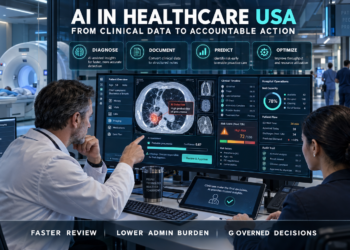
AI in Healthcare in the USA: Evidence and Safety
Executive Summary AI in healthcare is now embedded in U.S. imaging queues, clinical documentation, patient-flow systems, revenue-cycle operations, remote monitoring,...
















Recent News










NezzHub is a technology-focused knowledge hub delivering insights on AI, robotics, cybersecurity, biotech, and emerging innovations. Our mission is to simplify complex technologies through research-driven content and analysis.