





Executive Summary
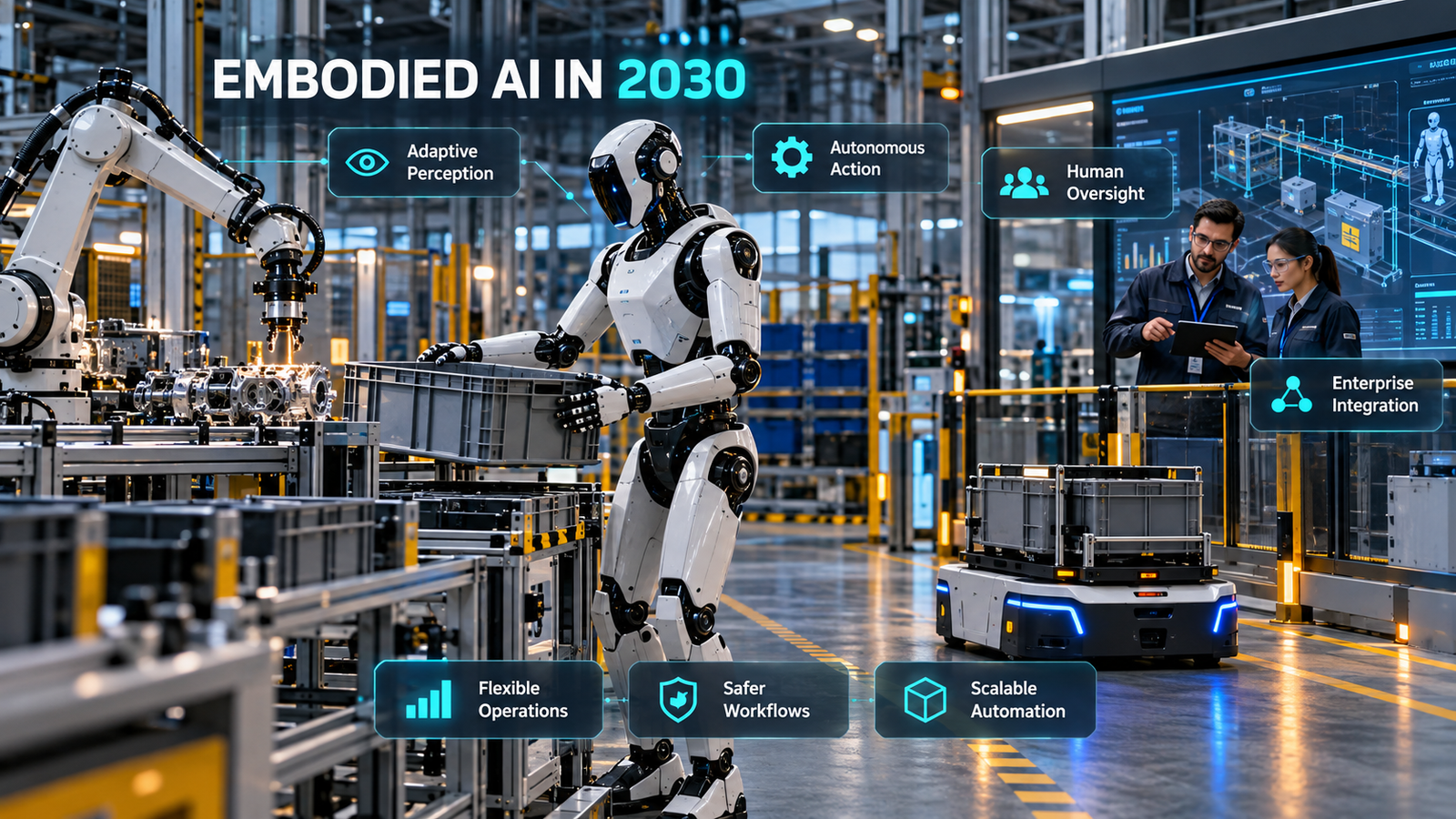
Embodied AI is moving from controlled demonstrations into factories, warehouses, hospitals, inspection sites, and research fleets. The commercial question is no longer whether autonomous machines can perform impressive tasks; it is whether they can repeat useful work safely, recover from exceptions, integrate with enterprise software, and produce defensible economics.
The installed base offers a stronger signal than speculative market forecasts. The International Federation of Robotics reports that 542,000 industrial robots were installed during 2024, while professional service-robot sales approached 200,000 units; neither figure proves that general-purpose robots will dominate by 2030, but both show that operational demand already exists.[1][2]
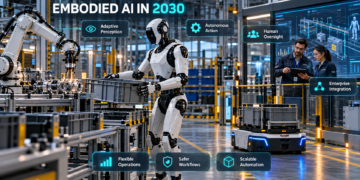
One plausible adoption scenario for 2030 is wider use of hybrid robot architectures. These systems could combine vision-language-action models with deterministic motion control, edge inference, fleet orchestration, digital twins and human approval gates. Adoption will depend on demonstrated reliability, integration effort, safety requirements and task economics.
That hybrid design matters because a fluent model can still misread a reflective surface, lose localization, exceed a force limit, or choose an unsafe action. Buyers should therefore evaluate task success, intervention frequency, recovery time, energy use, safety events, integration effort, and cost per completed mission—not staged demonstrations.
The likely winners will be organizations that standardize workflows before buying embodied AI hardware, build reusable integration layers, and treat embodied AI behavior as a governed production system. The likely losers will purchase a “general-purpose” machine before defining its operating envelope, evidence requirements, maintenance model, and stop conditions.
I. Current Market Landscape and the Cost of Waiting
Robot demand is real, but general autonomy remains uneven
Factory automation has already crossed the experimental threshold, yet most deployed embodied AI systems remain task-specific. IFR’s 2025 release says annual industrial-robot installations exceeded 500,000 for the fourth consecutive year, with Asia accounting for 74% of 2024 installations.[1]
Professional service robots are growing in logistics, cleaning, inspection, hospitality, agriculture, and medicine. IFR recorded almost 200,000 professional service robots sold in 2024, up 9%, while acknowledging that its service-robot sample is not a complete census of every producer.[2]
Those numbers support investment in enterprise robotics deployment and embodied AI, but not a claim that every workplace will use humanoids by 2030. Wheeled autonomous mobile robots, fixed arms, collaborative robots, drones, and specialized inspection machines will often remain cheaper, safer, and easier to maintain than general embodied AI.
The commercial bottleneck is the last 10% of the workflow
An embodied AI robot may achieve high task completion in a clean test cell and still fail commercially. Pallets arrive damaged, floors become wet, labels fold, wireless coverage drops, people block routes, replacement parts vary, and upstream systems send stale data.
That final layer of operational variability drives hidden cost. Every remote intervention, manual reset, blocked aisle, failed grasp, charging conflict, and software rollback consumes labor and reduces effective throughput.
The key procurement question is therefore not “Can embodied AI do the task?” It is “What percentage of production demand can the complete embodied AI system handle within the approved safety envelope, and what happens to cost when it cannot?”
Cost of inaction versus cost of premature deployment
Waiting carries measurable risks where labor shortages, ergonomic injuries, inspection gaps, or material-flow delays constrain output. A well-designed deployment can stabilize repetitive work and release skilled staff for exception handling, maintenance, quality, and process improvement.
Premature embodied AI adoption has its own cost. Custom integration, simulation infrastructure, site modification, safety validation, cloud inference, spare parts, field support, retraining, and cybersecurity monitoring can exceed the robot’s acquisition price.
Executives should frame the decision as a portfolio of workflows rather than a fleet purchase. Invest first where process volume is stable, exceptions are observable, failure is recoverable, and the value of each completed mission can be calculated.
How Virtual Robot Testing Reduces Cost and Time: Enterprise Guide 2026
II. Deep-Dive Technical Analysis and Evidence
Architecture Overview: embodied AI will be a system of systems
Embodied AI converts perception and instructions into physical action, but production reliability comes from separation of responsibilities. A probabilistic model can interpret a scene and propose a task, while certified or validated controllers enforce speed, force, collision, workspace, and emergency-stop constraints.
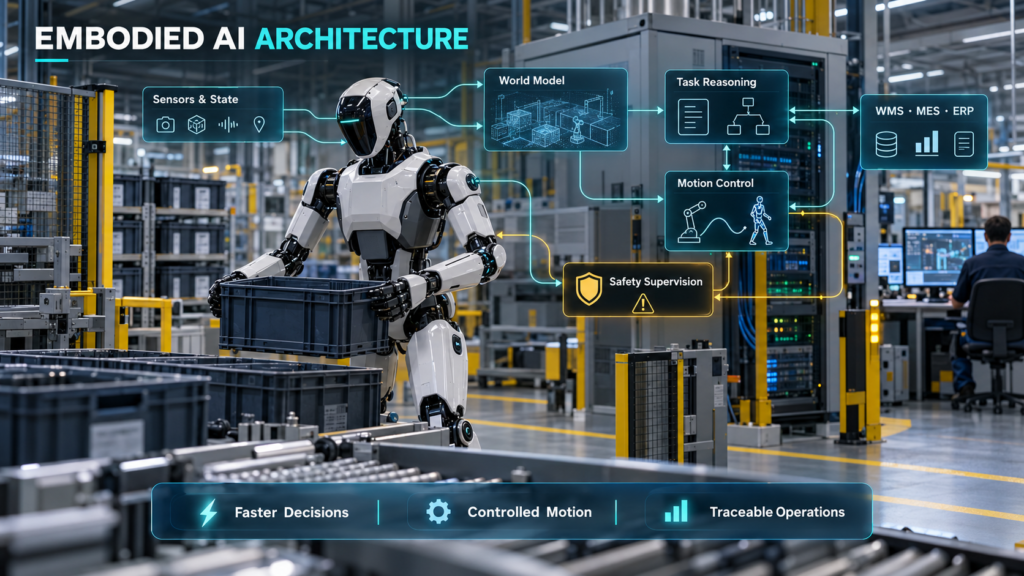
A practical architecture has six layers:
- Sensing and state estimation: cameras, depth sensors, LiDAR, tactile arrays, force-torque sensors, encoders, microphones, and battery telemetry.
- World modelling: object identity, free space, human position, semantic maps, uncertainty estimates, and task state.
- Task reasoning: instruction interpretation, job decomposition, tool selection, sequencing, and exception classification.
- Motion and manipulation: grasp generation, trajectory planning, balance, locomotion, impedance control, and collision avoidance.
- Safety and supervision: independent limits, protective stops, access control, human approval, health monitoring, and incident capture.
- Enterprise integration: WMS, MES, ERP, CMMS, identity management, observability, digital twins, and fleet scheduling.
Vision-language-action research attempts to connect visual observations and language instructions directly to embodied AI actions. Surveys published in 2024 and 2025 report rapid progress, but also identify generalization, data quality, evaluation, latency, memory demand, and real-world robustness as unresolved embodied AI deployment barriers.[3][4][5]
Why hybrid control beats model-only autonomy
An embodied AI foundation model can help a robot understand “place the damaged carton in the inspection area,” but it should not alone determine safe joint torque. High-level embodied AI flexibility and low-level control operate at different frequencies, latency budgets, and assurance levels.
The reasoning layer may run when a task changes or an exception occurs. Servo control and protective functions must respond continuously, even if network access, cloud inference, or the reasoning model becomes unavailable.
This leads to a two-speed design. Slow cognition selects goals and recovery strategies, while fast deterministic control maintains stability, contact forces, stopping distance, and actuator limits.
Integration Flowchart
```mermaid
flowchart TD
    A[Enterprise order or mission] --> B[Policy and identity check]
    B --> C[Task planner and world model]
    C --> D[Safety-approved skill library]
    D --> E[Robot controller and actuators]
    E --> F[Sensors and execution evidence]
    F --> C
    F --> G[Operations monitoring and audit log]
    G --> H{Exception within envelope?}
    H -- Yes --> C
    H -- No --> I[Protective stop and human review]
```
This diagram shows information flow, not the complete safety-control architecture. Independent protective controls remain active throughout execution and can stop motion without waiting for operations monitoring. The “Yes” branch permits only prevalidated recovery within the approved operating envelope; uncertainty about safety or an out-of-envelope exception requires a safe state and human review. Sensor feedback updates task state and does not automatically authorize model retraining or new skills.
The loop must preserve evidence across planning and execution. A useful event record includes mission ID, software and model versions, sensor health, operator identity, commanded action, measured state, safety status, exception code, and recovery decision.
Edge, cloud, and on-premise trade-offs
On-device inference reduces network dependence and can protect sensitive visual data. Its limits are power, heat, memory, model size, update complexity, and the difficulty of running several perception and control workloads concurrently.
Cloud inference provides elastic compute and centralized model management, but adds latency, connectivity, egress cost, and data-governance exposure. Safety-critical motion cannot assume that a remote service will always respond within deadline.
The most defensible 2030 architecture is hybrid. Keep protective functions, localization, basic perception, and motion control at the edge; use local servers or cloud resources for fleet optimization, large-model reasoning, simulation, retraining, and cross-site analytics.
Simulation helps scale learning, but it does not prove field safety
Simulation can generate rare events, parallelize embodied AI training, test software changes, and reduce wear on expensive hardware. NVIDIA’s Isaac GR00T initiative and Isaac Lab illustrate the commercial direction toward embodied AI foundation models, synthetic data, and GPU-accelerated physics.[6][7]
The sim-to-real gap remains material. Contact friction, deformable objects, sensor noise, actuator wear, human behavior, lighting, and radio interference are difficult to reproduce with sufficient fidelity.
Teams should use simulation to reject weak policies, not to certify success by itself. Every release still needs staged hardware tests, representative site trials, adversarial edge cases, rollback criteria, and post-deployment monitoring.
III. Where Embodied AI Can Create Business Value by 2030
Manufacturing: flexible handling before general assembly
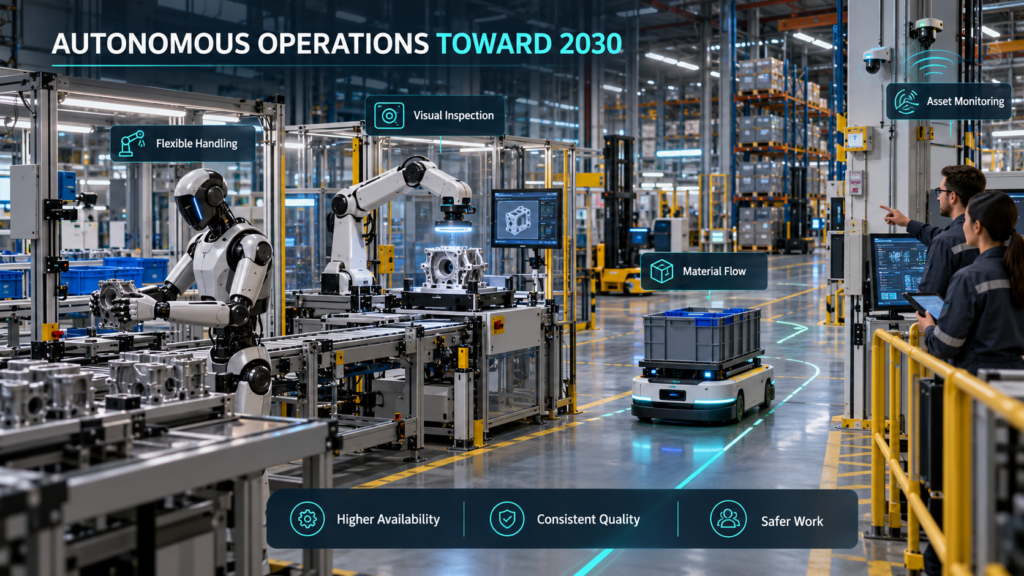
The best near-term manufacturing tasks have high repetition but enough variation to defeat rigid automation. Examples include parts sequencing, tote transfer, kitting, machine tending, visual inspection, and movement of materials between work cells.
Humanoid form factors may add value where facilities, tools, shelves, and aisles were designed for people. That advantage disappears when a fixed arm or mobile base can deliver the same throughput with fewer joints, lower energy use, and simpler maintenance.
Boston Dynamics positions Atlas for industrial material handling, while its public roadmap indicates factory deployments rather than immediate general consumer use.[8] This is strategically important: industrial sites offer controlled routes, trained supervisors, measurable tasks, and stronger maintenance support.
Warehousing and logistics: orchestration matters more than dexterity
Warehouses already use autonomous mobile robots at scale, so the next embodied AI step is not merely smarter navigation. Value comes from combining movement, manipulation, inventory state, dock schedules, worker traffic, and exception queues into one operational plan.
An embodied AI system may unload mixed containers, move irregular packages, replenish shelves, or recover dropped items. The economic case depends on items handled per hour, damage rate, intervention minutes, charging time, and whether the machine can share existing infrastructure safely.
Healthcare logistics: bounded missions, not autonomous medicine
Hospitals offer viable non-clinical missions such as sterile-supply movement, meal delivery, waste transport, pharmacy runs, specimen routing, and inventory scanning. These workflows can be valuable because staff time is scarce and hospital corridors create repeatable but dynamic navigation problems.
Clinical embodied AI claims require a separate evidence and regulatory pathway. An embodied AI robot that carries supplies is not equivalent to a system that diagnoses, physically assists a patient, administers treatment, or changes clinical priority.
Healthcare buyers should isolate the operational workflow from clinical decision-making. They must also address privacy, infection control, secure compartments, elevator integration, accessibility, downtime procedures, and manual recovery during emergencies.
Inspection, energy, and infrastructure
Embodied AI inspection robots can create value where access is hazardous, remote, or expensive. Thermal cameras, acoustic sensors, gas detectors, and computer vision can support wind, solar, pipeline, substation, construction, and industrial-plant inspections.
The embodied AI system should capture evidence rather than silently close a maintenance ticket. A qualified person must review high-consequence findings, while the system preserves location, calibration, confidence, images, environmental conditions, and the model version that produced the alert.
Home robotics faces additional adoption constraints
Homes are difficult environments for embodied AI because they contain stairs, pets, children, glass, clutter, deformable objects, private data, and untrained users. A household embodied AI robot also needs a consumer price, quiet operation, simple maintenance, and safe failure behavior.
By 2030, constrained home functions are more credible than a universal domestic worker. Cleaning, monitoring, fetching selected objects, telepresence, and accessibility support may expand, but unsupervised care and complex cooking demand much stronger evidence.
IV. Performance Evaluation Matrix
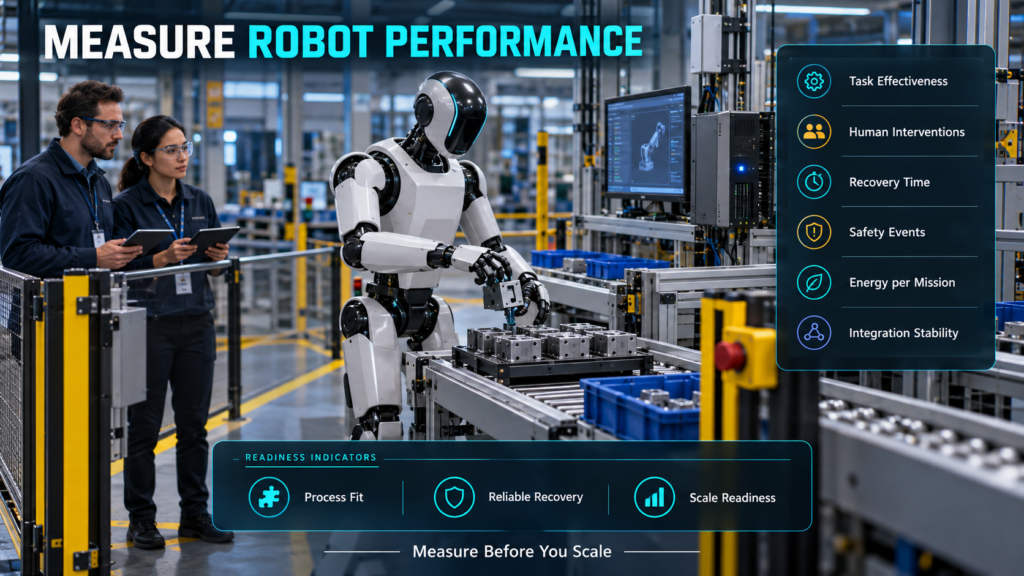
Metrics that expose commercial reality
Accuracy alone is inadequate because physical work has time, energy, recovery, and safety consequences. A 95% task-success rate can be unacceptable if the remaining 5% causes damage, long resets, or unsafe motion.
| Evaluation dimension | Required measure | Pilot evidence | Scale gate |
|---|---|---|---|
| Task effectiveness | Successful missions per attempted mission | Representative tasks and objects | Stable result across shifts |
| Reliability | Mean missions between interventions | Logged human assists and resets | Downward intervention trend |
| Recovery | Mean time to detect and recover | Blocked route, failed grasp, lost localization | Bounded autonomous recovery |
| Safety | Protective stops, near misses, force-limit events | Independent incident review | No unresolved critical hazard |
| Throughput | Completed units or missions per hour | End-to-end workflow timing | Meets process takt or SLA |
| Quality | Damage, placement, inspection false calls | Ground-truth sampling | Within approved quality limits |
| Energy | Watt-hours per completed mission | Charge and idle telemetry | Fits shift and charging plan |
| Integration | API failures and stale-state events | WMS/MES/ERP reconciliation | Controlled retry and rollback |
| Cybersecurity | Unauthorized commands, patch latency | Penetration and access testing | Closed critical findings |
| Economics | Fully loaded cost per completed mission | Labor, support, compute, downtime | Beats approved alternative |
Test across the operating envelope
The pilot dataset should include routine work, expected variation, and credible misuse. Test changing light, occlusion, reflective packaging, damaged containers, blocked aisles, network loss, low battery, sensor degradation, manual entry, and simultaneous fleet demand.
Report distributions rather than one average. Median performance can conceal a long tail of slow recoveries that breaks shift planning and damages robotics automation ROI.
V. Commercial Solutions and Best Practices
Feature and cost comparison table
Public list prices are uncommon for enterprise embodied AI systems, and embodied AI hardware price alone is misleading. The table therefore compares commercial posture and cost drivers rather than inventing purchase figures.
| Solution category | Representative offering | Strongest fit | Important limitation | Principal cost drivers |
|---|---|---|---|---|
| Robot foundation-model stack | NVIDIA Isaac GR00T and Isaac Lab | Simulation, synthetic data, VLA development, multi-robot R&D | Requires robotics engineering and suitable hardware | GPU compute, simulation, data, integration, validation |
| Embodied reasoning model | Google DeepMind Gemini Robotics ER | Spatial reasoning, task planning, robot-tool orchestration | Preview or partner access may limit production use; separate control stack required | API/compute, integration, safety validation, data governance |
| Industrial humanoid platform | Boston Dynamics Atlas | Human-designed industrial spaces and material handling | Deployment maturity, task economics, and support scope must be verified | Robot, tooling, site changes, support, spares, training |
| Specialized automation stack | AMR, cobot, fixed arm, or inspection robot | High-volume bounded workflows | Less general across unrelated tasks | Hardware, fleet software, fixtures, mapping, support |
NVIDIA describes Isaac GR00T as a research and development platform for humanoid foundation models and data pipelines.[6] Google describes Gemini Robotics as paired VLA and embodied-reasoning models, while its developer documentation identifies current robotics access as preview.[9]
Boston Dynamics markets Atlas for industrial work and material handling, but embodied AI buyers should demand site-specific evidence rather than infer production economics from capability videos.[8] A specialized robot remains the benchmark alternative because embodied AI generality has value only when it exceeds its added cost and complexity.
A five-gate procurement framework
Gate 1: workflow economics
Document volume, cycle time, staffing, injury exposure, quality loss, congestion, seasonality, and the current cost of exceptions. Reject workflows whose value cannot be measured.
Gate 2: environmental readiness
Map surfaces, slopes, doors, elevators, charging, lighting, wireless coverage, access zones, sanitation, object variation, and pedestrian density. The embodied AI operating design domain must match the real site.
Gate 3: integration readiness
Define authoritative systems, message ownership, data latency, retry logic, manual override, identity, and audit requirements. Avoid direct point-to-point connections that make every embodied AI robot a custom software project.
Gate 4: safety and security validation
Complete hazard analysis, protective-function tests, cybersecurity review, privacy assessment, emergency procedures, and worker training. Require evidence for hardware, software, models, tools, and the integrated application.
Gate 5: scale economics
Calculate the fully loaded cost per completed mission at expected utilization. Include lease or depreciation, integration, support, spares, batteries, cloud and edge compute, site changes, insurance, retraining, downtime, and human supervision.
VI. Deployment Challenges That Persist Through 2030
Long-tail failures and policy drift
Robots encounter combinations that were absent from training. A new packaging film, floor reflection, uniform color, cart geometry, or firmware update can shift perception and control performance without an obvious component failure.
Version every model, policy, map, calibration, skill, and configuration. Use canary deployment, change approval, shadow evaluation, rollback packages, and automatic suspension when performance leaves its validated range.
Dexterity, energy, and maintainability
Human hands combine sensing, compliance, strength, and fast recovery in a compact mechanism. Robotic hands add actuators, cables, joints, failure points, calibration demands, and replacement cost.
Legged mobility also consumes energy and increases fall risk. If wheels, fixtures, or a simpler gripper solve the workflow, they may deliver better availability and cost optimization than a human-shaped machine.
Data scarcity and evaluation fragmentation
Internet-scale text and images do not contain enough high-quality embodied AI action trajectories. Physical data is expensive because it requires hardware time, safe supervision, reset labor, calibration, and consistent annotation.
Cross-robot embodied AI learning is difficult because bodies differ in reach, payload, sensors, kinematics, and control interfaces. VLA research is addressing motion transfer and multi-embodiment learning, but the embodied AI literature continues to identify datasets, evaluation, and deployment robustness as open problems.[3][4][10]
Security becomes physical risk
An autonomous embodied AI robot expands the attack surface through cameras, wireless links, cloud APIs, remote support, update services, credentials, fleet managers, and enterprise connectors. A compromised account can expose sensitive video or create unauthorized physical action.
Minimum controls include unique device identity, least privilege, signed updates, secure boot where supported, encrypted communications, network segmentation, credential rotation, command authorization, tamper evidence, vulnerability response, and complete event logs.
Workforce design cannot be deferred
Robots change tasks before they eliminate entire occupations. New work appears in process design, fleet supervision, exception handling, maintenance, safety, training, data operations, and vendor management.
Ignoring workforce impact creates resistance and weakens incident reporting. Involve operators early, publish task boundaries, define escalation rights, train affected staff, and measure whether ergonomic and workload benefits actually occur.
VII. Business Outcomes and Strategic ROI Takeaways
Use mission economics, not labor substitution slogans
The basic comparison is the fully loaded cost of the embodied AI workflow against the risk-adjusted cost of the current process and credible alternatives. Do not assume that every embodied AI hour replaces one paid human hour.
Calculate cash payback separately from operational benefits:
Annual net cash benefit = verified annual cash savings + additional annual contribution margin − incremental annual operating costs.
Simple payback in years = total upfront investment ÷ positive annual net cash benefit.
Total upfront investment includes purchased robots, tooling, initial software, integration, site preparation and commissioning. Annual operating costs include recurring software, compute, energy, maintenance, support and human supervision. For leased systems, include initial implementation costs upfront and recurring lease payments in operating costs.
Report released employee capacity separately unless it changes expenditure or produces verified additional contribution margin. Count quality improvements, avoided downtime and other savings only where supported by evidence, without counting the same benefit twice. Do not deduct depreciation or annualized upfront investment again when calculating the cash benefit used for simple payback.
Three defensible value patterns
First, embodied AI can extend constrained operating hours where a stable backlog exists. The value disappears if upstream materials, maintenance, approvals, or downstream capacity remain unavailable.
Second, embodied AI can improve consistency in repetitive handling and inspection. The organization must still sample results, control model drift, and maintain a manual process for abnormal cases.
Third, embodied AI robots can reduce human exposure to heat, chemicals, heavy loads, heights, traffic, or contaminated areas. This benefit often justifies investment even when direct labor payback is not the shortest metric.
Board-level decision rules
Fund a limited pilot when the workflow is measurable, the environment is bounded, and failure can be contained. Expand only after performance remains stable across representative shifts and the support model survives real incidents.
Pause when the vendor cannot disclose operating limits, intervention data, update policy, incident ownership, or integration dependencies. Stop when unresolved safety, privacy, or cybersecurity risks exceed the business value.
VIII. Risk Mitigation and Regulatory Framework
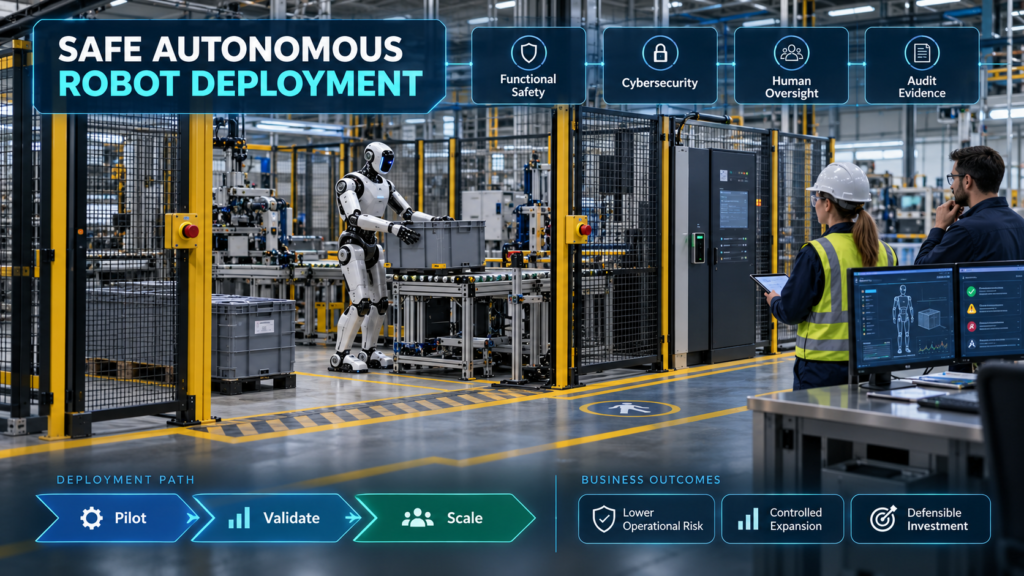
NIST AI RMF: govern, map, measure, manage
NIST AI RMF 1.0 organizes embodied AI risk work into Govern, Map, Measure, and Manage.[11] It is voluntary guidance, not an embodied AI safety certification, so organizations should combine it with applicable machinery, workplace, product, privacy, and cybersecurity obligations.
Use Govern to assign accountability, approve risk appetite, and control suppliers. Use Map to document people, environments, intended use, foreseeable misuse, affected groups, and harm scenarios.
Use Measure for performance, robustness, privacy, security, explainability, and human-factors testing. Use Manage to prioritize treatment, monitor production, respond to incidents, and withdraw unsafe functionality.
EU AI Act: classification depends on use and product context
The EU AI Act applies a risk-based framework, and certain embodied AI safety components of products covered by listed harmonisation legislation may qualify as high-risk systems when the statutory conditions are met.[12] A company should not label every embodied AI robot “high-risk” without completing the Article 6 and Annex I/III analysis.
Where high-risk duties apply, buyers and providers must examine risk management, data governance, technical documentation, logging, transparency, human oversight, accuracy, robustness, cybersecurity, quality management, registration, and post-market monitoring. Product-safety and workplace duties may apply independently of the AI Act.
Robotics and functional-safety standards
ISO 10218-1:2025 and ISO 10218-2:2025 address industrial robot and robot-application safety, while ISO 13482 covers personal-care robots and is being revised for broader service-robot safety.[13] Applicability to embodied AI depends on robot type, application, environment, and jurisdiction.
Standards are not a substitute for application-level risk assessment. Grippers, payloads, layout, speed, human access, software behavior, maintenance, and foreseeable misuse can create hazards that the base platform certification does not resolve.
Compliance checklist before production release
- Define intended use, prohibited use, users, environment, and operating design domain.
- Assign an accountable owner for safety, AI risk, cybersecurity, privacy, and operations.
- Complete hazard analysis for motion, contact, payload, battery, fire, falling, trapping, and tool use.
- Separate probabilistic reasoning from independent protective controls.
- Validate emergency stops, protective stops, speed and force limits, and safe recovery.
- Document model, software, map, calibration, and configuration versions.
- Test representative edge cases, misuse, network loss, sensor failure, and degraded operation.
- Enforce device identity, least privilege, signed updates, segmentation, and command authorization.
- Establish privacy rules for video, audio, biometric, worker, patient, and location data.
- Record missions, interventions, safety events, overrides, updates, and incident evidence.
- Train operators, maintainers, supervisors, security teams, and emergency responders.
- Define vendor notification, vulnerability handling, support, spare parts, and end-of-life terms.
- Review EU AI Act status and all applicable product, machinery, sector, and workplace rules.
- Approve rollback, shutdown, business-continuity, and manual-workaround procedures.
IX. Preparing an Evidence-Based Robotics Strategy
Do not build a 2030 robotics strategy around a forecasted market size or a humanoid demonstration. Build it around five assets: a ranked workflow portfolio, a reusable integration architecture, an evidence-based safety case, production telemetry, and a financial model based on completed missions.
Start with one bounded workflow and one accountable business owner. Run the pilot long enough to encounter normal variation, publish the intervention and failure data internally, and compare the result with simpler automation before approving scale.
Begin with a workflow and readiness assessment covering process economics, site constraints, architecture, safety, cybersecurity, applicable regulation, workforce impact and vendor evidence. A 30-day assessment may provide an initial planning window, but extend it where necessary to obtain representative operating data. Use the findings to decide whether to proceed, redesign, defer or reject the proposed application.
Frequently Asked Questions
Will embodied AI replace most workers by 2030?
Available evidence does not support a precise claim that most workers will be replaced by 2030. Adoption will vary by task economics, regulation, reliability, site readiness, labor availability, and whether simpler automation performs better.
Are humanoid robots always better for human-designed workplaces?
No. A humanoid can reuse stairs, tools, shelves, and workstations designed for people, but it also introduces balance, dexterity, energy, maintenance, and safety complexity.
What is the best first use case for autonomous robots?
Choose repetitive, measurable work with stable volume, controlled consequences, clear exception handling, and a calculable cost per mission. Avoid high-consequence autonomous decisions until the evidence and governance are mature.
Should robot reasoning run in the cloud?
Fleet optimization and large-model reasoning may use cloud or local servers, but essential protective functions and safe motion should remain available when connectivity fails. Architecture should match latency, privacy, availability, and regulatory requirements.
How should a company calculate robotics automation ROI?
Use fully loaded lifecycle cost and verified operational benefits. Include integration, compute, support, maintenance, spares, supervision, training, downtime, site changes, and decommissioning rather than comparing wages with hardware price.
Appendix A — Academic and Primary-Source Footnotes
- International Federation of Robotics, “Global Robot Demand in Factories Doubles Over 10 Years,” World Robotics 2025, 25 September 2025. Reports 542,000 industrial robots installed in 2024 and regional installation shares.
- International Federation of Robotics, “Service Robots See Global Growth Boom,” World Robotics 2025, 7 October 2025. Reports almost 200,000 professional service robots sold in 2024 and explains the statistical sample.
- Y. Ma, Z. Song, Y. Zhuang, J. Hao, and I. King, “A Survey on Vision-Language-Action Models for Embodied AI,” arXiv:2405.14093, 2024, revised 2025.
- Z. Xu et al., “A Survey on Robotics with Foundation Models: toward Embodied AI,” arXiv:2402.02385, 2024.
- W. Guan, Q. Hu, A. Li, and J. Cheng, “Efficient Vision-Language-Action Models for Embodied Manipulation: A Systematic Survey,” arXiv:2510.17111, 2025.
- NVIDIA, “Isaac GR00T — Generalist Robot 00 Technology,” official developer documentation.
- NVIDIA Research et al., “Isaac Lab: A GPU-Accelerated Simulation Framework for Multi-Modal Robot Learning,” arXiv:2511.04831, 2025.
- Boston Dynamics, “Atlas Humanoid Robot,” official product documentation, accessed 2026.
- Google DeepMind, “Gemini Robotics,” and Google AI for Developers, “Gemini Robotics ER,” official model documentation, accessed 2026.
- Google DeepMind et al., “Gemini Robotics 1.5: Pushing the Frontier of Generalist Robots with Advanced Embodied Reasoning, Thinking, and Motion Transfer,” arXiv:2510.03342, 2025.
- National Institute of Standards and Technology, Artificial Intelligence Risk Management Framework (AI RMF 1.0), NIST AI 100-1, January 2023.
- European Union, Regulation (EU) 2024/1689 Laying Down Harmonised Rules on Artificial Intelligence, 13 June 2024.
- International Organization for Standardization, ISO/TC 299 Robotics standards catalogue, including ISO 10218-1:2025, ISO 10218-2:2025, and ISO 13482 service-robot safety materials.
Appendix B — Research Integrity and Editorial Transparency
Forecast methodology
Statements about 2030 are scenario-based judgments, not guaranteed predictions. The analysis separates verified current adoption, public vendor positioning, academic research, and regulatory requirements from forward-looking interpretation.
Corporate Editorial Transparency and AI Usage Disclosure
AI-assisted tools were used to support research organization, drafting and language refinement. NezzHub retains editorial responsibility for the published article. Vendor inclusion does not constitute endorsement.
No vendor paid for inclusion in the comparison table. Product availability, pricing, model access, standards and regulation can change. Readers should confirm current details before procurement or deployment.
Author and Editorial Review
Author: Garikapati Bullivenkaiah
Technology research writer with LL.B., LL.M., M.A., and MBA qualifications. He writes about emerging technologies and their business, governance and legal implications. His multidisciplinary academic background informs his analysis of technology adoption, intellectual property, and organizational risk. His articles explain technical concepts and practical considerations for business owners, IT managers and technology decision-makers. LinkedIn Profile
Reviewed by: Chitikineni Ramadevi — Editor
Chitikineni Ramadevi holds an M.Sc. in Computers from Andhra University and has over 10 years of research experience in technology-related subjects. She reviews NezzHub articles for clarity, factual accuracy, source support and practical relevance.
Published by: NezzHub
Research approach: This article draws on primary sources, technical documentation and relevant industry research. References are provided within the article or its sources section.
Last reviewed: 09-27-2026
Corrections: To report a factual error or outdated information, please contact NezzHub.

Garikapati Bullivenkaiah is a seasoned entrepreneur with a rich multidisciplinary academic foundation—including LL.B., LL.M., M.A., and M.B.A. degrees—that uniquely blend legal insight, managerial acumen, and sociocultural understanding. Driven by vision and integrity, he leads his own enterprise with a strategic mindset informed by rigorous legal training and advanced business education. His strong analytical skills, honed through legal and management disciplines, empower him to navigate complex challenges, mitigate risks, and foster growth in diverse sectors. Committed to delivering value, Garikapati’s entrepreneurial journey is characterized by innovative approaches, ethical leadership, and the ability to convert cross-domain knowledge into practical, client-focused solutions.