










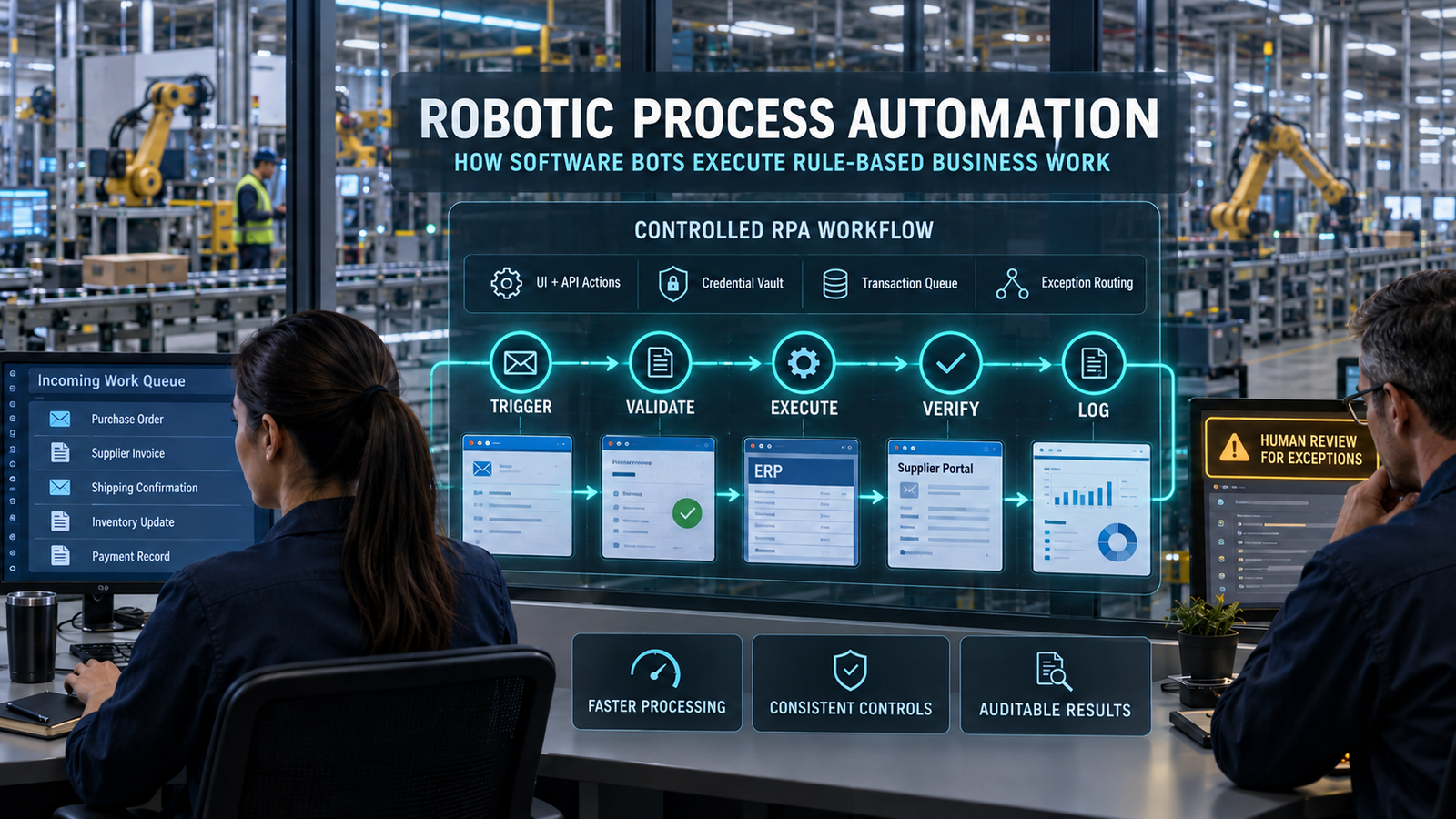
Executive Summary
Robotic process automation uses governed software workers to execute repeatable actions across enterprise applications, but the commercial result depends on much more than recorded mouse clicks. A durable program combines UI automation, APIs, orchestration, credential controls, queues, exception handling, testing and operational ownership.
For decision-makers, the central question is not whether a bot can complete a demonstration. It is whether robotic process automation can survive application changes, handle bad data, preserve segregation of duties, meet recovery targets and produce evidence for auditors.
The strongest candidates have stable rules, digital inputs, meaningful volume and a manageable exception rate. Processes dominated by judgment, frequent redesign, handwritten documents or unpredictable interfaces usually need process repair, integration work or human review before RPA software can add reliable value.
This Article explains the architecture, integration flow, deployment friction, platform choices, performance metrics, cost model and governance controls behind production-grade robotic process automation. It also distinguishes deterministic RPA from AI-assisted automation, because the two create different validation and regulatory obligations.
I. The Current Market Landscape and Challenge
The real robotic process automation problem is fragmented execution
Most enterprises do not suffer from a complete absence of software. They suffer from workflows that cross email, spreadsheets, browser portals, ERP screens, remote desktops, document stores and approval queues without a clean transaction boundary.
An accounts-payable analyst may download an invoice, verify a supplier, inspect a purchase order, key fields into an ERP system and notify a budget owner. Each system works, yet the end-to-end process still depends on manual transfer that robotic process automation may be able to remove.
Robotic process automation can bridge those gaps when replacing the underlying applications is slower or more expensive than automating the interaction layer. That advantage is tactical: a bot can operate an existing interface without waiting for a multi-year core-system replacement.
The same advantage creates technical debt. When robotic process automation depends on screen coordinates, unstable selectors, virtual-desktop rendering or undocumented business rules, every application release becomes a potential production incident.
Why simple demonstrations create false confidence
A recorded happy path proves only that one input worked in one environment at one moment. Production robotic process automation must cope with session timeouts, pop-ups, duplicate records, unavailable systems, malformed files, permission changes and partial transactions.
The engineering objective for robotic process automation is controlled execution, not imitation. A software worker needs explicit preconditions, transaction identifiers, retry policies, idempotency rules, exception categories, rollback behavior and a safe handoff to a person.
This distinction separates a desktop macro from an enterprise automation platform. The platform must schedule work, isolate credentials, distribute queues, capture logs, enforce releases and show operators what failed without exposing sensitive business data.
Cost of inaction
Manual work carries visible labor cost and less visible control cost. Robotic process automation targets re-keying, aging queues and local spreadsheet activity that can weaken access control and auditability.
Delay also affects working capital and service levels. A late invoice approval can forfeit an early-payment discount, while slow customer onboarding can delay revenue recognition or trigger repeated status calls.
The cost of inaction should not be estimated by multiplying every task minute by salary. Some saved minutes become productive capacity, while others are absorbed by meetings, waiting time or unchanged staffing constraints.
A defensible baseline records transaction volume, active handling time, queue time, rework, error cost, peak capacity and control failures. That baseline becomes the denominator for evaluating business process automation after deployment.
Cost of premature automation
Automating a broken process can make defects travel faster. If business units disagree about validation rules, robotic process automation encodes one version and turns policy ambiguity into repeatable operational conflict.
Premature robotic process automation also creates a support burden. Teams inherit brittle scripts, expired credentials, unmanaged virtual machines and undocumented dependencies after the original developer or implementation partner leaves.
Academic evidence supports this caution. A 2023 IEEE study on RPA benefits realization reported that roughly 30% to 50% of initiatives fail, predominantly because of managerial issues rather than an inability to build a bot.[1]
The implication is commercial, not academic: fund operating ownership and change management with the same seriousness as licenses and development.
II. Deep-Dive Technical Analysis and Evidence
Architecture Overview: how robotic process automation works
Production robotic process automation is a distributed execution system. The visible bot is only one component in a control plane that decides which package runs, which identity it uses, which transaction it processes and what evidence it retains.
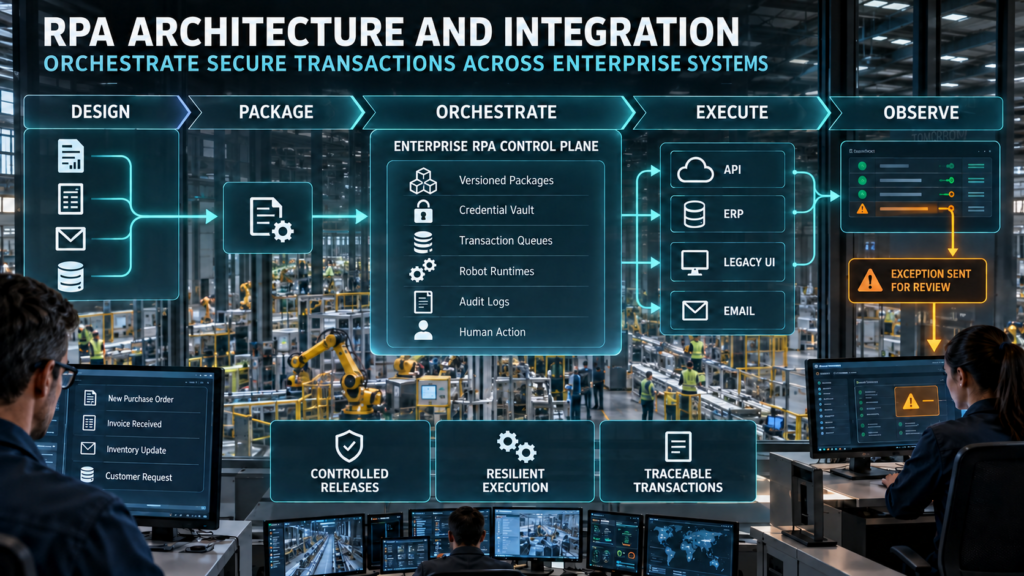
The core architecture normally includes:
- Design environment: Developers model workflows, selectors, API calls, business rules, tests and exception paths.
- Package repository: Approved versions are signed or controlled, then promoted through development, test and production.
- Orchestrator: A central service schedules jobs, assigns machines, manages queues and records execution state.
- Robot runtime: An attended desktop or unattended machine executes the approved package.
- Credential vault: Secrets are retrieved at runtime rather than stored inside workflow files.
- Queue and state store: Transactions receive unique identities, retry states and business or system exception codes.
- Observability layer: Logs, screenshots where permitted, alerts and service metrics support investigation.
- Human-action channel: Exceptions and approvals move to authorized staff with the required business context.
Attended robotic process automation runs in a user session and helps a person complete a bounded task. It suits contact-center guidance, desktop data retrieval and actions that require real-time judgment.
Unattended automation runs under a managed service identity or robot account. It suits scheduled reconciliation, overnight report preparation, batch data movement and queue-driven back-office work.
The difference affects licensing, infrastructure and control design. Unattended execution needs machine capacity, scheduling, non-interactive authentication, monitoring and support coverage; attended automation needs desktop compatibility and careful controls around what a user can trigger.
API-first, UI-second makes robotic process automation more durable
UI automation is useful when a supported API does not exist, but it is usually the least stable integration layer. Small changes to element identifiers, window focus, screen scaling, browser security or virtual-desktop latency can break execution.
A practical robotic process automation hierarchy is: supported API, database procedure controlled by the application owner, file exchange, accessibility selector, computer vision and finally coordinate-based interaction. Each step downward increases maintenance and test exposure.
This does not make UI automation inherently poor. It makes dependency management essential, especially for legacy software that cannot justify a custom integration project.
Strong RPA software can combine methods in one transaction. It may read an email through an API, extract an attachment, use a browser UI for a legacy portal, call an ERP connector and then post the final status through a workflow service.
Robotic Process Automation Integration Flowchart
- Receive a trigger or uniquely identified queue item.
- Validate the input, execution identity and required permissions.
- Check whether the transaction has already been completed before attempting it.
- Use a supported API where available; otherwise use controlled UI automation.
- Verify the committed result in the target application.
- Record the confirmation, transaction identifier and execution evidence.
- Route invalid inputs and unresolved outcomes to the appropriate reviewer.
- Retry eligible technical failures only within defined limits and after checking for duplicate effects.
Verification is crucial in robotic process automation. A successful click does not prove that the target application committed the transaction, so the workflow must query a confirmation number, status field or system-of-record record.
Idempotency prevents duplicate effects when a timeout occurs after the target system commits but before the bot receives confirmation. The automation should search for an existing transaction key before retrying a payment, claim, order or account update.
Queue design and exception semantics
Queues turn a long batch into independent transactions. Each item should carry a business key, input reference, priority, retry count, processing status and a link to evidence rather than unrestricted sensitive data.
A system exception is temporary or technical, such as a network timeout or unavailable application. A bounded retry with backoff may be appropriate.
A business exception means the input violates a rule, such as a missing purchase order or invalid policy number. Repeating the same transaction usually adds cost without changing the result.
Conflating the two creates retry storms and hides process quality problems. Mature robotic process automation reports business exceptions to process owners and technical exceptions to platform operations.
Document processing and AI-assisted RPA
Traditional robotic process automation performs deterministic actions against structured data. OCR, document classification, natural-language models and generative AI introduce probabilistic outputs that require confidence thresholds and validation samples.
An invoice extractor can misread a decimal point or supplier account even when its overall accuracy appears high. High-risk fields should be validated against master data, totals, tax logic and purchase-order records before posting.
AI should therefore sit inside a controlled decision envelope. Low-confidence cases go to human review, high-impact actions require approval, and the original document plus model version must remain traceable.
The EU AI Act applies based on the AI system and use case, not because a workflow is labeled RPA. A deterministic bot may fall outside the Act’s AI obligations, while an AI component used for employment, credit or another regulated purpose may trigger specific duties under Regulation (EU) 2024/1689.[2]
Robotic Process Automation Deployment Challenges: where bots break
The most common failure vector is interface drift. A browser upgrade, ERP patch, renamed field or changed authentication sequence can invalidate selectors before business staff notice a problem.
Remote desktop infrastructure adds another layer to robotic process automation. Resolution changes, disconnected sessions, latency and image compression can disrupt automations that rely on visual recognition.
Credentials create operational failure when passwords expire, multifactor authentication is not designed for service execution, or a bot account loses a role. Shared user credentials should never become the hidden foundation of RPA software.
Data quality is equally dangerous for robotic process automation. Bots execute bad input quickly, so validation needs to happen before the irreversible step rather than after a batch completes.
Concurrency exposes race conditions. Two robots can select the same unprocessed item, exceed application rate limits or update a shared spreadsheet unless locking and transaction ownership are explicit.
Vendor upgrades and operating-system patches require regression testing. A production calendar should map upstream application releases to automation smoke tests and rollback decisions.
Academic and IEEE evidence
Wewerka and Reichert’s systematic review identified 63 RPA publications and organized the field around assessment and comparison dimensions, reinforcing that suitability must be evaluated rather than assumed.[3]
Research on RPA component similarity found 655 matches across 156 processes, indicating meaningful reuse opportunities but also a maintenance burden when teams duplicate logic across large estates.[4]
The classic “ironies of automation” problem remains relevant: automation can remove routine practice while leaving people responsible for rare, difficult exceptions. Human reviewers therefore need training, usable evidence and periodic exposure to exception scenarios.[5]
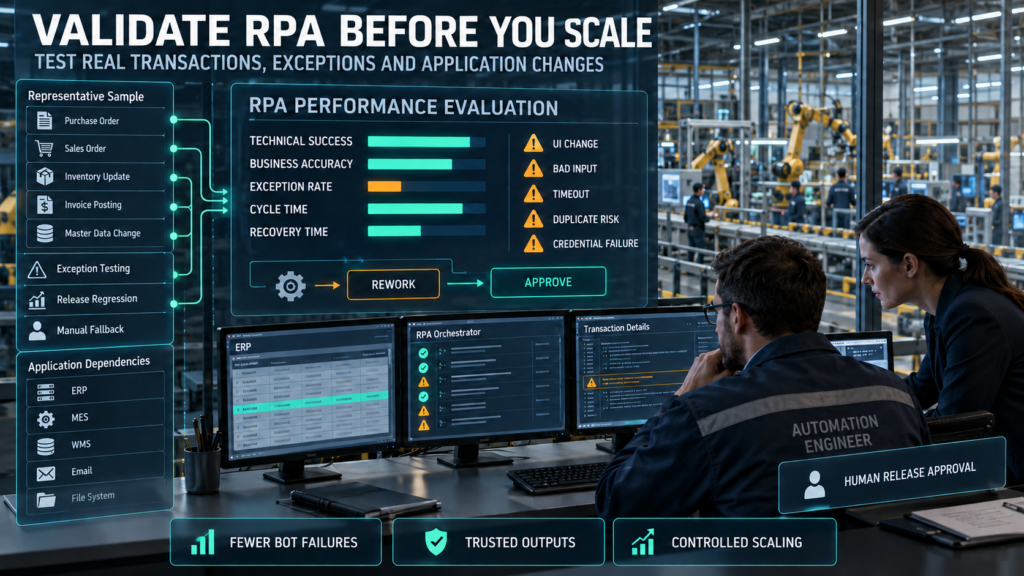
Performance Evaluation Matrix Table
| Measure | Calculation | Why it matters | Pilot acceptance rule |
| Straight-through rate | Unique eligible transactions completed correctly without human intervention ÷ all unique eligible transactions attempted | Shows real automation coverage | Set by process risk and exception profile |
| Technical success rate | Unique transactions reaching a verified successful technical outcome ÷ all unique transactions attempted | Measures platform and integration stability | Track by application and release |
| Business exception rate | Rule-invalid items ÷ attempted transactions | Exposes upstream data or policy problems | Must not be hidden as bot failure |
| Rework rate | Corrected automated outputs ÷ completed outputs | Tests output quality | Compare with the manual baseline |
| Cycle time | Completion timestamp − valid intake timestamp | Measures service improvement | Use median and tail percentiles |
| Cost per completed item | Total operating cost ÷ accepted completed transactions | Supports financial comparison | Include support and infrastructure |
| Recovery time | Service restoration − incident detection | Tests operational resilience | Align with process criticality |
| Control effectiveness | Passed control tests ÷ scheduled control tests | Supports audit confidence | Zero tolerance for critical-control bypass |
Count each transaction once using its business identifier, even when it requires multiple execution attempts. Report retry frequency separately. Exclude invalid inputs from the eligible straight-through population only under rules defined before testing, and report business exceptions separately.
Do not publish a single “accuracy” number for robotic process automation. A workflow can complete 99% of clicks while posting the wrong business value because the input rule or verification step is defective.
Robotic process automation performance should be segmented by application version, transaction type, business unit and exception class. Aggregation can conceal a failing subprocess behind a high-volume easy path.
III. Commercial Solutions and Best Practices
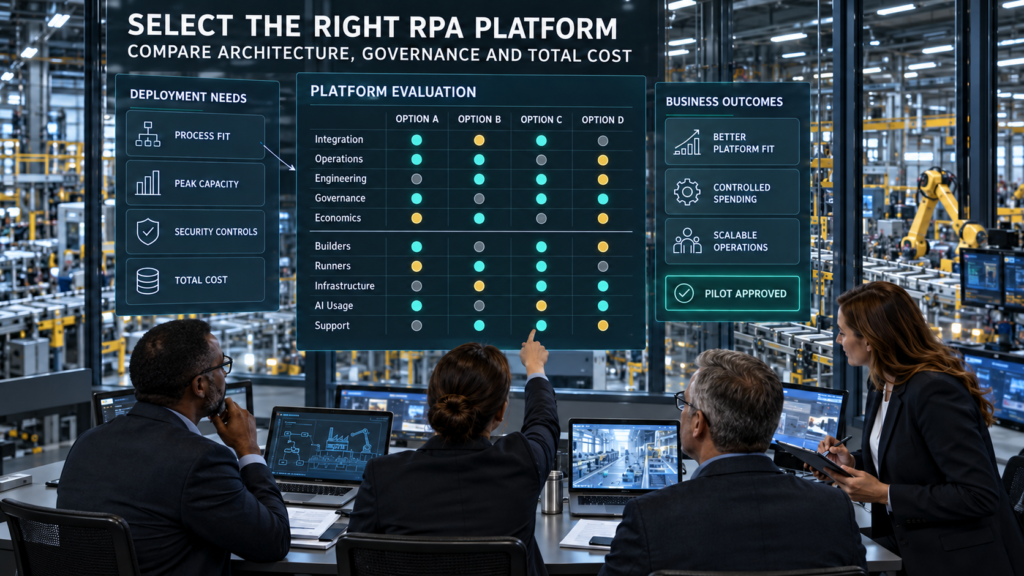
Feature and Cost Comparison Table
The table below compares buying patterns, not negotiated enterprise quotations. Prices and entitlements change by country, contract and edition, so procurement teams should validate current terms before approval.
| Platform | Best-fit environment | Architecture strengths | Public cost signal checked 13 Sep 2026 | Commercial caution |
| Microsoft Power Automate | Microsoft 365, Azure and Power Platform estates | Cloud flows, desktop RPA, connectors, hosted VM option, process mining | Premium: US$15/user/month; Process: US$150/bot/month; Hosted Process: US$215/bot/month, annual billing | Connector entitlements, request limits, Dataverse capacity and concurrency can change total cost |
| UiPath | Cross-application enterprise programs requiring broad orchestration and governance | UI and API workflows, human-in-loop, document processing, orchestration, deployment choices | Basic starts at US$25/month; Standard and Enterprise require sales quotes | Enterprise governance, robots, AI consumption, support and infrastructure require a complete bill of materials |
| Automation Anywhere | Cloud-oriented automation programs and document-heavy workflows | Cloud automation, orchestration, document automation and analytics | Quote-based on the public product pages reviewed | Confirm bot type, runner capacity, environment separation, storage, AI usage and support terms |
| SS&C Blue Prism | Centrally governed back-office automation and regulated operations | Digital workforce control, process orchestration and enterprise governance | Quote-based on the public product pages reviewed | Model production capacity, disaster recovery, development licenses and partner costs separately |
Microsoft’s public pricing page also states that one unattended bot assigned to a machine executes one desktop flow at a time; additional concurrent runs require additional bots.[6] This is a useful reminder that license count is partly a capacity calculation.
UiPath’s public plan comparison lists identity-provider support, custom roles, governance, human-in-loop automation and, at higher tiers, external vaults and CI/CD options.[7] Buyers should verify which control is included in the exact edition quoted.
A disciplined robotic process automation selection framework
Start with process architecture rather than vendor demonstrations. Inventory applications, authentication methods, transaction volumes, peak windows, document types, data residency, recovery needs and control owners.
Then run the same representative robotic process automation scenario on shortlisted platforms. Include a difficult exception, an application outage, a credential rotation and an interface change; a happy-path invoice is not a sufficient test.
Score the products across five domains:
- Integration: APIs, selectors, browser support, virtual desktops, ERP connectors and document services.
- Operations: Queues, schedules, retries, monitoring, capacity management and disaster recovery.
- Engineering: Source control, reusable components, testing, package promotion and CI/CD.
- Governance: Roles, credential vaults, audit logs, tenant separation, data controls and approval workflows.
- Economics: Builder, runner, orchestrator, AI, infrastructure, storage, support and implementation charges.
An enterprise automation platform should fit the operating model. A feature-rich product can still be the wrong choice if a small team cannot administer it or if the required specialists are unavailable locally.
Process selection scorecard
Use a weighted score before approving RPA implementation services. Candidate processes should earn points for volume, stability, rule clarity, digital inputs, measurable cost and a clear process owner.
Subtract points for frequent interface change, judgment-heavy decisions, poor master data, unresolved policy disagreements, high consequence of error and weak test environments.
A process with low volume but serious compliance exposure may still justify automation. In that case, the value comes from consistent controls and audit evidence rather than headcount reduction.
Build for change, not for launch day
Separate configuration from workflow logic. URLs, timeouts, queue names, file paths, tax rules and thresholds should be controlled values with environment-specific deployment.
Create reusable components for login, application health checks, audit logging and standard exceptions. Reuse lowers maintenance only when components have owners, version rules and regression tests.
Automations need runbooks. Operators must know how to pause schedules, drain queues, rotate credentials, replay safe transactions, identify duplicates and escalate business exceptions.
Release pipelines should enforce peer review, automated tests and promotion approvals. Direct editing on a production robot defeats the governance benefits of a central orchestrator.
Robotic Process Automation Pilot Design
A useful robotic process automation pilot processes a representative sample across normal, peak and exception conditions. It should run long enough to encounter password rotation, upstream release activity and operational handoffs.
Define acceptance criteria before development. Measures should include technical success, business accuracy, exception routing, recovery time, operator effort and cost per accepted transaction.
The pilot must also establish a manual fallback. If the automation fails near a payroll, payment or regulatory deadline, the business needs a tested way to continue safely.
IV. Business Outcomes and Strategic ROI Takeaways
Calculate benefit from accepted transactions
The core formula is straightforward:
Annual net benefit = verified labor capacity + avoided errors + avoided delay cost + retired tool cost − annual operating cost.
Use accepted robotic process automation transactions, not attempted bot runs. Failed, duplicated or manually corrected outputs do not deserve full benefit credit.
Labor capacity should be valued conservatively. If no overtime, contractor expense, hiring plan or service backlog changes, the benefit may be capacity released rather than cash removed from the income statement.
Error reduction needs evidence. Measure baseline defect frequency, remediation time, customer compensation and financial leakage, then compare the same definitions after robotic process automation goes live.
Robotic Process Automation Total Cost of Ownership
License cost is only one line. A full model includes discovery, process redesign, development, testing, infrastructure, orchestrator administration, credential management, monitoring, support, upgrades and business-owner time.
Document extraction or generative AI may add consumption charges and human-review labor. Process mining can add separate licensing and data-engineering work, as Microsoft’s public page demonstrates with a distinct process-mining add-on.[6]
Maintenance rises with the number of UI dependencies and duplicated components. A portfolio of 100 small bots can cost more to control than several API-led end-to-end workflows.
ROI and payback
Use the following decision equations:
ROI = (cumulative verified benefit − cumulative total cost) ÷ cumulative total cost.
Simple cash payback in months = upfront implementation investment ÷ positive monthly net cash savings after recurring operating costs.
This shortcut assumes reasonably constant monthly savings. If costs and savings vary during rollout, calculate payback from cumulative monthly cash flows. Report released staff capacity separately unless it produces documented cash savings.
Run sensitivity cases for transaction volume, exception rate, application-change frequency and license utilization. If the project only works under perfect straight-through processing, the business case is too fragile.
Capacity utilization matters for unattended robotic process automation. A runner licensed for one concurrent execution may sit idle between peaks, while a poorly designed schedule creates a queue during critical windows.
Strategic Robotic Process Automation Outcomes Beyond Labor
Well-controlled RPA software can shorten queues, standardize evidence, extend operating hours and reduce dependency on individual employees’ undocumented knowledge. These outcomes often matter more than raw task speed.
Robotic process automation can also buy time for core modernization. It can stabilize a transition or provide a temporary bridge, provided management sets an exit condition so the bot does not become a permanent barrier to replacing obsolete systems.
The strongest portfolio mixes technologies. APIs handle stable system transactions, workflow tools coordinate approvals, robotic process automation bridges UI gaps, and AI assists with unstructured inputs under explicit human oversight.
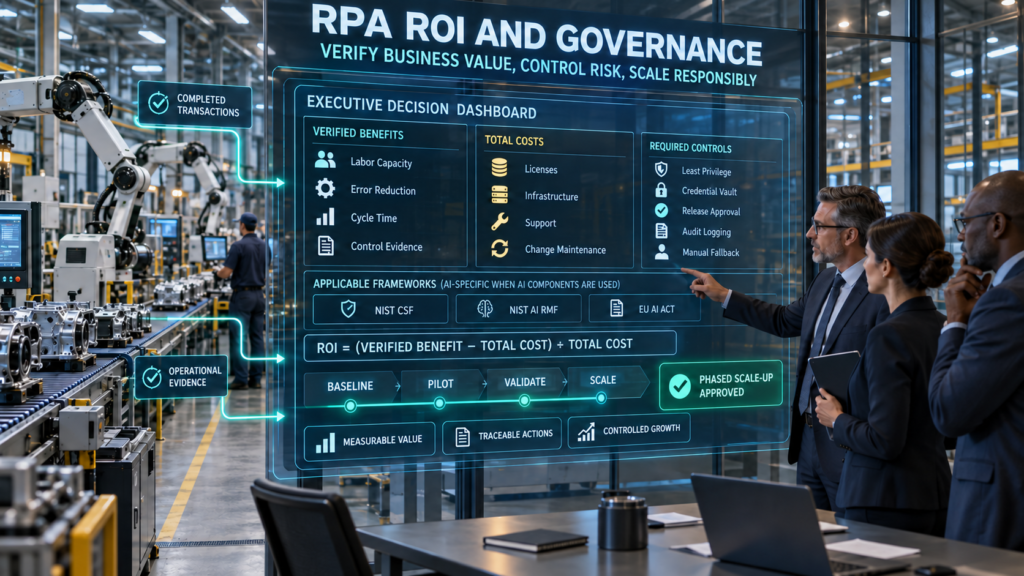
Strategic ROI checklist
- Establish a measured manual baseline before development.
- Count only accepted outputs and verified avoided costs.
- Separate cash savings, capacity release and risk reduction.
- Include licenses, infrastructure, support and change maintenance.
- Model peak concurrency rather than average volume alone.
- Recalculate the business case after the pilot and after major releases.
- Retire automations whose process, economics or control case has expired.
Risk Mitigation and Regulatory Framework
Cybersecurity and access controls
Robot identities must be unique, non-shared and restricted to the least privilege required. Credentials belong in an approved vault, with rotation, access logging and emergency revocation.
Network access should be limited to required services. An unattended machine that can browse broadly, read shared drives and reach finance systems creates a powerful lateral-movement target.
Use the NIST Cybersecurity Framework 2.0 functions—Govern, Identify, Protect, Detect, Respond and Recover—to structure platform controls.[8] Map each critical automation to an owner, data classification, dependency inventory, incident procedure and recovery test.
Logs should support investigation without copying passwords, tokens, health data or payment details into plain text. Screenshot capture must be disabled or masked when it could collect sensitive information.
Operational and financial controls
Segregation of duties applies to digital workers. The same person should not be able to change payment logic, deploy it, approve the run and erase the evidence.
High-impact transactions need limits and reconciliation. A bot should not create an unlimited supplier payment merely because every upstream field passed a formatting rule.
Use dual control for releases affecting payroll, finance, identity, safety or regulated records. Retain package version, approver, execution identity, transaction key and target-system confirmation.
AI governance and the EU AI Act
When RPA software includes machine learning, OCR confidence scoring or generative AI, use the NIST AI Risk Management Framework to govern validity, reliability, privacy, transparency and ongoing measurement.[9]
Classify the use case before deployment. Under the EU AI Act, employment-related systems and other listed uses can be high-risk, while prohibited practices and transparency duties have separate requirements.[2]
Do not claim that an automation is “EU AI Act compliant” merely because the vendor provides governance features. Compliance depends on role, use case, data, deployment context, documentation and operational practice.
RPA Governance and Deployment Checklist
- Named business owner, technical owner and risk owner
- Documented purpose, scope and prohibited uses
- Unique robot identity with least privilege
- Vaulted secrets and tested credential rotation
- Approved development, test and production separation
- Peer-reviewed code and controlled release package
- Input validation and idempotency protection
- Business and system exceptions separated
- Human review for high-impact or low-confidence decisions
- Audit logs with sensitive-data minimization
- Monitoring, alerting, recovery and manual fallback tested
- AI use-case classification completed where applicable
- Data retention, residency and deletion requirements mapped
- Vendor incident, subcontractor and exit obligations reviewed
- Quarterly access review and periodic control testing scheduled
Planning a Controlled RPA Pilot
Select one process with stable rules, measurable volume, a committed owner and a realistic exception set. Baseline it, build the hardest path into the pilot, test recovery and price the complete operating model.
Request RPA implementation services only after the organization defines architecture, acceptance metrics, security controls and ownership. This keeps procurement focused on a resilient business outcome rather than a polished demonstration.
The correct first investment is not the largest license package. It is a controlled proof that robotic process automation can produce accepted transactions, survive change and remain supportable at the expected cost.
V. Appendix and Research Integrity
Sources and Citations Index
- Nielsen, I. E., et al., “Benefits Realization of Robotic Process Automation,” IEEE, 2023. The indexed abstract reports that approximately 30%–50% of RPA initiatives fail, predominantly because of managerial issues: IEEE Xplore.
- European Union, Regulation (EU) 2024/1689, Artificial Intelligence Act: EUR-Lex official text.
- Wewerka, J. and Reichert, M., “Robotic Process Automation — A Systematic Literature Review and Assessment Framework,” 2020: arXiv.
- Průcha, P. and Madzík, P., “SiDiTeR: Similarity Discovering Techniques for Robotic Process Automation,” 2023: arXiv.
- Bainbridge, L., “Ironies of Automation,” Automatica, 1983, with later IEEE analysis by Strauch: DOI record.
- Microsoft, “Power Automate Pricing,” accessed 13 September 2026: official pricing page.
- UiPath, “Plans and Pricing,” accessed 13 September 2026: official pricing and plan comparison.
- National Institute of Standards and Technology, “Cybersecurity Framework 2.0”: NIST CSF.
- National Institute of Standards and Technology, “AI Risk Management Framework”: NIST AI RMF.
- Automation Anywhere, product portfolio, accessed 13 September 2026: official product page.
- SS&C Blue Prism, product portfolio, accessed 13 September 2026: official product page.
Research limitations
Public prices are dated snapshots and may exclude tax, regional adjustments, minimum commitments, infrastructure, AI consumption, support and implementation. Quote-based vendor rows must not be interpreted as equivalent commercial offers.
The academic figures describe studied samples and should not be applied as guaranteed project outcomes. Every ROI and reliability claim in procurement should be validated against the buyer’s own transaction data and pilot results.
Corporate Editorial Transparency and AI Usage Disclosure
AI-assisted tools were used to support research organization, drafting and language refinement. NezzHub retains editorial responsibility for the published article. Vendor inclusion does not constitute endorsement.
Author and Editorial Review
Author: Garikapati Bullivenkaiah
Technology research writer with LL.B., LL.M., M.A., and MBA qualifications. He writes about emerging technologies and their business, governance and legal implications. His multidisciplinary academic background informs his analysis of technology adoption, intellectual property, and organizational risk. His articles explain technical concepts and practical considerations for business owners, IT managers and technology decision-makers. LinkedIn Profile
Reviewed by: Chitikineni Ramadevi — Editor
Chitikineni Ramadevi holds an M.Sc. in Computers from Andhra University and has over 10 years of research experience in technology-related subjects. She reviews NezzHub articles for clarity, factual accuracy, source support and practical relevance.
Published by: NezzHub
Research approach: This article draws on primary sources, technical documentation and relevant industry research. References are provided within the article or its sources section.
Last reviewed: 09-13-2026
Corrections: To report a factual error or outdated information, please contact NezzHub.
Move the complete FAQ section immediately before the appendix.
What is robotic process automation in practical terms?
Robotic process automation is a governed software execution method for moving transactions through existing applications using APIs, UI interactions or both. Production deployments also require orchestration, credentials, queues, exception handling, logs and human escalation.
How does RPA differ from business process automation?
RPA software usually automates tasks at the application-interaction layer, while business process automation coordinates a broader end-to-end workflow. A mature design may use both, with workflow managing state and approvals while robots bridge legacy interfaces.
Is robotic process automation artificial intelligence?
Deterministic RPA is not necessarily AI because it follows explicit rules. AI enters the architecture when the workflow uses probabilistic classification, extraction, prediction or generation, which requires additional validation and governance.
Which processes are best for RPA?
Good candidates have stable rules, structured or reliably extractable inputs, repeatable volume, clear exceptions and measurable cost or control value. Highly variable, judgment-heavy or frequently redesigned processes should be repaired or handled through other technologies first.
What is the largest hidden RPA cost?
Change maintenance is often underestimated. Application releases, identity changes, duplicated components, test environments, monitoring and exception support can outweigh the apparent simplicity of the first build.
How should an organization start?
Begin with one controlled pilot and define baseline metrics, acceptance rules, security controls, owners and fallback procedures before selecting the final platform scope. Scale only after the pilot demonstrates accepted transactions and supportable economics.

Garikapati Bullivenkaiah is a seasoned entrepreneur with a rich multidisciplinary academic foundation—including LL.B., LL.M., M.A., and M.B.A. degrees—that uniquely blend legal insight, managerial acumen, and sociocultural understanding. Driven by vision and integrity, he leads his own enterprise with a strategic mindset informed by rigorous legal training and advanced business education. His strong analytical skills, honed through legal and management disciplines, empower him to navigate complex challenges, mitigate risks, and foster growth in diverse sectors. Committed to delivering value, Garikapati’s entrepreneurial journey is characterized by innovative approaches, ethical leadership, and the ability to convert cross-domain knowledge into practical, client-focused solutions.