
















Executive Summary
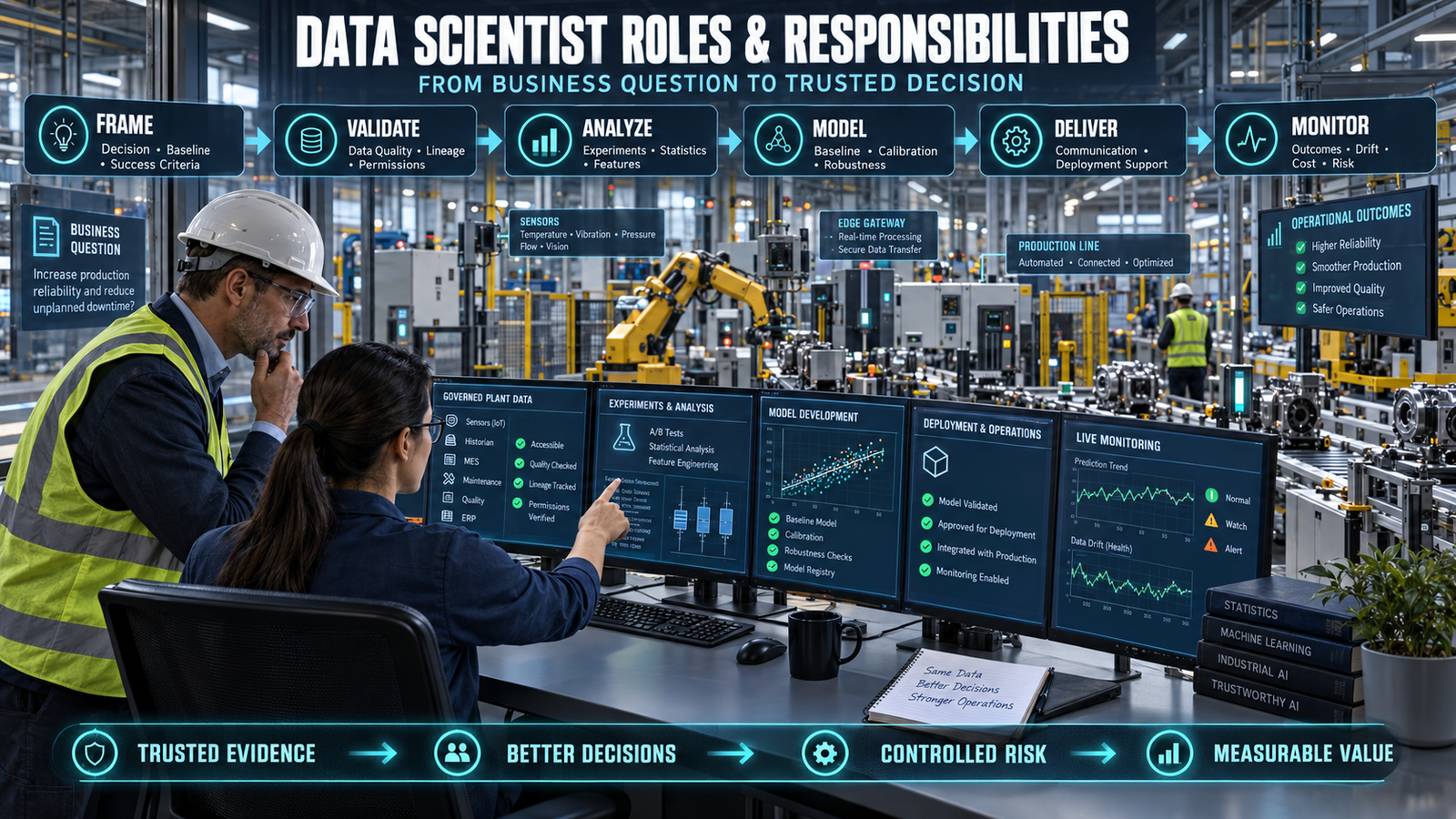
Data scientist roles and responsibilities begin with a decision, not a dataset. A capable enterprise data science team frames the commercial question, tests whether the available evidence can answer it, selects a defensible method, quantifies uncertainty, and helps the organization act without overstating what the analysis proves.
That mandate is wider than model training but narrower than owning every data system. Successful delivery requires a data science platform, reliable predictive analytics software, an engineering path for machine learning deployment, and named owners for data, product, security, privacy, and operations.
The distinction matters because weak job design produces expensive failure. Organizations hire a “unicorn,” combine analytics, data engineering, machine learning operations, product strategy, and compliance in one requisition, then blame the employee when the operating model breaks.
This Article gives business and technology leaders a production-grade framework. It defines accountable work, technical architecture, cross-functional boundaries, evaluation evidence, platform choices, hiring criteria, ROI calculations, and regulatory controls.
I. The Current Market Landscape and Challenge
Demand is strong, but the job title remains elastic
The U.S. Bureau of Labor Statistics reports a May 2025 median annual wage of $120,230 for data scientists and projects 35% employment growth from 2025 to 2035.[1] Those figures describe the federal occupation; they are not a universal salary quote for every person carrying the title.
O*NET lists duties including processing large datasets, testing and reformulating models, visualizing findings, writing analytical software, identifying trends, and presenting results to decision-makers.[2] Those activities validate the analytical core of data scientist roles and responsibilities without implying sole ownership of production infrastructure.
The title varies by employer. One company may need experimentation and causal inference, another forecasting, and another a production model developer working beside ML engineers.
A procurement or hiring decision should therefore start with the decision product. If the deliverable is a governed KPI and recurring dashboard, a strong analytics role may be appropriate; if it is a continuously scored decision service, the organization needs modeling plus machine learning deployment capability.
The cost of hiring against a fashionable title
Role ambiguity creates hidden expenditure before any cloud bill arrives. Senior candidates spend time reconciling metrics, fixing access, negotiating deployment ownership, and rebuilding undocumented transformations instead of addressing the commercial problem.
The recurring costs include:
- Analysis based on inconsistent definitions or unstable source tables.
- Models optimized for an offline metric that does not represent business harm.
- Duplicate feature pipelines maintained by separate teams.
- Experiments that cannot be reproduced or connected to a decision.
- Predictive analytics software without monitoring, rollback, or an accountable user.
- Compliance reviews initiated after design choices have become expensive to reverse.
- Cloud notebooks, warehouses, accelerators, and endpoints left running without unit-cost ownership.
The cost of inaction is equally concrete. Poor forecasts increase inventory or shortages, weak experimentation funds ineffective changes, and uncontrolled models expose customers and the organization to financial, privacy, and fairness risk.
A decision-grade definition of the role
Data scientist roles and responsibilities should be written as accountable outcomes. The role converts an ambiguous decision into a documented question, trustworthy dataset, appropriate analytical method, honest evaluation, usable recommendation or model, and measurable learning after release.
The data scientist owns analytical validity within an agreed scope. Product leaders own the business decision, data owners govern source quality and permitted use, engineers own shared production services, and designated executives accept material risk.
This division is not bureaucracy. It prevents an enterprise data science team from becoming the unbounded owner of every upstream defect and downstream adoption failure.
Definitive, High-Growth AI Jobs in the USA: Roles, Salaries and 2026 Trends
II. Deep-Dive Technical Analysis and Evidence
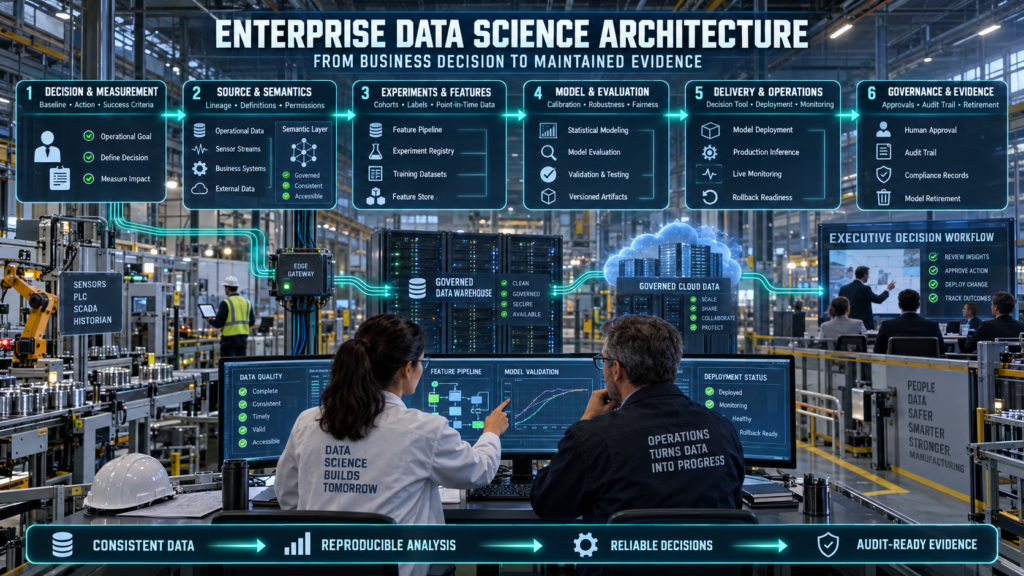
Architecture Overview: from business decision to maintained evidence
A durable analytical product has more layers than a notebook. Data scientist roles and responsibilities span several layers, but each layer must have a clear operational owner.
1. Decision and measurement layer
The work starts with the action to be improved, the baseline, the decision frequency, the affected population, the value at stake, and the cost of error. “Predict churn” is incomplete until the team specifies who can act, when they can act, and which intervention is economically rational.
The enterprise data science team defines an estimand or prediction target that matches the decision. It also records exclusions, time horizons, leakage risks, and the conditions under which the result should not be used.
2. Source and semantic layer
This layer includes operational systems, event streams, third-party data, warehouse tables, semantic definitions, lineage, consent, and retention. A large warehouse does not guarantee that an observation represents the same concept across time or business units.
Data scientist roles and responsibilities include profiling source behavior, reconciling definitions, testing joins, detecting duplicates, checking missingness, and documenting population coverage. Data engineers should own durable ingestion and shared transformation services.
3. Experiment and feature layer
The data scientist creates analysis-ready cohorts, treatment definitions, labels, features, and sampling rules. Time-aware splitting is essential when future information could leak into historical training records.
Feature reuse should be intentional. A feature store can improve consistency, but it can also institutionalize a poorly defined variable if ownership, freshness, and valid-use conditions are missing.
4. Modeling and evaluation layer
This layer covers baselines, statistical models, machine learning, causal methods, calibration, uncertainty, robustness, fairness, and interpretability. The simplest method that meets the decision requirement is usually easier to validate, operate, and explain.
Predictive analytics software should be evaluated against the real loss function. Accuracy can be misleading when classes are imbalanced, decision thresholds vary, or false negatives cost far more than false positives.
5. Delivery and operating layer
The output may be a decision memo, experiment result, batch score, API, alert, optimization recommendation, or embedded product feature. The delivery form determines requirements for latency, availability, access, monitoring, and rollback.
For machine learning deployment, data scientists supply validated artifacts, assumptions, thresholds, and expected behavior. ML or software engineers commonly own hardened serving, CI/CD, capacity, and incident integration.
6. Governance and evidence layer
The governance layer connects inventory, approvals, lineage, limitations, evaluation, change records, incidents, and retirement. NIST AI RMF organizes voluntary risk activity around Govern, Map, Measure, and Manage.[3]
Governance belongs inside the workflow. A model card written after launch cannot repair undocumented data use or an evaluation that ignored the affected population.
Integration Flowchart
flowchart TD
    A["Business decision"] --> B["Data and risk assessment"]
    B --> C["Baseline and experiment design"]
    C --> D["Build and validate"]
    D --> E{"Evidence meets release criteria?"}
    E -->|No| C
    E -->|Yes| F["Decision tool or deployment"]
    F --> G["Monitor outcome, drift, cost"]
    G --> H{"Material change or harm?"}
    H -->|Yes| I["Contain, rollback, review"]
    I --> C
    H -->|No| G
The loop is deliberate. Predictive analytics software remains valid only while its data, population, intervention, workflow, and operating environment stay within tested conditions.
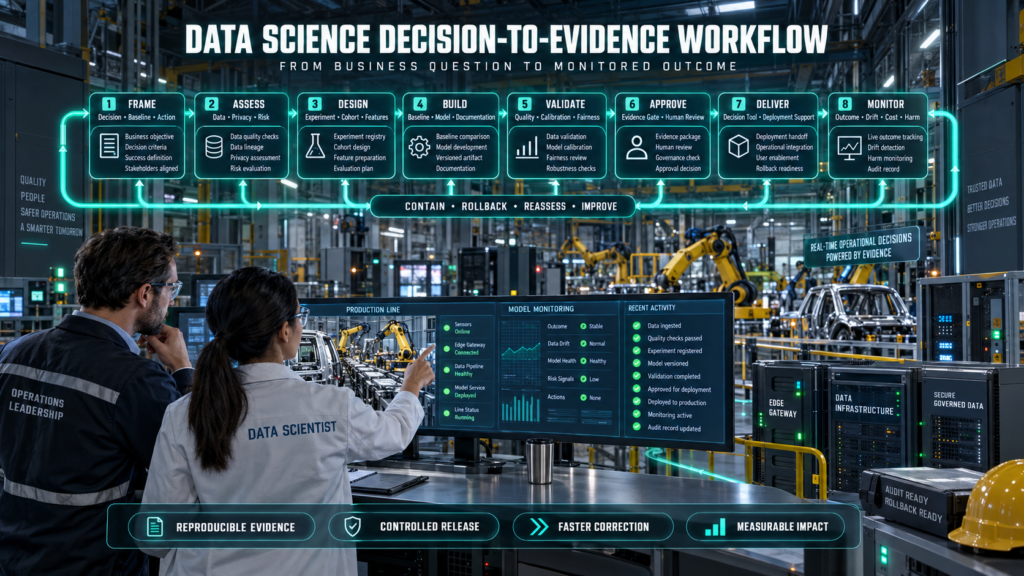
Data scientist roles and responsibilities across the lifecycle
Problem framing and feasibility
The data scientist converts a request into a measurable decision problem. This includes identifying a baseline, available actions, constraints, expected value, and a non-model alternative.
The team should stop work when the decision cannot be influenced, the target cannot be measured, or the available data cannot support the claim. Rejecting an invalid project is valuable analytical work.
Data assessment and analytical contracts
Data scientist roles and responsibilities include defining grain, keys, observation windows, label windows, freshness, allowable missingness, and exclusion rules. These expectations should become tests or contracts rather than comments in a notebook.
Privacy and permitted-use checks must occur before extraction. De-identification does not automatically remove re-identification risk, and access to a table does not prove legal authority to reuse it.
Experimental and statistical design
For controlled experiments, the data scientist defines the unit of randomization, primary outcome, guardrails, power assumptions, stopping rules and analysis plan. With a conventional fixed-sample significance test, repeatedly checking results and stopping when they become favorable can inflate false-positive risk. If early stopping is needed, use a statistical design that explicitly accounts for repeated monitoring.
Observational analysis requires explicit assumptions. Confounding, selection bias, censoring, interference, and measurement error should be explained in language decision-makers can understand.
Model development and validation
Development should begin with a transparent baseline. Complex methods earn their place only when incremental performance is material, stable, and operationally valuable.
The enterprise data science team tests temporal stability, relevant population slices, calibration, sensitivity, leakage, and threshold economics. Evaluation data must remain separate from training and tuning decisions.
Communication and decision support
The output should distinguish observation, estimate, assumption, limitation, and recommendation. A chart is useful only when its denominator, time window, uncertainty, and decision implication are clear.
Data scientist roles and responsibilities include challenging misuse. If an executive converts correlation into causation or treats a risk score as certainty, the scientist must correct the interpretation.
Machine learning deployment and operations
Before handoff, the data scientist packages code, dependencies, schema expectations, model artifact, threshold logic, evaluation report, limitations, and monitoring requirements. Production teams then need a reproducible path through the data science platform.
After release, the scientist reviews feature drift, prediction distribution, calibration, segment behavior, overrides, downstream outcomes, and emerging harm. Retraining should follow evidence and approval—not an arbitrary calendar alone.
Retirement and record closure
A model should be retired when the decision disappears, data authority changes, performance deteriorates beyond repair, a safer process replaces it, or operating cost exceeds benefit. Retirement includes disabling jobs and endpoints, removing credentials, archiving required evidence, and notifying dependent users.
Lifecycle closure prevents abandoned predictive analytics software from becoming shadow infrastructure. It is a core part of data scientist roles and responsibilities in mature organizations.
Responsibility boundaries for an enterprise data science team
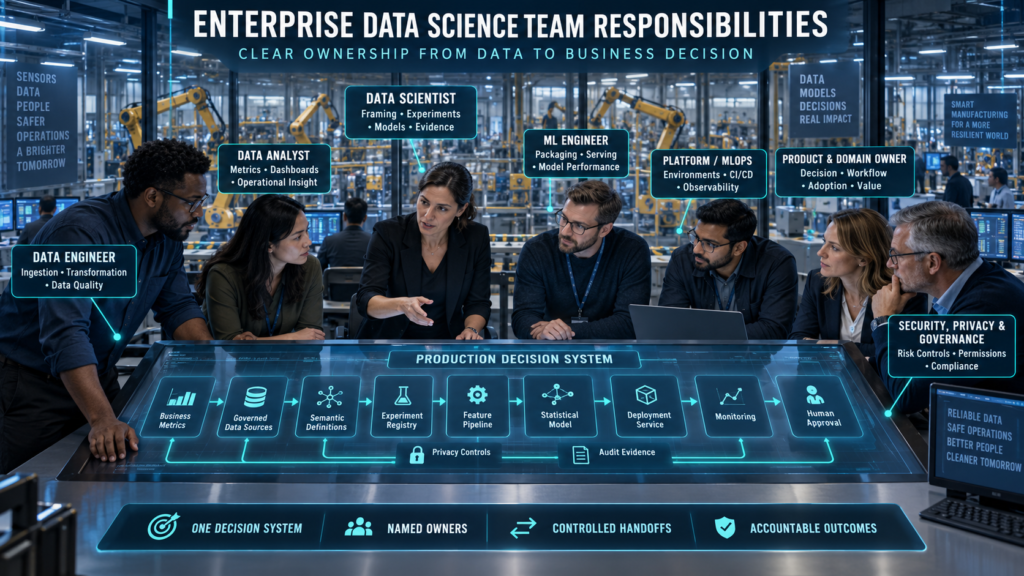
| Role | Primary accountability | Typical contribution | Should not own alone |
| Data scientist | Analytical validity and decision evidence | Framing, experiments, models, evaluation, interpretation | Enterprise risk acceptance |
| Data analyst | Metrics and descriptive decision support | SQL, dashboards, trends, operational analysis | Complex production-model lifecycle |
| Data engineer | Reliable governed data products | Ingestion, transformation, orchestration, quality services | Statistical validity of a model |
| ML engineer | Production model systems | Packaging, serving, optimization, monitoring | Business outcome definition |
| Platform/MLOps engineer | Shared runtime and delivery controls | Environments, CI/CD, registries, observability | Use-case analytical judgment |
| Product/domain owner | Decision, workflow, adoption, value | Requirements, intervention, acceptance criteria | Independent model validation |
| Security/privacy/legal | Control requirements and challenge | Threat, privacy, regulatory and vendor review | Day-to-day model development |
The table is an accountability map, not a staffing minimum. Smaller firms may combine roles, but combined roles still need documented review and decision rights.
Deployment Challenges
Target leakage and time travel
Leakage occurs when training data contains information unavailable at the moment of decision. A model can look exceptional offline and fail immediately when the hidden future signal disappears.
Use event-time joins, point-in-time feature generation, temporal validation, and explicit label windows. The data science platform should make the correct path easier than a leakage-prone shortcut.
Training-serving skew
The same feature can be computed differently in a notebook, batch job, and online service. Differences in defaults, time zones, missing-value treatment, or categorical mappings silently alter predictions.
Shared transformations, schema tests, reference records, and shadow comparisons reduce the risk. Machine learning deployment should promote both model and feature definitions as versioned artifacts.
Drift without outcome visibility
Input drift is observable quickly, but business outcomes may arrive weeks or months later. A changed distribution does not automatically mean the model is wrong, and a stable distribution does not prove it remains useful.
Monitoring should distinguish data quality, covariate drift, concept drift, calibration, intervention effects, and business performance. Each alert needs an owner and a defined response.
Experiment interference and adoption failure
Users may influence one another, treatments may spill across groups, or staff may ignore recommendations. A statistically sound model creates no value if the operating workflow cannot act on it.
Pilot design must measure adoption, overrides, capacity constraints, and unintended behavior. The enterprise data science team should treat workflow evidence as part of model evidence.
Compute and platform overhead
Warehouse scans, distributed training, hyperparameter searches, feature refreshes, endpoint capacity, lineage, and monitoring all add cost. Moving every workload to an accelerator or distributed engine can increase cost without reducing decision time.
Track spend per experiment, trained candidate, active model, thousand predictions, and accepted business outcome. Cost controls belong in predictive analytics software requirements, not only in finance reports.
Performance Evaluation Matrix
| Dimension | Example measure | Release evidence | Production trigger |
| Decision value | Incremental margin, loss avoided, cycle time | Baseline and economic model | Value falls below approved floor |
| Discrimination | Precision-recall, ROC-AUC, ranking lift | Holdout and slice results | Material decline in relevant segment |
| Calibration | Reliability curve, calibration error | Temporal validation | Predicted risk diverges from observed rate |
| Experiment validity | Power, balance, confidence interval | Pre-analysis plan and diagnostics | Guardrail harm or invalid assignment |
| Fairness | Error and selection rates by relevant group | Approved slice analysis | Material unexplained disparity |
| Reliability | Job success, availability, latency | Load and failure tests | SLO breach or stale output |
| Cost | Cost per accepted outcome | Volume-based forecast | Unit cost exceeds approved range |
| Reproducibility | Rebuild and rerun success | Versioned code, data reference, environment | Artifact cannot be reproduced |
Thresholds are contextual. A low-consequence marketing ranking and a high-impact employment or healthcare decision should not share the same evidence burden.
III. Commercial Solutions and Best Practices
Feature and Cost Comparison Table
| Platform | Strong fit | Commercial cost model | Practical advantage | Material trade-off |
| Amazon SageMaker AI | AWS-centered model development and serving | Compute, storage, processing, deployment, and MLOps consumption | Broad AWS integration and managed lifecycle tools | Multi-service bills and AWS coupling require active FinOps |
| Google Vertex AI | Google Cloud data and ML programs | Pay-as-you-go compute, prediction, pipelines, and model-specific services | Managed training, registry, pipelines, and monitoring | Region, quota, and workload-specific pricing need validation |
| Databricks Machine Learning | Lakehouse-centered analytics and ML | Platform units plus underlying cloud compute and storage | Close link among governed data, notebooks, MLflow, and serving | Best economics often assume broader Databricks standardization |
| Snowflake ML | Warehouse-centered teams keeping computation near governed data | Credits for compute and services plus storage and transfer | Integrated ML capabilities over governed Snowflake data | Specialized workloads may still need external runtimes or tooling |
Official documentation shows why exact list-price comparisons mislead. AWS exposes several cost dimensions, Snowflake uses consumption credits and storage, and every data science platform can create adjacent network, observability, and support charges.[7][8][9][10]
The selection should follow workload evidence. Test representative data volume, concurrency, feature refresh, training, batch scoring, online latency, monitoring retention, identity integration, and exit requirements.
Build, buy, and platform-selection framework
Buy managed capability when it removes undifferentiated engineering while preserving necessary controls. Build custom components when the decision logic, data advantage, latency requirement, or assurance evidence is materially differentiating.
Use this sequence:
- Define the decision, baseline, action, affected population, and risk owner.
- Classify analytical work as reporting, experimentation, forecasting, optimization, or production ML.
- Quantify data movement, compute, serving, monitoring, and human-review requirements.
- Assign data scientist roles and responsibilities separately from platform ownership.
- Run a time-boxed proof using representative workloads and security controls.
- Model total cost at expected scale, including idle and failed work.
- Test portability of code, artifacts, data contracts, and evaluation evidence.
- Contract for support, audit evidence, deletion, residency, and material-change notification.
Hiring scorecard for data scientist roles and responsibilities
A strong interview tests analytical judgment. Give the candidate an ambiguous decision, imperfect data description, and operational constraint; then assess the questions asked before any algorithm is proposed.
| Competency | Evidence to request | Warning sign |
| Problem framing | Decision, baseline, estimand, action and failure cost | Immediately selects a model |
| Data reasoning | Grain, keys, time, missingness, provenance and leakage | Treats a clean table as ground truth |
| Statistics | Assumptions, uncertainty, power and robustness | Reports significance without decision relevance |
| Modeling | Baselines, validation, calibration and slices | Uses one aggregate accuracy score |
| Reproducibility | Versioned code, environment, tests and documentation | Notebook works only on the author’s machine |
| Communication | Clear limits, alternatives and recommendation | Hides uncertainty behind jargon |
| Operations | Handoff, monitoring, rollback and retirement | Assumes deployment ends the project |
| Governance | Privacy, fairness, evidence and decision rights | Defers controls until after launch |
Portfolio review should focus on traceable decisions, not polished charts alone. The candidate should explain why a method was chosen, what could invalidate it, how users acted, and what changed after measurement.
Seniority based on decision scope
Junior professionals execute bounded analyses with reviewed definitions and methods. Mid-level data scientists independently frame work, select methods, manage stakeholders, and support delivery.
Senior data scientist roles and responsibilities include challenging whether a project should exist, designing evaluation standards, resolving cross-team ambiguity, reviewing high-impact work, mentoring colleagues, and shaping governance. Management is a separate path involving staffing, prioritization, performance, and organizational design.
Promotion should follow the reliability and leverage of decisions, not model complexity. A simpler method adopted across the company can demonstrate more senior impact than an impressive model nobody can operate.
IV. Business Outcomes and Strategic ROI Takeaways
Measure value against a counterfactual
Revenue after launch is not automatically model impact. Seasonality, pricing, campaigns, supply changes, and user selection can produce the same movement.
Use randomized experiments where feasible and credible quasi-experimental methods where they are not. Record assumptions and uncertainty so executives can distinguish measured incrementality from attribution.
A practical annual-value equation is:
Net annual value = estimated incremental annual financial benefit − total annual costs for people, data, platforms, deployment, assurance and change management.
Express all terms in the same currency and annual period. Support benefit estimates with experimental evidence or clearly stated assumptions, and avoid counting overlapping benefits or costs. Report staff time released separately unless its financial value can be demonstrated.
Distinguish adoption rate from the probability of successful delivery. In an illustrative scenario, if a $2 million annual gross benefit assumes full adoption and benefits scale proportionally with usage, 20% adoption would imply $400,000 in gross benefit before costs. Actual benefits may not scale proportionally because users, workloads and fixed costs differ.
Commercial outcomes by work type
Forecasting can reduce shortages, excess inventory, overtime, or capacity buffers. Experimentation can stop ineffective spending and identify changes that produce incremental improvement.
Risk models can prioritize review, but value depends on recovered loss, reviewer capacity, false-positive friction, and adversarial adaptation. Recommendation systems can improve conversion while also narrowing exposure or amplifying popularity bias.
Data scientist roles and responsibilities include naming these trade-offs. The enterprise data science team should not present gross benefit without operating cost, harmed segments, or displaced work.
Workforce and compensation planning
BLS wage data provides a defensible national reference, not a requisition-specific offer.[1] Employers should adjust for geography, seniority, regulated-domain expertise, management duties, on-call expectations, and whether the role owns machine learning deployment.
Budget for the surrounding system. One highly paid data scientist cannot substitute for reliable data engineering, a usable data science platform, product ownership, security review, or operational support.
Executive ROI checklist
- Is the decision and current baseline documented?
- Can the organization act on the prediction or experiment result?
- Are data scientist roles and responsibilities assigned by lifecycle stage?
- Does the data have valid provenance, semantics, permissions, and time behavior?
- Is there a non-model baseline and a quantified incremental benefit?
- Can another qualified person reproduce the result?
- Does predictive analytics software include monitoring and rollback?
- Are platform and human-review costs included at realistic scale?
- Is the risk owner different from the person who built the model?
If several answers are “no,” the next investment should address the operating gap. More model tuning will not repair unclear ownership or unusable evidence.
V. Risk Mitigation and Regulatory Framework

An AI governance framework connected to data science practice
NIST AI RMF is voluntary, but its Govern, Map, Measure, and Manage structure helps connect organizational responsibility with technical evidence.[3] NIST’s Generative AI Profile is relevant when the enterprise data science team uses foundation models for analysis, feature creation, synthetic data, code, or deployed applications.[4]
For organizations operating in or serving the European Union, Regulation (EU) 2024/1689 creates risk-based obligations that depend on the system, role, and use context.[5] Qualified counsel must determine applicability; data scientists must supply accurate documentation about data, methods, performance, limitations, and monitoring.
Governance checklist
- Maintain an inventory of analytical products, models, owners, users, data, purpose, and status.
- Document intended use, prohibited use, limitations, affected population, and human oversight.
- Separate development approval, independent challenge, and residual-risk acceptance.
- Retain data lineage, code version, evaluation, decision, change, and incident evidence.
- Reassess when the purpose, population, source, model, threshold, or workflow changes materially.
Data and privacy checklist
- Verify lawful purpose, consent or authority, minimization, retention, residency, and deletion.
- Record source provenance, collection context, known gaps, and downstream restrictions.
- Test re-identification, linkage, proxy variables, label quality, and historical bias.
- Apply least privilege to warehouses, notebooks, exports, features, and production scores.
- Keep sensitive information out of logs, demonstrations, and uncontrolled test fixtures.
Statistical and model-risk checklist
- Predefine the target, primary measure, relevant slices, and release threshold.
- Compare against a simple operational baseline.
- Test leakage, temporal stability, calibration, robustness, fairness, and uncertainty.
- Obtain independent review for high-impact uses.
- Define abstention, override, rollback, retraining, recalibration, and retirement criteria.
Security and operational checklist
- Threat-model data ingestion, dependencies, artifacts, registries, endpoints, and administrative paths.
- Sign or verify artifacts and restrict production promotion.
- Monitor source quality, feature freshness, drift, outcome performance, access, and cost.
- Exercise failure, rollback, and manual-continuity procedures.
- Assign incident severity, notification, containment, investigation, and evidence-preservation duties.
Vendor and platform checklist
- Review service terms, data use, subcontractors, retention, deletion, audit rights, and breach duties.
- Validate regional support, quotas, service objectives, recovery, and change notifications.
- Model warehouse, compute, acceleration, serving, storage, observability, support, and egress costs.
- Preserve portable code, data contracts, artifacts, tests, and evaluation records.
- Test an exit path before predictive analytics software becomes operationally critical.
Reviewing Ownership and Evidence Before Investment
Select one proposed or active model and trace it from executive decision through data, assumptions, evaluation, delivery, monitoring, and retirement. Name every owner and identify every unsupported handoff.
Use the findings to identify the main constraint: data quality, analytical validity, deployment capability, platform limitations or unclear ownership. Assign a responsible owner and measurable improvement criteria before approving another tool, platform or hire.
VI. Appendix and Research Integrity
Appendix A: Academic and Primary-Source Footnotes
- U.S. Bureau of Labor Statistics, “Data Scientists,” Occupational Outlook Handbook. May 2025 wage data and 2025–2035 employment outlook. https://www.bls.gov/ooh/math/data-scientists.htm
- ONET OnLine, “Data Scientists, 15-2051.00,” National Center for ONET Development, updated 2026. https://www.onetonline.org/link/summary/15-2051.00
- National Institute of Standards and Technology, Artificial Intelligence Risk Management Framework (AI RMF 1.0), NIST AI 100-1, 2023. https://nvlpubs.nist.gov/nistpubs/ai/NIST.AI.100-1.pdf
- National Institute of Standards and Technology, Artificial Intelligence Risk Management Framework: Generative Artificial Intelligence Profile, NIST AI 600-1, 2024. https://nvlpubs.nist.gov/nistpubs/ai/NIST.AI.600-1.pdf
- European Parliament and Council, Regulation (EU) 2024/1689 laying down harmonised rules on artificial intelligence. https://eur-lex.europa.eu/eli/reg/2024/1689/oj
- D. Sculley et al., “Hidden Technical Debt in Machine Learning Systems,” Advances in Neural Information Processing Systems 28, 2015. https://papers.nips.cc/paper/5656-hidden-technical-debt-in-machine-learning-systems
- Amazon Web Services, “Amazon SageMaker AI Pricing.” https://aws.amazon.com/sagemaker/ai/pricing/
- Google Cloud, “Vertex AI Pricing.” https://cloud.google.com/vertex-ai/pricing
- Databricks, “Machine Learning on Databricks.” https://docs.databricks.com/en/machine-learning/
- Snowflake, “Snowflake ML: End-to-End Machine Learning.” https://docs.snowflake.com/en/developer-guide/snowflake-ml/overview
- T. Gebru et al., “Datasheets for Datasets,” Communications of the ACM, 2021. https://doi.org/10.1145/3458723
- M. Mitchell et al., “Model Cards for Model Reporting,” Proceedings of the Conference on Fairness, Accountability, and Transparency, 2019. https://doi.org/10.1145/3287560.3287596
- National Institute of Standards and Technology, Secure Software Development Framework (SSDF) Version 1.1, NIST SP 800-218, 2022. https://csrc.nist.gov/pubs/sp/800/218/final
Appendix B: Source-to-Claim Index
| Claim area | Footnotes | Use in this paper |
| Employment, wage, and occupation duties | 1–2 | Current federal labor context and role-task evidence |
| AI risk governance | 3–5 | Governance functions, generative-AI risks, and EU legal context |
| Production architecture and technical debt | 6 | Evidence for cross-system coupling and maintenance risk |
| Platform capabilities and commercial cost models | 7–10 | Procurement comparison without fabricated price quotes |
| Dataset and model documentation | 11–12 | Evidence structure for provenance, limitations, and evaluation |
| Secure development lifecycle | 13 | Security practices integrated with development and delivery |
Research limitations
Platform functions, names, pricing, quotas, and legal obligations change. Buyers should verify current technical documentation, contract terms, regional availability, and applicable law before a purchase or deployment decision.
The matrices provide design patterns rather than universal thresholds. Each organization must calibrate evidence requirements to its decision, affected population, potential harm, reversibility, and human oversight.
Corporate Editorial Transparency and AI Usage Disclosure
AI-assisted tools were used to support research organization, drafting and language refinement. NezzHub retains editorial responsibility for the published article. Vendor inclusion does not constitute endorsement.
Author and Editorial Review
Author: Garikapati Bullivenkaiah
Technology research writer with LL.B., LL.M., M.A., and MBA qualifications. He writes about emerging technologies and their business, governance and legal implications. His multidisciplinary academic background informs his analysis of technology adoption, intellectual property, and organizational risk. His articles explain technical concepts and practical considerations for business owners, IT managers and technology decision-makers. LinkedIn Profile
Reviewed by: Chitikineni Ramadevi — Editor
Chitikineni Ramadevi holds an M.Sc. in Computers from Andhra University and has over 10 years of research experience in technology-related subjects. She reviews NezzHub articles for clarity, factual accuracy, source support and practical relevance.
Published by: NezzHub
Research approach: This article draws on primary sources, technical documentation and relevant industry research. References are provided within the article or its sources section.
Last reviewed: 09-22-2026
Corrections: To report a factual error or outdated information, please contact NezzHub.

Garikapati Bullivenkaiah is a seasoned entrepreneur with a rich multidisciplinary academic foundation—including LL.B., LL.M., M.A., and M.B.A. degrees—that uniquely blend legal insight, managerial acumen, and sociocultural understanding. Driven by vision and integrity, he leads his own enterprise with a strategic mindset informed by rigorous legal training and advanced business education. His strong analytical skills, honed through legal and management disciplines, empower him to navigate complex challenges, mitigate risks, and foster growth in diverse sectors. Committed to delivering value, Garikapati’s entrepreneurial journey is characterized by innovative approaches, ethical leadership, and the ability to convert cross-domain knowledge into practical, client-focused solutions.