

















Executive Summary
Generative AI ethics is now an operating discipline, not a statement of principles. In 2026, technology leaders must translate fairness, privacy, transparency, intellectual-property protection, safety, and accountability into enforceable controls across data ingestion, model access, retrieval, tool use, output review, monitoring, and incident response.
The EU AI Act has a phased application timetable. Its general application date was 2 August 2026, while prohibited-practice and AI-literacy provisions applied earlier and general-purpose AI obligations began applying in 2025. Certain high-risk requirements have later application dates. Article 50 establishes specific transparency duties, subject to scope and exceptions; organizations should check the current official timetable for their role and use case.[1][2]
This article rebuilds Generative AI ethics around engineering evidence. It covers model hallucination, prompt injection, sensitive-data leakage, bias, deceptive synthetic media, copyright exposure, agentic tool misuse, compute overhead, vendor concentration, and the cost of human oversight.
The commercial objective is not “perfectly ethical AI,” which no product can guarantee. It is controlled deployment: every approved use case has an owner, risk tier, data boundary, evaluation set, prohibited behaviors, monitoring plan, budget, escalation path, and shutdown procedure.
I. The Current Market Landscape and Challenge
Ethics Policies Are Not Runtime Controls
Many organizations already publish Generative AI ethics principles. The practical gap appears when a model receives confidential input, retrieves an outdated document, fabricates a source, invokes a tool, or creates content that a user mistakes for verified human work.
Generative AI ethics fails when policy cannot influence runtime behavior. A PDF stating “human oversight is required” has little value if the workflow does not record who reviewed the output, what evidence they saw, and whether they had authority to stop publication or execution.
Ethical principles become useful when they define how a system handles data, generates outputs, uses tools and responds to errors. Map each principle to a responsible owner, an implemented control, a test and retained evidence. Document unresolved risks and who has authority to approve, restrict or stop the system.
The 2026 Risk Surface
Enterprise Generative AI ethics deployments have moved beyond standalone chat. Retrieval, multimodal input, code generation, tool calling, agents, synthetic media, and automated workflows increase both utility and the paths through which an error can cause harm.
The Generative AI ethics risk surface now includes:
- Unverified answers presented with unjustified confidence.
- Prompts or documents designed to override system instructions.
- Personal, confidential, or licensed data entering unapproved services.
- Models reproducing stereotypes or creating disparate quality across groups.
- Generated code introducing insecure dependencies or unsafe logic.
- Agents taking unauthorized actions across email, finance, CRM, or infrastructure.
- Synthetic media enabling impersonation, deception, or reputational attack.
- Undocumented model changes invalidating earlier evaluation evidence.
These are not purely “model problems.” They arise from the complete application: identity, data, retrieval, prompts, models, tools, people, logs, and downstream decisions.
Cost of Inaction
Avoiding governance does not remove cost. It shifts spending into duplicated pilots, manual remediation, security incidents, legal review, vendor lock-in, inconsistent approvals, and emergency shutdowns.
A weak Generative AI ethics program also creates opportunity cost. Teams may block low-risk productivity uses because no approval lane exists, while higher-risk shadow deployments proceed without monitoring.
The right Generative AI ethics response is tiered governance. Low-risk drafting assistance should not carry the same control burden as hiring recommendations, patient communication, financial advice, identity verification, or autonomous infrastructure changes.
Risk-Tier Triage
| Tier | Example | Minimum control position | Release authority |
|---|---|---|---|
| Low | Internal brainstorming with non-sensitive data | Approved tool, usage policy, no external publication | Team owner |
| Moderate | Customer-service drafting with human approval | Evaluation set, grounding, logging, reviewer workflow | Product and risk owners |
| High | Regulated or rights-affecting recommendation support | Impact assessment, expert validation, appeal, intensive monitoring | Executive, legal, security, and domain approval |
| Prohibited internally | Deceptive impersonation, covert manipulation, unauthorized surveillance | Technical block and disciplinary escalation | No release path |
This table is not a legal classification. Generative AI ethics governance must separately assess applicable law, contractual duties, sector rules, geography, affected people, and the organization’s role.
Generative AI vs Reinforcement Learning: A Powerful, Practical Enterprise Decision Guide
II. Deep-Dive Technical Analysis and Evidence
Generative AI Ethics Architecture Overview

A controlled Generative AI ethics system is a chain of trust decisions. The organization must govern the user, input, retrieved context, model, tool permissions, output, reviewer, downstream action, and retained evidence.
The Generative AI ethics architecture should include:
- Identity layer: authenticated users, service identities, least privilege, and separation of duties.
- Data layer: classification, provenance, lawful use, minimization, retention, and deletion.
- Model gateway: approved models, version pinning where available, routing, quotas, and audit logs.
- Context layer: trusted sources, document permissions, freshness, malware scanning, and retrieval evaluation.
- Policy layer: content filters, tool constraints, sensitive-data controls, and use-case rules.
- Evaluation layer: quality, safety, privacy, bias, security, and cost tests.
- Human layer: meaningful review, appeal, escalation, incident authority, and training.
- Operations layer: monitoring, drift detection, rollback, vendor change management, and retirement.
NIST’s AI Risk Management Framework organizes risk work through Govern, Map, Measure, and Manage.[3] Its Generative AI Profile applies that structure to risks such as confabulation, dangerous content, data privacy, information integrity, intellectual property, and value-chain dependencies.[4]
Integration Flowchart
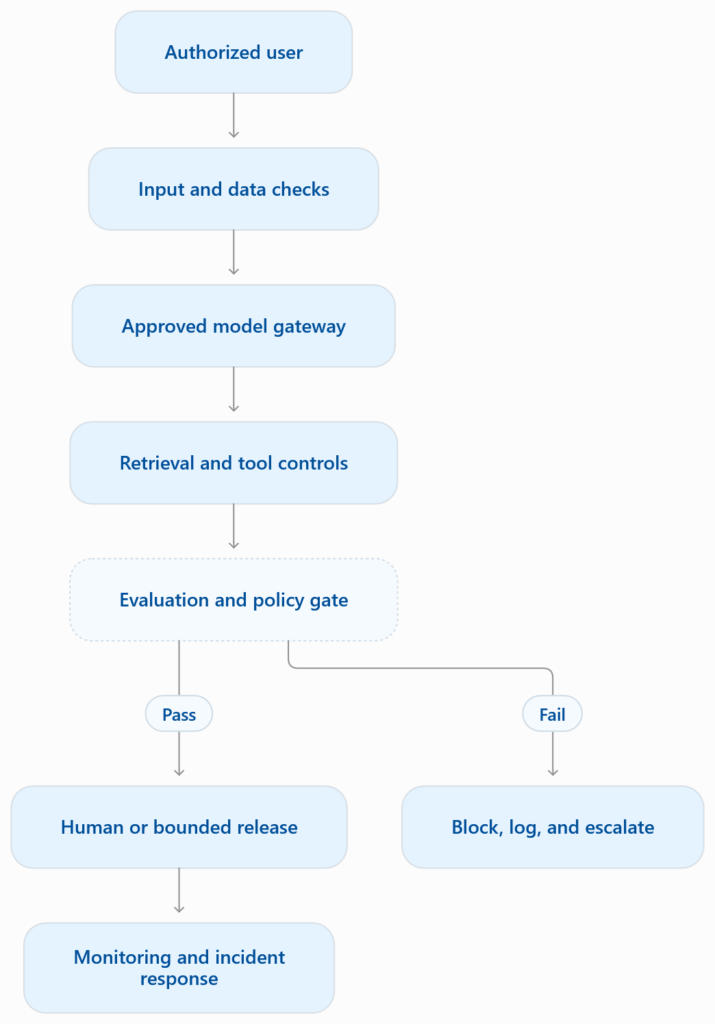
This diagram summarizes the control path rather than prescribing one execution order. Retrieval must enforce source permissions before information reaches the model. Tool authorization must be checked before execution, and output checks must occur before release.
The Generative AI ethics control point is not one filter placed after inference. Every arrow can carry sensitive data, malicious instructions, incorrect context, or unauthorized actions.
Data Sourcing, Privacy, and Consent
Training, fine-tuning, evaluation, and retrieval datasets create different Generative AI ethics requirements. A document may be accessible to an employee yet still be unsuitable for training, external processing, indefinite logging, or reuse in another business purpose.
Generative AI ethics requires a data ledger recording source, owner, license or legal basis, permitted uses, restrictions, retention, sensitive categories, geography, and deletion route. “Publicly available” is not a complete permission analysis.
Engineering Friction
- Data copied into notebooks loses original access controls.
- Retrieval indexes retain deleted or superseded documents.
- Prompt logs capture credentials, health data, or customer identifiers.
- Fine-tuning datasets lack item-level provenance.
- Vendor telemetry and abuse monitoring have different retention terms.
- Backups keep content after the primary record is deleted.
Minimize inputs before they reach the model. Redaction after logging is weaker because the sensitive material has already entered storage and backup flows.
Hallucination, Grounding, and Information Integrity
A Generative AI ethics review starts from a technical fact: a generative model predicts plausible output and does not independently verify every claim. Retrieval can improve grounding but can also surface stale, irrelevant, poisoned, or unauthorized evidence.
The Generative AI ethics requirement is claim-level validation proportional to harm. A marketing draft may need editorial review, while a medical, legal, financial, safety, or compliance statement requires authoritative sources and qualified human approval.
Grounding Controls
- Lock retrieval to approved repositories and enforce document permissions.
- Measure retrieval precision, answer support, citation correctness, and material omissions.
- Require the application to distinguish sourced facts from generated synthesis.
- Fail safely when evidence is absent, conflicting, or outside date limits.
- Re-evaluate after any change to the model, prompt, index, parser, or source corpus.
Guardrails can reduce risk but have scope limitations. AWS documentation, for example, states that its contextual grounding check supports summarization, paraphrasing, and question answering with reference material, while conversational QA/chatbot uses are not supported by that check.[5]
Bias, Fairness, and Unequal Quality
Average performance can conceal Generative AI ethics failures. A system may provide lower-quality answers across languages, dialects, disabilities, cultural contexts, occupations, or demographic groups even when its overall score appears strong.
Generative AI ethics testing must define affected groups and task-specific harm before evaluation. Teams should measure refusal rates, factuality, toxicity, sentiment, completion quality, and human-review outcomes by relevant slice.
Fairness cannot be reduced to identical output. Different users may require accessible formats, language support, or safeguards that produce equitable service rather than uniform treatment.
Bias-Control Workflow
- Identify affected users and foreseeable harms with domain stakeholders.
- Build representative and adversarial evaluation cases.
- Compare quality and failure rates across justified slices.
- Investigate data, prompt, retrieval, model, and reviewer contributions.
- Apply mitigation and test for performance regressions elsewhere.
- Retain residual-risk decisions and provide appeal where consequences matter.
Security, Prompt Injection, and Agentic Risk

Prompt injection is a central Generative AI ethics and security problem because it treats instructions inside untrusted content as a control signal. The attack becomes more serious when a model can access data, tools, messages, records, code, or transactions.
Generative AI security controls should assume that users, documents, websites, emails, images, and tool results can contain adversarial instructions. A system prompt is not a security boundary.
The Generative AI ethics principle of human agency becomes a concrete permission model:
- Give each tool the narrowest possible action and data scope.
- Separate read, draft, recommend, approve, and execute permissions.
- Require deterministic validation for tool arguments and destinations.
- Put human approval before external communication or consequential action.
- Limit steps, tokens, time, spending, and transaction value.
- Log attempted and completed actions with attributable identities.
- Provide an immediate kill switch and tested rollback.
Intellectual Property and Human Authorship
Copyright changes the Generative AI ethics analysis across training inputs, retrieved material, generated outputs, publication, and contractual warranties. Organizations need qualified legal advice for jurisdiction-specific questions rather than model-provider marketing.
The U.S. Copyright Office’s Part 2 report concluded that generative-AI output can be protected where a human author determines sufficient expressive elements, but mere prompting does not by itself provide sufficient human control.[6] Part 3 addresses the use of copyrighted works in generative-AI training and reflects ongoing legal and policy complexity.[7]
Generative AI ethics controls should record source materials, license terms, prompts, model and version, human edits, approvals, and publication context. Contract reviews should address indemnities, output ownership, training-data use, confidentiality, and infringement procedures.
Synthetic Media, Disclosure, and Provenance
Visible labels support Generative AI ethics, but labels can be removed and watermarks can fail under transformation. Provenance is evidence about origin and editing history, not proof that the depicted event is true.
C2PA Content Credentials use cryptographically protected manifests to record content provenance.[8] Version 2.4, published in April 2026, added asset-format support, assertions, and a JSON-based serialization for validation and interoperability.[9]
The Generative AI ethics approach combines:
- Clear human-readable disclosure at the point of consumption.
- Cryptographic provenance where the media workflow supports it.
- Preservation of original files and production records.
- Detection tools treated as probabilistic signals, not final proof.
- Escalation for impersonation, public-interest events, and manipulated evidence.
Environmental and Compute-Cost Trade-offs
Generative AI ethics includes resource use and economic efficiency. Larger models, longer contexts, repeated retries, multi-agent loops, image or video generation, and continuous evaluation increase compute, latency, and operating cost.
Generative AI ethics should require the smallest architecture that passes the approved quality and safety gates. A rules engine, search system, supervised model, smaller language model, or human workflow may be more responsible and cheaper.
Measure energy or compute proxies where direct energy data is unavailable: accelerator hours, tokens, model calls, context length, output length, retries, and cache hit rate. Avoid environmental claims that cannot be traced to a defined workload and measurement method.
Performance Evaluation Matrix
Score each dimension from 1 to 5 and multiply by its weight. A critical privacy, security, legal, or safety failure blocks release regardless of the weighted total.
| Dimension | Weight | Required evidence | Release gate |
|---|---|---|---|
| Task quality and grounding | 20% | Locked domain evaluation set | Beats approved baseline |
| Safety and harmful content | 15% | Adversarial and prohibited-use tests | No unresolved critical failure |
| Privacy and confidentiality | 15% | Data-flow review and leakage tests | Sensitive-data controls pass |
| Security and tool use | 15% | Prompt-injection and authorization tests | No unauthorized action path |
| Fairness and accessibility | 10% | Slice evaluation and stakeholder review | Material disparities addressed |
| Transparency and provenance | 10% | Disclosure and evidence verification | Users receive required notice |
| Reliability and operations | 10% | Repeated runs, fallback, rollback | Service tolerance met |
| Unit economics | 5% | Cost per accepted output | Within approved budget |
The Generative AI ethics matrix must use observed evidence, not vendor claims. It should record test data, assessor, model version, configuration, date, thresholds, failures, exceptions, and approval authority.
Deployment Challenges
Model and Provider Change
Managed models can change behavior, versions, filters, latency, pricing, and availability. Contractual notice does not eliminate the need for automated regression testing.
Human Review That Becomes Rubber-Stamping
Reviewers may accept fluent output under workload pressure. Measure review time, correction rate, escalation rate, disagreement, and whether reviewers can inspect supporting evidence.
Evaluation Contamination
Repeated tuning against the same test set converts it into training feedback. Preserve sealed holdout cases, rotate adversarial tests, and separate builders from final approvers.
Logging Versus Data Minimization
Operations teams need evidence, while privacy teams need limited collection. Define field-level logging, redaction, access, retention, deletion, and incident exceptions before launch.
Guardrail False Positives and False Negatives
Stricter filters can block legitimate use while permissive filters miss harmful content. Generative AI ethics requires measuring both safety and utility instead of reporting only blocked-request counts.
III. Commercial Solutions and Best Practices
Feature and Cost Comparison Table
Commercial Generative AI ethics tools cover different layers. Content filtering does not replace model inventory, impact assessment, data governance, security engineering, human oversight, or legal review.
| Solution | Primary role | Charging approach | Strength | Limitation |
|---|---|---|---|---|
| Amazon Bedrock Guardrails | Runtime content, topic, PII, grounding, and policy controls | Usage depends on selected checks and processed units | Integrates with Bedrock application flows | Does not create complete responsible AI governance |
| Microsoft Content Safety in Foundry Control Plane | Text and image safety classification and related controls | Text records and images are volume-billed in paid tiers | Useful for Azure-centered safety pipelines | Classification requires application-specific thresholds and appeals |
| Google Cloud Model Armor | Prompt and response protection across supported integrations | Published free allowance plus usage-based token pricing | Broad gateway-style protection integrations | Token-based scanning is only one governance layer |
| IBM watsonx.governance | Lifecycle governance, monitoring, risk and compliance workflows | Tiered or quoted plans; trial and deployment options vary | Central governance across models and environments | Higher process and integration overhead than a simple filter API |
Microsoft states that text is billed by submitted text records and images by images submitted.[10] Google Cloud publishes a free Model Armor allowance and per-token usage beyond it, while IBM publishes multiple watsonx.governance purchasing options.[11][12]
Do not compare list prices alone. The full Generative AI ethics cost includes integration, evaluation, policy configuration, reviewer labor, false-positive handling, logging, storage, networking, support, audit preparation, and incident response.
Responsible AI Governance Operating Model

Board and Executive Oversight
Approve risk appetite, prohibited uses, material exceptions, resources, and reporting. Executives must know which systems can affect customers, employees, regulated activity, money, or public information.
AI Governance Committee
Maintain the inventory, risk taxonomy, approval process, standards, and exception register. Membership should cover technology, security, privacy, legal, compliance, operations, procurement, HR, accessibility, and relevant business domains.
System Owner
Own intended use, performance, cost, user training, monitoring, incidents, and retirement. The owner cannot outsource accountability to a vendor or model API.
Independent Review
Challenge evaluation design, evidence, unresolved risk, and release decisions. High-risk systems require reviewers with sufficient domain authority and independence from delivery incentives.
Best-Practice Implementation Framework
Step 1: Inventory Models and Use Cases
The Generative AI ethics inventory must record approved, experimental, embedded, and employee-acquired tools. Include model APIs inside SaaS products, browser extensions, copilots, agents, and open-source deployments.
Step 2: Define the Intended Use and Prohibited Use
State users, inputs, outputs, affected people, business decision, jurisdictions, human role, and forbidden actions. A broad purpose such as “improve productivity” is not reviewable.
Step 3: Map Data and Dependencies
Create a Generative AI ethics data-flow diagram covering prompts, retrieval sources, models, logs, tools, human review, downstream storage, subprocessors, regions, and deletion. This is the foundation of enterprise AI risk management.
Step 4: Build the Evaluation Harness
Automate regression tests and retain human-review protocols. Include normal cases, edge cases, protected or vulnerable groups where relevant, adversarial inputs, absent evidence, conflicting sources, and prohibited requests.
Step 5: Enforce Runtime Policy
Apply identity, data, model, tool, rate, budget, content, and action controls. Generative AI ethics must function when the system is under load, attacked, or operating with incomplete information.
Step 6: Release Gradually
Use sandbox, shadow, internal pilot, limited traffic, canary release, and staged autonomy. Keep a control group and compare accepted outcomes rather than raw output volume.
Step 7: Monitor and Retire
Track quality, unsupported claims, privacy events, security attacks, bias indicators, review burden, latency, spend, vendor changes, and incidents. Define conditions for rollback, suspension, retraining, replacement, and deletion.
IV. Business Outcomes and Strategic ROI Takeaways
Measure Accepted Outcomes, Not Generated Volume
Generative AI ethics changes the ROI denominator because automation statistics can exaggerate value. A document requiring extensive correction is not an accepted document, and one blocked unsafe request does not prove that every unsafe request will be detected.
Use this formula:
Governed unit cost = total allocated model, platform, evaluation, review and incident-handling costs for the measurement period ÷ accepted, policy-compliant outputs produced during that period.
Use one currency and reporting period, count each expense once, and include the costs of rejected outputs and failed attempts. State how setup and evaluation costs are allocated. This measures cost per accepted output; it does not, by itself, establish ROI.
Generative AI ethics improves commercial decision-making when it reveals hidden costs early. A pilot can be stopped before vendor commitments, workflow dependence, or public exposure makes reversal expensive.
ROI Scorecard
| Outcome | Baseline | Governed pilot measure | Scale condition |
|---|---|---|---|
| Cycle time | Time per accepted task | Reviewer-adjusted time | Sustained reduction |
| Quality | Error and rework rate | Locked evaluation and live sample | No material quality loss |
| Risk | Incidents and near misses | Severity, frequency, time to contain | Residual risk approved |
| Cost | Fully loaded current cost | Cost per accepted output | Positive unit economics |
| Trust | Complaints, appeals, corrections | User and stakeholder evidence | No unresolved material harm |
| Compliance | Current control evidence | Traceable decisions and records | Required obligations satisfied |
Cost-Optimization Levers
Route low-risk work to smaller models, shorten context, improve retrieval, cache safe repeated results, cap output, block loops, batch evaluation, and reserve expert review for material cases. Cost optimization must not silently weaken required controls.
The strongest Generative AI ethics program is risk-proportionate. It spends heavily where a failure can affect rights, safety, money, regulated decisions, or public trust and keeps low-risk workflows lightweight.
V. Risk Mitigation and Regulatory Framework

NIST-Aligned Checklist
- Govern: assign owners, competence requirements, policies, decision rights, and escalation.
- Map: document context, users, affected groups, data, models, vendors, tools, and foreseeable misuse.
- Measure: test validity, reliability, safety, privacy, security, bias, transparency, cost, and human factors.
- Manage: prioritize risk, implement controls, monitor residual exposure, respond, and retire.
NIST AI RMF is voluntary guidance, not certification.[3] Claims of “NIST compliance” should identify the actual profile, scope, evidence, assessor, and unresolved gaps.
EU AI Act Checklist for 2026
- Determine whether the organization is a provider, deployer, importer, distributor, or other covered actor.
- Classify systems by intended purpose and applicable risk obligations.
- Maintain role- and context-appropriate AI literacy for personnel dealing with AI systems.[13]
- Review Article 50 marking, detection, deepfake, and public-interest text disclosure duties.[2]
- For GPAI-provider obligations, assess transparency, copyright-policy, documentation, and systemic-risk provisions where applicable.[14]
- Preserve technical documentation, instructions, logs, human-oversight evidence, and incident records required for the specific role.
- Reassess when the model, purpose, workflow, geography, or affected population changes.
Generative AI ethics and legal compliance overlap but are not identical. A lawful deployment can still create avoidable harm, while an ethical aspiration cannot substitute for a binding legal duty.
Security and Incident Checklist
- Authenticate every user and service; apply least privilege.
- Keep sensitive data out of unapproved prompts, indexes, logs, and evaluation tools.
- Treat retrieved content and tool output as untrusted.
- Validate tool calls deterministically and require approval for consequential actions.
- Test prompt injection, exfiltration, model denial of service, unsafe code, and privilege escalation.
- Version models, prompts, indexes, policies, tools, and evaluation sets.
- Set spend, token, time, action, and transaction limits.
- Define severity, notification, evidence preservation, rollback, and external reporting.
- Exercise the kill switch before production.
No Generative AI ethics or AI compliance software eliminates accountability. The buyer remains responsible for configuring controls, validating performance, training people, monitoring outcomes, and responding when safeguards fail.
Establishing Evidence for an Ethical Release
Start Generative AI ethics implementation with one complete system record: intended use, owner, data flow, risk tier, model and vendors, evaluation set, prohibited behaviors, human authority, unit-cost ceiling, monitoring, incident process, and retirement trigger. Review it jointly across engineering, security, privacy, legal, operations, and the affected business function.
Approve a limited pilot when the required controls have been implemented and tested, with unresolved risks documented. Expand only after predefined quality, safety, fairness, reliability and cost thresholds are met. Accountable reviewers must have enough information and authority to challenge outputs, override decisions and suspend the system.
VI. Appendix and Research Integrity
Appendix A: Academic and Primary-Source Footnotes
- European Commission, “AI Act: Regulatory Framework for Artificial Intelligence,” application timeline. https://digital-strategy.ec.europa.eu/en/policies/regulatory-framework-ai
- European Commission, “Transparency Obligations under Article 50 of the AI Act,” 2026. https://digital-strategy.ec.europa.eu/en/faqs/transparency-obligations-under-article-50-ai-act
- NIST, “Artificial Intelligence Risk Management Framework (AI RMF 1.0),” NIST AI 100-1, 2023. https://doi.org/10.6028/NIST.AI.100-1
- NIST, “Artificial Intelligence Risk Management Framework: Generative Artificial Intelligence Profile,” NIST AI 600-1, 2024. https://doi.org/10.6028/NIST.AI.600-1
- Amazon Web Services, “Use Contextual Grounding Check to Filter Hallucinations in Responses.” https://docs.aws.amazon.com/bedrock/latest/userguide/guardrails-contextual-grounding-check.html
- U.S. Copyright Office, “Copyright and Artificial Intelligence, Part 2: Copyrightability,” January 2025. https://www.copyright.gov/ai/Copyright-and-Artificial-Intelligence-Part-2-Copyrightability-Report.pdf
- U.S. Copyright Office, “Copyright and Artificial Intelligence, Part 3: Generative AI Training,” pre-publication version, May 2025. https://www.copyright.gov/ai/Copyright-and-Artificial-Intelligence-Part-3-Generative-AI-Training-Report-Pre-Publication-Version.pdf
- Coalition for Content Provenance and Authenticity, “C2PA: Verifying Media Content Sources.” https://c2pa.org/
- C2PA, “Content Credentials Technical Specification 2.4,” April 2026. https://spec.c2pa.org/specifications/specifications/2.4/specs/C2PA_Specification.html
- Microsoft Azure, “Content Safety in Foundry Control Plane Pricing.” https://azure.microsoft.com/en-us/pricing/details/content-safety/
- Google Cloud, “Model Armor.” https://cloud.google.com/security/products/model-armor
- IBM, “watsonx.governance Pricing.” https://www.ibm.com/products/watsonx-governance/pricing
- European Commission, “AI Literacy—Questions & Answers.” https://digital-strategy.ec.europa.eu/en/faqs/ai-literacy-questions-answers
- European Commission, “Guidelines for Providers of General-Purpose AI Models,” 2026. https://digital-strategy.ec.europa.eu/en/policies/guidelines-gpai-providers
- European Commission, “General-Purpose AI Code of Practice.” https://digital-strategy.ec.europa.eu/en/policies/contents-code-gpai
- Microsoft Learn, “What Is Azure AI Content Safety?” updated January 2026. https://learn.microsoft.com/en-us/azure/ai-services/content-safety/overview
Appendix B: Source-to-Claim Citation Index
| Claim | Supporting footnote |
|---|---|
| EU AI Act application timeline | [1] |
| Article 50 transparency obligations apply from August 2, 2026 | [2] |
| NIST AI RMF functions are Govern, Map, Measure, and Manage | [3] |
| NIST Generative AI Profile addresses generative-model risk | [4] |
| AWS contextual grounding check has stated supported-use limitations | [5] |
| U.S. Copyright Office position on sufficient human authorship | [6] |
| U.S. Copyright Office review of generative-AI training | [7] |
| C2PA provides cryptographically protected provenance | [8]–[9] |
| Commercial platform features and charging approaches | [10]–[12], [16] |
| EU AI Act AI-literacy requirements | [13] |
| GPAI-provider guidance and Code of Practice | [14]–[15] |
Appendix C: Corporate Editorial Transparency and AI Usage Disclosure
AI-assisted tools were used to support research organization, drafting and language refinement. NezzHub retains editorial responsibility for the published article. Vendor inclusion does not constitute endorsement.
Vendor inclusion is editorial and does not constitute endorsement. Sponsorship, affiliate relationships, or commercial consideration must be disclosed if present; pricing and product availability can change without notice.
This material is technical and commercial analysis, not legal, security, privacy, financial, or regulatory advice. Obtain qualified professional advice for the organization’s jurisdiction, sector, contracts, systems, and affected people.
Author and Editorial Review
Author: Garikapati Bullivenkaiah
Technology research writer with LL.B., LL.M., M.A., and MBA qualifications. He writes about emerging technologies and their business, governance and legal implications. His multidisciplinary academic background informs his analysis of technology adoption, intellectual property, and organizational risk. His articles explain technical concepts and practical considerations for business owners, IT managers and technology decision-makers. LinkedIn Profile
Reviewed by: Chitikineni Ramadevi — Editor
Chitikineni Ramadevi holds an M.Sc. in Computers from Andhra University and has over 10 years of research experience in technology-related subjects. She reviews NezzHub articles for clarity, factual accuracy, source support and practical relevance.
Published by: NezzHub
Research approach: This article draws on primary sources, technical documentation and relevant industry research. References are provided within the article or its sources section.
Last reviewed: 09-26-2026
Corrections: To report a factual error or outdated information, please contact NezzHub.