








Autonomous Mobile Robots (AMRs)
Autonomous Mobile Robots combine sensors, onboard computing, navigation software and safety controls to move materials or equipment through changing facilities. Unlike machines restricted to one fixed route, AMRs can calculate permitted paths and respond to mapped obstacles within their operating design.
This NezzHub subcategory helps business owners, technology decision-makers, IT managers, professionals and students evaluate AMR navigation, fleet software, deployment costs and operational risks. It connects mobile-robot technology with the broader Robotics and Automation category without treating every transport process as a suitable automation project.
Explore Autonomous Mobile Robots
AMRs are deployed for internal logistics, material movement, order fulfilment, hospital deliveries and selected smart-facility workflows. A successful system depends on more than purchasing robots; it requires suitable routes, reliable maps, charging capacity, wireless coverage, traffic rules, enterprise integration and trained operational support.
- Navigation: Localization, mapping, sensor fusion, obstacle detection and path planning.
- Fleet management: Task allocation, traffic coordination, charging and robot-health monitoring.
- Facility readiness: Routes, doors, lifts, floor conditions, loading points and human-traffic patterns.
- Enterprise integration: Connections with warehouse, manufacturing, maintenance or hospital systems.
- Operational measurement: Successful missions, availability, intervention rates and recovery time.
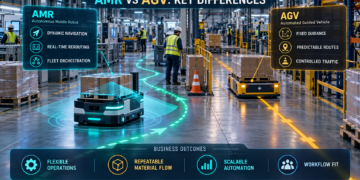
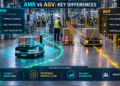
Readers comparing mobile-automation approaches should start with the AMR versus AGV guide. It explains differences in navigation, infrastructure, flexibility, cost exposure and suitable operating conditions.
Business and Enterprise Applications
AMRs can remove recurring travel and material-transfer work from operational processes. Their value depends on whether the deployment improves workflow capacity without creating excessive intervention, congestion or support costs.
- Warehousing: Moving inventory among receiving, storage, picking, packing and dispatch areas.
- Manufacturing: Supplying components, moving work in progress and transporting finished products.
- Healthcare: Delivering linen, meals, supplies or waste through approved facility routes.
- Smart facilities: Supporting scheduled internal deliveries across mapped buildings.
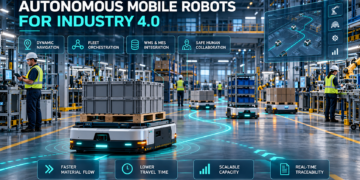
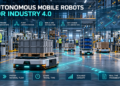
The Autonomous Mobile Robots for Industry 4.0 guide examines architecture, implementation cost, fleet software, operational metrics and risk-adjusted ROI planning. It can help buyers develop requirements before requesting vendor proposals.
An AMR business case should include robots, charging equipment, fleet-management software, integration, network improvements, mapping, training, maintenance, cybersecurity and human support. Purchase price alone does not represent total lifecycle cost.
Architecture, Integration and Deployment
An AMR architecture normally connects onboard sensors and compute with fleet orchestration, site infrastructure and enterprise applications. Immediate navigation and safe response require appropriate local capability, while centralized software can manage assignments, telemetry and coordinated movement.
- Document routes, payloads, mission volume and peak operating periods.
- Evaluate floors, ramps, doors, lifts, loading stations and shared spaces.
- Test wireless coverage, latency, roaming and loss of connectivity.
- Define interfaces with WMS, WES, MES or facility-management systems.
- Plan charging capacity, battery strategy and recovery procedures.
- Conduct staged trials under realistic human and vehicle traffic.
- Measure successful missions, interventions, downtime and cost per mission.
For the technical navigation layer, read how AMRs navigate warehouses and hospitals. The guide explains SLAM, localization, LiDAR, sensor fusion, route planning and the operational differences between industrial and healthcare environments.
Risks, Security and Governance
AMRs operate where software decisions affect physical movement. Weak identity controls, exposed interfaces, unreliable updates or inadequate network segmentation can therefore create both cybersecurity and operational risk.
- Authenticate robots, operators, fleet services and connected systems.
- Apply least-privilege access and segment robotics networks.
- Encrypt communications and protect certificates or credentials.
- Use controlled software releases with testing and rollback capability.
- Define safe behaviour during sensor, network or fleet-service failure.
- Restrict and audit remote-support or teleoperation sessions.
- Protect camera images, facility maps and operational telemetry.
Safety evaluation must reflect the complete application, including speed, payload, stopping behaviour, traffic, transfer equipment and human interaction. Vendor documentation does not replace site-specific risk assessment, commissioning and ongoing change control.
How to Use This Subcategory
Business owners should begin with the AMR versus AGV comparison and Industry 4.0 business guide. IT managers should focus on network design, fleet software, enterprise integration, cybersecurity and software lifecycle management.
Engineers and operational teams can use the navigation guide to examine mapping, localization, traffic and facility requirements. Students can follow the same sequence to move from technology selection to architecture and deployment.
Frequently Asked Questions
What is the difference between an AMR and an AGV?
An AMR generally calculates adaptable routes using onboard perception and mapping. An AGV commonly follows predefined paths, markers or controlled traffic routes.
How do AMRs navigate changing environments?
They may combine maps, localization, LiDAR, cameras, odometry, sensor fusion and path-planning software. The exact stack depends on the robot and operating environment.
What should an AMR business case include?
Include acquisition, charging, fleet software, integration, networking, training, maintenance, cybersecurity and human-intervention costs. Compare these with measurable operational improvements.
Can AMRs operate without continuous cloud access?
Safety and immediate navigation should not depend entirely on unpredictable remote connectivity. The required local, edge and cloud split depends on the system architecture.
Latest Autonomous Mobile Robots Articles
Browse the archive below for the latest NezzHub guides on Autonomous Mobile Robots, AMR navigation, AGV comparisons, fleet management, deployment costs, operational performance and safety planning.

Autonomous Mobile Robots in Industry 4.0: Material Flow and Fleet Capacity
Executive Summary Autonomous mobile robots can remove recurring travel, queueing, and material-transfer work from factories and warehouses, but a robot...

AMR Navigation in Warehouses and Hospitals: Routes, Traffic and Recovery
Executive Summary AMR Navigation becomes difficult at the exact moment a demonstration becomes an operation. An Autonomous Mobile Robot can...














Recent News








NezzHub is a technology-focused knowledge hub delivering insights on AI, robotics, cybersecurity, biotech, and emerging innovations. Our mission is to simplify complex technologies through research-driven content and analysis.