











Executive Summary
AMR Navigation becomes difficult at the exact moment a demonstration becomes an operation.
An Autonomous Mobile Robot can cross an empty warehouse aisle in minutes. Production Robot Navigation must survive forklifts, pallets, blocked intersections, wireless dead zones, changing racks, reflective surfaces, battery constraints and dozens of other robots competing for the same space.
A hospital changes the problem again.
The robot encounters beds, IV poles, patients, visitors, clinical carts, elevators, automatic doors and corridors whose operational priority can change without warning.
AMR navigation combines mapping, localization, path planning, obstacle response and fleet coordination. Commercial evaluation must establish whether these functions support reliable mission completion.
It is whether the AMR Navigation System can convert transport requests into completed missions while remaining inside the facility’s operational, safety and reliability envelope.
That requires a stack:
SENSE → LOCALIZE → PLAN → RESERVE → MOVE → YIELD → RECOVER → VERIFY
Warehouses usually monetize navigation through material flow.
Hospitals monetize it differently: reliable internal transport can release staff capacity, but navigation must coexist with clinical priorities, access controls and unpredictable pedestrian behavior.
The procurement principle is therefore:
Do not buy AMR Navigation by watching the robot complete its best route. Evaluate how it behaves on its worst credible route.
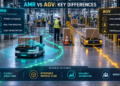
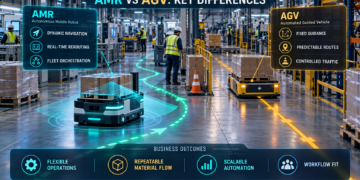
Autonomous Mobile Robots vs Automated Guided Vehicles: Key Differences
I. THE CURRENT MARKET LANDSCAPE & CHALLENGE
The Route Is Not the Real Problem
A map can show a clear line between Point A and Point B.
Production facilities rarely stay that simple.
The warehouse route can be blocked by a pallet.
A forklift can enter an intersection.
A staging lane can overflow.
A charger can become unavailable.
A hospital corridor can become occupied by a bed movement or emergency response.
An elevator can arrive full.
A secured door can refuse access.
The robot therefore needs more than a path.
It needs a continuously updated execution policy.
AMRs and AGVs Should Not Be Reduced to “Smart vs Dumb”
Modern guided vehicles can incorporate obstacle detection, controlled stopping and varying levels of route logic.
The more useful procurement distinction is navigation dependency.
Traditional AGV deployments commonly depend more heavily on engineered routes or infrastructure.
AMRs generally place more navigation intelligence onboard, allowing greater route flexibility within a mapped operating environment.
Neither architecture is automatically superior.
A highly repetitive transport lane may not economically justify sophisticated free navigation.
Indoor Navigation Is Not “GPS for a Building”
Indoor AMRs usually cannot depend on conventional GNSS.
Instead, Indoor Navigation can combine LiDAR, cameras, wheel encoders, inertial measurement units, landmarks and—in some deployments—UWB, QR/AprilTag-style fiducials or other infrastructure aids.
The robot estimates where it is.
That distinction matters.
The Unit of Navigation Is the Mission
A robot travelling efficiently but failing the handoff has accomplished little.
The business transaction might be:
move tote from storage to picking
deliver component to production
return empty container
move medication from pharmacy to controlled destination
transport linen
remove waste
Therefore:
Mission Success ≠ Robot Reached Coordinate
A stronger definition is:
Verified Mission Success = Correct Payload + Correct Destination + Required Handoff + Allowed Time + Valid Completion Confirmation
That is the metric the navigation stack should serve.
The Cost of Inaction Appears as Transport Friction
Navigation problems create small delays before they create dramatic failures.
A robot waits at an intersection.
Another queues behind it.
A third takes a longer route.
A human clears a stranded vehicle.
A charger becomes congested.
A nurse waits for a delivery.
A picker waits for material.
Each event has an economic cost.
A useful NezzHub analytical framework is:
Navigation Friction Cost = Queue Cost + Detour Cost + Recovery Labor Cost + Failed-Handoff Cost + Downtime Cost + Charging-Delay Cost + Missed-Service Cost
Express every term in money, use the same reporting period and count each loss once. Do not add downtime separately when it is already included in recovery or missed-service costs.
This is not an accounting standard.
It is a deployment model for finding where autonomy is leaking money.
Cost of Inaction Should Be Measured Per Mission
Start with:
Cost per Verified Mission = Total AMR Operating Cost ÷ Verified Completed Missions
Then separate avoidable navigation losses.
Navigation Loss per Mission = Navigation-Related Delay and Recovery Cost ÷ Verified Missions
This prevents a common mistake.
A fleet can report high robot utilization while the business process remains inefficient.
Adding More AMRs Can Make Navigation Worse
More robots increase theoretical capacity.
They also increase contention.
Shared resources include:
intersections
narrow aisles
doors
elevators
charging stations
pick stations
transfer points
hospital service corridors
When resource demand approaches capacity, queueing effects become nonlinear.
Buying another robot without examining traffic can therefore add congestion rather than throughput.

II. DEEP-DIVE TECHNICAL ANALYSIS & EVIDENCE
AMR Navigation Architecture: Eight Layers Between a Mission and a Verified Delivery
The following eight-layer model separates business requests, robot navigation, protective functions and fleet coordination for deployment planning.

Layer 1 — Business Mission
The mission originates outside the navigation stack.
In a warehouse, it may come from:
WMS
WES
ERP
MES
operator interface
A hospital mission may originate from logistics software, a departmental workflow or another approved system.
Navigation should not need to understand the entire business application.
It needs a validated mission contract.
Layer 2 — Mission Orchestration
The orchestration layer converts business intent into executable robot work.
For example:
Collect tote A → travel to station B → wait for handoff → confirm transfer → return to C
This layer manages dependencies.
Navigation manages movement.
Confusing the two creates brittle systems.
Layer 3 — Perception
Sensors measure the environment.
Typical inputs include:
- safety laser scanners;
- navigation LiDAR;
- depth/stereo cameras;
- monocular cameras;
- wheel encoders;
- IMUs;
- ultrasonic or short-range sensors where appropriate.
But sensor count is not sensor quality.
Calibration, field of view, contamination, latency and mounting matter.
Layer 4 — Localization
The robot estimates:
x-position
y-position
orientation
and, ideally, confidence in that estimate.
SLAM is one option.
Localization against an existing map is another operating mode.
Infrastructure aids can provide additional constraints.
The key requirement is not “uses SLAM.”
It is:
maintains sufficient localization confidence for the task.
Layer 5 — Global Planning
The global planner chooses a route through the mapped facility.
A shortest path is rarely sufficient.
The cost function can include:
distance
estimated congestion
restricted zones
one-way lanes
payload constraints
floor conditions
mission priority
resource reservations
A conceptual model is:
Route Cost = Distance + Congestion Penalty + Risk Penalty + Resource Delay + Mission-Priority Penalty
The weights are application-specific.
Layer 6 — Local Planning
The local planner deals with the next seconds of motion.
A person walks into the corridor.
A pallet appears.
A cart moves.
Another AMR crosses ahead.
The local planner adjusts velocity and trajectory within the authority allowed by the navigation architecture.
Global planning selects the facility route; local planning adjusts near-term movement as obstacles and conditions change.
Layer 7 — Safety Functions
Safety is not simply another navigation feature.
Safety-rated protective functions may constrain or override ordinary navigation.
ISO 3691-4:2023 specifies safety requirements and verification for driverless industrial trucks and explicitly includes autonomous mobile robots among its examples.
Do not describe a navigation algorithm as “safe” merely because it avoids obstacles during normal operation.
Functional safety requires its own engineering and verification.
Layer 8 — Fleet Coordination and Verification
At scale, the robot is no longer navigating alone.
Fleet software coordinates:
missions
traffic
shared resources
charging
priorities
exceptions
completion state
The mission should end with verification.
Not with “robot stopped moving.”
Architecture Overview
A mature deployment can be represented as:
WMS / ERP / MES / HOSPITAL WORKFLOW
↓
MISSION ORCHESTRATION
↓
FLEET MANAGER
↓
RESOURCE / TRAFFIC AUTHORITY
↓
ROBOT MISSION EXECUTIVE
↓
GLOBAL PLANNER
↓
LOCAL PLANNER
↓
MOTION CONTROLLER
Meanwhile:
LiDAR + Cameras + Encoders + IMU
↓
PERCEPTION + LOCALIZATION
↓
MAP + POSE + OBSTACLES
↓
PLANNERS
And independently where required:
SAFETY SENSORS / SAFETY CONTROLLER
↓
PROTECTIVE RESPONSE
This separation is crucial.
Fleet software should not be casually treated as the robot’s functional-safety controller.
Integration Flowchart: From Warehouse Order to Verified Delivery
BUSINESS REQUEST RECEIVED
↓
Mission Valid?
No → reject / escalate
Yes → continue
↓
FLEET SOFTWARE SELECTS ELIGIBLE ROBOT
↓
Robot Ready?
Check:
battery
payload capability
current mission
fault state
location
↓
ROUTE CANDIDATES GENERATED
↓
Shared Resources Available?
Check:
aisle
intersection
door
elevator
transfer station
charger
↓
RESERVE REQUIRED RESOURCES
↓
SEND MISSION
↓
ROBOT LOCALIZES
↓
GLOBAL ROUTE ACCEPTED
↓
LOCAL NAVIGATION EXECUTES
↓
Dynamic Obstacle?
Yes → slow / stop / replan within allowed policy
↓
Localization Confidence Lost?
Yes → execute localization recovery policy
↓
Resource Becomes Unavailable?
Yes → release / re-reserve / reroute / escalate
↓
ARRIVE AT DESTINATION
↓
VERIFY HANDOFF
↓
RETURN COMPLETION STATE TO BUSINESS SYSTEM
This is what turns Robot Navigation into enterprise automation.
Warehouse AMR Navigation: Throughput Is a Network Property
Warehouse AMRs often operate in structured spaces.
That does not make navigation trivial.
The difficult areas are usually:
cross-aisles
end-of-aisle turns
staging zones
dock areas
conveyors
transfer stations
charger approaches
forklift crossings
The navigation problem is therefore partly spatial and partly temporal.
A route can be physically open but operationally unavailable.
The Fastest Robot Can Create the Slowest Fleet
Imagine ten robots approaching one intersection.
Every robot independently chooses the geometrically shortest route.
The result can be a queue.
A fleet-aware route planner may deliberately send some robots farther.
That can reduce total completion time.
This creates a critical distinction:
Local Route Efficiency ≠ Fleet Throughput Efficiency
For warehouse automation, optimize the system.
Not the individual vehicle.
Hospital AMR Navigation: Predictability Matters More Than Aggression
Warehouse and hospital deployments both require safe movement and timely deliveries. Hospitals additionally require navigation policies that respect clinical priorities, patient movement and restricted areas
Warehouses also require safety.
Hospitals also require timely transport.
The weighting changes.
A Hospital Route Is a Social and Infrastructure Route
The robot may need to:
yield to patients
avoid crowding a nurse station
wait outside an elevator
authenticate at a door
avoid restricted clinical areas
use preferred service corridors
respect quiet-area behavior
handle temporary closures
A two-meter detour can therefore be better than the mathematically shortest path.
Elevator Integration Is a Distributed-System Problem
The robot reaches an elevator lobby.
What happens next?
The AMR may need to request a car through a building interface.
It may need confirmation that the elevator arrived.
Doors must be open.
The robot must determine whether entry is possible.
The elevator must move to the requested floor.
The robot then has to exit and re-establish reliable localization.
Every step creates a failure state.
Elevator Failure States
A production test should include:
elevator does not arrive
wrong car arrives
door opens briefly
car is occupied
network request times out
robot cannot enter
robot enters but destination request fails
robot cannot localize after exit
fire-service mode changes elevator availability
The point is not to make the robot clever.
It is to make failure behavior defined.
Door Integration Has the Same Problem
A hospital robot approaching a secured door may need authorization.
The sequence might be:
request access → validate permission → unlock/open → confirm state → traverse → confirm clearance → close
If confirmation is lost, what does the robot do?
That belongs in commissioning.
Not in post-deployment improvisation.
Indoor Navigation Should Use Infrastructure Selectively
Infrastructure aids can include fiducial markers, reflective landmarks and radio-based positioning systems. Select them to address a measured localization problem.
Do not install hundreds of markers because “more localization is better.”
Use infrastructure where natural-feature localization cannot reliably meet the mission requirement.
Typical examples include:
repetitive corridors
precision docking
elevator lobbies
large open spaces
visually ambiguous zones
areas with changing geometry
Deployment Challenge #1: A Pallet Blocks the Warehouse Aisle
The global route says straight ahead.
The local perception stack sees a pallet.
What Should Happen?
The robot determines whether local avoidance is possible.
If not, it stops or requests a new route.
The fleet layer may need to mark the aisle temporarily constrained.
Other robots should not blindly repeat the same failed route.
Engineering Question
How quickly does a local obstruction become fleet-level knowledge?
That is more commercially useful than asking whether the robot “has obstacle avoidance.”
Deployment Challenge #2: The Hospital Corridor Fills With People
A robot encounters a crowd near a nursing station.
The shortest path remains geometrically valid.
Operationally, it may be undesirable.
What Should Happen?
Depending on configured behavior, the robot may:
slow
wait
increase clearance
choose another corridor
escalate prolonged blockage
The correct behavior depends on risk assessment and facility policy.
There is no universal “human-aware” algorithm that fits every hospital.
Deployment Challenge #3: Localization Confidence Drops
A camera becomes partially obscured.
LiDAR geometry becomes repetitive.
Wheel slip introduces odometry error.
What Should Happen?
The navigation stack should detect degraded localization confidence.
Possible recovery actions include:
reduce speed
seek stronger landmarks
relocalize
use redundant sensing
stop in an appropriate location
request assistance
A robot that knows it is uncertain is easier to manage than one that confidently publishes a wrong pose.
Deployment Challenge #4: Wi-Fi Disappears
Wireless connectivity is important for fleet coordination.
But losing Wi-Fi should not automatically mean losing basic onboard protective behavior.
Define explicitly what remains local.
The robot may retain:
local perception
localization
protective stopping
limited local navigation
while losing:
new mission assignments
central traffic updates
remote diagnostics
enterprise-system integration
The exact architecture varies.
The requirement is predictable degraded behavior.
Deployment Challenge #5: Two Robots Want the Same Narrow Resource
Local obstacle avoidance alone does not solve this.
Both robots may repeatedly yield.
Or both may block each other.
This is a resource-allocation problem.
The fleet layer can reserve the narrow segment for one robot and delay the other.
This is why fleet coordination becomes essential as density rises.

VDA 5050 Version 3.0 Changes the Interoperability Conversation
VDA 5050 Version 3.0.0 was released by VDA on 19 March 2026. It supports communication between mobile robots and a fleet-control system and adds concepts for freer-navigation robots, including zones and path sharing.
That matters for mixed fleets.
It does not solve everything.
The specification explicitly excludes safety requirements and traffic-management algorithms such as routing, prioritization, congestion handling and deadlock resolution.
Therefore:
VDA 5050 Compatibility ≠ Complete Multi-Vendor Navigation Compatibility
That distinction belongs in every serious RFP.
Performance Evaluation Matrix
| Metric | Formula / Measurement | Warehouse Meaning | Hospital Meaning |
| Verified Mission Success | verified completed missions ÷ assigned missions | successful material transfers | successful service deliveries |
| Navigation Availability | navigation-ready robot-hours ÷ scheduled robot-hours | usable capacity | service continuity |
| Route Efficiency | productive route distance ÷ total route distance | wasted travel | unnecessary corridor exposure |
| Queue Time | mean/95th percentile waiting time | congestion loss | corridor/elevator delay |
| Localization Recovery Time | loss to validated pose | downtime | corridor disruption |
| Human Intervention Rate | assisted missions ÷ missions | labor leakage | staff burden |
| Blocked-Route Recovery | successful autonomous reroutes ÷ route blockages | resilience | continuity |
| Docking Success | successful docks ÷ attempts | transfer reliability | station/elevator interface reliability |
| Elevator Mission Success | verified elevator transitions ÷ attempts | usually N/A | critical multi-floor KPI |
| Pose Latency | sensor timestamp to usable pose | control quality | predictable movement |
| Safety-Related Stops | categorized events per operating hour | operational signal | operational signal |
| Cost per Verified Mission | total operating cost ÷ verified missions | unit logistics economics | service-delivery economics |
Do not compare vendors without matching operating conditions.
A warehouse benchmark is not a hospital benchmark.
III. COMMERCIAL SOLUTIONS & BEST PRACTICES
AMR Navigation System Procurement: Buy the Operating Envelope
A polished fleet dashboard is easy to demonstrate.
Ask harder questions.
Can the system navigate when:
an aisle is blocked?
Wi-Fi disappears?
a map changes?
a robot loses localization?
an elevator is occupied?
a charger fails?
multiple robots converge?
an integration API times out?
That is the real product evaluation.
Feature & Cost Comparison Table
| Solution / Approach | Strong Fit | Navigation / Orchestration Strength | Cost Structure to Investigate |
| Seegrid Fleet Central | warehouse material handling | fleet orchestration, traffic/bottleneck management, WMS/ERP/MES integration, VDA 5050 interoperability | AMR hardware, software, integration, support, facility commissioning |
| InOrbit Space Intelligence | heterogeneous enterprise fleets | multi-vendor orchestration, traffic coordination, enterprise-system dispatch, unified operations | platform licensing, connectors, robot adapters, cloud/edge architecture, integration |
| VDA 5050-based orchestration | organizations seeking interface portability | standardized job/status communication and freer-navigation concepts in v3.0 | fleet controller, adapters, validation, traffic logic, safety engineering |
| Integrated single-vendor AMR stack | sites prioritizing accountability and faster integration | robot, navigation and fleet management designed as one ecosystem | hardware premium, fleet licenses, support, integration, potential lock-in |
Prices are deliberately not fabricated.
Enterprise robotics pricing depends heavily on robot type, payload, fleet size, software tier, facility integration, infrastructure, service agreement and geography.
Seegrid Fleet Central
Seegrid describes Fleet Central as an enterprise platform that can assign tasks, monitor battery status, manage traffic and integrate with existing WMS, ERP and MES systems through APIs. It also positions the platform for mixed-fleet orchestration using VDA 5050.
That makes it commercially relevant to warehouse buyers.
Its vendor claims should still be validated against the buyer’s actual routes, loads and mixed-traffic conditions.
InOrbit Space Intelligence
InOrbit.AI demonstrated multi-vendor orchestration at Automate 2026 across robots from multiple manufacturers, with enterprise-system dispatch and shared traffic coordination.
Its missions platform supports robot dispatch, traffic management and mission analytics across connected robots.
This is relevant when an enterprise already owns several robot ecosystems.
But an orchestration layer does not erase differences in each robot’s local navigation or safety implementation.
VDA 5050: Standardized Interface, Not Free Fleet Software
VDA 5050 can reduce integration complexity between mobile robots and central control.
Version 3.0 specifically supports higher-autonomy mobile robots through zone concepts and path sharing.
The standard still leaves traffic-management strategy to the implementation.
That means engineering remains.
Interoperability changes where the work occurs.
It does not eliminate it.
Best Practice: Write an AMR Navigation Contract
Before issuing an RFP, define measurable requirements.
Examples:
minimum verified mission success
maximum 95th-percentile queue time
maximum localization recovery time
required docking tolerance
maximum intervention rate
maximum acceptable pose latency
required network-loss behavior
door/elevator recovery behavior
traffic deadlock recovery
battery reserve policy
The values must come from your process.
Do not copy them from a vendor brochure.
Best Practice: Test at Peak Density, Not Average Density
A fleet that works at 10:00 a.m. may fail at shift change.
Warehouse testing should include:
peak picking
forklift traffic
staging overflow
charger contention
cross-aisle congestion
Hospital testing should include:
visitor peaks
meal delivery
shift changes
bed movement
elevator competition
temporary corridor closure
Test the operation you actually need.
Best Practice: Separate Navigation From Safety Validation
Path planning decides where the robot would like to travel.
Safety functions determine whether movement is permitted under applicable conditions.
Do not allow a successful obstacle-avoidance demo to substitute for safety engineering.
For industrial driverless trucks and AMRs within scope, ISO 3691-4:2023 provides the relevant safety requirements and verification framework.
Local laws, machinery requirements, facility risk assessments and manufacturer instructions can add further obligations.
Best Practice: Design Recovery Before Optimization
Teams often tune route speed first.
Reverse the order.
Test:
robot lost
map mismatch
sensor degraded
door unavailable
elevator unavailable
network unavailable
mission cancelled
charger unavailable
traffic deadlock
payload handoff failed
A fleet that recovers predictably is easier to scale than a fleet that is spectacular only under nominal conditions.
IV. BUSINESS OUTCOMES & STRATEGIC ROI TAKEAWAYS
AMR Navigation ROI Starts With Cost per Verified Mission
Do not begin with “robots save labor.”
Begin with a baseline.
Measure the current transport process:
moves per shift
labor minutes per move
travel distance
waiting
handoff delay
failed deliveries
expedites
downtime
Then measure the automated process using the same business boundary.
Calculate Transport Capacity Value
Use:
Verified Throughput Gain = Post-Deployment Verified Missions − Baseline Verified Missions
Then:
Throughput Value = Verified Throughput Gain × Economic Contribution per Additional Mission
Do not assign revenue to movements that do not create incremental business capacity.
That is how ROI becomes inflated.
Calculate Labor Capacity Released
Use:
Released Labor Hours = Baseline Transport Labor Hours − Residual Transport and Robot-Support Labor Hours
The second term matters.
AMRs still require support.
That may include:
exception recovery
cleaning
charging infrastructure support
map maintenance
fleet supervision
software administration
integration support
Automation changes labor.
It does not make labor disappear.
Hospital ROI Requires a Different Value Model
A hospital should be cautious about claiming direct “labor savings” simply because a robot transports supplies.
Released clinical time is not automatically cash savings.
A stronger measure is:
Clinical Capacity Released = Baseline Staff Transport Time − Residual Robot-Support Time
Then determine whether that time actually produces measurable value.
Examples may include more patient-facing time, reduced internal transport workload or improved service responsiveness.
Those benefits require local measurement.
Calculate Queue Reduction
Use:
Queue-Time Reduction = Baseline Shared-Resource Wait − Post-Deployment Shared-Resource Wait
Measure by resource.
A fleet-wide average can hide one catastrophic elevator or intersection bottleneck.
Track:
intersection queue
charger queue
elevator queue
transfer-station queue
door queue
This turns navigation analytics into facility-design evidence.
Calculate Intervention Cost
Use:
Intervention Rate = Human-Assisted Missions ÷ Total Missions × 100
Then:
Annual Intervention Cost = Intervention Events × Mean Loaded Cost per Intervention
This is one of the most revealing automation metrics.
A robot can complete thousands of missions yet remain expensive if staff repeatedly rescue it.
Calculate Navigation Availability
Use:
Navigation Availability = Navigation-Ready Robot-Hours ÷ Scheduled Robot-Hours × 100
Exclude periods when a robot cannot perform assigned missions because of navigation-related faults.
This separates theoretical fleet size from usable capacity.
Full AMR Navigation TCO
A serious model includes:
robot hardware
navigation software
fleet-management software
integration
WMS/MES/ERP or hospital-system connectors
wireless infrastructure
edge/cloud compute
doors and elevators
charging infrastructure
mapping and commissioning
safety engineering
cybersecurity
maintenance
support
training
spares
downtime
human exception handling
Therefore:
Annual AMR TCO = Annualized Capital + Software + Integration + Infrastructure + Support + Energy + Maintenance + Cybersecurity + Labor + Downtime
Cheap robot hardware can coexist with expensive integration.
Evaluate the system.

Avoid the “More Robots = More ROI” Trap
Fleet expansion should be justified by marginal throughput.
Use:
Marginal Robot Throughput = (Throughput After Addition − Baseline Throughput) ÷ Robots Added
Then:
Incremental Capacity Value = Economic Value of Added Throughput − Incremental Fleet TCO
If throughput barely moves after adding robots, investigate traffic before purchasing more units.
The bottleneck may be physical.
Verified Annual Benefit
First-Year Benefit = Verified Avoided Baseline Costs + Verified Additional Capacity Value
First-Year Cost = Initial Implementation Investment + First-Year AMR Operating Cost
First-Year ROI (%) = [(First-Year Benefit − First-Year Cost) ÷ First-Year Cost] × 100
Compare the automated operation with a defined baseline over the same first-year period. Count each benefit and cost once. Avoided baseline costs may include manual transport, intervention and downtime costs, provided they do not overlap. Additional capacity value must represent a measured business benefit. Released staff time is not automatically a cash saving.
Estimated Payback Period (months) = Initial Implementation Investment ÷ Average Monthly Net Benefit
Monthly net benefit excludes the upfront investment and deducts ongoing AMR operating costs. Use this estimate only when monthly net benefit is positive and reasonably stable. If benefits vary substantially, calculate payback using cumulative cash flows.
A Day in the Life of an Enterprise AMR Navigation System
The following hypothetical examples illustrate how warehouse and hospital navigation requirements change during daily operations.
At 06:55, the warehouse fleet is lightly loaded.
Routes look excellent.
At 07:10, inbound pallets begin entering staging.
One cross-aisle becomes constrained.
The fleet controller diverts lower-priority missions.
At 07:35, a robot loses localization confidence near repetitive racking.
It slows and relocalizes rather than continuing on an uncertain pose.
At 08:00, several robots approach charging thresholds.
Charging is staggered because removing too many units simultaneously would reduce capacity.
At 08:20, a forklift blocks a preferred route.
Local navigation stops safely while the fleet layer adjusts future missions.
Now consider a hospital.
At 14:00, a robot receives a supply mission.
The direct corridor is crowded.
Its policy favors a longer service route.
At 14:08, the elevator is unavailable.
The robot waits in its defined holding area instead of obstructing pedestrian traffic.
At 14:13, service resumes.
The robot transitions floors, re-establishes localization and completes the handoff.
That is AMR Navigation in production.
Not “go from A to B.”
It is continuous management of uncertainty, shared resources and exceptions.
RISK MITIGATION & REGULATORY FRAMEWORK
Navigation Software Does Not Replace Safety Engineering
Obstacle detection alone does not establish that a robot can stop safely in every situation.
Stopping performance depends on the vehicle, speed, payload, sensing architecture, protective fields, floor conditions, braking capability, system design and validated safety functions.
ISO 3691-4:2023 explicitly covers safety requirements and verification for driverless industrial trucks, including AMRs.
Safety claims should be tied to the actual certified/configured system.
Cybersecurity: AMRs Are Operational Technology
AMRs interact with the physical environment.
Their fleet software can influence physical movement.
That makes OT cybersecurity guidance relevant.
NIST SP 800-82 Rev. 3 covers programmable systems that interact with physical processes and specifically addresses OT security while accounting for performance, reliability and safety requirements.
Treat robot credentials and fleet APIs accordingly.
AMR Threat Model
Include at least:
stolen robot credentials
unauthorized mission injection
map modification
fleet API abuse
malicious software update
compromised remote-support account
network denial of service
false telemetry
unauthorized door/elevator commands
cloud-control dependency failure
logging manipulation
supply-chain compromise
A fleet management server is not “just another dashboard.”
It can influence cyber-physical operations.
NIST OT Security Checklist
- Inventory every robot, fleet server and integration endpoint.
- Separate IT and OT trust boundaries.
- Apply least privilege to fleet and robot accounts.
- Protect API credentials.
- Authenticate software and configuration updates.
- Version and protect navigation maps.
- Restrict remote support.
- Log mission and configuration changes.
- Define backup and recovery.
- Test network-loss behavior.
- Monitor abnormal robot/fleet traffic.
- Maintain incident-response procedures.
- Document cloud dependencies.
- Test rollback before production updates.
NIST is already working on SP 800-82 Rev. 4, while Rev. 3 remains the final published revision as of September 2026.
AI Risk Management: Only Apply AI Governance Where AI Exists
Not every AMR navigation function is artificial intelligence.
Classical SLAM, graph search, optimization and deterministic controllers should not be mislabeled simply to make a product sound advanced.
If machine learning is used for perception, semantic understanding, learned navigation, human-motion prediction or AI-assisted fleet optimization, then AI-specific governance becomes more relevant.
NIST AI Risk Management Framework is voluntary and is currently being revised. NIST’s 2026 critical-infrastructure work explicitly includes autonomous robots and vehicles using multimodal sensing, redundant safety systems and deterministic fail-safe controllers as an example.
NIST AI RMF-Oriented Checklist
- Identify which navigation components actually use AI/ML.
- Document intended operating conditions.
- Define regions where model performance has been validated.
- Test environmental distribution shifts.
- Measure false detections and missed detections.
- Separate AI recommendations from safety authority.
- Maintain deterministic fallback where required.
- Version models and training dependencies.
- Log consequential AI-driven decisions.
- Test graceful degradation.
- Define human intervention.
- Prevent unvalidated models from reaching production.
NIST’s Playbook organizes AI risk activity around Govern, Map, Measure and Manage.
Use that structure where it genuinely applies.
EU AI Act: Do Not Assume Every AMR Is Automatically High-Risk AI
An AMR is not automatically a high-risk AI system simply because marketing describes it as “AI-powered.”
Classification depends on whether the relevant component meets the AI Act definition, its intended purpose and whether the conditions for high-risk classification are met.
The Commission’s 2026 guidance identifies two major high-risk routes: certain Annex III use cases, or AI used as a safety component/product under listed harmonisation legislation where the product is subject to third-party conformity assessment.
Following the AI Omnibus, high-risk rules for AI embedded in regulated physical products apply from 2 August 2028; certain Annex III high-risk systems apply from 2 December 2027.
Legal classification must be deployment-specific.
EU AI Act Assessment Checklist
- Determine whether the relevant software qualifies as an AI system.
- Document intended purpose.
- Identify AI functions separately from deterministic navigation.
- Determine whether AI performs a safety function.
- Identify applicable product legislation.
- Determine whether Article 6 high-risk criteria apply.
- Identify provider and deployer responsibilities.
- Maintain required technical documentation where applicable.
- Preserve logs and traceability.
- Establish appropriate human oversight.
- Validate robustness and accuracy.
- Address cybersecurity.
- Control substantial modifications.
- Track the applicable 2027/2028 dates.
Do not claim “EU AI Act compliant” from a generic checklist.
Compliance depends on the actual system and legal role.
AMR Navigation Production Promotion Gate
Navigation
- Map validated.
- Localization accuracy validated.
- Localization-loss recovery tested.
- Global planner tested.
- Local planner tested.
- Blocked-route behavior tested.
- Dead-end recovery tested.
- Narrow-passage behavior tested.
People and Traffic
- Pedestrian interaction tested.
- Forklift interaction tested where applicable.
- Intersection behavior tested.
- Queueing tested.
- Right-of-way rules documented.
- High-density conditions tested.
Infrastructure
- Door integration tested.
- Elevator integration tested.
- Charger availability tested.
- Network loss tested.
- Building-system timeout tested.
- Restricted zones validated.
Fleet
- Simultaneous missions tested.
- Deadlock scenarios tested.
- Robot failure tested.
- Charger contention tested.
- Priority mission tested.
- Resource reservation tested.
Safety and Governance
- Applicable safety requirements identified.
- Risk assessment completed.
- Safety functions independently verified as required.
- Cybersecurity controls reviewed.
- Update/rollback tested.
- Audit logs enabled.
- Operator escalation documented.
Do not promote the fleet because ten demo missions succeeded.
Promote it when credible failure scenarios have known responses.
Evaluate the Most Difficult Routes Before Purchase
Take your proposed AMR route.
Do not start with the cleanest aisle.
Start with the worst one.
In a warehouse, choose the forklift crossing, narrow intersection, staging bottleneck and busiest transfer station.
In a hospital, choose the crowded corridor, elevator, secured door and area where pedestrian priority is non-negotiable.
Then run the shortlisted Autonomous Mobile Robots through those routes repeatedly.
Measure:
mission success
queue time
localization loss
recovery time
interventions
docking success
resource waits
network-loss behavior
traffic conflicts
cost per verified mission
Only after that should you compare purchase price.
The best AMR Navigation System is not the robot that travels fastest through an empty corridor.
It is the system that knows where the robot is, understands what constrains its next move, coordinates shared resources, degrades predictably when something fails and completes the business transaction without turning routine exceptions into human rescue work.
That is the difference between a mobile robot demonstration and an enterprise transport system.
V. APPENDIX & RESEARCH INTEGRITY
Academic and Primary-Source Reference Index
[1] ISO 3691-4:2023 — Industrial trucks: Safety requirements and verification, Part 4. The standard covers driverless industrial trucks and explicitly lists autonomous mobile robots among the included examples.
[2] VDA/VDMA — VDA 5050 Version 3.0.0, March 2026. Defines communication between mobile robots and fleet control and supports heterogeneous fleets; Version 3.0 adds free-navigation zone concepts and path sharing.
[3] VDA 5050 Version 3.0 Specification. Explicitly excludes safety requirements and traffic-management algorithms such as routing, prioritization, congestion handling and deadlock resolution.
[4] NIST SP 800-82 Rev. 3 — Guide to Operational Technology Security. Provides OT security architecture, threat, vulnerability and countermeasure guidance while accounting for reliability and safety constraints.
[5] NIST AI Risk Management Framework. Voluntary framework for managing AI risks; AI RMF 1.0 is currently undergoing revision.
[6] NIST AI RMF Trustworthy AI in Critical Infrastructure Concept Note, 2026. Includes autonomous robots and vehicles among examples requiring trustworthy AI characteristics, multimodal sensing and fail-safe controls.
[7] European Commission — AI Act High-Risk Classification Guidance and 2026 AI Omnibus Timeline. Provides current high-risk classification framework and extended enforcement dates.
[8] Seegrid Fleet Central. Current vendor documentation for AMR fleet orchestration, enterprise integration, traffic management and VDA 5050 interoperability. Vendor performance claims require buyer validation.
[9] InOrbit Space Intelligence / Missions. Current documentation and 2026 multi-vendor demonstration covering robot orchestration, enterprise-system integration, mission dispatch and traffic coordination.
Corporate Editorial Transparency & AI Usage Disclosure
NezzHub Editorial Transparency Statement
This article examines AMR navigation architecture, warehouse and hospital deployment challenges, procurement requirements and methods for evaluating operating costs.
AI-assisted systems may support research organization, source comparison, drafting and editorial refinement. Final publication responsibility—including source verification, interpretation, commercial analysis, corrections and editorial judgment—remains with NezzHub’s human editorial process.
Vendor statements describe supplier capabilities and require validation against the buyer’s operating conditions.
Author and Editorial Review
Author: Garikapati Bullivenkaiah
Technology research writer with LL.B., LL.M., M.A., and MBA qualifications. He writes about emerging technologies and their business, governance and legal implications. His multidisciplinary academic background informs his analysis of technology adoption, intellectual property, and organizational risk. His articles explain technical concepts and practical considerations for business owners, IT managers and technology decision-makers. LinkedIn Profile
Reviewed by: Chitikineni Ramadevi — Editor
Chitikineni Ramadevi holds an M.Sc. in Computers from Andhra University and has over 10 years of research experience in technology-related subjects. She reviews NezzHub articles for clarity, factual accuracy, source support and practical relevance.
Published by: NezzHub
Research approach: This article draws on primary sources, technical documentation and relevant industry research. References are provided within the article or its sources section.
Last reviewed: 09-10-2026
Corrections: To report a factual error or outdated information, please contact NezzHub.