














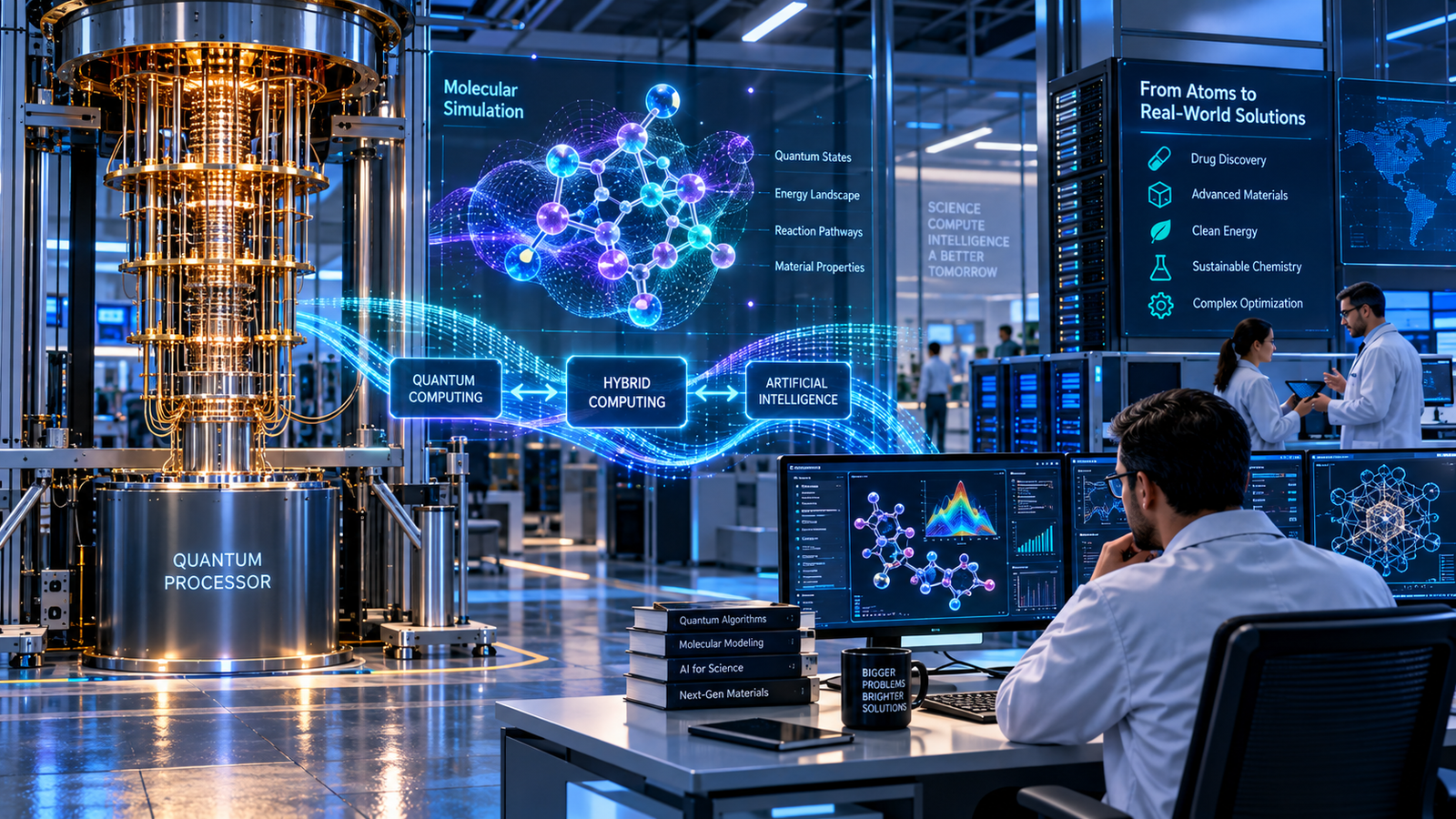
Quantum AI Simulation combines quantum processors, classical computing and AI to investigate complex scientific problems through a hybrid computational workflow.
Executive Summary
Quantum AI Simulation is commercially interesting for one reason: some valuable scientific problems become brutally expensive as the number of interacting states, particles or optimization variables grows.
The opportunity is not a magical computer that “tries every answer simultaneously.” It is a hybrid architecture in which quantum processors perform carefully selected computations while classical HPC, optimization and AI systems prepare inputs, tune circuits, mitigate noise, interpret measurements and validate outputs.
That distinction materially changes the business case.
Research applications include chemistry, materials, catalysts, carbon capture and selected optimization problems. Current hardware limitations make hybrid quantum-classical workflows an important approach to evaluating these applications.
Current quantum computers have not established that drug development will collapse from a decade to months, that logistics problems can routinely be solved better than leading classical optimizers, or that financial crises can be predicted through a universal quantum model.
The enterprise case is narrower—and stronger.
Use Quantum AI Simulation where a quantum representation has a defensible connection to the problem, where classical baselines are expensive or inadequate, where output quality can be independently validated and where the value of improved candidate selection exceeds the cost of quantum experimentation.
The operating model is:
FORMULATE → CLASSICALLY BASELINE → ENCODE → EXECUTE → MEASURE → LEARN → VALIDATE → DECIDE
The procurement principle is equally important:
Do not buy quantum because the problem is difficult. Buy experimentation only when the problem contains structure that gives a quantum method a credible path to measurable advantage.
I. THE CURRENT MARKET LANDSCAPE & CHALLENGE
Quantum AI Simulation Is Facing a Proof Problem
Quantum hardware is improving.
Commercial proof remains much harder.
IBM’s current fleet includes 133/156-qubit Heron processors and 120-programmable-qubit Nighthawk processors, while its platform exposes processors capable of workloads involving thousands of gates. Those numbers show engineering progress, but qubit count alone does not establish application-level advantage.
Google’s Willow work provides another important milestone.
A 101-qubit distance-7 surface-code memory achieved a logical error rate of 0.143% per error-correction cycle, with error suppression improving as code distance increased. That is evidence of below-threshold quantum error correction—not proof that today’s hardware can economically solve arbitrary chemistry, finance or logistics problems.
That distinction should govern enterprise investment.
The Classical Baseline Is Moving Too
Quantum systems are not competing against frozen 2020-era algorithms.
They compete against improving GPUs, HPC clusters, tensor networks, specialized solvers, surrogate models and increasingly capable AI.
Tensor-network methods, for example, compress structured quantum states and remain important classical tools for simulating quantum systems, quantum circuits and error-correction problems.
Google’s own qsim documentation illustrates the point.
A straightforward state-vector simulation becomes memory-intensive quickly: its current Cirq guidance recommends qsim for deep circuits around 30 qubits with 8 GB RAM and notes that memory approximately doubles for each additional qubit. Google’s larger qsim implementation can reach roughly 40 qubits on a 90-core workstation under suitable workloads.
The exponential wall is real.
Its location depends on structure.
Why Quantum State Simulation Can Scale Exponentially
Simulation complexity depends on the system, representation, algorithm and required accuracy. There is no universal increase in computational cost for adding one particle.
For a system of n two-level quantum components, a full state vector contains:
2ⁿ complex amplitudes
Adding one such component doubles that state-space dimension.
For more complicated local Hilbert spaces, the factor changes.
Algorithms can also exploit symmetry, locality, sparsity, approximations and tensor structure.
The accurate enterprise statement is therefore:
Exact classical representation can scale exponentially with system size, but practical computational difficulty depends on the physics, representation, algorithm and required accuracy.
That is less dramatic.
It is far more useful.
Cost of Inaction Is Not “Failing to Buy Quantum”
The wrong business case says:
competitors are investing in quantum, therefore we must invest too.
The useful question is whether existing computational constraints are creating measurable R&D friction.
That friction may include:
expensive HPC runs
large experimental search spaces
slow materials screening
too many wet-lab candidates
high optimization latency
inadequate uncertainty characterization
excessive solver cost
poor approximation quality at required scale
A NezzHub analytical framework is:
Complexity Friction Cost = Classical Compute + Experimental Iteration + Candidate Screening + Engineering Delay + Opportunity Cost + Validation Cost
Only part of this cost is potentially addressable by quantum methods.
Quantum Opportunity Must Be Measured Against the Best Classical Alternative
Define:
Quantum Opportunity Value = Cost of Best Validated Classical Workflow − Cost of Validated Hybrid Quantum Workflow
But cost alone is insufficient.
Output quality matters.
A better decision measure is:
Validated Computational Value = Quality Improvement + Time-to-Decision Value + Experimental Reduction Value − Incremental Quantum TCO
If that value is negative, quantum experimentation may still produce research knowledge.
It is not yet a business deployment.
Match Each Application to Its Computational Structure
Drug discovery, batteries, catalysts, financial risk, carbon capture, protein folding and logistics present different computational challenges. Their suitability for quantum methods must be evaluated separately.
Chemistry and materials problems are naturally quantum mechanical.
Portfolio optimization and logistics are primarily classical combinatorial problems, even though quantum algorithms can be formulated for them.
Protein structure prediction is also not automatically a quantum-computing problem simply because proteins are composed of atoms.
The business priority should therefore reflect problem-to-hardware fit, not headline appeal.
II. DEEP-DIVE TECHNICAL ANALYSIS & EVIDENCE
Quantum AI Simulation Architecture: Eight Layers Between a Business Problem and a Defensible Result
A serious Quantum AI Simulation workload is not “AI + quantum computer.”
It is a distributed computational pipeline.
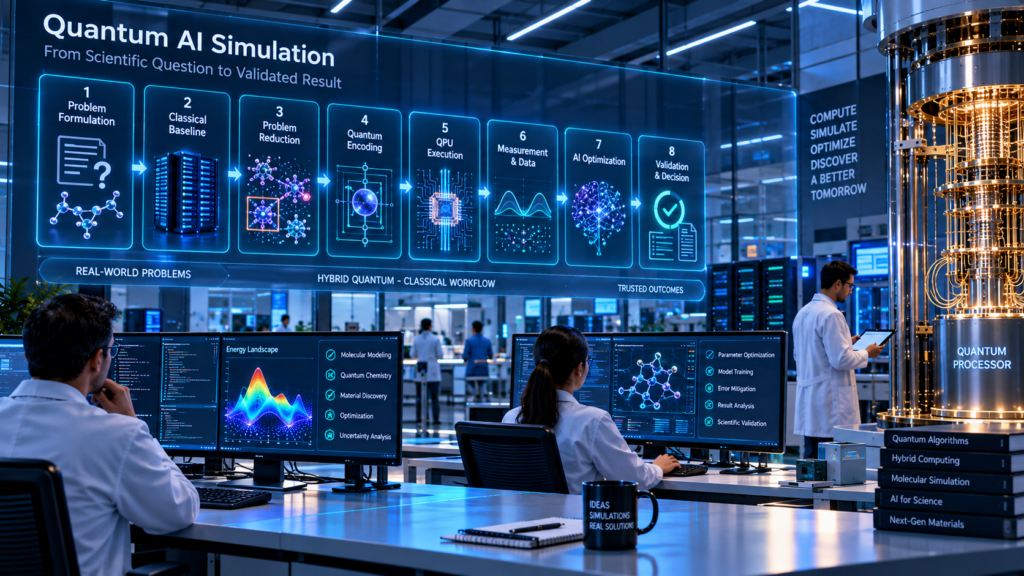
A production-ready Quantum AI Simulation architecture connects problem formulation, classical benchmarking, quantum execution, AI-assisted optimization and independent validation.
Layer 1 — Problem Formulation
Start with the quantity the business needs.
Examples include:
ground-state energy
reaction barrier
molecular spectrum
material property
candidate ranking
portfolio objective
routing objective
A vague goal such as “use quantum to discover batteries” is not executable.
Layer 2 — Classical Baseline
Before touching a QPU, establish the strongest reasonable classical benchmark.
That might involve:
density functional theory
coupled-cluster methods
tensor networks
Monte Carlo
molecular dynamics
mixed-integer optimization
GPU simulation
classical machine learning
Without this baseline, “quantum improvement” cannot be measured.
Layer 3 — Problem Reduction and Encoding
Real enterprise problems are usually too large to place directly on present hardware.
The workload must be reduced.
Chemistry teams may select an active space containing the orbitals most relevant to the target phenomenon.
Optimization teams may compress constraints or decompose the problem.
This reduction creates model risk.
The quantum processor cannot recover physics or business constraints that were removed incorrectly before execution.
Layer 4 — Quantum Circuit or Hamiltonian Construction
The reduced problem is mapped into a quantum representation.
Depending on the application, the implementation may use:
variational circuits
Hamiltonian simulation
quantum kernels
sampling circuits
annealing-style formulations
QAOA-like optimization
VQE-like energy estimation
Circuit depth, connectivity and measurement requirements now become cost drivers.
Layer 5 — QPU Execution
The circuit runs repeatedly.
Why repeatedly?
Because quantum measurements are statistical.
One execution—commonly called a shot—does not normally provide the full answer.
A production experiment may require many circuit evaluations, parameter settings and measurement shots.
This is where cloud pricing begins to matter.
Layer 6 — Classical Optimization and AI
A classical optimizer can update circuit parameters.
Machine learning can help with tasks such as surrogate modeling, calibration analysis, candidate prioritization, anomaly detection or selected error-mitigation workflows.
But AI does not automatically “find the correct part of Hilbert space.”
The AI component must have a defined objective, training signal and validation procedure.
Layer 7 — Error Handling and Uncertainty
Current QPUs are noisy.
A useful pipeline may therefore require:
error suppression
error mitigation
calibration-aware compilation
measurement mitigation
statistical confidence intervals
repeat runs
cross-device validation
These activities increase compute cost.
They can also materially change the answer.
Layer 8 — Independent Validation
A quantum output is not a business decision.
Validate it against:
known solutions
classical approximations
laboratory measurements
holdout data
alternative QPUs
repeat experiments
domain constraints
Only then should the result influence R&D or operational decisions.
Architecture Overview
A practical Hybrid Quantum Computing stack looks like this:
BUSINESS / SCIENTIFIC QUESTION
↓
DOMAIN MODEL
↓
CLASSICAL BASELINE
↓
PROBLEM REDUCTION
↓
QUANTUM ENCODING
↓
CIRCUIT COMPILATION
↓
QPU
↓
MEASUREMENTS
↓
ERROR HANDLING
↓
CLASSICAL OPTIMIZER / AI MODEL
↓
UPDATED PARAMETERS
↺ QPU ITERATION
↓
UNCERTAINTY ESTIMATION
↓
CLASSICAL / EXPERIMENTAL VALIDATION
↓
BUSINESS DECISION
The QPU occupies one part of the architecture.
That is the engineering reality behind Quantum AI Simulation.
Integration Flowchart: How a Quantum AI Experiment Actually Runs
DEFINE TARGET PROPERTY
↓
Does the problem have credible quantum structure?
No → stay classical
Yes → continue
↓
BUILD BEST CLASSICAL BASELINE
↓
REDUCE PROBLEM
↓
Does reduction preserve the required physics or constraints?
No → reformulate
Yes → continue
↓
MAP TO QUANTUM REPRESENTATION
↓
SIMULATE SMALL INSTANCE CLASSICALLY
↓
Implementation agrees with known result?
No → debug
Yes → continue
↓
COMPILE FOR TARGET QPU
↓
EXECUTE SHOTS
↓
MITIGATE / CHARACTERIZE ERRORS
↓
AI OR CLASSICAL OPTIMIZER UPDATES PARAMETERS
↓
Convergence achieved?
No → repeat
Yes → continue
↓
COMPARE WITH CLASSICAL BASELINE
↓
VALIDATE EXPERIMENTALLY WHERE REQUIRED
↓
Material advantage?
No → document research result
Yes → scale cautiously
This loop prevents a research prototype from being misrepresented as enterprise value.
Quantum Computing Simulation Still Needs Classical Simulation
This sounds contradictory.
It is not.
Before expensive QPU execution, developers often simulate small quantum circuits classically to verify logic and compare expected outputs.
Google Cirq, for example, provides pure-state and density-matrix simulation, plus external high-performance simulators such as qsim.
This produces a useful hierarchy:
Laptop simulation → HPC/GPU simulation → noisy hardware model → QPU experiment
Skipping the cheaper layers wastes budget.
Quantum AI Simulation for Chemistry and Materials
This is one of the strongest technical cases.
Electronic structure is intrinsically quantum mechanical.
Accurate simulation becomes difficult when electron correlation cannot be represented efficiently by manageable classical approximations.
A 2025 Nature Physics study demonstrated programmable simulations of strongly correlated model systems using reconfigurable quantum processors and classical post-processing to extract chemically relevant spectral properties. The paper also explicitly states that achieving practical quantum advantage remains challenging.
That combination—progress plus limitation—is the correct commercial framing.

Quantum AI Simulation can support chemistry and materials research by helping scientists evaluate molecular systems and prioritize promising candidates for further validation.
Drug Discovery: Candidate Reduction, Not “Drugs in Months”
Drug development includes:
target identification
assay development
lead discovery
ADME/Tox
preclinical testing
clinical trials
regulatory review
Improved molecular simulation addresses only parts of this chain.
A credible value proposition is narrower.
Quantum-enhanced chemistry could eventually improve calculations that help rank or understand molecular candidates, thereby reducing some computational or experimental search.
That is valuable without claiming that a QPU eliminates clinical development.
How Quantum Molecular Simulation Helps Drug Discovery
Battery and Catalyst Design: Follow the Electron-Correlation Bottleneck
The defensible opportunity is electronic-structure calculation.
Battery interfaces, catalytic surfaces and strongly correlated materials can require computationally difficult models.
If a quantum workflow predicts a target property more accurately or at lower effective cost than the best classical method, it may help narrow candidate materials.
The laboratory still decides whether the material works.
Carbon Capture: Simulation Is Candidate Screening, Not a Capture Plant
One research target is identifying materials that selectively bind CO₂. Simulation can help evaluate candidates before laboratory and process testing.
But molecular selectivity is only one commercial constraint.
A capture material must also be evaluated for:
regeneration energy
stability
water sensitivity
manufacturability
cycle life
kinetics
material cost
process integration
A computationally attractive molecule can still be commercially useless.
Fertilizer Catalysis: Evaluating Candidate Mechanisms
Nitrogen-fixation chemistry involves difficult catalytic and electronic interactions.
Better simulation could help researchers evaluate catalyst mechanisms and candidate materials.
But Quantum AI Simulation does not currently provide a proven replacement for industrial Haber-Bosch chemistry.
Protein Folding: Do Not Confuse Structure Prediction With Quantum Simulation
Predicting a protein’s structure and simulating its folding dynamics are different tasks. Quantum computing should not be presented as an established method for simulating complete protein-folding trajectories or identifying precisely when misfolding begins.
Protein folding spans multiple physical scales.
Classical molecular dynamics, enhanced sampling, coarse-grained models and AI already address different parts of the problem.
Quantum methods may eventually contribute to electronically difficult subproblems.
That is not the same as putting an entire medically relevant protein-folding trajectory onto a QPU.
Quantum Optimization: Logistics Needs a Higher Evidence Bar
Combinatorial problems such as vehicle routing can be encoded into quantum optimization formulations.
But classical optimization is extremely mature.
Commercial evaluation must compare the quantum or hybrid approach with strong classical solvers under identical:
constraints
time limits
hardware budgets
solution-quality requirements
problem sizes
preprocessing
If the classical solver wins, use it.
Quantum Machine Learning Is Not Classical AI With a Faster Processor
Quantum Machine Learning uses quantum circuits or quantum data within learning workflows.
Potential methods include:
quantum kernels
variational quantum classifiers
quantum generative models
quantum feature maps
The hard question is not whether these models can be constructed.
It is whether they provide a meaningful advantage after data-loading cost, training cost, measurement overhead and classical alternatives are included.
Barren Plateaus Are a Production Risk
Variational circuits can become difficult to train.
A 2025 Nature Reviews Physics review describes barren plateaus as regions where gradients become exponentially suppressed as problem size increases, with circuit design, initialization, observables, loss functions and hardware noise all capable of contributing.
That creates a commercial failure mode:
More Qubits → Larger Model → Worse Trainability → More Iterations → Higher QPU Cost
Scaling the circuit can therefore reduce rather than improve practical usefulness.
Deployment Challenge #1: QPU Noise Changes the Objective
Suppose a chemistry team minimizes molecular energy using a variational algorithm.
The optimizer receives noisy expectation values.
It may move in the wrong direction.
More measurements can reduce statistical uncertainty.
More measurements also increase cost.
This creates a three-way trade-off:
Accuracy ↔ Execution Cost ↔ Time
There is no free mitigation.
Deployment Challenge #2: Calibration Changes Between Runs
Quantum hardware is not static.
Calibration conditions drift.
An experiment executed Monday may not experience precisely the same hardware characteristics Friday.
Store:
backend identifier
calibration metadata
circuit version
compiler version
shot count
mitigation configuration
random seeds where applicable
optimizer configuration
Without provenance, reproducibility becomes weak.
Deployment Challenge #3: Classical Preprocessing Dominates
A quantum subroutine may be fast while the surrounding pipeline is expensive.
Data preparation, embedding, Hamiltonian construction, decomposition, compilation, network transfer and classical optimization all consume resources.
Therefore measure:
End-to-End Time = Preprocessing + Queue + QPU Execution + Measurement + Post-Processing + Validation
Do not publish QPU execution time as if it represents workflow time.
Deployment Challenge #4: Sampling Becomes the Bottleneck
Quantum processors return samples.
Higher precision can require more samples.
For straightforward independent sampling with fixed variance, the number of shots needed to reach statistical uncertainty ε scales approximately as:
Shots ∝ 1 / ε²
The exact requirement depends on estimator variance and measurement strategy.
The business implication is straightforward.
Another decimal place can be expensive.
Deployment Challenge #5: The Quantum Result Cannot Be Verified
This is one of the deepest scaling problems.
If the quantum system solves a problem specifically because classical systems cannot reproduce the calculation, how do you validate the result?
Possible strategies include:
smaller classically tractable instances
physical conservation laws
cross-platform execution
analytical limits
experimental measurements
problem-specific certificates
statistical consistency
Validation architecture must be designed before advantage is claimed.
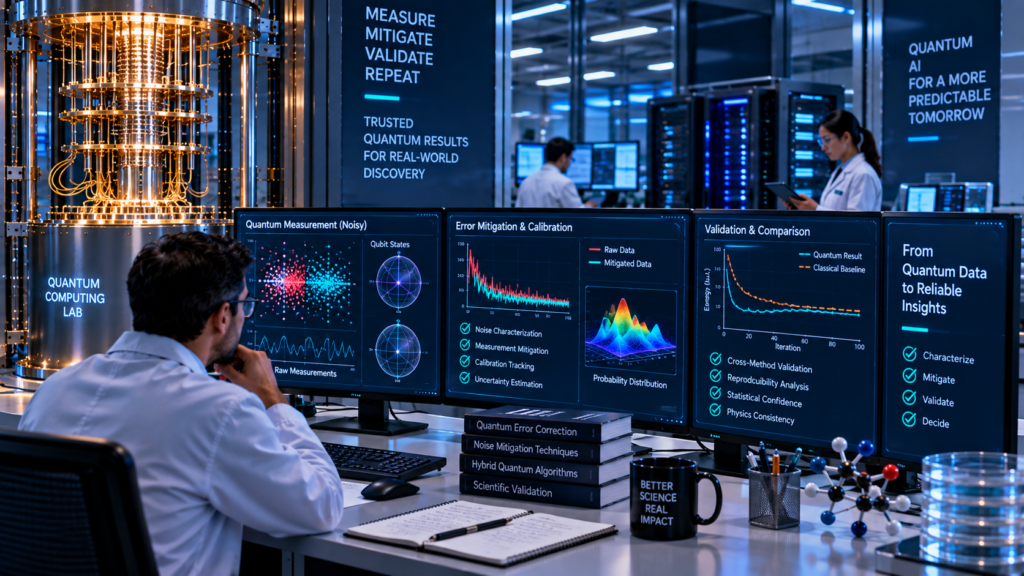
Reliable Quantum AI Simulation requires rigorous noise characterization, error mitigation, calibration tracking and independent validation before results influence business or scientific decisions.
Performance Evaluation Matrix
| Metric | Measurement | Why It Matters | Commercial Failure Signal |
| End-to-End Runtime | preprocessing through validated result | measures actual workflow | QPU fast, pipeline slow |
| QPU Runtime | physical execution time | direct compute consumption | excessive repeated execution |
| Shot Count | measurements per workload | cost/precision driver | precision requires runaway sampling |
| Solution Quality | domain-specific error/objective | tests usefulness | classical baseline better |
| Reproducibility | variance across runs/calibrations | reliability | conclusions change by run |
| Convergence Rate | iterations to target | hybrid efficiency | optimizer stalls |
| Classical Baseline Gap | quantum result vs best classical | evidence of value | no measurable improvement |
| Error-Mitigation Overhead | additional execution/processing | hidden TCO | mitigation costs exceed benefit |
| Validation Cost | classical/lab cost to verify | deployment economics | verification erases savings |
| QPU Queue Time | submit-to-execution delay | workflow latency | research cycle becomes unpredictable |
| Cost per Validated Result | total cost ÷ accepted outputs | procurement metric | result cost exceeds alternative |
| Experimental Reduction | avoided physical tests | R&D value | no candidate reduction |
No single metric establishes quantum advantage.
Benchmark the complete workflow.
III. COMMERCIAL SOLUTIONS & BEST PRACTICES
Quantum Simulation Software: Buy Access Before Buying Infrastructure
Most enterprises should not begin by installing a quantum computer.
Start with cloud access, classical simulators and small controlled experiments.
The objective is to determine whether a problem deserves a larger budget.
Feature & Cost Comparison Table
| Platform | Strong Fit | Access Model | Current Cost Signal |
| IBM Quantum | Qiskit workflows, enterprise quantum experiments, large circuit research | free + PAYG + contracted capacity | Open free; PAYG starts at $96/minute; Flex starts $72/minute; Premium starts $48/minute |
| Amazon Braket | multi-hardware experimentation, simulators, hybrid jobs | per-task/per-shot or reservation depending on QPU | current QPUs range from $0.000425–$0.08/shot plus $0.30/task; reservations vary by provider |
| Azure Quantum | multi-provider enterprise cloud integration | provider-specific PAYG/subscription | provider-specific; examples include per-gate-shot and hourly models |
| Google Quantum AI / Cirq | research, Cirq development, quantum circuit simulation | open-source software; restricted QPU service | Cirq/qsim available; Google’s Quantum Computing Service is not generally public |
Current pricing and access terms can change; procurement teams should verify them directly before budgeting. IBM currently publishes PAYG access starting at $96 per minute, while its Flex and Premium contracted tiers start at $72 and $48 per minute respectively.
Amazon Braket currently uses provider-dependent pricing. Its published gate-based/analog QPU examples range from $0.000425 to $0.08 per shot plus a $0.30 task charge, while dedicated reservations range from $2,500 to $7,000 per hour among the listed providers.
IBM Quantum and Qiskit
IBM Quantum provides cloud quantum-compute access plus the Qiskit software ecosystem.
IBM’s current Qiskit Functions catalog includes abstractions targeting chemistry, optimization, partial differential equations and machine learning, while circuit functions can abstract transpilation, error suppression and mitigation. Some Functions remain preview features restricted to qualifying plans.
This is attractive when an enterprise wants a managed path from algorithm research to hardware.
It does not remove the need for independent benchmarking.
Amazon Braket
Amazon Braket exposes several hardware technologies through one cloud environment.
It also provides state-vector, density-matrix and tensor-network simulators plus managed hybrid jobs.
The commercial advantage is experimentation breadth.
The risk is cost fragmentation: QPU shots, tasks, simulators, notebooks, storage and other cloud services can all contribute to TCO.
Azure Quantum
Azure Quantum provides access to multiple quantum providers within Microsoft’s cloud ecosystem.
Current provider economics differ substantially: Microsoft’s published pricing includes per-gate-shot models, execution-time models and subscriptions depending on hardware provider.
That makes architecture portability important.
A workload economically viable on one billing model may become expensive on another.
Google Quantum AI and Cirq
Google Quantum AI maintains Cirq as an open-source Python framework for constructing, optimizing and simulating quantum circuits.
Its qsim tooling is particularly useful for classical circuit validation before hardware execution.
Google’s Quantum Computing Service, however, is currently restricted rather than generally publicly accessible.
For most enterprise teams, Cirq is therefore more immediately accessible than Google’s QPU fleet.
Best Practice: Build a Quantum Advantage Contract
Before funding the experiment, define what success means.
Specify:
classical baseline
target problem size
required accuracy
maximum runtime
maximum compute budget
validation procedure
minimum improvement
reproducibility threshold
exit criterion
For example:
Promote the quantum workflow only if it reaches target solution quality at lower validated total cost or produces materially better solution quality within the same decision window.
Now “advantage” has a business definition.
Best Practice: Use a Three-Gate Investment Model
Gate 1 — Classical Feasibility
Can established classical methods solve the problem economically?
If yes, stop unless quantum research has strategic value.
Gate 2 — Quantum Technical Feasibility
Can the problem be mapped to available hardware without destroying the useful structure?
If no, wait or reformulate.
Gate 3 — Commercial Feasibility
Does the validated benefit exceed quantum execution, engineering, validation and switching costs?
If no, keep it in R&D.
This prevents experimentation from silently becoming production spending.
Best Practice: Benchmark Against More Than One Classical Solver
A weak classical baseline can manufacture apparent quantum advantage.
Use strong baselines.
Document:
solver
hardware
runtime
memory
tolerance
preprocessing
initialization
hyperparameters
stopping criteria
solution quality
Then publish the comparison.
IV. BUSINESS OUTCOMES & STRATEGIC ROI TAKEAWAYS
Quantum AI Simulation ROI Starts With Cost per Validated Result
Qubit count is not an ROI metric.
Circuit depth is not an ROI metric.
The business unit is:
validated useful result.
Calculate:
Cost per Validated Result = Total Workflow Cost ÷ Number of Results Passing Validation
Total workflow cost includes more than QPU time.
Calculate Quantum Experiment TCO
Use:
Quantum Experiment TCO = QPU + Classical Compute + Cloud + Storage + Software + Engineering + Data Preparation + Error Handling + Validation + Security + Support
For research organizations, add:
domain-scientist time
algorithm development
benchmark maintenance
laboratory confirmation
reproducibility testing
A cheap QPU experiment can sit inside an expensive research pipeline.
Calculate Experimental Reduction Value
The following hypothetical example illustrates the calculation; it is not a reported quantum-computing result.
Suppose a materials team normally synthesizes 500 candidates.
A validated simulation workflow narrows that to 80 without reducing discovery quality.
Then:
Avoided Experiments = Baseline Experiments − Post-Simulation Experiments
And:
Experimental Reduction Value = Avoided Experiments × Mean Fully Loaded Experimental Cost
This is a much stronger ROI claim than “quantum accelerates innovation.”
It can be audited.
Calculate Time-to-Decision Value
Use:
Decision-Time Reduction = Classical Workflow Duration − Hybrid Workflow Duration
Then determine whether faster information actually has economic value.
For a pharmaceutical candidate-selection stage, months may matter.
For an academic study with no commercial deadline, the same time reduction may have less direct financial value.
Context determines ROI.
Calculate Compute Substitution Value
A quantum workflow may replace some classical computation.
Measure:
Compute Substitution Value = Avoided Classical Compute Cost − Incremental Quantum Compute Cost
But include preprocessing and validation.
Otherwise the equation is incomplete.
Calculate Solution-Quality Value
Sometimes quantum does not reduce cost.
It may produce a better solution.
For optimization:
Incremental Solution Value = Economic Outcome of Hybrid Solution − Economic Outcome of Best Classical Solution
This must be measured on held-out or real operational instances.
Not hand-picked demonstrations.
Full Quantum AI Simulation TCO
A production-oriented budget can include:
quantum cloud access
HPC/GPU infrastructure
AI training
quantum software
specialist engineering
domain expertise
data pipelines
experiment tracking
security
integration
validation
laboratory experiments
vendor support
training
governance
migration risk
Therefore:
Annual Quantum AI TCO = Quantum Compute + Classical Compute + Software + Engineering + Integration + Validation + Security + Support + Training + Experimental Cost
Quantum computing does not eliminate classical infrastructure.
It adds another compute modality.
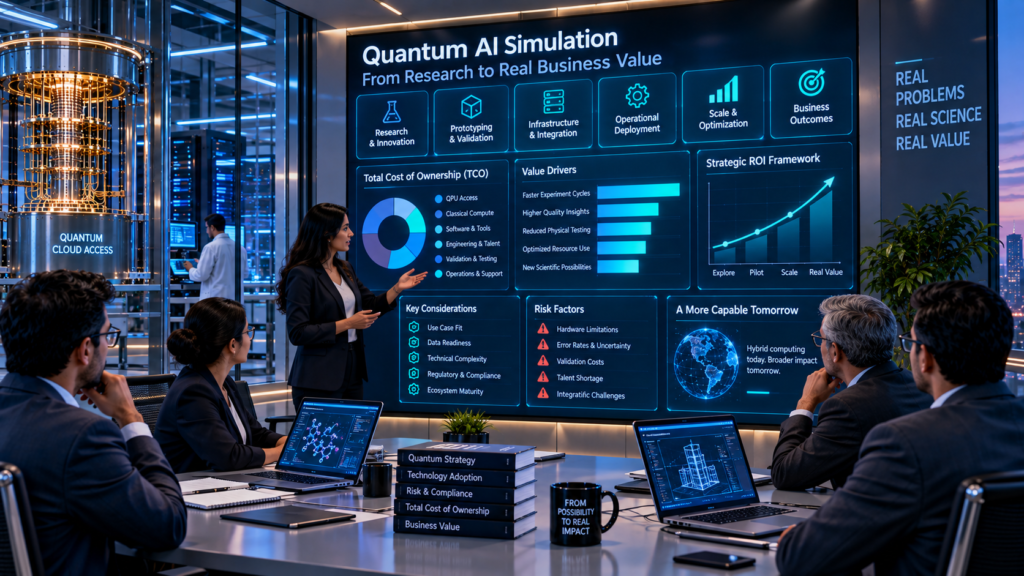
Quantum AI Simulation delivers measurable enterprise value only when validated outcomes justify the combined cost of QPU access, classical compute, engineering, software and scientific verification.
ROI Formula
First-Year Benefit = Verified Avoided Baseline Costs + Verified Additional Business Value
First-Year Cost = Implementation Investment + Incremental First-Year Operating Cost
First-Year ROI (%) = [(First-Year Benefit − First-Year Cost) ÷ First-Year Cost] × 100
Compare the hybrid workflow with a clearly defined classical baseline over the same first-year period. Express every term in money and count each benefit and cost once. Include quantum execution, additional classical computing, engineering, error handling and validation in the cost calculation.
Avoided experiments, faster decisions and improved solutions may produce overlapping benefits. Include them separately only when each represents a distinct, measured economic gain. Forecast benefits should remain labeled as estimates until validated.
Avoid Paying for Quantum Complexity the Problem Cannot Monetize
A reduction in molecular-energy estimation error may be scientifically valuable.
It is not automatically commercially valuable.
Ask:
Does this improvement change which candidate we select?
Does it eliminate experiments?
Does it reduce compute?
Does it shorten a critical decision?
Does it reveal behavior unavailable from classical methods?
If not, the additional accuracy may have no immediate economic value.
Performance Evidence Must Remain Contextual
IBM reports substantial hardware progress, including a 156-qubit Heron r3 with a median two-qubit error rate of 1.17×10⁻³ in a May 2026 retrospective.
That is hardware evidence.
It is not a claim that an enterprise receives a corresponding percentage improvement in drug discovery, optimization or financial forecasting.
Likewise, Google’s below-threshold error-correction result is a major engineering milestone.
It does not convert directly into commercial ROI.
Keep the evidence layer attached to the claim it actually supports.
RISK MITIGATION & REGULATORY FRAMEWORK
Quantum AI Simulation Creates Model Risk Before It Creates Regulatory Novelty
There is no universal “quantum AI regulation.”
Existing obligations attach to data, AI use, industry, cybersecurity, product safety and decision impact.
The governance question is therefore:
What does this particular system do, what decisions does it influence, and which regulated process receives its output?
A chemistry research simulator has a different risk profile from an AI-assisted credit decision.
Failure Vector #1 — False Quantum Advantage
The easiest failure is a weak benchmark.
A team compares an optimized quantum workflow against:
old classical code
poor hyperparameters
smaller compute budget
different accuracy tolerance
different preprocessing
The quantum result wins.
The comparison does not.
Mitigation
Pre-register the benchmark.
Match resource boundaries.
Publish the classical configuration.
Failure Vector #2 — Noise-Induced Scientific Error
Hardware noise can shift measured observables.
Error mitigation can reduce some effects.
It can also introduce overhead and statistical complexity.
Mitigation
Track raw and mitigated results separately.
Repeat across calibrations.
Validate against tractable instances.
Never discard inconvenient runs without documented criteria.
Failure Vector #3 — AI Learns Hardware Artifacts
An AI model trained on QPU outputs may learn device-specific noise instead of target physics.
The model can then appear accurate on one calibration regime and fail elsewhere.
Mitigation
Use:
cross-calibration validation
cross-device testing
noise-aware holdouts
classical controls
uncertainty estimates
Treat hardware identity as a potential confounder.
Failure Vector #4 — Barren Plateaus
Variational optimization can become effectively untrainable as gradients vanish.
This is a recognized technical limitation rather than an implementation nuisance.
Mitigation
Evaluate ansatz structure, initialization, observables, circuit depth and problem-specific methods before scaling.
Do not assume more qubits improve the model.
Failure Vector #5 — Cloud and Supply-Chain Dependence
Enterprise quantum workloads may depend on:
cloud identity
provider APIs
SDK versions
compiler services
QPU availability
third-party optimization libraries
external research code
A dependency failure can make an experiment irreproducible.
Mitigation
Pin versions.
Store circuit representations.
Preserve raw measurement data.
Maintain classical fallback.
Document provider-specific transformations.
NIST: Quantum Risk Already Matters Through Cryptography
One quantum issue is commercially actionable now.
Post-quantum cryptography.
NIST states that organizations should begin migrating to its finalized post-quantum standards now rather than waiting for a cryptographically relevant quantum computer.
This is separate from Quantum AI Simulation.
Do not confuse quantum-computing R&D with post-quantum security migration.
An enterprise can reasonably postpone a quantum optimization project while still needing a PQC roadmap.
NIST-Oriented Quantum/AI Governance Checklist
- Identify the exact decision supported by the simulation.
- Maintain the best available classical baseline.
- Document hardware and software versions.
- Record QPU calibration context.
- Preserve raw measurement outputs.
- Separate measured results from mitigated results.
- Quantify statistical uncertainty.
- Test reproducibility.
- Validate against known instances.
- Document AI training data.
- Test for device-specific artifacts.
- Control access to cloud quantum accounts.
- Protect research IP and credentials.
- Maintain experiment provenance.
- Establish human review before consequential use.
- Maintain a post-quantum cryptography migration program separately.
NIST’s current PQC position is particularly clear: finalized standards such as ML-KEM and ML-DSA are available for implementation now.
EU AI Act: Quantum Does Not Automatically Change AI Classification
Using a QPU does not automatically make an AI system high-risk.
The EU AI Act classification depends on the system’s intended purpose and the applicable high-risk criteria.
The European Commission’s 2026 draft guidance is specifically intended to help providers and deployers determine whether an AI system falls into Article 6 high-risk scenarios.
Therefore a quantum-enhanced molecule-screening research tool should not automatically be labeled “high-risk AI.”
Neither should a quantum component be used to avoid AI governance when the overall system performs a regulated high-risk function.
EU AI Act Assessment Checklist
- Determine whether the deployed component meets the AI-system definition.
- Document intended purpose.
- Identify provider and deployer roles.
- Determine whether Article 6 high-risk criteria apply.
- Separate quantum computation from AI functionality.
- Document training and validation data where applicable.
- Preserve technical documentation.
- Establish logging and traceability.
- Define human oversight.
- Measure robustness.
- Address cybersecurity.
- Document substantial modifications.
- Review sector-specific regulation independently.
The Commission’s high-risk guidance remains use-case driven, not “quantum” driven.
Quantum AI Simulation Production Promotion Gate
Scientific Validity
- Target quantity defined.
- Classical baseline reproduced.
- Problem reduction justified.
- Quantum encoding reviewed.
- Small instances verified.
- Uncertainty quantified.
- Independent validation completed.
Quantum Execution
- Backend recorded.
- Calibration context retained.
- Shot requirements measured.
- Circuit depth documented.
- Error-handling overhead measured.
- Repeatability tested.
- Cross-device testing considered.
AI Layer
- AI objective documented.
- Training data documented.
- Hardware-artifact leakage tested.
- Holdout validation completed.
- Drift monitoring defined.
- Uncertainty retained through the pipeline.
Commercial
- Classical TCO measured.
- Quantum TCO measured.
- Validation cost included.
- Cost per validated result calculated.
- Business benefit independently verified.
- Exit threshold defined.
Governance
- Data classification completed.
- Cloud access controlled.
- IP exposure assessed.
- Experiment logs retained.
- AI Act applicability assessed where relevant.
- PQC migration treated as a separate security program.
If these gates fail, the workload remains an experiment.
That is not failure.
It is disciplined R&D.
Start With a Measurable Quantum Experiment
Do not begin your quantum strategy by asking which provider has the most qubits.
Choose one expensive computational problem.
Document the strongest classical workflow.
Measure its cost, runtime, accuracy and business impact.
Then construct the smallest credible Quantum AI Simulation experiment that challenges that baseline.
Run it.
Measure the QPU cost.
Measure classical preprocessing.
Measure error mitigation.
Measure validation.
Measure whether the answer changes a real decision.
If it does not, stop scaling.
If it does, reproduce it.
Then test a larger instance.
This approach will appear slower than announcing an “enterprise quantum transformation.”
It is financially safer and scientifically stronger.
Quantum AI Simulation becomes commercially valuable when the hybrid system produces a validated result that changes what the organization can discover, predict or optimize at an economically defensible cost.
Until then, it is research infrastructure.
That distinction is precisely what technology decision-makers should protect.
V. APPENDIX & RESEARCH INTEGRITY
Academic and Primary-Source Reference Index
[1] Google Quantum AI et al., “Quantum error correction below the surface code threshold,” Nature, 2024. Demonstrated below-threshold surface-code memories, including a 101-qubit distance-7 code with reported logical-error suppression as code distance increased.
[2] Larocca et al., “Barren plateaus in variational quantum computing,” Nature Reviews Physics 7, 174–189, 2025. DOI: 10.1038/s42254-025-00813-9. Reviews gradient suppression and trainability problems affecting variational quantum algorithms.
[3] Proctor et al., “Benchmarking quantum computers,” Nature Reviews Physics 7, 105–118, 2025. DOI: 10.1038/s42254-024-00796-z. Establishes why quantum performance cannot be reduced to a single hardware number.
[4] “Programmable simulations of molecules and materials with reconfigurable quantum processors,” Nature Physics 21, 289–297, 2025. Demonstrates programmable simulation of strongly correlated model systems and classical co-processing for extracting chemically relevant spectral information while explicitly recognizing the challenge of practical quantum advantage.
[5] Nature Reviews Physics, “Tensor networks for quantum computing,” 2025. Reviews tensor networks as classical compressed representations used across quantum-system simulation, circuit simulation, error correction and quantum machine learning.
[6] IBM Quantum processor documentation, September 2026. Documents current Heron and Nighthawk processor families, including 156-qubit Heron and 120-programmable-qubit Nighthawk revisions.
[7] Google Quantum AI Cirq/qsim documentation. Documents current classical circuit-simulation capabilities and the exponential memory pressure of full state-vector simulation.
[8] NIST Post-Quantum Cryptography Program, 2026. States that organizations should begin migration to finalized post-quantum standards and identifies standards including ML-KEM and ML-DSA as ready for implementation.
[9] European Commission, Draft Guidelines on Classification of High-Risk AI Systems, 2026. Provides current Article 6 classification guidance for assessing whether AI systems are high-risk.
Corporate Editorial Transparency & AI Usage Disclosure
NezzHub Editorial Transparency Statement
This article examines hybrid quantum-classical workflows, potential scientific applications, technical limitations and methods for evaluating commercial value.
AI-assisted tools may support research organization, source comparison, drafting and editorial refinement. Final publication responsibility—including factual verification, interpretation, commercial analysis, corrections and editorial judgment—remains with NezzHub’s human editorial process.
Vendor specifications and pricing describe supplier offerings and should be checked before procurement. Hardware benchmarks do not establish application-level performance or commercial returns.
Author and Editorial Review
Author: Garikapati Bullivenkaiah
Technology research writer with LL.B., LL.M., M.A., and MBA qualifications. He writes about emerging technologies and their business, governance and legal implications. His multidisciplinary academic background informs his analysis of technology adoption, intellectual property, and organizational risk. His articles explain technical concepts and practical considerations for business owners, IT managers and technology decision-makers. LinkedIn Profile
Reviewed by: Chitikineni Ramadevi — Editor
Chitikineni Ramadevi holds an M.Sc. in Computers from Andhra University and has over 10 years of research experience in technology-related subjects. She reviews NezzHub articles for clarity, factual accuracy, source support and practical relevance.
Published by: NezzHub
Research approach: This article draws on primary sources, technical documentation and relevant industry research. References are provided within the article or its sources section.
Last reviewed: 09-11-2026
Corrections: To report a factual error or outdated information, please contact NezzHub.

Garikapati Bullivenkaiah is a seasoned entrepreneur with a rich multidisciplinary academic foundation—including LL.B., LL.M., M.A., and M.B.A. degrees—that uniquely blend legal insight, managerial acumen, and sociocultural understanding. Driven by vision and integrity, he leads his own enterprise with a strategic mindset informed by rigorous legal training and advanced business education. His strong analytical skills, honed through legal and management disciplines, empower him to navigate complex challenges, mitigate risks, and foster growth in diverse sectors. Committed to delivering value, Garikapati’s entrepreneurial journey is characterized by innovative approaches, ethical leadership, and the ability to convert cross-domain knowledge into practical, client-focused solutions.