














Natural Language Processing (NLP)
Natural Language Processing (NLP) covers the methods used by computer systems to process, analyze and generate human language. This NezzHub subcategory helps technology decision-makers, business owners, IT managers, professionals and students understand how language systems support search, document analysis, sentiment detection and conversational interfaces.
The coverage extends beyond chatbots. It examines language processing models, data pipelines, enterprise integration, multilingual performance, implementation costs, output evaluation, security and the governance required when automated language analysis influences business decisions.
Explore Natural Language Processing (NLP)
NLP systems convert text or speech into representations that software can process. Depending on the task, a system may classify a document, extract information, identify entities, translate language, summarize content or generate a response.
The NezzHub guide explaining how NLP helps machines process human language provides a practical starting point. It connects common language tasks with the models and workflows used to perform them.
Readers seeking a broader technical foundation can also visit the AI and Machine Learning category. It places NLP within the wider subjects of machine learning, neural networks, generative AI and responsible deployment.
Major topics covered in this subcategory include:
- Text classification and information extraction
- Search, translation and document summarization
- Sentiment and customer-feedback analysis
- Chatbots and conversational AI systems
- Language models and enterprise knowledge retrieval
- Multilingual processing, bias and output evaluation
Business and Enterprise Applications
NLP business applications can support customer-service routing, contract review, knowledge search, document classification, compliance monitoring and employee assistance. The value of enterprise NLP solutions depends on whether they process the organization’s language, terminology and document formats reliably.
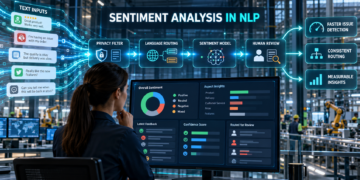
Sentiment analysis may help organizations organize opinions expressed in reviews, survey responses or support messages. The enterprise guide to sentiment analysis in NLP explains why tone, sarcasm, context and regional expressions can complicate apparently simple positive-or-negative classifications.
Language models can also support drafting, summarization and question-answering workflows. The guide to AI language models without coding provides an accessible explanation for readers evaluating these systems without a software-engineering background.
Commercial evaluation should include subscriptions, API usage, cloud infrastructure, integration, data preparation, employee training and human review. The cheapest tool may not provide the privacy, reliability or administrative controls required for organizational use.
Architecture, Integration and Deployment
An enterprise NLP system may connect document sources, speech services, preprocessing components, language models, business applications and monitoring tools. Access controls must ensure that each user and model can retrieve only authorized information.
Deployment teams should evaluate:
- Supported languages, dialects and domain terminology
- Document quality, labelling and usage permissions
- Cloud, on-premises or hybrid infrastructure
- API limits, latency, availability and scalability
- Integration with search, CRM and document systems
- Output evaluation and human-review requirements
- Logging, model versioning and rollback procedures
- Data retention, vendor access and migration options
A model that performs well on general text may struggle with legal, medical, financial or technical language. Testing should therefore use representative documents and clearly defined acceptance criteria.
Risks, Security and Governance
NLP systems can misinterpret context, produce unsupported answers or expose sensitive information included in prompts and connected documents. Poorly controlled conversational AI systems may also follow malicious instructions embedded in external content.
Bias can arise from training data, annotation decisions and uneven language coverage. Performance should be evaluated across the languages, communication styles and user groups relevant to the intended deployment.
Governance should define approved data sources, permitted uses, human-review thresholds and responsibility for incorrect output. Security teams should protect model credentials, document stores, conversation logs and application interfaces.
How to Use This Subcategory
Select articles according to your role and objective:
- Business owners: Examine use cases, workflow value and total implementation cost.
- IT managers: Focus on integration, access control, security, monitoring and scalability.
- Customer-service teams: Review sentiment analysis, routing and conversational workflows.
- Developers: Study preprocessing, model integration, retrieval and evaluation methods.
- Students: Begin with text classification and language fundamentals before advanced models.
Frequently Asked Questions
How does NLP process human language?
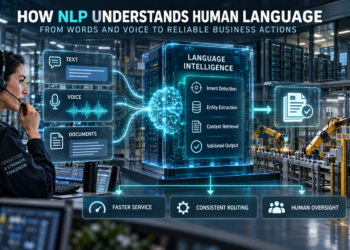
NLP systems convert language into machine-processable representations and apply rules or learned models to perform a specific task. The complete process may include cleaning, tokenization, model inference and output validation.
What is sentiment analysis in NLP?
Sentiment analysis estimates the attitude expressed in text, such as positive, negative or neutral. Reliable results require attention to context, domain language, sarcasm and mixed opinions.
Is NLP the same as a large language model?
No. NLP is the broader field of processing human language, while a large language model is one type of model used for some NLP and generative-language tasks.
What should businesses evaluate before deploying NLP?
Businesses should evaluate language coverage, data privacy, accuracy, integration, operating cost and human-review requirements. Testing should use realistic documents and conversations from the intended workflow.
Latest Natural Language Processing Articles
Explore the latest NezzHub articles below for practical explanations of Natural Language Processing (NLP), including language models, sentiment analysis, conversational AI, enterprise architecture and responsible deployment.
Review publication and update dates when using technical, commercial or regulatory information for important decisions.
Natural Language Processing: How Machines Interpret Language
Executive Summary Natural language processing turns emails, calls, contracts, tickets and search queries into machine-readable signals, but production success depends...

AI Language Models Explained Clearly Without Coding
Executive Summary AI language models are no longer an experimental technology that IT leaders can evaluate solely through impressive chatbot...

















Recent News











NezzHub is a technology-focused knowledge hub delivering insights on AI, robotics, cybersecurity, biotech, and emerging innovations. Our mission is to simplify complex technologies through research-driven content and analysis.