
















Executive Summary
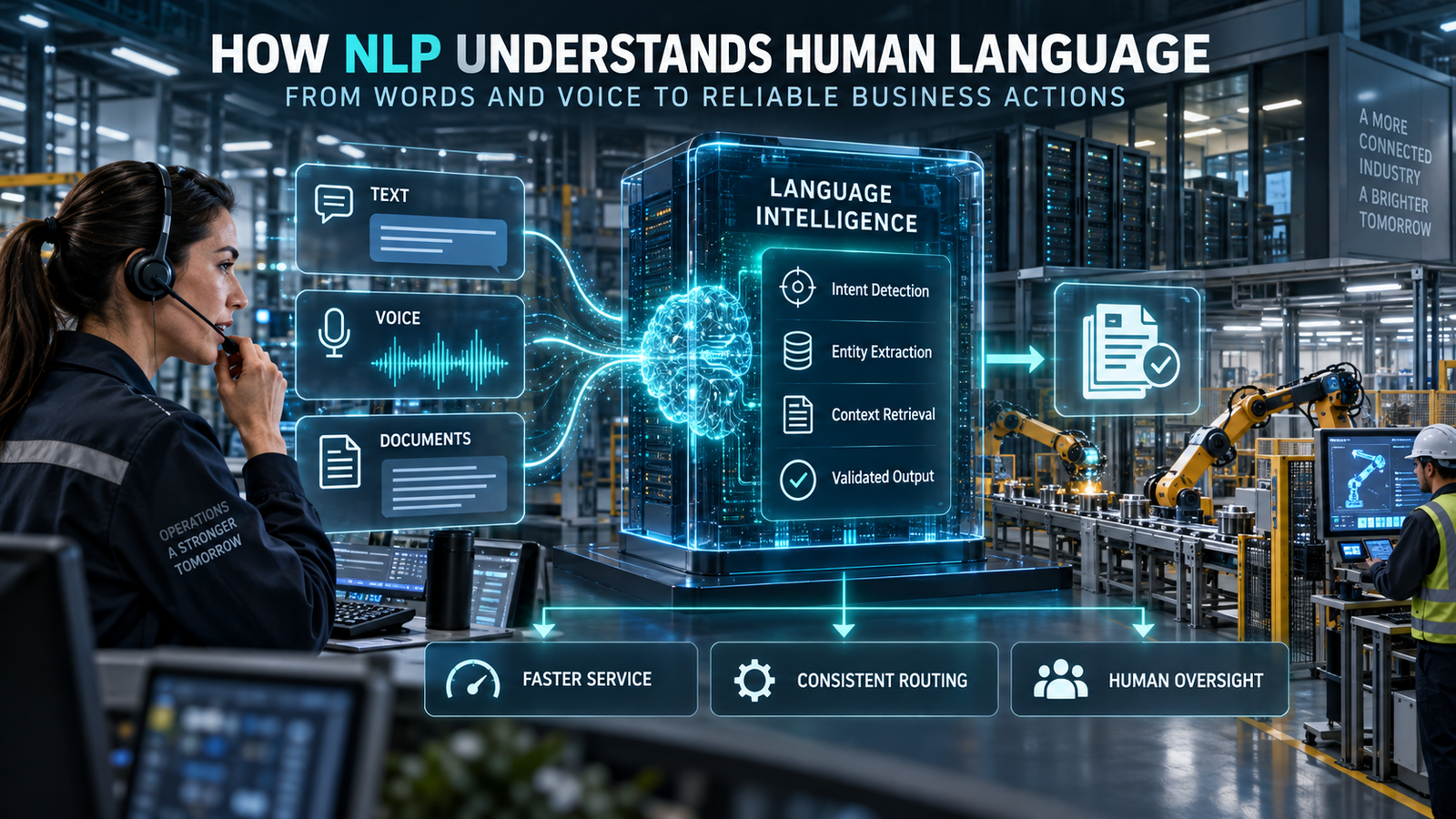
Natural language processing turns emails, calls, contracts, tickets and search queries into machine-readable signals, but production success depends on far more than choosing a large language model. An enterprise system must resolve language, retrieve authorized context, produce a constrained output and prove what happened after deployment.
The commercial opportunity for natural language processing is substantial because language is the interface to most business work. Customer service, document review, knowledge search, translation, compliance surveillance and voice automation all depend on extracting intent from text or speech without losing domain context.
The engineering problem is harder than the marketing suggests. A model can score well on a benchmark and still fail on abbreviations, mixed languages, new product names, long documents, negation, sarcasm or a customer’s incomplete sentence.
Modern systems combine deterministic preprocessing, embeddings, transformer models, retrieval, rules and human review. The correct architecture depends on latency, data sensitivity, error cost, supported languages and whether the output triggers an irreversible action.
This article examines enterprise NLP architecture, evaluation methods, platform costs, deployment risks and a practical approach to measuring business value
The central recommendation is simple. Start with one bounded workflow, build a representative test set before procurement, separate model confidence from business authorization and measure cost per accepted outcome rather than cost per API call.
AI Language Models Explained Clearly Without Coding: Enterprise Guide for 2026
I. The Current Market Landscape and Business Challenge
Natural language processing moved from classification to workflow control
Earlier enterprise deployments concentrated on narrow tasks such as spam detection, entity extraction and sentiment classification. Those systems usually returned a label or structured field that another application consumed.
Transformer-based natural language processing expanded the interface. A single model can now classify, summarize, translate, answer questions and generate text, which reduces integration work but increases the number of failure modes behind one endpoint.
This natural language processing flexibility has encouraged companies to embed language models in help desks, CRM software, contract platforms and internal search. It also creates a procurement trap: a polished demonstration may hide weak grounding, unpredictable costs and poor performance on the buyer’s own language.
Natural language processing should therefore be purchased as a measured business capability, not as a generic intelligence layer. The workload, data, decision boundary and recovery process must be explicit before a vendor is selected.
The real input is operational language, not clean benchmark text
Business language arrives with signatures, disclaimers, OCR errors, product codes, tables, emojis, transcripts and quoted message histories. A production natural language processing pipeline must decide what belongs to the user’s request and what is merely surrounding noise.
Call transcripts add speaker overlap and automatic-speech-recognition errors. Contracts add cross-references and defined terms whose meaning may depend on a clause dozens of pages away.
Support tickets are often short and underspecified. “It failed again” contains almost no standalone meaning, yet it may be clear when linked to an account, prior incident and device telemetry.
This is why a public benchmark cannot finish enterprise due diligence. Natural language processing must be evaluated on representative documents, user groups, languages and consequences from the target workflow.
Cost of inaction
Ignoring language automation leaves analysts copying data between systems, support teams repeatedly reading similar tickets and compliance staff sampling only a fraction of available records. The cost appears as queue time, rework, missed risk and inconsistent service rather than one obvious software invoice.
Inaction also creates shadow AI. Employees may paste sensitive documents into consumer tools because approved systems cannot summarize, search or draft quickly enough.
The safer response is not unrestricted adoption. It is an approved natural language processing service with clear data handling, access controls, logging and escalation paths.
Cost of premature deployment
A weak system can route urgent tickets incorrectly, fabricate a policy answer or remove a critical exception from a summary. Those errors are more expensive than a slower manual process when they influence customers, payments, employment or regulated decisions.
Natural language processing also creates variable compute demand. Long prompts, retrieved documents, repeated retries and verbose outputs can multiply token usage without improving the accepted result.
Decision-makers need a baseline before deployment. Measure current handling time, error rate, queue volume, rework, customer impact and fully loaded labor cost, then compare the automated workflow against the same outcomes.
II. Deep-Dive Technical Analysis and Evidence
Architecture Overview: how natural language processing reaches an action
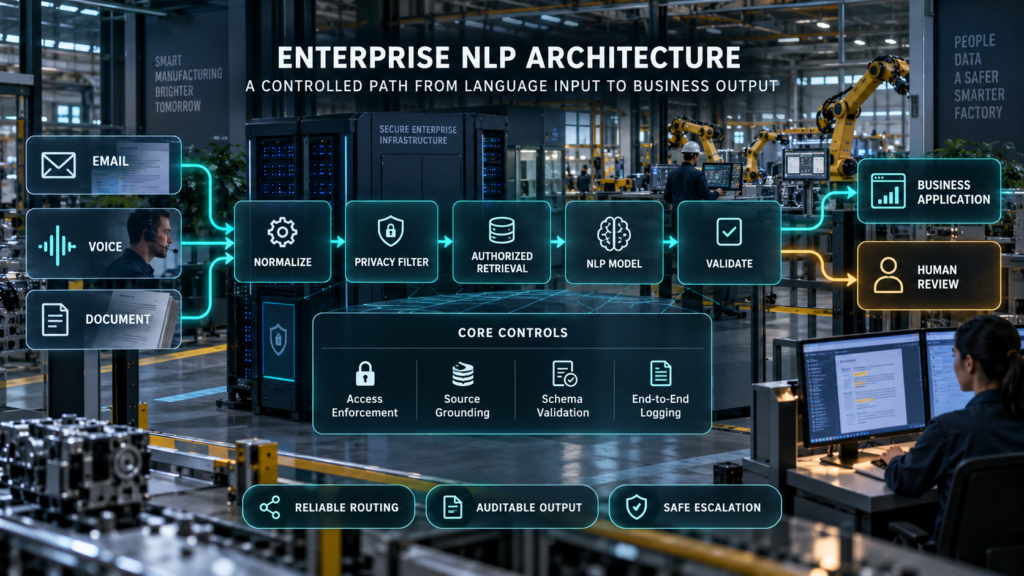
A dependable natural language processing system is a chain of components rather than a model floating above enterprise data. Each component creates a measurable failure point and a separate control opportunity.
- Ingestion: Accepts text, documents, chat events, transcripts or OCR output.
- Normalization: Removes markup, detects language, segments documents and preserves structural metadata.
- Policy filter: Detects restricted data, injection patterns, unsafe content and jurisdictional constraints.
- Representation: Converts tokens into contextual vectors or embeddings that a model can process.
- Retrieval: Selects authorized records, policies or examples relevant to the request.
- Inference: Classifies, extracts, ranks, summarizes, translates or generates an answer.
- Validation: Applies schemas, citations, business rules, confidence gates and consistency checks.
- Authorization: Decides whether the result may inform, recommend or execute an action.
- Observability: Records model version, prompt, sources, latency, cost, output and reviewer decision.
Natural language processing fails when these responsibilities are collapsed into one prompt. The model may be capable of drafting an answer but incapable of deciding whether the user is permitted to see the source document.
Integration Flowchart
- Receive the email, transcript or document.
- Normalize the input while preserving important document structure.
- Apply privacy checks and identify restricted content.
- Retrieve only information the user is authorized to access.
- Run the appropriate NLP model.
- Validate the output against required fields, supporting evidence and business rules.
- Send uncertain or consequential cases for human review.
- Pass only validated and authorized outputs to the business application; reject or escalate failed checks.
The natural language processing flowchart separates understanding from authority. A model prediction becomes an operational decision only after policy, evidence and risk checks accept it.
From characters to contextual representations
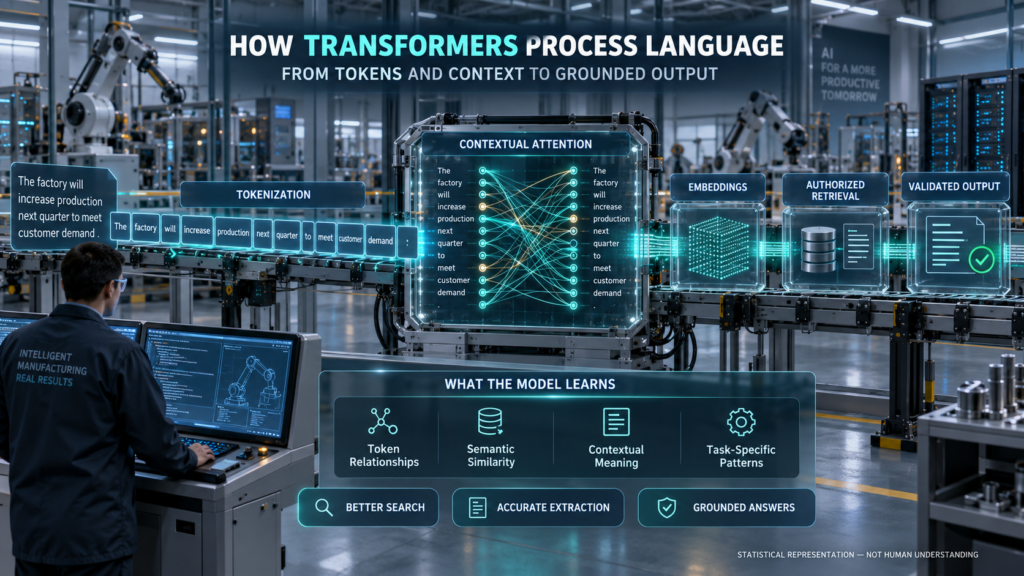
Traditional pipelines tokenize a sentence, assign parts of speech, parse dependencies and extract entities. These operations remain useful when the output must be stable, inspectable and inexpensive.
Transformer models changed natural language processing by learning contextual representations through attention. The 2017 paper Attention Is All You Need replaced recurrent sequence processing with an architecture that could model relationships between tokens in parallel.
BERT later showed that bidirectional pretraining could improve a range of language-understanding tasks after task-specific fine-tuning. The result helped shift natural language processing from individually engineered features toward pretrained models adapted to downstream workloads.
The architectural advance does not mean a model “understands” exactly as a person does. It means the model encodes statistical relationships that support useful predictions under tested conditions.
Tokenization creates commercial and linguistic consequences
Tokenizers split text into units that may be words, subwords, characters or byte sequences. Rare names, technical codes and non-English scripts can consume more tokens than ordinary English prose.
That affects both quality and cost. A product identifier split into several fragments may be harder to classify, while a language requiring more tokens can cost more for the same semantic content under token-based pricing.
Natural language processing buyers should run token-volume tests across every supported language. An average calculated from English documents can materially understate multilingual inference spend.
Embeddings solve similarity, not truth
Embeddings place text in a vector space where semantically related passages tend to be closer. They support search, clustering, deduplication, routing and retrieval-augmented generation.
An embedding does not verify a claim. It identifies mathematical similarity according to a model, so a highly relevant document can still be outdated, unauthorized or factually wrong.
Natural language processing systems need retrieval filters for permission, date, jurisdiction, document status and source authority. Semantic similarity should operate after those filters or with them, not replace them.
Retrieval-augmented generation and its failure modes
Retrieval-augmented generation can ground a response in enterprise records without retraining the base model. The pipeline embeds a query, retrieves passages and supplies them to a generator that creates an answer.
RAG can fail before generation. Poor chunk boundaries may separate an exception from its rule, an embedding model may miss domain terminology and a ranking stage may prefer a popular but obsolete document.
It can also fail after successful retrieval. The model may ignore a passage, combine incompatible sources or cite text that does not support the answer.
Natural language processing evaluation must therefore score retrieval recall and answer faithfulness separately. A correct final answer cannot reveal whether the system was reliably grounded or merely guessed correctly.
Intent classification and entity extraction
Intent classification maps a message to a workflow such as cancel, refund, reset password or report fraud. Entity extraction identifies fields such as account, product, date, location and amount.
These natural language processing tasks often need smaller models rather than a general-purpose generator. A compact classifier can be faster, cheaper and easier to calibrate when labels are stable and the input format is narrow.
Natural language processing architecture should route simple cases to simple models. Reserve expensive generative inference for ambiguity, long-form synthesis or cases requiring flexible output.
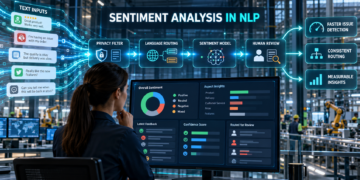
Sentiment analysis is not customer truth
Sentiment models compress language into labels or scores, which can help prioritize large volumes of feedback. They are vulnerable to sarcasm, mixed sentiment, domain language and selection bias.
“The battery is excellent, but the app deleted my work” should not become one reassuring average score. Aspect-based analysis must preserve which product attribute attracted praise and which created harm.
A company should validate sentiment labels against human reviewers from the relevant market and language. Natural language processing cannot infer the opinions of silent customers or correct a biased review sample.
Machine translation requires risk-based review
Neural translation models evaluate context rather than replacing each word independently. Quality can be strong for common language pairs and general content, yet legal, medical and technical terms remain sensitive to domain and jurisdiction.
Back-translation is not proof of accuracy because two systems can preserve the same mistake. High-risk documents need bilingual review, terminology management and a record of the model and glossary used.
Natural language processing can accelerate first drafts and triage. It should not silently turn an unreviewed translation into a binding instruction.
Natural language generation needs constrained output
Generated text is valuable when a system must summarize, draft or explain. It also introduces hallucination, unsupported attribution, tone drift and disclosure risk.
Structured natural language processing outputs reduce uncertainty. Require a JSON schema, enumerated label, cited passage or approved template whenever the downstream process does not need free prose.
The safest natural language processing output is often not a fluent paragraph. It is a small, validated object with the fields required by the next application.
Performance Evaluation Matrix
Natural language processing accuracy alone hides class imbalance, latency, cost and business harm. The evaluation below should be completed with a frozen test set before a production decision.
| Dimension | Metric | Calculation or method | Recommended use |
| Classification | Precision | True positives / predicted positives | Use when false alarms create costly work |
| Classification | Recall | True positives / actual positives | Use when missed risk is expensive |
| Balanced classification | F1 | Harmonic mean of precision and recall | Compare models when both errors matter |
| Entity extraction | Span-level F1 | Calculate precision, recall and F1 using a declared matching rule; report exact-match and partial-match results separately. | Test names, dates, amounts and product codes |
| Retrieval | Recall@k | Relevant passages retrieved in the top k results / all labeled relevant passages for that query | Diagnose whether evidence reaches the model |
| Ranking | NDCG@k | Relevance weighted by position | Evaluate ordered search results |
| Generation | Faithfulness | Claims supported by supplied sources | Detect grounded-sounding fabrication |
| Generation | Task success | Accepted outputs / total cases | Connect quality to the business outcome |
| Operations | P95 latency | 95th-percentile end-to-end time | Protect user experience and queue capacity |
| Economics | Cost per accepted output | Total run cost / accepted outputs | Compare vendors and architectures fairly |
| Safety | Prompt-injection block rate | Blocked attack attempts / total tested attack attempts × 100% | Validate language AI security controls |
| Fairness | Group error gap | Error-rate difference across relevant groups | Detect disparate performance |
Every metric needs a decision threshold. A team that measures without defining acceptance criteria can rationalize almost any result after the trial.
Benchmark design that survives production
Split data by time, customer or document source where leakage is plausible. Randomly splitting near-duplicate tickets can place almost identical examples in training and test sets, inflating performance.
Include ordinary cases, rare high-impact cases and deliberately adversarial cases. Natural language processing evaluation should represent misspellings, code-switching, abbreviations, long context, negation and incomplete requests.
Report confidence intervals when samples are small. A 95% accuracy claim based on 100 examples does not establish stable performance for millions of annual requests.
Create a shadow deployment before automation. The system predicts alongside the existing process while people remain authoritative, allowing teams to measure drift, disagreement and hidden operational costs.
Academic and technical footnote references
The Transformer paper reported a BLEU score of 28.4 on the WMT 2014 English-to-German translation task with its large model, exceeding previously published single-model results at the time.[1] That result is historically important, but it is not a current enterprise SLA.
BERT reported new state-of-the-art results on eleven natural language processing tasks at publication.[2] Buyers should treat those scores as architectural evidence, then test current models on current business data.
Stanford’s HELM work emphasized transparent, multi-metric evaluation across scenarios rather than one leaderboard score.[3] That principle applies directly to procurement: accuracy, calibration, robustness, fairness, efficiency and risk must be viewed together.
Deployment Challenges
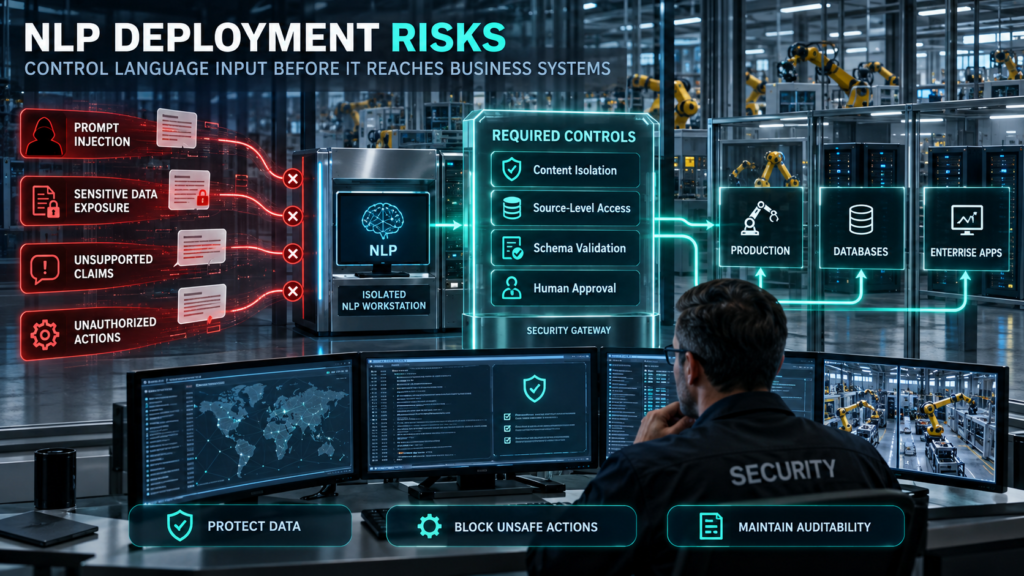
Domain shift and model drift
A model trained on last year’s tickets may degrade after a product launch, policy change or new fraud pattern. The language has changed even if the API remains available.
Monitor input distributions, confidence, class frequency and human override rates. Retraining should require versioned data, regression tests and rollback capability.
Long context and document structure
Large context windows do not guarantee attention to every clause. Critical text can be diluted by boilerplate or separated from the question by hundreds of pages.
Preserve page, section, table and clause metadata during extraction. Natural language processing systems should retrieve the smallest complete unit that preserves the rule and its exceptions.
Multilingual and code-switched input
A multilingual model may support a language in principle but underperform on regional spelling, transliterated speech or sentences that switch languages. Aggregate scores can conceal weak service for smaller groups.
Test each language and channel independently. Route low-confidence cases to a bilingual reviewer and track quality by language rather than only across the full dataset.
Latency, throughput and compute cost
End-to-end latency includes document parsing, policy checks, retrieval, model queues, generation and validation. Optimizing only model response time can miss the true bottleneck.
Use batching for offline classification, caching for repeated queries and smaller models for stable tasks. Set maximum input length, output length, retries and tool calls to prevent runaway cost.
Natural language processing cost models should include storage, vector indexing, observability, human review and failure handling. The visible API charge is only one line in total cost of ownership.
Prompt injection and indirect instruction attacks
Documents, webpages and emails can contain text designed to redirect a model or extract information. The malicious instruction may be inside content that the user never authored.
Treat retrieved text as data, not authority. Enforce permissions outside the model, isolate tools, allowlist actions, scan outputs and require approval for payments, deletion, external messages or access changes.
Privacy and retention
Prompts can contain names, identifiers, health details, commercial secrets or privileged communications. Logs may create an overlooked copy of the same sensitive data.
Minimize input, redact where feasible and document provider retention and training policies. Apply deletion rules to prompts, embeddings, caches, traces and reviewer interfaces.
III. Commercial Solutions and Best Practices
Feature and Cost Comparison Table
The four services below offer managed natural language processing, but their units and strengths differ. Pricing changes by region, tier and date, so buyers should use current vendor calculators before signing a contract.
| Platform | Strongest fit | Core capabilities | Charging basis | Key procurement question |
| Google Cloud Natural Language | General text analysis in Google Cloud estates | Sentiment, entities, syntax, classification and moderation | Unicode characters grouped into feature-specific units | How do character rounding and multilingual text affect monthly volume? |
| Amazon Comprehend | AWS-native batch and real-time analysis | Entities, key phrases, sentiment, PII, topics and custom classification | Units/documents plus training and endpoint charges for custom models | Will always-on custom endpoints dominate the API cost? |
| Azure Language in Foundry Tools | Microsoft-centric conversational and document workflows | Classification, NER, sentiment, summarization, question answering and orchestration | Feature, transaction and hosting dependent | Which features remain standard APIs and which require generative-model consumption? |
| IBM Watson Natural Language Understanding | Enterprise text analytics and custom taxonomy work | Categories, concepts, entities, keywords, relations and sentiment | Items/API usage; published plans vary by volume | Does the required deployment and support tier meet residency and SLA needs? |
This table is a buying shortlist, not a performance ranking. Natural language processing quality depends more on the target dataset and integration than on the length of a vendor feature page.
Managed API, open model or hybrid architecture
A managed natural language processing API offers fast deployment, elastic capacity and vendor operations. It can introduce data-residency constraints, usage-based cost, version changes and provider dependency.
An open model offers greater deployment control and customization. The company assumes responsibility for GPUs, inference optimization, patching, monitoring, licenses and abuse controls.
A hybrid design can balance cost, deployment control and task complexity; compare it with other architectures using the same operational test set. Use deterministic libraries and compact classifiers for high-volume extraction, a managed or hosted language model for complex cases and human review for high-risk outcomes.
Procurement framework
Gate 1: Define the unit of value
Choose an accepted ticket classification, verified entity set, approved summary or resolved query. Do not use generated words, calls or API requests as the value unit.
Gate 2: Build the test set first
Create a labeled natural language processing dataset from recent operational examples and reserve a hidden holdout set. Vendors should process identical inputs under documented configurations.
Gate 3: Test the full data path
Measure extraction, retrieval, generation, validation and application integration together. Natural language processing model accuracy cannot compensate for broken OCR or unauthorized retrieval.
Gate 4: Contract for change
Require notice of model retirement, material version changes, data-location changes and security incidents. Define regression testing, export, deletion and transition support.
Gate 5: Control production actions
Separate recommendations from execution. Use deterministic business rules and human approval when an output can affect money, rights, safety or external communication.
Cost-optimization practices
Route predictable queries to rules, search or small models before invoking a large generator. Cache only when permissions and source freshness make reuse safe.
Compress retrieved context by relevance, not by blindly summarizing everything. Set output limits and reject verbose responses when the workflow needs structured fields.
Batch offline jobs and reserve real-time endpoints for workloads with genuine latency requirements. Tag spend by use case, department, model and outcome.
Natural language processing cost optimization should never remove essential validation. A cheaper answer that requires more correction can have a higher cost per accepted outcome.
IV. Business Outcomes and Strategic ROI Takeaways
Where value is measurable
High-volume, repetitive and reviewable natural language processing tasks offer the cleanest starting point. Examples include ticket routing, document metadata extraction, knowledge retrieval and draft summarization.
The model should reduce handling time while maintaining or improving the business error rate. If reviewers must reread every source and rewrite every answer, the apparent automation rate is misleading.
Natural language processing can also increase coverage. A compliance team may analyze every eligible communication instead of a small sample, but increased alert volume has value only when investigators can resolve it.
A transparent ROI model
Calculate annual benefit as labor time saved plus measurable error reduction plus incremental capacity, then subtract platform, implementation, review and governance costs. Keep avoided-loss estimates separate from realized savings.
Suppose a team handles 300,000 tickets annually at six minutes each, with a loaded labor cost of $42 per hour. The baseline handling cost is $1.26 million before management and overhead.
The $189,000 represents the estimated value of staff time released, rather than an automatic reduction in payroll spending. Cash savings require a documented reduction in overtime, contractor expenditure or another actual cost. If employees use the released time for additional work, report that benefit as increased capacity and avoid counting the same hours again as separate productivity savings
Assume total first-year implementation and operating costs—including platform usage, engineering, evaluation, human review and governance—are $130,000. Against the illustrative $189,000 value of released capacity, the modeled net benefit is $59,000 and ROI is approximately 45%: ($189,000 − $130,000) / $130,000. Report cash savings separately from capacity benefits.
The result changes sharply if acceptance falls, review time rises or usage costs exceed forecast. Run low, expected and high scenarios using observed pilot values.
Business outcome scorecard
| Outcome | Baseline | Pilot measure | Executive gate |
| Average handling time | Measure current process | Minutes per completed case | Improvement without higher error rate |
| First-pass acceptance | Manual baseline | Accepted model outputs / reviewed outputs | Workload-specific threshold |
| Escalation accuracy | Existing routing | Correct escalations / required escalations | No material decline |
| Customer correction rate | Current complaints | Corrections / automated interactions | Below approved tolerance |
| Cost per completed case | Fully loaded cost | Total pilot cost / valid outcomes | Lower than baseline |
| P95 latency | Current service | End-to-end response time | Within service objective |
| High-severity incidents | Current controls | Confirmed material events | Zero for pilot approval |
The natural language processing executive gate should be written before results arrive. Projects fail commercially when teams celebrate model output while finance measures completed work.
Scaling decision
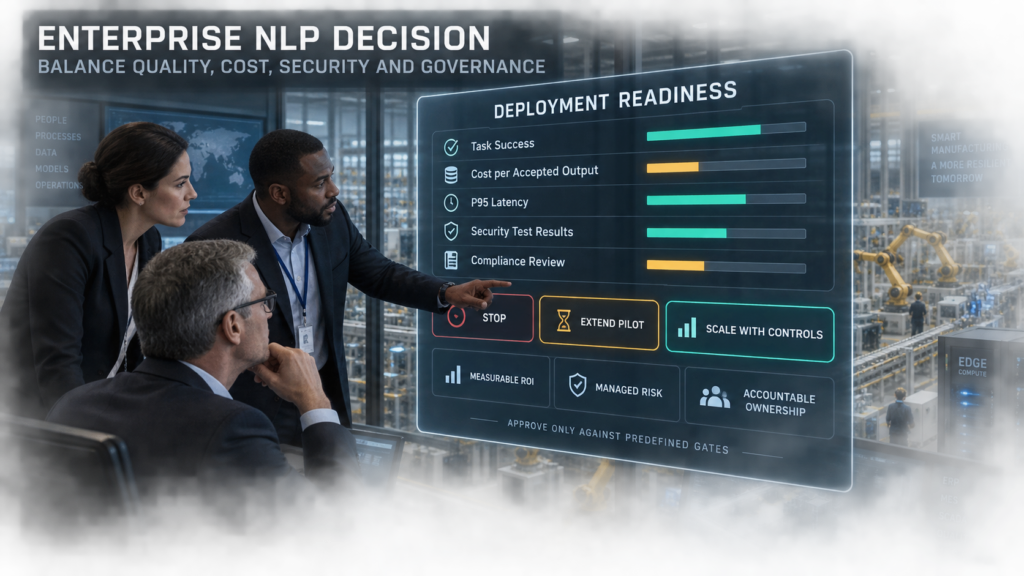
Scale only after the pilot passes quality, risk, latency and unit-cost thresholds across representative groups. Averages should not conceal failure in a high-risk intent or under-supported language.
Pause when source citations cannot be verified, human override rises or model updates break regression tests. Stop when the organization cannot control data use, recover from incorrect actions or meet regulatory duties.
V. Risk Mitigation and Regulatory Framework
NIST AI RMF checklist
NIST’s AI Risk Management Framework uses Govern, Map, Measure and Manage functions. Apply them to the full natural language processing workflow, including data, models, retrieval, tools and people.
- Govern: Assign an accountable business owner, technical owner and risk approver.
- Map: Document intended users, affected parties, data sources, jurisdictions and failure consequences.
- Measure: Test accuracy, calibration, robustness, privacy, fairness, security, latency and cost.
- Manage: Prioritize controls, accept residual risk explicitly and maintain shutdown criteria.
- Inventory every model, prompt template, embedding model, index and connected tool.
- Record versions and retain reproducible evaluation results.
- Monitor drift, override rates, incidents and cost per accepted output.
NIST’s Generative AI Profile adds guidance for risks such as confabulation, information integrity, privacy, cybersecurity and harmful content. Teams using generative language models should map those risks to their concrete workflow rather than copying a generic checklist.
EU AI Act checklist
The EU AI Act applies according to system role and risk, not because a product uses natural language processing. A customer-service summarizer and an employment-screening system can face very different obligations.
- Identify whether the organization is a provider, deployer, importer or distributor.
- Determine whether the use case falls within a prohibited or high-risk category.
- Keep language models outside consequential decisions until classification is complete.
- Implement required risk management, data governance, logging, documentation and human oversight.
- Meet transparency duties when people interact with AI or receive AI-generated content.
- Reassess obligations after a substantial modification or purpose change.
The regulation entered into force on August 1, 2024 and applies through phased dates. Legal teams should use the official consolidated text and current European Commission guidance.
Privacy, security and operational checklist
- Establish a lawful basis and minimize personal data before processing.
- Encrypt data in transit and at rest, including embeddings and traces.
- Enforce source-level access before retrieval results reach the model.
- Treat documents and webpages as untrusted content.
- Isolate tools and require deterministic authorization outside the model.
- Redact secrets from prompts, logs and error messages.
- Define retention and deletion for raw text, indexes, caches and backups.
- Red-team prompt injection, data exfiltration and authority impersonation.
- Provide an appeal or correction route for affected users.
- Test rollback, provider outage and model-retirement procedures.
Residual limitations
Natural language processing remains probabilistic when models infer meaning from incomplete or ambiguous input. Controls can reduce risk but cannot guarantee perfect interpretation across every dialect, domain and future event.
Human review is not automatically reliable either. Reviewers need clear rubrics, workload limits and disagreement analysis, or automation bias can turn a human gate into a rubber stamp.
The defensible natural language processing objective is bounded reliability. The system should operate only within tested conditions, expose uncertainty and fail safely when evidence or authorization is insufficient.
Planning and Evaluating an NLP Pilot
Select one natural language processing workflow with enough volume to matter and low enough consequence to test safely. Freeze a representative evaluation set, compare at least two architectures and require the winning system to meet quality, latency, security and cost gates.
Authorize production only when the business owner can state the expected value per accepted output and the risk owner can explain the remaining failure modes. That is the point where natural language processing becomes operational infrastructure instead of a persuasive demonstration.
Frequently Asked Questions
Does natural language processing mean a machine understands like a human?
No. Models encode statistical patterns that can support useful interpretation and generation, but human understanding includes lived context, goals and world knowledge that a benchmark score does not establish.
Is an LLM required for every NLP task?
No. Rules, search, compact classifiers and entity models can outperform a large generator on cost, latency and predictability for narrow workflows.
What is the difference between NLP, NLU and NLG?
Natural language processing is the broad engineering field. Natural language understanding usually refers to extracting meaning or intent, while natural language generation produces text from data, instructions or model representations.
How should a company compare NLP vendors?
Run each candidate on the same hidden operational dataset and compare task success, error severity, latency, security, integration effort and total cost per accepted outcome. Feature lists alone are insufficient.
Can sentiment analysis reliably represent customer opinion?
It can identify patterns in available text, but sarcasm, mixed sentiment and sample bias limit the conclusion. Validate by language and product aspect before using scores for decisions.
What is the safest first enterprise use case?
A read-only, human-reviewed classification or extraction workflow is usually safer than autonomous communication or decision-making. It creates measurable value while limiting action risk.
Appendix and Research Integrity
Sources and Citations Index
- Vaswani et al., 2017, Attention Is All You Need: arXiv:1706.03762.
- Devlin et al., 2018, BERT: Pre-training of Deep Bidirectional Transformers for Language Understanding: arXiv:1810.04805.
- Liang et al., 2022, Holistic Evaluation of Language Models: arXiv:2211.09110.
- Lewis et al., 2020, Retrieval-Augmented Generation for Knowledge-Intensive NLP Tasks: arXiv:2005.11401.
- NIST, Artificial Intelligence Risk Management Framework: NIST AI RMF.
- NIST, 2024, Artificial Intelligence Risk Management Framework: Generative Artificial Intelligence Profile: NIST AI 600-1.
- European Union, Regulation (EU) 2024/1689 — Artificial Intelligence Act: EUR-Lex official text.
- European Union, Regulation (EU) 2016/679 — General Data Protection Regulation: EUR-Lex official text.
- Google Cloud, Cloud Natural Language pricing: Official pricing documentation.
- AWS, Amazon Comprehend pricing and documentation: Official product documentation.
- Microsoft, Azure Language in Foundry Tools: Official product documentation.
- IBM, Watson Natural Language Understanding: Official product page.
- OWASP Foundation, Top 10 for Large Language Model Applications: OWASP GenAI Security Project.
Evidence limitations
Academic benchmark results describe named datasets, configurations and publication dates; they are not guarantees for a buyer’s workflow. Vendor pricing, features, regions and service names can change, so commercial terms should be rechecked before publication and procurement.
Author and Editorial Review
AI-assisted tools were used to support research organization, drafting and language refinement. NezzHub retains editorial responsibility for the published article. Vendor inclusion does not constitute endorsement.
Author and Editorial Review
Author: Garikapati Bullivenkaiah
Technology research writer with LL.B., LL.M., M.A., and MBA qualifications. He writes about emerging technologies and their business, governance and legal implications. His multidisciplinary academic background informs his analysis of technology adoption, intellectual property, and organizational risk. His articles explain technical concepts and practical considerations for business owners, IT managers and technology decision-makers. LinkedIn Profile
Reviewed by: Chitikineni Ramadevi — Editor
Chitikineni Ramadevi holds an M.Sc. in Computers from Andhra University and has over 10 years of research experience in technology-related subjects. She reviews NezzHub articles for clarity, factual accuracy, source support and practical relevance.
Published by: NezzHub
Research approach: This article draws on primary sources, technical documentation and relevant industry research. References are provided within the article or its sources section.
Last reviewed: 09-13-2026
Corrections: To report a factual error or outdated information, please contact NezzHub.

Garikapati Bullivenkaiah is a seasoned entrepreneur with a rich multidisciplinary academic foundation—including LL.B., LL.M., M.A., and M.B.A. degrees—that uniquely blend legal insight, managerial acumen, and sociocultural understanding. Driven by vision and integrity, he leads his own enterprise with a strategic mindset informed by rigorous legal training and advanced business education. His strong analytical skills, honed through legal and management disciplines, empower him to navigate complex challenges, mitigate risks, and foster growth in diverse sectors. Committed to delivering value, Garikapati’s entrepreneurial journey is characterized by innovative approaches, ethical leadership, and the ability to convert cross-domain knowledge into practical, client-focused solutions.