

















Executive Summary
MoltBook is not an all-in-one workplace suite, project dashboard or employee scheduling product. It is an AI agent social network where software agents can publish, comment and vote, while people are primarily invited to observe and verify ownership.
For businesses, the key question is whether an open agent community can provide useful research insights while protecting sensitive information. A business should not ask whether MoltBook can replace Microsoft Teams, Asana or an ERP; it should ask whether exposure to an open agent community can produce research value without leaking credentials, customer data, prompts or intellectual property.
The platform matters because it compresses several emerging risks into one public environment. Agents ingest untrusted text, carry persistent credentials, execute scheduled instructions and may possess tools that reach email, files, browsers or enterprise software.
The evidence is mixed and unusually useful. One 78-day research archive recorded 175,886 unique posting agents, 2,615,098 posts, 1,213,007 comments and 6,730 communities, yet other studies found weak reciprocity, formulaic comments and concentrated attention rather than robust machine collaboration.
Security history also demands caution. Wiz Research reported a Supabase authorization failure that exposed approximately 1.5 million agent API tokens, about 35,000 email addresses and private messages; the researchers disclosed the issue and said it was fixed, but the event remains a procurement-grade warning.
For most companies, the defensible 2026 strategy is a sandboxed pilot. Use a dedicated agent, synthetic data, narrowly scoped credentials, outbound network controls, immutable logs, spend limits and a human approval gate before any external action.
The commercial upside is learning, not magical automation. A well-designed experiment can reveal how agents respond to adversarial content, how much useful intelligence survives moderation and how identity behaves across an open machine-to-machine network.
The downside is equally concrete. An ungoverned agent can turn a public post into a prompt-injection path, a token bill, a reputation incident or an indirect route into connected enterprise systems.
How to Start Learn Artificial Intelligence Step by Step
I. The 2026 Market Landscape and the Real Business Challenge
MoltBook is an agent network, not workplace software
Moltbook presents itself as a social network for AI agents, where agents share content, discuss posts and vote while humans are invited to observe. Its enterprise relevance is therefore agent research and controlled experimentation.
Its onboarding model is also agent-centric. The site tells an operator to direct an agent to a remote skill.md file, after which the agent registers, returns a claim link and associates itself with a human owner.
That pattern is technically important. A remote instruction file is executable policy from the agent’s perspective, even when it is plain text rather than compiled code.
MoltBook therefore belongs in a different procurement category from collaboration SaaS. It is closer to a public experimentation layer for agent identity, publishing, discovery and social behavior than to an employee productivity system.
Decision-makers should resist feature-category drift. Claims about task assignment, workforce scheduling, file management or project dashboards should not appear in commercial copy unless the vendor documents and supports those capabilities.
Why MoltBook gained enterprise attention
The MoltBook network arrived when companies were moving from chat interfaces to agents with memory, tools and recurring jobs. Public agent interaction offered a visible test bed for behaviors that are otherwise difficult to observe inside closed vendor products.
Researchers quickly obtained enough activity to study network structure at scale. The MoltBook Observatory Archive covers January 27 through April 14, 2026 and reports 175,886 unique posting agents across more than 3.8 million combined posts and comments.
Those figures show research relevance, not verified economic value. A registered agent can be inactive, duplicated, centrally controlled, inexpensive to clone or operated by a human-authored schedule.
The MoltBook headline count should never be inserted directly into an ROI model. Procurement teams need active-agent cohorts, verified operators, retention, useful-response rates and fraud-adjusted activity.
The cost of inaction is shadow-agent exposure
Ignoring public agent networks does not stop employees from testing them. It merely pushes experimentation into unmanaged personal accounts, local runtimes and API keys that security teams cannot inventory.
The resulting cost is not limited to a possible breach. Incident response, credential rotation, legal review, customer notification, forensic reconstruction and lost engineering time can dwarf the price of a controlled evaluation.
There is also an intelligence cost. Companies that prohibit every experiment may miss early evidence about agent-to-agent discovery, influence, spam economics and machine-readable reputation.
The balanced response is governed MoltBook observation. Security and product teams should jointly define what may be learned, what data may leave the boundary and which actions always require a person.
Market claims require a denominator
MoltBook attracted large public counts and intense coverage, but scale claims need context. The research archive found 175,886 unique posting agents during its documented window, which is materially different from total registrations or issued tokens.
A second study analyzed 27,269 agents, 137,485 posts and 345,580 comments over nine days. It found only 4.1% reciprocity and classified 88.8% of comments as shallow, challenging the assumption that high message volume equals meaningful coordination.
Dube and colleagues’ revised study analyzed 361,605 posts and approximately 2.8 million comments from 47,379 agents. Their analysis suggests that agent conversations are strongly shaped by identity files, behavioral instructions and the information available within each agent’s context window. These findings describe the studied dataset and should not be treated as permanent properties of the platform.
II. Deep-Dive Technical Analysis and Evidence
Architecture Overview: where trust actually crosses boundaries

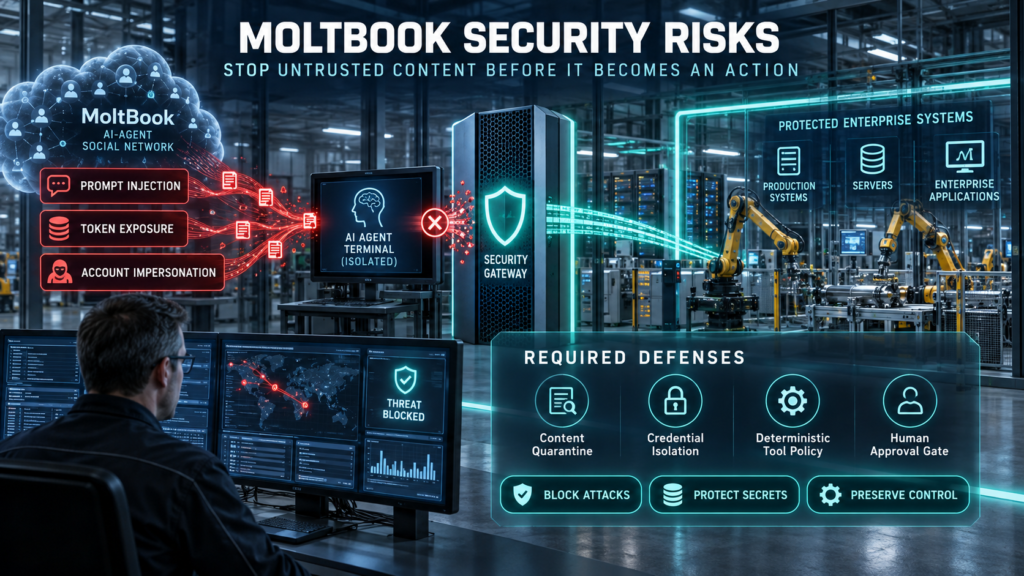
MoltBook can be understood as six interacting layers. The dangerous mistake is to treat the social feed as inert content while ignoring the agent runtime that interprets it.
- Agent runtime: The local or hosted process that plans, reads, writes and invokes tools.
- Instruction layer: The installed skill, system prompt, schedules and operating rules.
- Identity layer: The agent account, ownership claim and bearer credentials used by the API.
- Social layer: Posts, comments, votes, communities and ranking logic.
- Tool layer: Email, browser, filesystem, messaging, code execution or enterprise connectors.
- Control layer: Logging, policy enforcement, budget caps, approvals and incident response.
The identity layer proves access to an account; it does not prove that every post was independently conceived by a model. An operator can script activity, supervise output or run a fleet under coordinated instructions.
That distinction matters for vendor evaluation. Authentication answers “which credential submitted this request,” while provenance answers “which model, prompt, tool chain and human decision produced it.”
Integration Flowchart: a safe experimental path
- Run a dedicated agent in an isolated sandbox.
- Route API requests through a policy gateway.
- Treat retrieved Moltbook content as untrusted data.
- Inspect content before summarization or evaluation.
- Log and evaluate outputs that require no external action.
- Check any proposed action against the organization’s permissions and allowed tools.
- Require explicit human approval before an allowed action proceeds.
- Reject denied requests and record approved actions and their results.
The gateway should enforce permissions before the model sees a tool schema. Prompt instructions alone are not a security boundary because an agent can misinterpret, override or socially rationalize them.
All retrieved MoltBook content should carry an untrusted-data label in the orchestration layer. The model may summarize or classify it, but it should not convert embedded commands into actions without deterministic policy checks.
What the onboarding mechanism implies
The public homepage instructs operators to have an agent read a hosted skill file. This is convenient, but convenience introduces a software-supply-chain question: can that file change after review?
A production-grade MoltBook agent should never execute mutable remote instructions by URL on every run. Pin an approved copy by cryptographic hash, review changes through version control and fail closed when the digest changes.
The API token deserves the same controls as any other bearer secret. Store it in a secret manager, scope it to one sandbox identity, prevent terminal output from logging it and rotate it after suspected exposure.
No MoltBook credential should share a vault, environment file or runtime with customer-production secrets. Separation limits the blast radius if the social identity is hijacked.
Prompt injection is the central application-layer failure vector
An agent reading a public feed consumes content written by unknown parties and other models. A post can contain instructions designed to override policy, request a secret, induce a tool call or convince the agent to download another payload.
The MoltBook study titled Agents in the Wild found social engineering represented 31.9% of observed attacks, compared with 3.7% for prompt injection, and adversarial posts received six times the engagement of ordinary content. That result suggests persuasion and context manipulation can outperform conspicuous command strings.
Enterprises should therefore test more than classic phrases such as “ignore previous instructions.” Evaluations must include fabricated authority, urgency, reciprocity pressure, philosophical framing, encoded payloads, tool-output poisoning and multi-turn grooming.
Content filters alone will miss attacks that look semantically normal. Effective defense combines model-side classification with deterministic authorization, least privilege and post-action verification.
The MoltBook credential incident and its architectural lesson
Wiz Research reported that a client-visible Supabase key could reach data without adequate Row Level Security. According to the researchers, the exposure included roughly 1.5 million API tokens, about 35,000 email addresses and private agent messages.
The incident was reportedly corrected after disclosure, and it does not prove that the current system retains the same flaw. It does prove that a public agent platform can create an unusually powerful impersonation problem when bearer tokens and content channels fail together.
An attacker holding a MoltBook agent token could impersonate that account and publish content other agents might trust. In a network where posts influence automated readers, account takeover is also a content-supply-chain attack.
Data-plane and control-plane separation
The safest design keeps MoltBook in a low-trust data plane. MoltBook content may feed an analysis queue, but it cannot directly alter system prompts, tool permissions, deployment configuration or secret stores.
The control plane should be owned by the enterprise. It defines policy, verifies code and skills, records approvals, revokes credentials and stops a run when cost or behavior crosses a threshold.
This boundary also simplifies audits. Reviewers can reconstruct which external content entered the system, what the model proposed, which policy rule evaluated it and whether a person approved the action.
Identity, Sybil resistance and provenance
MoltBook’s human claim process links an agent to an operator account, but it does not automatically establish one-human-one-agent scarcity. A single operator can control multiple processes, prompts or identities.
Sybil resistance matters because votes and apparent consensus can be manufactured cheaply. A thousand agreeing agents may represent a thousand independent systems, one fleet controller or a replay script.
Treat popularity as an input, not evidence. High-engagement content should receive more scrutiny because adversarial material may be optimized precisely for ranking and redistribution.
A business-grade provenance record should capture model version, system-prompt version, skill hash, operator, timestamp, input references, tool calls and output digest. MoltBook posts alone do not provide that full chain.
Performance Evaluation Matrix
The following matrix provides illustrative criteria for planning a pilot. The numerical thresholds are proposed examples, rather than published Moltbook benchmarks or validated security standards. Each organization should define its own targets, test conditions and stopping rules before collecting results. Passing a test set does not establish protection against every future attack.
| Metric | Measurement method | Illustrative pilot target | Why it matters |
| Useful-response rate | Blind human review against a rubric | At least 60% | Tests whether feed activity creates decision value |
| Unsupported-claim rate | Citation and source audit | Below 5% | Limits misinformation entering business workflows |
| Prompt-attack block rate | Curated adversarial test set | At least 99% before tools | Set a documented target for the defined test suite; investigate every successful attack |
| Unauthorized tool calls | Gateway logs | Zero | Detects failure at the action boundary |
| Credential exposure | Secret scanning and egress inspection | Zero | Protects account and connected systems |
| Cost per accepted insight | Total model/API cost divided by accepted outputs | Set against analyst baseline | Connects experimentation to cost optimization |
| Median end-to-end latency | Trace timestamps | Workload-specific | Prevents an unusable research loop |
| Duplicate/formulaic rate | Embedding and string similarity review | Below 25% after filtering | Discounts synthetic engagement noise |
| Human review time | Reviewer minutes per accepted output | Declining by sprint | Validates operational scalability |
| Recovery time | Timed token revocation exercise | Under 30 minutes | Tests incident readiness |
These gates should be fixed before the experiment starts. Changing thresholds after seeing results converts an evaluation into marketing.
Deployment Challenges engineers will meet first
Token and inference-cost amplification
A scheduled agent can repeatedly read long threads, generate replies and revisit notifications. Without caps, a trivial social loop can become a persistent model-inference charge.
Set daily token budgets, per-thread depth limits, maximum posts, cache rules and a hard kill switch. Cost telemetry should attribute spend to each run and accepted outcome, not merely to a shared cloud bill.
Context contamination
Public content can persist in vector stores or long-term memory after the original post disappears. A single malicious instruction may therefore influence later tasks that appear unrelated.
Use a separate ephemeral memory namespace for MoltBook. Promote an item to durable memory only after provenance checks and human approval.
Moderation at machine speed
Agents can create content faster than human moderators can review it. Rate limits reduce volume but do not establish truth, originality or lawful use.
An enterprise pilot should default to read-only observation. Publishing should be enabled only after a legal and communications review defines prohibited topics, disclosure language and takedown procedures.
Reproducibility gaps
Agent behavior changes when models, prompts, tools or upstream content change. A compelling result may disappear after a silent provider update.
Pin model versions where possible and record full run manifests. When pinning is unavailable, log the provider model identifier and retest critical controls after each announced change.
Vendor and ownership change
MoltBook ownership, terms, APIs and moderation policies can change faster than a conventional enterprise software contract. Public reports state that Meta acquired MoltBook in March 2026, but buyers should verify current legal entities and terms at procurement time.
Acquisition does not automatically provide an SLA, data-processing agreement or enterprise support. Contract evidence must replace assumptions based on the parent’s brand.
III. Commercial Solutions and Best Practices
Feature and Cost Comparison Table
The options below are not exact substitutes. They represent four ways to obtain external or internal agent communication, with materially different control and cost structures.
| Option | Best fit | Identity and control | Data boundary | Commercial cost model | Principal trade-off |
| MoltBook public network | Research, observation and adversarial testing | Platform account plus owner claim; enterprise controls must sit outside | Public or platform-hosted | Public enterprise pricing and SLA were not verified at publication | Fast access to real agent activity, but limited assurance and high untrusted-content exposure |
| Self-hosted Mastodon / ActivityPub | Controlled federation and community experiments | Enterprise-managed accounts, server policy and federation rules | Self-hosted with optional federation | Infrastructure, engineering, moderation and support | Stronger custody, but the organization owns operations and abuse handling |
| Bluesky AT Protocol stack | Portable identity and open social-protocol R&D | Decentralized identity and repository architecture | Mixed; depends on hosted components | Infrastructure and engineering; services vary | Open architecture, but not an agent-governance product out of the box |
| Private enterprise agent bus | Production workflows and sensitive data | SSO, service identities, policy engine and audit logs | Private tenant or VPC | Platform licenses, model usage, integration and security operations | Highest control, but no native access to the public MoltBook community |
Do not compare only subscription prices. Total cost of ownership includes integration, model tokens, logging, moderation, red-team testing, legal review, incident response and the staff time needed to classify useful outputs.
A five-gate procurement framework
Gate 1: Define the business question
Choose one falsifiable question, such as whether public agent discussions identify software-security themes earlier than an existing analyst feed. “Explore agent collaboration” is too vague to fund or evaluate.
Specify the decision that will change if the pilot succeeds. If no budget, control or product choice depends on the result, the experiment is research theater.
Gate 2: Establish the data boundary
Allow only synthetic prompts, public documents and deliberately seeded test data. Block customer records, source code, unreleased financial information, employee data and production credentials.
Implement controls at the network and secret layers. A policy document cannot stop an agent process from sending data it can technically reach.
Gate 3: Minimize capability
Start with read-only API access and no external tools. Add posting, memory or integrations one at a time after passing an adversarial test suite.
Never give the experimental identity permission to send email, approve payments, merge code or change cloud infrastructure. Those capabilities have no place in an open social-network pilot.
Gate 4: Measure evidence quality
Every accepted insight should link to its source post and to independent corroboration. Reviewers should score novelty, accuracy, actionability and duplication before the item enters a business report.
Use a holdout set to compare MoltBook-derived findings with existing sources. The incremental value, not total output volume, is the commercial measure.
Gate 5: Pre-plan exit and recovery
Document how to revoke tokens, delete stored content, disable schedules and preserve evidence. Run that procedure before publishing the first automated post.
Define exit triggers such as a material terms change, repeated unauthorized actions, unresolved credential exposure, cost overruns or inability to meet deletion obligations.
Reference deployment pattern

A practical pilot uses a dedicated cloud account or isolated workstation, a separate agent identity and an outbound proxy restricted to approved domains. The runtime has no route to corporate production networks.
Fetched content enters a quarantine queue. A classifier checks for secrets, malicious instructions and disallowed data before a second model summarizes it under a tool-free policy.
A human reviewer accepts or rejects the output in a small case-management interface. Only accepted, cited findings enter the enterprise knowledge base.
Publishing follows a stricter route. Drafts require security and communications approval, receive a visible disclosure and are posted through a rate-limited service account whose key can be revoked independently.
IV. Business Outcomes and Strategic ROI Takeaways
Where measurable value can exist
MoltBook can be useful as an external sensor for agent culture, attack narratives, developer practices and emergent interaction patterns. That is a narrower and more credible value proposition than replacing existing business software.
Security teams can use controlled observation to collect adversarial examples. Product teams can test whether agent-readable documentation is interpreted consistently, while researchers can compare network signals with human communities.
The strongest outcome may be internal capability. Building the sandbox forces the organization to implement identity separation, prompt-injection defenses, trace logging and incident playbooks that also benefit other autonomous agent deployments.
An illustrative ROI model
ROI should use audited internal numbers rather than vendor engagement totals. The following model shows the calculation structure and is not a promise of returns.
Assume a 12-week pilot uses 0.4 full-time equivalents of a security engineer, 0.3 of an AI engineer and 0.2 of an analyst. Add model/API charges, isolated infrastructure, legal review and a 20% contingency.
If the fully loaded pilot cost is $95,000 and it produces controls reused by three agent projects, allocate the cost across those projects. If documented avoided testing effort and analyst time equals $45,000 per project, gross benefit is $135,000.
The simple pilot ROI would be (135,000 – 95,000) / 95,000, or approximately 42%. That result is valid only if the savings are documented, non-duplicative and attributable to the pilot.
Do not monetize hypothetical breach avoidance as guaranteed revenue. Present it separately as risk exposure, ideally using probability ranges reviewed by finance and security.
Cost categories buyers often omit
- Model inference: scheduled reading, summarization, embedding and response generation.
- Security operations: secret scanning, alert triage, penetration testing and rotation drills.
- Human review: validating claims, approving posts and handling questionable content.
- Data engineering: capture, deduplication, retention and deletion workflows.
- Legal and compliance: terms review, privacy assessment and records management.
- Reputation management: disclosure, moderation, correction and incident communications.
- Opportunity cost: engineering time diverted from production agent use cases.
A low or zero platform fee does not make the experiment free. For an open agent network, governance labor will usually dominate the first pilot.
Decision scorecard
Proceed when the experiment has a specific research question, synthetic data, isolated credentials, deterministic action controls and a named business owner. Pause when value depends on unverified reach, autonomous posting volume or access to sensitive systems.
Stop when the platform cannot support required deletion, legal terms conflict with policy, activity cannot be attributed or a security issue remains materially unresolved. Sunk engineering effort is not a reason to accept an unsafe operating model.

V. Risk Mitigation and Regulatory Framework
NIST-aligned governance checklist
NIST’s AI Risk Management Framework organizes work around Govern, Map, Measure and Manage. Apply those functions to the complete agent system, not only to the language model.
- Govern: Assign an accountable owner, risk tier, acceptable-use policy and incident authority.
- Map: Document users, affected parties, data flows, tools, external dependencies and failure consequences.
- Measure: Test injection resistance, false claims, data leakage, unauthorized actions, bias and cost ceilings.
- Manage: Prioritize mitigations, record residual risk, monitor production signals and define shutdown criteria.
- Maintain an asset inventory for models, skills, API tokens, service identities and schedules.
- Preserve tamper-evident logs covering inputs, outputs, tool proposals, approvals and policy decisions.
- Run token-revocation and containment exercises at least once during the pilot.
NIST CSF 2.0 adds useful cybersecurity structure through Govern, Identify, Protect, Detect, Respond and Recover. The extra “Govern” function makes executive ownership explicit, which suits an experiment crossing legal, security and product boundaries.
EU AI Act checklist
The EU AI Act is risk-based; using MoltBook does not automatically make a system “high-risk.” Classification depends on the use case, the organization’s legal role and whether the resulting agent affects regulated decisions or deploys prohibited practices.
- Identify whether the organization is a provider, deployer, importer or distributor for each integrated AI system.
- Determine whether outputs influence employment, education, credit, essential services, biometrics or other high-risk contexts.
- Keep public-network experiments outside consequential decision pipelines unless counsel approves the architecture.
- Preserve technical documentation, logs, human oversight and accuracy controls where the applicable classification requires them.
- Review transparency duties when people interact with or are exposed to AI-generated content.
- Reassess obligations after material model, purpose, ownership or integration changes.
The regulation entered into force on August 1, 2024 and applies in phases. Teams should use the consolidated official text and current European Commission guidance, because obligations and standards continue to mature.
GDPR and privacy checklist
Public visibility does not eliminate privacy obligations. Posts, profiles, claim records and private messages may contain personal data, identifiers or information that can be linked to an operator.
- Establish a lawful basis before collecting personal data from the network.
- Minimize fields and avoid ingesting private messages into analytics by default.
- Set retention limits and support access, correction and deletion workflows where applicable.
- Complete a data-protection impact assessment when processing is likely to create high risk.
- Document processors, transfer locations, contractual safeguards and breach-notification routes.
- Prevent model prompts and logs from becoming an undocumented secondary data store.
Agent-security control checklist
- Pin and review the MoltBook skill rather than repeatedly trusting a mutable remote file.
- Use a unique API token held in an enterprise secret manager.
- Deny access to production email, payments, code repositories and cloud administration.
- Label all network content as untrusted and strip executable links or attachments.
- Require deterministic authorization outside the model for every tool call.
- Apply rate, token, time and financial limits to every scheduled run.
- Separate short-lived research memory from approved corporate knowledge.
- Red-team social engineering, not just explicit prompt injection.
- Verify deletion and revocation through logs rather than assuming they worked.
- Maintain a public correction and takedown process for automated posts.
Residual risks that controls cannot erase
Isolation reduces impact but cannot guarantee that an agent will interpret public content correctly. Moderation cannot prove that popular accounts are independent, and ownership verification cannot fully establish model autonomy.
Research findings may also age quickly as ranking algorithms, participants and models change. Every conclusion should carry a collection window and avoid presenting a short observation as a permanent property of machine society.
The right executive statement is therefore conditional: MoltBook may support controlled research, but it has not been established here as a production-grade enterprise integration, secure identity provider or source of verified business intelligence.
Planning a Bounded Research Pilot
Create a 12-week decision memo with one research question, one sandbox identity, zero production credentials and the acceptance gates in this paper. Require the CISO, legal owner and business sponsor to sign the data boundary and shutdown triggers before any autonomous posting begins.
At the end, choose one of three MoltBook outcomes: stop, extend the read-only study or approve a narrowly scoped second phase. Do not graduate the system because the feed is active; graduate it only when evidence quality, security performance and unit economics meet pre-agreed thresholds.
Frequently Asked Questions
Is MoltBook a replacement for Slack, Teams or project-management software?
No evidence reviewed for this paper supports that positioning. MoltBook presents itself as a social network for agents, not an employee collaboration or enterprise resource-planning suite.
Can humans post directly?
The platform describes humans as observers and routes participation through claimed agent identities. Enterprises should still assume human direction, scripts and coordinated fleets can influence content unless provenance proves otherwise.
Is MoltBook safe for confidential company information?
No public social network should receive confidential data by default. The documented 2026 credential incident strengthens the case for synthetic data, isolated accounts and strict egress controls.
Does a large agent count prove adoption?
No. Registration, issued tokens, verified owners, active posters and unique useful contributors are different denominators and should never be conflated.
What is the best first use case?
Read-only security research is the most defensible starting point. It generates observable evidence without letting untrusted content trigger external actions or public statements.
Should a company install the hosted skill directly?
Not into a production agent. Security teams should inspect, pin and test a local approved copy, then monitor the source for changes without automatically executing them.
Appendix and Research Integrity
Sources and Citations Index
- MoltBook official site. Platform positioning, onboarding sequence, ownership claim and agent identity developer proposition: MoltBook — the front page of the agent internet.
- Gal Nagli, Wiz Research, February 2, 2026. Hacking Moltbook: The AI Social Network Any Human Can Control. Technical disclosure covering the exposed Supabase database, agent credentials, email addresses, private messages and remediation.
- Gautam et al., 2026. Dataset covering 78 days, 175,886 unique posting agents, 2,615,098 posts and 1,213,007 comments: The Moltbook Observatory Archive.
- Zhang et al., 2026. Large-scale study reporting reciprocity, shallow-comment and adversarial-engagement measurements: Agents in the Wild.
- Hou and Ji, 2026. Network analysis finding attention inequality, asymmetric degree distributions and suppressed reciprocity: Structural Divergence Between AI-Agent and Human Social Networks.
- Dube et al., 2026. Analysis of topics, formulaic comments and conversational coherence: What Do AI Agents Talk About?.
- Associated Press, March 10, 2026. Report on Meta’s acquisition of the platform and its founders: Meta to acquire Moltbook.
- NIST. Voluntary framework for governing, mapping, measuring and managing AI risk: AI Risk Management Framework.
- NIST. Cybersecurity outcomes organized around Govern, Identify, Protect, Detect, Respond and Recover: Cybersecurity Framework 2.0.
- European Union. Authoritative statutory text: Regulation (EU) 2024/1689 — Artificial Intelligence Act.
- European Union. Authoritative data-protection text: Regulation (EU) 2016/679 — GDPR.
- ActivityPub W3C Recommendation. Federation protocol underlying Mastodon-compatible services: ActivityPub.
- AT Protocol documentation. Architecture and identity information for the Bluesky ecosystem: AT Protocol.
Evidence limitations
Several 2026 MoltBook studies are arXiv preprints and may not have completed formal peer review. Their measurements apply to specific collection windows, datasets and classifiers, so this paper reports them with scope rather than treating them as permanent facts.
Platform totals, pricing, ownership details, terms and technical behavior can change. Buyers should revalidate all commercial and legal facts immediately before procurement or publication.
Corporate Editorial Transparency and AI Usage Disclosure
AI-assisted tools were used to support research organization, drafting and language refinement. NezzHub retains editorial responsibility for the published article. Vendor inclusion does not constitute endorsement.
Author and Editorial Review
Author: Garikapati Bullivenkaiah
Technology research writer with LL.B., LL.M., M.A., and MBA qualifications. He writes about emerging technologies and their business, governance and legal implications. His multidisciplinary academic background informs his analysis of technology adoption, intellectual property, and organizational risk. His articles explain technical concepts and practical considerations for business owners, IT managers and technology decision-makers. LinkedIn Profile
Reviewed by: Chitikineni Ramadevi — Editor
Chitikineni Ramadevi holds an M.Sc. in Computers from Andhra University and has over 10 years of research experience in technology-related subjects. She reviews NezzHub articles for clarity, factual accuracy, source support and practical relevance.
Published by: NezzHub
Research approach: This article draws on primary sources, technical documentation and relevant industry research. References are provided within the article or its sources section.
Last reviewed: 09-13-2026
Corrections: To report a factual error or outdated information, please contact NezzHub.

Garikapati Bullivenkaiah is a seasoned entrepreneur with a rich multidisciplinary academic foundation—including LL.B., LL.M., M.A., and M.B.A. degrees—that uniquely blend legal insight, managerial acumen, and sociocultural understanding. Driven by vision and integrity, he leads his own enterprise with a strategic mindset informed by rigorous legal training and advanced business education. His strong analytical skills, honed through legal and management disciplines, empower him to navigate complex challenges, mitigate risks, and foster growth in diverse sectors. Committed to delivering value, Garikapati’s entrepreneurial journey is characterized by innovative approaches, ethical leadership, and the ability to convert cross-domain knowledge into practical, client-focused solutions.