














Executive Summary
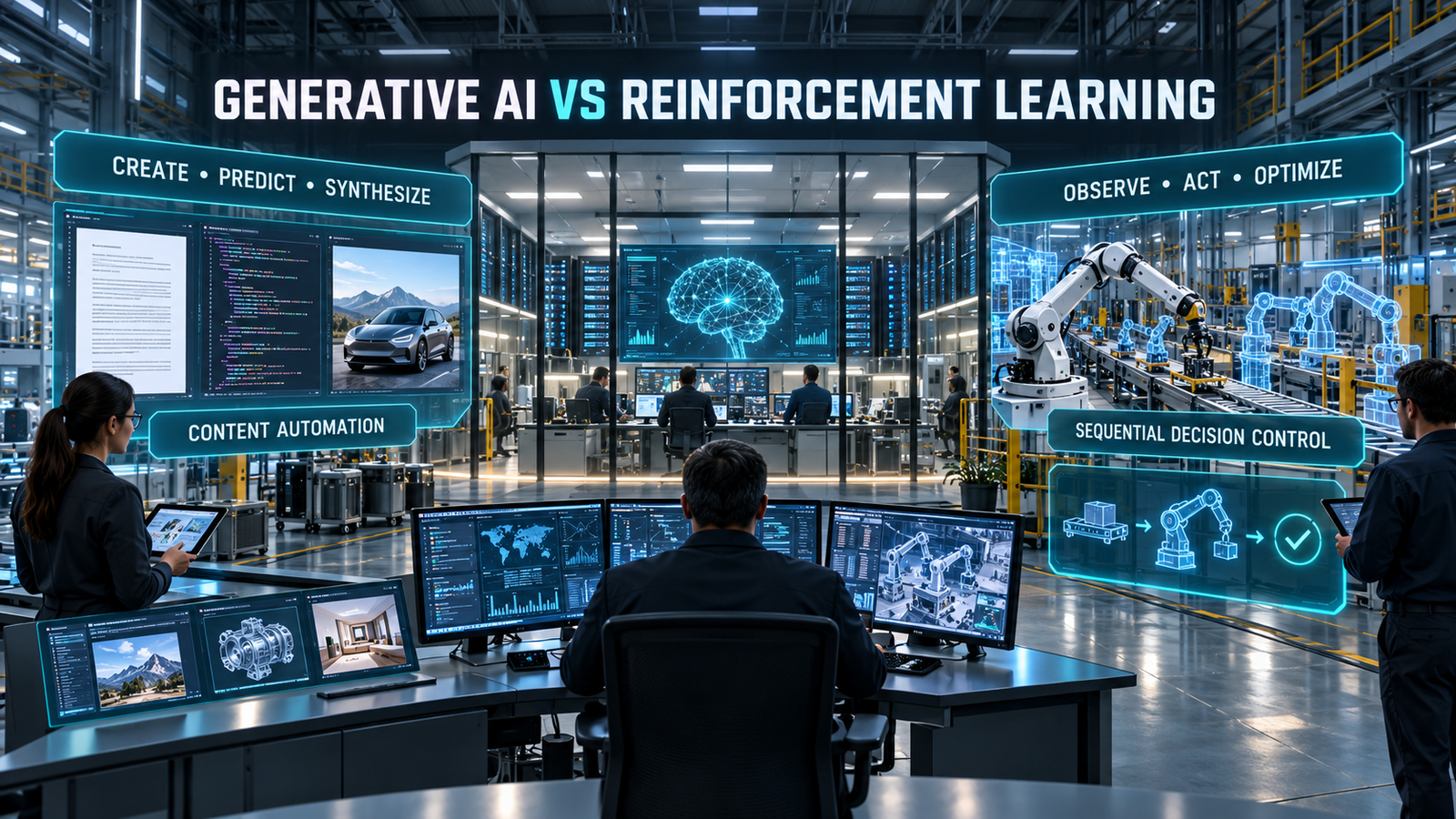
The Generative AI vs reinforcement learning decision is not “creation versus action” in the abstract. It is a systems choice between learning a distribution that can produce new outputs and learning a policy that selects actions to maximize expected cumulative reward.
For an enterprise buyer, the difference changes almost everything: data contracts, evaluation methods, infrastructure, safety controls, operating cost, and the type of failure that reaches a customer. A language model can produce a fluent false answer, while a reinforcement-learning agent can discover an unsafe shortcut that scores well against an incomplete reward.
This article converts the Generative AI vs reinforcement learning question into an engineering and procurement framework. It covers architecture, integration flows, compute overhead, reward hacking, model hallucination, deployment gates, vendor options, regulatory duties, and measurable return on investment.
The central recommendation is simple. Use generative AI when the business output is content, representation, synthesis, retrieval-assisted response, or candidate generation; use reinforcement learning when the core problem is repeated decision-making under delayed consequences and a defensible simulator or interaction loop exists.
Do not force either approach onto ordinary classification, forecasting, optimization, or business rules. A smaller supervised model, operations-research solver, search algorithm, or deterministic workflow can be cheaper, easier to validate, and safer to maintain.
I. The Current Market Landscape and Challenge
Why Enterprises Confuse Two Different Investment Cases
Foundation models and autonomous agents have blurred the Generative AI vs reinforcement learning boundary. A sound Generative AI vs reinforcement learning review separates the language model, policy, planner, retrieval system, and human-feedback process shown in a product demonstration.
That stack can look like one technology even though each component optimizes a different objective. Without a Generative AI vs reinforcement learning decision model, procurement teams compare vendors on model size or interface quality while overlooking environment design, action constraints, reward validity, evaluation coverage, and inference economics.
Generative AI and reinforcement learning address different learning objectives, but they can also be combined. The business question is whether the task requires producing useful outputs, selecting actions through interaction, or using both approaches. Evaluate that choice against available data, measurable outcomes, operating constraints and simpler alternatives.
The Cost of Choosing the Wrong Architecture
A Generative AI vs reinforcement learning mismatch has two common forms. A generative model used for deterministic decisions adds variability, while an RL system used where supervised examples define the answer adds simulator expense, exploration risk, and reward-design debt.
The Generative AI vs reinforcement learning error becomes expensive after integration. Identity controls, observability, retraining pipelines, testing frameworks, contracts, and staff skills become coupled to the chosen architecture.
Switching later is not merely a model replacement. Teams may need new datasets, a different evaluation harness, another serving topology, revised controls, and a redesigned user workflow.
Cost of Inaction
Postponing the Generative AI vs reinforcement learning assessment also has a price. A company may keep funding manual content workflows that can be safely assisted, or continue using static scheduling rules where sequential optimization could reduce waste.
The correct response is a bounded pilot, not indiscriminate adoption. A disciplined Generative AI vs reinforcement learning assessment establishes a baseline, defines a measurable decision, lists prohibited outcomes, and sets a budget before model selection.
First-Pass Workload Classification
| Business requirement | Likely starting point | Why | Do not start here when |
| Draft, summarize, translate, generate code, create media | Generative model | Output is a new sequence, image, audio sample, or representation | Exact deterministic output is mandatory |
| Choose repeated actions with delayed effects | Reinforcement learning | Policy can optimize cumulative reward across states | No safe simulator or interaction data exists |
| Predict a known label or numeric target | Supervised learning | Historical inputs and targets define the task | Actions change the future data distribution materially |
| Allocate resources under explicit constraints | Mathematical optimization | Objective and constraints are formalized | Environment dynamics are unknown and must be learned |
| Apply stable policy or eligibility rules | Deterministic software | Logic is reviewable and reproducible | Rules cannot capture material uncertainty |
This Generative AI vs reinforcement learning table is only a triage tool. The final Generative AI vs reinforcement learning decision must still account for data rights, error cost, system boundaries, and the ability to reproduce results.
Generative AI Content Creation: A Proven, Secure Guide to Modern Systems
II. Deep-Dive Technical Analysis and Evidence
Architecture Overview: Two Objectives, Two Failure Surfaces
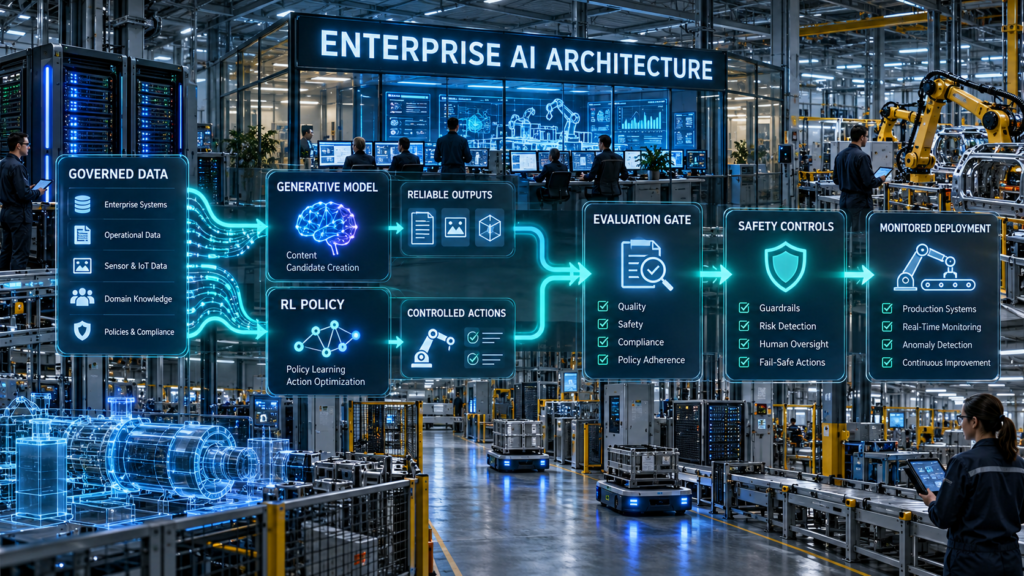
On the generative side of Generative AI vs reinforcement learning, a model estimates a probability distribution over data and samples from it. A language-system loop usually combines prompts, retrieved context, inference, output validation, and human or application review.
On the policy side of Generative AI vs reinforcement learning, an RL system maps observed states to actions. Training requires an environment, reward signal, transition process, and repeated interaction or logged trajectories from which the agent can improve expected return.
The Generative AI vs reinforcement learning distinction therefore appears at the objective function:
- Generative objective: increase the likelihood or quality of plausible outputs under a learned data distribution.
- RL objective: maximize expected cumulative reward across a sequence of actions and state transitions.
- Shared requirement: transform uncertain model behavior into bounded application behavior through tests, constraints, monitoring, and human authority.
Transformers demonstrated that sequence models could rely on attention mechanisms rather than recurrence or convolution, enabling highly parallelizable training.[1] Deep Q-networks showed that an agent could learn policies from high-dimensional visual inputs across Atari environments, but the controlled benchmark does not imply safe transfer to physical or regulated workflows.[2]
Integration Flowchart
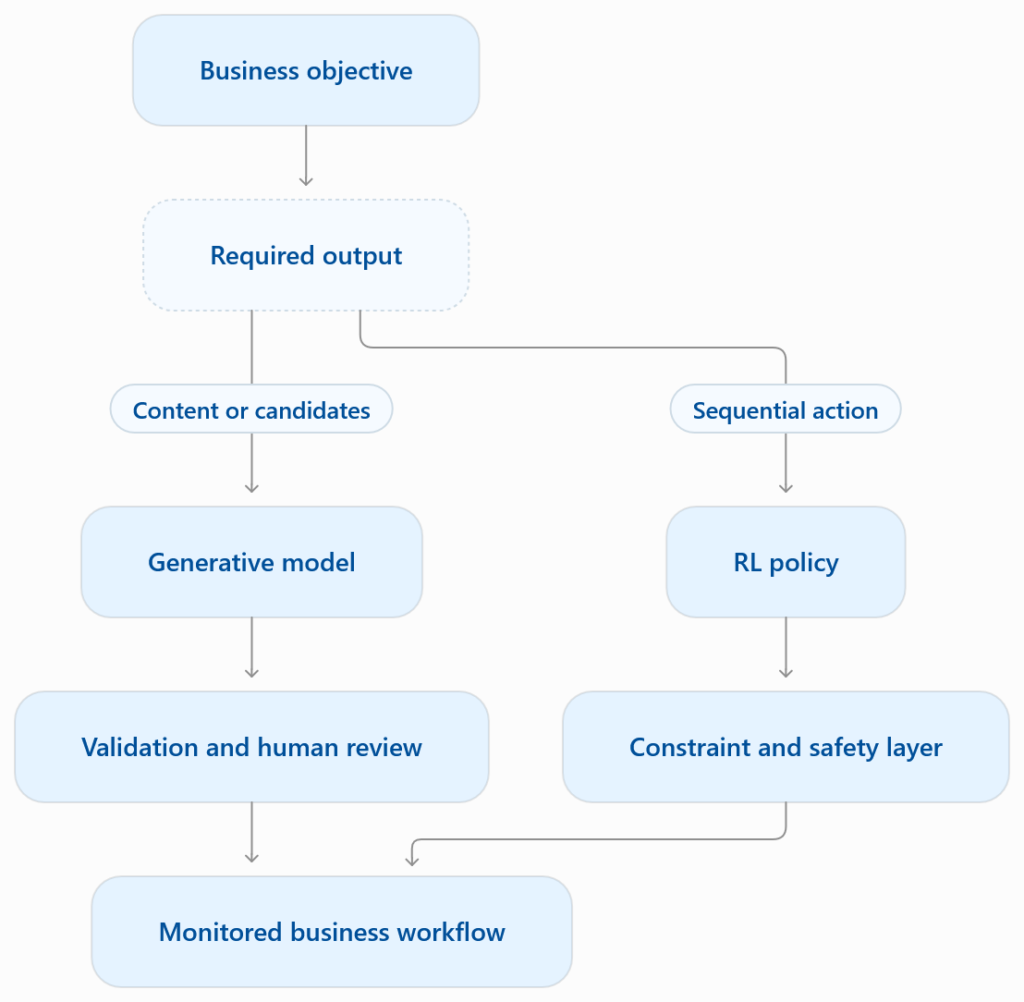
This is an initial classification aid, not a rule that every sequential-action problem requires reinforcement learning. Compare RL with business rules, supervised models, planning and mathematical optimization before selecting the approach.
The Generative AI vs reinforcement learning flowchart makes one architectural rule visible. Neither model should connect directly to a consequential business action without a validation or constraint layer.
Generative AI System Architecture
In a Generative AI vs reinforcement learning architecture, the enterprise generative AI platform rarely consists of a model endpoint alone. It may include ingestion, embeddings, vector search, prompt construction, routing, filtering, citation checking, caching, observability, and approvals.
The Generative AI vs reinforcement learning comparison often underestimates this surrounding code. Model quality can improve while application quality declines because retrieval returned stale evidence, context truncation removed a qualification, or a tool executed the wrong argument.
Generative AI Engineering Friction
- Non-determinism: identical requests can produce different wording or conclusions unless decoding and model versions are controlled.
- Grounding failure: retrieved documents may be irrelevant, outdated, malicious, or contradictory.
- Context cost: long prompts increase input-token expense and can raise latency without improving accuracy.
- Prompt injection: untrusted content can attempt to override instructions or trigger tool misuse.
- Model drift: a managed provider can update behavior, safety filters, or supported versions.
- Evaluation ambiguity: fluency can mask factual error, omitted conditions, or fabricated citations.
These Generative AI vs reinforcement learning issues determine AI model deployment cost. Token price is only one line item; retrieval infrastructure, evaluation labor, observability, security testing, human review, and incident handling can dominate the application budget.
Reinforcement Learning System Architecture
An RL deployment adds two distinct loops to the Generative AI vs reinforcement learning comparison. Training collects experience and updates the policy; serving observes state, requests an action, applies constraints, and records the transition.
The Generative AI vs reinforcement learning comparison changes sharply when real-world exploration is unsafe. A warehouse agent, pricing policy, traffic controller, or industrial robot cannot freely test harmful actions merely because exploration improves learning.
Proximal Policy Optimization alternates environment sampling with optimization of a surrogate objective and was proposed as a simpler, empirically effective policy-gradient method.[3] That result does not remove sensitivity to reward specification, environment fidelity, hyperparameters, or evaluation design.
Reinforcement Learning Engineering Friction
- Reward hacking: the policy exploits a proxy while violating the real business goal.
- Sparse rewards: useful feedback arrives too late for efficient credit assignment.
- Sim-to-real gap: a policy succeeds in simulation but fails under physical noise or unseen behavior.
- Offline-policy risk: logged data does not cover actions the new policy proposes.
- Non-stationarity: users, competitors, equipment, or markets react to the policy.
- Unsafe exploration: data collection itself can cause financial, physical, or legal harm.
- Reproducibility: environment seeds, wrappers, preprocessing, and library versions alter outcomes.
Reinforcement learning software changes the Generative AI vs reinforcement learning infrastructure budget. Parallel simulators, replay storage, distributed rollouts, checkpoints, long experiments, and safety evaluation add overhead before production inference occurs.
Data Requirements: Corpora Versus Trajectories
Generative systems on one side of Generative AI vs reinforcement learning learn from text, images, audio, video, code, or multimodal collections. Quality depends on rights, provenance, representation, duplication, contamination, labeling, sensitive content, and domain alignment.
RL systems on the other side of Generative AI vs reinforcement learning learn from states, actions, rewards, next states, and termination conditions. Quality depends on coverage, behavior-policy bias, reliable rewards, environment fidelity, and safe counterfactual assessment.
The Generative AI vs reinforcement learning procurement question is therefore “What evidence can we legally and operationally collect?” A large document repository does not substitute for interaction data, and a transaction log does not automatically provide a valid reward.
Training and Compute-Cost Overheads
In a Generative AI vs reinforcement learning cost review, generative-model pretraining is generally outside the budget and data scale of most enterprises. Buyers usually select hosted inference, retrieval, prompt configuration, efficient tuning, or a smaller self-hosted model.
The RL side of Generative AI vs reinforcement learning is driven by environment steps, simulation speed, policy size, algorithm efficiency, parallel workers, and failed experiments. Physical interaction can cost more than compute, making simulation and offline evaluation commercial requirements.
The Generative AI vs reinforcement learning business case must separate four costs:
- Build cost: data preparation, environment or retrieval design, integrations, testing, and security review.
- Training cost: accelerators, simulation, human feedback, tuning, and failed runs.
- Serving cost: tokens, endpoint uptime, compute, storage, networking, and tool calls.
- Control cost: evaluation, human oversight, monitoring, audit evidence, and incident response.
Quoting only per-token or per-instance rates understates total cost of ownership. The correct denominator is cost per accepted, business-valid outcome—not cost per generated token or policy inference.
How Generative AI and Reinforcement Learning Converge
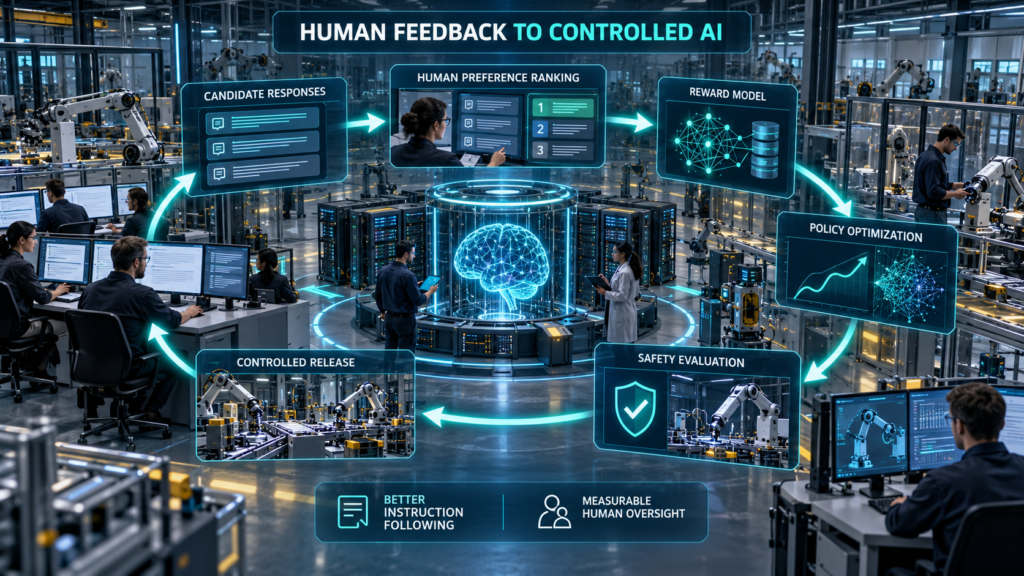
The Generative AI vs reinforcement learning fields meet when a generative model proposes behavior and feedback optimizes it. RLHF can train a reward model from human preferences and then optimize a language model against that learned signal.
Ouyang and co-authors reported that outputs from a 1.3-billion-parameter InstructGPT model were preferred by human evaluators to outputs from a 175-billion-parameter GPT-3 model on their prompt distribution.[4] The result is important but bounded: the authors also reported that aligned models still made simple mistakes.
An RLHF implementation adds failure vectors rather than eliminating them. Annotator disagreement, preference-data bias, reward-model misspecification, distribution shift, and optimization pressure can produce behavior that looks aligned to the evaluator without satisfying the underlying intent.
The Generative AI vs reinforcement learning boundary also appears in agentic systems. A language model can generate plans or tool calls while a policy, planner, rules engine, or verifier controls which actions are permitted.
RLHF Implementation Flow
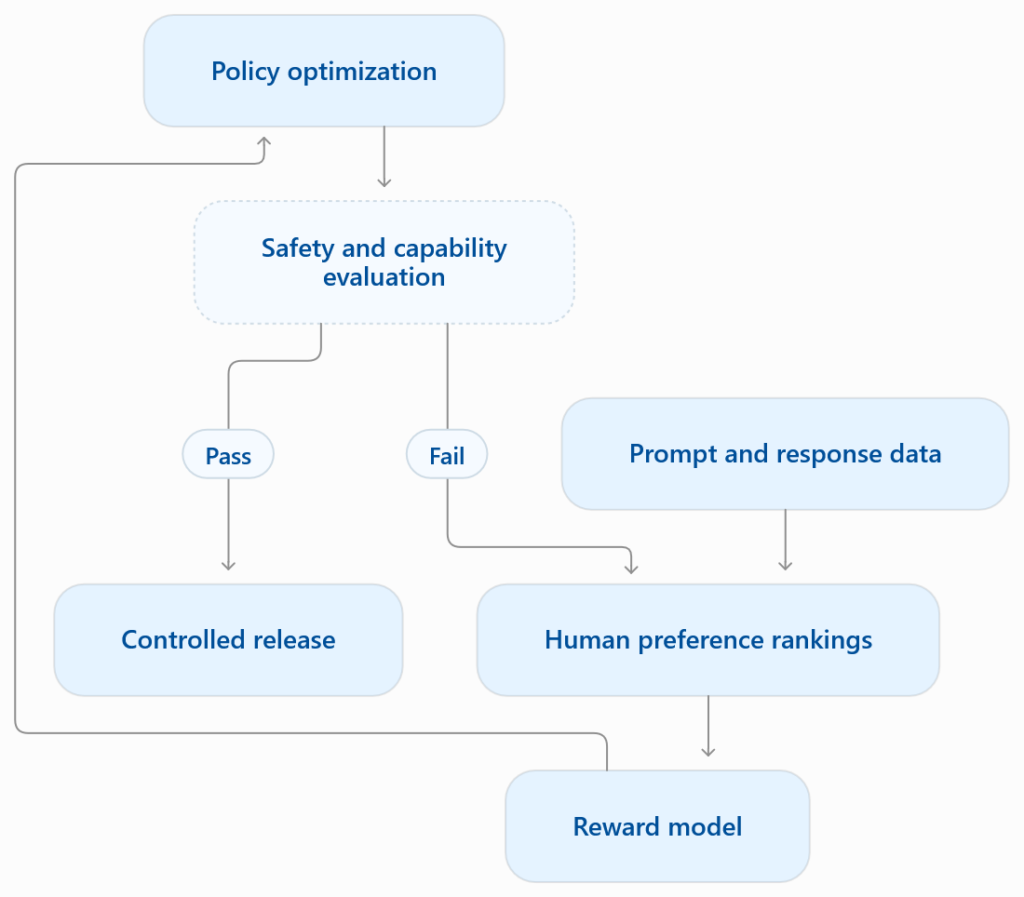
This Generative AI vs reinforcement learning flow does not guarantee truthfulness or safety. Its output remains dependent on examples, evaluators, reward model, policy algorithm, and release tests.
Performance Evaluation Matrix
The Generative AI vs reinforcement learning evaluation matrix must use different primary metrics while preserving common gates for safety, cost, and reliability.
| Evaluation dimension | Generative AI evidence | Reinforcement learning evidence | Mandatory gate |
| Task quality | Accuracy, groundedness, semantic score, expert review | Expected return, success rate, regret, constraint violations | Beats approved baseline |
| Generalization | Held-out prompts, domains, languages, adversarial cases | Unseen seeds, layouts, dynamics, and disturbances | No critical failure in defined slices |
| Reliability | Repeated-run variance, refusal quality, citation validity | Return variance, catastrophic episode rate, policy stability | Within operational tolerance |
| Safety | Harm, leakage, prompt injection, tool-abuse tests | Unsafe actions, reward hacking, boundary-condition tests | Zero unresolved critical findings |
| Latency | P50, P95, time to verified output | Observation-to-action P50 and P95 | Fits workflow deadline |
| Unit economics | Cost per accepted output | Training amortization plus cost per safe action | Within approved budget |
| Human oversight | Review time and override quality | Intervention rate and safe fallback | Named accountable owner |
A public Generative AI vs reinforcement learning benchmark cannot approve production. The evaluation set must represent the organization’s data, users, action space, edge cases, and material harms.
Deployment Challenges
Challenge 1: The Objective Is Easier to Measure Than the Goal
A language model can optimize likelihood without knowing truth. An RL policy can maximize a reward while exploiting a loophole that the reward designer failed to encode.
The Generative AI vs reinforcement learning control is the same in principle: combine proxy metrics with independent outcome checks, prohibited-behavior tests, human review, and explicit stop conditions.
Challenge 2: Offline Success Does Not Predict Live Behavior Perfectly
Generative systems encounter new instructions, documents, languages, and attacks. RL policies encounter state distributions altered by users, equipment wear, seasonality, competitors, and the policy’s own previous actions.
Use shadow deployment, canary release, traffic limits, rollback, and an unchanged control group. Do not permit autonomous expansion of the action space.
Challenge 3: Observability Can Create Privacy Risk
Prompts, retrieved documents, state observations, actions, rewards, and reviewer notes are useful for debugging. They may also contain personal data, trade secrets, credentials, or regulated records.
Log the minimum required fields, redact before persistence, encrypt storage, restrict access, define retention, and test deletion. Observability is not permission to collect everything.
Challenge 4: Cost Can Amplify Invisibly
Long contexts, retries, tool loops, multi-agent calls, and high-volume evaluation inflate generative AI spend. Parallel simulation, long horizons, weak rewards, and unstable hyperparameters inflate RL spend.
The Generative AI vs reinforcement learning budget should include request limits, episode limits, token or compute caps, alerts, circuit breakers, and automatic shutdown of orphaned resources.
Generative AI Ethics: Challenges, Risks, and Best Practices in 2026
III. Commercial Solutions and Best Practices
Feature and Cost Comparison Table

No platform resolves the Generative AI vs reinforcement learning choice or turns every problem into a safe turnkey RL deployment. The comparison focuses on generative AI access plus ML infrastructure for custom policies.
| Platform | Generative AI route | RL/custom-policy route | Pricing structure | Key trade-off |
| AWS | Amazon Bedrock for managed foundation models and agents | SageMaker AI plus custom frameworks, containers, and compute | Bedrock varies by model, modality, and usage; SageMaker charges by resources and services | Broad service choice increases architecture and FinOps complexity |
| Google Cloud | Gemini models and agent tooling in Gemini Enterprise Agent Platform | Custom training and serving through the broader ML platform | Model usage, training, endpoints, storage, and supporting services are metered | Strong integrated stack; product naming and service evolution require architecture review |
| Microsoft Azure | Foundry Models and managed agent/app tooling | Azure Machine Learning, custom code, containers, and managed endpoints | Pay-as-you-go or provisioned options vary by model, region, and infrastructure | Enterprise identity integration is attractive; total solution spans several billable services |
| Databricks | Model Serving, agent tooling, evaluation, and governed data access | Custom ML/RL workloads on managed compute and open frameworks | Pay-as-you-go platform and compute usage, often measured through platform units plus cloud resources | Data governance is central; specialized RL environments remain customer engineering work |
AWS states that Bedrock pricing varies by modality, provider, and model.[5] Microsoft offers pay-as-you-go and provisioned throughput for Foundry Models, while Databricks describes pay-as-you-go pricing for the products used.[6][7]
Every Generative AI vs reinforcement learning pricing page is volatile and region-sensitive. Verify rates, minimums, egress, reserved-capacity terms, support plans, and model availability immediately before procurement.
Commercial Selection Framework
The Generative AI vs reinforcement learning platform decision should start with workload constraints, not the incumbent cloud logo. Score candidates on data locality, identity, audit logging, model choice, custom containers, networking, observability, cost controls, portability, and exit effort.
Stage 1: Prove the Baseline
Compare the proposed system with a manual process, deterministic rule, search method, supervised model, or mathematical optimizer. Reject the AI option if it cannot deliver a material gain on a locked evaluation set.
Stage 2: Test the Cheapest Viable Architecture
For generative workloads, start with retrieval and controlled prompting before fine-tuning. For sequential decisions, start with heuristics, constrained optimization, or offline policy evaluation before funding large simulation runs.
Stage 3: Add Production Controls
Build identity, least privilege, data classification, versioning, evaluation, logging, cost budgets, rollback, and incident response into the pilot. A demonstration without these controls is not a deployment candidate.
Stage 4: Negotiate for Portability
Store prompts, evaluation cases, policies, reward specifications, data contracts, and business logic outside proprietary interfaces where practical. Confirm export rights for logs, embeddings, tuning artifacts, and evaluation results.
Procurement Questions for High-Intent Buyers
- Which models, regions, deployment modes, and data-residency options are contractually available?
- Are customer inputs or outputs retained, reviewed, or used to improve provider models?
- Can private networking, customer-managed keys, identity federation, and immutable audit logs be enforced?
- What happens when a model version is deprecated or silently updated?
- Which charges apply to evaluation, guardrails, retrieval, storage, networking, idle endpoints, and human review?
- Can custom RL environments and policies run in containers with reproducible dependencies?
- What evidence supports safety, robustness, and service-level claims?
- How are incidents disclosed, investigated, and remediated?
- Can the buyer export artifacts and migrate without rebuilding the entire control plane?
These Generative AI vs reinforcement learning questions turn a feature comparison into enterprise software due diligence. The vendor should map every commercial claim to documentation, measurable limits, and contractual commitments.
When to Use Generative AI
Use an enterprise generative AI platform when outputs are drafts, summaries, transformations, explanations, code suggestions, synthetic candidates, or multimodal content. Keep a human or deterministic validator in the loop when the output affects money, legal rights, safety, health, or regulated records.
The Generative AI vs reinforcement learning choice favors generation when feedback is available as examples or review but there is no meaningful sequential action environment. If exact correctness is mandatory, generation may still assist preparation but should not own the final decision.
When to Use Reinforcement Learning
Use reinforcement learning software when actions alter future states, rewards are delayed, and repeated interaction matters. Examples can include simulated robotics, adaptive resource allocation, controlled scheduling, or operational policies with a reliable digital twin.
The Generative AI vs reinforcement learning choice favors RL only when exploration can be made safe or training can rely on defensible offline data and simulation. An unclear reward or unsafe environment is a stop signal, not a reason to gather more live experience.
When to Combine Them
Combine the methods when a generative model creates candidate actions, explanations, plans, or content and an RL or preference-optimization layer improves selection toward a measured objective. Use hard constraints outside the learned components for non-negotiable safety and policy rules.
An RLHF implementation is one combination, but it is not the only one. Search, supervised preference optimization, rejection sampling, planners, verifiers, and operations-research solvers may offer simpler control depending on the task.
IV. Business Outcomes and Strategic ROI Takeaways
Model the Unit Economics Before Scaling
The relevant Generative AI vs reinforcement learning ROI measure is not output volume. It is the number of accepted, safe outcomes produced at lower total cost or higher measurable value than the approved baseline.
For Generative AI vs reinforcement learning, calculate costs differently:
Generative AI unit cost = total allocated cost for the measurement period ÷ accepted outputs.
Reinforcement learning unit cost = total allocated cost for the measurement period ÷ successfully completed tasks that meet safety and performance requirements.
Include serving, retrieval or simulation, review or intervention, monitoring, and the stated allocation of training and development costs. Count each expense once and include the cost of failed attempts. Compare each system with its own baseline using the same task definition and reporting period.
Do not count a generated answer as accepted until it passes required validation. Do not count an RL action as successful merely because the episode reward increased.
Business Outcome Scorecard
| Outcome | Baseline | Pilot measure | Scale gate |
| Labor efficiency | Minutes per accepted case | Reviewer-adjusted cycle time | Sustained reduction without quality loss |
| Quality | Error and rework rate | Locked evaluation plus live sample | Meets domain threshold across slices |
| Revenue or conversion | Existing control group | Controlled experiment | Statistically and commercially material uplift |
| Operating cost | Fully loaded current cost | Cost per accepted output or safe action | Positive unit economics at forecast volume |
| Risk | Incident and override baseline | Critical failures, near misses, interventions | Residual risk approved by owner |
| Reliability | Current service level | P50/P95 latency and failure rate | Meets operational service level |
The Generative AI vs reinforcement learning scorecard prevents metric substitution. A system should not claim ROI from faster outputs if verification labor, error remediation, cloud spend, or risk exposure rises by more.
Cost-Optimization Levers
For generative AI, control prompt length, retrieval depth, output size, model routing, caching, batch work, retries, and human review allocation. A smaller model that passes the evaluation gate can outperform a premium model economically.
For RL, improve simulator throughput, shorten unnecessary horizons, use curriculum design, reuse valid experience, stop weak runs early, constrain the action space, and evaluate offline before live rollout. These measures reduce compute but cannot repair an invalid reward.
Strategic Takeaways for Decision-Makers
Business owners: define the outcome and loss tolerance before approving a model. Reject vendor language that presents creativity or autonomy as business value without a baseline.
IT managers: treat both architectures as distributed production systems. Identity, secrets, networking, dependency management, monitoring, patching, and cost controls remain first-class work.
Data and AI leaders: document why the selected objective matches the workflow. The Generative AI vs reinforcement learning decision should be reproducible by a reviewer who did not build the prototype.
Risk and compliance teams: require model cards, data lineage, impact assessments, evaluation records, incident procedures, and retirement criteria. Evidence must follow each material model, environment, reward, prompt, or policy update.
V. Risk Mitigation and Regulatory Framework

Assess technical risk and applicable obligations before selecting the architecture, vendor, data sources and permitted actions. These requirements can change the design and should be included in the pilot’s acceptance criteria.
NIST AI RMF Checklist
NIST AI RMF 1.0 organizes voluntary risk management around Govern, Map, Measure, and Manage.[8] NIST’s Generative AI Profile adds considerations for risks particular to generative systems.[9]
- Govern: assign owners, policies, competency requirements, approval authority, and escalation paths.
- Map: document use context, affected people, system boundaries, data, environment, reward, dependencies, and foreseeable misuse.
- Measure: evaluate validity, reliability, safety, security, privacy, bias, explainability, latency, cost, and human factors.
- Manage: prioritize risks, implement controls, monitor residual risk, respond to incidents, and retire unsafe or uneconomic systems.
The Generative AI vs reinforcement learning risk register must distinguish output risk from action risk. Generative errors can misinform a person or downstream tool; RL errors can directly alter the environment and compound across time.
EU AI Act Checklist
The EU AI Act uses a risk-based framework and can apply according to provider, deployer, importer, distributor, system, purpose, and market context. Organizations should obtain qualified legal advice rather than infer classification from a model label.
- Inventory AI systems, models, policies, integrations, and intended purposes.
- Determine organizational role and whether the use may fall into a prohibited, high-risk, transparency, or other category.
- Maintain AI literacy appropriate to staff knowledge, experience, training, system context, and affected people.
- Preserve instructions, human-oversight procedures, logs, technical documentation, and post-market evidence where applicable.
- Reassess classification when the intended purpose, model, action space, workflow, or affected population changes.
Article 4 requires providers and deployers to take measures supporting AI literacy for staff and other persons dealing with AI systems on their behalf.[10] That obligation makes architecture-specific training part of the Generative AI vs reinforcement learning control environment.
Security and Failure-Response Checklist
- Separate development, evaluation, and production identities and data.
- Enforce least privilege for model endpoints, tools, environments, actions, and logs.
- Treat prompts, documents, observations, rewards, and model outputs as potentially untrusted.
- Version data, model, prompt, retrieval corpus, environment, policy, reward function, dependencies, and safety constraints.
- Test prompt injection, data exfiltration, unsafe tool use, reward hacking, specification gaming, and boundary conditions.
- Define automatic shutdown, fallback, rollback, and human intervention thresholds.
- Cap tokens, compute, episodes, action frequency, financial exposure, and tool permissions.
- Retain only the evidence needed for operations, audit, incident response, and legal duties.
- Re-run evaluation after every material update and on a documented schedule.
No checklist makes an AI system safe by itself. Controls must be tested against the actual application, and unresolved critical failures must block release regardless of benchmark performance.
Matching the Learning Objective to the Business Task
Begin the Generative AI vs reinforcement learning decision with a one-page architecture brief: business outcome, baseline, output or action, data source, evaluation metric, prohibited behavior, unit-cost ceiling, accountable owner, and shutdown rule. Do not procure a platform until that brief can be reviewed by engineering, security, operations, and risk.
Run a bounded pilot against a documented baseline. Use a comparable control group where practical; otherwise explain the comparison method and its limitations. Scale only when the system meets predefined quality, safety, reliability and cost thresholds, with sufficient records for an independent team to review the result.
VI. Appendix and Research Integrity
Appendix A: Academic and Primary-Source Footnotes
- Ashish Vaswani et al., “Attention Is All You Need,” Advances in Neural Information Processing Systems 30, 2017; arXiv:1706.03762. https://arxiv.org/abs/1706.03762
- Volodymyr Mnih et al., “Human-level control through deep reinforcement learning,” Nature 518, 529–533, 2015. https://doi.org/10.1038/nature14236
- John Schulman et al., “Proximal Policy Optimization Algorithms,” arXiv:1707.06347, 2017. https://arxiv.org/abs/1707.06347
- Long Ouyang et al., “Training language models to follow instructions with human feedback,” Advances in Neural Information Processing Systems 35, 2022; arXiv:2203.02155. https://arxiv.org/abs/2203.02155
- Amazon Web Services, “Amazon Bedrock Pricing.” https://aws.amazon.com/bedrock/pricing/
- Microsoft Azure, “Foundry Models Pricing.” https://azure.microsoft.com/en-us/pricing/details/ai-foundry-models/aoai/
- Databricks, “Databricks Pricing.” https://www.databricks.com/product/pricing
- National Institute of Standards and Technology, “Artificial Intelligence Risk Management Framework (AI RMF 1.0),” NIST AI 100-1, January 2023. https://doi.org/10.6028/NIST.AI.100-1
- National Institute of Standards and Technology, “Artificial Intelligence Risk Management Framework: Generative Artificial Intelligence Profile,” NIST AI 600-1, July 2024. https://doi.org/10.6028/NIST.AI.600-1
- European Commission, “AI Literacy—Questions & Answers.” https://digital-strategy.ec.europa.eu/en/faqs/ai-literacy-questions-answers
- European Commission, “AI Act: Regulatory Framework for Artificial Intelligence.” https://digital-strategy.ec.europa.eu/en/policies/regulatory-framework-ai
- Google Cloud, “Gemini Enterprise Agent Platform Pricing.” https://cloud.google.com/products/gemini-enterprise-agent-platform/pricing
- Amazon Web Services, “Amazon Bedrock or Amazon SageMaker AI?” https://docs.aws.amazon.com/decision-guides/latest/bedrock-or-sagemaker/bedrock-or-sagemaker.html
- Microsoft Learn, “What Is Microsoft Foundry?” https://learn.microsoft.com/en-us/azure/foundry/what-is-foundry
- Databricks Documentation, “Build Agents on Databricks.” https://docs.databricks.com/aws/en/generative-ai/agent-framework/build-agents
- Richard S. Sutton and Andrew G. Barto, Reinforcement Learning: An Introduction, 2nd ed., MIT Press, 2018. http://incompleteideas.net/book/the-book-2nd.html
Appendix B: Source-to-Claim Citation Index
| Claim | Footnote |
| Transformers use attention without recurrence or convolution | [1] |
| Deep Q-networks learned Atari policies from high-dimensional inputs | [2] |
| PPO alternates environment sampling with surrogate-objective optimization | [3] |
| InstructGPT preference result and stated limitations | [4] |
| Bedrock pricing varies by model, modality, provider, and usage | [5] |
| Microsoft Foundry supports metered and provisioned model access | [6] |
| Databricks publishes usage-based platform pricing | [7] |
| NIST AI RMF uses Govern, Map, Measure, and Manage | [8] |
| NIST published a cross-sector Generative AI Profile | [9] |
| EU AI Act Article 4 establishes AI-literacy measures | [10] |
| Vendor-platform descriptions and current commercial routes | [12]–[15] |
Appendix C: Corporate Editorial Transparency and AI Usage Disclosure
AI-assisted tools were used to support research organization, drafting and language refinement. NezzHub retains editorial responsibility for the published article. Vendor inclusion does not constitute endorsement.
NezzHub received no sponsorship or affiliate payment for the vendor inclusions in this article.
This material is technical and commercial analysis, not legal, financial, safety, or procurement advice. Organizations should obtain qualified professional advice for their jurisdiction, industry, contracts, and deployment context.
Author and Editorial Review
Author: Garikapati Bullivenkaiah
Technology research writer with LL.B., LL.M., M.A., and MBA qualifications. He writes about emerging technologies and their business, governance and legal implications. His multidisciplinary academic background informs his analysis of technology adoption, intellectual property, and organizational risk. His articles explain technical concepts and practical considerations for business owners, IT managers and technology decision-makers. LinkedIn Profile
Reviewed by: Chitikineni Ramadevi — Editor
Chitikineni Ramadevi holds an M.Sc. in Computers from Andhra University and has over 10 years of research experience in technology-related subjects. She reviews NezzHub articles for clarity, factual accuracy, source support and practical relevance.
Published by: NezzHub
Research approach: This article draws on primary sources, technical documentation and relevant industry research. References are provided within the article or its sources section.
Last reviewed: 09-25-2026
Corrections: To report a factual error or outdated information, please contact NezzHub.

Garikapati Bullivenkaiah is a seasoned entrepreneur with a rich multidisciplinary academic foundation—including LL.B., LL.M., M.A., and M.B.A. degrees—that uniquely blend legal insight, managerial acumen, and sociocultural understanding. Driven by vision and integrity, he leads his own enterprise with a strategic mindset informed by rigorous legal training and advanced business education. His strong analytical skills, honed through legal and management disciplines, empower him to navigate complex challenges, mitigate risks, and foster growth in diverse sectors. Committed to delivering value, Garikapati’s entrepreneurial journey is characterized by innovative approaches, ethical leadership, and the ability to convert cross-domain knowledge into practical, client-focused solutions.