

















Executive Summary
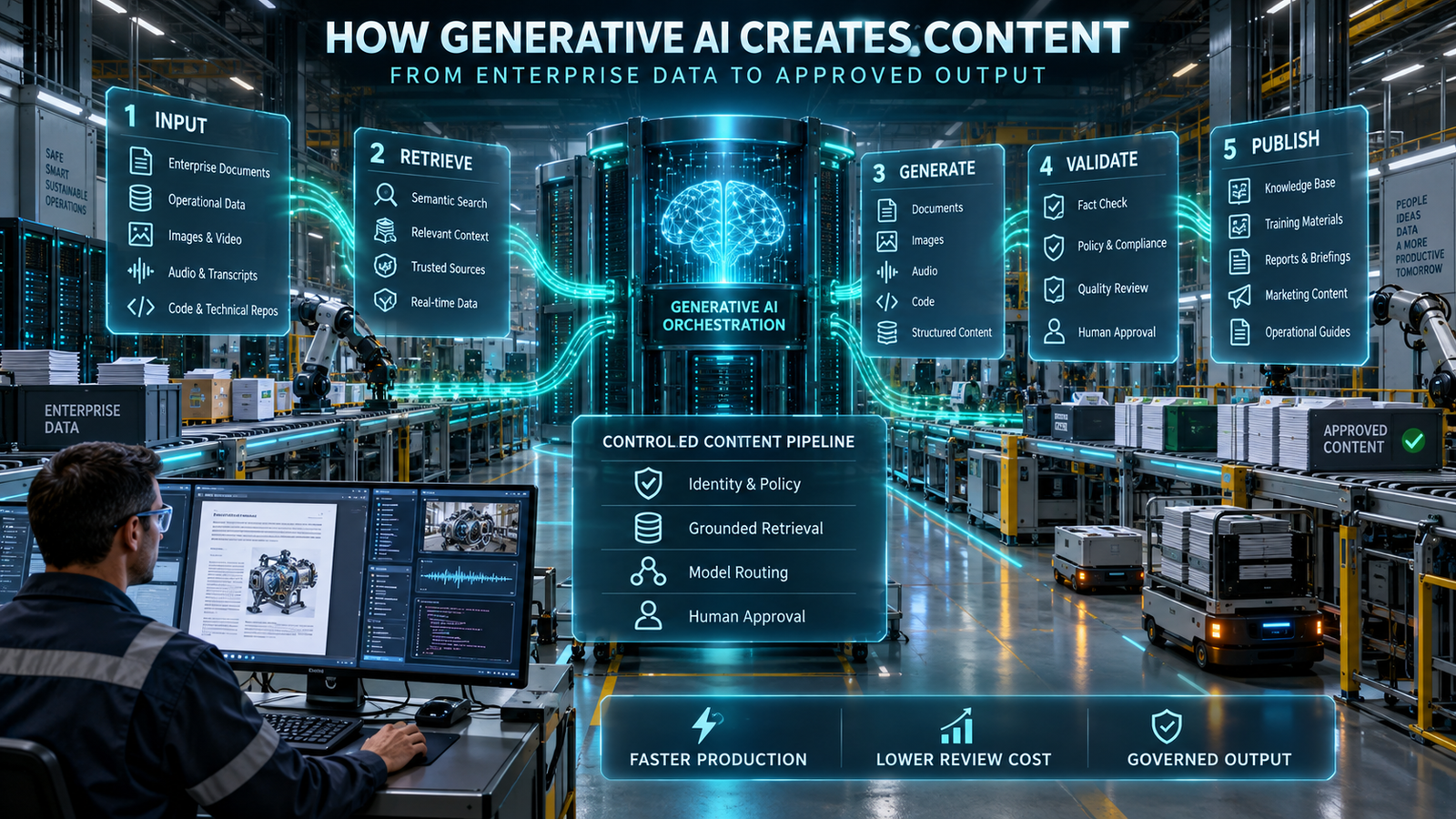
Generative AI content creation is not a single model answering a prompt. In a production environment, it is a governed software pipeline that combines identity, enterprise data, retrieval, model routing, policy checks, human review, publishing controls, and continuous evaluation.
The model produces candidate material by estimating a likely continuation or reconstructing media from learned representations. The surrounding system decides which data the model may see, which tools it may call, whether its claims are supported, and whether the result is safe to release.
That distinction changes the buying decision. A strong model inside a weak architecture can leak data, invent facts, overspend on inference, or publish content that violates a license or brand rule.
A smaller model inside a disciplined architecture can outperform it on a narrow workflow because retrieval, templates, validation, and human approval reduce the error surface. The commercial unit is therefore not “cost per token” alone; it is cost per accepted, compliant output.
This Article explains the architecture behind generative AI content creation, the trade-offs between prompting, retrieval-augmented generation, and fine-tuning, and the controls required for enterprise generative AI deployment. It also supplies an evaluation matrix, a vendor comparison framework, an ROI model, and a practical governance checklist.
I. The Current Market Landscape and Challenge
The Enterprise Problem Is Control, Not Access
Access to capable models is widely available, but reliable content production requires more than model access. Organizations must connect variable model outputs to defined business rules, source permissions and approval processes.
A content workflow may draw from product records, contracts, support tickets, analytics, and brand assets. Each source has a different owner, retention rule, update cadence, and permission model.
The generative AI content creation model also has a knowledge boundary. Its training data has a cutoff, its context window is finite, and its output can sound confident without being supported by the supplied evidence.
This creates a systems problem. A buyer needs an enterprise generative AI platform that can enforce data boundaries, record provenance, route requests, measure quality, and stop unsafe actions.
What is Artificial Intelligence and How Does It Work? A Complete Business Guide
Why Pilot Success Often Fails to Survive Production
A generative AI content creation pilot usually uses a small group, clean prompts, and hand-selected documents. Production introduces contradictory files, malicious content, missing metadata, role changes, multilingual requests, peak traffic, and downstream systems that expect exact schemas.
The model itself may also change. A provider can release a new version, alter a safety layer, deprecate an endpoint, or change pricing, which can shift latency, tone, and cost without a change in the application code.
Teams that evaluate only a demonstration miss these dependencies. They need versioned prompts, fixed evaluation sets, model-release tests, rollback paths, and acceptance thresholds before generative AI deployment reaches customers.
The Cost of Inaction
Doing nothing does not preserve a neutral state. Employees may adopt unapproved AI content generation software, copy confidential material into consumer tools, and create outputs that lack an audit trail.
Shadow generative AI content creation can also multiply subscription costs. Different departments may buy overlapping products while legal, security, and procurement teams lack a complete vendor and data-flow inventory.
The alternative cost is slower content operations. Manual research, drafting, localization, metadata creation, and revision consume skilled time even when the final judgment still belongs to a subject-matter expert.
The rational response is controlled experimentation. Start with a bounded workflow, quantify the current baseline, and require evidence that generative AI content creation improves an accepted business metric.
Commercial Objectives That Can Be Measured
Useful generative AI content creation objectives are operational. Examples include reducing time to a reviewed product description, increasing the percentage of support drafts accepted without factual correction, or lowering agency spend per approved campaign asset.
Avoid broad targets such as “increase creativity.” They cannot establish causality, support a budget decision, or identify whether the bottleneck is the model, the retrieval layer, or the approval process.
Each use case should have a business owner, a risk owner, a gold-standard test set, and a stop condition. That structure turns generative AI content creation into an accountable software investment.
II. Deep-Dive Technical Analysis and Evidence
Architecture Overview for Generative AI Content Creation

Modern generative AI content creation systems separate the control plane from the data plane. The control plane manages identities, policies, model versions, evaluation rules, budgets, and audit records; the data plane moves prompts, retrieved passages, model responses, and tool results.
This separation limits accidental privilege. It also lets an organization change a generative AI content creation model without rebuilding its source connectors, publishing workflow, or governance process.
The core components are:
- Experience layer: A web application, editor plug-in, service desk, API, or automated job submits a structured request.
- Identity and policy: Single sign-on, role-based access, tenant rules, consent, and purpose checks determine what the request may access.
- AI gateway: The gateway applies rate limits, token budgets, redaction, model routing, caching, and request logging.
- Orchestration: Prompt templates, state machines, agents, and tool definitions translate business intent into controlled steps.
- Retrieval layer: Search, embeddings, metadata filters, and reranking select authorized evidence from current enterprise sources.
- Model layer: A hosted or self-managed model generates text, code, images, audio, or structured data.
- Validation layer: Schema validation, groundedness checks, policy filters, citation verification, and deterministic business rules inspect the result.
- Human decision point: An authorized reviewer approves, edits, rejects, or escalates material before a high-impact action.
- Publishing layer: Approved output moves to a CMS, DAM, CRM, ticketing platform, code repository, or product information system.
- Telemetry and evaluation: Traces, feedback, latency, cost, incidents, and quality scores feed release decisions.
Integration Flowchart
- Receive a user request or business event.
- Verify identity, permissions and permitted data use.
- Apply the approved prompt template and workflow.
- Retrieve authorized source material and validate proposed tool access.
- Generate a candidate output using the selected model.
- Check required fields, citations, factual support and content policies.
- Approve, revise, reject or escalate the output according to risk.
- Publish only approved material to the designated system.
- Record review decisions, publication details, quality results and costs.
What the Model Actually Does
For text-based generative AI content creation, a tokenizer converts input into units called tokens. A transformer processes relationships among those tokens through attention layers, then predicts a probability distribution for the next token.
Decoding rules convert that distribution into an output. Temperature and top-p can change variation, but neither setting proves truth or removes the need for validation.
The generative AI content creation model does not query a verified fact database unless the application gives it that capability. It generates from parameters plus the current context, which is why fluent language can contain unsupported claims.
Image diffusion systems follow a different inference path. They iteratively remove noise while conditioning the process on text or other signals, producing pixels that match learned visual relationships rather than retrieving a stored image on demand.
Multimodal generative AI content creation systems connect representations across text, images, audio, and video. Their usefulness expands the attack and review surface because a malicious instruction can be hidden in a document, image, web page, or tool response.
Prompting, Retrieval, and Fine-Tuning Are Different Investments
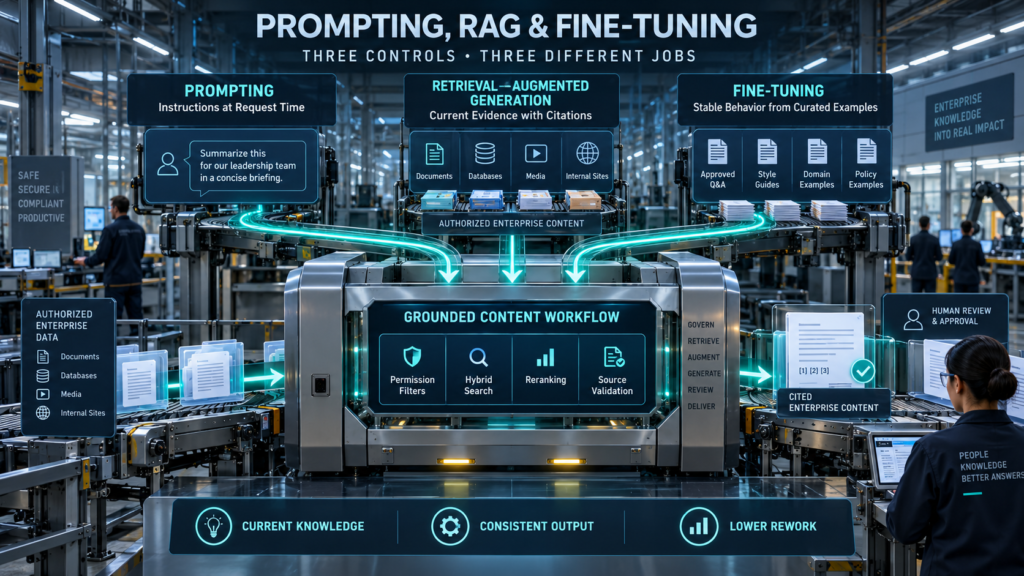
Prompt engineering changes generative AI content creation instructions at request time. It is inexpensive to test and easy to reverse, but long prompts consume context and cannot guarantee access to current facts.
Retrieval-augmented generation supplies selected evidence before generation. It is the usual choice when content must reflect frequently changing, permissioned, or citable enterprise knowledge.
Fine-tuning adjusts model behavior using curated examples. It can improve style, format, or task consistency, but it creates dataset governance, evaluation, maintenance, and version-management work.
Fine-tuning is not a reliable substitute for a current knowledge base. Facts that change weekly belong in retrieval or tools, while stable response patterns may justify fine-tuning after simpler controls fail.
Retrieval-Augmented Generation in Practice
A serious retrieval-augmented generation pipeline for generative AI content creation begins before vector search. Documents must be classified, permissioned, parsed, deduplicated, chunked, versioned, and linked to source metadata.
Chunk size creates a trade-off. Large chunks preserve context but can bury the relevant sentence and increase token cost; small chunks improve precision but can separate qualifications from the claim they constrain.
Hybrid retrieval combines lexical and semantic search. Enforce source permissions and tenant boundaries before retrieved material reaches the model. Metadata filters can support these controls, but their configuration and isolation must be tested. Reranking improves relevance ordering; it does not establish authorization.
The generative AI content creation system should retain the source identifier, revision date, passage boundaries, retrieval score, and access decision. A citation is useful only if it points to evidence that actually supports the generated claim.
Retrieval also creates a new failure vector. An attacker can plant instructions in a document so the model follows the document rather than the system policy, a pattern OWASP classifies under prompt-injection risk.
Tool Use and Agentic Workflows
Tools let models call search, databases, calculators, email, code execution, or business APIs. They move generative AI content creation from drafting toward action, but they also multiply consequences.
Grant each generative AI content creation tool the narrowest permission possible. A research agent rarely needs write access, and a publishing agent should not be able to change identity policy or retrieve unrestricted customer records.
Treat model output as untrusted input. Arguments must pass allowlists, schema checks, business rules, and authorization after the model proposes them and before a tool executes them.
High-impact actions require confirmation. Financial transactions, customer communications, production code changes, employment decisions, and legal filings should not depend on an unreviewed probabilistic decision.
Deployment Challenges That Appear After Launch
Generative AI content creation latency accumulates across identity checks, retrieval, reranking, model inference, tool calls, validation, and human queues. A fast model cannot compensate for a slow vector index or an overloaded approval process.
Context growth also raises cost and may reduce focus. Sending an entire policy manual on every request is usually worse than retrieving a few authoritative passages with clear dates and scope.
Generative AI content creation model drift is another operational reality. Even when an API name stays constant, provider-side updates can alter refusal behavior, formatting, or tool-call patterns.
Version pinning, canary tests, and regression suites are therefore part of generative AI deployment. Release management should treat prompts, retrieval settings, policies, and model versions as code.
Inference Cost and Capacity Engineering
Generative AI content creation API pricing is typically driven by input tokens, output tokens, model tier, caching, batch mode, and additional services. Retrieval, vector storage, reranking, moderation, observability, network transfer, and human review add separate costs.
A useful model router sends routine classification or rewriting to a smaller model and reserves a stronger model for complex reasoning. The decision rule must be tested against quality thresholds rather than based on model reputation.
Caching helps when system instructions or long reference material repeat. It may reduce billed input and latency, but the cache key and retention policy must not mix customers or preserve sensitive context beyond its approved lifetime.
Self-hosted generative AI content creation changes the ledger rather than eliminating cost. GPU capacity, idle time, orchestration, patching, monitoring, incident response, and specialist labor replace the simplicity of a metered API.
Performance Evaluation Matrix

| Evaluation dimension | Measurement | Release gate example | Why it matters |
| Grounded factuality | Supported claims ÷ checked claims | Threshold set by use-case risk | Detects plausible but unsupported content |
| Citation precision | Correct citations ÷ citations shown | No fabricated or irrelevant sources | Tests evidence quality, not citation appearance |
| Retrieval recall | Relevant passages retrieved ÷ relevant passages in test set | Baseline and regression threshold | Separates retrieval failure from generation failure |
| Task success | Outputs meeting the business rubric ÷ attempts | Compared with current manual process | Links model quality to actual work |
| Human acceptance | Approved with no material correction ÷ reviewed outputs | Tracked by workflow and content type | Exposes hidden editing labor |
| Brand compliance | Passed style and prohibited-claim checks | Mandatory for external publishing | Protects customer trust |
| Safety failure rate | Policy-violating outputs ÷ adversarial tests | Near-zero for critical policies | Measures control effectiveness |
| Prompt-injection attack success rate | Successful attacks ÷ attack attempts | No privileged action from untrusted text | Tests retrieval and tool boundaries |
| Latency | P50, P95, and P99 end-to-end time | Service-level objective by workflow | Captures tail delays users experience |
| Unit economics | Fully loaded cost per accepted output | Below approved baseline | Prevents token savings from hiding review cost |
Automated graders can scale generative AI content creation evaluation, but an “LLM as judge” can reproduce bias or prefer a familiar writing style. Calibrate it against a human-labeled gold set and investigate disagreements instead of treating one score as objective truth.
Use two commercial formulas:
Cost per accepted output = total workflow cost during the measurement period ÷ accepted outputs during that period.
Include model usage, retrieval, tools, platform charges, review, rework and an allocated share of implementation and support costs.
Net annual benefit = verified annual benefits − total annual costs.
Count each benefit once. Separate cash savings from released staff capacity, and include review, rework, integration, security and ongoing support costs.
These formulas make generative AI content creation comparable with an existing process. They also discourage teams from celebrating cheap drafts that require expensive correction.
Academic and Standards Evidence
The transformer architecture established the attention-based foundation used by modern language models. Retrieval-augmented generation research then demonstrated how generation can be paired with external evidence rather than relying only on model parameters.
Instruction tuning with human feedback improved adherence to user intent, while also showing that model behavior depends on the data and objectives used during alignment. Research on training-data extraction demonstrates why memorization and privacy testing cannot be dismissed as theoretical concerns.
NIST’s Generative AI Profile organizes risks and actions across governance, content provenance, data privacy, information integrity, security, and incident disclosure. It is a practical basis for an enterprise control map, not a product certification.
III. Commercial Solutions and Best Practices
Enterprise Generative AI Platform Comparison
The following generative AI content creation comparison covers four common cloud routes. It is a procurement aid, not an endorsement, and contracts, regions, model availability, retention terms, and prices must be verified during buying.
| Platform | Model and deployment approach | Retrieval and integration | Governance strengths to validate | Cost structure and buying fit |
| OpenAI API | Direct access to OpenAI models and platform tools | File search, embeddings, tool calling, structured outputs, APIs | Project controls, data handling, regional options, logging, retention | Public usage pricing varies by model and feature; strong fit for teams wanting direct access and rapid product integration |
| Amazon Bedrock | Managed access to multiple model providers through AWS | Knowledge Bases, Agents, Guardrails, AWS data and security services | IAM, private networking, CloudTrail integration, regional service availability | Model-specific on-demand, batch, or provisioned structures may apply; fit for AWS-centered estates |
| Google Vertex AI | Google and partner models within Google Cloud | Vertex AI Search, grounding, evaluation, pipelines, BigQuery integration | IAM, VPC controls, audit logs, data residency and service controls | Usage pricing varies by model, modality, grounding, and region; fit for Google Cloud data and ML operations |
| Microsoft Azure AI Foundry / Azure OpenAI | Managed models and development services in the Azure ecosystem | AI Search, prompt flow, agents, evaluation, Microsoft data connectors | Entra ID, private networking, policy, monitoring, regional deployment | Token and service pricing vary by model and region; fit for Microsoft identity, data, and application estates |
Official pricing pages should be attached to the procurement record: OpenAI, Amazon Bedrock, Google Vertex AI, and Microsoft Azure.
The Five-Gate Buying Framework
Gate 1: Business fit.
Define the generative AI content creation unit, current cycle time, quality baseline, demand volume, and economic owner before reviewing a model leaderboard.
Gate 2: Data fit:
Map every source, classification, region, license, retention period, and user group that the proposed enterprise generative AI platform will touch.
Gate 3: Quality fit:
Run generative AI content creation vendors against the same private test set, rubric, prompts, retrieval corpus, and reviewer pool; do not compare a tuned demonstration with an unconfigured competitor.
Gate 4: Control fit:
Test access isolation, logging, encryption, deletion, incident notification, model updates, content filters, exportability, and contract terms.
Gate 5: Economic fit:
Model low, expected, and peak volume with input, output, retrieval, tool, storage, network, observability, support, and human-review costs.
Build, Buy, or Combine
Buying packaged AI content generation software can reduce integration time when the workflow is standard. The trade-off is less control over prompts, model routing, telemetry, and data portability.
Building generative AI content creation on a model API offers flexibility but creates ownership for identity, orchestration, retrieval, evaluation, user experience, and support. That engineering burden should appear in the total-cost model.
A hybrid architecture is common. A business may buy a governed writing interface for general teams while building specialized workflows for regulated product claims, customer support, or proprietary research.
Recommended Generative AI Deployment Sequence
Start generative AI content creation with a read-only, internal workflow whose errors are visible and reversible. Drafting from approved knowledge, summarizing controlled documents, or generating metadata are usually easier to govern than autonomous publishing.
Run the generative AI content creation system in shadow mode before replacing work. Compare its output with the current process without exposing customers or allowing the model to execute consequential actions.
Introduce human approval, then limited automation for low-risk cases that repeatedly pass the acceptance threshold. Expand permissions only after monitoring proves that the prior boundary is stable.
Finally, establish an exit path. Export prompts, evaluations, source indexes, telemetry, and approved content so the organization is not trapped by a proprietary orchestration layer.
IV. Business Outcomes and Strategic ROI Takeaways
Where Generative AI Content Creation Produces Measurable Value
Marketing teams can use generative AI content creation for first drafts, channel variants, metadata, and localization suggestions from an approved campaign brief. The measurable outcome is reviewed asset throughput, not raw text volume.
Support teams can apply generative AI content creation to draft responses from current knowledge articles and display supporting passages to the agent. The critical metrics are acceptance without factual correction, handle time, escalation rate, and customer outcome.
Sales teams can assemble account briefs from authorized CRM and research sources. The system should record provenance and avoid inventing customer facts, pricing, or contractual commitments.
Product teams can use generative AI content creation to transform structured catalog data into descriptions while deterministic validators check required fields and prohibited claims. This use case benefits from templates, retrieval, schema enforcement, and batch processing.
Engineering teams can draft tests, documentation, and migration notes, but generated code still requires review, dependency scanning, and execution in isolated environments. Speed is valuable only when defect and remediation rates remain controlled.
An ROI Scenario That Finance Can Audit
Assume a team produces 4,000 reviewed content units each month. The current process averages 18 minutes per unit, while the controlled generative AI content creation workflow reduces active work to 10 minutes.
If all 4,000 monthly units achieve the eight-minute reduction, the illustrative time saving is approximately 533 hours per month. Treat this as released capacity unless it produces documented cash savings or measurable additional output. The 10-minute workflow time must include drafting, review and rework; do not subtract the same review labor again as an additional cost.
Then subtract model usage, retrieval, platform licenses, implementation amortization, evaluation, review, support, security, and expected incident cost. Apply a conservative adoption curve rather than assuming every unit is eligible on day one.
A sensitivity table is more credible than one headline return:
| Scenario | Eligible volume | Minutes saved per accepted unit | Acceptance rate | Commercial interpretation |
| Conservative | 35% | 4 | 65% | Continue only if control and learning value justify fixed cost |
| Expected | 60% | 8 | 80% | Scale if fully loaded cost remains below the manual baseline |
| Strong | 80% | 11 | 90% | Expand carefully while testing reviewer capacity and model drift |
For these scenarios, estimate gross monthly time savings as 4,000 units × eligible-volume share × acceptance rate × minutes saved per accepted unit ÷ 60. Then subtract additional time spent on rejected attempts that is not already included in the measured workflow time.
These figures are illustrative inputs, not market benchmarks. Replace them with time studies, invoice data, workflow logs, and acceptance records from the organization.
Strategic Takeaways for Decision Makers
First, select the workflow before selecting the model. A precise business case will reveal whether generative AI content creation needs retrieval, tools, multimodality, or only a controlled template.
Second, optimize cost per accepted output. Low token prices do not compensate for factual corrections, legal review, rejected assets, or damaged customer trust.
Third, preserve model choice. A gateway and independent evaluation layer can reduce switching cost and prevent application logic from becoming inseparable from one provider.
Fourth, invest in source quality. Retrieval cannot repair obsolete policies, duplicate documents, missing ownership, or inconsistent product data.
Fifth, keep human accountability explicit. Reviewers need evidence, clear authority, and enough time to challenge the output rather than rubber-stamp it.
V. Risk Mitigation and Regulatory Framework

Governance Baseline
Map the generative AI content creation program to the NIST AI RMF functions: Govern, Map, Measure, and Manage. Use the NIST Generative AI Profile to extend that map for content provenance, information integrity, privacy, security, harmful bias, and incident handling.
The framework is risk-based. An internal brainstorming assistant does not need the same controls as a system that creates customer advice, employment material, regulated disclosures, or executable code.
Regulatory and Legal Scope
Under the EU AI Act, duties depend on role and use case, including whether an organization is a provider, deployer, importer, distributor, or provider of a general-purpose AI model. Classification should be documented with qualified counsel rather than inferred from a marketing label.
Transparency duties may apply to certain AI-generated or manipulated content, while prohibited practices and high-risk obligations follow separate tests and phased application dates. Preserve technical documentation and monitor the official consolidated text and implementing guidance.
If personal data enters the workflow, apply the GDPR principles of lawful basis, purpose limitation, data minimization, accuracy, retention, security, and data-subject rights. A model contract does not replace the controller’s own assessment.
Copyright analysis must cover training and input licenses, output similarity, third-party marks, jurisdiction, contractual allocation, and the degree of human authorship. The U.S. Copyright Office’s AI materials provide an authoritative starting point, but a specific publication may require legal review.
Security and Reliability Checklist
- Maintain an inventory of models, versions, prompts, agents, tools, data sources, owners, and vendors.
- Enforce single sign-on, least privilege, tenant isolation, secrets management, and short-lived credentials.
- Classify and redact sensitive inputs before they reach an unauthorized service or log.
- Treat retrieved documents, web pages, images, and tool outputs as untrusted content.
- Test direct and indirect prompt injection, data exfiltration, jailbreaks, and excessive agency.
- Validate every tool argument with authorization, schemas, allowlists, and deterministic rules.
- Isolate code execution and block unrestricted network or file access.
- Require human approval for high-impact publishing, transactions, legal claims, and customer commitments.
- Record input lineage, model version, retrieval evidence, policy decisions, edits, approvals, and publication destination.
- Establish rate limits, spend caps, timeouts, circuit breakers, and denial-of-wallet alerts.
- Run release evaluations after model, prompt, source, retrieval, policy, or tool changes.
- Maintain incident response, notification, rollback, kill-switch, and content-recall procedures.
- Scan the actual libraries, containers, gateways, and orchestration components for applicable CVEs.
- Review vendor subprocessors, retention, training-use terms, residency, deletion, availability, and exit assistance.
Content Integrity and Provenance Checklist
- Require evidence for material factual claims and verify that each citation supports the adjacent statement.
- Mark synthetic or materially altered content where policy or law requires disclosure.
- Preserve original assets and edits; use cryptographic provenance such as C2PA where the ecosystem supports it.
- Test for protected-class bias, dialect disparities, language coverage, and accessibility failures.
- Block unsupported medical, legal, financial, safety, or performance claims unless an authorized expert approves them.
- Maintain a correction channel and the ability to identify where a generated asset was published.
Deciding Whether to Scale the Workflow
Approve generative AI content creation only when the workflow has an accountable owner, a permissioned data path, a representative evaluation set, a fully loaded cost model, a human escalation route, and a tested rollback plan.
The next practical step is a 30-day controlled assessment: select one reversible workflow, baseline its time and quality, test at least two model routes, run adversarial evaluations, and present cost per accepted output to the technical, security, legal, and business owners before scaling.
VI. Appendix and Research Integrity
Sources and Citations Index
Key references include:
- Vaswani et al. — Attention Is All You Need
- Lewis et al. — Retrieval-Augmented Generation for Knowledge-Intensive NLP Tasks
- Ouyang et al. — Training Language Models to Follow Instructions with Human Feedback
- Carlini et al. — Extracting Training Data from Large Language Models
- OWASP Top 10 for LLM Applications
- NIST Generative AI Profile, AI 600-1
- NIST AI Risk Management Framework
- EU AI Act
- U.S. Copyright Office AI materials
- C2PA Technical Specification
Corporate Editorial Transparency and AI Usage Disclosure
AI-assisted tools were used to support research organization, drafting and language refinement. NezzHub retains editorial responsibility for the published article. Vendor inclusion does not constitute endorsement.
Author and Editorial Review
Author: Garikapati Bullivenkaiah
Technology research writer with LL.B., LL.M., M.A., and MBA qualifications. He writes about emerging technologies and their business, governance and legal implications. His multidisciplinary academic background informs his analysis of technology adoption, intellectual property, and organizational risk. His articles explain technical concepts and practical considerations for business owners, IT managers and technology decision-makers. LinkedIn Profile
Reviewed by: Chitikineni Ramadevi — Editor
Chitikineni Ramadevi holds an M.Sc. in Computers from Andhra University and has over 10 years of research experience in technology-related subjects. She reviews NezzHub articles for clarity, factual accuracy, source support and practical relevance.
Published by: NezzHub
Research approach: This article draws on primary sources, technical documentation and relevant industry research. References are provided within the article or its sources section.
Last reviewed: 09-17-2026
Corrections: To report a factual error or outdated information, please contact NezzHub.

Garikapati Bullivenkaiah is a seasoned entrepreneur with a rich multidisciplinary academic foundation—including LL.B., LL.M., M.A., and M.B.A. degrees—that uniquely blend legal insight, managerial acumen, and sociocultural understanding. Driven by vision and integrity, he leads his own enterprise with a strategic mindset informed by rigorous legal training and advanced business education. His strong analytical skills, honed through legal and management disciplines, empower him to navigate complex challenges, mitigate risks, and foster growth in diverse sectors. Committed to delivering value, Garikapati’s entrepreneurial journey is characterized by innovative approaches, ethical leadership, and the ability to convert cross-domain knowledge into practical, client-focused solutions.