
















Executive Summary
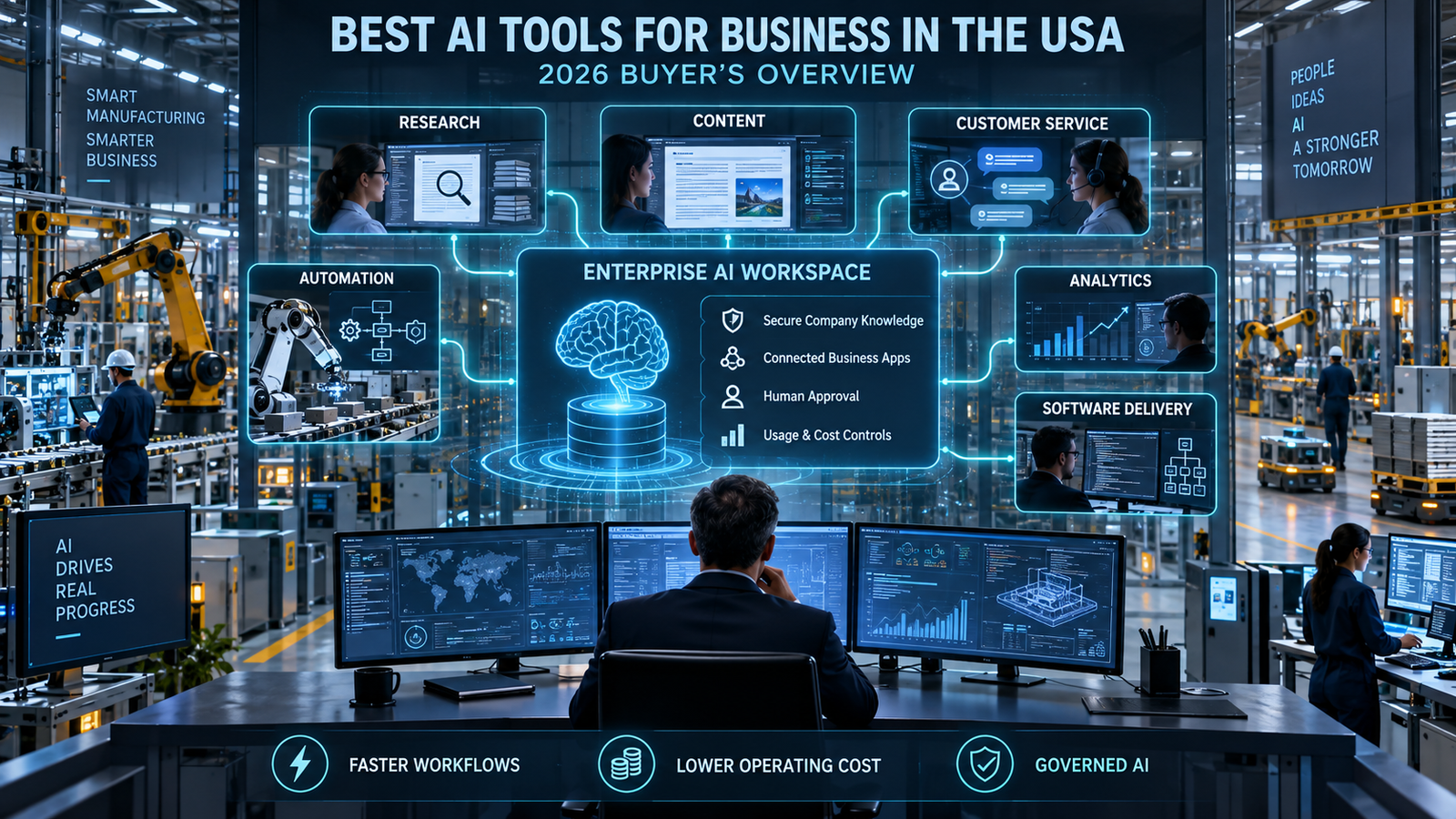
The Best AI Tools for Business in the USA are not the products with the longest feature lists. They are the tools that improve a defined workflow, fit the existing identity and data stack, pass security review, and cost less per accepted outcome than the process they replace.
This distinction matters in 2026. Chat interfaces now include research, file analysis, connectors, coding, images, meeting support, agents, and enterprise search, while productivity suites embed similar capabilities directly inside email, documents, spreadsheets, meetings, and customer systems.
Feature overlap makes procurement harder. A company can easily pay for the same summarization, drafting, search, and meeting functions through four different licenses while none of them has a verified owner, retention rule, or adoption target.
This Article compares the Best AI Tools for Business in the USA through a buyer’s lens. It evaluates ChatGPT Business, Microsoft 365 Copilot, Google Workspace with Gemini, and Claude Team, then maps specialist products to marketing, sales, support, automation, design, meetings, and software delivery.
The central recommendation is simple. Select the workflow first, measure its current cost and quality, test tools against the same private evaluation set, and scale only when the fully loaded cost per accepted outcome improves.
I. The Current Market Landscape and Challenge
Why Business AI Platforms Are Hard to Compare
Business AI platforms now extend beyond writing assistance. Depending on the product and purchased plan, they can search company knowledge, analyze files, generate media, connect to applications and support automated workflows.
Overlapping features make comparison difficult. Products offering enterprise search can differ in source permissions, indexing freshness, citation quality, deletion behavior and audit coverage.
Subscription price is only one part of the cost. Buyers may also need a productivity-suite license, usage credits, premium connectors, implementation support or a higher plan for required security controls.
Buyers therefore need a common evaluation model. Compare the complete workflow, not a chatbot response captured during a sales demonstration.
The Cost of Tool Sprawl
The first cost is duplicate licensing across the Best AI Tools for Business in the USA. Marketing, sales, operations, and engineering teams can purchase separate AI productivity tools that perform nearly identical drafting, transcription, research, and summarization work.
The second cost is fragmented governance among the Best AI Tools for Business in the USA. Each tool introduces its own identity store, connectors, retention settings, model changes, exports, browser extensions, and third-party subprocessors.
The third cost is hidden review labor. A low subscription price is irrelevant when employees spend more time checking unsupported claims, fixing tone, rebuilding citations, or transferring outputs into systems the tool cannot update safely.
The fourth cost is data exposure. Staff may paste contracts, customer records, source code, health information, or acquisition documents into products that procurement has not approved.
The Cost of Inaction
Rejecting all sanctioned use of the Best AI Tools for Business in the USA does not necessarily stop it. It can push employees toward consumer accounts where administrators cannot enforce single sign-on, retention, connector policy, or incident response.
The organization also loses a controlled way to test measurable uses. Routine document comparison, first-draft creation, meeting follow-up, support-response assistance, and internal search may remain slower than necessary.
The responsible path is neither unrestricted adoption nor a blanket ban. It is a managed portfolio of the Best AI Tools for Business in the USA, matched to risk-classified workflows and supported by clear usage rules.
A Practical Definition of “Best”
For the Best AI Tools for Business in the USA, “best” should mean highest verified business value after quality, risk, integration, and cost are considered. It should never mean the tool with the most social-media attention or the strongest benchmark selected by its own vendor.
For each workload, calculate a weighted score:
First reject any product that fails mandatory security, legal or access-control requirements. For the remaining candidates, score output quality, integration fit, governance, adoption readiness and cost on a common 0–5 scale, where 5 is most favorable. Agree the weights before testing, with weights totaling 100%. Multiply each score by its weight and add the results.
Top AI Jobs in the USA: Roles, Salaries, and Trends
II. Deep-Dive Technical Analysis and Evidence
Architecture of a Governed Business AI Workspace
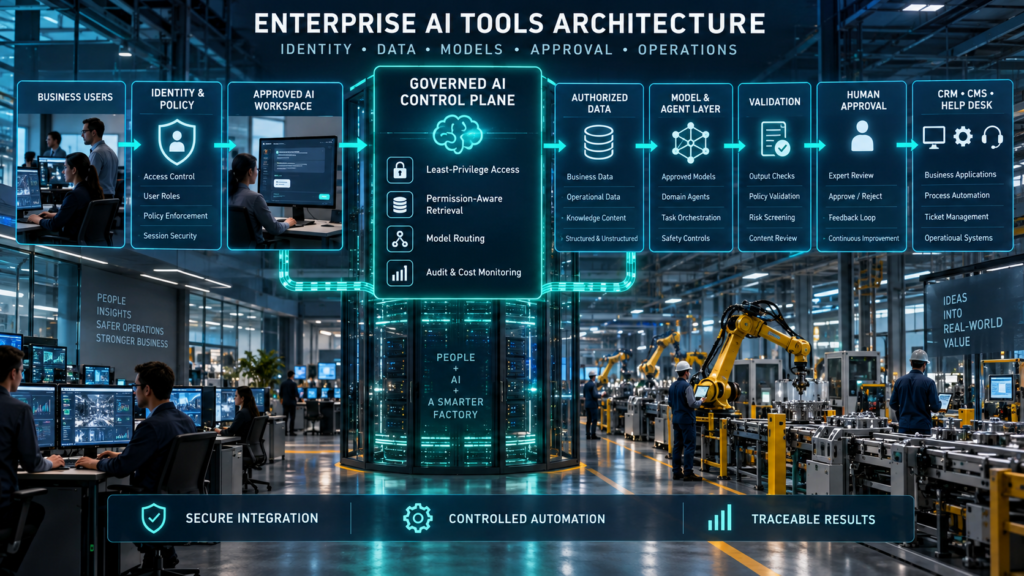
A deployment of the Best AI Tools for Business in the USA is more than a vendor login. It is an identity, data, model, workflow, validation, and monitoring system that crosses existing cloud and SaaS boundaries.
The recommended architecture for the Best AI Tools for Business in the USA has nine layers:
- Identity: Single sign-on, multifactor authentication, lifecycle management, group membership, device posture, and privileged roles.
- Policy gateway: Approved use cases, data-classification rules, model restrictions, rate limits, content filters, and spend controls.
- Experience layer: Chat, office applications, CRM, help desk, design tools, developer environments, or custom applications.
- Connector layer: Authorized access to files, email, calendars, customer systems, knowledge bases, repositories, and analytics platforms.
- Retrieval layer: Permission-aware search, indexing, embeddings, reranking, source freshness, and citation metadata.
- Model layer: General-purpose models, smaller task models, image models, speech models, or vendor-specific agents.
- Action layer: Business automation software, tool calls, approvals, queues, and application programming interfaces.
- Validation layer: Schema checks, policy enforcement, groundedness tests, human review, and deterministic business rules.
- Observability layer: Usage, cost, latency, quality, incidents, model version, connector activity, and outcome reporting.
The Best AI Tools for Business in the USA should fit this architecture without bypassing existing permissions. A connector that ignores source-system access rules can turn a useful search function into a cross-department disclosure channel.
Integration Flowchart
- Request: An employee submits a task, or a business event starts the workflow.
- Identity and policy checks: Verify the user’s identity, permissions and permitted use.
- Approved AI workspace: Route the request to the authorized platform.
- Data retrieval: Retrieve only information the requesting user is allowed to access.
- AI processing: Generate a draft, analysis or proposed action.
- Validation: Check the output against business rules, source evidence and security requirements.
- Approval: Apply the required review. Approve the result, return it for revision or reject it.
- Delivery: Send approved outputs to the CRM, CMS, help desk or office application.
- Monitoring: Record decisions, errors, quality, usage and costs.
An employee request or business event passes through identity and policy checks before entering the approved AI workspace. The system retrieves authorized information, generates an output and applies validation rules. Depending on the risk, a reviewer approves, revises or rejects the result. Approved outputs move to the destination application, while monitoring records quality, cost and operational outcomes.
Suite AI Versus Standalone AI
Among the Best AI Tools for Business in the USA, suite-native products reduce context switching. Microsoft 365 Copilot works inside Microsoft applications, while Gemini capabilities are built into Google Workspace plans and operate near Gmail, Docs, Sheets, Meet, and Drive.
Standalone candidates for the Best AI Tools for Business in the USA can provide broader model-centric capabilities, flexible projects, connectors, and research workflows. ChatGPT Business and Claude Team are examples, but their exact controls differ from their enterprise tiers.
The trade-off is operational. A suite tool may inherit familiar identity and data controls, while a standalone tool may deliver better cross-platform work but add another administration and connector boundary.
Retrieval and Company Knowledge
Many buyers assume the Best AI Tools for Business in the USA make every answer accurate after connecting a file repository. Retrieval can improve grounding, but it still depends on source quality, permission inheritance, indexing freshness, chunking, ranking, and whether the citation supports the claim.
Test the Best AI Tools for Business in the USA with conflicting policies, obsolete files, restricted folders, scanned PDFs, tables, multilingual material, and questions that have no supported answer. A trustworthy system should abstain or disclose uncertainty instead of composing a convenient answer.
Connector scope also matters. Read-only access is safer for research than broad write permission, and an AI agent should not receive a shared service account that exceeds the requesting user’s authority.
Agents and Business Automation Software
Agent features in the Best AI Tools for Business in the USA can plan steps, retrieve information, and call tools. They can also send an email, modify a record, expose data, trigger excessive API consumption, or repeat an action when state tracking fails.
The Best AI Tools for Business in the USA should support least privilege, confirmation gates, idempotency, timeouts, rate limits, transaction logs, and rollback. An agent should never convert untrusted text from an email or web page directly into a privileged action.
Use deterministic automation for stable rules. Use a model where language interpretation or judgment is necessary, then place the model between explicit input and output contracts.
Deployment Challenges
The most common failure with the Best AI Tools for Business in the USA is buying seats before selecting workflows. Employees receive a new icon, experiment for a week, and then return to familiar processes because templates, source access, training, and ownership were never designed.
The second failure when assessing the Best AI Tools for Business in the USA is evaluating output without measuring acceptance. A tool may create 1,000 drafts, but business value exists only when approved outputs reduce cycle time, external spend, backlog, or avoidable errors.
The third failure is weak change management. Models, usage limits, interfaces, connectors, and plan entitlements can change, so procurement screenshots cannot serve as permanent architecture documentation.
The fourth failure is uncontrolled proliferation. One platform should not become the answer to every workload merely because the company already signed a contract.
Compute, Licensing, and Hidden Cost
Seat-based pricing for the Best AI Tools for Business in the USA is predictable only at low complexity. Metered agents, premium model usage, API calls, data processing, vector search, storage, observability, implementation, and human review create variable costs.
The Best AI Tools for Business in the USA should be modeled under low, expected, and peak usage. Include inactive seats, premium-seat mix, annual commitments, taxes, underlying licenses, support, onboarding, connector charges, and termination rights.
The correct unit is cost per accepted outcome:
Cost per accepted outcome = total workflow cost ÷ accepted outcomes, measured over the same period.
Include licenses, usage, integration, review, rework and support.
This formula exposes “cheap” tools that create large review queues. It also rewards tools that integrate cleanly with existing work and reduce manual transfer.
Performance Evaluation Matrix

| Evaluation dimension | Test method | Required evidence | Buying implication |
| Task accuracy | Blind review against a human-produced gold set | Error taxonomy and acceptance rate | Reject broad claims based on selected demos |
| Groundedness | Verify every material claim against cited sources | Citation precision and unsupported-claim rate | Critical for research, support, legal and policy work |
| Permission isolation | Test users with different source access | No retrieval outside inherited rights | Mandatory before company-wide search |
| Prompt-injection resistance | Plant malicious instructions in connected content | Attack success rate and containment log | Essential for agents and web-connected workflows |
| Human acceptance | Track approve, edit, reject, and escalation | Accepted-without-material-change rate | Reveals hidden review cost |
| Latency | Measure full workflow at P50, P95, and P99 | End-to-end trace | Determines whether staff will keep using the tool |
| Unit cost | Attribute seat and variable charges to outcomes | Cost per accepted outcome | Supports renewal and seat-allocation decisions |
| Adoption | Track eligible active users and repeat workflows | Cohort usage, not login count | Identifies training or product-fit failure |
| Administrative control | Test offboarding, audit, export, and policy changes | Evidence from the purchased tier | Prevents enterprise features being assumed from marketing pages |
| Portability | Export prompts, files, outputs, logs, and workflows | Tested exit procedure | Reduces vendor lock-in |
Do not let the Best AI Tools for Business in the USA grade themselves without calibration. Automated evaluation should be compared with human decisions on a representative set, with disagreements reviewed by the workflow owner.
III. Commercial Solutions and Best Practices
Four-Platform Comparison: Prices and Plan Limits
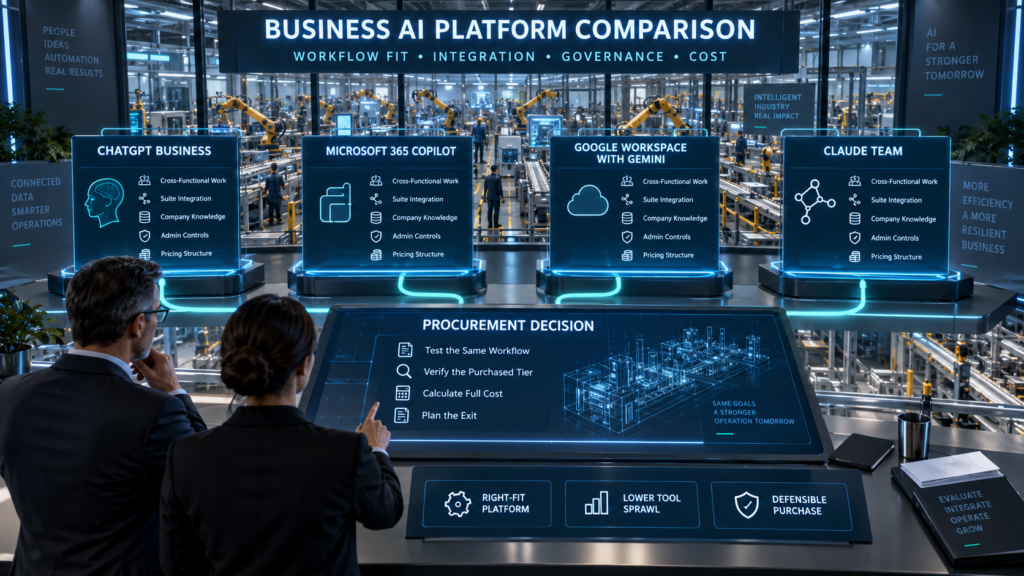
This comparison of the Best AI Tools for Business in the USA uses publicly displayed U.S. prices available on September 17, 2026. Prices exclude tax, promotions, implementation, underlying licenses, API or agent consumption, and enterprise contract changes unless stated otherwise.
| Product | Public U.S. business price | Strongest deployment fit | Governance boundary to verify | Cost and limitation watchpoint |
| ChatGPT Business | Standard seat: $20/user/month annually or $25 monthly | Cross-functional research, writing, data analysis, coding, images, connectors, projects and workspace agents | Business includes SAML SSO and administration, but the published comparison reserves SCIM, RBAC, compliance API logs, IP allowlisting and data residency for Enterprise | Broad capability can duplicate existing suite features; premium seats and credits increase spend |
| Microsoft 365 Copilot | $30/user/month, paid yearly, plus a qualifying Microsoft 365 license | Organizations centered on Teams, Outlook, Word, Excel, PowerPoint and Microsoft identity | Validate Graph permissions, sensitivity labels, agent governance, retention, eDiscovery and Copilot Studio capacity | The headline price excludes the qualifying base license; agents may use metered or prepaid capacity |
| Google Workspace with Gemini | Business Standard: $14/user/month on the displayed annual commitment; Enterprise is quote-based | Gmail, Docs, Sheets, Meet, Drive and Google-centered collaboration | Validate edition-specific DLP, context-aware access, Vault, data regions and endpoint controls | AI is bundled with Workspace tiers, but advanced governance may require Plus, Enterprise or add-ons |
| Claude Team | Standard seat: $20/user/month annually or $25 monthly | Long-document analysis, writing, coding, enterprise search and mixed Microsoft 365 workflows | Team publishes SSO and central administration, while RBAC, SCIM, audit logs, retention controls and compliance API are listed for Enterprise | Usage limits, premium-seat mix and enterprise usage charges require modeling |
No single product wins every column. The Best AI Tools for Business in the USA depend on whether the business values suite integration, cross-platform research, coding, long-context work, advanced controls, or low incremental license cost.
Decision Guidance by Company Stack
Among the Best AI Tools for Business in the USA, choose Microsoft 365 Copilot for a controlled pilot when the work already lives in Microsoft 365 and the company can manage permissions, labels, and agent capacity. Its economic case is strongest when employees can complete the target workflow without leaving familiar applications.
From the Best AI Tools for Business in the USA, choose Google Workspace with Gemini when Gmail, Drive, Docs, Sheets, and Meet are the operating core. The bundled model can reduce separate-tool sprawl, but the organization must confirm which security controls exist in its purchased edition.
Within the Best AI Tools for Business in the USA, choose ChatGPT Business when teams need a broad, model-centered workspace across research, analysis, writing, coding, images, files, and connectors. Move to an enterprise review when SCIM, role-based access, compliance logs, data residency, or custom retention is mandatory.
Among the Best AI Tools for Business in the USA, choose Claude Team when long-form analysis, drafting, coding, connectors, and enterprise search match the workload. Buyers needing audit logs, SCIM, custom retention, role-based access, or regulated deployment should compare the enterprise plan rather than assume Team contains those controls.
Specialist AI Tools by Business Function
The Best AI Tools for Business in the USA often include a horizontal assistant plus one or two specialist platforms. Adding more tools should require evidence that a specialist materially outperforms the suite capability.
| Business function | Products to evaluate | Appropriate workload | Critical buying test |
| Marketing and brand | Jasper, Writer, Grammarly Enterprise | Campaign drafts, style enforcement, rewrites and governed brand language | Does it reduce approval time without inventing product claims? |
| Design and media | Adobe Firefly for Enterprise, Canva Enterprise | Brand assets, variations, presentations and image workflows | Are training, indemnity, provenance and asset rights suitable? |
| Sales and CRM | Salesforce Agentforce, HubSpot Breeze | Account research, call summaries, next actions and CRM updates | Does the tool preserve field permissions and explain recommendations? |
| Customer support | Zendesk AI, Intercom Fin, Salesforce Service tools | Triage, suggested responses, knowledge-grounded answers and escalation | What counts as a resolved interaction, and how is it billed? |
| Workflow automation | Microsoft Power Automate, Zapier, UiPath | App integration, routing, document processing and approval workflows | Can every write action be authorized, retried safely and rolled back? |
| Meetings | Microsoft Teams Copilot, Google Meet with Gemini, Zoom AI Companion | Notes, summaries, action items and follow-up | Are consent, recording, retention and speaker attribution controllable? |
| Software delivery | GitHub Copilot, Claude Code, OpenAI Codex | Code explanation, tests, refactoring, review and task execution | Does generated code pass human review, tests, SAST and dependency scanning? |
| Knowledge work | Notion AI, Glean, Atlassian Rovo | Enterprise search, workspace summaries and internal assistance | Does search enforce source permissions and display reliable citations? |
This table is a shortlist, not an affiliate ranking. Capabilities and contract terms must be confirmed on official product pages and in the actual order form.
The Seven-Gate Procurement Framework
Gate 1: Workflow
Document the trigger, inputs, decisions, outputs, exceptions, volume, current cycle time, error rate, and accountable owner. The Best AI Tools for Business in the USA should be tested against this workflow, not an invented demonstration.
Gate 2: Data
Classify every data source as public, internal, confidential, regulated, or prohibited. Record storage location, retention, deletion, model-training terms, subprocessors, and cross-border transfers.
Gate 3: Integration
Test identity, groups, source permissions, connectors, APIs, export, workflow triggers, and downstream write controls. A manual copy-and-paste dependency can erase expected savings and weaken auditability.
Gate 4: Quality
Build a private evaluation set containing normal cases, difficult cases, missing information, conflicts, and adversarial inputs. Score outputs against the same rubric and blind reviewers to the vendor where practical.
Gate 5: Security and Compliance
Verify controls in the exact plan being purchased. Security pages often describe the vendor’s enterprise portfolio, not the lower-priced tier shown in the proposal.
Gate 6: Economics
Calculate three-year total cost, cost per eligible employee, cost per active employee, and cost per accepted outcome. Include implementation, training, review, premium connectors, agent consumption, and exit work.
Gate 7: Exit
Test exports and define deletion evidence before signing. The Best AI Tools for Business in the USA should not trap prompts, knowledge indexes, workflows, evaluation history, or business records in an unusable format.
Deployment Sequence
Deploy the Best AI Tools for Business in the USA first in a reversible, internal, read-only workflow. Examples include summarizing approved documents, comparing policies, drafting internal briefs, or producing meeting follow-up for employee review.
Run the tool in shadow mode against the current process. Do not expose customers or allow autonomous writes until quality, permissions, latency, and cost are measured.
Next, deploy to a trained cohort with office hours and workflow templates. Review support requests, rejected outputs, unused seats, and shadow-tool activity every week.
Expand only after the pilot meets a documented gate. The Best AI Tools for Business in the USA should earn broader permissions through evidence rather than receive them by default.
IV. Business Outcomes and Strategic ROI Takeaways
Measuring Business Value and ROI
ROI from the Best AI Tools for Business in the USA comes from accepted work, not generated volume. A business should measure whether the tool reduced cycle time, increased throughput, lowered external spend, improved response speed, reduced avoidable error, or protected revenue.
The annual value model is:
Net annual value = verified annual benefits − fully loaded annual AI cost.
Separate cash savings from released capacity and avoid counting the same benefit under multiple categories.
Redeployed labor counts only when saved capacity produces another valuable outcome, removes overtime, avoids hiring, or replaces a paid external service. Minutes that disappear without operational change should not be booked as cash savings.
Illustrative 100-Employee Scenario
Assume a 100-employee company licenses 40 users at $20 per user per month, billed annually. The subscription costs $9,600 per year. Adding $18,000 for implementation and training, $7,200 for administration and evaluation, and $5,000 for variable services gives an illustrative first-year cost of $39,800.
If 30 active users each save 45 verified minutes per week across 46 working weeks, the tool releases 1,035 hours. At a loaded labor rate of $55 per hour, the theoretical capacity value is $56,925.
That is not automatically a $17,125 return. Finance should apply a realization factor based on whether the released time reduces invoices, supports more customer work, prevents hiring, or improves another measurable output.
| Realization scenario | Capacity value recognized | First-year net value | Interpretation |
| 30% | $17,078 | -$22,722 | Redesign the workflow or reduce fixed cost |
| 60% | $34,155 | -$5,645 | Continue only if quality or strategic value supports the gap |
| 80% | $45,540 | $5,740 | Positive but sensitive to adoption and review cost |
| 100% | $56,925 | $17,125 | Requires the saved capacity to be fully converted into value |
The figures are illustrative, not market benchmarks or promised results. Replace them with payroll, invoice, workflow, quality, adoption, and renewal data from the business.
Outcome Measures by Department
Marketing teams using the Best AI Tools for Business in the USA should track approved assets per reviewer hour, campaign cycle time, agency spend, factual corrections, brand violations, and content reuse. They should not treat word count as productivity.
Sales should track research time, CRM completeness, response speed, conversion by stage, forecast accuracy, and unauthorized claims. AI-generated outreach volume can damage deliverability and trust if quality controls are weak.
Support should track time to first response, resolution, escalation, reopen rate, customer satisfaction, and grounded-answer rate. Deflection alone can reward a system that blocks customers without solving their problem.
Finance and operations should track processing time, exception rate, duplicate payment, manual touches, forecast error, and control overrides. Automated approval requires stronger evidence than automated document classification.
Engineering should track accepted suggestions, review time, escaped defects, security findings, test coverage, and remediation. Lines of generated code are not an ROI measure.
Strategic Takeaways
First, consolidate before buying the Best AI Tools for Business in the USA. Inventory current AI features across productivity, CRM, support, design, analytics, development, and automation licenses.
Second, buy controls at the required tier. The Best AI Tools for Business in the USA may reserve SCIM, audit logs, role-based access, retention, data residency, or compliance APIs for enterprise plans.
Third, assign workflow ownership. IT can operate the platform, but the business owner must define acceptable output and approve process changes.
Fourth, budget for evaluation. A model or connector update can change behavior, so testing is a recurring operating cost rather than a one-time procurement task.
Fifth, retain human accountability. Employees should know when they may accept, edit, reject, escalate, or publish AI-assisted work.
V. Risk Mitigation and Regulatory Framework
NIST-Aligned Governance Checklist
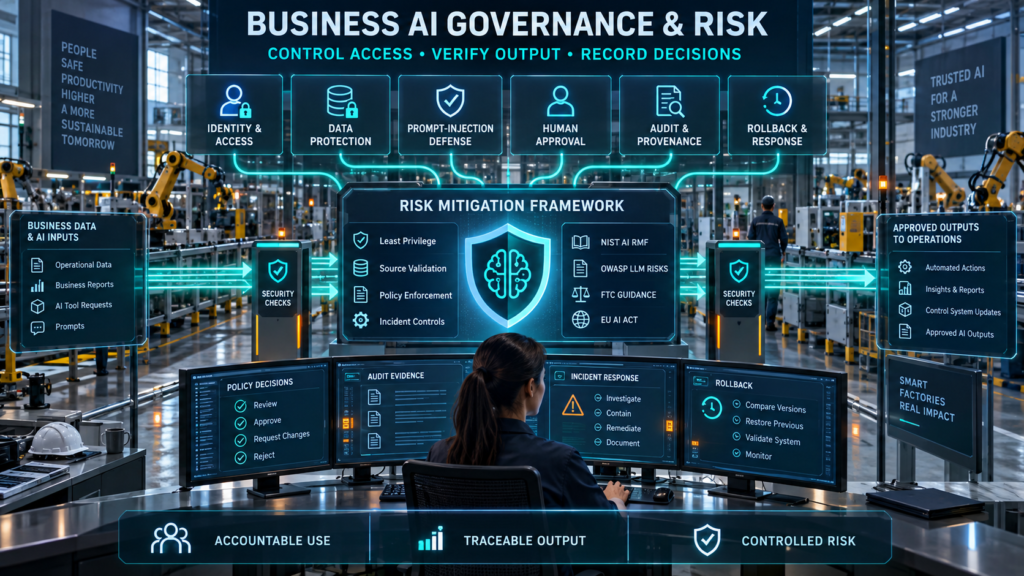
Use the NIST AI RMF functions—Govern, Map, Measure, and Manage—to structure ownership, context, evaluation, response, and documentation. Apply the NIST Generative AI Profile for risks involving confabulation, privacy, information integrity, harmful bias, intellectual property, security, and incident disclosure.
- Maintain an inventory of every approved model, tool, edition, connector, agent, data source, owner, and renewal date.
- Assign a business owner, technical owner, risk owner, and escalation contact to each production workflow.
- Document permitted data classes and prohibited uses in plain language.
- Require single sign-on, multifactor authentication, least privilege, and rapid offboarding.
- Verify plan-specific audit logs, retention, export, deletion, encryption, residency, DPA, and subprocessor terms.
- Test output quality, permission isolation, prompt injection, data exfiltration, excessive agency, and denial-of-wallet scenarios.
- Record the model or service version, sources, actions, reviewer, decision, and publication destination.
- Define release gates, rollback, kill switch, incident notification, correction, and content-recall procedures.
- Re-evaluate after material model, prompt, connector, policy, source, or workflow changes.
U.S. Legal and Regulatory Checklist
NIST guidance is voluntary, while enforceable duties can arise from federal sector rules, state privacy and consumer-protection laws, contracts, employment law, intellectual-property law, and regulators such as the FTC. Counsel should classify the exact use case and jurisdictions rather than approve “AI” as one category.
- Do not make unsubstantiated claims about accuracy, bias removal, productivity, security, or guaranteed ROI.
- Review automated decisions affecting employment, credit, housing, insurance, education, health, or essential services.
- Provide notices, consent, access, deletion, appeal, or human-review mechanisms where applicable.
- Apply data minimization and purpose limitation to customer, employee, and regulated data.
- Check state biometric, wiretap, recording-consent, privacy, and automated-decision requirements.
- Preserve accessibility and test for disparate performance across relevant user groups.
- Review licenses, trademarks, output similarity, confidential inputs, and human authorship before commercial publication.
Global Operations and the EU AI Act
A U.S. company may still face EU obligations when it places systems on the EU market, operates in the EU, or produces outputs used there. The EU AI Act assigns different obligations to providers, deployers, importers, distributors, and providers of general-purpose AI models, with phased application dates.
- Determine the organization’s legal role for each system and market.
- Screen for prohibited practices and high-risk classifications.
- Map transparency duties for chatbots, synthetic media, and other covered outputs.
- Preserve technical documentation, logging, human oversight, monitoring, and incident evidence where required.
- Track the official consolidated text, standards, codes, and implementing guidance rather than relying on a vendor badge.
Technical Security Checklist
OWASP identifies prompt injection, sensitive-information disclosure, supply-chain weaknesses, improper output handling, excessive agency, and unbounded consumption among material risks for LLM applications. These risks increase when the Best AI Tools for Business in the USA connect to internal data or execute actions.
- Treat email, web pages, files, images, retrieved passages, and tool responses as untrusted input.
- Validate tool arguments with schemas, allowlists, authorization, and business rules after model generation.
- Separate read, draft, approve, and publish permissions.
- Use short-lived credentials and never expose broad service-account authority to an agent.
- Sandbox code and file processing; restrict network destinations and secrets.
- Apply rate limits, spend caps, timeouts, circuit breakers, retry limits, and duplicate-action protection.
- Scan relevant clients, extensions, libraries, containers, APIs, and orchestration components for applicable CVEs.
- Red-team connected workflows before adding autonomous write access.
Choosing a Platform for a Controlled Pilot
Do not purchase the Best AI Tools for Business in the USA from a generic top-ten list. Select one measurable workflow, inventory capabilities already licensed, compare two qualified tools against the same private test set, and calculate cost per accepted outcome.
Approve broader generative AI deployment only after the pilot passes quality, permission, security, compliance, adoption, and economic gates. A disciplined 30-day test will reveal more than a year of unused enterprise seats.
VI. Appendix and Research Integrity
Sources and Reference Links
- OpenAI. “ChatGPT Business and Enterprise Pricing.” Accessed September 17, 2026. https://openai.com/business/pricing/
- Microsoft. “Microsoft 365 Copilot Plans and Pricing.” Accessed September 17, 2026. https://www.microsoft.com/en-us/microsoft-365-copilot/pricing/enterprise
- Google. “Google Workspace Pricing.” Accessed September 17, 2026. https://workspace.google.com/pricing.html
- Anthropic. “Claude Team and Enterprise Pricing.” Accessed September 17, 2026. https://claude.com/pricing
- National Institute of Standards and Technology. “AI Risk Management Framework.” https://www.nist.gov/itl/ai-risk-management-framework
- National Institute of Standards and Technology. Artificial Intelligence Risk Management Framework: Generative Artificial Intelligence Profile. NIST AI 600-1, July 2024. https://nvlpubs.nist.gov/nistpubs/ai/NIST.AI.600-1.pdf
- OWASP Foundation. “OWASP Top 10 for Large Language Model Applications.” https://genai.owasp.org/llm-top-10/
- European Union. Regulation (EU) 2024/1689—Artificial Intelligence Act, consolidated text. https://eur-lex.europa.eu/eli/reg/2024/1689/2026-07-27/eng
- Federal Trade Commission. “Business Guidance Resources,” including advertising, privacy, data-security, and artificial-intelligence enforcement guidance. https://www.ftc.gov/business-guidance
- United States Copyright Office. “Copyright and Artificial Intelligence.” https://www.copyright.gov/ai/
- Carlini, Nicholas, et al. “Extracting Training Data from Large Language Models.” arXiv, 2020. https://arxiv.org/abs/2012.07805
- Lewis, Patrick, et al. “Retrieval-Augmented Generation for Knowledge-Intensive NLP Tasks.” Advances in Neural Information Processing Systems, 2020. https://arxiv.org/abs/2005.11401
Research Integrity Notes
Prices are public U.S. list prices observed on the evidence date and may change. Promotional pricing, taxes, negotiated discounts, base-suite licenses, add-ons, usage charges, support, implementation, and regional availability can alter the actual contract.
No product was selected through affiliate commission, sponsorship, or vendor payment. The shortlist reflects workflow fit and published capability, but every buyer must validate the current plan, order form, data-processing terms, and security evidence.
Vulnerability checks should cover the exact browser extensions, desktop clients, connectors, agent frameworks, libraries and container versions selected for deployment. Applicability depends on the component, version and configuration.
Corporate Editorial Transparency and AI Usage Disclosure
AI-assisted tools were used to support research organization, drafting and language refinement. NezzHub retains editorial responsibility for the published article. Vendor inclusion does not constitute endorsement.
The illustrative ROI model is not a customer case study. It is a transparent calculation template designed to be replaced with the reader’s own evidence.
Research Evidence and Limitations
Author and Editorial Review
Author: Garikapati Bullivenkaiah
Technology research writer with LL.B., LL.M., M.A., and MBA qualifications. He writes about emerging technologies and their business, governance and legal implications. His multidisciplinary academic background informs his analysis of technology adoption, intellectual property, and organizational risk. His articles explain technical concepts and practical considerations for business owners, IT managers and technology decision-makers. LinkedIn Profile
Reviewed by: Chitikineni Ramadevi — Editor
Chitikineni Ramadevi holds an M.Sc. in Computers from Andhra University and has over 10 years of research experience in technology-related subjects. She reviews NezzHub articles for clarity, factual accuracy, source support and practical relevance.
Published by: NezzHub
Research approach: This article draws on primary sources, technical documentation and relevant industry research. References are provided within the article or its sources section.
Last reviewed: 09-17-2026
Corrections: To report a factual error or outdated information, please contact NezzHub.

Garikapati Bullivenkaiah is a seasoned entrepreneur with a rich multidisciplinary academic foundation—including LL.B., LL.M., M.A., and M.B.A. degrees—that uniquely blend legal insight, managerial acumen, and sociocultural understanding. Driven by vision and integrity, he leads his own enterprise with a strategic mindset informed by rigorous legal training and advanced business education. His strong analytical skills, honed through legal and management disciplines, empower him to navigate complex challenges, mitigate risks, and foster growth in diverse sectors. Committed to delivering value, Garikapati’s entrepreneurial journey is characterized by innovative approaches, ethical leadership, and the ability to convert cross-domain knowledge into practical, client-focused solutions.