








Executive Summary
The Top Robotics Companies in the USA cannot be identified by robot shipments, funding headlines, or demonstration videos alone. A serious buyer must test whether a supplier can solve a defined production constraint, integrate with operational technology, pass a site-specific safety assessment, and support the system after commissioning.
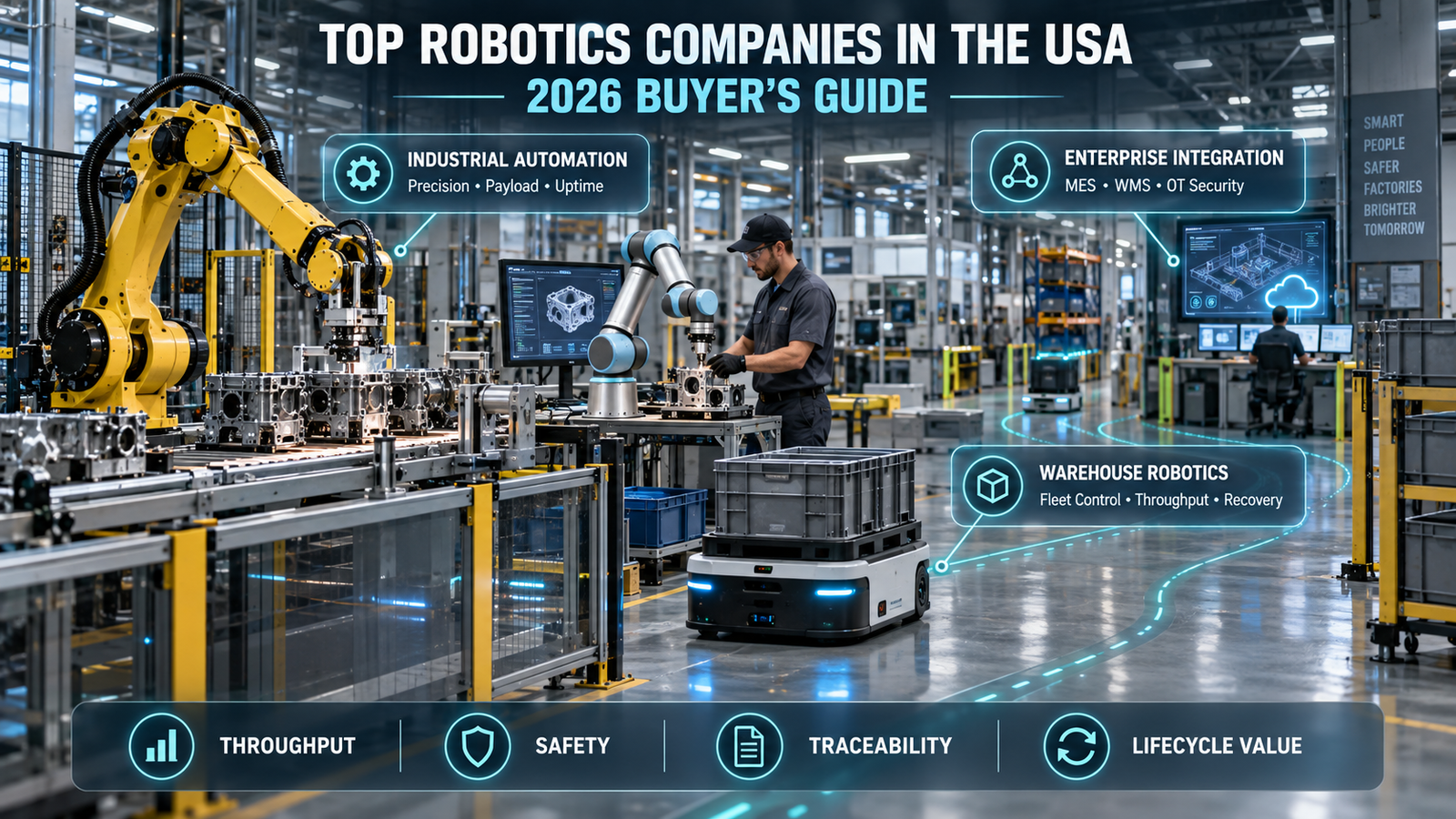
This Article evaluates the Top Robotics Companies in the USA through that commercial lens. It covers industrial arms, collaborative robots, autonomous mobile robots, fulfillment systems, surgical platforms, field robots, agricultural machines, humanoids, and the computing software that increasingly coordinates them.
The shortlist includes U.S.-headquartered businesses and international manufacturers with substantial U.S. sales, service, integration, or production operations. That distinction matters because “in the USA” does not mean every vendor is American-owned.
The practical finding is simple. The best supplier is the one whose hardware, software, safety case, service network, and integration economics fit the task—not the company with the most ambitious general-purpose robot.
Amazon offers a useful scale benchmark: in 2025 it reported deploying its one-millionth robot across more than 300 facilities and said its DeepFleet model could improve fleet travel efficiency by 10%. Buyers should not misread that result as an independent benchmark or an off-the-shelf Amazon product claim.
I. The Current Market Landscape and Challenge
Why a Robotics Ranking Can Mislead Buyers
The Top Robotics Companies in the USA sell fundamentally different outcomes. FANUC and ABB supply broad industrial portfolios, Universal Robots concentrates on accessible collaborative automation, and Rockwell Automation’s OTTO Motors business addresses autonomous material movement.
Other names play different roles. NVIDIA sells simulation, compute, and robotics software; Intuitive Surgical serves regulated clinical workflows; Symbotic sells high-throughput warehouse systems; Amazon Robotics primarily builds for Amazon’s own network.
A buyer comparing those companies as interchangeable vendors will produce a distorted request for proposal. The comparison unit must be an operational job with defined inputs, hazards, throughput, quality tolerances, interfaces, and service-level requirements.
The U.S. Demand Signal
The commercial case for monitoring the Top Robotics Companies in the USA is broader than labor substitution. U.S. operators deploy automation to stabilize cycle time, reduce ergonomic exposure, capture traceable process data, and keep production viable when product mix changes.
International Federation of Robotics reporting remains the most useful global baseline for installed industrial robots, although its published statistics lag current purchasing conditions. Procurement teams should use IFR figures to size a market, not to predict the economics of one plant.
Demand is also spreading beyond fixed cells. Warehouse automation systems now combine mobile platforms, perception, fleet orchestration, charging, traffic control, and WMS integration; every additional layer creates another dependency that must be owned.
Top AI Jobs in the USA: Roles, Salaries, and Trends
The Cost of Inaction
Doing nothing has a measurable cost when the constrained process produces overtime, scrap, missed orders, injury exposure, or unstable takt time. The calculation should use the actual bottleneck, not an industry-average productivity percentage.
Delay also has an architectural cost. Unsupported PLCs, flat OT networks, undocumented interfaces, and unreliable master data make later deployment slower and more expensive, regardless of which company wins the bid.
The Top Robotics Companies in the USA cannot repair weak process discipline with hardware. If part presentation changes by shift, labels are unreadable, Wi-Fi coverage is intermittent, or product routing is not authoritative, automation will reproduce those defects at machine speed.
The Cost of Acting Too Early
A premature purchase can be worse than waiting. Common stranded costs include an arm sized without end-of-arm-tool mass, an AMR fleet purchased before traffic simulation, and a vision system trained on images that do not represent real production variation.
The robot is often a minority of the installed system. Tooling, guarding, safety controls, vision, conveyors, electrical work, software integration, validation, training, spares, and launch support can dominate the business case.
This is why the Top Robotics Companies in the USA should be screened with a total-cost model. A low hardware quote is not cost optimization if integration change orders erase the saving.
II. Deep-Dive Technical Analysis and Evidence
Architecture Overview: The System Around the Robot
A production robot does not operate as an isolated appliance. It sits inside a layered control architecture whose weakest interface usually determines availability.
- Mechanical layer: arm or mobile base, payload, reach, speed, duty cycle, repeatability, environmental rating, brakes, and wear components.
- Application layer: gripper, welder, dispenser, scanner, surgical instrument, tote interface, or other process-specific tooling.
- Perception layer: encoders, torque sensing, cameras, LiDAR, safety scanners, force-torque sensors, and condition-monitoring signals.
- Control layer: robot controller, safety PLC, machine PLC, motion planning, fleet manager, and deterministic interlocks.
- Edge layer: inference, buffering, protocol translation, local historian, and degraded-mode logic when a cloud service is unavailable.
- Enterprise layer: MES, WMS, ERP, CMMS, quality systems, identity services, data platforms, and enterprise software licensing.
- Operations layer: change control, backup and recovery, preventive maintenance, patching, spare parts, and escalation ownership.
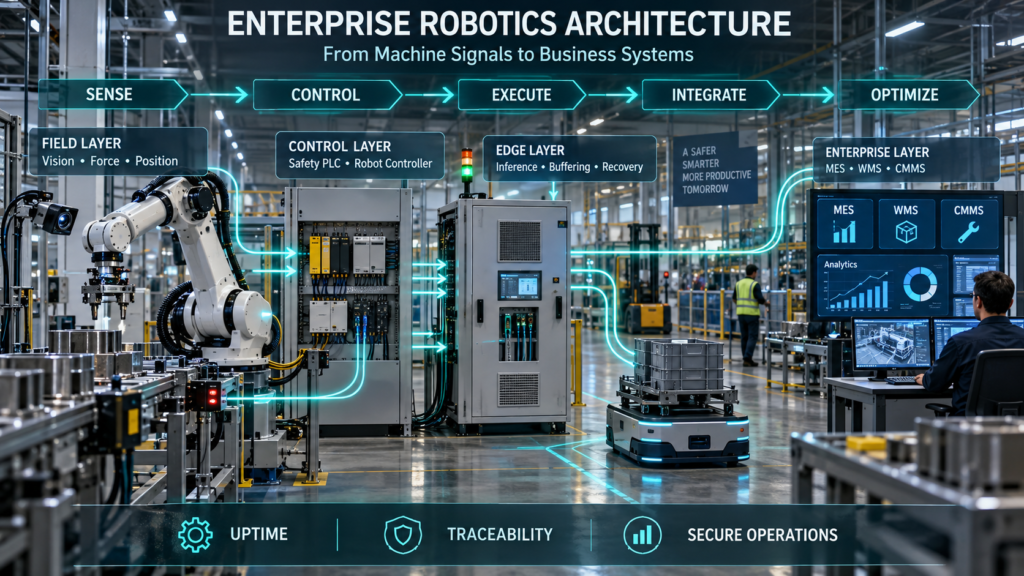
The Top Robotics Companies in the USA differ as much in these surrounding layers as in robot mechanics. A mature evaluation therefore scores APIs, backup procedures, identity controls, log export, lifecycle policy, safety documentation, and integrator availability.
Integration Flowchart
- Production demand: An order or production requirement creates a task.
- Task scheduling: The MES or WMS sends the task to the cell controller or fleet manager.
- Readiness checks: The system checks equipment availability, material readiness and applicable operating conditions.
- Safety supervision: Safety controllers and interlocks permit or stop hazardous motion according to the validated safety design.
- Task execution: The robot, tooling and perception system perform the permitted operation.
- Quality verification: Inspection determines whether the output meets acceptance requirements.
- Operational records: Task status, quality results and equipment events are recorded in the historian, CMMS or analytics system.
- Exception handling: Blocked routes, failed grasps, safety stops and rejected inspections update task status and scheduling. Authorized personnel follow the defined recovery procedure.
The flow is bidirectional in a real deployment. A blocked zone, failed grasp, safety stop, unreadable barcode, depleted battery, or rejected inspection must change scheduling upstream without losing task state.
Engineering Trade-Offs That Decide the Outcome
Payload is not the mass printed on the workpiece drawing. The calculation includes the gripper, adapters, hoses, cables, sensors, and the moment created by the load’s center of gravity.
Reach is also not usable reach. Joint limits, fixtures, singularities, dress packs, guarding, and safe approach paths can remove a large portion of the nominal work envelope.
Speed claims deserve the same scrutiny. A fast robot cannot overcome slow clamping, curing, inspection, operator replenishment, or upstream starvation; the relevant metric is sustained good units per scheduled hour.
For AMRs, navigation accuracy does not equal mission completion. Congestion, reflective surfaces, temporary staging, floor damage, doors, elevators, wireless roaming, and manual traffic determine whether warehouse automation systems remain productive during peak load.
For cobots, power-and-force limiting is not a blanket permission to run unguarded. Tool geometry, payload, speed, workpiece edges, trapping points, and foreseeable misuse still belong in the application risk assessment.
Deployment Challenges the Sales Demo Hides
The Top Robotics Companies in the USA can show polished reference cells, yet the buyer owns the production environment. Dust, washdown, freezer temperatures, welding spatter, electromagnetic interference, vibration, and hazardous materials narrow the usable product list quickly.
High-mix work creates another failure mode. Every SKU variation affects fixturing, grasping, vision, recipes, exception handling, and operator instructions; frequent changes can turn a technically successful cell into an expensive engineering queue.
Brownfield connectivity is rarely clean. A new robot may need to exchange states with twenty-year-old PLC logic, proprietary WMS interfaces, serial devices, or a CMMS that has no trustworthy asset hierarchy.
Robotics system integrators become decisive at that boundary. The integrator must translate a process into a validated machine while preserving safety, maintainability, cybersecurity, and production ownership.
Performance Evaluation Matrix
| Metric | Definition | Acceptance evidence | Failure signal |
| Good units per scheduled hour | Accepted output divided by scheduled runtime | Shift-level production historian | Fast motion with low usable output |
| First-pass yield | Percentage of completed units accepted on the first attempt without rework: first-pass accepted units ÷ total completed units × 100 | Quality-system records | Automation accelerates defect creation |
| Technical availability | Percentage of required operating time during which equipment is technically available: available time ÷ required operating time × 100. Define planned-stop exclusions before testing | Controller and line-state logs | Vendor reports uptime without exclusions |
| Mean time to recover | Elapsed time from fault to stable production | Incident timestamps | Recovery depends on one specialist |
| Intervention rate | Human assists per 100 or 1,000 missions | Fleet or cell event log | Labor moves from production to babysitting |
| Safety-stop rate | Protective stops by cause and shift | Safety PLC/event history | Nuisance stops become normalized |
| Energy per good unit | Cell energy divided by accepted output | Meter plus quality count | Energy falls while scrap rises |
| Changeover duration | Last good unit to first validated new unit | MES and recipe audit trail | Recipe edits are undocumented |
The matrix prevents a common reporting error: claiming success from robot utilization while ignoring quality, recovery labor, and blocked downstream equipment. Robotic automation ROI must be calculated from good output and avoided cost.
Evidence Validation Rules
Vendor case studies are useful for discovery, not for underwriting a capital request. Each claim should be tagged as vendor-reported, customer-confirmed, independently measured, or modeled.
The Top Robotics Companies in the USA publish different levels of technical and commercial detail. When a price, installed base, throughput claim, or model capability is not public, the correct entry is “not publicly disclosed,” followed by a request for evidence under nondisclosure.
No CVE should be inserted simply to make an article look technical. Security teams should build a software and firmware inventory, identify actual versions in scope, then query CISA and the National Vulnerability Database for applicable records.
III. Commercial Solutions and Best Practices
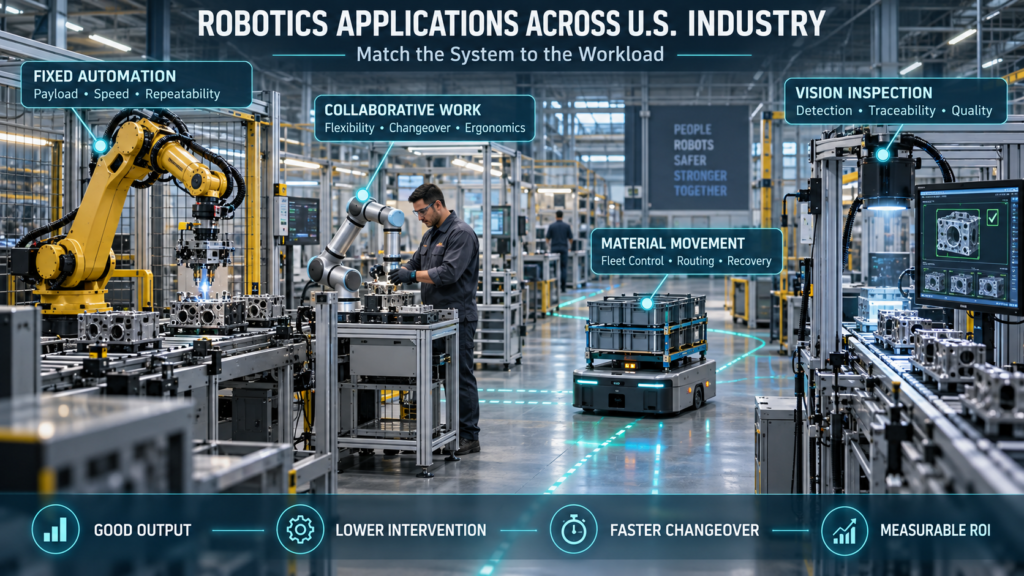
Top Robotics Companies in the USA by Buying Problem
The following watchlist is deliberately not a one-to-ten popularity ranking. It maps each company to the buying problem it is positioned to address and flags the commercial boundary.
| Company | U.S. market role | Primary buying problem | What to validate before purchase |
| FANUC America | Industrial robot OEM with U.S. engineering, training, service, and integration ecosystem | High-duty assembly, material handling, welding, palletizing, machining | Exact model availability, controller lifecycle, integrator capacity, safety design, spares |
| ABB Robotics | Global industrial and collaborative robotics supplier with substantial U.S. operations | Flexible cells, machine tending, welding, painting, palletizing, simulation | Corporate/product continuity, local support, offline-programming fit, application package scope |
| Universal Robots, a Teradyne company | Collaborative robot supplier with distributor and integrator ecosystem | Lower-payload, high-mix tasks where rapid redeployment matters | Application risk assessment, cycle-time ceiling, tooling compatibility, support ownership |
| Yaskawa America Motoman Robotics | Industrial robot OEM and automation supplier | Welding, handling, assembly, packaging, and coordinated motion | Application references, programming skills, controller roadmap, regional service |
| Rockwell Automation OTTO Motors | Autonomous mobile robot and fleet-management supplier | Intralogistics and line-side material movement | Wi-Fi survey, traffic model, charging plan, WMS/MES interface, manual recovery |
| Locus Robotics | Warehouse robotics company focused on fulfillment workflows | Person-to-goods picking and multi-site fulfillment | Subscription terms, workflow fit, peak capacity, data ownership, support SLA |
| Symbotic | U.S. warehouse automation systems provider | Large-scale case handling, storage, sequencing, and distribution-center throughput | Facility fit, implementation concentration, ramp plan, long-term service economics |
| Amazon Robotics | Captive robotics developer, manufacturer, and fleet operator | Benchmark for vertically integrated fulfillment automation | Not generally a comparable third-party purchasing option; separate observation from procurement |
| Intuitive Surgical | U.S. medical robotics company | Robot-assisted surgery within a regulated clinical system | FDA-cleared indications for the specific system and procedure, manufacturer labeling, clinician training, clinical governance, instrument costs and service terms. |
| Boston Dynamics | U.S. mobile robotics developer | Inspection, remote sensing, and specialized logistics | Terrain, autonomy boundaries, payload, battery workflow, remote supervision, data controls |
| Agility Robotics | U.S. humanoid robotics developer | Early commercial trials for repetitive material movement | Production readiness, safety case, task success, service model, deployment evidence |
| Carbon Robotics | U.S. agricultural robotics company | Precision weed control using computer vision and lasers | Crop/field fit, acreage economics, service coverage, weather limits, laser safety |
| NVIDIA | Enabling compute, simulation, and robotics software platform supplier | Training, simulation, perception, edge inference, and accelerated computing | Hardware lifecycle, model validation, licensing, cloud/edge cost, portability |
The Top Robotics Companies in the USA table mixes headquarters origins by design. FANUC, ABB, and Yaskawa are not U.S.-headquartered, but they are commercially important in American automation programs; procurement documents should state ownership and support location separately.
Feature and Cost Comparison Table
| Commercial solution | Best-fit workload | Architecture strength | Main limitation | Pricing visibility | Installed-cost drivers |
| FANUC industrial robot cell | High-volume or demanding fixed automation | Broad robot range, industrial controls, mature integration base | Engineering and guarding can be substantial | Usually quote-based | Tooling, fixtures, safety, controls, vision, installation, validation |
| ABB industrial/collaborative cell | Flexible industrial applications and simulation-led commissioning | Integrated robot portfolio and engineering software | Scope depends heavily on application and integrator | Usually quote-based | Robot, software, application package, tooling, safety, service |
| Universal Robots cobot cell | High-mix, lower-payload applications | Accessible programming and broad tooling ecosystem | Collaborative speed/payload constraints can weaken cycle-time economics | Hardware may be channel-quoted; system cost varies | End effector, risk reduction, stand, vision, integration, operator training |
| OTTO Motors AMR deployment | Repetitive internal transport | Fleet orchestration and integration with industrial operations | Site traffic and infrastructure dominate performance | Quote-based | Fleet size, carts, chargers, wireless, doors, integration, support |
This is a feature and cost comparison, not a list-price table. Most enterprise deployments from the Top Robotics Companies in the USA are configured projects, and a naked hardware price would conceal the largest cost categories.
A Procurement Framework That Survives Commissioning
1. Freeze the Business Constraint
Define the constrained operation in physical terms: product mix, arrival variability, takt, payload, reach, tolerance, environment, shift pattern, and exception frequency. Attach twelve months of real production data where available.
2. Write Acceptance Tests Before Selecting a Vendor
Specify sustained good output, changeover time, intervention rate, recovery time, quality thresholds, safety functions, cybersecurity controls, and the duration of the site-acceptance run. A short vendor demo is not an acceptance test.
3. Separate OEM and Integrator Accountability
The OEM supports the robot product; robotics system integrators usually own fixtures, tooling, cell controls, safety integration, and production commissioning. The contract must show who resolves interface failures and who pays for retesting.
4. Require an Installed-Cost Breakdown
Demand separate lines for hardware, tooling, guarding, engineering, software, network work, electrical and mechanical installation, validation, training, launch support, spares, and recurring licenses. This makes competing bids comparable.
5. Run a Representative Pilot
Use production-like parts, operators, lighting, floor conditions, network load, and failure cases. For warehouse automation systems, simulate peak traffic and blocked routes rather than measuring an empty aisle.
6. Contract for Evidence and Exit
Require log access, data ownership terms, backup and restore procedures, vulnerability notification, patch policy, spare-parts commitments, source-code escrow where justified, and exportable configurations. The Top Robotics Companies in the USA should be evaluated on operational reversibility as well as capability.
Choosing Robotics System Integrators
An experienced integrator should show applications similar in process physics, not merely the same robot brand. Welding, dispensing, vision-guided bin picking, sterile workflows, and mobile traffic control require different engineering disciplines.
Reference calls should ask about change orders, launch stability, documentation quality, safety validation, response time, and how faults were divided between OEM and integrator. Ask the reference customer what it would rewrite in the contract.
The best robotics system integrators also design for maintenance. Technicians need safe access, diagnostic context, replaceable cable routing, version-controlled backups, clear fault trees, and recovery procedures that work on the night shift.
IV. Business Outcomes and Strategic ROI Takeaways
Robotic Automation ROI Starts With Total Installed Cost
The capital request should use total installed cost rather than robot price. A defensible model adds engineering, end-of-arm tooling, fixtures, safety, vision, conveyors, utilities, software, validation, training, launch loss, spares, and internal labor.
Annual benefits should reflect verified changes, such as avoided overtime, reduced external spending, incremental contribution from additional accepted output, lower scrap and reduced downtime. Report released labor capacity separately from cash savings unless it reduces spending or produces measurable additional value. Avoid counting the same improvement under more than one benefit category.
Use these formulas:
Net annual benefit = annual gross benefit − annual operating cost.
Simple payback in years = total installed cost ÷ positive net annual benefit.
This simplified calculation assumes a steady annual benefit; model deployment ramp-up separately.
Three-year ROI (%) = (total three-year benefits − total three-year costs) ÷ total three-year costs × 100.
Costs include the initial installed cost and operating costs over the period.
Robotic automation ROI is not complete without a ramp curve. A cell that reaches its target in month nine has a different cash profile from one that passes acceptance in month two.
Illustrative ROI Scenario—Not an Industry Benchmark
Assume a company is evaluating a machine-tending cell from one of the Top Robotics Companies in the USA. The following figures demonstrate the model and are not vendor quotes or predicted results.
| Illustrative input | Conservative | Base | Upside |
| Total installed cost | $420,000 | $380,000 | $350,000 |
| Annual gross benefit | $165,000 | $230,000 | $310,000 |
| Annual support and operating cost | $45,000 | $40,000 | $38,000 |
| Net annual benefit | $120,000 | $190,000 | $272,000 |
| Simple payback | 3.50 years | 2.00 years | 1.29 years |
The sensitivity table reveals what a single payback number hides. If utilization, yield, or recovery performance misses plan, robotic automation ROI can move outside the company’s capital hurdle even when the cell technically works.
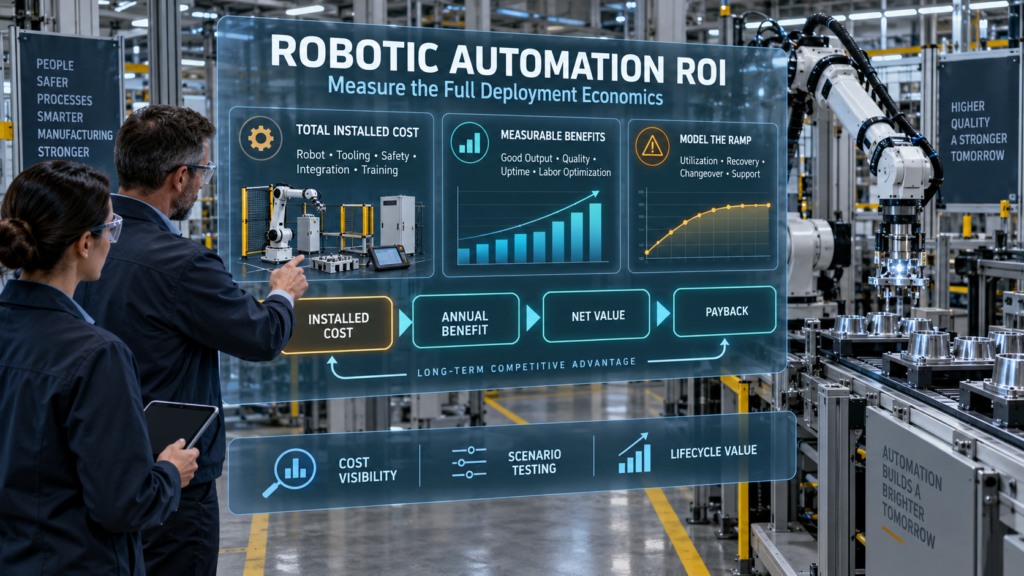
Value Levers Worth Measuring
Labor is only one lever. Stable cycle time can improve line balance, automated inspection can strengthen traceability, and hazardous-task removal can reduce exposure even when headcount does not change.
The Top Robotics Companies in the USA should provide evidence that maps to the buyer’s financial model. A 10% travel-time improvement in Amazon’s internal fleet is meaningful for Amazon, but it does not prove a 10% benefit in another warehouse.
Quality claims should be stated as changes in first-pass yield, false-reject rate, escape rate, rework hours, or cost per good unit. “More accurate” is not a finance-grade outcome.
Portfolio Strategy Beats the One-Vendor Myth
Large enterprises rarely need one robotics vendor everywhere. They need controlled patterns: approved industrial cells, an AMR reference architecture, standard safety components, common telemetry, identity controls, and a limited set of integration partners.
This approach reduces enterprise software fragmentation without forcing the wrong robot into an application. It also gives procurement leverage while keeping technical teams focused on reusable interfaces and skills.
The shortlist of Top Robotics Companies in the USA should therefore be refreshed by workload. A vendor can be strategic for welding, irrelevant for case picking, and experimental for humanoid handling at the same time.
V. Risk Mitigation and Regulatory Framework
Safety Governance Checklist
- Define intended use, foreseeable misuse, operating modes, and all human access points.
- Complete a documented application risk assessment; a supplier declaration for the robot alone is not a cell assessment.
- Validate safety functions, stopping behavior, tooling hazards, trapping points, restart logic, and energy isolation.
- Apply ISO 10218-1:2025 and ISO 10218-2:2025 where they fit the industrial robot and application scope.
- Treat collaborative operation as a validated application property, not a product label.
- Test non-routine work: teaching, jam clearing, calibration, maintenance, cleaning, and recovery.
- Train authorized personnel and retain validation records after software, tooling, layout, or payload changes.
OSHA’s robotics material highlights risks during programming, maintenance, testing, setup, and adjustment. Those modes deserve explicit procedures because normal automatic production is not the only exposure condition.
OT Cybersecurity Checklist
- Inventory robot controllers, safety controllers, PLCs, edge computers, cameras, access points, servers, firmware, and software versions.
- Segment robot networks by function and safety consequence; control traffic between enterprise IT, vendor access, and cell networks.
- Replace shared vendor credentials with named identities, least privilege, multifactor authentication where supported, and time-bound remote access.
- Export logs to a monitored location without making production dependent on the log platform.
- Test backups and bare-metal or controller recovery before go-live.
- Document patch qualification, compensating controls, vulnerability notification, and end-of-support dates using NIST SP 800-82 Rev. 3.
- Maintain a manual or degraded operating plan for unavailable cloud, WMS, fleet manager, or identity services.
The Top Robotics Companies in the USA vary in disclosure maturity. Procurement should require a security contact, secure-development information, software bill of materials where appropriate, vulnerability handling, and contractual notice of material security issues.
AI, Data, and Model Governance Checklist
- Define which decisions use machine learning and which remain deterministic safety functions.
- Record training-data origin, coverage, labeling controls, and known blind spots for perception models.
- Test lighting, product, demographic, environmental, and seasonal variation that matches the application.
- Establish drift detection, rollback, human override, and model-change approval.
- Measure false accepts, false rejects, missed detections, task failures, and downstream consequence—not accuracy alone.
- Use NIST AI RMF as a voluntary governance structure and track its ongoing revision.
- For EU deployment or market access, obtain role-specific analysis under the EU AI Act and Machinery Regulation.
Do not connect AI outputs directly to safety-critical motion without an engineered safety architecture. A high-performing model is not equivalent to a certified protective function.
Commercial and Continuity Checklist
- Confirm ownership of configurations, recipes, maps, models, process data, and derived telemetry.
- Price recurring licenses, cloud inference, support, batteries, consumables, instruments, and spare parts over the planned asset life.
- Contract response and restoration targets separately from general support availability.
- Identify single-source components and define last-time-buy or migration options.
- Require change-control records and revalidation triggers.
- Review vendor financial condition, insurance, acquisition risk, and product-roadmap commitments.
- Maintain an exit plan for data export, fleet replacement, controller migration, and integrator transition.
No list of the Top Robotics Companies in the USA can remove deployment risk. It can only focus due diligence on vendors whose products, evidence, support model, and commercial terms deserve deeper testing.
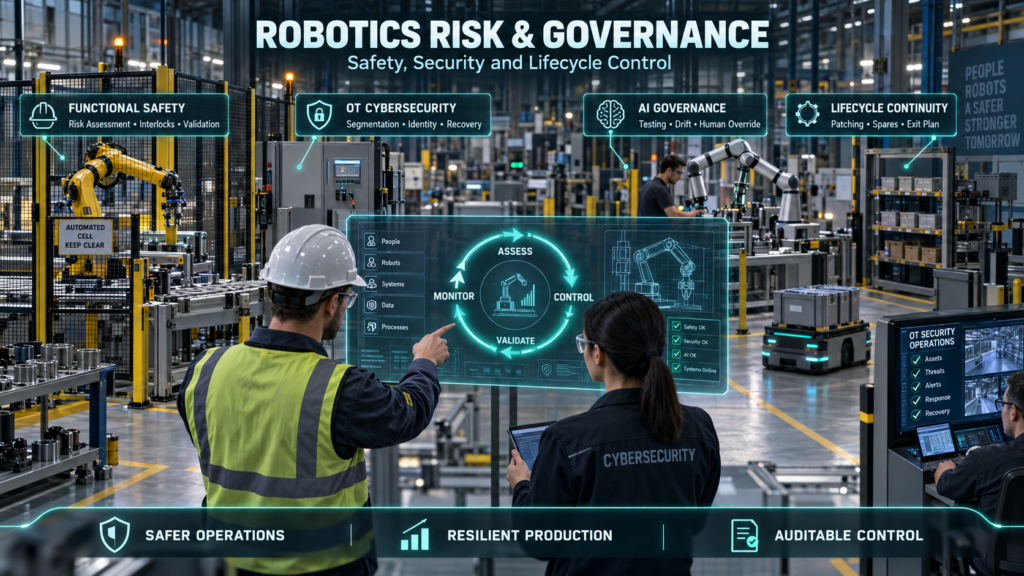
Building a Shortlist for Site Evaluation
Select one constrained workflow, document its baseline for four representative weeks, and issue the same acceptance matrix to two qualified vendors and at least one independent integrator. Require each bidder to show total installed cost, recurring cost, safety scope, cyber controls, ramp assumptions, and measured performance on representative work.
The winning proposal should not be the most futuristic. It should be the one that produces the strongest robotic automation ROI after integration, risk, recovery, and lifecycle cost are included.
VI. Evidence, Validation, and Research Integrity
Robotics Safety and Governance Standards
ISO 10218-1:2025 covers safety requirements for industrial robots as partly completed machinery, while ISO 10218-2:2025 addresses robot applications and cells. The standard explicitly excludes several categories, including medical, service, consumer, and public-access robots, so buyers must not apply it as a universal safety certificate.
NIST SP 800-82 Revision 3 addresses OT security while recognizing performance, reliability, and safety constraints. That is more relevant to a production robot network than copying a generic office-IT hardening checklist.
For AI-enabled perception or planning, the voluntary NIST AI Risk Management Framework organizes governance around trustworthy design, deployment, use, and evaluation. As of September 2026, NIST states that AI RMF 1.0 is being revised and has published a 2026 concept note for a critical-infrastructure profile.
Source and Citation Index
| Citation | Where used in the article | Supported claim |
|---|---|---|
[1] | Executive Summary; IV. Business Outcomes → Value Levers Worth Measuring | Amazon’s one-millionth robot, 300+ facilities, and claimed 10% DeepFleet travel-efficiency improvement |
[2] | I. Current Market Landscape → The U.S. Demand Signal | IFR as the source for industrial-robot installation statistics |
[3] | V. Evidence → Academic and Standards Footnote References; VI. Safety Governance Checklist | ISO 10218-1:2025 and ISO 10218-2:2025 safety scope |
[4] | V. Evidence → Academic and Standards Footnote References; VI. OT Cybersecurity Checklist | NIST SP 800-82 Rev. 3 OT-security guidance |
[5] | V. Evidence → Academic and Standards Footnote References; VI. AI, Data, and Model Governance Checklist | NIST AI Risk Management Framework |
[6] | VI. Safety Governance Checklist | OSHA guidance on robot accidents during programming, maintenance, setup, testing, and adjustment |
[7] | Present in the Source and Citation Index, but not cited in the article body | FDA guidance for computer-assisted surgical systems |
[8] | VI. AI, Data, and Model Governance Checklist | EU AI Act requirements |
[9] | VI. AI, Data, and Model Governance Checklist | EU Machinery Regulation 2023/1230 |
Medical robotics purchasing must be tied to cleared indications, labeling, training, clinical governance, and applicable FDA requirements.[7]
Corporate Editorial Transparency and AI Usage Disclosure
This article was developed with AI-assisted drafting and editorial analysis. Company classifications, standards references, equations, and public claims were reviewed against primary sources available on September 18, 2026; no vendor paid for placement in this version.
AI assistance does not replace engineering, legal, safety, financial, or procurement review. Readers should obtain current quotations, product documentation, regulatory advice, and site-specific validation before purchasing.
Author and Editorial Review
Author: Garikapati Bullivenkaiah
Technology research writer with LL.B., LL.M., M.A., and MBA qualifications. He writes about emerging technologies and their business, governance and legal implications. His multidisciplinary academic background informs his analysis of technology adoption, intellectual property, and organizational risk. His articles explain technical concepts and practical considerations for business owners, IT managers and technology decision-makers. LinkedIn Profile
Reviewed by: Chitikineni Ramadevi — Editor
Chitikineni Ramadevi holds an M.Sc. in Computers from Andhra University and has over 10 years of research experience in technology-related subjects. She reviews NezzHub articles for clarity, factual accuracy, source support and practical relevance.
Published by: NezzHub
Research approach: This article draws on primary sources, technical documentation and relevant industry research. References are provided within the article or its sources section.
Last reviewed: 09-18-2026
Corrections: To report a factual error or outdated information, please contact NezzHub.

Garikapati Bullivenkaiah is a seasoned entrepreneur with a rich multidisciplinary academic foundation—including LL.B., LL.M., M.A., and M.B.A. degrees—that uniquely blend legal insight, managerial acumen, and sociocultural understanding. Driven by vision and integrity, he leads his own enterprise with a strategic mindset informed by rigorous legal training and advanced business education. His strong analytical skills, honed through legal and management disciplines, empower him to navigate complex challenges, mitigate risks, and foster growth in diverse sectors. Committed to delivering value, Garikapati’s entrepreneurial journey is characterized by innovative approaches, ethical leadership, and the ability to convert cross-domain knowledge into practical, client-focused solutions.