









Executive Summary
Quantum error correction is the engineering layer that decides whether a quantum processor can run a useful calculation or merely demonstrate a short circuit before noise overwhelms the result. For technology buyers, that distinction matters more than the physical-qubit count printed in a product announcement.
The strongest public evidence is no longer purely theoretical. Google Quantum AI reported a 101-qubit, distance-7 surface-code memory with a logical error of 0.143% per correction cycle, suppression factor of 2.14 when code distance increased by two, and real-time decoding at a reported average latency of 63 microseconds for its distance-5 experiment.[1][2]
That result demonstrated below-threshold quantum memory, not a commercially useful universal computer. Fault-tolerant quantum computing still requires reliable logical gates, state preparation, magic-state resources, high-throughput classical decoding, stable control electronics, and many logical qubits operating together.
Quantum error correction therefore changes the scaling question. The relevant unit is not “How many qubits does the machine have?” but “How many useful logical operations can it execute at an acceptable failure probability, latency, energy demand, and total cost?”
This Article translates that issue into architecture, procurement, risk, and ROI terms. It separates peer-reviewed measurements from roadmaps, explains why physical error rates drive enormous overhead, and supplies a practical framework for enterprises considering quantum-computing pilots.
I. The Current Market Landscape and Scaling Challenge
Why Physical Qubits Need Quantum Error Correction
A physical qubit can lose phase coherence, flip state, leak outside its computational subspace, suffer control error, or become correlated with noise affecting neighboring qubits. Measurement and reset operations introduce additional failure modes.
Adding more imperfect qubits without quantum error correction can make the system harder to control. Wiring density, calibration time, crosstalk, heat load, fabrication yield, frequency collisions, and decoder workload all rise with scale.
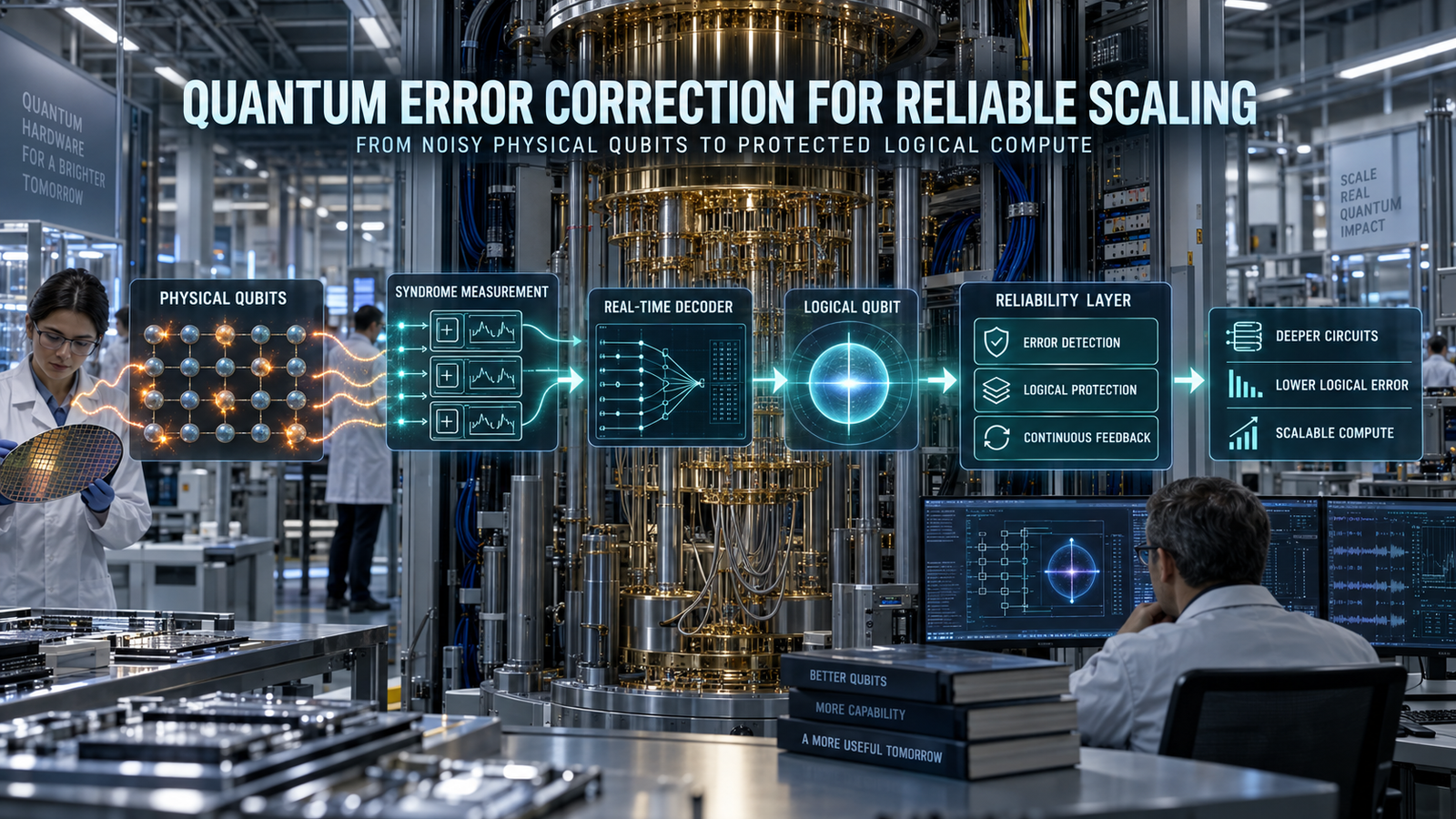
Quantum error correction addresses this by encoding a logical state across multiple physical components and repeatedly measuring stabilizers through ancillary qubits. The system infers an error syndrome without directly reading the protected logical information.
The decoder then estimates the most likely error chain. In many architectures, software updates a Pauli frame rather than physically applying every correction, which avoids injecting unnecessary gates.
What is Quantum Computing and Why It Matters for Business
The Quantum Error Correction Threshold Is a System Property
The threshold theorem says arbitrarily long computation is possible in principle when errors remain below a code-and-noise-dependent threshold and operations are implemented fault tolerantly. It does not promise that every processor below a quoted one-percent error rate will scale.
Threshold behavior depends on gate, measurement, reset, leakage, loss, correlation, connectivity, scheduling, and decoder assumptions. A favorable threshold derived for independent noise may fail under burst errors or spatially correlated events.
Quantum error correction creates value only when increasing code distance suppresses logical errors faster than additional correction machinery creates them. Engineers often summarize that relationship with a suppression factor, but the factor must be measured across relevant distances and workloads.
Google’s published experiment reported a suppression factor above one and a logical memory beyond break-even relative to its best physical qubit. The paper also observed rare correlated events approximately once per hour in long repetition-code runs, illustrating why average error rates are insufficient.[1]
The Cost of Delaying Quantum Error Correction Planning
An enterprise that ignores quantum error correction may buy access based on headline qubit counts, then discover that the workload cannot sustain the circuit depth required for a business result. The immediate loss is research time, integration cost, and credibility.
The second cost is architectural lock-in. Algorithms, compilers, pulse assumptions, and error-mitigation workflows built around one noisy platform may not transfer cleanly to a future logical qubit architecture.
The third cost is portfolio distortion. Executives may fund speculative production claims while underfunding classical baselines, post-quantum cryptography migration, data preparation, and staff development.
Quantum computing scalability should therefore be governed as an option portfolio. Near-term experiments should produce reusable capability even if hardware timelines move.
II. Deep-Dive Technical Analysis and Evidence
Quantum Error Correction Architecture Overview
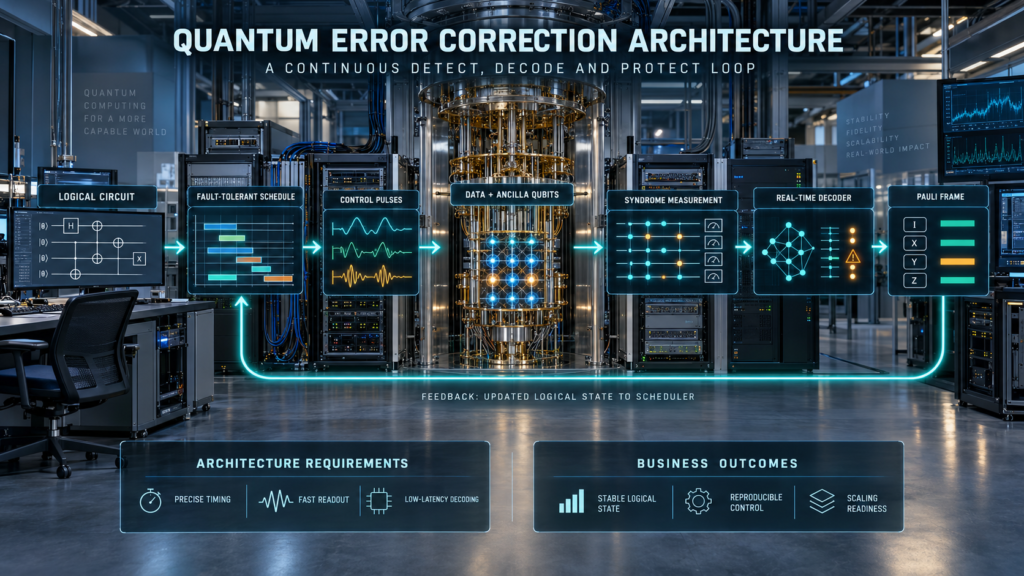
Quantum error correction is not a code library placed after the quantum program. It is a closed cyber-physical loop spanning the qubit device, analog controls, readout chain, classical processing, decoder, scheduler, compiler, and logical instruction layer.
The core production path contains these components:
- Physical data qubits: hold the encoded state across a code block.
- Ancilla or check qubits: couple to data qubits and expose parity information.
- Control hardware: emits timed microwave, laser, voltage, or photonic operations.
- Readout and discrimination: converts analog measurements into classical syndromes.
- Syndrome stream: records changes across both space and repeated correction cycles.
- Decoder: maps syndrome history to a likely error or frame update.
- Logical scheduler: coordinates correction cycles with logical gates and state preparation.
- Telemetry plane: tracks calibration, leakage, decoder confidence, timing, and logical failures.
Every stage contributes latency and error. A fast decoder cannot compensate for corrupted readout, and high-fidelity gates cannot rescue a control stack that misses correction deadlines.
Integration Flowchart
- Compile the logical circuit into a fault-tolerant schedule.
- Apply the scheduled physical control operations to data and ancillary qubits.
- Repeatedly measure error-checking relationships to generate syndrome data.
- Decode the syndrome history using the classical processing system.
- Update the Pauli frame and supply required feedback to subsequent operations.
- Record timing, leakage, error patterns and calibration telemetry.
- Review and validate calibration changes before applying them to later runs.
- Repeat the correction cycle throughout the protected computation.
This is a feedback system, not a linear batch process. Quantum error correction must maintain deterministic timing while the quantum workload and classical decoder exchange information continuously.
Why the no-cloning constraint changes redundancy
Classical systems can copy a bit and vote across replicas. An unknown quantum state cannot be copied perfectly, and direct measurement generally destroys the superposition the computation needs.
Quantum error correction spreads logical information into entangled correlations. Stabilizer measurements reveal whether specified parity relationships changed without revealing the logical amplitudes themselves.
Bit flips, phase flips, and combinations can be expressed through Pauli operators for code analysis. Real hardware also experiences leakage, erasure, photon loss, dephasing, amplitude damping, measurement bias, and correlated faults.
A code must fit the dominant noise, device connectivity, available measurements, and control cadence. Selecting a code because it is popular can create unnecessary physical-qubit and decoder overhead.
Surface codes: practical locality with expensive overhead
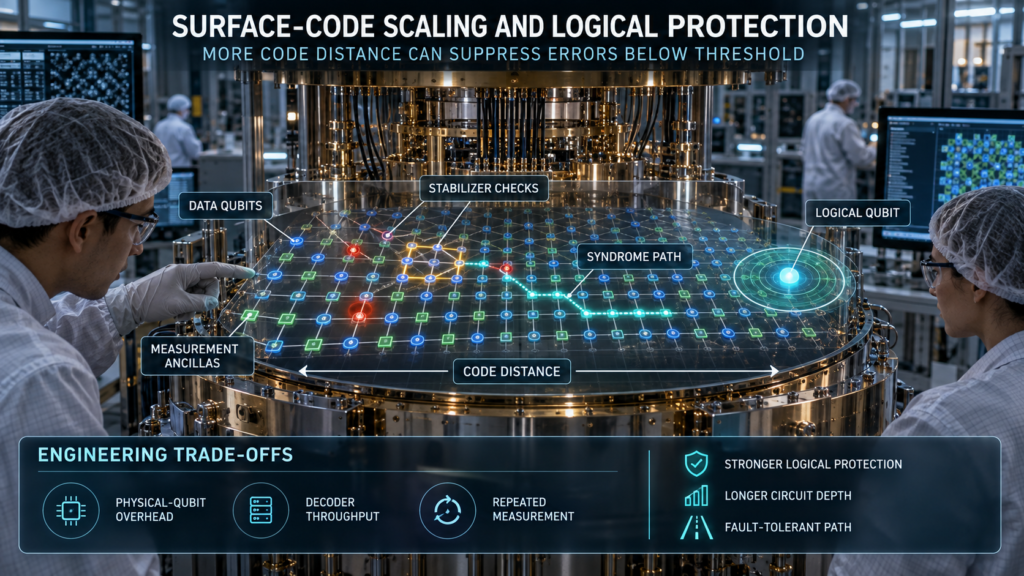
Surface codes arrange checks on a two-dimensional local structure. That locality aligns well with superconducting layouts where long-range interactions are difficult or costly.
For a quantum error-correcting code, distance is the minimum weight of a nontrivial logical operator—the smallest number of physical qubits on which an undetectable logical operation acts. The number of circuit faults that can cause decoding failure also depends on the measurement schedule, decoder and noise model.
Increasing distance can suppress logical error below threshold, but it also consumes more data qubits, ancillas, routing, measurements, and classical decoding.
Quantum error correction with surface codes also needs a path to universal logical operations. Clifford operations alone are insufficient, so architectures commonly plan for magic-state preparation and distillation, which can dominate resources for algorithms rich in non-Clifford gates.
The correct capacity plan counts logical qubits, code cycles, logical gate error, magic-state throughput, factory footprint, and decoder compute. Counting only data qubits materially understates cost.
Quantum LDPC codes: better encoding rate, harder connectivity
Quantum low-density parity-check codes can encode more logical information per physical qubit than conventional surface-code layouts. Recent code families have improved the theoretical trade-off among rate, distance, and check weight.
The engineering challenge is implementing their nonlocal checks. Hardware may need long-range couplers, shuttling, photonic links, modular interconnects, additional routing, or compiled interactions that increase depth.
IBM’s public roadmap emphasizes qLDPC-based fault tolerance and targets its Starling system for 2029 with 200 logical qubits and 100 million quantum operations.[3] These are roadmap targets, not delivered benchmark results, and procurement documents should label them accordingly.
Quantum error correction evaluations should compare the physical connectivity actually required by the code against the hardware graph. An attractive asymptotic rate can lose its advantage when routing faults and schedule congestion are included.
Bosonic, cat, and erasure-aware approaches
Bosonic codes encode information in oscillator modes rather than only across two-level qubits. Gottesman–Kitaev–Preskill, cat, and binomial codes seek hardware-efficient protection against particular noise channels.
Bias-preserving or erasure-aware hardware can expose information about the type or location of a fault. A decoder can use that structure to reduce overhead compared with treating every error as equally unknown.
These approaches shift complexity rather than eliminate it. State preparation, oscillator control, loss detection, nonlinear elements, leakage handling, and concatenation with an outer code remain demanding.
Quantum error correction architecture must therefore be evaluated end to end. A lower physical-qubit ratio has little commercial meaning if control hardware, calibration, or logical-gate performance is not included.
Quantum Error Correction Decoding Is a Real-Time Problem
The decoder receives a three-dimensional history: two spatial dimensions plus repeated rounds in time for a surface code. It must identify likely error chains quickly enough that the control system can schedule subsequent operations.
Minimum-weight perfect matching is well established for surface-code decoding. Union-find, belief propagation, tensor-network, neural, and hybrid decoders trade accuracy, speed, memory, hardware suitability, and robustness to changing noise.
Quantum error correction software may run on CPUs, GPUs, FPGAs, ASICs, or cryogenic-adjacent electronics. The correct platform depends on syndrome rate, code distance, acceptable backlog, power envelope, and physical distance from the quantum processor.
Average latency can conceal a dangerous tail. A production design needs P95, P99, and worst-case bounds, queue behavior under bursts, and a safe action when confidence or timing limits are breached.
Control-plane and data-plane separation
The quantum data plane performs gates, stabilizer measurements, resets, and readout. The classical control plane schedules pulses, discriminates signals, decodes syndromes, maintains frames, and records telemetry.
Configuration changes must be versioned across both planes. A decoder trained or tuned against one calibration state can become miscalibrated after gate, frequency, or readout changes.
Quantum error correction deployments need atomic release bundles covering firmware, pulse definitions, discrimination models, decoder weights, code layout, and compiler mapping. Partial rollback can produce an internally inconsistent machine.
III. Performance Evaluation Matrix and Mathematical Validation
Quantum Error Correction Metrics That Expose Scaling Reality
Physical gate fidelity is necessary but not sufficient for quantum error correction. Buyers need logical metrics collected under repeated correction and workload-relevant operations.
| Evaluation dimension | Metric | What it proves | What it does not prove |
| Physical operations | One- and two-qubit error rates | Component-level control quality | Logical fault tolerance |
| Memory protection | Logical error per cycle | Stability of an encoded idle state | Universal logical computation |
| Scaling behavior | Suppression factor across code distances | Whether larger codes reduce logical error | Economic viability at large scale |
| Break-even | Logical lifetime versus best physical lifetime | Net benefit from encoding | Useful algorithm execution |
| Decoder | Mean, P99, throughput, backlog | Real-time classical feasibility | Accuracy under unseen correlated noise |
| Leakage | Leakage rate and removal effectiveness | Control of non-computational states | Full correlated-fault resilience |
| Logical gates | Error per logical gate | Protected operation quality | Sufficient algorithmic depth by itself |
| Resources | Physical qubits per logical qubit | Hardware overhead | Magic-state and routing overhead |
| Availability | Calibration and productive runtime | Operational usability | Correctness of results |
| Cost | Cost per validated logical operation | Commercial efficiency | Business value without an application baseline |
For a simplified phenomenological model below threshold, logical error is often approximated as:
pL ≈ A × (p / pth)^((d+1)/2)
Here, pL is logical error, p is physical error, pth is the threshold, d is code distance, and A depends on the code, circuit, decoder, and noise assumptions. It is a planning approximation, not a substitute for measured circuit-level data.
Quantum error correction capacity can then be framed against a target workload. If an algorithm requires G logical fault locations and the acceptable total failure probability is ε, a rough budget requires average logical error materially below ε/G, with margin for correlated faults and nonuniform operations.
Evidence from below-threshold memory
Google Quantum AI’s peer-reviewed Nature result used distance-5 and distance-7 surface-code memories. The distance-7 experiment used 101 physical qubits and reported 0.143% ± 0.003% logical error per cycle.[1]
The reported suppression factor was 2.14 ± 0.02 when distance increased by two, and the logical memory exceeded the best physical qubit’s lifetime by 2.4 ± 0.3. Real-time decoding at distance 5 averaged 63 microseconds while correction cycles ran at 1.1 microseconds, with frame processing handled asynchronously.[1]
This is strong evidence for quantum error correction below threshold in a memory experiment. It is not evidence that a long industrial algorithm, universal logical gate set, or economically useful workload has been achieved.
Foundational Research on Quantum Error Correction
The surface-code engineering baseline is well represented by Fowler, Mariantoni, Martinis, and Cleland’s review in Physical Review A.[4] Dennis, Kitaev, Landahl, and Preskill established foundational topological-memory and threshold analysis.[5]
Gottesman’s stabilizer formalism provides the mathematical framework behind many codes.[6] The 2023 Reviews of Modern Physics survey on quantum error mitigation clarifies why mitigation and correction should not be treated as equivalent.[7]
Quantum error mitigation estimates cleaner expectation values through techniques such as zero-noise extrapolation or probabilistic cancellation. Quantum error correction actively encodes and protects logical information throughout a computation.
IV. Deployment Challenges That Determine Scale
Correlated Errors Can Defeat Quantum Error Correction
Cosmic rays, substrate events, control faults, shared electronics, crosstalk, and heating can disturb multiple qubits. A decoder optimized for independent errors may confidently choose the wrong correction.
Quantum error correction validation needs injected correlated-fault tests and natural long-duration runs. Short benchmark windows can miss rare events that dominate large-scale failure probability.
Leakage requires explicit detection and removal
Many physical qubits have levels outside the intended computational pair. Leakage can persist across cycles, contaminate neighboring operations, and violate the decoder’s assumed error model.
Leakage-reduction units, reset strategies, teleportation, or hardware-aware schedules consume time and introduce their own faults. The overhead belongs in logical performance and cost calculations.
Calibration does not scale linearly
A larger processor adds more frequencies, couplers, drive lines, readout channels, and interaction contexts. Pairwise calibration is not enough when simultaneous operations create higher-order interference.
Quantum error correction depends on automated calibration, drift detection, safe parameter rollout, and rapid recovery. Productive runtime can be much lower than laboratory uptime if recalibration dominates access windows.
Decoder drift can follow hardware drift
The optimal decoder uses knowledge of current noise. Static weights become less accurate when gate errors, measurement bias, leakage, or spatial hot spots change.
Adaptive quantum error correction software can update weights from telemetry, but ungoverned adaptation risks instability and irreproducibility. Changes should pass shadow evaluation and rollback tests before controlling live frames.
Logical gates are harder than logical memory
Preserving an idle encoded state proves only one layer. Computation also requires state initialization, measurement, lattice surgery or code deformation, logical entangling gates, and non-Clifford resources.
Magic-state distillation can require large factories and repeated verification. Workload estimates should report T-count, T-depth, logical cycle count, routing, and failure budget rather than only logical-qubit count.
Distributed and modular systems add network faults
Modular architectures can reduce monolithic fabrication and wiring pressure. They add link loss, entanglement-generation latency, synchronization, transduction, purification, and remote-operation errors.
Quantum error correction across modules needs an explicit network error model. A code optimized for local gates may perform poorly when inter-module operations are slow or probabilistic.
V. Commercial Solutions and Best Practices
Quantum Error Correction Access Options Are Not Equivalent
Public cloud services provide useful experimentation, but commercial access to large fault-tolerant systems is not generally available. Most users today access physical noisy processors, simulators, error-mitigation tools, or limited logical-qubit demonstrations.
The table compares procurement paths, not proven production-grade fault-tolerant computers. Public pricing and device availability change, so buyers must verify current terms before committing spend.[8][9][10][11]
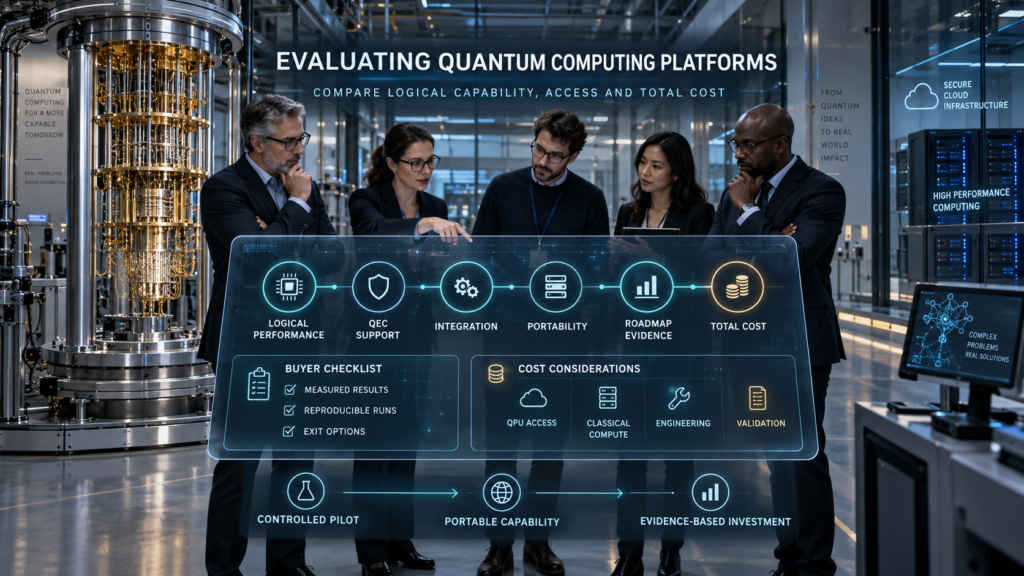
Feature and Cost Comparison Table
| Access path | QEC-relevant position | Commercial access | Pricing visibility | Main cost drivers | Best-fit buyer |
| IBM Quantum | Public qLDPC roadmap, Qiskit tooling, cloud processors | Plans and enterprise arrangements; fault-tolerant roadmap is future-facing | Plan details and contract pricing vary | Reserved capacity, runtime, support, integration, research labor | Teams testing IBM software and roadmap alignment |
| Microsoft Azure Quantum | Brokered access to multiple hardware providers plus resource estimation | Cloud service; hardware availability depends on provider and region | Provider-specific pricing displayed through Azure terms | Provider QPU time, classical cloud, support, development | Enterprises wanting multi-provider orchestration |
| Amazon Braket | Managed access to several quantum hardware modalities and simulators | Pay-as-you-go cloud access for listed devices | Public per-task and per-shot pricing for available devices | Task fee, shots, simulator compute, data, engineering | Teams comparing hardware through one cloud control plane |
| Google Quantum AI | Leading published surface-code research; selected research access | No broad public commercial Willow service verified | No public general-access price | Partnership, research integration, specialist labor | Research partners focused on surface-code evidence |
No row earns a universal winner. Quantum error correction maturity, workload fit, data location, intellectual-property terms, support, queue time, and exit portability must be evaluated together.
Procurement questions that prevent expensive demos
Ask the provider to distinguish physical qubits, logical qubits, logical memories, logical gates, and error-mitigated outputs. These terms are often collapsed in commercial presentations.
Require measured logical error by operation, code distance, correction-cycle count, decoder mode, noise conditions, and confidence interval. A single “fidelity” number is not enough.
Request a resource estimate that includes data blocks, ancillas, routing, factories, decoding, calibration, and retry probability. The estimate should show how assumptions change total physical qubits and runtime.
Quantum error correction software should export code, circuit, results, metadata, and calibration context in usable formats. Proprietary abstractions without reproducibility create lock-in.
A four-stage enterprise deployment framework
Stage 1 — Classical baseline:
Define the business problem, best classical method, accuracy target, runtime, energy, and total cost. A quantum pilot without this baseline cannot demonstrate advantage.
Stage 2 — Logical resource model:
Estimate logical qubits, logical gates, T-count, T-depth, target failure probability, and code-cycle requirements. Run sensitivity analysis across physical error rates and code choices.
Stage 3 — Hardware experiment:
Test small kernels on accessible processors, separate mitigation from correction, record calibration context, and compare repeated runs. Do not extrapolate a short circuit directly to production scale.
Stage 4 — Option review:
Update the roadmap when measured logical performance changes. Continue, pause, switch provider, or exit based on evidence rather than sunk cost.
Build-versus-buy reality
Few enterprises should build quantum hardware or a complete correction stack. Cryogenics, fabrication, control electronics, precision measurement, and specialized talent create a capital profile closer to advanced scientific infrastructure than conventional enterprise software.
Building internal capability can still make sense at the algorithm, compiler, resource-estimation, decoder-research, or hybrid-workflow layer. The boundary should match durable intellectual property and recruiting capacity.
Quantum error correction partnerships need measurable deliverables: logical metrics, reproducible experiments, access commitments, data rights, publication rights, milestones, and termination conditions. Roadmap slides are not acceptance criteria.
VI. Business Outcomes and Strategic ROI Takeaways
QEC creates option value before direct revenue
For most enterprises, quantum error correction does not yet produce a deployable application return. It creates option value by improving technical literacy, algorithm readiness, supplier intelligence, and the ability to recognize credible scaling evidence.
That value must still be budgeted. Research programs should define learning assets, decision gates, reusable code, staff capability, patents, partnerships, and classical improvements produced along the way.
Model total cost at the logical-operation level
The useful commercial denominator is not cost per physical shot. It is cost per validated workload result at the required confidence.
Use this planning equation:
Total validated-result cost = QPU access + classical decoding + cloud/HPC + retries + integration + specialist labor + validation + governance + data preparation.
Quantum error correction can reduce retries by lowering logical failure, while increasing qubit, control, decoder, and infrastructure cost. The optimum is workload- and hardware-specific.
Scenario-based ROI instead of a single forecast
The downside case should assume roadmaps slip, logical gates remain expensive, and classical algorithms improve. The program must still yield useful skills, intellectual property, or supplier leverage.
The base case should use published logical metrics and conservative resource estimates. It should not treat vendor target dates as delivered capability.
The upside case may model an economically useful fault-tolerant service, but must state the physical error, code rate, logical gate quality, queue, pricing, and availability assumptions required. Discount that scenario for technical and schedule risk.
Executive decision dashboard
| Business question | Evidence required | Stop condition |
| Does the use case need quantum computation? | Classical benchmark and complexity rationale | Classical method meets target economics |
| Can the circuit be protected? | Logical resource estimate and failure budget | Overhead exceeds plausible roadmap capacity |
| Is the provider progressing? | Repeated peer-reviewed logical metrics | Claims rely only on physical-qubit growth |
| Is the pilot portable? | Open circuit, data, metadata, and result export | Critical assets remain vendor-locked |
| Is spend controlled? | Stage gates and total-cost model | Milestones missed without new evidence |
| Is risk acceptable? | Security, export, IP, safety, and governance review | Unresolved legal or control gaps |
Quantum computing scalability should be reviewed quarterly as an R&D portfolio, not operated as an ordinary SaaS rollout. Funding should increase only when technical evidence reduces uncertainty.
VII. Risk Mitigation and Regulatory Framework
Quantum error correction has no single dedicated global regulation. The applicable controls arise from cybersecurity, cloud governance, export restrictions, research ethics, intellectual property, sector obligations, and any AI used inside the classical decoder or operations workflow.
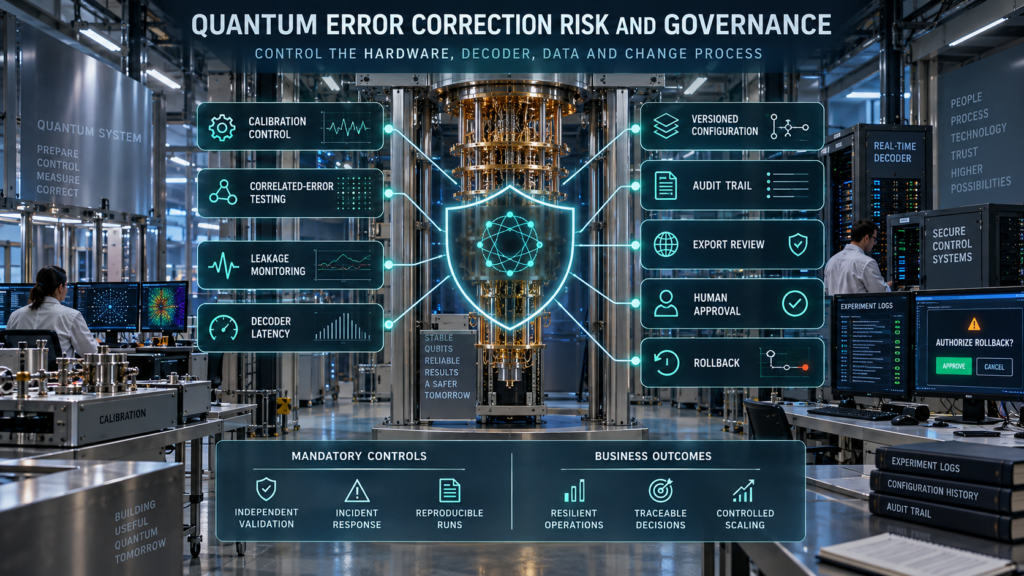
Technical and governance checklist
- Define the logical workload, acceptable failure probability, and classical baseline before procurement.
- Separate peer-reviewed measurements, internal test results, and vendor roadmap targets in every approval paper.
- Version the code layout, compiler, pulses, calibration, discriminator, decoder, firmware, and control policy as one release bundle.
- Measure logical memory and logical gates across code distance, time, and device regions with confidence intervals.
- Test correlated faults, leakage, decoder backlog, stale calibration, control loss, and partial rollback.
- Track mean, P95, P99, and worst-case decoder latency under realistic syndrome bursts.
- Require reproducible run metadata, immutable logs, access control, encryption, secrets management, and supply-chain review.
- Map connected classical infrastructure to NIST CSF 2.0 or the organization’s approved security framework.[13]
- Review the selected hardware, software, technical data, destination, end user, and collaboration under applicable export-control rules.[12]
- Protect unpublished results, device parameters, source code, patents, and partner information through explicit IP terms.
- Establish vendor exit rights and export formats for circuits, results, telemetry, and experiment metadata.
- Validate energy, cryogenic, facility, and electronic-waste claims before using them in sustainability reporting.
- Apply the EU AI Act only where an AI system falls within its scope; quantum error correction itself is not automatically an AI system.[14]
- If machine learning controls decoding or calibration, document training data, drift, robustness, human authority, and fallback behavior.
- Maintain independent review, incident response, emergency shutdown, and post-incident reconstruction procedures.
The EU AI Act should not be inserted as a decorative compliance claim. A deterministic matching decoder and a learned neural decoder may require different legal analysis, and the final classification depends on the system’s function and use.
Quantum error correction research can also be dual-use. International collaboration, remote access, technical-data sharing, and hardware transfer should receive counsel from professionals familiar with the relevant jurisdictions.
Assessing Readiness for Logical Quantum Computing
Before purchasing more quantum access, convert the target use case into logical qubits, logical gates, T-count, correction cycles, failure probability, decoder demand, and total validated-result cost. Compare that requirement with measured platform capability, not the largest physical-qubit headline.
A disciplined assessment gives management a defensible choice: fund the next experiment, wait for a specific logical milestone, switch architecture, or invest the budget in stronger classical computing and post-quantum readiness.
VIII. Appendix and Research Integrity
Sources and Citations Index
- Google Quantum AI and Collaborators, Quantum error correction below the surface code threshold, Nature 638, 920–926 (2025).
- Google Research, Making quantum error correction work, 9 December 2024.
- IBM, IBM lays out clear path to fault-tolerant quantum computing, 10 June 2025.
- A. G. Fowler et al., Surface codes: Towards practical large-scale quantum computation, Physical Review A 86, 032324 (2012).
- E. Dennis et al., Topological quantum memory, Journal of Mathematical Physics 43, 4452 (2002).
- D. Gottesman, Stabilizer Codes and Quantum Error Correction, PhD thesis, Caltech (1997).
- Z. Cai et al., Quantum error mitigation, Reviews of Modern Physics 95, 045005 (2023).
- IBM Quantum, Plans and access, official commercial page.
- Microsoft Azure, Azure Quantum pricing, official commercial page.
- Amazon Web Services, Amazon Braket pricing, official commercial page.
- Google Quantum AI, Quantum computing research, official research site.
- US Bureau of Industry and Security, Commerce Control List, current export-control reference.
- NIST, Cybersecurity Framework 2.0, governance reference for connected classical infrastructure.
- European Union, Regulation (EU) 2024/1689, consolidated AI Act text.
Research limitations
Vendor roadmaps are forward-looking statements. They are included to compare direction and access models, not to certify future delivery dates or commercial performance.
Published experiments use different hardware, codes, noise, operations, and metrics. Cross-provider rankings are invalid unless a buyer defines a common task, failure criterion, confidence interval, and cost boundary.
Cybersecurity assessment should cover the actual control servers, firmware, orchestration software, cloud services and dependencies used in the selected deployment.
Corporate Editorial Transparency and AI Usage Disclosure
AI-assisted tools were used to support research organization, drafting and language refinement. NezzHub retains editorial responsibility for the published article. Vendor inclusion does not constitute endorsement.
Author and Editorial Review
Author: Garikapati Bullivenkaiah
Technology research writer with LL.B., LL.M., M.A., and MBA qualifications. He writes about emerging technologies and their business, governance and legal implications. His multidisciplinary academic background informs his analysis of technology adoption, intellectual property, and organizational risk. His articles explain technical concepts and practical considerations for business owners, IT managers and technology decision-makers. LinkedIn Profile
Reviewed by: Chitikineni Ramadevi — Editor
Chitikineni Ramadevi holds an M.Sc. in Computers from Andhra University and has over 10 years of research experience in technology-related subjects. She reviews NezzHub articles for clarity, factual accuracy, source support and practical relevance.
Published by: NezzHub
Research approach: This article draws on primary sources, technical documentation and relevant industry research. References are provided within the article or its sources section.
Last reviewed: 09-17-2026
Corrections: To report a factual error or outdated information, please contact NezzHub.

Garikapati Bullivenkaiah is a seasoned entrepreneur with a rich multidisciplinary academic foundation—including LL.B., LL.M., M.A., and M.B.A. degrees—that uniquely blend legal insight, managerial acumen, and sociocultural understanding. Driven by vision and integrity, he leads his own enterprise with a strategic mindset informed by rigorous legal training and advanced business education. His strong analytical skills, honed through legal and management disciplines, empower him to navigate complex challenges, mitigate risks, and foster growth in diverse sectors. Committed to delivering value, Garikapati’s entrepreneurial journey is characterized by innovative approaches, ethical leadership, and the ability to convert cross-domain knowledge into practical, client-focused solutions.