


















Executive Summary
The central challenge is connecting activity across channels quickly enough to intervene, while distinguishing genuine threats from unfamiliar but legitimate customer behavior.
The commercial pressure is measurable. US consumers reported more than $12.5 billion in fraud losses during 2024, up 25% year over year, while the EBA and ECB recorded €4.2 billion of payment fraud in the European Economic Area for the same period.[1][2]
Those figures do not prove that every bank needs the same model. They show why fraud controls must be evaluated against loss avoided, customer friction, review capacity, latency, regulatory exposure, and full technology cost.
This Article explains the production architecture behind AI fraud detection in banking. It also identifies where projects fail: stale features, delayed labels, biased feedback, broken entity resolution, opaque vendor models, weak fallback logic, and thresholds optimized for an impressive chart rather than bank economics.
The practical conclusion is direct. A bank should buy or build banking fraud detection software only after defining its decision latency, action policy, evidence requirements, model-risk tier, and unit economics.
I. The Current Market Landscape and Challenge
AI Fraud Detection in Banking: From Transactions to Journeys
A card payment, password reset, payee addition, device enrollment, and transfer may each look ordinary. The sequence can still reveal account takeover, authorized push-payment fraud, card testing, or a mule network.
That is the central problem for AI fraud detection in banking. AI fraud detection in banking must join activity across channels quickly enough to intervene, without converting every unfamiliar customer action into a false alarm.
Legacy rules remain useful for explicit controls such as sanctions, hard velocity limits, impossible values, or known compromised identifiers. They become brittle when criminals distribute activity across accounts, devices, merchants, and time windows.
A modern stack therefore uses rules as guardrails rather than pretending rules are obsolete. Machine learning ranks ambiguous risk; deterministic policy retains control over prohibited actions, regulatory obligations, and emergency fallbacks.
The Cost of Delaying AI Fraud Detection in Banking
Direct fraud loss is only the first ledger. Banks also absorb investigation labor, chargeback handling, customer remediation, authentication expense, complaint management, and incident-response work.
The second ledger for AI fraud detection in banking is customer friction. A false decline can interrupt travel, payroll, supplier payment, or a time-sensitive purchase even when the bank ultimately restores access.
The third ledger is compliance exposure. Weak evidence retention, uncontrolled model changes, inconsistent overrides, or insufficient third-party oversight can turn an operational defect into a supervisory finding.
The fourth ledger is opportunity cost. Analysts who review low-quality alerts cannot investigate coordinated activity, and data engineers maintaining duplicated pipelines cannot improve real-time transaction monitoring.
AI fraud detection in banking should reduce the combined cost across all four ledgers. Optimizing only the fraud-loss line can produce an aggressive system that damages approval rates and customer trust.
Why “Accuracy” Misprices AI Fraud Detection in Banking
Fraud is usually a rare event. A classifier that calls every transaction legitimate may show impressive accuracy while detecting no fraud at all.
Procurement teams evaluating AI fraud detection in banking should ask for precision, recall, false-positive rate, false-decline rate, alert yield, captured value, inference latency, availability, and calibration by channel. Results must be reported on temporally separated data, not a random split that leaks future behavior into training.
AI fraud detection in banking also needs segment-level analysis. A single portfolio average can hide poor performance for new customers, small merchants, particular regions, accessibility groups, or low-volume payment types.
How to Start Learn Artificial Intelligence Step by Step
II. Deep-Dive Technical Analysis and Evidence
Architecture Overview for AI Fraud Detection in Banking

The production path for AI fraud detection in banking begins when a payment switch, digital channel, core platform, or identity service emits an event. A streaming layer validates its schema, assigns an idempotency key, and enriches it with customer, device, beneficiary, merchant, session, and historical features.
The online feature service must return point-in-time-correct values. If a model sees data that would not have existed at decision time, offline evaluation will exaggerate performance and the deployed model will disappoint.
AI fraud detection in banking commonly combines these components:
- Deterministic rules: regulatory blocks, known bad identifiers, velocity caps, and operational safeguards.
- Supervised models: patterns learned from confirmed fraud and legitimate outcomes.
- Anomaly models: departures from peer, account, device, or transaction behavior.
- Graph features: links among customers, devices, IP addresses, merchants, beneficiaries, and prior cases.
- Behavioral signals: session timing, navigation, device integrity, authentication state, and interaction consistency.
- Decision policy: thresholds and actions governed by channel, amount, customer state, and risk appetite.
- Case management: evidence, reason codes, investigator queues, dispositions, and customer contact.
- Feedback pipeline: chargebacks, confirmations, recoveries, complaints, and analyst outcomes returned as delayed labels.
The score is not the decision. A calibrated probability or ranking becomes useful only after policy maps it to an action and considers the economic cost of each error.
Integration Flowchart
- Receive a payment, login or transfer event.
- Validate the event and retrieve authorized, current contextual information.
- Evaluate rules, machine-learning scores, graph relationships and behavioral signals.
- Apply the bank’s approved decision policy.
- Approve, request additional authentication, hold or decline according to the event type and policy.
- Route appropriate cases to investigators with supporting evidence.
- Record decisions and collect confirmed outcomes as labels mature.
- Monitor performance and validate model changes before approving their deployment.
This flow separates detection from treatment. AI fraud detection in banking can rank two events similarly while policy treats them differently because one is reversible, one is a high-value wire, and one occurs during an incident.
Online Decisions and Offline Model Development
The online plane serves decisions under a strict latency and availability budget. It needs cached or incrementally updated features, bounded network calls, timeouts, and a documented response when a dependency fails.
The offline plane for AI fraud detection in banking creates training sets, reconstructs historical features, validates labels, runs backtests, and registers approved model artifacts. It can perform heavier graph calculations that would be too slow on the authorization path.
Feature parity is the engineering hinge. Training code and serving code must calculate the same feature from the same definition, timestamp convention, entity key, and missing-value policy.
AI fraud detection in banking often fails quietly when an offline feature counts events through the end of a day while the online version counts only events received before the transaction. That is target leakage disguised as model lift.
Rules, Machine Learning and Graph-Based Risk Scores
Supervised gradient-boosted trees remain practical for structured transaction data because they handle nonlinear interactions, missing values, and mixed feature scales. Neural models can add value for sequences, text, images, or large graphs, but introduce greater compute, validation, and explainability cost.
Unsupervised detection in AI fraud detection in banking is useful when a fraud pattern lacks labels. It also raises false positives because “unusual” is not synonymous with “malicious.”
Graph methods can expose shared infrastructure and mule networks. Their value depends on entity resolution: a recycled IP address, household device, corporate gateway, or public Wi-Fi node can create misleading links.
Fraud detection machine learning therefore works best as a portfolio. Independent scores and rules feed a policy layer, while reason codes preserve operational interpretability.
Decision Latency and Fallback Behavior
“Real time” is not a universal number. A card authorization, mobile login, instant payment, ACH file, and post-event AML review have different service-level objectives.
The bank should allocate an AI fraud detection in banking latency budget across ingestion, feature retrieval, model inference, graph lookup, policy evaluation, and response serialization. P95 and P99 latency matter more than a favorable average.
AI fraud detection in banking must degrade predictably. If the feature store is unavailable, the approved fallback may use cached features and conservative rules; silently approving without scoring is rarely defensible.
Operational controls should include circuit breakers, request deadlines, bulkheads, idempotent retries, schema compatibility checks, and replay-safe event handling. A duplicated decline or duplicate case can be as damaging as a missed score.
Feature Definitions and Data Lineage
Every AI fraud detection in banking feature needs an owner, definition, source, timestamp semantics, quality thresholds, retention period, and permitted use. “Customer velocity” is not a sufficient specification.
A defensible definition might be successful outbound transfers by customer ID in the preceding ten rolling minutes, excluding reversals, measured at event time. That precision makes testing and investigation possible.
AI fraud detection in banking also needs lineage from raw event through transformation, model version, score, policy version, action, and final outcome. Without lineage, validation cannot reproduce a disputed decision.

AI Fraud Detection in Banking Performance Evaluation Matrix
| Metric | Calculation or test | Operational meaning | Common misuse |
| Precision | TP ÷ (TP + FP) | Share of flagged events confirmed as fraud | Ignoring missed fraud |
| Recall | TP ÷ (TP + FN) | Share of known fraud detected | Ignoring customer friction |
| False-positive rate | FP ÷ (FP + TN) | Legitimate population incorrectly flagged | Reporting it without transaction value |
| F1 score | 2 × precision × recall ÷ (precision + recall) | Balance of precision and recall | Treating error costs as equal |
| PR-AUC | Area under precision–recall curve | Ranking quality under class imbalance | Comparing unlike prevalence periods |
| Captured value | Incremental net fraud loss avoided or recovered against a defined baseline, without double-counting recoveries | Financial impact of treatment | Counting attempted value as saved value |
| Alert yield | Reviewed alerts confirmed as fraud ÷ all reviewed alerts in the defined cohort; report unresolved outcomes separately | Investigator productivity | Excluding unresolved cases |
| P99 decision latency | 99th percentile end-to-end time | Tail experience under load | Quoting model inference alone |
| Calibration | Predicted probability versus observed outcome | Whether scores support threshold economics | Checking only aggregate buckets |
| Stability | Performance by time and segment | Drift and distribution change | Hiding weak segments in a portfolio average |
Precision–recall analysis is generally more informative than raw accuracy for rare fraud classes. Research on realistic credit-card fraud evaluation also emphasizes temporal validation, delayed labels, class imbalance, and cost-sensitive learning.[3][4]
The AI fraud detection in banking matrix should be populated from the bank’s shadow or pilot results. Vendor benchmark percentages are not transferable when fraud mix, labels, channels, review policy, and customer behavior differ.
AI Fraud Detection in Banking Decision Economics
The preferred threshold minimizes expected cost, not classification error. A simple decision model is:
Expected annual cost = missed-fraud loss + false-positive friction + review expense + authentication expense + platform and operations cost.
Each term needs local data. The average recoverable card loss, irreversible transfer loss, customer abandonment rate, analyst cost, and step-up completion rate can differ substantially.
AI fraud detection in banking may justify different thresholds by payment rail or value band. A reversible low-value purchase and an irrevocable first-time beneficiary transfer should not share one action curve.
III. Deployment Challenges That Decide Production Value
Delayed Fraud Labels
Labels for AI fraud detection in banking arrive through chargebacks, customer confirmations, investigator decisions, recoveries, and external intelligence. These sources mature on different schedules and can contradict one another.
Training only on early labels biases the model toward fraud discovered quickly. Treating every unreported event as legitimate creates additional noise.
AI fraud detection in banking needs a label policy that records source, confidence, maturity date, dispute state, and reversals. Retraining windows should exclude outcomes that have not matured sufficiently.
Selective Labels and Investigation Bias
The bank observes outcomes for approved transactions more readily than for declined ones. A declined transaction cannot reveal whether it would have become fraud, producing a selective-label problem.
Similarly, investigators review what the current system prioritizes. Their labels can reinforce the current model’s blind spots rather than represent the full event population.
Controlled exploration, counterfactual evaluation, randomized review samples, and shadow models can reduce this bias. They must be bounded by customer protection and risk policy.
Changing Customer Behavior and Fraud Tactics
Customer behavior changes during holidays, product launches, migrations, outages, and economic shocks. Fraudsters also probe limits and adapt to visible friction.
AI fraud detection in banking needs drift monitoring at input, score, action, and outcome levels. A stable feature distribution does not guarantee stable fraud tactics, and an alert spike may reflect a pipeline defect rather than an attack.
Champion–challenger testing should compare models on the same matured observation window. Automatic promotion based solely on a short online lift invites governance and safety failures.
Identity Resolution for AI Fraud Detection in Banking
Entity resolution links a person, account, card, device, phone, IP address, merchant, beneficiary, and case. Weak linking misses organized activity; aggressive linking creates guilt by association.
Graph features should carry link type, source, confidence, age, and direction. Shared devices, carrier-grade NAT, corporate networks, and recycled phone numbers require explicit handling.
Explainable AI Fraud Detection in Banking
A technically valid score can still fail if the case queue offers no actionable evidence. Analysts need reason codes, contributing events, link context, timeline, confidence, and the policy that selected the action.
Explanation methods must be tested for stability and faithfulness. A plausible narrative generated after the fact is not proof of why a model reached its score.
If generative AI summarizes a case, the bank should ground the output in retrieved evidence, restrict tool access, log prompts and sources, and prohibit the summary from becoming the sole basis for an adverse action. Prompt injection and hallucination are separate risks from the underlying fraud model.
Privacy Controls for AI Fraud Detection in Banking
Behavioral biometrics, device intelligence, location, and network links can improve detection. They also increase privacy, consent, retention, and cross-border transfer obligations.
AI fraud detection in banking should use purpose limitation, role-based access, field-level protection, retention schedules, and documented lawful bases. Collecting every available signal “just in case” creates cost and risk without guaranteeing lift.
IV. Commercial Solutions and Best Practices
Buy or Build AI Fraud Detection in Banking
A packaged platform can shorten deployment by providing connectors, case management, model tooling, decision orchestration, and vendor-maintained threat intelligence. It may also create opaque pricing, feature constraints, data-egress charges, or switching friction.
A custom platform offers control over data, models, latency, and workflow. It demands continuous investment in feature infrastructure, model operations, investigation tooling, security, validation, and 24-hour support.
Many banks choose a hybrid design. A commercial decision platform manages orchestration and cases while bank-owned features, rules, or models preserve differentiated intelligence.

Feature and Cost Comparison Table
Public list prices were not available on the vendors’ official product pages reviewed for this article. “Quote-based” therefore means buyers should request a written total-cost model rather than infer affordability from a demo.[5][6][7][8]
| Solution | Notable positioning | Deployment questions | Pricing visibility | Major cost drivers |
| FICO Falcon Fraud Manager | Payment fraud analytics and decisioning with consortium intelligence | Confirm supported rails, score explainability, hosting model, and data residency | Quote-based | Transaction volume, modules, integrations, services, environments |
| Feedzai | Risk operations platform spanning transaction monitoring and fraud workflows | Test feature latency, rule portability, graph capability, and investigator workflow | Quote-based | Events scored, products, data connectors, compute, professional services |
| SAS Fraud Management | Enterprise analytics, alerting, network analysis, and case workflows | Validate infrastructure footprint, model lifecycle, skills needed, and upgrade effort | Quote-based | Software scope, hosting, compute, implementation, administration |
| Featurespace ARIC Risk Hub | Behavioral analytics and real-time risk decisioning | Assess cold-start behavior, policy control, reason codes, and integration patterns | Quote-based | Volume, use cases, integration, managed service, support |
This comparison is not a ranking or affiliate endorsement. Product scope and commercial terms change, so a procurement decision requires current documentation, architecture workshops, security review, reference calls, and a bank-controlled proof of value.
A defensible procurement scorecard
Evaluate banking fraud detection software against production requirements rather than slideware. Weight categories before demonstrations so a vendor cannot steer the scorecard toward its strongest feature.
- Detection value: temporal backtest, shadow results, captured value, calibration, and segment stability.
- Decision performance: P95/P99 latency, throughput, regional availability, and failure behavior.
- Data architecture: connectors, point-in-time features, lineage, residency, deletion, and export capability.
- Operations: reason codes, queue design, workflow controls, search, audit history, and customer contact.
- Model governance: validation access, documentation, versioning, approvals, monitoring, and rollback.
- Security: encryption, key control, privileged access, tenant isolation, incident response, and testing evidence.
- Commercials: implementation, minimum commitments, overages, sandboxes, storage, compute, support, and exit costs.
Require the vendor to identify subcontractors and third-party data. AI fraud detection in banking inherits dependency risk from device-intelligence providers, cloud services, consortium feeds, and telecommunications signals.
Proof-of-value design
A credible pilot uses representative data, matured outcomes, a frozen baseline, and agreed cost weights. It runs long enough to include pay cycles, weekends, promotions, operational incidents, and normal seasonal variation.
The candidate should operate in shadow mode before actions affect customers. Investigators then review a controlled sample from both incumbent and candidate systems, including low-score events to detect blind spots.
Success criteria should cover fraud value, false declines, alert workload, latency, availability, and explanation quality. A platform that catches more fraud by doubling customer challenges has not necessarily improved financial crime prevention.
Phased deployment framework
Phase 1 — Instrument: standardize event schemas, timestamps, identifiers, outcome labels, and current decision telemetry. Baseline loss, approval, challenge, false-positive, and review metrics.
Phase 2 — Shadow: score events without changing treatment. Compare AI fraud detection in banking with the incumbent under identical traffic and matured labels.
Phase 3 — Assist: provide scores and explanations to investigators while humans retain action authority. Measure queue behavior and override patterns.
Phase 4 — Constrain: automate low-risk approvals and tightly bounded high-confidence actions. Route uncertainty to step-up authentication or review.
Phase 5 — Scale: expand channels only after validation, resilience testing, customer-support readiness, and governance approval. Maintain rollback and kill-switch procedures.
V. Business Outcomes and Strategic ROI Takeaways
Build the business case from observable cash flows
Do not start with a vendor’s percentage reduction claim. Start with the bank’s fraud ledger, review workload, authentication expense, customer remediation, and technology baseline.
Use this formula:
Annual net benefit = prevented and recovered net fraud + reduced review cost + avoided operational cost − false-decline margin loss − added authentication friction − platform, data, compute, integration, validation, and support cost.
Use the same assessment period and baseline for every benefit and cost. Count prevented losses and recoveries once, and ensure review savings do not overlap with other operational savings. Measure financial benefit from the bank’s perspective, distinguishing losses borne by the bank from losses borne by customers or other parties.
“Prevented fraud” must exclude attempts that would have failed for another reason and amounts likely to be recovered. Use incremental lift against the incumbent, not the gross value of every blocked event.
AI fraud detection in banking can improve analyst productivity when alert yield rises and evidence is clearer. Savings materialize only if staffing, outsourced review, overtime, or avoided future hiring changes; a theoretical minute saved is not automatically cash.
Three ROI scenarios, not one forecast
The downside case should assume lower fraud lift, higher false declines, longer integration, and greater review demand. It tests whether the project survives plausible disappointment.
The base case should use pilot evidence and current internal costs. The upside case may include network effects, better labels, and workflow automation, but should remain separate from the approved budget.
Each case needs a sensitivity analysis for fraud prevalence, loss severity, approval-rate impact, chargeback recovery, analyst cost, transaction growth, and vendor overages. These variables often dominate small changes in model AUC.
Strategic outcomes worth tracking
AI fraud detection in banking should produce a measurable decision record across prevention, customer experience, operations, and control quality. The executive dashboard should avoid collapsing these dimensions into one composite score.
| Outcome | Board-level measure | Operational diagnostic |
| Loss control | Net fraud loss per transaction value | Recall and captured value by fraud type |
| Customer experience | Approval and challenge completion rates | False declines by segment and channel |
| Operations | Cost per resolved case | Alert yield, queue age, handling time |
| Resilience | Decision-service availability | P99 latency, fallback rate, replay errors |
| Governance | Material issues and validation status | Drift, overrides, exceptions, overdue actions |
No universal benchmark can replace local baselines. The credible outcome is an audited improvement over a defined incumbent during a comparable period.
VI. Risk Mitigation and Regulatory Framework
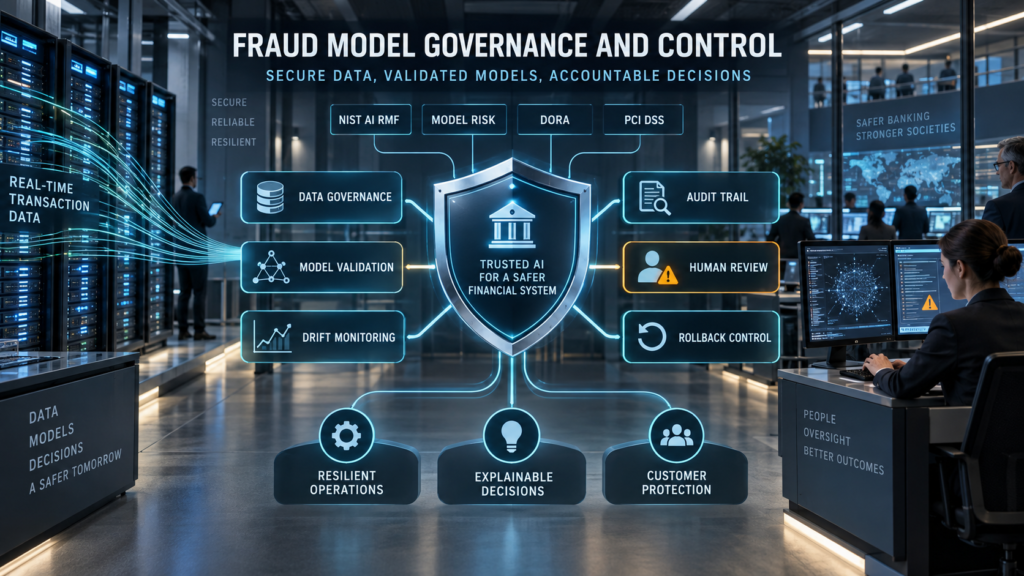
AI fraud detection in banking is a control system with financial and customer consequences. Governance must cover the data, model, decision policy, human workflow, vendor dependencies, and customer remedy—not only the model artifact.
Compliance and control checklist
- Classify every use case by jurisdiction, decision impact, customer population, and model-risk tier.
- Document purpose, lawful basis, data provenance, minimization, retention, residency, and deletion controls.
- Map AI governance to the NIST AI RMF and cybersecurity controls to the NIST CSF.[9][10]
- Apply the 2026 US interagency model-risk guidance to relevant models and banking organizations within its scope. The guidance excludes generative AI and agentic AI models; govern any such components separately under applicable requirements and the bank’s approved controls.[11]
- Assess the EU AI Act by use case; fraud detection is not automatically high-risk, while a connected use such as creditworthiness assessment may fall within Annex III.[12]
- Apply DORA obligations to in-scope EU financial entities, including ICT risk, incident handling, resilience testing, and third-party risk.[13]
- Protect payment-account data under applicable PCI DSS scope and controls.[14]
- Test disparate impact, accessibility, false declines, and complaint outcomes across relevant customer segments.
- Require independent validation before production and after material data, model, policy, or vendor changes.
- Maintain model cards, data dictionaries, feature lineage, versioned thresholds, approvals, and reproducible decisions.
- Monitor data quality, drift, calibration, fraud capture, false positives, overrides, latency, availability, and fallback use.
- Red-team evasion, data poisoning, model extraction, privilege abuse, dependency failure, and case-management manipulation.
- Keep bounded human review for uncertainty and high-impact cases, with documented override authority and customer remedy.
- Maintain tested rollback, kill switch, disaster recovery, vendor exit, and manual operating procedures.
Regulatory classification is use-specific. A fraud score used only to trigger additional authentication may create different obligations from a score that freezes funds, terminates an account, or feeds a credit decision.
The EU AI Act should therefore be mapped to the exact system and downstream purpose, not invoked as a generic badge. The same discipline applies to privacy, payments, consumer-protection, outsourcing, and model-risk rules in every jurisdiction.
AI fraud detection in banking also requires an accountable owner who can reconcile competing objectives. Fraud operations, security, data science, payments, compliance, legal, customer support, and product teams should approve the treatment strategy together.
Planning a Bank-Controlled Fraud Assessment
Before signing a platform contract, document the event flows, latency budget, feature lineage, fallback behavior, model-risk tier, action policy, pilot design, and five-year total cost. Then require each shortlisted vendor or internal team to prove value against the same frozen baseline.
The next decision should not be “Which AI demo looks smartest?” It should be “Which controlled system produces the best risk-adjusted economics, customer outcome, and audit record for this bank?”
VII. Appendix and Research Integrity
Sources and Citations Index
- US Federal Trade Commission, New FTC Data Show a Big Jump in Reported Losses to Fraud to $12.5 Billion in 2024, 10 March 2025.
- European Banking Authority and European Central Bank, Joint report on payment fraud, 15 December 2025.
- Andrea Dal Pozzolo et al., Credit Card Fraud Detection: A Realistic Modeling and a Novel Learning Strategy, IEEE Transactions on Neural Networks and Learning Systems, 2018.
- Fabrizio Carcillo et al., Combining Unsupervised and Supervised Learning in Credit Card Fraud Detection, Information Sciences, 2021 issue record.
- FICO, FICO Falcon Fraud Manager, official product page.
- Feedzai, RiskOps Platform, official corporate and product site.
- SAS, SAS Fraud Management, official product page.
- Featurespace, ARIC Risk Hub, official corporate and product site.
- National Institute of Standards and Technology, AI Risk Management Framework, official framework page.
- National Institute of Standards and Technology, Cybersecurity Framework, official framework page.
- Office of the Comptroller of the Currency, Model Risk Management: Revised Guidance, 17 April 2026.
- European Union, Regulation (EU) 2024/1689, consolidated version of 27 July 2026, Artificial Intelligence Act.
- European Union, Regulation (EU) 2022/2554, Digital Operational Resilience Act.
- PCI Security Standards Council, PCI DSS, official standard overview.
Research Evidence and Limitations
The academic references support evaluation methods and modeling constraints, not guaranteed commercial results. Dataset age, geography, payment rail, fraud prevalence, label policy, and intervention design limit external validity.
The cited vendor pages establish product positioning only. They do not independently validate performance, pricing, implementation time, or return on investment.
Corporate Editorial Transparency and AI Usage Disclosure
AI-assisted tools were used to support research organization, drafting and language refinement. NezzHub retains editorial responsibility for the published article. Vendor inclusion does not constitute endorsement.
Author and Editorial Review
Author: Garikapati Bullivenkaiah
Technology research writer with LL.B., LL.M., M.A., and MBA qualifications. He writes about emerging technologies and their business, governance and legal implications. His multidisciplinary academic background informs his analysis of technology adoption, intellectual property, and organizational risk. His articles explain technical concepts and practical considerations for business owners, IT managers and technology decision-makers. LinkedIn Profile
Reviewed by: Chitikineni Ramadevi — Editor
Chitikineni Ramadevi holds an M.Sc. in Computers from Andhra University and has over 10 years of research experience in technology-related subjects. She reviews NezzHub articles for clarity, factual accuracy, source support and practical relevance.
Published by: NezzHub
Research approach: This article draws on primary sources, technical documentation and relevant industry research. References are provided within the article or its sources section.
Last reviewed: 09-13-2026
Corrections: To report a factual error or outdated information, please contact NezzHub.

Garikapati Bullivenkaiah is a seasoned entrepreneur with a rich multidisciplinary academic foundation—including LL.B., LL.M., M.A., and M.B.A. degrees—that uniquely blend legal insight, managerial acumen, and sociocultural understanding. Driven by vision and integrity, he leads his own enterprise with a strategic mindset informed by rigorous legal training and advanced business education. His strong analytical skills, honed through legal and management disciplines, empower him to navigate complex challenges, mitigate risks, and foster growth in diverse sectors. Committed to delivering value, Garikapati’s entrepreneurial journey is characterized by innovative approaches, ethical leadership, and the ability to convert cross-domain knowledge into practical, client-focused solutions.