





ADVERTISEMENT
  • About NezzHub
  • Author Bio
  • Privacy Policy
  • Advertise & Disclaimer
  • Cookie Policy
  • Terms & Conditions
  • Contact Us
Latest Technology | Nezz hub
Advertisement
  • Home
    • All
    • AI & Machine Learning
    • AI in Healthcare & Biotech
    • AI Tools, Frameworks & Platforms
    • Autonomous Mobile Robots (AMRs)
    • Computer Vision & Image Recognition
    • Cybersecurity
    • Cybersecurity Tools & Frameworks
    • Data Security & Compliance
    • Digital Twins & Simulation
    • Generative AI & LLMs
    • Humanoids & Embodied AI
    • Industrial Robots & Cobots
    • Natural Language Processing (NLP)
    • Quantum AI in Simulation
    • Quantum Algorithms
    • Quantum Computing
    • Robotics and Automation
    • Robotics Software (ROS, ROS2)
    • Uncategorized
    • USA AI Jobs & Careers
    • USA Artificial Intelligence
    • USA Healthcare & Biotech AI
    • USA Quantum Computing
    • USA Robotics & Automation
    • USA Tech & Innovation
    • USA Tech Industry News
    Scientists conducting neutral atom quantum research using optical tweezers, laser systems, and atomic qubits in an advanced quantum computing laboratory.

    How Does Neutral Atom Quantum Research Work at a Fundamental Level?

    What DARPA Quantum Research Is Doing and Why It Matters

    What DARPA Quantum Research Is Doing and Why It Matters

    Embodied AI robots interacting with their environment and collaborating with humans using advanced sensors, machine learning, and intelligent decision-making.

    The Future of Embodied AI and Autonomous Robots in 2030

    Humanoid AI robots collaborating with professionals in a modern workplace using artificial intelligence, automation, and advanced robotics technology

    The Rise of Humanoid AI in Healthcare Logistics and Manufacturing

    Automated Guided Vehicles transporting materials in a smart warehouse using automated routes and Industry 4.0 logistics technology

    Autonomous Mobile Robots vs Automated Guided Vehicles: Key Differences

    Autonomous mobile robots transporting materials in a smart Industry 4.0 warehouse with AI-powered navigation and automation systems.

    The Business Benefits of Autonomous Mobile Robots for Industry 4.0

  • AI & Machine Learning
    • All
    • AI in Healthcare & Biotech
    • AI Tools, Frameworks & Platforms
    • Computer Vision & Image Recognition
    • Generative AI & LLMs
    • Natural Language Processing (NLP)
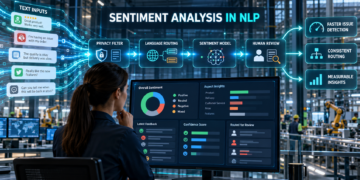
    Data analyst using AI-powered sentiment analysis in NLP to evaluate customer opinions, reviews, and social media feedback in a modern workplace.

    What Is Sentiment Analysis in NLP?

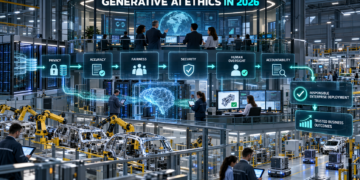
    AI ethics specialist reviewing Generative AI systems, transparency metrics, and responsible AI governance in a modern workplace.

    Generative AI Ethics: Challenges, Risks, and Best Practices in 2026

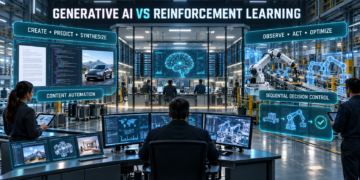
    AI engineer comparing Generative AI and Reinforcement Learning systems using advanced analytics dashboards in a modern workplace.

    Comparing Generative AI and Reinforcement Learning

    Entrepreneur using AI SEO tools and analytics dashboards in a modern digital marketing workspace.

    Top AI SEO Tools for Entrepreneurs and Better Search Accuracy

    Modern small business workplace using AI-powered tools, automation software, and digital analytics technology.

    Recommended AI tools for small businesses for students in 2026

    AI engineer working on machine learning models in a modern office with data visualizations and neural network diagrams on multiple screens.

    AI & Machine Learning

    • AI Tools, Frameworks & Platforms
    • AI in Healthcare & Biotech
    • Computer Vision & Image Recognition
    • Deep Learning & Neural Networks
    • Generative AI & LLMs
    • Machine Learning Fundamentals
    • Natural Language Processing (NLP)
  • Quantum Computing
    • All
    • Quantum AI in Simulation
    • Quantum Algorithms
    Scientists conducting neutral atom quantum research using optical tweezers, laser systems, and atomic qubits in an advanced quantum computing laboratory.

    How Does Neutral Atom Quantum Research Work at a Fundamental Level?

    What DARPA Quantum Research Is Doing and Why It Matters

    What DARPA Quantum Research Is Doing and Why It Matters

    Quantum Computing

    Quantum Computing

    Scientist analyzing quantum molecular simulation in a modern lab with holographic molecule visualization and advanced computing tools

    How Quantum Molecular Simulation Helps Drug Discovery

    • Quantum AI in Simulation
    • Quantum Algorithms
    • Quantum Applications in Biotech
    • Quantum Computing Industry Trends
    • Quantum Cryptography & Security
    • Quantum Hardware & Processors
  • Robotics and Automation
    • All
    • Autonomous Mobile Robots (AMRs)
    • Digital Twins & Simulation
    • Humanoids & Embodied AI
    • Industrial Robots & Cobots
    • Robotics Software (ROS, ROS2)
    Embodied AI robots interacting with their environment and collaborating with humans using advanced sensors, machine learning, and intelligent decision-making.

    The Future of Embodied AI and Autonomous Robots in 2030

    Humanoid AI robots collaborating with professionals in a modern workplace using artificial intelligence, automation, and advanced robotics technology

    The Rise of Humanoid AI in Healthcare Logistics and Manufacturing

    Automated Guided Vehicles transporting materials in a smart warehouse using automated routes and Industry 4.0 logistics technology

    Autonomous Mobile Robots vs Automated Guided Vehicles: Key Differences

    Autonomous mobile robots transporting materials in a smart Industry 4.0 warehouse with AI-powered navigation and automation systems.

    The Business Benefits of Autonomous Mobile Robots for Industry 4.0

    Engineer working alongside an industrial robotic arm in a smart factory, demonstrating modern robotics & automation in manufacturing.

    Robotics and Automation

    Digital robot automating computer tasks on multiple screens, representing robotic process automation in modern office workflows.

    What Is Robotic Process Automation and How It Works

    • Automation Tools & Workflow Systems
    • Autonomous Mobile Robots (AMRs)
    • Digital Twins & Simulation
    • Humanoids & Embodied AI
    • Industrial Robots & Cobots
    • Robotics Software (ROS, ROS2)
  • Cybersecurity
    • All
    • Cybersecurity Tools & Frameworks
    • Data Security & Compliance
    Cybersecurity professional monitoring compliance dashboards and data protection systems in a modern business workplace

    Cybersecurity Compliance Trends Businesses Should Know

    Cybersecurity analyst monitoring identity and access management tools and authentication dashboards in a modern enterprise security operations center.

    Identity and Access Management Tools Explained

    Cybersecurity compliance analyst reviewing a SOC 2 compliance checklist and data protection dashboards in a modern U.S. corporate IT security office.

    SOC2 Compliance Checklist for Data Security

    • Cybersecurity Tools & Frameworks
    • Data Security & Compliance
    • Healthcare & Biotech Security
    • Identity, Access & Zero Trust
    • Network & Cloud Security
    • Ransomware & Incident Response
  • USA Tech & Innovation
    • All
    • USA AI Jobs & Careers
    • USA Artificial Intelligence
    • USA Healthcare & Biotech AI
    • USA Quantum Computing
    • USA Robotics & Automation
    • USA Tech Industry News
    Security analyst using AI-powered systems in a modern operations center for national security monitoring

    How AI for National Security Today

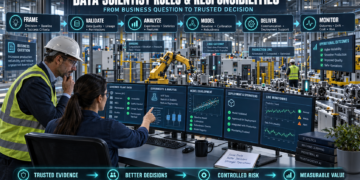
    Data scientist analyzing data and working with charts and code on multiple screens in a modern office

    Data Scientist Roles and Responsibilities Explained

    AI engineer working in a modern office with multiple screens showing code, data, and machine learning models

    AI Engineer Roles and Responsibilities Explained

    Tesla Optimus humanoid robot working with a human in a modern office workplace environment

    What Tesla Optimus Can Do and Why It Matters

    Professional interacting with an advanced robotic dog in a modern workplace representing Boston Dynamics robotics innovation

    Boston Dynamics Robots: What They Can Do Today

    Healthcare cybersecurity specialist monitoring HIPAA compliance and patient data protection systems in a modern U.S. hospital IT security center.

    HIPAA Cybersecurity Requirements for Healthcare Organizations

    • USA Artificial Intelligence
    • USA Quantum Computing
    • USA Healthcare & Biotech AI
    • USA Robotics & Automation
    • USA AI Jobs & Careers
    • USA Tech Industry News
No Result
View All Result
  • Home
    • All
    • AI & Machine Learning
    • AI in Healthcare & Biotech
    • AI Tools, Frameworks & Platforms
    • Autonomous Mobile Robots (AMRs)
    • Computer Vision & Image Recognition
    • Cybersecurity
    • Cybersecurity Tools & Frameworks
    • Data Security & Compliance
    • Digital Twins & Simulation
    • Generative AI & LLMs
    • Humanoids & Embodied AI
    • Industrial Robots & Cobots
    • Natural Language Processing (NLP)
    • Quantum AI in Simulation
    • Quantum Algorithms
    • Quantum Computing
    • Robotics and Automation
    • Robotics Software (ROS, ROS2)
    • Uncategorized
    • USA AI Jobs & Careers
    • USA Artificial Intelligence
    • USA Healthcare & Biotech AI
    • USA Quantum Computing
    • USA Robotics & Automation
    • USA Tech & Innovation
    • USA Tech Industry News
    Scientists conducting neutral atom quantum research using optical tweezers, laser systems, and atomic qubits in an advanced quantum computing laboratory.

    How Does Neutral Atom Quantum Research Work at a Fundamental Level?

    What DARPA Quantum Research Is Doing and Why It Matters

    What DARPA Quantum Research Is Doing and Why It Matters

    Embodied AI robots interacting with their environment and collaborating with humans using advanced sensors, machine learning, and intelligent decision-making.

    The Future of Embodied AI and Autonomous Robots in 2030

    Humanoid AI robots collaborating with professionals in a modern workplace using artificial intelligence, automation, and advanced robotics technology

    The Rise of Humanoid AI in Healthcare Logistics and Manufacturing

    Automated Guided Vehicles transporting materials in a smart warehouse using automated routes and Industry 4.0 logistics technology

    Autonomous Mobile Robots vs Automated Guided Vehicles: Key Differences

    Autonomous mobile robots transporting materials in a smart Industry 4.0 warehouse with AI-powered navigation and automation systems.

    The Business Benefits of Autonomous Mobile Robots for Industry 4.0

  • AI & Machine Learning
    • All
    • AI in Healthcare & Biotech
    • AI Tools, Frameworks & Platforms
    • Computer Vision & Image Recognition
    • Generative AI & LLMs
    • Natural Language Processing (NLP)
    Data analyst using AI-powered sentiment analysis in NLP to evaluate customer opinions, reviews, and social media feedback in a modern workplace.

    What Is Sentiment Analysis in NLP?

    AI ethics specialist reviewing Generative AI systems, transparency metrics, and responsible AI governance in a modern workplace.

    Generative AI Ethics: Challenges, Risks, and Best Practices in 2026

    AI engineer comparing Generative AI and Reinforcement Learning systems using advanced analytics dashboards in a modern workplace.

    Comparing Generative AI and Reinforcement Learning

    Entrepreneur using AI SEO tools and analytics dashboards in a modern digital marketing workspace.

    Top AI SEO Tools for Entrepreneurs and Better Search Accuracy

    Modern small business workplace using AI-powered tools, automation software, and digital analytics technology.

    Recommended AI tools for small businesses for students in 2026

    AI engineer working on machine learning models in a modern office with data visualizations and neural network diagrams on multiple screens.

    AI & Machine Learning

    • AI Tools, Frameworks & Platforms
    • AI in Healthcare & Biotech
    • Computer Vision & Image Recognition
    • Deep Learning & Neural Networks
    • Generative AI & LLMs
    • Machine Learning Fundamentals
    • Natural Language Processing (NLP)
  • Quantum Computing
    • All
    • Quantum AI in Simulation
    • Quantum Algorithms
    Scientists conducting neutral atom quantum research using optical tweezers, laser systems, and atomic qubits in an advanced quantum computing laboratory.

    How Does Neutral Atom Quantum Research Work at a Fundamental Level?

    What DARPA Quantum Research Is Doing and Why It Matters

    What DARPA Quantum Research Is Doing and Why It Matters

    Quantum Computing

    Quantum Computing

    Scientist analyzing quantum molecular simulation in a modern lab with holographic molecule visualization and advanced computing tools

    How Quantum Molecular Simulation Helps Drug Discovery

    • Quantum AI in Simulation
    • Quantum Algorithms
    • Quantum Applications in Biotech
    • Quantum Computing Industry Trends
    • Quantum Cryptography & Security
    • Quantum Hardware & Processors
  • Robotics and Automation
    • All
    • Autonomous Mobile Robots (AMRs)
    • Digital Twins & Simulation
    • Humanoids & Embodied AI
    • Industrial Robots & Cobots
    • Robotics Software (ROS, ROS2)
    Embodied AI robots interacting with their environment and collaborating with humans using advanced sensors, machine learning, and intelligent decision-making.

    The Future of Embodied AI and Autonomous Robots in 2030

    Humanoid AI robots collaborating with professionals in a modern workplace using artificial intelligence, automation, and advanced robotics technology

    The Rise of Humanoid AI in Healthcare Logistics and Manufacturing

    Automated Guided Vehicles transporting materials in a smart warehouse using automated routes and Industry 4.0 logistics technology

    Autonomous Mobile Robots vs Automated Guided Vehicles: Key Differences

    Autonomous mobile robots transporting materials in a smart Industry 4.0 warehouse with AI-powered navigation and automation systems.

    The Business Benefits of Autonomous Mobile Robots for Industry 4.0

    Engineer working alongside an industrial robotic arm in a smart factory, demonstrating modern robotics & automation in manufacturing.

    Robotics and Automation

    Digital robot automating computer tasks on multiple screens, representing robotic process automation in modern office workflows.

    What Is Robotic Process Automation and How It Works

    • Automation Tools & Workflow Systems
    • Autonomous Mobile Robots (AMRs)
    • Digital Twins & Simulation
    • Humanoids & Embodied AI
    • Industrial Robots & Cobots
    • Robotics Software (ROS, ROS2)
  • Cybersecurity
    • All
    • Cybersecurity Tools & Frameworks
    • Data Security & Compliance
    Cybersecurity professional monitoring compliance dashboards and data protection systems in a modern business workplace

    Cybersecurity Compliance Trends Businesses Should Know

    Cybersecurity analyst monitoring identity and access management tools and authentication dashboards in a modern enterprise security operations center.

    Identity and Access Management Tools Explained

    Cybersecurity compliance analyst reviewing a SOC 2 compliance checklist and data protection dashboards in a modern U.S. corporate IT security office.

    SOC2 Compliance Checklist for Data Security

    • Cybersecurity Tools & Frameworks
    • Data Security & Compliance
    • Healthcare & Biotech Security
    • Identity, Access & Zero Trust
    • Network & Cloud Security
    • Ransomware & Incident Response
  • USA Tech & Innovation
    • All
    • USA AI Jobs & Careers
    • USA Artificial Intelligence
    • USA Healthcare & Biotech AI
    • USA Quantum Computing
    • USA Robotics & Automation
    • USA Tech Industry News
    Security analyst using AI-powered systems in a modern operations center for national security monitoring

    How AI for National Security Today

    Data scientist analyzing data and working with charts and code on multiple screens in a modern office

    Data Scientist Roles and Responsibilities Explained

    AI engineer working in a modern office with multiple screens showing code, data, and machine learning models

    AI Engineer Roles and Responsibilities Explained

    Tesla Optimus humanoid robot working with a human in a modern office workplace environment

    What Tesla Optimus Can Do and Why It Matters

    Professional interacting with an advanced robotic dog in a modern workplace representing Boston Dynamics robotics innovation

    Boston Dynamics Robots: What They Can Do Today

    Healthcare cybersecurity specialist monitoring HIPAA compliance and patient data protection systems in a modern U.S. hospital IT security center.

    HIPAA Cybersecurity Requirements for Healthcare Organizations

    • USA Artificial Intelligence
    • USA Quantum Computing
    • USA Healthcare & Biotech AI
    • USA Robotics & Automation
    • USA AI Jobs & Careers
    • USA Tech Industry News
No Result
View All Result
Latest Technology | Nezz hub
No Result
View All Result
Home Robotics and Automation Autonomous Mobile Robots (AMRs)

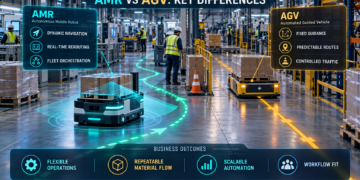
Autonomous Mobile Robots vs Automated Guided Vehicles: Key Differences

Garikapati Bullivenkaiah by Garikapati Bullivenkaiah
June 8, 2026
in Autonomous Mobile Robots (AMRs)
0
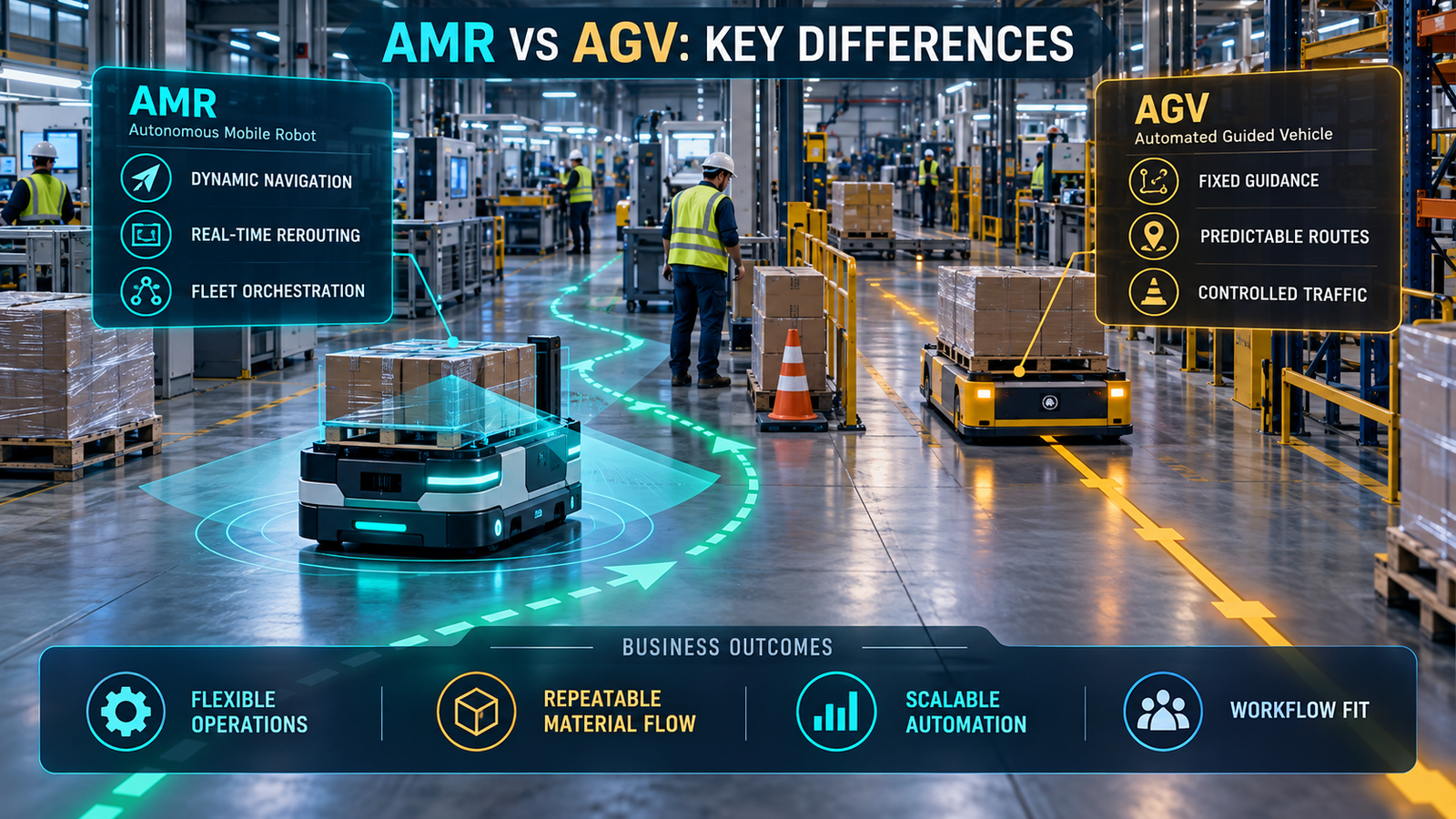
Automated Guided Vehicles transporting materials in a smart warehouse using automated routes and Industry 4.0 logistics technology
Share on LinkedinShare on FacebookShare on X
Automated Guided Vehicles transporting materials in a smart warehouse using automated routes and Industry 4.0 logistics technology

Autonomous mobile robots (AMRs), automated guided vehicles (AGVs), and other autonomous systems are revolutionizing how many businesses operate. Many organizations have recognized that AMRs and AGVs are critical components of today’s automation strategy.

One similarity both share is their role in transporting goods/materials. However, there are several significant differences in how each type of robot operates.

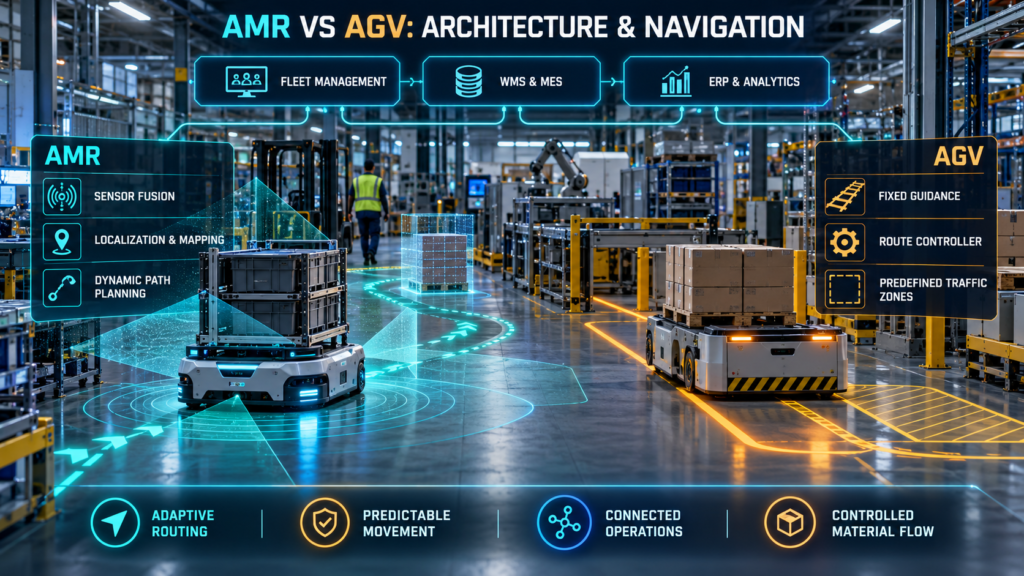
AMRs operate using computer vision, artificial intelligence, and sensor technologies. The ability to detect and understand its environment using this technology enables an AMR to move through space without a predetermined path.

On the other hand, AGVs require pre-defined paths. These paths can be established by installing magnetic stripes or wire lines along the route the vehicle will travel. As such, AGVs function best within structured spaces.

The major advantage of AMRs is their flexibility. An AMR can quickly modify its route as it travels if it detects changes in its surrounding environment. In addition, because an AMR uses artificial intelligence and can recognize objects, people, and obstacles in its environment, it can adjust its speed and stop at needed areas.

AGVs work best with repetitive applications within defined operating parameters. Due to the costs of creating predefined paths, AGVs may be less expensive than AMRs for basic tasks.

Ultimately, whether you should use an AGV or an AMR depends on your organization’s specific requirements. Each has different strengths and weaknesses.

It is essential to understand the characteristics of both types of robots to make the most effective decision possible about which is the best fit for your company’s automation objectives.

Automated Guided Vehicles

Summary

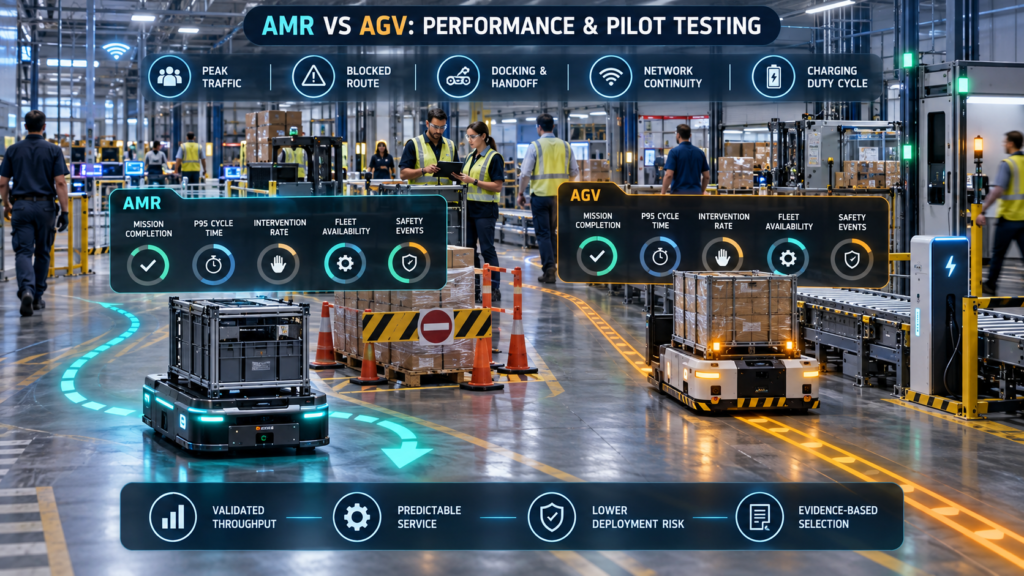
This post identifies the essential differences between autonomous mobile robots (AMRs) and automated guided vehicles (AGVs), as well as their applications in today’s manufacturing and automation environments. AGVs follow a predetermined path and route using fixed navigation systems and established traffic regulations. Therefore, they are often used for repetitive point-to-point movements within an organized environment.

In contrast, AMRs utilize onboard sensors, mapping, and onboard intelligence to dynamically navigate their working area, avoid obstacles, and adjust to changes in the layout or other traffic in real time. As a result, AMRs can be applied in both flexible environments where the layout may vary from day to day and mixed-traffic environments.

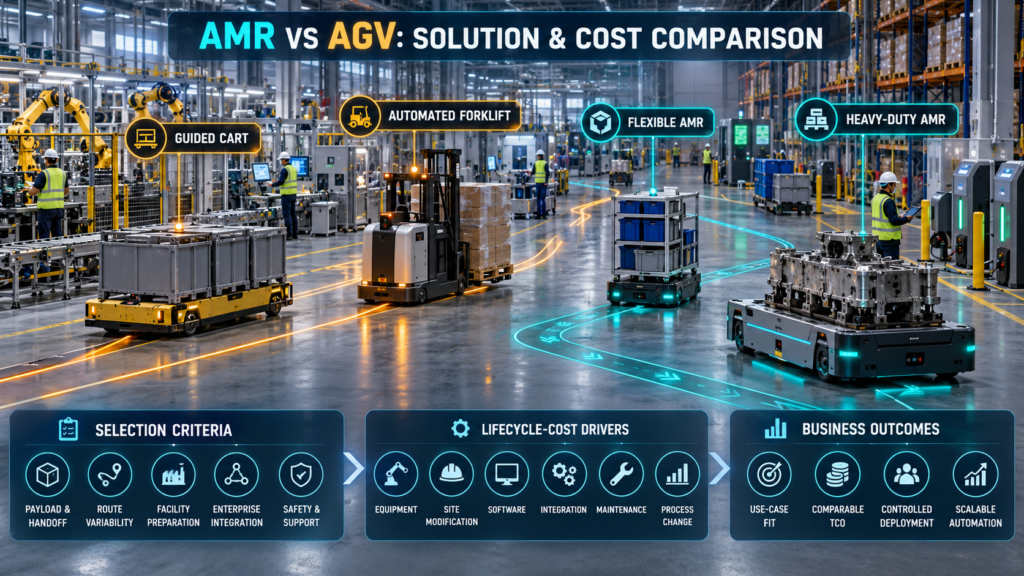
In addition to comparing AMRs and AGVs based on the aforementioned attributes, this post discusses additional areas for comparison, including Safety Features, Scalability, Integration With Warehouse Management Systems (WMS)/Material Execution System (MES), and Total Cost of Ownership (TCO). The post provides examples of use cases for both types of robotic solutions, including production-line supply, warehouse restocking, transportation of finished goods, and hospital logistics.

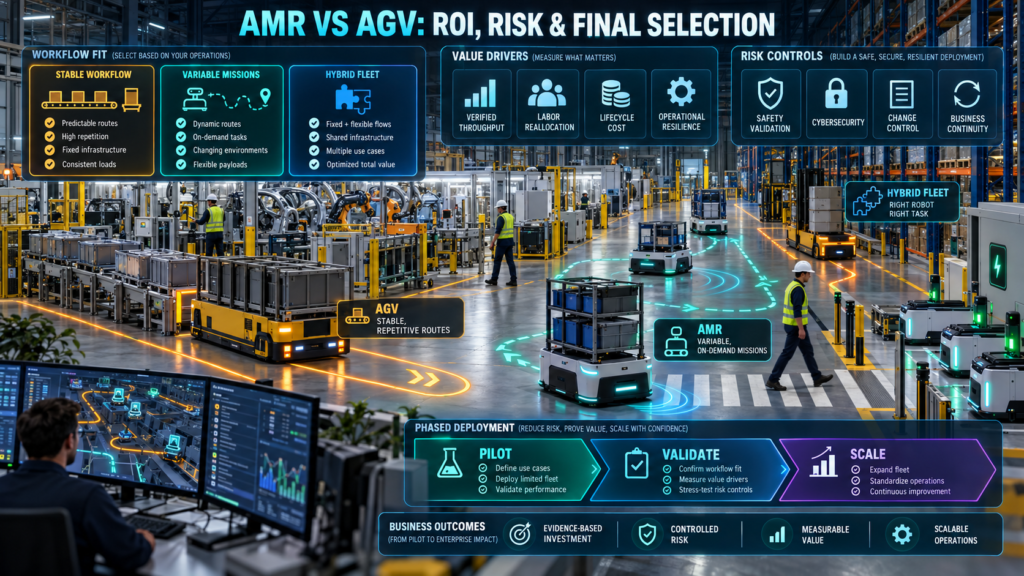
These use case examples will illustrate when the need for constant routing requires AGVs and when the ability to adapt to changing layouts or variable traffic demands AMRs. The final portion of the post will provide examples of evaluation criteria to determine whether an organization should employ AGVs, AMRs, or a combination thereof.

These evaluation criteria include workflow variation, physical plant constraints, required throughput rates, and frequency of environmental changes. Additionally, the post suggests that many companies now operate hybrid fleets consisting of AGVs for constant-loop operations and AMRs for on-demand, mission-based work.

The Business Benefits of Autonomous Mobile Robots for Industry 4.0

Understanding the Basics: What Are AMRs and AGVs?

Autonomous Mobile Robots (AMRs) are among the most innovative developments in mobile robotics. Their ability to function autonomously is a key characteristic. This means they will be able to read sensor data, use algorithms to understand their environment, and take action based on what they see.

The history of Automated Guided Vehicles (AGV’s) spans decades. These vehicles are used extensively in industrial automation settings. The reliability of AGVs has been established over the years; they follow predefined paths and are directed by electronic commands.

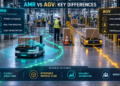
Here’s a brief comparison to illustrate their functions:

  • Navigation System: AMRs use sensors and AI for navigation, while AGVs follow set paths.
  • Adaptability: AMRs adjust to changes in their environment; AGVs excel in stable settings.
  • Deployment Time: AMRs can be deployed quickly; AGVs often require infrastructure adjustments.

AMRs are adaptable — they can be used across a wide variety of industries (retail, e-commerce, etc.) and can complete tasks such as pick/pack/sort. AGVs are often found in industries that have very structured workflows (automotive, for example)

Each is valuable in performing automated functions; however, each will function best depending on the specific need it addresses.

AMR vs AGV Feature Comparison

FeatureAutonomous Mobile Robots (AMRs)Automated Guided Vehicles (AGVs)
NavigationDynamic AI-based navigationFixed routes and guides
Obstacle AvoidanceAutomatic reroutingStops when blocked
Infrastructure ChangesMinimalRequires tracks, tape, or markers
FlexibilityHighModerate
ScalabilityEasyMore complex
Best Use CaseDynamic warehousesRepetitive transport tasks

Example

An e-commerce warehouse benefits from AMRs because routes frequently change, while AGVs excel in stable manufacturing environments.

Source:

  • https://www.mhi.org
  • https://www.dhl.com/global-en/home/insights-and-innovation.html
What are AMRs and AGVs

Automated Guided Vehicles (AGVs): Automated Guided Vehicles transport materials efficiently using predefined routes and automated navigation systems

Automated Guided Vehicles transporting materials in a smart warehouse using automated routes and Industry 4.0 logistics technology

Automated Guided Vehicles (AGVs) have become the backbone of intralogistics in today’s industry. Automated Guided Vehicles are used to move products such as pallets, totes, and carts around a facility with minimal human interaction. Unlike forklifts, which rely on an operator being available and consistent in their operation, Automated Guided Vehicles follow a predetermined path and complete a repeatable mission, allowing the operations department to maintain consistent throughput throughout the day.

Typically, Automated Guided Vehicles use one of four methods to navigate: magnetic tape, QR code markers, lasers, or wire guides. Once a method has been chosen, the onboard controller will control speed, stopping distance, and docking precision.

The Automated Guided Vehicles will first receive a dispatch request from a Warehouse Management System (WMS), Manufacturing Execution System (MES), or similar system. Then it will go to the designated pick-up location, confirm that there is product to be picked up using sensor(s), and then head to the designated drop-off location.

Since the routes and traffic patterns have already been pre-programmed into the vehicle, this allows for improved efficiency, less congestion in the aisles, limits access to areas they should not enter, and provides safety improvements to employees walking in these same areas through the use of light curtains, bumpers, and/or 360-degree cameras. In addition, the ability to plan ahead based on the predictable duration of each trip gives planners better insight into the buffer stock levels to establish and allows for synchronization between when materials arrive at the dock doors and when those materials are consumed on the line side.

Automated Guided Vehicles are most effectively utilized in environments where they follow consistent paths and make repetitive trips, such as delivering raw materials to production cells, transferring finished goods to staging, or transporting linens/food to hospitals. These types of applications allow them to run continuously without worrying about battery life, recharge opportunistically, and provide valuable information on operational performance that can be used for both preventive maintenance and continuous process improvement.

When coupled with smart scheduling, Automated Guided Vehicles can significantly reduce wasted travel miles, improve damage rates, and release highly skilled personnel from low-value tasks such as quality inspections and exception handling. For companies looking to implement an automated transportation solution utilizing standardized lanes and automated navigation systems, AGVs are a viable option.

Example

A beverage manufacturing facility uses Automated Guided Vehicle Systems (AGVS) to transport empty glass bottles from the receiving docks to the rinsing area. The AGVs follow the preinstalled floor wiring and stop at designated queue locations once the maximum number of vehicles is waiting. If production changes from 12-ounce to 20-ounce containers, the AGVS does not make a decision; instead, it receives an updated routing schedule from its Manufacturing Execution System (MES) and continues along the same predetermined path. Pedestrian safety is addressed through scanner systems and limited speed limits throughout all crosswalks.

How AMRs Navigate Warehouses and Hospitals

Mobile Robotics: Mobile robotics focuses on intelligent robots that move, navigate, and interact within changing environments

Mobile robotics systems autonomously transporting materials and optimizing operations in a smart Industry 4.0 warehouse and manufacturing facility

The area of study known as Mobile Robotics focuses on robots that are able to move through a space, understand their environment, and make choices in “real-time.” The difference is adaptability from fixed automation. That is, Mobile Robotics’ emphasis on flexibility will enable robots to navigate warehouse spaces, factory aisles, hospital hallways, retail stock rooms, and even open fields, where layout, obstacles, and priority levels can vary from day to day.

As such, the integration of sensor technologies (LIDAR, Cameras, IMU) combined with mapping and localization technologies, path planning algorithms, and control mechanisms all combine to create a system that can transform the decision of how you want your robot to behave in a physical sense into actual movement in a safe manner.

The main objective of Mobile Robotics is to provide reliable navigation in dynamic environments. In addition to navigating around static objects within a room or building, robots are required to develop and/or utilize existing maps to know exactly where they are, locate moving obstacles (such as people walking or carts traveling down an aisle), and adjust their planned route accordingly while still providing maximum productivity without putting themselves or others at risk.

This is one reason why Mobile Robotics is compared to Automated Guided Vehicle Systems; Autonomous Guided Vehicle Systems typically rely on pre-defined paths and rules governing traffic flow between vehicles. While Autonomous Guided Vehicle Systems excel at transporting items in repetitive patterns along designated routes, Mobile Robotics allows organizations to expand upon the capabilities of Autonomous Guided Vehicle Systems when workflows change, when there are obstructions in the aisle(s) requiring alternative routes, or when tasks require greater nuance in interaction.

Mobile Robotics can also support higher levels of autonomy beyond simply transporting items from point A to point B. Depending on the intended application of a Mobile Robotics platform, it may be capable of identifying specific products/shelves/bin locations; positioning itself in precise alignment with workstation requirements; coordinating with other robots; interacting with elevators and door controls; etc. Additionally, fleet management software is available to assign tasks to individual robots, prevent workflow bottlenecks, and balance battery charge levels across multiple units.

By deploying mobile robotics technology in modern operations, organizations have enabled flexible, timely material transport, automated on-demand inventory restocking, and enhanced responsiveness to customer orders. In addition to these operational benefits, mobile robotics has enabled organizations to collect and store data on product location, travel time, exceptions, near-miss events, and other information, allowing them to continually evaluate and optimize facility layouts and business processes.

Even if an organization currently uses autonomous guided vehicle systems to provide predictable service loops, mobile robotics can enhance this capability by enabling it to handle varying routes, seasonal changes, and mixed-traffic areas. Ultimately, the focus of mobile robotics is the development of intelligent motion that safely integrates collaborative behavior and scalable autonomy in rapidly evolving, unstructured environments.

Example

In an E-commerce-oriented 3PL warehouse, Mobile Robotics supports Goods-To-Person (GTP) picking by moving shelving pods to Pick Stations, where workers pick items and confirm completion using scanning technology. The mobile robots will continuously update their route plans as congestion builds, rerouting through different aisles when forklifts are operating. The robots update their mapping of the entire warehouse area during a customer’s layout changes overnight and also update the rules for how each aisle can be used without installing additional tape or wire.

If the weight is redistributed from one end of a pod to the other, the robot slows down and takes wider turns as it moves along the aisle to maintain stability. The use of Mobile Robotics has increased the rate at which workers can make picks and has also provided operational flexibility to accommodate new stockkeeping units (SKUs) and seasonal re-slots.

Autonomous Robots: Autonomous robots operate independently, making decisions and completing tasks in dynamic environments

Autonomous robots independently performing industrial tasks in a smart factory using AI, machine learning, and advanced navigation systems

Autonomous robots do not require human supervision; they sense the world around them, make decisions, and complete tasks within a rapidly evolving environment. Rather than relying solely on predetermined scripting, autonomous robots use sensor-based perception, planning, and control to adapt to changing conditions, such as newly developed obstacles and shifting priorities. This ability to self-adapt makes autonomous robots particularly effective in warehouses, manufacturing, health care delivery, and field applications, which are characterized by significant variability.

An example of how an autonomous robot operates is to first identify the mission or task (e.g., transporting, inspecting, providing pick assistance, conducting inventory counts). Once this has been accomplished, the robot uses one or more sensors (lidar, cameras, depth sensors, and/or wheel encoders) to assess its environment.

Following an evaluation of its environment, the robot identifies its location, plans a safe route, and executes movement along this route while continually monitoring for hazards posed by the proximity of other individuals or objects. If the environment changes (for instance, if an aisle becomes blocked or a docking station is occupied), the autonomous robot can reassess its path or waiting strategy and perform accordingly without stopping the overall process.

For comparison, it may be helpful to distinguish Autonomous Robots from Automated Guided Vehicles. While automated guided vehicles are very successful at performing repetitive tasks in structured facilities using predefined paths and well-defined traffic rules, Autonomous Robots have greater flexibility because they can take detours around temporary obstructions and operate effectively in multi-directional traffic.

As a result, many enterprises will employ both technologies: automated guided vehicles to support repetitive loop-type activities and Autonomous Robots for variable-length mission requirements and high-frequency changeover-time applications.

Autonomous Robots can also realize benefits from shared mapping technology across several units and from coordination among units on who has the right-of-way and which tasks need to be completed to minimize congestion. Additionally, Autonomous Robots can continue to optimize their performance as they collect operational data, including travel times, bottlenecks, exception rates, safety incidents, etc., to create continuous improvements.

Whether employed individually or alongside automated guided vehicles, Autonomous Robots enable companies to automate work processes that previously relied heavily on human judgment. Simply stated, Autonomous Robots represent flexible, decision-making-based automation for environments with constantly changing conditions throughout each working day.

Example

Autonomous robots in a major hospital deliver lab samples, medications to patients, and hospital linens across all floors. Robots autonomously travel through the hallway with live obstruction detection; enter elevators by requesting entry from the building management systems; and modify their routes if a corridor is being cleaned and therefore blocked. Instead of ceasing its delivery route when a nurse’s cart obstructs the doorway, the robot will wait until the doorway is clear, back away, and then select another route.

When a priority STAT sample arrives at the lab, the Fleet Manager will reassign the closest robot to pick it up and/or automatically reroute lower-priority items on the current delivery route(s). The hospital has seen improved turnaround times for deliveries (of lab samples, etc.) and reduced disruptions to hospital staff during peak hours.

AI Robots: AI robots use artificial intelligence to learn, adapt, and perform tasks with minimal human intervention

AI robots using artificial intelligence, machine learning, and automation to optimize operations in a modern Industry 4.0 workplace

AI Robots are a combination of hardware and software that provides perception of their environment, learning, and adaptability while performing tasks with minimal human intervention.

Unlike rigid, rule-based approaches to automation (with limited ability to handle real-world variability), AI Robots use techniques such as computer vision, machine learning, and probabilistic decision-making to address the complexity of real-world situations.

This type of capability is especially helpful in environments where lighting conditions change, objects vary in size or position, or workflows evolve over time.

In practice, AI Robots “know” what is going on in their surroundings through sensors like cameras, depth sensors, lidar, force/torque feedback, etc.; they can classify items, detect defects, estimate free space for navigation, recognize people/vehicles close by, and then translate this understanding into actions. They can select a pathway, adjust speed, regrasp the product, or escalate the exception to a human. Because they learn from data, they frequently improve performance as they encounter more examples, e.g., new packaging types or changing aisle conditions.

AI Robots are commonly compared with autonomous guided vehicles in material-handling applications. An autonomous guided vehicle typically optimizes for predictable transport along predefined routes with consistent cycle times in structured facilities. An AI robot is often better suited to tasks that require perception and adaptability, e.g., supporting mixed-SKU picking, dynamic obstacle avoidance, and visual inspection. Many organizations will deploy both an AGV for repetitive point-to-point movements and an AI robot for variable/data-driven operations.

Within a fleet of robots, AI Robots can share map data and operational telemetry, enhancing smart dispatching, congestion management, and predictive maintenance. This reduces downtime and improves throughput without constant manual tuning. When used in the right context (factory floor/warehouse/service), AI Robots extend automation beyond repetition by adding learning and context-aware behavior. When used in coordination with AGVs, AI Robots can also enhance the flexibility, safety, and resiliency of systems as conditions change

Example

An automated food distribution service uses artificial intelligence robots equipped with computer vision to visually classify items in mixed cases of packaged snack foods for shipment directly to retailers. Each item is scanned and analyzed by the robots, which recognize distorted label images and packaging damage. After receiving new seasonal SKUs, the system learns what the products look like from a small number of training examples and continually improves its ability to recognize them.

In instances when light glare or film wrap on an item interferes with robotic scanning, it adjusts camera exposure and reviews the item again before making a selection. Any exceptions identified during processing where the robots were unable to determine readable UPC’s will then be directed to a manual workstation. This results in increased accuracy and reduced rework, without requiring the automation equipment to be replaced or significantly redesigned.

Smart Robots: Smart robots use sensors, machine learning, and AI to adapt and perform tasks intelligently

Smart robots using AI, machine learning, and advanced sensors to automate industrial operations in a modern Industry 4.0 workplace

Smart robots employ an integration of sensors (machine learning), artificial intelligence (AI) based algorithms, and hardware-based smart robotics systems to execute tasks using reasoning and understanding of dynamic changes in the environment and/or task requirements. Unlike simple robotic systems that can only execute predefined sequences of steps, Smart Robots will continuously monitor the changing environment around them, interpret sensor data, and dynamically adapt their actions and decisions to ensure safe and efficient goal achievement.

These capabilities allow Smart Robots to be effective in applications with high variability (e.g., light levels, number of people/pallets), which would typically cause automated systems (e.g., AGVs) to malfunction.

From a technical perspective, Smart Robots employ sensor fusion techniques to combine camera images, LiDAR, depth sensors, encoder data, and, in some cases, force/torque feedback to create a comprehensive view of their operating environment. Based on this perceptual capability, Smart Robots can identify potential obstacles, classify objects, determine available free space, and confirm successful task completion.

The ability of machine learning to continually improve object classification and decision-making allows Smart Robots to develop increased confidence in identifying/performing increasingly complex tasks. Additionally, the use of AI planning technologies enables Smart Robots to select optimal routes, plan action sequences, and recover from unanticipated events during execution (such as a path obstruction or a misalignment at a pick-up point).

In industrial settings such as manufacturing and logistics, Smart Robots often offer additional functionality and flexibility compared to established systems like Autonomous Guided Vehicles (AGVs). While AGVs have been successfully utilized for repetitive movements along fixed routes under conditions requiring minimal decision-making (i.e., determining traffic flow rules), Smart Robots have been used to support flexible routing in situations with changing route conditions and/or higher complexity sensing and decision-making requirements (e.g., performing mixed traffic routes; completing on-demand replenishments, etc.).

In many instances, companies utilize AGVs for fixed-loop applications (e.g., warehouse travel routes) and deploy Smart Robots for variable-mission applications. Additionally, Smart Robots may interact with other types of fleet management platforms. Such interactions enable the coordination of task assignments, determination of right-of-way, and tracking of performance metrics across multiple vehicles. Through continued operation and utilization, Smart Robots collect significant amounts of operational data on vehicle travel times, identified bottlenecks, near-miss occurrences, and the rate of exception occurrences.

This collected data provides facility personnel with meaningful insights to support ongoing process improvements and proactively schedule preventive maintenance activities. When integrated into safety-conscious design approaches, Smart Robot vehicles will include detection zones, speed limits, and controlled braking procedures to safely navigate around humans while maintaining production efficiencies.

Example

Smart robots at a recycling plant use hyperspectral sensing technology (which has higher resolution than normal cameras) and artificial intelligence (AI), or machine learning algorithms, to identify PET versus HDPE plastic, as well as contaminants such as food waste or metal tops from other materials.

The robots will also vary their gripping pressure and picking timing depending on the conveyor belt’s velocity and the geometry of the objects being picked. This improves the robot’s ability to pick up overlapping pieces.

Since the chemical makeup of incoming recyclables can vary by time of year (e.g., more bottles during summer months), the AI models are periodically updated with new test data that reflect those seasonal variations.

Dashboards for performance metrics allow the plant to report purity per bale and provide insights into potential problems within the upstream processes.

Autonomous Technology: Autonomous technology enables machines and systems to operate independently using AI, sensors, and real-time data

Autonomous technology systems using AI, robotics, and automation to optimize operations in a modern Industry 4.0 workplace

With autonomous technology, you have a combination of artificial intelligence, advanced sensors, and real-time data that enable machines and systems to work independently. Autonomous Technology replaces fixed instructions with the ability of equipment to see what is going on around it, understand the situation it finds itself in, and then decide how best to continue working safely and effectively. The use of autonomous technology will dramatically improve logistics, manufacturing, health care, and service industry applications where variability and time constraints limit an individual’s ability to coordinate manually.

Practically speaking, Autonomous Technology relies on sensing (cameras, lidar, radar, encoders), connectivity (edge computing, Wi-Fi/5G), and intelligence (machine learning, planning algorithms, and rule-based safety layers) for the autonomous process to take place.

Once the autonomous system has been provided with the above elements, it can locate itself within a given space; identify potential obstacles; determine the most efficient path of travel; and adapt its actions based on factors such as congestion levels, time-sensitive tasks, and changes to the environment’s layout. Additionally, the autonomous element enables continuous monitoring of all activity in the workspace, allowing the autonomous system to respond quickly to unanticipated events—e.g., a blocked aisle, changes in workload, or equipment malfunction—without requiring human involvement.

In the area of Material Handling, Autonomous Technology is often paired with automated guided vehicles. Automated guided vehicles are commonly used to transport items along predetermined paths. In this manner, automated guided vehicles provide reliable performance when operating in structured environments. However, as Autonomous Technology evolves, it will enable increased flexibility in navigation and routing; improved dispatching logic; and greater interaction among multiple types of traffic.

Today, many organizations utilize automated guided vehicle technology for repetitive loop-type activities while implementing Autonomous Technology-driven systems for mission-specific or workflow-variable type applications.

Additionally, Autonomous Technology will capture operational metrics through data collection: cycle times, usage rates, bottleneck points, and exceptions, which will aid operators in optimizing their layout configurations and schedules. Predictive maintenance is another benefit of using Autonomous Technology, as it can detect abnormal vibration patterns, battery degradation, or sensor drift before failure.

When properly implemented — often in a hybrid fleet configuration that may include both Automated Guided Vehicle technology and Autonomous Technology — Autonomous Technology will increase overall resilience, scalability, and safety. Ultimately, Autonomous Technology enables independent operation through sensing, intelligence, and real-time decision-making.

Example

The Port is adopting Autonomous Technology for Yard Operations by integrating Sensors, Artificial Intelligence Scheduling, and Real-Time Telemetry into all Equipment in its Yards. Optimized assignments are provided to Container Tractor drivers, taking into account Vessel Priority, Travel Distance, and Congestion at Cranes. All Vehicles have GPS (Global Positioning System) / RTK (Real-Time Kinematic), LIDAR (Light Detection and Ranging), and Geofencing to limit vehicle speeds close to Pedestrians and automatically route them away from restricted Areas.

Using Live Queue Data, the Autonomous System predicts Bottlenecks before they occur and adjusts work shifts to Alternate Lanes to prevent Delays from cascading. Maintenance Analytics identify Abnormal Battery Temperatures and Tire Wear conditions, allowing for Service appointments to be scheduled during low-demand windows. Through Autonomous Technology making Decisions at Fleet Scale, the Port will improve Turnaround Times and reduce Idle Travel without increasing yard Space.

Robotic Systems: Robotic systems combine hardware, software, and AI technologies to automate industrial and business operations

Advanced robotic systems integrating AI, automation, sensors, and industrial robotics in a smart Industry 4.0 manufacturing workplace

The integration of Hardware, Software, and increasing amounts of Artificial Intelligence (AI) enables Robotic Systems to perform Industrial & Business Operations automatically at scale, quickly, consistently, and with complete accountability.

As a simple example of this, a Robotic System consists of three layers of functionality: The Physical Layer (the robot itself, including sensors, grippers, battery power sources, etc., safety features); the Control Layer (including firmware for control/coordination; motion control, etc.; navigation algorithms); and the Application Layer (application task logic; integration to other systems/applications; analytics).

When all three layers interact appropriately, a Robotic System can execute repetitive tasks while simultaneously accounting for variability in a dynamic world using sensor-based perception, decision-support tools, and/or autonomous behavior.

Robotic Systems have been deployed in Manufacturing Applications to assist with Assembly, Welding, Machine Tending, Packaging, and quality inspection. Warehouses/Distribution Centers utilize Robotic Systems for Picking Assistance, Goods-To-Person Transport/Inventory Scanning, and Sortation. Often, Warehouse/Distribution Center Deployments involve the integration of AGV’s (Automated Guided Vehicles) and/or mobile robots.

These vehicles move material efficiently along predetermined routes, following proven traffic rules. Some organizations view their AGV’s as a reliable transportation backbone upon which they build additional smart mobile units, robotic arms, and/or high-end vision-based inspection stations to further increase the automation efficiency.

Most organizations will connect their Robotic Systems to Enterprise Software Platforms (WMS/MES/ERP) that enable them to receive Work Orders, Prioritize Tasks, Confirm Task Completion Statuses, and Generate Performance Data in Real Time. Additionally, many organizations will implement AI-enhanced robotic systems capable of recognizing specific items/objects, detecting defects during production, optimizing routing paths to minimize travel times between locations, and improving efficiency in exception detection.

Safety is paramount when implementing Robotic Systems. Organizations will utilize various safety components on their Robotic Systems (scanner systems, interlock mechanisms, guardrail systems, validated stop behaviors) to operate safely around employees and machinery.

Robotic Systems provide numerous benefits to an organization, including but not limited to: eliminating manual labor requirements; improving product accuracy; providing consistent throughput regardless of shift; and supporting continuous process improvements by utilizing real-time data collected by the system on cycle time/downtime causes/congestion points, and quality trends.

Regardless of whether your organization deploys Fixed Automation Solutions, Mobile Fleet Solutions, or Hybrid Solutions that incorporate AGVs into your automation strategy, Robotic Systems provide a scalable platform for automating multiple aspects of your organization’s operations in alignment with established organizational processes, technologies used, and measurable outcomes.

Example

The electronics company developed robotic manufacturing systems to assemble smart thermostats. The collaborative robotic arm installed a printed circuit board (PCB), the robotic vision inspection station inspected the connector alignment, and the robotically controlled torque screwdriver tightened the fasteners according to specifications. In addition to the physical stations, a higher-level software layer coordinated handoffs between stations on the production line, recorded the serial number of every product assembled, and uploaded test results to the enterprise resource planning (ERP) system.

When the robotic vision inspection station detects that the ribbon cable is not properly seated, only this station will stop the entire production line. An operator will be prompted to correct or replace the defective part. After correcting or replacing the defective part, the software will record the type of error that occurred so it can analyze trends based on those error types.

Technology Behind the Machines: Sensors, AI, and Control Systems

The types of technology used in Autonomous Mobile Robots (AMRs), and in Automated Guided Vehicles (AGVs) offer a significant amount of insight as to what they can do.

As such, both AMRs and AGVs include distinct technologies that allow them to function.

AMRs use various sensors to perceive their environment. Utilizing cameras, LiDAR, and Infrared Sensors for environmental perception. The collected sensor data is then fed into complex artificial intelligence (AI) algorithms.

The AI makes decisions based on this collected data. This allows AMRs to adapt to changes in their environment and optimize task completion. Additionally, the control systems used in these autonomous mobile robots are designed to continue learning from their experiences over time.

In contrast to the sophisticated technologies employed in Autonomous Mobile Robots, Automated Guided Vehicles use relatively simple ones. Like many forms of vehicles, utilizing a variety of sensors to track predetermined routes that an AGV has been configured to travel. Most often, these sensors are infrared or magnetic, enabling an AGV to stay on its assigned path.

  • AMRs: Use LiDAR, cameras, and AI for dynamic tasks.
  • AGVs: Depend on simple sensors for path-following.
  • Control Systems: AMRs evolve; AGVs are stable.

While both are capable of high levels of flexibility in how they operate, Autonomous Mobile Robots (AMRs) rely on sophisticated technologies, while Autonomous Guided Vehicles (AGVs) depend upon a much less complex system to provide the control needed to perform repetitive functions. To properly implement robotics in their operations for maximum benefit, business owners will need to understand the core technologies each type of robot relies on.

Each type of robot provides businesses with opportunities to increase operational efficiency. However, the technological composition of each vehicle also determines its most viable applications across various industries.

How Do They Navigate? Fixed Paths vs. Intelligent Navigation

The way autonomous mobile robots (AMRs) and automated guided vehicles (AGVs) navigate an environment is one of the key differentiators. How they move around a space reflects how each technology has been designed.

AMRs will use advanced sensing technologies and artificial intelligence (AI) to map their operational areas. AMRs can perceive their immediate environment and make continuous navigation decisions based on information from their sensing systems. Therefore, they may easily recognize obstacles in their path and modify their route as needed.

In contrast, AGVs rely on pre-established routes. Those routes may be established using methods such as magnetic tape along their path, wire embedded in the floor, or tracks laid specifically for the vehicle’s use. As a result, the movement of an AGV is predictable and repetitive. While this provides benefits regarding operational consistency, it also limits the potential for successful performance in changing environments.

  • AMRs use sensors and AI to understand their environment.
  • AGVs rely on preset paths like tracks or magnetic strips.
  • Adaptability: AMRs navigate dynamically; AGVs are best in stable layouts.

AMRs provide flexibility with their ability to learn and navigate. AMRs can quickly find alternative routes when needed or adjust as circumstances change. As such, they are ideal in many situations where an operation’s floor plan will continue to change over time.

AGVs are ideal in areas that require high degrees of route consistency. The performance of AGVs is best when traffic patterns and the facility layout do not change. Their consistent performance makes AGVs a very reliable option for routine operations.

In most cases, determining which type of unit is best suited to your specific needs depends on your navigation requirements.

Navigation Technologies Comparison

Navigation MethodAMRsAGVs
LiDARYesLimited
SLAM MappingYesNo
Magnetic TapeNoYes
QR CodesOptionalCommon
Computer VisionYesLimited
Dynamic Route PlanningYesNo

Example

If a pallet blocks an AMR’s path, it creates a new route. An AGV typically pauses until the obstruction is removed.

Source:

  • https://www.nvidia.com/en-us/autonomous-machines/
  • https://www.omron.com/global/en/technology/
Fixed Paths vs Intelligent Navigation

by Arum Visuals (https://unsplash.com/@arumvisuals)

Robot Automation: Robot automation increases productivity, accuracy, and efficiency by reducing repetitive manual work

Robot automation systems using AI, robotics, and smart factory technologies to improve productivity and efficiency in an Industry 4.0 workplace

Robot Automation improves the reliability and consistency of business and manufacturing activities by automating mundane, high-volume, repetitive tasks currently performed by employees. All common, error-prone, and fatiguing jobs, such as palletizing, product inspection, sorting, counting, scanning, and material transport, can be standardized with Robot Automation. This will provide consistent throughput and improved product quality while creating a safe working environment for employees to focus on supervising, monitoring exceptions, and performing value-added activities.

Successful Robot Automation projects generally begin by defining well-documented workflows with fixed input/output interfaces, defined steps, and measurable performance criteria. From this point forward, Robot Automation is achieved through the combination of physical components (conveyers, robots, sensors, safety equipment) and logical control elements (control program, scheduling module, integration modules, analytics modules).

In many instances, integrating Robot Automation into Warehouse Management Systems (WMS), Manufacturing Execution Systems (MES), and Enterprise Resource Planning (ERP) Systems is necessary to allow Robot Automation to receive tasks assigned by the above-mentioned systems, confirm when those tasks are completed, and adjust its operation based upon the current operating conditions.

The largest group of Robot Automation applications involves mobile material handling, including many different types of Automated Guided Vehicles (AGVs). AGVs perform particularly well for transporting materials along established paths at predictable intervals, making them well-suited for repeated transport between stock staging, production, and warehouse storage areas.

Many organizations establish AGV deployments as their initial means of providing transport support and subsequently expand their use of Robot Automation to encompass other related functions, including automated depalletizing, visual product verification prior to shipping, and dynamic inventory replenishment.

Additionally, Robot Automation facilitates continuous improvement through data collection. Data collected by Robot Automation includes information on trip completion times, pick-up/drop-off success rates, reasons for downtime, safety incidents, etc. These data can help organizations determine potential modifications to layouts, staffing levels, and preventive maintenance programs.

Another benefit of Robot Automation is the ability to enforce a uniform process across all instances of similar tasks. Because AGVs operate consistently according to predetermined parameters, they eliminate opportunities for human error such as damaging product during handling, missing required scans, or causing additional processing costs due to rework.

Although Robot Automation requires some initial investment and organizational change before implementation, several benefits can be expected once it is implemented. Benefits may include lower employee-related variability in hours worked per week/month or year, fewer errors, increased productivity and/or revenue growth, and greater utilization of company assets.

Once a facility has clearly defined processes in place and strong system integration (which may include AGVs), the scope of Robot Automation can expand beyond individual tasks to a comprehensive automation solution that enables facilities to remain flexible in response to changing customer demands.

Example

A subscription cosmetics company uses robotic automation systems to reduce labor costs and improve efficiency for repetitive kitting functions. Human packers perform all finishing and the last step of customer-customized packaging and notes. The robots take standard-sized boxes, add in pre-made inserts or product information cards, and then place them on the floor where they can be easily picked up by the human packer.

Although the system is not “totally automated,” its purpose is to minimize repetition in the process while allowing flexible changes as often as necessary due to the constant rotation of new products. To meet high demand for its products, the company will simply scale its production (throughput) by setting up additional similar robotic cells and updating its warehouse management system (WMS) to route packages along new paths.

Using robot-automated systems greatly increases consistency and reduces the physical stress on workers historically associated with manual kitting processes; however, it allows employees to focus on managing exceptions such as backorders and product substitutions.

Flexibility and Adaptability in Dynamic Environments

Autonomous Mobile Robots have a great ability to adapt to changing conditions. They will operate well under changing environmental conditions. Autonomous mobile robots use artificial intelligence to dynamically adapt to real-time changes, such as obstacles and route updates.

Autonomous mobile robots can dynamically transition between tasks or route around unexpected objects/obstacles. These types of robots are best suited for industries that experience significant change and unexpected obstacles.

Automated guided vehicles (AGVs), however, have a limited ability to dynamically respond to new information. AGVs follow fixed routes, so they lack the same level of dynamic responsiveness as autonomous mobile robots. To change an automated guided vehicle’s route or path, manual intervention or route redefinition is required.

  • AMRs: Adapt swiftly to real-time changes.
  • AGVs: Remain on fixed paths and require manual changes.
  • Dynamic Environments: Favor AMRs for variability.

The ability to “change” on the fly makes AMRs a popular solution for warehouse or manufacturing floor applications where both the layout and the task(s) are subject to change. Conversely, when reliability/consistency is paramount (i.e., in an environment with relatively static processes), AGVs become a better option.

Whether you choose AMRs or AGVs ultimately depends on whether your needs require flexibility (AMRs) or stability (AGVs).

Flexibility and Adaptability in Dynamic Environments

by Arum Visuals (https://unsplash.com/@arumvisuals)

Applications and Use Cases Across Industries

Autonomous Mobile Robots (AMRs) and Automated Guided Vehicles (AGVs) are found in numerous types of businesses. The versatility in applications allows both to be used in many different business areas.

Ecommerce/retail has seen an increase in the use of autonomous mobile robots due to their ability to perform tasks such as picking/sorting much more quickly than a manual worker. Warehouses have adopted autonomous mobile robots to improve efficiency and consistency in fulfilling orders and managing inventory.

Automotive manufacturers rely heavily on automated guided vehicles. These vehicles provide the reliability needed to ensure that parts can be moved accurately along an assembly line and to move repeat products around the facility. In addition, large warehouses benefit from the use of automated guided vehicles. Due to their predictability, these vehicles are ideal for handling repetitive, predictable workloads within the warehouse.

Autonomous mobile robots have proven to be beneficial in hospitals. They help to improve logistics by delivering medical supplies to various locations while providing the flexibility to navigate through unpredictable situations. On the other hand, Automated Guided Vehicles provide stability and consistency in transporting materials in a controlled environment, requiring little to no human interaction.

  • E-Commerce: AMRs optimize picking and sorting.
  • Automotive: AGVs enhance manufacturing efficiency.
  • Healthcare: AMRs improve logistics with adaptability.
  • Warehousing: AGVs shine in routine operations.

Both robotic systems boost productivity, but their applications depend on the industry’s needs. Innovation in each sector enhances its deployment, proving its worth in various applications.

Industry Use Case Matrix

IndustryAMRsAGVs
E-CommerceExcellentGood
WarehousingExcellentGood
ManufacturingGoodExcellent
AutomotiveGoodExcellent
HealthcareExcellentLimited
Retail DistributionExcellentGood

Example

Hospitals often use AMRs to deliver medications because routes change frequently, while automotive plants use AGVs for repetitive assembly-line transport.

Source:

  • https://www.forbes.com/sites/forbestechcouncil/
  • https://www.dhl.com/global-en/home/insights-and-innovation.html

Safety, Collaboration, and Human Interaction

The safety issue must be a top priority for all types of robotic systems operating in human-centered environments. This is especially true for Autonomous Mobile Robots (AMRs), since they use multiple sensors to detect potential obstacles to navigation around human workers.

Automated Guided Vehicles (AGVs), compared to AMRs, typically require less human interaction; AGVs frequently operate in isolated or minimally populated work areas and can use predefined routes to limit opportunities for collisions. However, because of these defined routes, an AGV’s ability to interact with humans is limited.

Another major aspect of collaboration is also important. Because of their adaptability, AMRs can collaborate with human team members to increase efficiency and/or enhance productivity by working together to complete multiple tasks at once. In addition to their adaptability, AMRs can adjust to changes in the work environment.

  • AMRs: Safe, obstacle avoidance, real-time adaptation.
  • AGVs: Less human interaction, routine precision.
  • Collaboration: AMRs enhance teamwork; AGVs offer reliability.

In environments where robots and humans converge, choosing the right system is vital. Balancing safety and collaboration can lead to improved operational outcomes.

Cost, Investment, and ROI Considerations

When assessing the overall value of robotic systems, cost is the most important factor. The total cost at implementation varies dramatically from one type of automated mobile robot (AMR) to another, as well as from an Automated Guided Vehicle (AGV). Although the highest implementation cost is typically that of an AMR, this cost reflects much of the technology required for AMR development, including artificial intelligence (AI) and sensor systems.

Although AMRs have a high initial cost, they can provide long-term cost savings by enabling quick deployment in new locations without requiring major modifications to the layout or structure. As such, there are many ways in which quick deployments using existing layouts will reduce setup costs and generate a quicker return on investment (ROI) than more traditional approaches.

On the other hand, although AGVs have a lower initial implementation cost than AMRs, they are best suited for simple, repetitive tasks and perform very well in structured environments with clearly defined paths. However, because AGVs require significant structural changes to accommodate them, implementation costs can be substantial.

In addition to the cost of implementing AGVs, these systems create additional operating expenses for maintaining their paths and upgrading their systems. Depending on the specific operating conditions, these additional expenses may negatively affect the AGV’s long-term ROI.

  • AMRs: Higher initial investment, quick deployment, adaptable to changes.
  • AGVs: Lower initial cost, infrastructure dependencies, more maintenance.

Understanding your operation’s needs and budget is crucial. Balancing upfront investment and potential long-term savings is key to choosing the right robotic solution.

Warehouse Automation ROI Statistics

MetricTypical Improvement
Labor ProductivityUp to 30% increase
Order Fulfillment SpeedUp to 25% faster
Picking AccuracyUp to 99% accuracy
Workplace Safety IncidentsReduced significantly
Operating CostsReduced by 15-30%

Statistic

Warehouse automation investments continue to grow as organizations seek higher productivity and operational efficiency.

Source:

  • https://www.mckinsey.com/capabilities/operations/our-insights
  • https://www.weforum.org/reports

Scalability, Integration, and Future-Proofing Operations

The ability of a business to scale will be one of the key factors that determines the quality of a robotic solution. Scalable solutions offer the most flexibility. AMRs allow businesses to increase production volume or capacity by adding additional units or locations, rather than modifying existing equipment.

In addition to being scalable, AMRs also support rapid integration into existing technology platforms. The ease of connecting IoT-enabled devices provides real-time data, enabling data-driven decision-making. Additionally, the adaptability of an AMR is valuable because it allows businesses to respond quickly to changes in their market environment and customer needs.

While AGVs offer many efficiencies, they do not provide the same level of adaptability in dynamic environments. Due to their dependence upon installed infrastructure, AGVs require significant capital investment and time to upgrade to meet increased demand. To effectively use AGVs to meet increasing demand, businesses typically must invest in new infrastructure and redesign their existing systems.

Although AGVs may lack in adaptability, they are very good at performing routine, high-volume tasks over long periods of time.

  • AMRs: Scalability, IoT integration, flexible growth.
  • AGVs: Stability, efficiency, structured scalability.

Strategic investment in technology that supports long-term goals ensures a business remains competitive. Weighing the pros and cons helps in future-proofing operations for sustainability.

Key Advantages and Limitations: AMRs vs AGVs

Both AMRs and AGVs offer advantages when used in robotic systems; however, each has its own limitations. AMRs provide an unprecedented level of flexibility by navigating changing environments that include people and objects. Because they can adapt to changing conditions in real time, they are well suited to highly complex, ever-changing work processes.

On the other hand, AGVs are well-suited for static workspaces that require consistent performance. In these types of spaces, AGVs use predefined routes and navigate them with great precision, providing repeatable results. Once an AGV’s route has been defined, if the environment changes (e.g., a new object is placed in the path), significant reprogramming will be required before the AGV can operate correctly again.

AMRs and AGVs also differ significantly in purchase cost. For example, while AMRs often have advanced sensors and artificial intelligence (AI) capabilities that enable them to dynamically adapt to changing workspace conditions, the additional expense of purchasing a more advanced system yields long-term benefits, such as lower labor costs and increased productivity. On the other hand, AGVs typically have less expensive navigation systems compared to AMRs. Therefore, for simple repetitive tasks, AGVs are often a better value.

  • AMR Advantages: Flexibility, dynamic navigation, advanced technology.
  • AMR Limitations: Higher initial cost.
  • AGV Advantages: Cost-effective for routine tasks, predictable paths.
  • AGV Limitations: Less adaptable to changes.

Choosing between AMRs and AGVs depends heavily on the specific needs of your operation.

Making the Right Choice: Decision Factors for Your Business

The selection of an appropriate robotic system will depend on what your organization needs to accomplish. First consider where the robots will be operating. A changing, unpredictable environment may require a different robotic system than a static, routine environment.

Then evaluate the nature of the tasks that you want your robotic systems to accomplish. Are there multiple task requirements that can change dynamically in real time, or are the tasks repeated at the same level of frequency and consistency? Choose a robotic system based on the complexity of those tasks.

Finally, determine whether your company’s long-term objective is to reduce expenses immediately or to build a long-term foundation for growth (future-proofing). Determine whether the selected robotic system has the flexibility to accommodate future expansion and/or integration with other processes.

Also, assess the relationship between a robotic system’s initial cost and its return on investment (ROI) over time. Will a higher initial cost for an Autonomous Mobile Robot (AMR) than for another type of robotic system (e.g., a fixed-arm robot) ultimately yield the desired savings through improved efficiency from increased automation?

  • Key Considerations:
    • Environment type
    • Task complexity
    • Operational goals
    • Initial cost versus ROI

A careful analysis will guide you to the right choice for your business objectives.

Business Decision Framework: Choosing AMRs or AGVs

Business RequirementRecommended Solution
Dynamic EnvironmentAMR
Fixed Repetitive RoutesAGV
Rapid ScalingAMR
Lower Initial ComplexityAMR
High-Volume ManufacturingAGV
Frequent Layout ChangesAMR
Predictable WorkflowsAGV

Example

A fast-growing fulfillment center typically chooses AMRs, while a large automotive assembly line may achieve better ROI with AGVs.

Source:

  • https://www.gartner.com/en
  • https://www.ibm.com/topics/automation

The Future of Mobile Robotics and Autonomous Technology

Industry insiders believe that mobile robotic and autonomous technologies have a strong, positive outlook. Experts believe that this industry will grow rapidly and be widely adopted. Many companies have begun investing in smart robots to increase their operational efficiency.

In time, robots will get smarter and more diverse. As Artificial Intelligence (AI) and Machine Learning (ML) improve, robots will reach unprecedented levels of autonomy. This growth in robotic capabilities will enable them to accomplish complex, multi-dimensional tasks.

The combination of IoT Devices with Autonomous Robots will provide them with instant communication. The use of IoT Technology will enable seamless information sharing, enabling faster, better data collection and real-time decision-making.

Companies will achieve greater efficiency and higher productivity through improved operations enabled by these technologies.

Robots working with humans are another area of technological development that is gaining momentum. Robotic Safety Features will continue to evolve to make it easier for robots to safely coexist and collaborate with humans. This will create new opportunities for Innovation across multiple industries.

Key trends to watch include:

  • Continuous AI improvements
  • Enhanced IoT integration
  • Greater human-robot collaboration
The Future of Mobile Robotics and Autonomous Technology

by Marília Castelli (https://unsplash.com/@liacastelli)

In conclusion, the future holds vast potential for mobile robotics as technology and innovation continue to evolve.

Conclusion: Which Robotic System Is Right for You?

When deciding whether to implement Autonomous Mobile Robots (AMRs) or Automated Guided Vehicles (AGVs), it is important that you consider both your unique needs and your work environments. A key aspect of choosing an AMR over an AGV, or vice versa, is evaluating which type of robot would be most beneficial for adapting to your changing demands, as well as the level of complexity associated with each task. In addition, evaluating how much flexibility you desire in how robots can move throughout your facility is important.

In general, Autonomous Mobile Robots are designed to be versatile and adaptable; therefore, they are best suited for dynamic, ever-changing environments. On the other hand, while AGVs can provide high levels of reliability and efficiency, they are generally limited to performing structured, repetitive tasks along predetermined routes.

Evaluating what you need most from your robotics solution will allow you to determine if one type of robot is better suited than another for meeting your goals. Ultimately, selecting the appropriate type of robot will enable you to achieve greater efficiencies and help drive your company toward a future of continuous improvement and innovation in automated solutions.

FAQs

1) What’s the main difference between AMRs and AGVs?

AGVs follow predefined routes and fixed guidance (tape, wires, markers, lasers), while AMRs navigate more dynamically using sensors and mapping to choose paths and reroute around obstacles.

2) Which is better for a facility that changes layouts often?

AMRs are usually a better fit because they can adapt to aisle changes, temporary blockages, and evolving workflows with less physical infrastructure rework.

3) Do AGVs require facility infrastructure?

Often yes. Many AGV systems depend on installed guidance and clearly defined routes/traffic rules. AMRs typically require less fixed guidance but still need mapping, connectivity, and operational rules.

4) Are AMRs safer than AGVs around people?

Both can be safe when properly specified and implemented. AMRs tend to handle mixed traffic better through real-time obstacle detection and rerouting, while AGVs rely more on predictable paths and controlled zones.

5) Can a business use both AMRs and AGVs together?

Yes. Many operations run hybrid fleets—AGVs for stable, repetitive transport loops and AMRs for variable, on-demand moves—managed through fleet software and integrated with WMS/MES systems.

Previous Post

The Business Benefits of Autonomous Mobile Robots for Industry 4.0

Next Post

The Rise of Humanoid AI in Healthcare Logistics and Manufacturing

Garikapati Bullivenkaiah

Garikapati Bullivenkaiah

Garikapati Bullivenkaiah is a seasoned entrepreneur with a rich multidisciplinary academic foundation—including LL.B., LL.M., M.A., and M.B.A. degrees—that uniquely blend legal insight, managerial acumen, and sociocultural understanding. Driven by vision and integrity, he leads his own enterprise with a strategic mindset informed by rigorous legal training and advanced business education. His strong analytical skills, honed through legal and management disciplines, empower him to navigate complex challenges, mitigate risks, and foster growth in diverse sectors. Committed to delivering value, Garikapati’s entrepreneurial journey is characterized by innovative approaches, ethical leadership, and the ability to convert cross-domain knowledge into practical, client-focused solutions.

Next Post
Humanoid AI robots collaborating with professionals in a modern workplace using artificial intelligence, automation, and advanced robotics technology

The Rise of Humanoid AI in Healthcare Logistics and Manufacturing

Leave a Reply Cancel reply

Your email address will not be published. Required fields are marked *

  • Trending
  • Comments
  • Latest
Quantum computing concept illustrating qubits and advanced computational processing

What is Quantum Computing and Why It Matters

May 1, 2026
A visual AI learning roadmap showing a beginner progressing step by step through artificial intelligence skills from basics to advanced projects

How to Start Learning Artificial Intelligence Step by Step

May 1, 2026
Digital robot automating computer tasks on multiple screens, representing robotic process automation in modern office workflows.

What Is Robotic Process Automation and How It Works

May 23, 2026
Key Machine Learning Advancements You Should Know Today

Key Machine Learning Advancements You Should Know Today

May 1, 2026
Quantum computing concept illustrating qubits and advanced computational processing

What is Quantum Computing and Why It Matters

8
What is Artificial Intelligence and How Does It Work?

What is Artificial Intelligence and How Does It Work?

5
smart IoT sensors collecting and transmitting data for intelligent AI-driven systems

How Smart IoT Sensors and AI Work Together in Real Systems

5
Side-by-side comparison of image classification and object detection: the left shows a single label identifying a dog, while the right shows multiple objects in the same scene marked with bounding boxes

Object Detection vs Image Classification: Key Differences Explained

4
Scientists conducting neutral atom quantum research using optical tweezers, laser systems, and atomic qubits in an advanced quantum computing laboratory.

How Does Neutral Atom Quantum Research Work at a Fundamental Level?

June 12, 2026
What DARPA Quantum Research Is Doing and Why It Matters

What DARPA Quantum Research Is Doing and Why It Matters

June 10, 2026
Embodied AI robots interacting with their environment and collaborating with humans using advanced sensors, machine learning, and intelligent decision-making.

The Future of Embodied AI and Autonomous Robots in 2030

June 9, 2026
Humanoid AI robots collaborating with professionals in a modern workplace using artificial intelligence, automation, and advanced robotics technology

The Rise of Humanoid AI in Healthcare Logistics and Manufacturing

June 8, 2026

Recent News

Scientists conducting neutral atom quantum research using optical tweezers, laser systems, and atomic qubits in an advanced quantum computing laboratory.

How Does Neutral Atom Quantum Research Work at a Fundamental Level?

June 12, 2026
What DARPA Quantum Research Is Doing and Why It Matters

What DARPA Quantum Research Is Doing and Why It Matters

June 10, 2026
Embodied AI robots interacting with their environment and collaborating with humans using advanced sensors, machine learning, and intelligent decision-making.

The Future of Embodied AI and Autonomous Robots in 2030

June 9, 2026
Humanoid AI robots collaborating with professionals in a modern workplace using artificial intelligence, automation, and advanced robotics technology

The Rise of Humanoid AI in Healthcare Logistics and Manufacturing

June 8, 2026
Latest Technology | Nezz hub

NezzHub is a technology-focused knowledge hub delivering insights on AI, robotics, cybersecurity, biotech, and emerging innovations. Our mission is to simplify complex technologies through research-driven content and analysis.

Follow Us

Browse by Category

  • AI & Machine Learning
  • AI in Healthcare & Biotech
  • AI Tools, Frameworks & Platforms
  • Autonomous Mobile Robots (AMRs)
  • Computer Vision & Image Recognition
  • Cybersecurity Tools & Frameworks
  • Data Security & Compliance
  • Digital Twins & Simulation
  • Generative AI & LLMs
  • Humanoids & Embodied AI
  • Industrial Robots & Cobots
  • Natural Language Processing (NLP)
  • Quantum AI in Simulation
  • Quantum Algorithms
  • Quantum Computing
  • Robotics and Automation
  • Robotics Software (ROS, ROS2)
  • Uncategorized
  • USA AI Jobs & Careers
  • USA Artificial Intelligence
  • USA Healthcare & Biotech AI
  • USA Quantum Computing
  • USA Robotics & Automation
  • USA Tech Industry News

Recent News

Scientists conducting neutral atom quantum research using optical tweezers, laser systems, and atomic qubits in an advanced quantum computing laboratory.

How Does Neutral Atom Quantum Research Work at a Fundamental Level?

June 12, 2026
What DARPA Quantum Research Is Doing and Why It Matters

What DARPA Quantum Research Is Doing and Why It Matters

June 10, 2026
  • About NezzHub
  • Author Bio
  • Privacy Policy
  • Advertise & Disclaimer
  • Cookie Policy
  • Terms & Conditions
  • Contact Us

© 2025/ website made by nezzhub.com.

No Result
View All Result
  • AI & Machine Learning
  • Quantum Computing
  • Robotics and Automation

© 2025/ website made by nezzhub.com.