


















Imagine waking up, heading straight for your cup of coffee, and then opening your company’s social media dashboard. Overnight, there were over 10s of thousands of tweets, reviews, and forum posts about the latest product release from your company. It could take weeks to read through all of them individually to determine if anyone actually likes the new product.
So, what do you do? How do you know whether the public reaction to your new product was overwhelmingly positive or a total PR disaster?
The answers lie at the crossroads of linguistics and computer science. If you’ve ever asked yourself, “What is Sentiment Analysis in NLP?” you’re going to find out why it is one of the most important technological advancements currently revolutionizing modern Business Intelligence.
Sentiment analysis enables computers to detect the underlying emotions, feelings, and perspectives contained within written language. Using Natural Language Processing (NLP), companies can convert an unruly sea of unstructured text into organized, usable, and measurable data.
This extensive article will go through every detail on how Sentiment Analysis in NLP works, which specific algorithms enable it, the problems developers encounter when developing systems that detect Sarcasm and other forms of humor, as well as provide you with tools to create your own Opinion Mining Engine.
Summary
Sentiment Analysis is used in Natural Language Processing (NLP). It uses computer programs to identify and measure opinion in very large amounts of text. It takes reviews, social media posts, customer service emails, etc., and converts them into quantifiable data to understand public opinion. The text describes how Sentiment Analysis classifies all types of language (positive, negative, neutral) while also explaining how emotion and fact/opinion can be detected by NLP systems.
It also discusses how Sentiment Scoring Systems work. In addition to a “yes/no” answer, many Sentiment Scoring Systems use rating scales on a continuum. The system also discusses the process of Pre-Processing Text before analysis. This includes Tokenization, Stop-Words, Lemmatization, etc. The article continues to describe two ways to perform Sentiment Analysis. First, Rule-Based Methods (Lexicons) and Second, Machine Learning Methods (Naive Bayes, Support Vector Machines, Deep Learning Models), along with how Word Embeddings can help contextualize the words in text.
It then discusses an even more advanced method called Aspect-Based Sentiment Analysis. With this method, multiple opinions can be identified within a single piece of text. Then it describes some of the real-world applications of sentiment analysis (customer service prioritizing, brand monitoring, competitive analysis), along with some of the most popular Tools and Best Practices for performing Sentiment Analysis (Domain Specific Training Data, Human Review of Results, Ongoing Evaluation of Precision, recall, and F1-score).
How NLP Helps Machines Understand Human Language
Understanding the Basics: What Is Sentiment Analysis in NLP?
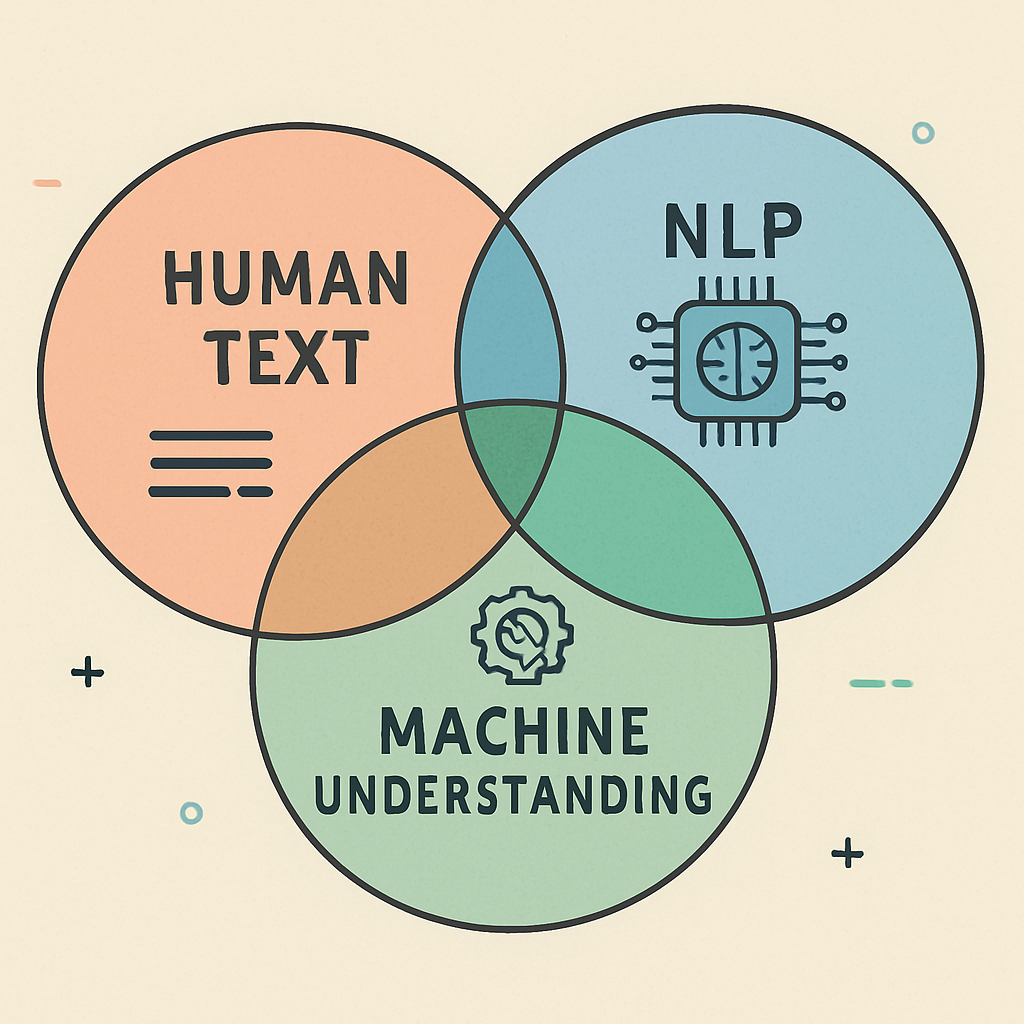
At its most basic level, Sentiment Analysis (also known as Opinion Mining) is a subset of Natural Language Processing. To understand the nuances of Human emotions/feelings/subjective opinions and assign them an analytical number or score, NLP uses Text Analysis, Biometrics, Computational Linguistics, and other tools to enable this process.
How does NLP help computers relate to human emotions? Humans can look at a sentence and quickly figure out whether it has positive or negative sentiment. When we read “this laptop is frustratingly slow,” we instantly know there was a lot of negative sentiment. A computer sees a sentence as nothing but a group of random letters; NLP helps computers learn grammar, context, and the emotional content associated with words.
The Intersection of AI and Human Emotion
Sentiment Analysis can be better understood by looking at how AI (artificial intelligence) categorizes text. Most of the time, sentiment analysis is done by breaking the text into three categories.
- Polish: “I absolutely love this new feature!”
- Negatively: “The customer service was horrible.”
- Neutral: “The package arrived on Tuesday.”
However, sentiment analysis has evolved rapidly over the years. It now often integrates emotion recognition as part of AI; therefore, in addition to recognizing whether someone expressed an opinion positively or negatively, AI also recognizes other emotions such as joy, anger, fear, sadness, and surprise.
Fact vs. Opinion
An essential part of the overall approach outlined above is distinguishing between subjectivity and objectivity in NLP. Before an NLP engine may be able to conclude whether an opinion expressed in text is positive or negative, it must first be able to find that opinion in the text.
- Objective statement: “This camera comes with a 12 megapixel image sensor.” (Does contain no sentiment.)
- Subjective statement: “With a 12-megapixel camera, you will capture some truly stunning and colorful photographs!” (Does contain positive sentiment.)
By removing purely factual statements from the output, we will have our sentiment engine use its computational resources only on subjective comments. This leads to cleaner and therefore more precise results.
Sentiment Analysis Example Classification
| Cutomer Review | Sentiment |
|---|---|
| "This product is amazing and exceeded my expectations" | Positive |
| "The delivery was okay, but nothing special" | Neutral |
| "I am disappointed with the quality and support" | Negative |
| "The phone is great, but the battery life is poor" | Mixed |
Example Insight
Sentiment analysis systems automatically categorize customer opinions to help businesses understand user satisfaction.
Source:
https://developers.google.com/machine-learning/problem-framing/cases
Sentiment Analysis in NLP: Sentiment analysis in NLP helps identify emotions, opinions, and attitudes expressed in text data

The ability to determine how someone feels when they communicate about something using a computer program is called Sentiment Analysis in NLP. The way this is done is to classify the text an individual creates as positive, negative, or neutral – and even sometimes more specific than just those three categories, such as happy, angry, frustrated, etc. Using Sentiment Analysis in NLP allows businesses to know how customers truly feel on a large scale.
For instance, in customer service, using Sentiment Analysis in NLP could help alert a business’s staff that a person who sent a message was upset, direct that unhappy message to a more experienced agent, and see whether the reply improved that customer’s happiness.
For instance, in Social Listening, Sentiment Analysis in NLP can quickly summarize public reactions to a new product launch, campaign, etc., within minutes of it happening. Plus, in Human Resources (HR) and Internal Communications, using Sentiment Analysis in NLP can identify trends in employee morale from surveys or anonymous feedback, allowing leadership to address concerns before issues grow.
There are many modern ways to do this by combining scoring techniques that rely on dictionaries with Machine Learning & Deep Learning techniques that create sentiment detection algorithms based upon training data, where each piece of data is annotated with the correct sentiment.
To perform Sentiment Analysis in NLP you would typically take the original text, remove unwanted items (such as extra spaces), handle special characters such as emojis & negations, extract relevant information (or “features”) from the text or replace the text with a mathematical representation (“embedding”), and finally predict which type of sentiment existed – either positive, negative or neutral – or even predict an emotion.
However – because humans speak loosely – there will always be some errors while doing Sentiment Analysis in NLP, including but not limited to: detecting irony; understanding technical jargon used only inside certain industries; and having the ability to adjust for contextual changes (e.g., “sick” means “cool” in slang).
Therefore, good tests will include representative samples from your data sets and include a method for tracking whether the model continues to work correctly over time (i.e., “drift”).
To further increase accuracy, companies need to build customized models that fit their business/industry needs – adding company-specific terminology and annotating examples of real-world user-created content. Companies can also set boundaries around the confidence levels that exist for predictions made using Sentiment Analysis in NLP.
If the predicted confidence level falls below a threshold, instead of automatically acting on a prediction, send it to a human reviewer. Companies should also report on how Sentiment Analysis in NLP varies across communication channels, geographic regions, and demographics. Finally, privacy is important. Sensitive text should be reduced as much as possible, anonymized, and kept safe.
Once all of the above conditions have been met, the results of using Sentiment Analysis in NLP can provide trustworthiness for input for creating roadmaps for products/services and improving existing services.
Overall – Sentiment Analysis in NLP converts unstructured natural language text into structured, actionable data. When combined with reporting tools and qualitative reviews, Sentiment Analysis in NLP enables quicker decision-making, more personalized customer experiences through empathetic responses, and ultimately better products because it measures emotions/opinions/attitudes that cannot be measured simply using statistics.
Example
Beginning of Text A major coffee retailer runs an NLP-based sentiment analysis on 50,000 app comments per week to identify customer attitudes toward their brand. The NLP tool identifies whether the comment is positive, negative, or neutral; it also determines which emotion is present (i.e., happiness, frustration). After introducing a new oat milk product, the NLP dashboard indicated a significant spike in “negative-confused” sentiment in comments containing words such as “extra charge” and “we didn’t know about this.”
Following this discovery, managers modified the menus of their mobile application; they also waived fees for loyalty members. Two weeks after making these changes, both sentiment toward the company’s products and overall average ratings increased significantly, from 3.9 to 4.4. These results provided evidence that the company had addressed its customers’ actual concerns, which they expressed through both online forum posts and in-store survey responses.
AI Language Models Explained Clearly Without Coding
NLP Used in Sentiment Analysis: NLP is used in sentiment analysis to understand language patterns, context, and user opinions accurately

NLP used in Sentiment Analysis enables systems to analyze human communication in a structured way, supporting opinion analysis and assessment. Unlike simply identifying positive and negative terms, NLP used in Sentiment Analysis identifies the actual ways people communicate through grammatical structure, contextual relationships, and inferred purpose. This matters due to the fact that a single term can reverse its sentiment based upon the context in which it was stated (e.g., “Not bad” vs. “I wanted more”).
The standard workflow is an example of how NLP used in Sentiment Analysis can enhance the accuracy of the process. The first step is to clean and normalize the text. Second, the text is tokenized and tagged by the model to identify each part of speech and regular phrases. Third, NLP used in Sentiment Analysis addresses linguistic aspects such as negations (“no”), intensifiers (“very disappointed”), and modifiers (“somewhat better”). Most current models use embeddings to capture semantics, enabling NLP for Sentiment Analysis to identify similar opinions regardless of the exact words used.
It is also at this point that NLP used in Sentiment Analysis is most valuable. A number of features, including sarcasm, jargon, and domain-specific terminology, may cause simplistic rule sets to fail; therefore, many teams will adjust their models using industry-specific data. Once adjusted, NLP used for Sentiment Analysis can more effectively determine whether the phrase “killer feature” represents praise or “fine” indicates satisfaction or discontent. If the input contains multiple languages, NLP used for Sentiment Analysis can detect which languages are present and provide consistent sentiment scores across all languages.
Example
The chatbots in health care use Natural Language Processing (NLP) to identify a user’s emotional state from their wording, distinguishing when they are expressing concern about their health from when they are simply asking a routine question. The user typed “My chest is tight, but it’s probably nothing.” The dependency parser and negation handler noted that “probably” indicated less-than-serious concern; however, “tightly,” located near “chest,” clearly signaled potential danger.
The classifier therefore identified this message as negative-high-urgency rather than neutral and activated an appropriate safety response: asking for additional information about the person’s other symptoms and suggesting they seek immediate medical attention. On the other hand, when a second user wrote “I have a tight deadline at work, but I’m fine,” those exact same words were found to convey two different meanings based upon the context provided by each user; thus, they yielded neutral sentiment.
Sentiment Analysis Work in NLP: Sentiment analysis works in NLP by processing text, extracting meaning, and determining emotional sentiment

At a high level, the Sentiment Analysis Work in NLP process is a pipeline. First, Sentiment Analysis Work in NLP preprocesses text by cleaning it (removing unwanted items such as extra whitespace), normalizing it (to remove variations in wording or spelling and to handle cases), and tokenizing it into smaller units of language. Then, Sentiment Analysis in NLP uses its linguistic abilities (i.e., its ability to recognize certain features of the text) to identify elements that provide clues about the overall emotional tone.
For example, when analyzing customer feedback for a product or service, Sentiment Analysis work in NLP will look at negative expressions (“I am not happy”) and emphasize positive expressions (“This has been extremely helpful”). Additionally, Sentiment Analysis work in NLP identifies contextual information such as emojis and punctuation. Both of these processes help to increase the reliability of Sentiment Analysis in NLP across all forms of writing.
Following this stage are either feature extraction or representation learning. Traditional methods of Sentiment Analysis work in NLP use techniques such as n-grams and sentiment lexicons to identify specific patterns or “sentiment” within text. Modern approaches, however, have come to rely on embeddings generated by machine-learning or deep-learning models that attempt to represent both the semantic content of the text (what does the text mean?) and the context in which it was written (how did they feel?).
The output from this stage is then fed into an algorithmic structure known as a classifier or sequence model, where the text’s predicted polarity is identified (i.e., Positive/Negative/Neutral). Alternatively, depending on the needs of your application, you could also train your classifier to predict one of several categories representing emotions or other subjective characteristics (e.g., joy/sadness/etc.)
Sentiment Analysis Work in NLP is typically evaluated using performance metrics that measure how accurately the classifier performs against a labeled dataset. To further improve the reliability of Sentiment Analysis in NLP, teams periodically evaluate their classifiers to ensure accuracy remains relatively stable over time. Additionally, teams set confidence thresholds for low-certainty classifications; if the classifier cannot determine with sufficient confidence whether a piece of text should be classified as positive, neutral, or negative, that classification is reviewed manually by a team member.
As language is constantly evolving, there is always a need to retrain and adapt your classifier to new and emerging terminology. When done correctly, Sentiment Analysis work in NLP provides a highly reliable method for analyzing public opinion, assessing brand reputation, and identifying potential issues from very large amounts of text.
Example
At an e-commerce retailer, a sentiment analysis task in Natural Language Processing (NLP) begins when return-reason comments are entered via the checkout form. From there, the process of cleaning and formatting text is done, as well as expanding contractions such as “definitely.” Normalizing spelling errors, for example, would convert “definately” to “definitely,” so that it can be compared to other similar words.
Tokenization and Lemmatization identify all word forms that mean the same thing. For example, the words “scratch”, “scratches”, and “scratching” are all mapped to the same meaning. A Model is used to determine Polarity and a Score. Aspect Extraction identifies the sentiment associated with terms such as “Packaging”, “Delivery”, and similar terms. As soon as “Delivery” shows a sharp decline in its overall sentiment score, Analysts look more closely at Phrases that indicate the customer was told “your package left in the rain” and/or had “No Knock”.
This will prompt the logistics team to update their shipping carrier instructions. Therefore, the overall Delivery Sentiment Score increases by 0.22 for the entire next month. In addition to changing their Shipping Carrier Instructions, they add Photo Prompts. This leads to fewer Vague Comments; therefore, the Quality of Training Data for the Model greatly increased.
The Mechanics: How Sentiment Scoring Works
A computer does not simply make an educated guess when it evaluates a subjective sentence as having a certain amount of sentiment. To effectively implement such systems, you will need to understand how they assign sentiment scores.
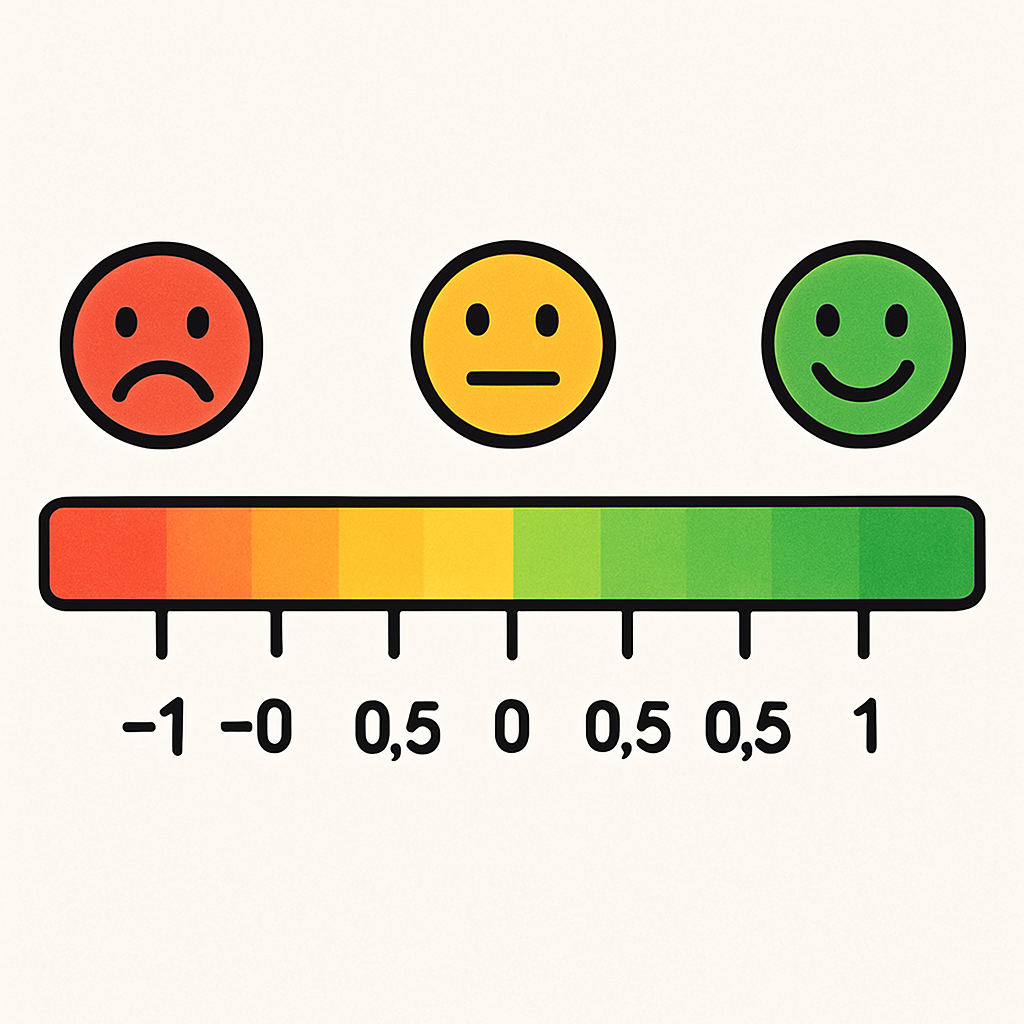
Sentiment Score: The numerical representation of the emotional polarity of a piece of text. Sentiment scores are typically represented as a number between -1 (very negative) and +1 (very positive), with 0 indicating neutral.
Going Beyond Good and Bad
Binary systems for evaluating whether comments are positive or negative have proven effective in many ways; however, new uses of comment analysis require additional levels of detail. Fine-Grained Sentiment Classification provides this level of detail by replacing binary responses with multiple sentiment ratings on a continuous scale based upon a 5-star model (or similar):
- Very Negative (e.g., “This was the most terrible experience I’ve had.”)
- Negative (e.g., “I’m unhappy with the quality of this product.”)
- Neutral (e.g., “It’s good enough, no big deal.”)
- Positive (e.g., “Good job. Satisfied.”)
- Very Positive (e.g., “Fantastic. I would definitely recommend it.”)
Utilizing fine-grained classifications allows organizations to assess small changes in customers’ overall satisfaction. For example, if an organization has a very large number of customers that rate their products as Very Positive, one or two percent may begin to rate them as just Positive. Although this represents only a relatively small decline in customer satisfaction compared with the prior year, the use of fine-grained classification may indicate that many customers are beginning to lose interest in the company’s products and services.
Sentiment Scoring Framework
| Sentiment Score | Interpretation |
|---|---|
| +1.0 to +0.5 | Strongly Positive |
| +0.5 to +0.1 | Positive |
| 0 | Neutral |
| -0.1 to -0.5 | Negative |
| -0.5 to -1.0 | Strongly Negative |
Example
Review: “Excellent customer support and fast delivery.”
Sentiment Score: +0.82 (Positive)
Source:
https://vader-sentiment.readthedocs.io/en/latest/
Preparing the Data: The Foundation of Good Analysis
How good machine learning models are depends entirely on the quality of the data they are given. The raw text found online is full of errors and irregularities, such as typos, emojis, unorthodox punctuation, and slang, making it unusable for meaningful evaluation until it has been preprocessed and formatted for use with an algorithm.
Preprocessing is generally considered one of the most important components of an NLP pipeline for opinion mining. Below is the typical order of operations used during the preprocessing stage of an opinion mining project:
- Lowercase all text: lowercase conversion takes care of the problem of case sensitivity, so “Great” and “Great” would both be treated identically by the algorithm.
- Punctuation/special character removal: any non-essential punctuation marks or special characters, i.e., Commas, periods, etc., should be removed from the text before processing because these items do not add any value to the meaning of the text while also helping to prevent distractions from the words themselves (in some cases however, punctuation that indicates emotion is retained – e.g. “!”).
- Tokenization: Tokenization breaks up large sentences into separate tokens or word/phrase groups. For example, “i love NLP” would become “[“i”, “love,” “NLP”]”.
- Removing stop words: a stop word is a common word such as “the”, “is,” “and,” “in” that does not contribute to a subjective assessment of a product/service. Since stop words have little, if any, bearing on the overall subjectivity or objectivity of a product/service, removing them eliminates superfluous work for the algorithm and allows it to concentrate on words that do bear some relationship to a subjective assessment.
- Lemma extraction/stemming: In addition to reducing each word to its basic stem, lemmatizing reduces each word to a form that fits linguistically within the context of a valid word found in a dictionary.
Practical advice: do not skip thorough preprocessing. Although there may be times when it seems easier to simply feed raw social media text into a sentiment classification algorithm for analysis, the amount of “noise” contained in this type of raw text will almost always reduce your accuracy rate dramatically.
NLP Sentiment Analysis Workflow
| Step | Process |
|---|---|
| 1 | Collect text data |
| 2 | Remove noise and special characters |
| 3 | Tokenize words |
| 4 | Analyze language patterns |
| 5 | Apply sentiment model |
| 6 | Generate sentiment score |
| 7 | Visualize insights |
Example
A company analyzes 10,000 customer reviews to identify recurring complaints and satisfaction trends.
Source:
https://www.ibm.com/topics/natural-language-processing
Under the Hood: Approaches and Algorithms
Once the data has been thoroughly cleaned, it is passed to the analytical engine. So what drives a decision by the analytical engine? That question leads to another important consideration in designing your NLP model: the debate between machine learning and rule-based sentiment analysis. We will discuss each in detail as well as their respective algorithms.
Rule-Based Sentiment Analysis
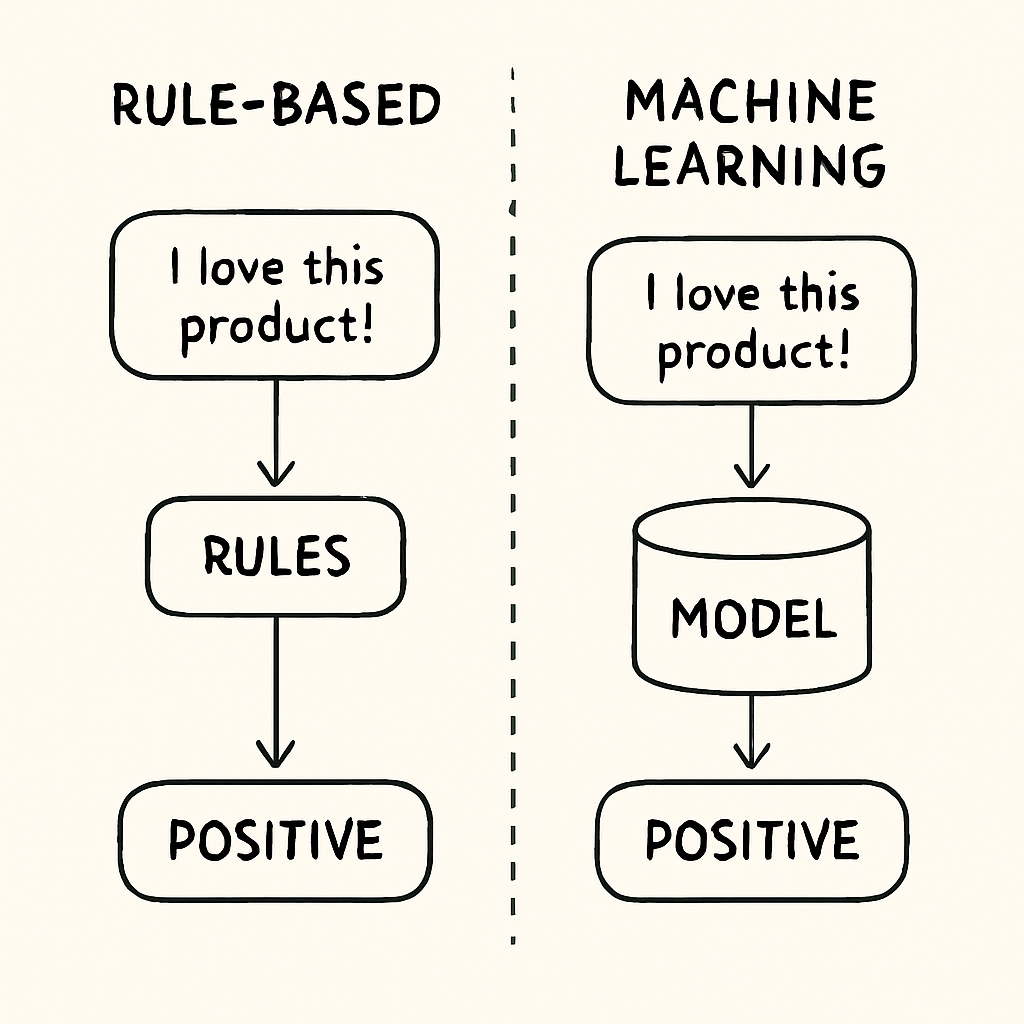
Rule-based systems are also referred to as lexicon-based methods. This type of approach relies on hand-built dictionaries or lists of words that have been pre-assigned a value based on their presumed sentiment, used to determine how likely a word is to reflect something positive or negative about a product or service.
- For example, you would assign a plus (+) value to a word like “excellent” and a minus (-) value to a word such as “terrible.” For example: excellent = + .8; terrible = – .9.
Each time you want to analyze a sentence, you simply count all the positive words and all the negative words and calculate your average sentiment by dividing the total of all positive values by the total of all negative values. The advantage of using this method is that it is very simple to establish and very transparent. However, there are many limitations. It does not account well for context and idioms and can even cause errors when using phrases that contain two opposing values (for example, “not bad” could be viewed as negative because the phrase contains the word “bad”).
Machine Learning Sentiment Analysis
Most machine learning systems for sentiment analysis are trained using large amounts of labeled text that have already been reviewed and analyzed by people. The system can then use this training data to identify which combinations and word contexts are associated with positive or negative feelings.
There are several popular methods used for sentiment analysis in machine learning, including:
- naive bayes: naive bayes uses the frequency of a specific word in relation to other words when determining if it relates to a positive or negative feeling.
- Support vector machine (SVM): An SVM creates an n-dimensional map in which each dimension represents a feature. It then identifies which point best divides the two categories.
- Long short-term memory (LSTM) deep learning models: LSTMs are very good at remembering sequences of events. They provide additional information about context.
The Magic of Word Embeddings
One of the many groundbreaking developments in NLP that greatly improved how Machine Learning Models were trained was the introduction of word embeddings.
Word Embeddings can play a huge role in the ability of algorithms to classify the Sentiment of an item. Algorithms do not see letters; they simply look at numbers.
Word Embeddings represent words as high-dimensional vectors. Technologies such as Word2Vec and GloVe, along with recent transformer technologies such as BERT represent words by looking at their relationship within context.
In this representation, each word’s vector will be closer to a synonym than a non-related word. Words with similar emotional weights (such as horrible and awful) will be grouped together. Therefore, the AI does not need to have these items programmed into it by a human.
Traditional vs AI-Powered Sentiment Analysis
| Feature | Rule-Based Analysis | AI/ML - Based Analysis |
|---|---|---|
| Setup | Manual rules | Model training |
| Accuracy | Moderate | Higher |
| Scalability | Limited | Excellent |
| Context Understanding | Low | High |
| Sarcasm Detection | Poor | Better |
| Adaptability | Low | High |
Statistic
Modern transformer-based NLP models significantly outperform traditional rule-based sentiment systems on many benchmark tasks.
Source:
https://huggingface.co/docs/transformers/index
Sentiment Analysis Algorithms: Sentiment analysis algorithms classify text as positive, negative, or neutral using machine learning and NLP techniques

Sentiment Analysis Algorithms utilize machine learning techniques combined with natural language processing (NLP) to classify text as positive, negative, or neutral based on its linguistic structure and vocabulary. Many Sentiment Analysis Applications rely heavily upon algorithms that process text through multiple steps. For example, Product Reviews, Social Media Reactions, and Brand Perception are common applications of Sentiment Analysis that also apply Sentiment Analysis Algorithms.
Historically, early forms of Sentiment Analysis Algorithms used Rule-Based Systems and Lexicons. The Lexicon was a list of predefined words, each assigned a value based on its emotional connotations. Examples included “Excellent” and “Terrible”. Although Rule-Based Systems and Lexicons enabled rapid analysis of large volumes of data, they had several limitations. A primary limitation of Rule-Based Systems and Lexicons was their inability to effectively analyze complex relationships within text, including Negation and Sarcasm.
With advances in machine learning, newer Sentiment Analysis Algorithms have emerged that utilize Supervised Learning Techniques. These newer Sentiment Analysis Algorithms use labeled examples to train models to recognize patterns and phrases that typically indicate sentiment in a specific domain. Logistic Regression, Support Vector Machines, and Gradient Boosted Trees are some of the most common machine learning algorithms used today.
In addition to using traditional machine learning techniques, many current Sentiment Analysis Algorithms utilize Deep Learning Techniques. One common deep learning technique used in Sentiment Analysis is the Convolutional Neural Network (CNN). Additionally, CNN’s for Text and Transformer-Based Models are being utilized to develop Sentiment Analysis Algorithms.
These newer techniques allow Sentiment Analysis Algorithms to analyze complex relationships such as negation and sarcasm. They do this by developing word and sentence-level representations. As an example, if a customer states “this isn’t terrible”, the previous Sentiment Analysis Algorithm may have indicated a neutral or slightly negative sentiment. However, utilizing a Recurrent Neural Network or CNN will allow the algorithm to determine that the statement implies a slight positive sentiment due to the negation of the term “terrible”.
As previously mentioned, the use of deep learning techniques has significantly increased the overall accuracy of Sentiment Analysis in Natural Language Processing (NLP).
There are numerous stages involved in building a Sentiment Analysis Algorithm. Preprocessing is one stage. It involves tokenizing the text into individual words (or tokens), normalizing it, and handling non-standard characters such as emojis. Another stage is feature extraction or embedding generation. Finally, the last stage is to assign a sentiment label and a confidence score to each piece of input text.
Evaluating Sentiment Analysis Algorithms is critical. Teams evaluate their Sentiment Analysis Algorithms on real user-generated content, monitor how quickly language evolves over time, and adjust their models to meet industry-specific standards (such as financial services, healthcare, or retail/e-commerce).
Ultimately, the choice of approach will depend on both your goals and constraints. Lighter-weight Sentiment Analysis Algorithms will be sufficient for high-volume dashboard purposes. Conversely, Transformer Models provide greater nuance when that detail is required.
Example
A finance technology (fintech) team tested and evaluated several different sentiment analysis models on 20,000 loan application email messages that were all previously labeled. A Naïve Bayes baseline performed fairly well; it flagged “Thank you” as positive sentiment but did not consider the context when it read “Thanks for rejecting me.” The team then used an SVM model trained using bigram features to improve its ability to identify negation in sentences; however, it still struggled with emojis and slang.
The team then fine-tuned a transformer-based model, specifically trained on their domain’s training data, and added a unique token to include the account ID for each email. The transformer model interpreted “Payment has been successfully posted 🙌” as positive sentiment and “Posted… again?” as negative.
In their A/B routing test, they routed high-confidence negative-sentiment messages to senior customer service representatives, resulting in an 18% decrease in escalated complaints. They also implemented a review of lower confidence messages so they could avoid sending costly messages in production due to incorrect classification
Diving Deeper: Advanced Opinion Mining Techniques
With advancements in technology, we can no longer just analyze an individual’s document-level (i.e., a single review) sentiment (positive or negative). Performing modern opinion mining tasks and applications with such precision requires surgical accuracy.
Aspect-Based Sentiment Analysis Explained
Consider a guest leaves the following review of their stay at a hotel: “I thought the view was beautiful; I also found the cleanliness of my room perfect. Unfortunately, I had issues with extremely slow WiFi and horrible service from the staff.”
A common sentiment analyzer may use some form of averaging positive vs. negative word usage and would categorize that review as “neutral”. Categorizing this review as neutral is an enormous oversight. This review provides the hotel manager with no usable information.
This is how you will use Aspect-Based Sentiment Analysis (as I described above), as it is a perfect fit for this. Aspect-Based Sentiment Analysis (ABSA) analyzes text to identify both the “aspect” the customer is discussing and the exact sentiment associated with that feature of the product or service.
For example, if the customer states: “The hotel had a great room at a great price.” An ABSA Model would report:
- Location: The customer has a Highly Positive Sentiment regarding the location (breathtaking)
- Room Cleanliness: The customer has a Positive Sentiment toward the cleanliness of the room (spotless)
- WiFi: The customer has a Highly Negative Sentiment toward the WiFi speed (agonizingly slow)
- Staff: The customer has a Negative Sentiment toward the staff (rude)
If you can perform ABSA on your customers’ comments, you can quickly determine which aspects of your business need improvement, where to focus, and which features to emphasize in your marketing efforts.
The Roadblocks: Challenges in Sentiment Analysis
Beyond tremendous advancements in artificial intelligence, there remain vast differences in complexity, messiness, and subjectivity in human language. As developers build out sentiment pipeline systems, they have to get through some of the biggest barriers.
1. The Complexities of Context and Nuance
For example, a single word can be extremely positive in one instance but devastatingly negative in another. The battery for my laptop was reviewed with the comment, “It is completely unpredictable.” This would be considered a very negative sentiment. On the other hand, I read a mystery novel and said that “the plot was completely unpredictable.” This was a glowing endorsement.
2. The Nightmare of Sarcasm and Irony
The hardest part of Natural Language Processing (NLP) could be detecting sarcasm from natural language. Sarcasm is a form of communication that expresses the opposite of what one really means.
When a person tweets to an Airline about their flight being delayed for four hours and says, “Oh Brilliant! Another 4-hour delay. That’s exactly how I want to spend my Friday”, most Sentiment Analysis algorithms will look at the words “Brilliant” & “Exactly How I Wanted” and conclude that this is a very Positive Interaction with the Airline.
To detect sarcasm, the artificial intelligence system has to be able to understand both what people expect from conversations in the world outside the computer program and Conversational Pragmatics, an area of study in Deep Learning that continues to evolve today.
3. Evaluating Success and Model Accuracy
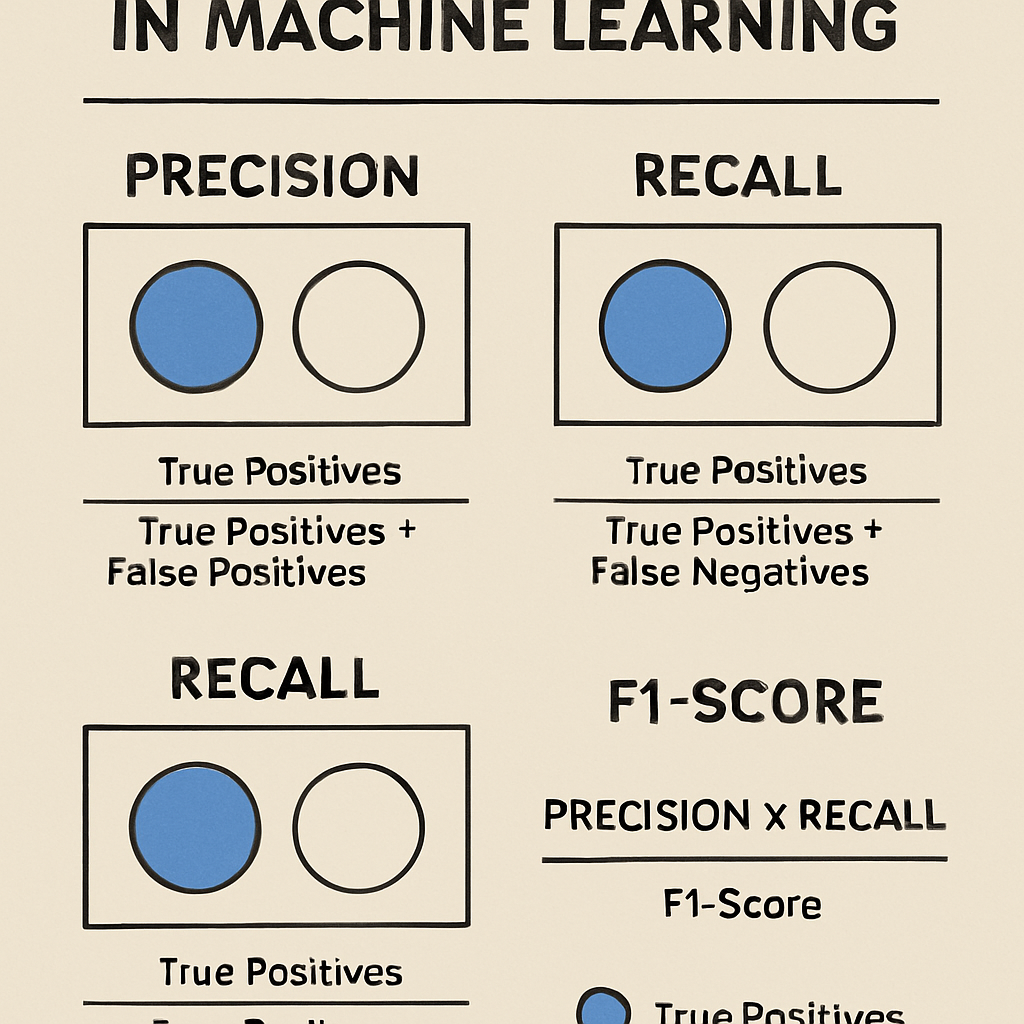
How can you be sure whether or not an algorithm is indeed working? Evaluating the accuracy of the models used for Sentiment Analysis (a machine learning technique to determine the emotion behind a piece of writing) is more than simply determining what percent of predictions were correct.
For example, if a model was trained on a dataset where 90% of reviews were positive and it always guessed ‘positive,’ then it would have 90% accuracy. Therefore, in order to really evaluate a model, data scientists use the following three metrics:
- Precision: What proportion of the time did the model predict that something was going to be classified as “Positive”, when it actually was?
- Recall: Of all the positive things in the test dataset, what portion did the model correctly classify as such?
- F1-Score: The harmonic average of precision and recall; this provides a much better indication of the performance level of the model.
Real-World Impact: Applications and Business Benefits
Companies are spending millions of dollars to learn about “What Is Sentiment Analysis in NLP?” The reason? Data-driven decision-making. There are numerous benefits to using automated text analytics across all departments within an organization, such as marketing and product development.
Transforming Customer Support
The use of natural language processing (NLP) is revolutionizing how support centers function. Rather than prioritizing tickets by the order they were received, many organizations are now using NLP to read incoming messages as they are submitted and determine which should be routed based on the urgency of their emotion.
For example, if a large, long-term client submits a message through a support center’s ticketing process that contains highly negative and emotionally charged words or phrases, the NLP system will automatically send this message directly to a senior retention specialist so that the issue can be addressed quickly enough to prevent the loss of this client.
Protecting Brand Reputation
Given the speed at which information spreads via virality today, a public relations crisis can escalate within minutes. Using Natural Language Processing (NLP) with real-time social media monitoring will serve as an automated smoke detector for your brand.
Marketing teams can monitor the ever-changing sentiment users express about their brands across social media platforms such as X (Twitter), Reddit, and LinkedIn. As a result, if there was a recent software update with a bug that has caused people to begin expressing a large amount of negative sentiment toward your company, or if a recent advertising campaign included content that some have found to be insensitive and has created a negative sentiment toward your company, these issues can be addressed quickly so they do not make mainstream news.
Competitive Analysis
Your company can also use a sentiment analysis algorithm to analyze your competition. Your company can scrape all reviews from a competitor left on Amazon or G2 (for example) and then run aspect-based sentiment analysis on them. The results will tell you which aspect(s) of the product(s) the customer hated most. For example, if your competitor has many complaints about a difficult-to-understand user interface, your sales team can target those customers and highlight how easy your product or platform is to use.
Business Impact & Adoption Statistics
| Business Use Case | Benefit |
|---|---|
| Customer Support | Faster issue resolution |
| Brand Monitoring | Track public opinion |
| Product Reviews | Identify product improvements |
| Scocial Media Analysis | Measure campaign sentiment |
| Market Research | Understand customer needs |
Industry Statistics
| Metric | Result |
|---|---|
| Consumers expecting quick responses | 90% + |
| Businesses using AI for customer insights | Growing rapidly |
| Social media mentions analyzed daily | Millions |
Example
Major brands analyze social media sentiment to detect customer concerns before they become larger issues.
Source:
https://www.salesforce.com/resources/research-reports/state-of-service/
https://sproutsocial.com/insights/social-media-statistics/
Sentiment Analysis Tools: Sentiment analysis tools automatically evaluate customer feedback, reviews, and social media conversations

Customer Service Teams use Sentiment Analysis tools to quickly analyze customer sentiment in customer comments and on social media. Rather than reading each comment individually, Sentiment Analysis tools analyze comments to determine whether the author was positive, negative, or neutral about the service.
Many Sentiment Analysis tools use a somewhat standardized process for collecting and cleaning text data. They either pull text from multiple sources, such as surveys, apps, and chat logs, or allow you to upload your own text files. Once they have collected all this data, they will cleanse it (removing unnecessary characters), format it to ensure consistency across all data sets, and then run it through a machine-learning model.
After running the data through the model, the tool will assign an emotional value to the text. Typically, these values are Positive, Negative, Neutral, or sometimes Emotionally Challenged. Additionally, many of these tools will give you a score indicating how confident they are in the emotion assigned to the text. The tool may also provide you with graphs showing emotional trends. Finally, some tools will send you alerts if there is a spike in negative emotion.
Some of the ways that Customer Experience Teams use Sentiment Analysis Tools include routing angry comments directly into a Priority Queue. Customer Experience Teams can also use Sentiment Analysis to assess the impact of policy changes. Additionally, Sentiment Analysis enables Customer Experience Teams to track overall satisfaction over time.
Marketing Teams use Sentiment Analysis Tools to gauge consumer reaction to campaigns. Marketing Teams can compare their campaign performance against competitors. Sentiment Analysis can also be used to gain insight into consumer perceptions of products by demographic or geographic location.
Product Development Teams use Sentiment Analysis Tools to identify patterns of complaints related to particular products. Product Development Teams can link these complaints back to specific features or events.
The accuracy of Sentiment Analysis Tools varies depending on how well customized they are to the team’s domain and the complexity of their content. Many tools offer options for “domain tuning,” which allows users to teach the model specific terminology unique to their organization. Additionally, many tools offer customizable keyword lists and labeling schemes to help capture nuances of language (e.g., slang or brand-specific terminology).
Good Sentiment Analysis Tools also support multi-lingual data and can differentiate between mixed sentiment expressed in a single piece of user-generated content (e.g., “I love the design, but I hate the price”).
To maintain the reliability of results generated by Sentiment Analysis Tools, teams should regularly review samples of output, retrain models as language evolves, and be vigilant for bias.
Sentiment Analysis Tools convert unstructured conversations into quantifiable insights. When used in combination with a dashboard and/or a qualitative review, Sentiment Analysis helps teams respond rapidly to customer needs, prioritize improvement efforts, and align internally with actual customer sentiment.
Example
A telecom company uses sentiment analysis tools to monitor all three data sources (Twitter, chat transcripts, and NPS survey text) in one workspace. These sentiment analysis tools automatically deduplicate reposts, identify language, and assign confidence ratings to each message. When a storm causes an outage for hours, posts on social media are mostly “negative-angry,” which increases by 300%, and users are asking about ETA’s for updates and why there were no updates.
To help manage the crisis, the social team adds a pinned update every hour while support adds an IVR message and proactive sms. Once service is restored, the tools show how negativity gradually decreased while positive-relief reactions increased. This allows leadership to document their response efforts. Additionally, the tools allow them to export weekly reports to regulators and improve future outage playbooks
Building Your Stack: Sentiment Analysis Tools
Sentiment analysis does not require a Ph.D. in Computer Science. For those who wish to leverage opinion mining, there are a variety of sentiment analysis tools, ranging from beginner-friendly SaaS platforms to advanced developer libraries.
For Developers and Data Scientists
If an organization wishes to develop its own custom NLP pipeline to perform sentiment analysis, it may utilize many free/open source NLP libraries such as:
- NLTK (Natural Language Toolkit): One of the earliest and most influential Python NLP Libraries. As part of its toolset, NLTK offers VADER (Valence Aware Dictionary and Sentiment Reasoner) – a natural language processing toolkit specifically developed for social media data and delivers strong results with symbols/emojis/slang, etc.
- TextBlob: A much easier-to-use alternative to NLTK with the same functionality but less overhead. TextBlob allows developers to receive polarity and subjectivity ratings in only two lines of code.
- Hugging Face: The go-to place for today’s AI/Machine Learning. With Hugging Face, developers can access hundreds of pre-trained, state-of-the-art transformer models (e.g., RoBERTa, BERT) that have been trained and fine-tuned specifically for emotion and sentiment detection.
Breaking the Language Barrier
Our global economy has created enormous interest in using multilingual sentiment analysis tools. Doing this type of analysis requires far more than just analyzing English-language text.
Major cloud providers provide very strong APIs that can automatically detect the languages included in the input text; translate those languages (natively) in the background; and then analyze and score the sentiment of each. All three of these major cloud providers, Google Cloud Natural Language API, AWS Comprehend, and IBM Watson, have out-of-the-box multilingual support so you can track and analyze your teams’ reviews, whether they were submitted in Japanese with negative comments or Spanish as recommendations.
Best Practices for Implementing Sentiment Analysis
To maximize Return On Investment (ROI) when utilizing sentiment analysis within your organization, implement the following:
- Train Your Models Using Domain-Specific Data: Training an algorithm on movie reviews from IMDb, for instance, will produce unacceptable results when applied to evaluating financial statements. Therefore, always train your models on data that includes terms specific to your industry or sector.
- Use Sentiment Analysis Combined With Metadata: The value of a sentiment score is only as good as the information it represents. When combined with metadata such as user demographic data, purchasing history, and geographical location, you can gain a much better understanding of what may be occurring. For example, why do European millennials display negative sentiments towards the checkout process at your site?
- Keep Humans Involved in Sentiment Analysis Evaluations: As previously discussed, artificial intelligence (AI) is not flawless. Due to the above-mentioned challenges in detecting sarcasm in written communication and the contextual complexities involved, it is essential to manually audit your model’s evaluations at random intervals to ensure accuracy over time.
Conclusion
So, What Is Sentiment Analysis in NLP? Sentiment analysis is so much more than just a fad – it is the glue that binds computers to the way we feel when we communicate with each other.
Sentiment analysis technology runs the gamut from simple text pre-processing techniques used to mine opinions to sophisticated neural networks that use word embeddings to classify sentiment; this is an incredible example of how computers can be designed to do things today.
The ability of businesses to listen to their customers’ feelings at scale through advanced, multilingual sentiment analysis tools and AI-based emotion recognition systems will continue to improve as these technologies evolve.
Companies that have already moved toward real-time social media monitoring using NLP (Natural Language Processing) and have leveraged automation for text analytics in business will not only thrive in the digital age but also deliver the level of service their customers expect and deserve. In addition, they will be able to differentiate themselves from others by providing a higher-quality product or service and ultimately create long-lasting relationships with their customers based on that trust.
If you are either a developer looking to explore machine learning or a business leader looking to take advantage of the latest developments in Natural Language Processing (NLP) for the improvement of customer experiences, there has never been a better time to begin hearing what your data wants you to know.
FAQs
1) What is sentiment analysis in NLP?
Sentiment analysis in NLP is the use of natural language processing techniques to detect and classify the emotional tone in text—typically as positive, negative, or neutral, and sometimes as specific emotions like joy, anger, or frustration.
2) How does sentiment analysis work in NLP?
It usually follows a pipeline: collect text – clean and preprocess (tokenize, normalize, remove noise) – convert text into features/embeddings – run a model to predict sentiment – output a label and/or sentiment score with confidence.
3) What are the main approaches to sentiment analysis?
The two most common approaches are rule-based (lexicon/dictionary scoring) and machine-learning/deep-learning methods trained on labeled data. Deep-learning models often perform better when context and nuance matter.
4) Why is sentiment analysis sometimes inaccurate?
Language can be ambiguous. Sarcasm, slang, domain-specific meanings, mixed sentiment in one sentence, and limited training data can all reduce accuracy – especially if the model isn’t tuned for the specific industry or text source.
5) What are common uses of sentiment analysis for businesses?
Businesses use it to analyze reviews and survey comments, prioritize customer support tickets, monitor brand reputation on social media, compare competitors, and identify which product features customers praise or complain about.

Garikapati Bullivenkaiah is a seasoned entrepreneur with a rich multidisciplinary academic foundation—including LL.B., LL.M., M.A., and M.B.A. degrees—that uniquely blend legal insight, managerial acumen, and sociocultural understanding. Driven by vision and integrity, he leads his own enterprise with a strategic mindset informed by rigorous legal training and advanced business education. His strong analytical skills, honed through legal and management disciplines, empower him to navigate complex challenges, mitigate risks, and foster growth in diverse sectors. Committed to delivering value, Garikapati’s entrepreneurial journey is characterized by innovative approaches, ethical leadership, and the ability to convert cross-domain knowledge into practical, client-focused solutions.