










Executive Summary
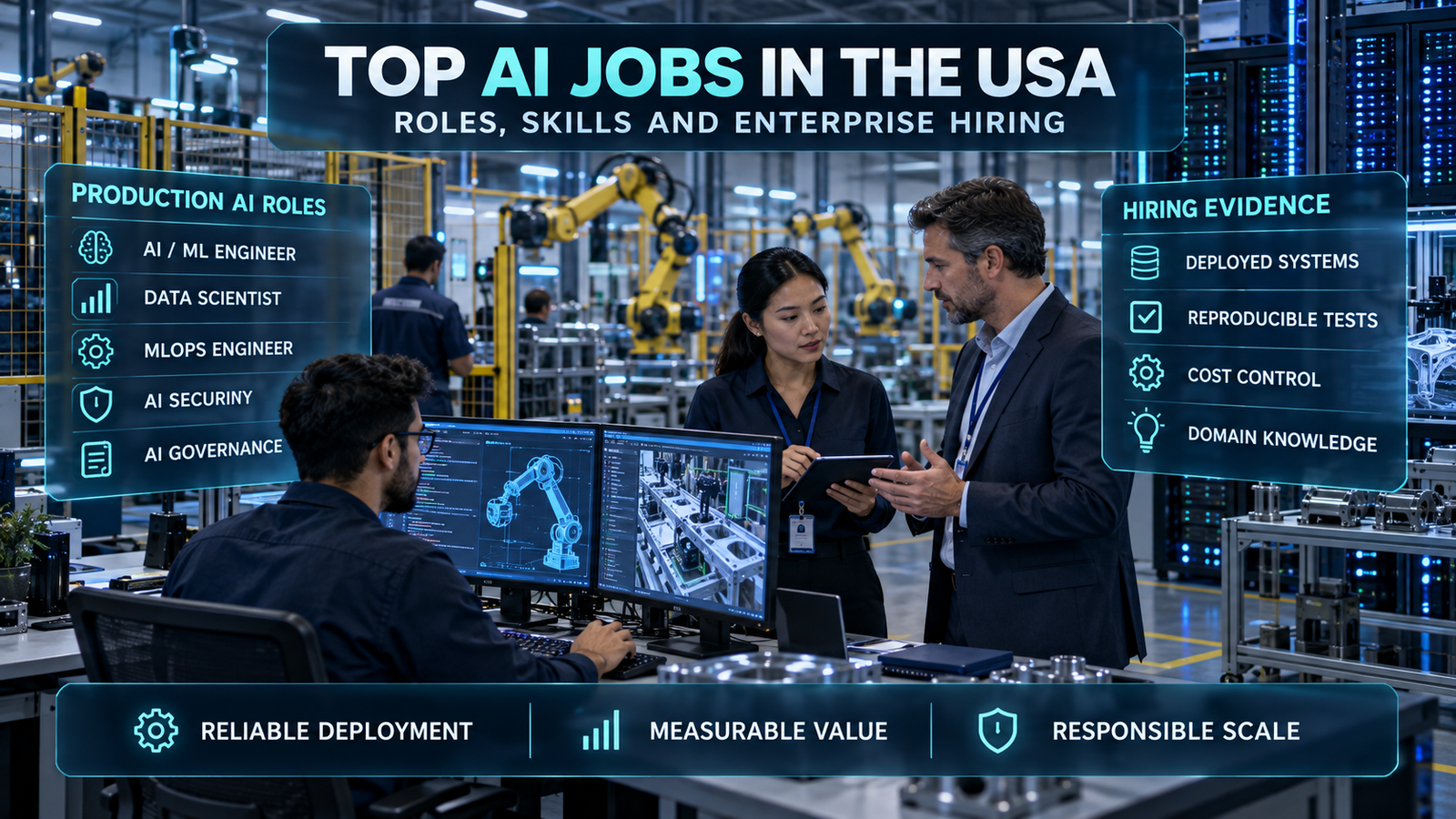
AI jobs in the USA are moving away from isolated model experiments and into production engineering, evaluation, security, product management and governance. For employers, the constraint is no longer simply finding someone who knows Python; it is assembling teams that can connect data, models, enterprise software, cloud infrastructure, controls and measurable business outcomes.
The salary story needs discipline. The U.S. Bureau of Labor Statistics does not publish a single national wage for “AI engineer,” “prompt engineer” or “MLOps engineer,” so this Article uses the closest established occupational categories and labels them as proxies rather than pretending they are exact title-level benchmarks.
The latest BLS profiles report May 2025 median annual wages of $120,230 for data scientists, $135,980 for software developers, $140,300 for computer and information research scientists, $129,180 for information security analysts and $88,940 for operations research analysts. Their projected 2025–2035 growth rates range from 10% to 35%, compared with 3% for all occupations. [1][2][3][4][5]
For candidates, the strongest position combines one technical spine with proof of deployment: reliable data, reproducible evaluation, monitored inference, security controls and domain knowledge. For buyers, AI jobs in the USA should be planned as a system of complementary roles, not as a shopping list of fashionable titles.
I. Current Market Landscape and Hiring Challenge
Investment Is Broad, but Hiring Is Selective
Stanford’s 2025 AI Index reported $109.1 billion in U.S. private AI investment during 2024 and said 78% of surveyed organizations used AI, up from 55% a year earlier. Those figures show adoption pressure, but they do not prove that every company has a mature production program or that every AI title is expanding at the same rate. [6]
AI jobs in the USA increasingly sit inside healthcare, finance, retail, manufacturing, logistics, cybersecurity and professional services. Employers are paying for operational capability: integrating models with systems of record, measuring performance, limiting failure, controlling cloud cost and proving compliance.
The market is also bifurcated. Frontier-model laboratories compete for scarce research and distributed-systems talent, while most enterprises need applied engineers, data professionals, product owners, platform staff and risk specialists who can make existing models useful inside constrained workflows.
The Cost of Hiring the Wrong Role
A company can hire a research scientist when the actual bottleneck is poor data engineering. It can hire a prompt specialist when the product needs access control, retrieval quality, evaluation and incident response.
That mismatch creates idle specialists, duplicated tools and pilots that never reach production. AI jobs in the USA generate return only when each role owns a defined failure mode, service level or business metric.
Under-hiring is equally expensive. One “AI engineer” cannot simultaneously own data quality, model development, application integration, cloud reliability, security, legal review, human factors and product adoption without creating hidden operational debt.
Titles Are Noisy; Work Products Are More Reliable
The same title can describe very different work. An AI engineer at one company may build retrieval-augmented generation services, while another manages computer-vision inference on edge devices and a third configures vendor APIs.
Enterprise AI hiring should therefore begin with artifacts and decisions. Specify the datasets, interfaces, evaluation gates, latency budgets, availability targets, regulatory obligations and cost ceilings the employee will own.
AI jobs in the USA are easier to compare when employers publish those operating conditions.
II. Top AI Jobs in the USA: Role and Salary Evidence
Salary Methodology: Use BLS Proxies Correctly
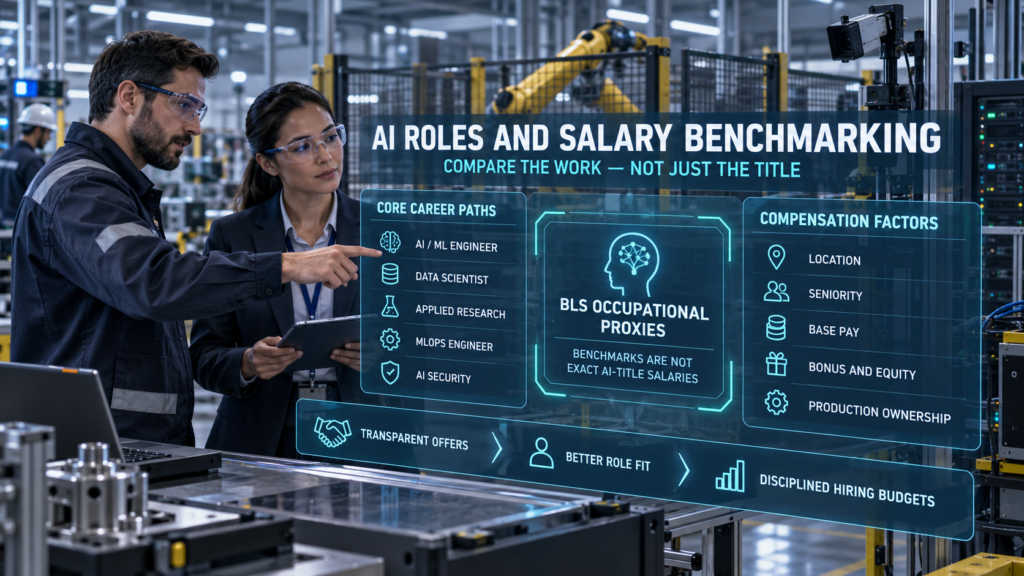
BLS Occupational Employment and Wage Statistics classify established occupations, not every employer-created AI title. The following table maps common AI roles to the nearest defensible BLS category; it is a planning baseline, not an offer calculator.
Location, seniority, equity, bonus, clearance, industry and scarce specialization can move compensation far above or below a national median. AI jobs in the USA should be benchmarked again at state, metropolitan and company level before an offer is approved.
Top Robotics Companies in the USA: Proven 2026 Buyer’s Guide
BLS Occupational Salary and Growth Benchmarks
| Common AI role | Closest BLS proxy | 2025 median pay | 2025–2035 growth | Average annual openings | Evidence caveat |
| Data scientist / decision scientist | Data Scientists | $120,230 | 35% | 24,800 | Includes non-AI analytics roles |
| AI engineer / ML engineer | Software Developers | $135,980 | 10% | Included within 106,100 for developers, QA and testers | AI specialization is not separately priced |
| Applied research scientist | Computer and Information Research Scientists | $140,300 | 22% | 2,900 | Usually more research-intensive and often graduate-level |
| AI security engineer | Information Security Analysts | $129,180 | 21% | 14,100 | Covers security beyond AI systems |
| Optimization / AI operations analyst | Operations Research Analysts | $88,940 | 12% | 7,500 | Includes optimization work without machine learning |
Sources: U.S. Bureau of Labor Statistics, May 2025 wage data and 2025–2035 projections. [1][2][3][4][5]
These figures describe broad occupations, not AI-specific job titles or entry-level offers. Projected annual openings include replacement hiring as well as employment growth; they are not counts of current vacancies. The software-development openings figure combines developers, quality assurance analysts and testers. Compare local wages, experience requirements and the complete compensation package before using these figures in a hiring or career decision.
1. AI and Machine Learning Engineer
This role turns a model or model API into a dependable product capability. Work commonly includes data preparation, feature or retrieval pipelines, model serving, application interfaces, evaluation, logging, observability and rollback.
The closest broad benchmark is software development, with a May 2025 median of $135,980 and 10% projected growth through 2035. BLS specifically links demand to expanding software for AI, robotics, automation and connected products. [3]
Salary estimates for AI engineers vary because employers use the title for different responsibilities. Compare base pay, incentives, equity, location, on-call requirements and production ownership rather than treating one national figure as a precise offer benchmark.
AI jobs in the USA at this layer reward engineers who can debug the entire request path. That means inspecting data lineage, retrieval, model behavior, tool permissions, caching, latency, unit economics and user feedback rather than tuning prompts in isolation.
2. Data Scientist and Decision Scientist
Data scientists frame measurable questions, build analytical or predictive models and translate results into operating decisions. Strong practitioners distinguish correlation from causal claims and communicate uncertainty without hiding it behind a dashboard.
BLS reports a $120,230 median annual wage, 35% projected growth and about 24,800 openings per year for data scientists. The occupation is one of the clearest official signals supporting demand for AI jobs in the USA, though it includes analytics work that may not use advanced AI. [1]
The premium skill is not notebook fluency. It is the ability to define a baseline, prevent leakage, choose decision-relevant metrics, validate subgroup performance and connect model output to an accountable business owner.
3. Applied AI Research Scientist
Applied researchers test new model architectures, optimization methods, multimodal systems, reinforcement learning or domain-specific techniques. Their output must survive reproducibility review and, in commercial settings, eventually connect to product constraints.
Computer and information research scientists had a $140,300 median wage in May 2025 and 22% projected growth through 2035. BLS notes that a master’s degree is typical, although some federal roles accept a bachelor’s degree. [2]
AI jobs in the USA at the research frontier may offer compensation well beyond occupational medians, especially when equity is material. Those exceptional packages should not be presented as the normal salary for an entry-level machine learning role.
4. MLOps and AI Platform Engineer
MLOps engineers build the delivery path around models: registries, pipelines, feature or embedding stores, deployment automation, secrets, observability, cost attribution and incident recovery. The work overlaps software engineering, platform engineering, data engineering and site reliability.
There is no dedicated BLS MLOps occupation. Software developer pay is a useful starting proxy, but recruiters should add evidence-based adjustments for cloud scale, Kubernetes, distributed systems, GPU scheduling, security and production ownership.
AI jobs in the USA at this layer carry premiums when on-call and platform accountability are real.
These AI jobs in the USA matter because models decay operationally even when their weights do not change. Upstream schemas shift, retrieval corpora become stale, vendor endpoints change, traffic grows and latency budgets collapse.
5. AI Product Manager
An AI product manager converts a business decision into product requirements, evaluation criteria, human-review rules and launch gates. The role must understand probabilistic behavior well enough to reject misleading demos and define acceptable residual risk.
Salary comparison is difficult because BLS does not publish a dedicated AI product manager category. Employers should benchmark against their product-management architecture, then price premiums for technical depth, regulated-domain experience and responsibility for commercial outcomes.
AI jobs in the USA on product teams require compensation methods that reflect decision authority.
AI jobs in the USA on the product side require unusually explicit acceptance criteria. “The chatbot feels better” is not a release standard; task completion, groundedness, escalation quality, cost per successful outcome and severe-error rates are closer to operational measures.
6. AI Security Engineer and Red-Team Specialist
AI security work covers model endpoints, training and retrieval data, agent tools, secrets, identity, supply chains and abuse. Failure paths include prompt injection, data exfiltration, insecure output handling, excessive agency, model theft and denial-of-wallet attacks.
Information security analysts recorded a $129,180 median wage and 21% projected growth from 2025 to 2035. BLS links demand partly to growing AI use and the need to secure new technologies. [5]
AI jobs in the USA in this category should not be limited to theatrical jailbreak demonstrations. Teams need threat models, reproducible tests, privilege boundaries, incident playbooks and evidence that mitigations remain active after model or tool changes.
7. AI Governance, Risk and Compliance Specialist
Governance specialists translate laws, standards, contracts and internal risk appetite into operational controls. They maintain inventories, coordinate impact assessments, document accountability, test notices and appeals, and prepare evidence for buyers or regulators.
This is not purely a legal role. Effective specialists understand model lifecycle, data flows, evaluation limits and vendor architecture, while technical teams need enough policy literacy to implement controls correctly.
AI jobs in the USA increasingly reward this combination of technical and regulatory fluency.
AI jobs in the USA are expanding around governance because automated employment, credit, healthcare and consumer systems face existing civil-rights, privacy, security and sector obligations. NIST’s voluntary AI Risk Management Framework supplies a useful Govern–Map–Measure–Manage structure, but it does not create legal immunity. [7]
8. AI Evaluation Engineer
Evaluation engineers design test sets, failure taxonomies, graders, human-review protocols and release thresholds. They measure factuality, safety, robustness, bias, tool use, retrieval performance and the real task outcome.
The role is emerging because generative systems can produce fluent output while failing silently. AI jobs in the USA increasingly separate evaluation from model building so that release decisions receive independent challenge.
Strong evaluators know when an automated judge is unreliable. They estimate sampling uncertainty, preserve difficult cases, monitor distribution shift and trace every score to a versioned model, prompt, dataset and configuration.
9. Data Engineer for AI Systems
Data engineers build ingestion, transformation, quality, lineage, access and retention systems. For generative AI, they may also manage document parsing, chunking, embeddings, permissions and retrieval freshness.
Poor data creates expensive downstream symptoms: unstable training, irrelevant retrieval, privacy leakage and evaluation results that cannot be reproduced. AI jobs in the USA often remain unfilled effectively because companies advertise for model builders while the real constraint is data architecture.
The hiring test should include failure recovery and governance, not only a clean pipeline demo. Candidates should explain late data, schema changes, backfills, access revocation, deletion, lineage and cost control.
10. Optimization and AI Operations Analyst
Operations research analysts use mathematical models to improve scheduling, routing, pricing, inventory and resource allocation. They often create more measurable value than a general-purpose chatbot because the decision, constraint and objective are explicit.
BLS reports a May 2025 median of $88,940, 12% projected growth and roughly 7,500 openings per year. Manufacturing shows a $108,120 median within the occupation, demonstrating how industry context can materially change compensation. [4]
These AI jobs in the USA suit candidates who combine optimization, statistics and domain operations. The work demands stakeholder persuasion because an optimal mathematical answer may be infeasible under labor, safety, service or regulatory constraints.
III. Architecture Overview for Enterprise AI Hiring
The Workforce Architecture
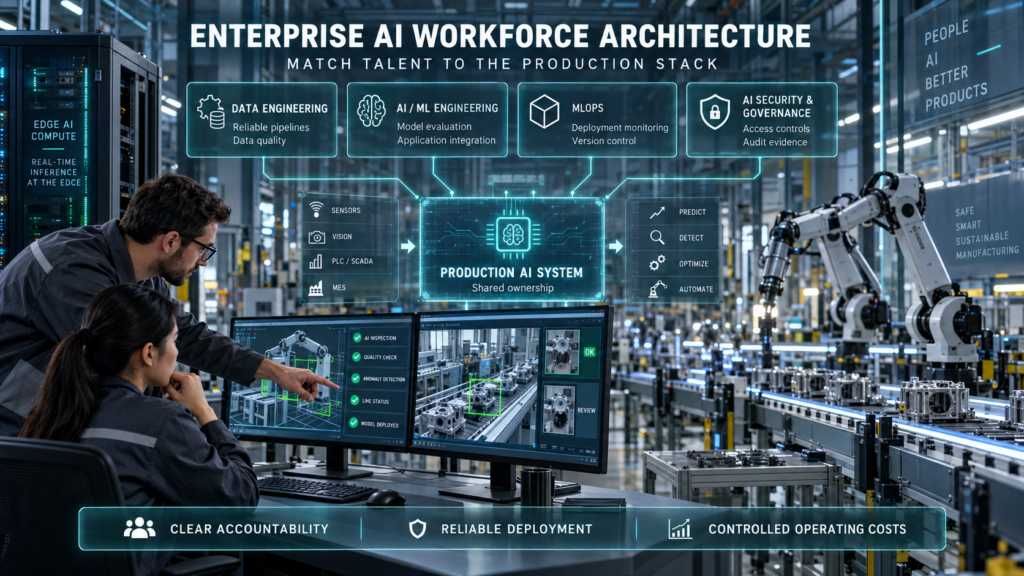
An AI team should mirror the production system it owns. Separate accountability for product outcome, data, model behavior, software delivery, infrastructure, security, evaluation and governance, then make handoffs explicit.
- Business owner: owns the decision, budget and measurable outcome.
- AI product manager: converts the outcome into requirements and release criteria.
- Data engineer: owns reliable, governed data inputs.
- Data scientist or researcher: develops the analytical or model approach.
- AI/ML engineer: integrates the approach into a usable service.
- Platform/MLOps engineer: owns deployment, observability and recovery.
- Evaluation engineer: supplies independent evidence against release thresholds.
- Security and governance specialists: control misuse, legal exposure and auditability.
AI workforce planning should scale these functions by risk and system complexity. A small team may combine roles, but it should never erase accountability for the function.
AI jobs in the USA should map visibly to this workforce architecture.
Integration Flowchart
- Define the outcome: Identify the business decision, desired result and risk level.
- Assign data and model work: Give named owners responsibility for data quality, analysis and model development.
- Evaluate readiness: Test performance, security, relevant subgroup results and operating limitations against agreed thresholds.
- Deploy and monitor: Assign engineering and platform owners for release, observability, recovery and ongoing support.
- Record results: Track business outcomes, incidents, corrections and operating costs.
- Review and improve: Use the evidence to revise the system, controls, staffing or business process through approved change procedures.
AI jobs in the USA create durable value when the feedback path is funded. Production evidence must change training data, prompts, models, controls, staffing and sometimes the underlying business process.
Deployment Challenges
Hidden Technical Debt
Machine-learning systems accumulate dependencies in data, configuration, consumers and feedback loops. Sculley and co-authors documented this risk as hidden technical debt, explaining why a model can represent only a small fraction of the production system. [10]
Enterprise AI hiring that funds only model creation leaves monitoring, rollback, documentation and maintenance unfunded. The initial demo then becomes a fragile service owned by whoever is still available.
AI jobs in the USA must include maintenance ownership before launch.
Compute Cost and Latency
Model quality is not the only engineering target. Teams must control accelerator time, inference tokens, storage, network transfer, retrieval calls and third-party API charges while meeting latency and availability targets.
AI jobs in the USA increasingly include FinOps responsibility. A candidate who can route workloads across model sizes, cache safely, batch requests and measure cost per successful task may deliver more value than one who optimizes a benchmark alone.
AI jobs in the USA are becoming inseparable from compute-cost governance.
Evaluation Drift
A static test set becomes easier to pass and less representative over time. User behavior, products, documents, threats and model versions move faster than a quarterly evaluation spreadsheet.
Evaluation owners need a living corpus, production sampling, incident-derived tests and documented human adjudication. Model Cards research offers a useful precedent for reporting intended use, evaluation conditions and limitations. [11]
AI jobs in the USA need evaluation evidence that survives model replacement.
Vendor and Model Substitution
Cloud platforms can change model versions, safety behavior, rate limits and regional availability. Enterprise applications may also route between models for price or resilience.
AI jobs in the USA at the platform and governance layers must preserve model identity, configuration, vendor notices and revalidation triggers. Otherwise, the approved system and deployed system quietly diverge.
AI jobs in the USA should assign that change-control duty explicitly.
Performance Evaluation Matrix
| Role | Production evidence | Core KPI | Failure signal |
| AI engineer | Versioned service and test report | Successful task rate within cost and latency | Demo works; production errors are untraceable |
| Data scientist | Reproducible analysis and decision memo | Incremental business outcome | Offline accuracy without decision impact |
| MLOps engineer | Deployment, monitoring and rollback evidence | Recovery time and release reliability | Manual releases and unknown model versions |
| Evaluation engineer | Versioned test corpus and adjudication guide | Severe-error detection and coverage | One aggregate score hides critical failures |
| AI security engineer | Threat model and remediation evidence | Risk reduction and response time | Jailbreak screenshots without control validation |
| Governance specialist | Inventory, impact assessment and audit package | Control coverage and closure time | Policies exist but cannot be tied to systems |
| AI product manager | Acceptance criteria and outcome review | Value delivered per governed use case | Adoption metric without quality or risk limits |
IV. Commercial Solutions and Hiring Best Practices
Feature and Cost Comparison Table
The following platforms support different parts of enterprise AI hiring. Pricing and packaging change, so buyers should verify current quotes and include implementation, integrations, recruiter time, data migration, governance and exit costs.
| Platform | Best fit | Relevant capabilities | Pricing approach | Main commercial risk |
| LinkedIn Recruiter | Broad professional sourcing | Network search, candidate outreach, talent-market visibility | Subscription or enterprise agreement | High seat cost without disciplined recruiter workflow |
| Indeed Smart Sourcing | Active and resume-based sourcing | Candidate matching, outreach and employer workflow | Product and market dependent | Match volume can exceed review capacity |
| Eightfold AI | Large-enterprise talent intelligence | Skills inference, acquisition, internal mobility and workforce planning | Enterprise quote | Data integration, bias validation and change management |
| Workday Recruiting | Existing Workday estates | Requisition, workflow, candidate management and HCM integration | Enterprise subscription and modules | Configuration complexity and suite dependency |
No recruiting platform can validate technical competence automatically. AI jobs in the USA require structured work samples, consistent scorecards, trained interviewers and documented human decisions.
AI jobs in the USA still depend on accountable human selection.
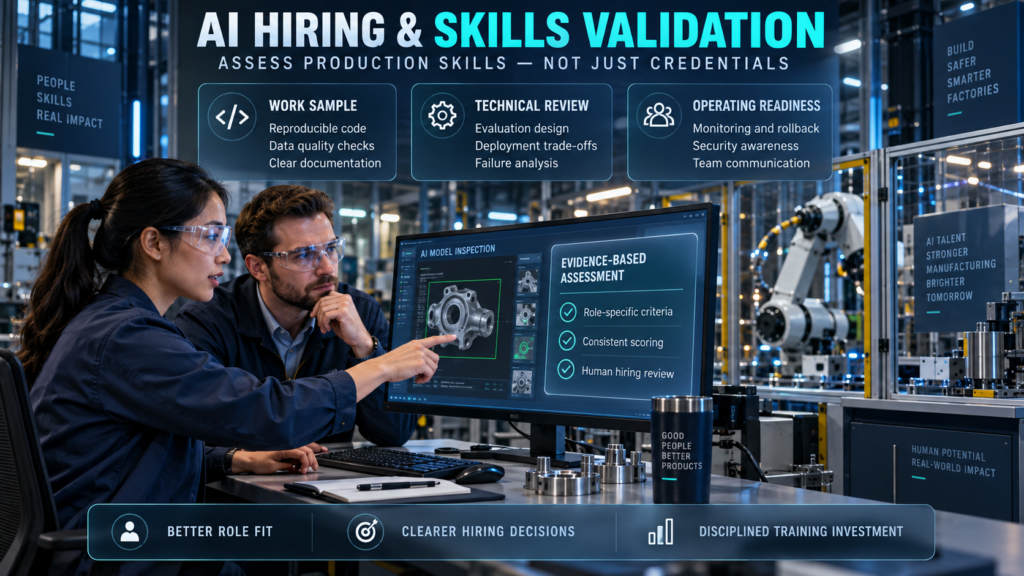
Eight-Gate Hiring Framework
Gate 1: Define the Business Outcome
State the decision, workflow or product outcome the role will own. Remove requirements that do not change the person’s first-year work.
Gate 2: Map the Production Architecture
Identify data sources, models, applications, infrastructure, controls and vendors. This exposes whether the need is research, engineering, analytics, security or governance.
Gate 3: Build a Skills Evidence Matrix
Separate must-have capabilities from learnable tools. For AI jobs in the USA, evidence may include code, design documents, experiment reports, incident reviews, model cards or shipped systems.
Gate 4: Use a Realistic Work Sample
Give candidates a bounded problem with incomplete data, trade-offs and a clear time limit. Score reasoning, assumptions, testing, communication and risk handling rather than presentation polish alone.
Gate 5: Validate Production Judgment
Ask how the candidate would monitor quality, recover from failure, control access and reduce cost. The strongest answer names measurable thresholds and escalation paths.
Gate 6: Price the Role Transparently
Use BLS and regional data as a baseline, then document adjustments for seniority, industry, equity and scarce skills. An AI engineer salary USA benchmark must distinguish base salary from total compensation.
Gate 7: Audit the Selection Process
Automated employment tools can create disability, discrimination and notice risks. New York City Local Law 144, for example, requires specified bias-audit and notice steps for covered automated employment decision tools. [8]
Gate 8: Fund the First 90 Days
Give the hire data access, compute budget, owners, test environments and decision rights. AI jobs in the USA fail when onboarding consists of a vague innovation mandate without production authority.
Leading Quantum Computing Companies in the USA: Proven 2026 Buyer’s Guide
V. Business Outcomes and Strategic ROI
Hiring ROI Is a System Metric
Do not calculate return as salary versus estimated labor savings. Include software licenses, cloud usage, data work, security, legal review, management time and the opportunity cost of delayed deployment.
AI jobs in the USA can produce revenue, cost reduction, risk reduction or faster decisions. Each requisition should specify which value mechanism applies and which executive owns verification.
AI jobs in the USA should be reviewed against realized value after deployment.
Workforce Cost Formula
Annual role cost = cash compensation + recognized equity expense + benefits + recruiting and onboarding + allocated tools and compute + management and control costs.
Measure costs over the same period. Allocate shared expenses consistently and avoid counting the same platform, management or governance cost against multiple roles.
Compare that cost with realized gross-margin contribution, avoided operating cost or quantified risk reduction. Do not label speculative fines or unapproved headcount reductions as guaranteed savings.
Illustrative Team Economics
| Planning input | Applied AI pod | Regulated AI pod | Platform pod |
| Core employees | 5 | 8 | 7 |
| Primary objective | One product workflow | Consequential decision system | Shared deployment platform |
| Major non-pay cost | Inference and integration | Testing, review and compliance | Cloud and observability |
| Expected evidence | Task outcome and unit cost | Performance, fairness and appeals | Reliability, adoption and cost allocation |
| Stop condition | No measurable workflow gain | Unacceptable harm or control gap | Adoption cannot justify platform cost |
This table is a planning structure, not a salary benchmark. AI workforce planning should insert actual compensation, vendor, cloud and review costs for the company and location.
Cost Optimization Rules
- Hire against a funded production bottleneck, not a fashionable title.
- Use smaller models or conventional analytics when they satisfy the requirement.
- Reuse platform, evaluation and governance capabilities across products.
- Track cloud and model costs by use case and accountable owner.
- Build internal mobility paths for software, data, security and domain staff.
- Remove duplicate tools before expanding the recruiting technology stack.
AI jobs in the USA become less expensive per use case when shared controls and infrastructure are mature. Centralization still needs boundaries so one platform team does not become a release bottleneck.
VI. 2026 Hiring Trends That Matter
Prompt Engineering Is Becoming a Skill, Not a Department
Prompt design remains useful, but durable roles usually include evaluation, workflow design, domain expertise, integration or product ownership. A title built around prompts alone is vulnerable as interfaces and models improve.
AI jobs in the USA are consolidating prompt work into broader system roles.
Candidates should show how prompts interact with retrieval, tools, permissions, structured output and test suites. AI jobs in the USA are rewarding system ownership more consistently than clever one-off instructions.
Domain Knowledge Commands a Practical Premium
Healthcare, finance, industrial operations, insurance and government impose constraints that generic model experience does not teach quickly. Domain fluency shortens requirements discovery and prevents technically elegant but unusable systems.
Enterprise AI hiring should test real constraints: clinical escalation, adverse-action explanations, safety interlocks, records retention, model risk or public-sector procurement. Domain knowledge is valuable when it changes system design.
Evaluation and Governance Move Earlier
Teams once added safety and compliance near launch. Stronger programs define prohibited outcomes, test evidence and human-review requirements before data collection or vendor selection.
The EU AI Act treats certain employment-related AI uses as high-risk, which can affect U.S. companies operating in or serving the EU. That does not make every HR tool high-risk, but it does make role, geography and use-case classification essential. [9]
AI Security Converges with Platform Engineering
Agents can invoke tools, access data and take actions, so security controls must operate at runtime. Identity, least privilege, secret management, sandboxing, egress control and monitoring belong in the architecture.
AI jobs in the USA will increasingly blend application security, cloud security and model-specific testing. A separate red team cannot compensate for insecure default permissions.
Entry-Level Roles Demand Better Proof
AI-assisted coding makes polished portfolios easier to produce and harder to trust. Hiring teams now need repository history, test design, architectural explanation and live debugging to distinguish ownership from generated output.
Entry-level candidates should build small, complete systems with honest limitations. A deployed baseline with monitoring and a clear README is stronger than an oversized demo that cannot explain its data or cost.
VII. Candidate and Employer Decision Guide
Best Path for Technical Candidates
Choose one foundation: software engineering, data engineering, statistics, optimization, security or research. Add enough machine learning to build an end-to-end project, then deepen the production skills adjacent to your foundation.
For machine learning careers, a useful portfolio shows problem framing, baseline comparison, versioned data, evaluation, deployment, monitoring and cost. AI jobs in the USA rarely require every skill, but employers value candidates who understand the complete lifecycle.
AI jobs in the USA reward evidence of ownership more than certificate volume.
Best Path for Nontraditional Candidates
Domain experts can enter through analytics, evaluation, operations, product, governance and implementation roles. The credible bridge is a project that converts domain rules into data, metrics, workflow controls or test cases.
Law, healthcare, finance, manufacturing and customer-operations experience can be valuable when paired with technical literacy. Avoid claiming engineering competence without evidence; position domain expertise as a design and risk advantage.
Employer Scorecard
| Question | Strong evidence | Warning sign |
| Can the candidate define success? | Baseline, metric, threshold and owner | “Accuracy improved” without business context |
| Can the candidate ship? | Interface, tests, deployment and rollback | Notebook-only result |
| Can the candidate manage cost? | Unit economics and routing choices | Assumes unlimited compute |
| Can the candidate manage risk? | Threats, controls and escalation | Treats governance as paperwork |
| Can the candidate communicate? | Decision memo with uncertainty | Dense technical detail without recommendation |
| Can the candidate maintain? | Monitoring, lineage and change triggers | No plan after launch |
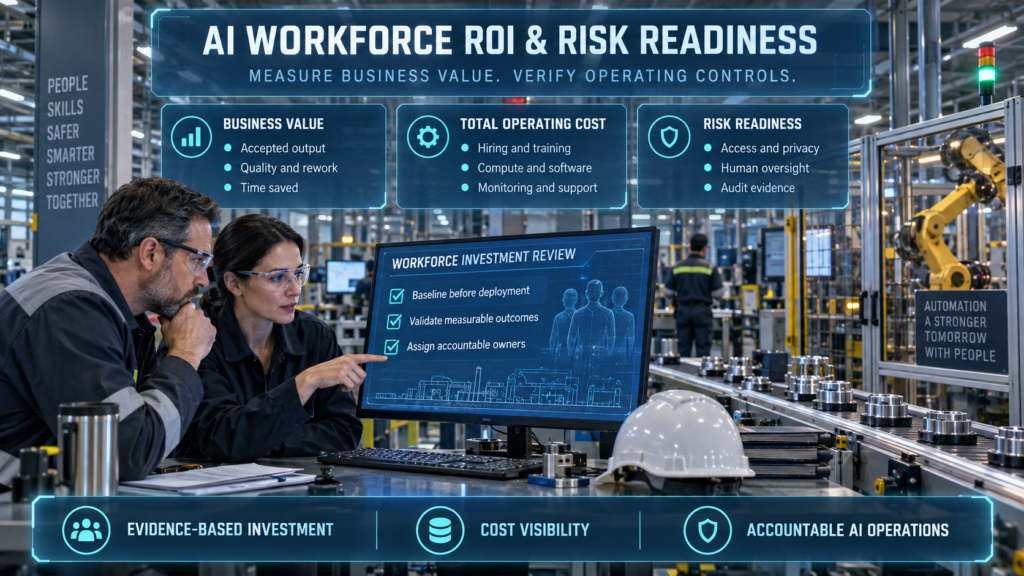
VIII. Risk Mitigation and Regulatory Framework
Automated hiring and workforce analytics can affect access to employment. Evaluate selection criteria, accessibility, data handling and human oversight before using these systems in consequential decisions.
Responsible Hiring Checklist
- Every automated screening or ranking tool has an accountable owner.
- The company documents whether the tool influences or substantially assists a hiring decision.
- Job criteria are tied to actual work and reviewed for unnecessary exclusion.
- Candidates receive required notices and accommodation paths.
- Bias audits and impact tests use relevant groups, outcomes and deployment conditions.
- Recruiters can challenge recommendations and document reasons.
- Vendor model, data, update and subprocessor information is retained.
- Appeals, complaints and correction requests reach trained humans.
- Security controls protect resumes, assessments and interview records.
- Retention and deletion rules apply to prompts, recordings, scores and derived profiles.
NIST AI RMF Checklist
- Govern: Define ownership, acceptable use, oversight and escalation.
- Map: Record people affected, context, data, vendors and foreseeable harm.
- Measure: Test validity, reliability, bias, privacy, security and human factors.
- Manage: Prioritize risk, implement controls, monitor change and stop unsafe use.
NIST describes AI RMF 1.0 as voluntary and is revising it under the federal AI Action Plan. Organizations should version their mappings rather than treating framework adoption as a permanent certification. [7]
Failure Vectors Leaders Should See
Common failures include proxy discrimination, inaccessible assessments, training-data leakage, résumé parsing errors, inflated automated scores, weak accommodation procedures and recruiters who rubber-stamp recommendations. AI jobs in the USA should include ownership for detecting and correcting these failures.
Other risks are commercial: vendor lock-in, opaque model changes, expensive integrations, duplicate sourcing tools and unusable audit exports. Procurement must test evidence portability before signing a multi-year agreement.
Choosing Roles and Building Evidence
Employers should identify the production bottleneck before opening a role. Define the responsibilities, expected work products, available resources and first-year outcomes, then benchmark compensation by occupation, location and experience.
Candidates should choose a role that fits their existing strengths and compare its requirements across current job postings. Build a focused project that demonstrates relevant skills, testing, limitations and ownership.
Appendix A: Academic and Primary-Source Footnotes
- U.S. Bureau of Labor Statistics. “Data Scientists.” Occupational Outlook Handbook; May 2025 median pay and 2025–2035 projections. https://www.bls.gov/ooh/math/data-scientists.htm
- U.S. Bureau of Labor Statistics. “Computer and Information Research Scientists.” Occupational Outlook Handbook; May 2025 median pay and 2025–2035 projections. https://www.bls.gov/ooh/computer-and-information-technology/computer-and-information-research-scientists.htm
- U.S. Bureau of Labor Statistics. “Software Developers, Quality Assurance Analysts, and Testers.” Occupational Outlook Handbook; May 2025 wages and 2025–2035 projections. https://www.bls.gov/ooh/computer-and-information-technology/software-developers.htm
- U.S. Bureau of Labor Statistics. “Operations Research Analysts.” Occupational Outlook Handbook; May 2025 wages and 2025–2035 projections. https://www.bls.gov/ooh/math/operations-research-analysts.htm
- U.S. Bureau of Labor Statistics. “Information Security Analysts.” Occupational Outlook Handbook; May 2025 wages and 2025–2035 projections. https://www.bls.gov/ooh/computer-and-information-technology/information-security-analysts.htm
- Stanford Institute for Human-Centered Artificial Intelligence. “The 2025 AI Index Report.” Investment, organizational adoption, technical performance and responsible-AI evidence. https://hai.stanford.edu/ai-index/2025-ai-index-report
- National Institute of Standards and Technology. “AI Risk Management Framework.” AI RMF 1.0, Generative AI Profile and 2026 revision status. https://www.nist.gov/itl/ai-risk-management-framework
- New York City Department of Consumer and Worker Protection. “Automated Employment Decision Tools.” Local Law 144 guidance, bias-audit and notice resources. https://www.nyc.gov/site/dca/about/automated-employment-decision-tools.page
- European Union. Regulation (EU) 2024/1689, Artificial Intelligence Act. Official Journal text. https://eur-lex.europa.eu/eli/reg/2024/1689/oj
- Sculley, D., et al. “Hidden Technical Debt in Machine Learning Systems.” Advances in Neural Information Processing Systems 28, 2015. https://papers.nips.cc/paper/5656-hidden-technical-debt-in-machine-learning-systems
- Mitchell, M., et al. “Model Cards for Model Reporting.” Proceedings of the Conference on Fairness, Accountability, and Transparency, 2019. https://doi.org/10.1145/3287560.3287596
Appendix B: Citation Integrity Index
| Claim area | Source numbers | Validation rule |
| National wages and projections | 1–5 | BLS occupation data; no title-level overclaim |
| AI investment and adoption | 6 | Stanford AI Index methodology and dated reporting |
| Risk-management framework | 7 | Voluntary framework; not described as law |
| Automated employment controls | 8–9 | Jurisdiction and scope must be checked by counsel |
| Engineering and reporting practice | 10–11 | Peer-reviewed research; not a compensation source |
Every bracketed citation in the article resolves to a numbered entry above. Commercial examples, planning tables and role mappings are labeled as analysis rather than market statistics.
Appendix C: Corporate Editorial Transparency and AI Usage Disclosure
AI-assisted tools were used to support research organization, drafting and language refinement. NezzHub retains editorial responsibility for the published article. Vendor inclusion does not constitute endorsement.
Author and Editorial Review
Author: Garikapati Bullivenkaiah
Technology research writer with LL.B., LL.M., M.A., and MBA qualifications. He writes about emerging technologies and their business, governance and legal implications. His multidisciplinary academic background informs his analysis of technology adoption, intellectual property, and organizational risk. His articles explain technical concepts and practical considerations for business owners, IT managers and technology decision-makers. LinkedIn Profile
Reviewed by: Chitikineni Ramadevi — Editor
Chitikineni Ramadevi holds an M.Sc. in Computers from Andhra University and has over 10 years of research experience in technology-related subjects. She reviews NezzHub articles for clarity, factual accuracy, source support and practical relevance.
Published by: NezzHub
Research approach: This article draws on primary sources, technical documentation and relevant industry research. References are provided within the article or its sources section.
Last reviewed: 09-18-2026
Corrections: To report a factual error or outdated information, please contact NezzHub.

Garikapati Bullivenkaiah is a seasoned entrepreneur with a rich multidisciplinary academic foundation—including LL.B., LL.M., M.A., and M.B.A. degrees—that uniquely blend legal insight, managerial acumen, and sociocultural understanding. Driven by vision and integrity, he leads his own enterprise with a strategic mindset informed by rigorous legal training and advanced business education. His strong analytical skills, honed through legal and management disciplines, empower him to navigate complex challenges, mitigate risks, and foster growth in diverse sectors. Committed to delivering value, Garikapati’s entrepreneurial journey is characterized by innovative approaches, ethical leadership, and the ability to convert cross-domain knowledge into practical, client-focused solutions.