
















Executive Summary
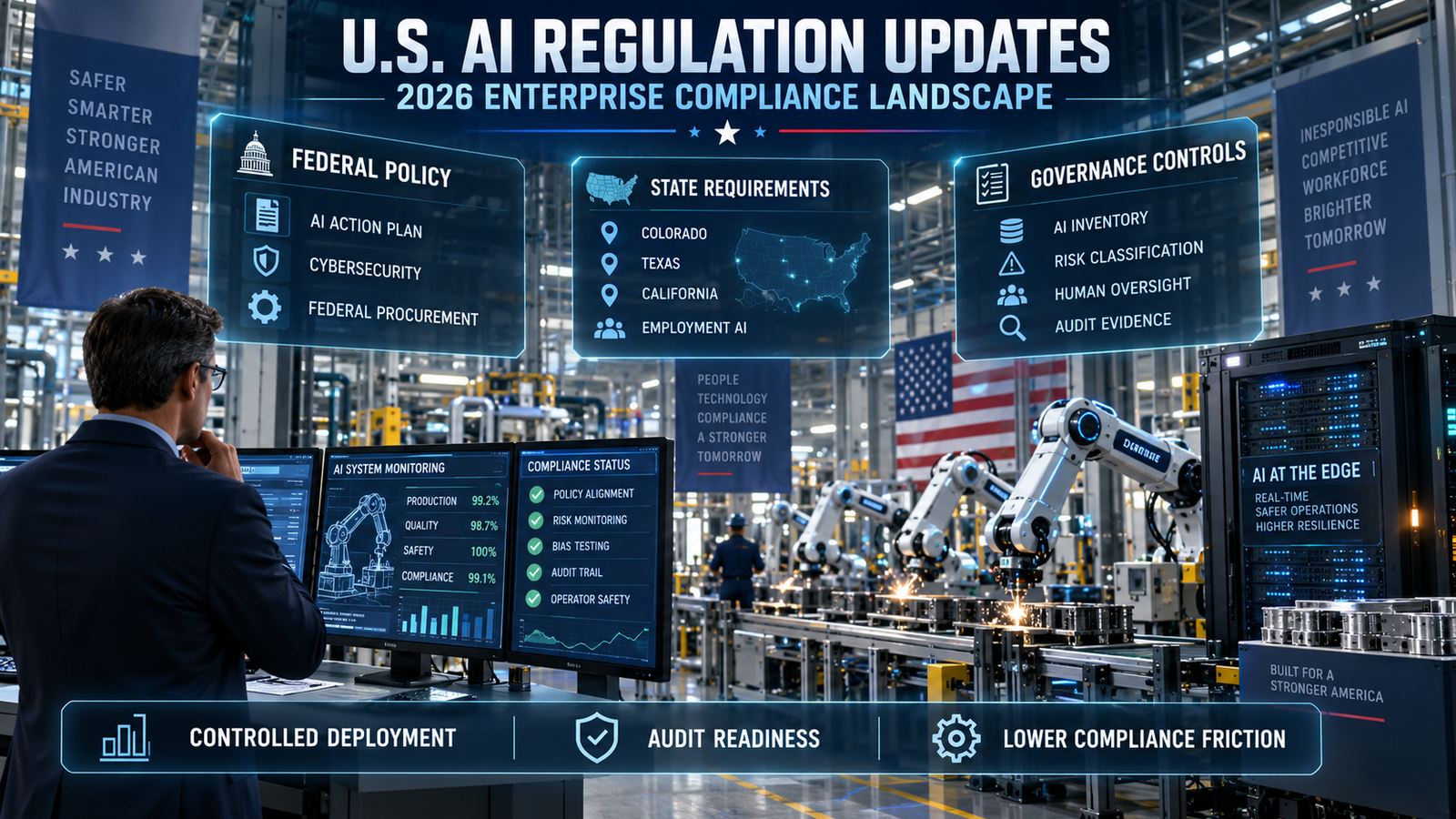
AI regulation updates in the United States no longer follow the policy described in many 2023-era explainers. Executive Order 14110 was revoked in January 2025, the White House issued an innovation-led AI Action Plan in July 2025, and a December 2025 order directed federal action against selected state AI laws while Congress considers a national framework. [1][2][3]
That federal pivot did not erase enterprise exposure. Existing consumer-protection, civil-rights, privacy, employment, financial-services, healthcare, intellectual-property, cybersecurity and product-liability rules still apply when software automates or influences decisions.
State requirements differ in scope and timing. Texas’s Responsible Artificial Intelligence Governance Act took effect January 1, 2026. Colorado enacted a replacement automated decision-making framework in May 2026, with requirements taking effect January 1, 2027. California also introduced training-data and frontier-model transparency requirements. [4][5][6][7]
For decision makers, the correct response is not a static legal checklist. It is a governed system that maps each AI use case to people, jurisdictions, data, decisions, controls, evidence, contracts and change events.
This Article explains the architecture, deployment friction, commercial tooling, validation metrics and cost model needed to operationalize AI regulation updates. It is a business and technical briefing, not legal advice; counsel should confirm obligations for each product, entity and jurisdiction.
I. Current Market Landscape and Compliance Challenge
The Federal Policy Reversal Is Material
On January 23, 2025, Executive Order 14179 directed development of a new action plan and ordered agencies to review actions taken under revoked Executive Order 14110. It also instructed OMB to revise the prior federal AI governance and acquisition memoranda. [1]
The July 2025 AI Action Plan then listed more than 90 federal policy actions across innovation, infrastructure, and international diplomacy and security. Its direction favors faster deployment, expanded infrastructure and reduced federal barriers rather than a horizontal private-sector AI licensing regime. [2]
AI regulation updates therefore require teams to separate a presidential policy document from a statute, agency rule, enforcement authority or contractual obligation. An executive order directs the executive branch; it does not automatically repeal state statutes or generally applicable federal law.
A Federal Push Against State Fragmentation
Executive Order 14365, issued December 11, 2025, created an AI Litigation Task Force and directed evaluation of state AI laws that may conflict with the administration’s policy. It also called for consideration of a federal reporting standard and a legislative recommendation for a national framework. [3]
This creates uncertainty, not automatic preemption. Until a court, Congress or valid federal rule changes the result, a business should not treat a state requirement as void merely because federal officials criticize it.
The order itself identifies areas that a legislative recommendation should not propose preempting, including child safety, AI infrastructure, and state-government procurement and use. Legal teams must track litigation, agency action and enacted legislation instead of relying on political headlines.
June 2026 Added a Frontier-Model Cybersecurity Track
Executive Order 14409, dated June 2, 2026, directs federal work on AI-enabled cyber defense, a vulnerability-clearinghouse model and classified benchmarking for “covered frontier models.” It describes voluntary pre-release engagement and expressly says the order does not create mandatory licensing or preclearance for new models. [8]
These AI regulation updates matter commercially to frontier-model developers, critical-infrastructure operators and federal contractors. They also influence buyer expectations for vulnerability disclosure, controlled early access, patch coordination and protection of model intellectual property.
Existing Law Remains the Enforcement Backbone
A model does not create an exemption from discrimination, deception, privacy, security or sector rules. The legal issue is usually the conduct and impact: who was affected, what representation was made, which data was processed, and whether the organization used reasonable controls.
Employment screening can trigger federal anti-discrimination law, local automated-employment rules and state notice duties. Credit underwriting can trigger fair-lending, adverse-action and model-risk requirements; medical software may trigger FDA oversight, HIPAA duties or professional standards.
The Cost of Inaction
Uncontrolled AI can create inconsistent disclosures, undocumented model changes, cross-border data transfers, inaccessible appeals, unsupported performance claims and vendor concentration. Those failures increase investigation costs, contract disputes, remediation work and delayed enterprise sales.
The opposite failure is over-control. A program that treats every autocomplete feature like a consequential-decision system consumes review capacity, drives teams toward shadow AI and delays low-risk automation without reducing material exposure.
Top AI Jobs in the USA: Roles, Salaries, and Trends
II. AI Regulation Updates and the 2026 State-Law Map
Colorado: Automated Decision-Making Requirements Starting in 2027
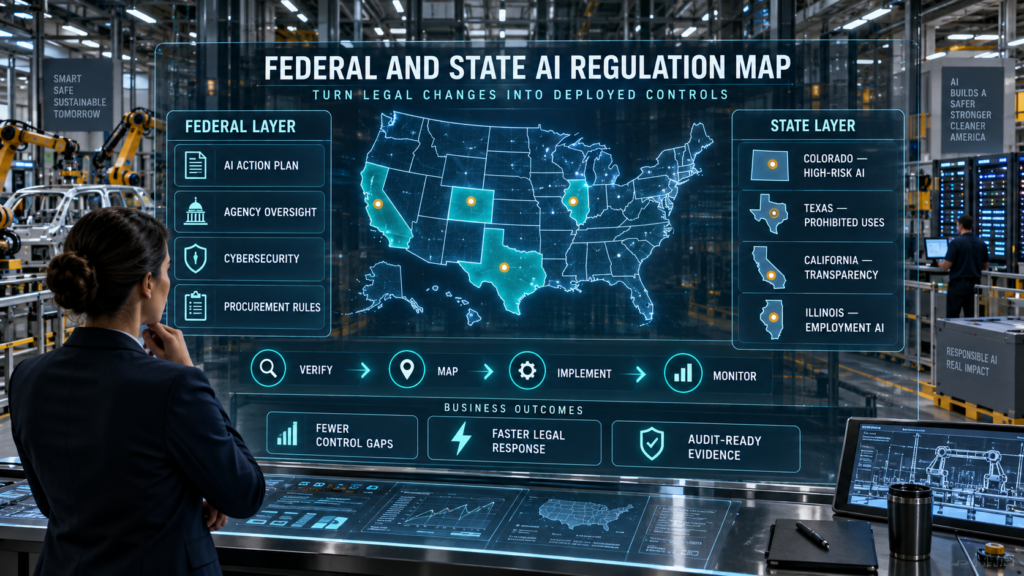
Colorado enacted SB 26-189 in May 2026, replacing the provisions introduced by SB 24-205. The new framework covers automated decision-making technology used to materially influence consequential decisions, with requirements taking effect January 1, 2027. [4]
Covered developers must provide technical documentation about intended uses, training-data categories, known limitations and appropriate human review. Deployers face consumer-notice requirements, while consumers receive rights concerning access to personal data, correction and meaningful human reconsideration after adverse outcomes.
Assess scope, exemptions, recordkeeping and implementing rules against the enacted replacement law. Do not rely on the original SB 24-205 requirements or its original February 2026 timetable.
Texas: Prohibited Uses, Disclosure and Regulatory Sandbox
Texas HB 149 took effect January 1, 2026. The Texas Responsible Artificial Intelligence Governance Act addresses prohibited uses, government applications, certain biometric uses, enforcement and a regulatory sandbox. Its disclosure provisions specifically cover governmental entities and healthcare service or treatment providers; they should not be described as a universal disclosure requirement for every commercial chatbot. [5]
The final Texas statute is narrower than earlier proposals for broad high-risk impact assessments. Businesses should map the enacted text, definitions, intent standards, exemptions and attorney-general authority rather than rely on summaries of introduced versions.
California: Training Data and Frontier-Developer Transparency
California AB 2013 requires developers of generative AI systems or services made available to Californians to publish documentation about training data, subject to statutory scope and exceptions. The disclosure regime became operative January 1, 2026. [6]
California SB 53 addresses large frontier developers and includes transparency, safety-framework and incident-related provisions tied to defined computational and revenue thresholds. It should not be applied indiscriminately to ordinary enterprise application teams. [7]
AI regulation updates from California also sit beside privacy, employment, biometric, consumer-protection and synthetic-media rules. One product may require several independent analyses rather than one “California AI compliance” checkbox.
Illinois and New York City: Employment Automation
Illinois Public Act 103-0804 amended the Illinois Human Rights Act for employer use of AI beginning January 1, 2026. It restricts discriminatory effects and requires notice when AI is used for specified employment purposes. [9]
New York City Local Law 144 requires a recent bias audit, public summary information and notices before an employer or employment agency uses a covered automated employment decision tool. The rule applies by tool and use, not by a vendor’s marketing category. [10]
Utah: Disclosure and Regulatory Learning
Utah’s Artificial Intelligence Policy Act established disclosure requirements in specified consumer interactions and created an AI learning laboratory. Amendments and sunset dates make version control essential when translating this law into product requirements. [11]
The practical lesson across AI regulation updates is that “chatbot law,” “high-risk AI law” and “employment AI law” are not interchangeable labels. Definitions, exemptions, enforcement routes, cures and effective dates decide the real obligation.
III. Deep-Dive Technical Analysis and Evidence
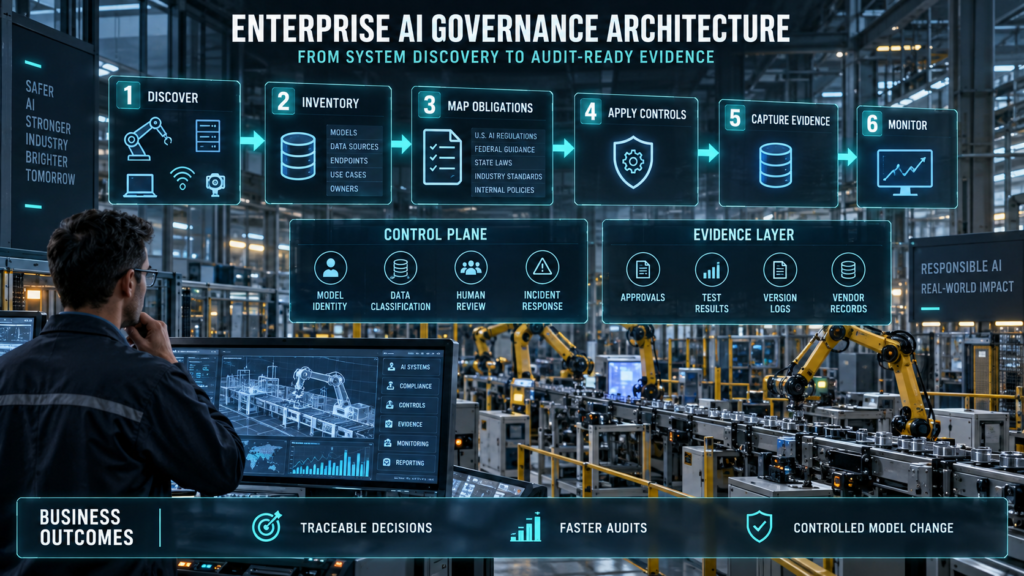
Architecture Overview for Enterprise AI Governance
Compliance cannot operate from a spreadsheet that is updated once a year. A production architecture needs authoritative inventory, policy logic, evidence capture, runtime telemetry and accountable approval.
- Discovery layer: cloud accounts, SaaS catalogs, code repositories, expense systems, browser tools, model endpoints and vendor questionnaires.
- Inventory layer: use case, owner, vendor, model, version, purpose, users, affected people, geography, data classes and decision impact.
- Obligation layer: federal, state, local, sector, contract and internal-policy requirements mapped to facts and effective dates.
- Control layer: access, notices, consent, evaluation, human review, appeals, content provenance, security, retention and incident handling.
- Evidence layer: approvals, test sets, results, model cards, impact assessments, logs, vendor documents, complaints and remediation.
- Monitoring layer: drift, bias, unsafe output, latency, misuse, cost, policy violations, model changes and regulatory changes.
- Reporting layer: regulator response, customer assurance, board metrics, audit packages and public disclosures.
AI regulation updates should enter the obligation layer as versioned events. They should not overwrite historical rules because auditors need to know which requirement applied when a decision or release occurred.
Integration Flowchart
- Discover AI use: Identify applications, embedded features, models and responsible owners.
- Classify the workflow: Record the decision, data, affected people, sector and relevant locations.
- Map obligations: Identify applicable legal, contractual and internal-policy requirements.
- Apply controls: Implement required notices, testing, access restrictions, review procedures and evidence records.
- Make the deployment decision: Approve the assessed use, permit it with restrictions or reject it.
- Monitor permitted deployments: Track performance, incidents, complaints, model changes and control evidence.
- Reassess changes: Reopen the assessment when the model, workflow, population, jurisdiction or applicable requirement changes.
The return path is the operating core. A model update, new state, changed user population, added data source or new decision purpose can invalidate the original assessment even when the product name remains unchanged.
Deployment Challenges
Model and Vendor Identity Drift
Enterprise gateways can route the same application across models for price, availability or quality. A compliance record that lists only “generative AI assistant” cannot prove which model handled a sensitive interaction.
Contracts should require version notice, subprocessor disclosure and revalidation rights. Runtime logs should preserve the minimum evidence needed for accountability without retaining sensitive prompts indefinitely.
Consequential Decisions Hidden Inside Workflow Automation
A system may be marketed as a productivity tool yet rank applicants, prioritize fraud investigations or influence access to services. Legal classification must follow the actual workflow, not the procurement category.
Teams should document whether output is advisory, determinative or a substantial factor. They should also measure whether reviewers meaningfully disagree with the tool or merely approve it automatically.
Generative AI Evidence Is Difficult to Reproduce
Prompts, retrieval content, model versions, system instructions and sampling settings can all affect output. Reconstructing an incident becomes difficult when vendors expose none of those elements.
AI compliance software should capture versioned configuration, relevant source identifiers, output and reviewer action. Evidence design must still respect privacy, privilege, security and retention limits.
Rule Conflicts and Geographic Ambiguity
A national service can involve a user, employer, vendor and data center in different jurisdictions. The safest standard is not always the legally required standard, while a universal control can conflict with another law or product requirement.
Use jurisdictional policy rules with legal ownership and documented fallback behavior. Do not make a model infer governing law from an IP address without human-approved logic.
Performance Evaluation Matrix
| Control domain | Evidence metric | Failure signal | Management threshold |
| Inventory coverage | Known systems ÷ discovered systems | Shadow AI rate rises | Target and escalation set by risk tier |
| Assessment freshness | Systems reviewed within policy period | Stale approvals after model change | Automatic reassessment trigger |
| Bias testing | Selection/error rates by relevant group | Material unexplained disparity | Counsel-approved investigation rule |
| Human review | Override and appeal outcomes | Near-zero overrides despite errors | Human-factors review |
| Notice delivery | Successful notice and consent events | Missing or late disclosure | Block covered workflow |
| Vendor evidence | Required artifacts received and current | Expired model card or test report | Suspend change or renewal |
| Runtime safety | Severe incidents per use volume | Harm trend or repeated unsafe output | Kill switch and incident response |
| Compliance cost | Annual cost per governed use case | Low-risk reviews consume budget | Risk-tier redesign |
NIST’s AI Risk Management Framework remains voluntary, and NIST states that AI RMF 1.0 is being revised under the AI Action Plan. Its Govern, Map, Measure and Manage functions remain a useful control vocabulary, but companies should version their mappings as NIST updates the framework. [12]
IV. Commercial Solutions and Best Practices
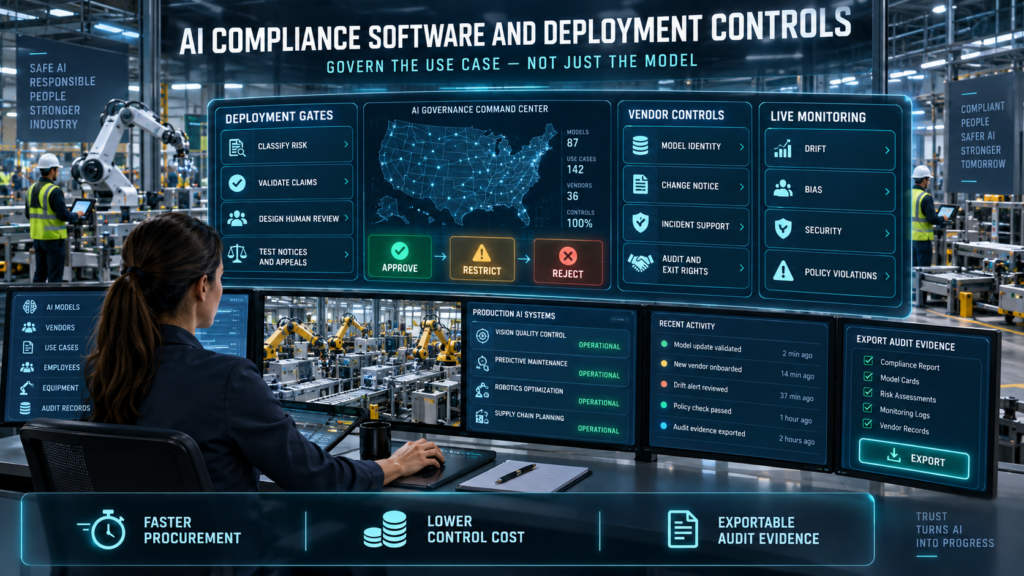
Feature and Cost Comparison Table
No platform makes an organization compliant automatically. Pricing for enterprise governance products is commonly quote-based and depends on users, integrations, model volume, modules, support and deployment architecture.
| Platform | Strongest fit | Notable capabilities | Commercial model | Cost and deployment risk |
| OneTrust AI Governance | Privacy-led enterprises and broad GRC programs | Inventory, assessments, policy workflows, third-party risk and regulatory mapping | Negotiated enterprise subscription | Configuration and connector work can expand scope |
| Credo AI | Dedicated enterprise AI governance teams | Policy packs, risk workflows, evidence, model assessments and oversight dashboards | Negotiated subscription | Value depends on reliable technical evidence feeds |
| IBM watsonx.governance | IBM-centered data and model estates | Model lifecycle governance, factsheets, monitoring and compliance workflows | Software or cloud subscription; quote and usage components | Integration effort rises across non-IBM stacks |
| Microsoft Purview plus Azure AI controls | Microsoft-heavy cloud environments | Data governance, compliance, identity, monitoring and AI platform controls | License, consumption and support components | Capabilities span products; cost attribution can be difficult |
Buyers should request a total-cost model rather than comparing license quotes. Include implementation, API connectors, legal-content maintenance, model monitoring, evidence storage, internal administration, audit support and exit costs.
AI regulation updates affect each cost category differently.
Eight-Gate Procurement Framework
Gate 1: Define the Use Case
Name the decision, affected population, operator, geography, data, output, reviewer and business purpose. Reject vague requests to “approve the platform” for unknown future uses.
Gate 2: Classify Risk and Law
Map the use case to consequential decisions, regulated sectors, sensitive data, minors, biometrics, synthetic media, safety functions and government customers. Record assumptions and counsel decisions.
Gate 3: Validate Claims
Test accuracy, robustness, subgroup performance, security and human factors against the actual operating environment. Marketing benchmarks are not acceptance criteria.
Gate 4: Design Human Oversight
Define who reviews, what evidence they see, how long they have, and what happens after disagreement. An “approve” button is not meaningful oversight if performance targets penalize reviewers for using it carefully.
Gate 5: Engineer Notices and Appeals
Notices must arrive at the legally relevant time and in an accessible form. Correction and appeal paths must connect to case systems, service levels and trained staff.
Gate 6: Contract for Evidence
Require model identity, update notice, evaluation artifacts, incident cooperation, subprocessors, data-use limits, audit support, deletion and exit. Allocate responsibility for disclosures and complaints explicitly.
Gate 7: Run a Limited Release
Use controlled users, jurisdictions and volume. Monitor failure modes, overrides, complaints, costs and unexpected uses before wider deployment.
Gate 8: Reassess Continuously
AI regulation updates, model changes and workflow changes must trigger review. The governance platform should open a task automatically and preserve prior decisions.
V. Business Outcomes and Strategic ROI
Compliance Is a Revenue-Control System
Enterprise buyers increasingly require AI inventories, security evidence, data provenance, evaluation results and contractual protections. A reusable evidence package can shorten security and legal reviews without promising that every sale will close faster.
The strongest financial case joins compliance with product operations. The same inventory and telemetry used for audit can reduce duplicate tools, detect unused licenses, identify expensive model routing and stop unapproved data transfers.
AI regulation updates can therefore protect revenue while exposing avoidable software and infrastructure spend.
Total Cost Formula
Annual governance cost = software + integration + legal-content maintenance + testing + monitoring + human review + audit support.
Separate one-time implementation costs from recurring annual expenses, and include only costs incurred within the period being measured.
The benefit side includes avoided duplicate spend, faster evidence production, reduced remediation effort, improved contract readiness and controlled deployment. Avoid presenting hypothetical fines as guaranteed savings.
AI regulation updates belong in the cost model because each material change can create engineering, legal and operational work.
Illustrative Business Case—Not a Market Benchmark
| Planning input | Conservative | Base | Expanded program |
| AI use cases discovered | 60 | 120 | 240 |
| High-impact or regulated use cases | 8 | 24 | 55 |
| Annual software and support | $140,000 | $260,000 | $480,000 |
| Integration and first-year configuration | $180,000 | $350,000 | $700,000 |
| Internal review and monitoring | $220,000 | $420,000 | $850,000 |
| Total first-year program cost | $540,000 | $1,030,000 | $2,030,000 |
These figures are scenario inputs, not vendor quotes or industry averages. A buyer should substitute its own labor rates, review volume, connector count, retention design and legal footprint.
AI regulation updates should be modeled as a variable workload rather than a one-time implementation fee.
Cost Optimization Rules
- Apply deeper testing to consequential, safety-related and externally facing systems.
- Use standardized evidence schemas so vendors do not answer the same question repeatedly.
- Reuse controls across laws while retaining jurisdiction-specific outputs.
- Archive or terminate unused AI services after owner confirmation.
- Store only evidence that has a defined compliance, safety or operational purpose.
- Track model consumption alongside governance status to expose uncontrolled spend.
AI regulation updates also affect retention assumptions.
Recalculate the business case when AI regulation updates alter testing depth, notice volume or human-review demand.
VI. Regulatory Update Operating Model
Weekly Intake
Monitor enacted laws, effective-date changes, final agency rules, binding orders, enforcement actions and material court decisions. Proposed bills belong in a watchlist, not the production control library.
Each entry needs source, jurisdiction, status, effective date, affected roles, product facts and an accountable legal reviewer. AI regulation updates without those fields become noise.
Only verified AI regulation updates should enter the production obligation library.
Monthly Impact Review
Legal, product, security, HR, procurement and data leaders should evaluate whether a change affects existing systems, planned launches or contract commitments. The result should be a recorded no-impact finding or a funded implementation task.
Material AI regulation updates need an owner, budget, due date and verification step.
Quarterly Evidence Review
Sample inventory accuracy, notices, assessments, approval records, monitoring alerts, appeals and vendor documents. Confirm that the evidence is reproducible and linked to the deployed model version.
The review should confirm that prior AI regulation updates produced traceable control changes.
Board and Executive Reporting
Report exposure by risk tier, overdue remediation, serious incidents, inventory coverage, jurisdiction readiness and spend. Avoid vanity metrics such as the number of policies published.
Board reporting should separate enacted AI regulation updates from proposals and political announcements.
VII. Buyer FAQ on AI Regulation Updates
Is there one comprehensive federal AI law?
No horizontal federal statute currently replaces the full mix of United States AI laws. AI regulation updates come from executive policy, agency authority, sector rules, state statutes, local ordinances and court decisions.
Did revoking Executive Order 14110 remove AI compliance duties?
No. The revocation changed executive-branch policy and related federal work, but AI regulation updates did not erase generally applicable statutes, state law, contracts or sector obligations.
Are state AI laws invalid after Executive Order 14365?
Not automatically. The order establishes federal policy and directs challenges and recommendations; organizations should follow AI regulation updates from courts, agencies and legislatures before changing compliance positions.
Does NIST AI RMF compliance create legal immunity?
NIST describes the framework as voluntary. Some laws may recognize framework alignment within defenses or compliance structures, but AI regulation updates must be mapped to the precise statutory text and facts.
Must every chatbot disclose that it is AI?
Requirements vary by jurisdiction, sector, speaker and context. AI regulation updates should be translated into a disclosure matrix rather than one universal chatbot banner.
Who is accountable for a vendor’s model?
Responsibility can attach across developer, deployer, employer, service provider and regulated entity roles. Contracts allocate tasks, but AI regulation updates may impose duties that cannot be transferred away from the buyer.
How often should impact assessments be refreshed?
Follow the applicable law and internal risk tier, then trigger reassessment for material changes. AI regulation updates, new data, new locations, changed purposes and model replacements are common triggers.
Can a company use one national standard?
A national baseline can simplify engineering, but exceptions may still be necessary. AI regulation updates should be modeled as reusable controls plus jurisdiction-specific notices, rights and records.

VIII. Risk Mitigation and Regulatory Framework
This section sits immediately before the call to action because governance determines whether the deployment should proceed.
The checklist converts AI regulation updates into controls that operators can test and executives can fund.
Regulatory Readiness Checklist
- Every AI system and material embedded AI feature has an owner and inventory record.
- Actual use—not the vendor category—determines legal classification.
- Jurisdiction, affected person, sector and consequential-decision status are recorded.
- Required notices, correction rights, appeals and human review are operationally tested.
- Model versions, prompts, retrieval sources and material configurations are traceable.
- Bias, safety, security, privacy and performance tests match the risk tier.
- Vendor contracts provide evidence, change notice, incident support and exit rights.
- Retention rules cover prompts, outputs, logs, assessments and complaints.
- A kill switch and accountable incident commander exist for serious failures.
- AI regulation updates trigger versioned legal review and implementation tasks.
NIST and Security Checklist
- Governance roles map to Govern, Map, Measure and Manage activities.
- The Generative AI Profile is used where foundation-model risks are relevant.
- Threat modeling includes prompt injection, data exfiltration, insecure output handling and agent privilege.
- Identity, secrets, tools and connectors follow least privilege.
- Model and data supply chains are included in vulnerability management.
- Monitoring distinguishes model drift, policy violations, abuse and ordinary errors.
EU AI Act Boundary Check
A U.S. company may face EU AI Act obligations through EU market placement, deployment, providers, importers, distributors or affected persons. The Act’s phased application and role-specific duties require a separate scope analysis; U.S. controls are useful inputs but not a substitute. [13]
AI regulation updates in the United States should therefore be tracked separately from EU implementation milestones.
Failure Vectors the Board Should See
The most common governance failure is incomplete discovery. The next is evidence that exists in separate teams but cannot be connected to the model, use case and decision under review.
Other failure vectors include automatic approvals, untested appeals, stale vendor documentation, silent model substitution, excessive logging of sensitive data and compliance tools that cannot export evidence. These are system-design failures, not merely policy gaps.
AI regulation updates will not reduce exposure when the evidence pipeline cannot prove that required controls operated.
Turning Regulatory Changes Into Deployment Decisions
Start with the AI systems that most affect people, safety, revenue or regulated decisions. Record each system’s owner, purpose, applicable jurisdictions, required controls and supporting evidence.
Assign material regulatory changes to an accountable reviewer. Document whether each change requires a revised notice, contract, test, approval or operating procedure. Preserve earlier assessments so the organization can show which requirements and controls applied at the time.
Appendix A: Academic and Primary-Source Footnotes
The numbered sources below are fully visible and correspond to the bracketed citations used throughout the article.
- The White House. Executive Order 14179, “Removing Barriers to American Leadership in Artificial Intelligence,” January 23, 2025. View source.
- The White House. “Winning the AI Race: America’s AI Action Plan,” July 23, 2025. View source.
- The White House. Executive Order 14365, “Ensuring a National Policy Framework for Artificial Intelligence,” December 11, 2025. View source.
- Colorado General Assembly. SB 26-189, “Automated Decision-Making Technology.” Signed May 14, 2026; requirements effective January 1, 2027.
View enacted legislation
View Colorado Attorney General rulemaking information - Texas Legislature. HB 149, Texas Responsible Artificial Intelligence Governance Act, effective January 1, 2026. View source.
- California Legislature. AB 2013, “Generative Artificial Intelligence: Training Data Transparency.” View source.
- California Legislature. SB 53, “Artificial Intelligence Models: Large Developers.” View source.
- The White House. Executive Order 14409, “Promoting Advanced Artificial Intelligence Innovation and Security,” June 2, 2026. View source.
- Illinois General Assembly. Public Act 103-0804, employment use of artificial intelligence under the Illinois Human Rights Act. View source.
- New York City Department of Consumer and Worker Protection. Automated Employment Decision Tools, Local Law 144. View source.
- Utah Legislature. SB 149, Artificial Intelligence Policy Act. View source.
- National Institute of Standards and Technology. AI Risk Management Framework and Generative AI Profile resources; NIST notes that AI RMF 1.0 is under revision. View source.
- European Union. Regulation (EU) 2024/1689, Artificial Intelligence Act. View official regulation.
Appendix B: Citation Integrity Index
| Citation | Evidence used | First placement |
| [1] | 2025 federal policy reversal | Executive Summary |
| [2] | AI Action Plan and 90-plus actions | Executive Summary |
| [3] | Federal state-law challenge framework | Executive Summary |
| [4] | Colorado’s replacement automated decision-making framework and January 1, 2027 effective date | State-Law Map |
| [5] | Texas TRAIGA status and effective date | State-Law Map |
| [6] | California training-data disclosure | State-Law Map |
| [7] | California frontier-developer rules | State-Law Map |
| [8] | 2026 frontier-model cybersecurity order | Market Landscape |
| [9] | Illinois employment AI requirements | Employment Automation |
| [10] | NYC automated employment tool requirements | Employment Automation |
| [11] | Utah AI disclosure and learning laboratory | Utah section |
| [12] | NIST AI RMF status and structure | Performance Matrix |
| [13] | EU AI Act cross-border scope check | Risk Framework |
Appendix C: Corporate Editorial Transparency and AI Usage Disclosure
AI-assisted tools were used to support research organization, drafting and language refinement. NezzHub retains editorial responsibility for the published article. Vendor inclusion does not constitute endorsement.
This article provides general business and technology information, not legal advice. Applicable obligations depend on the use case, jurisdiction and current law.
Author and Editorial Review
Author: Garikapati Bullivenkaiah
Technology research writer with LL.B., LL.M., M.A., and MBA qualifications. He writes about emerging technologies and their business, governance and legal implications. His multidisciplinary academic background informs his analysis of technology adoption, intellectual property, and organizational risk. His articles explain technical concepts and practical considerations for business owners, IT managers and technology decision-makers. LinkedIn Profile
Reviewed by: Chitikineni Ramadevi — Editor
Chitikineni Ramadevi holds an M.Sc. in Computers from Andhra University and has over 10 years of research experience in technology-related subjects. She reviews NezzHub articles for clarity, factual accuracy, source support and practical relevance.
Published by: NezzHub
Research approach: This article draws on primary sources, technical documentation and relevant industry research. References are provided within the article or its sources section.
Last reviewed: 09-18-2026
Corrections: To report a factual error or outdated information, please contact NezzHub.

Garikapati Bullivenkaiah is a seasoned entrepreneur with a rich multidisciplinary academic foundation—including LL.B., LL.M., M.A., and M.B.A. degrees—that uniquely blend legal insight, managerial acumen, and sociocultural understanding. Driven by vision and integrity, he leads his own enterprise with a strategic mindset informed by rigorous legal training and advanced business education. His strong analytical skills, honed through legal and management disciplines, empower him to navigate complex challenges, mitigate risks, and foster growth in diverse sectors. Committed to delivering value, Garikapati’s entrepreneurial journey is characterized by innovative approaches, ethical leadership, and the ability to convert cross-domain knowledge into practical, client-focused solutions.