

Executive Summary
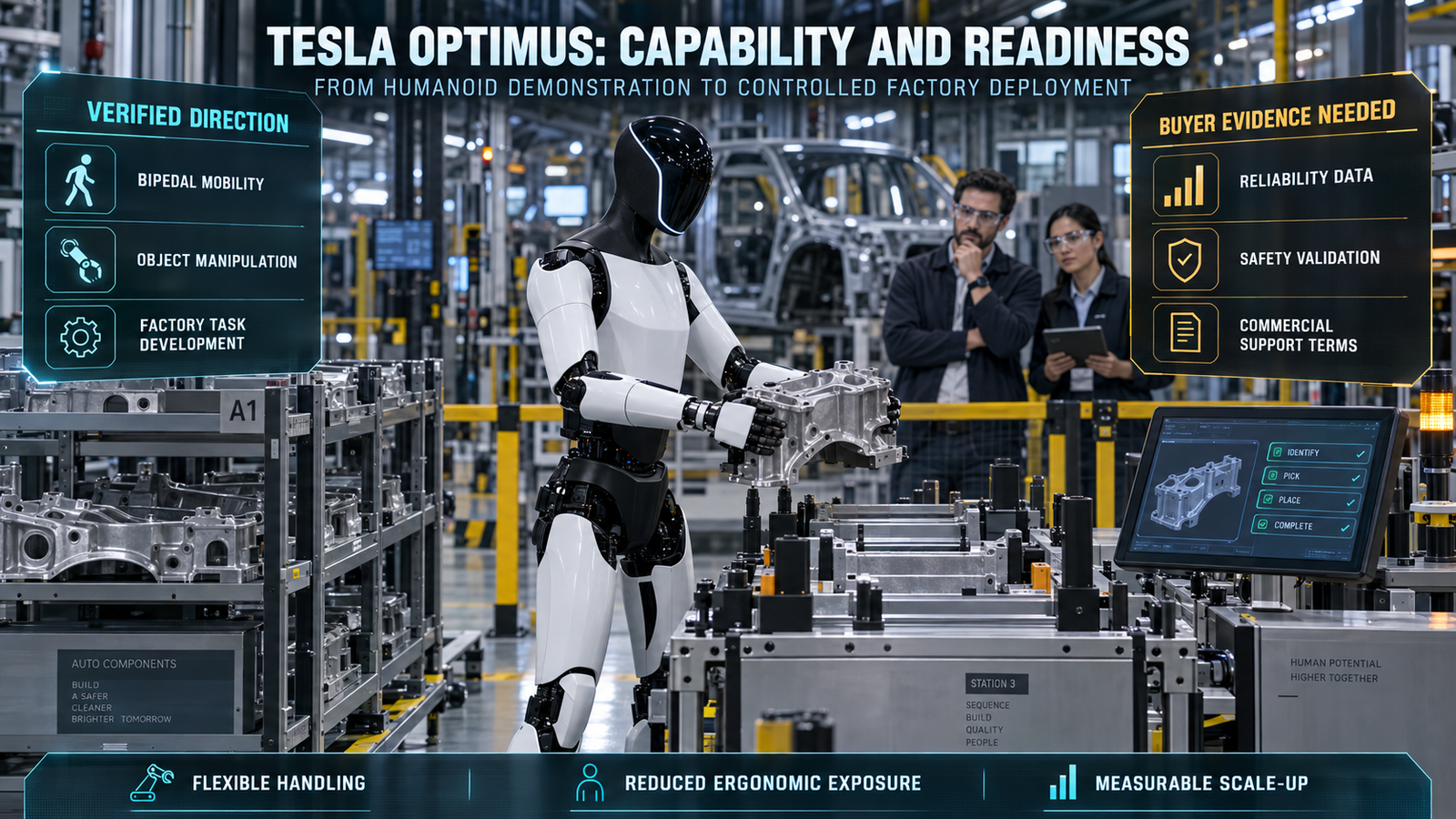
Tesla Optimus is one of the most watched humanoid programs, but buyers need a sharper answer than a demonstration video provides. Tesla describes the platform as a general-purpose, autonomous biped intended for unsafe, repetitive, or boring work, while its 2025 annual report still classifies the robot as “in development.”[1][2]
The practical evidence shows progress in walking, balance, object manipulation, teleoperation-assisted learning, and factory-oriented tasks. It does not yet establish general commercial availability, independently verified uptime, a published safety case, service-level commitments, or a confirmed Tesla robot price.
That distinction matters because a humanoid robot deployment is not purchased as a body alone. It requires a validated task, reliable perception, safe motion control, production integration, industrial automation software, charging, maintenance, data governance, trained operators, and measurable exception handling.
Tesla’s July 2026 update reported installation of first-generation Optimus production lines at Fremont and construction activity in Texas. It also stated that initial builds would support training-data collection and further functionality development in its Optimus Academy. These manufacturing plans do not establish general external customer availability or supported fleet operations.[4]
This paper evaluates Tesla Optimus from a commercial decision-maker’s perspective. It separates verified status from aspiration, maps the technical architecture, identifies deployment friction, compares four humanoid platforms, defines performance and ROI metrics, and closes with safety, cybersecurity, privacy, and AI-governance controls.
Top Robotics Companies in the USA: Proven 2026 Buyer’s Guide
I. Current Market Landscape and the Cost of Waiting
The automation gap humanoids are trying to close
Fixed robots dominate stable, high-volume work because their environment can be engineered around repeatability. Autonomous mobile robots move loads effectively on mapped floors, but most do not manipulate the diverse tools, bins, fixtures, and doors found in workspaces designed for human bodies.
Humanoids target the space between those categories. Legs, arms, hands, cameras, and learned control promise a machine that can approach an existing workstation, handle an object, move to another station, and accept a different task without rebuilding the entire facility.
The attraction is real, but morphology is not a business case. If a conveyor, cobot, lift-assist, autonomous mobile robot, or process redesign performs the job more reliably and cheaply, the humanoid form adds cost without adding value.
What Tesla has verified publicly
Tesla’s official AI page defines Tesla Optimus as a general-purpose autonomous humanoid for unsafe, repetitive, or boring tasks.[1] Public demonstrations have shown locomotion and manipulation progress, while Tesla job postings describe active development in manipulation, reinforcement learning, tactile sensing, integration, reliability, production testing, and manufacturing scale.[5][6][7]
Corporate filings provide the most disciplined status signal. Tesla’s 2025 Form 10-K calls Optimus a humanoid robot in development, while 2026 quarterly disclosures describe preparations for large-scale production and installation of first-generation production lines.[2][3][4]
These sources document development activity and manufacturing preparation. They do not establish routine external customer deployments across retail, healthcare, construction or household settings. Proposed applications should therefore be presented as possibilities requiring validation, rather than established operating examples.[2][3][4]
What remains commercially unproven
Tesla has not published a generally available enterprise ordering process, audited fleet statistics, standard warranty, support plan, public API contract, or confirmed Tesla robot price. It also has not published enough application-specific evidence to calculate independent payback across industries.
A demonstration proves that a capability occurred under presented conditions. Production evidence must show how often it succeeds, how failures are recovered, how long recovery takes, how updates affect performance, and whether the system remains safe across shifts and environmental variation.
The cost of inaction
Waiting has a cost only when an organization has a measurable problem. Candidate losses include ergonomic exposure, internal transport delays, machine starvation, repetitive handling labor, quality escapes, constrained night-shift capacity, and the engineering cost of rigid automation.
Establish the baseline before tracking the market
Measure task cycle time, walking time, touch time, load range, error rate, near misses, staffing gaps, equipment idle time, and exception frequency. If those data do not exist, an organization cannot distinguish a valuable humanoid robot deployment from an expensive experiment.
The best near-term action may be readiness rather than purchase. Standardized bins, machine-readable work instructions, safer handoff points, better network coverage, and clean interfaces to industrial automation software benefit conventional automation now and reduce future integration cost.
II. Deep-Dive Technical Analysis and Evidence
Architecture Overview
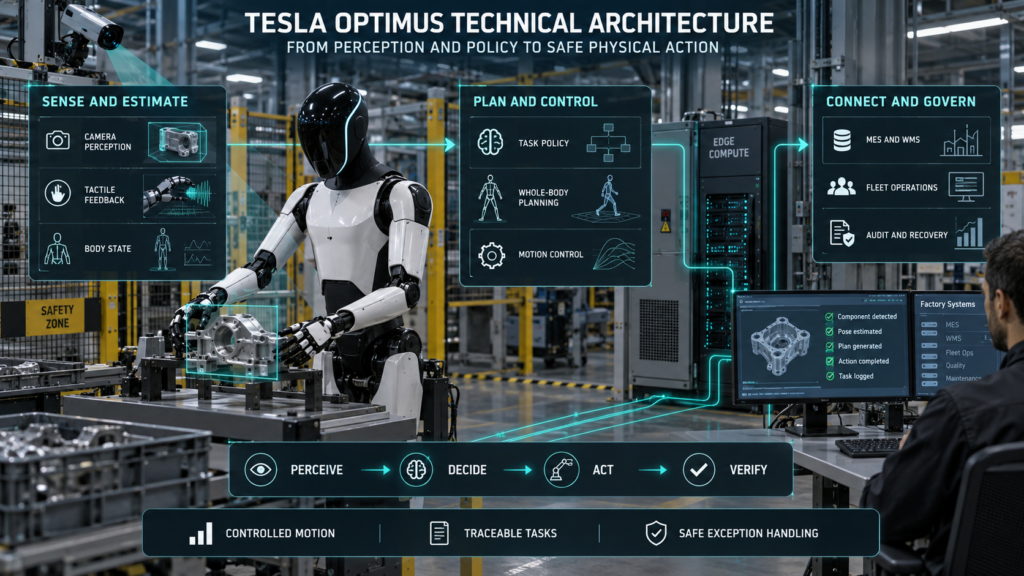
The following architecture is a proposed enterprise evaluation model, rather than a verified description of Tesla’s complete production system. It identifies the mechanical, sensing, control, learning, integration and governance layers that a buyer would need to assess before deployment.
1. Mechanical body and power system
The body includes actuators, joints, transmissions, structural members, hands, feet, batteries, thermal controls, and protective housings. Commercial success depends less on a single impressive motion than on repeatable cycles, wear behavior, safe torque limits, service access, and predictable energy use.
Battery runtime must be translated into productive availability. Travel, waiting, charging, thermal limits, task intensity, battery aging, and recovery from faults all reduce the useful hours delivered per shift.
2. Perception and state estimation
Cameras and proprioceptive sensors estimate the robot’s pose, surroundings, object geometry, and contact state. Tactile sensing can improve grasp control, but transparent objects, glare, occlusion, deformation, poor lighting, and clutter still create perception uncertainty.
The architecture needs confidence thresholds, fallback behavior, and observability. A robot that cannot explain whether it lost the object, misread the scene, or exceeded a joint limit creates long diagnosis cycles and weak operational trust.
3. Whole-body planning and control
Humanoid manipulation couples balance, reach, grip, collision avoidance, and load movement. Picking a part changes the center of mass; stepping changes the reachable workspace; an unexpected contact may require a controlled stop rather than a continued action.
The hard problem is not generating a nominal trajectory. It is maintaining safe behavior when a container shifts, a worker enters the area, the grasp slips, the floor differs from the training environment, or the object is outside tolerance.
4. Task learning and policy layer
Tesla recruits for learned manipulation and reinforcement-learning roles, indicating that policies and data-driven training are central to the program.[5][6] A production buyer should ask how skills are created, validated, versioned, transferred, monitored, and rolled back.
Learned behavior requires representative data and bounded authority. A successful policy in one workstation should not be assumed safe at another without checking fixtures, object variation, lighting, traffic, and failure consequences.
5. Enterprise and fleet layer
The robot must exchange task state with manufacturing execution, warehouse management, quality, maintenance, identity, and analytics systems. This is where industrial automation software converts motion into an accountable production transaction.
Robotics fleet management should track configuration, software version, task assignment, health, battery, location, intervention, safety events, and outcome quality. Without that layer, ten robots become ten isolated support problems.
Integration Flowchart
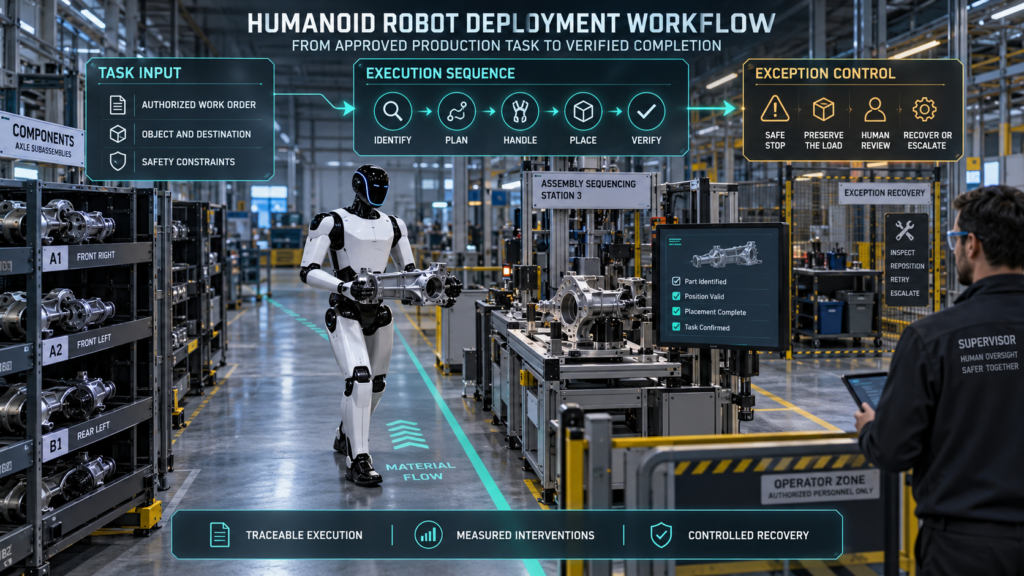
This workflow describes a possible future integration pattern. It does not confirm that Tesla currently provides the depicted MES/WMS interfaces, fleet scheduler or production-record integration.
flowchart TD
A[Approved task and work instruction] –> B[MES or WMS task queue]
B –> C[Fleet scheduler and identity controls]
C –> D[Optimus perception and task policy]
D –> E[Whole-body motion and manipulation]
E –> F[Sensor-verified completion]
F –> G[Production record or exception]
G –> H[Human review and corrective action]
H –> B
The flow must support a safe exception path. If task confirmation fails, the system should preserve the object, stop or retreat safely, identify the reason, and route the event to an authorized person rather than improvising indefinitely.
What Tesla Optimus can demonstrably do today
The evidence supports describing Tesla Optimus as a functional development platform with bipedal locomotion, evolving dexterity, learned manipulation, and a manufacturing roadmap. It does not support describing it as a generally available autonomous employee for any environment.
Public material and recruitment priorities indicate work on object handling, tactile sensing, policy learning, hardware validation, integration, and production tests.[5][6][7] These capabilities align most directly with structured factory material handling, part presentation, sorting, and repetitive workstation support.
The most credible early applications have limited object families, controlled travel, repeatable handoff points, low consequence of a failed pick, and a nearby recovery process. They are less glamorous than home assistance but much easier to validate and govern.
Why household claims remain premature
Homes contain children, pets, stairs, liquids, fragile items, deformable objects, personal data, and constantly changing layouts. Agility Robotics, another humanoid developer, publicly states that current humanoid capability still lags what is required for the home and argues for training first in controlled environments.[8]
That assessment is relevant to Tesla Optimus even though the platforms differ. A factory can restrict access, standardize containers, mark zones, train staff, and document hazards; a household offers far fewer engineering controls.
Deployment Challenges That Decide the Outcome
Long-tail exceptions
The average case is rarely the budget killer. A dropped object, blocked aisle, reflective package, damaged tote, moved fixture, network outage, or human interruption can consume more support time than many successful cycles save.
Dexterity versus durability
Hands need fine motion and tactile feedback, yet production hands also need impact tolerance, contamination resistance, rapid replacement, calibration stability, and affordable wear components. More degrees of freedom can improve capability while increasing failure and maintenance points.
Safety validation
A humanoid’s reach and mobility make the hazard boundary dynamic. The validation plan must cover walking, carrying, reaching, falling, dropped loads, unexpected contact, teaching, maintenance, restart, remote operation, and software change.
Integration and data ownership
Industrial automation software must define which system authorizes the task and which system records completion. Duplicated commands, stale inventory, clock drift, connectivity loss, and inconsistent identifiers can produce physical errors, not merely bad reports.
Production support
A humanoid robot deployment needs spare parts, trained maintainers, diagnostic access, escalation paths, service response, and safe manual recovery. These operating requirements remain uncertain until Tesla publishes commercial terms and external support arrangements.
Performance Evaluation Matrix
| Evaluation dimension | Pilot metric | Evidence required | Failure signal |
| Task success | Correct completions / attempts | Representative objects and shifts | Curated demonstrations replace logged trials |
| Intervention burden | Human assists per 100 cycles | Reason, duration, and role recorded | Assistance hidden outside cycle time |
| Cycle consistency | Median and 95th-percentile cycle time | Full distribution, not a highlight | Tail latency breaks production takt |
| Safety | Protective stops, contacts, near misses | Reviewed logs and observation | Throughput rises by weakening controls |
| Availability | Productive hours / scheduled hours | Charging, updates, maintenance included | Runtime quoted as availability |
| Quality | Correct object, placement, orientation | Downstream acceptance record | Visual success without process confirmation |
| Integration | Valid transactions / attempted events | Reconciled MES, WMS, or quality records | Duplicate or orphaned tasks |
| Economics | Verified annual benefit / full annual cost | Finance-approved baseline | Savings assume immediate labor removal |
The matrix turns Tesla Optimus from a spectacle into a testable production asset. It also allows conventional automation and competing humanoids to be compared using the same outcome definitions.
III. Commercial Solutions and Best Practices
Feature and Cost Comparison
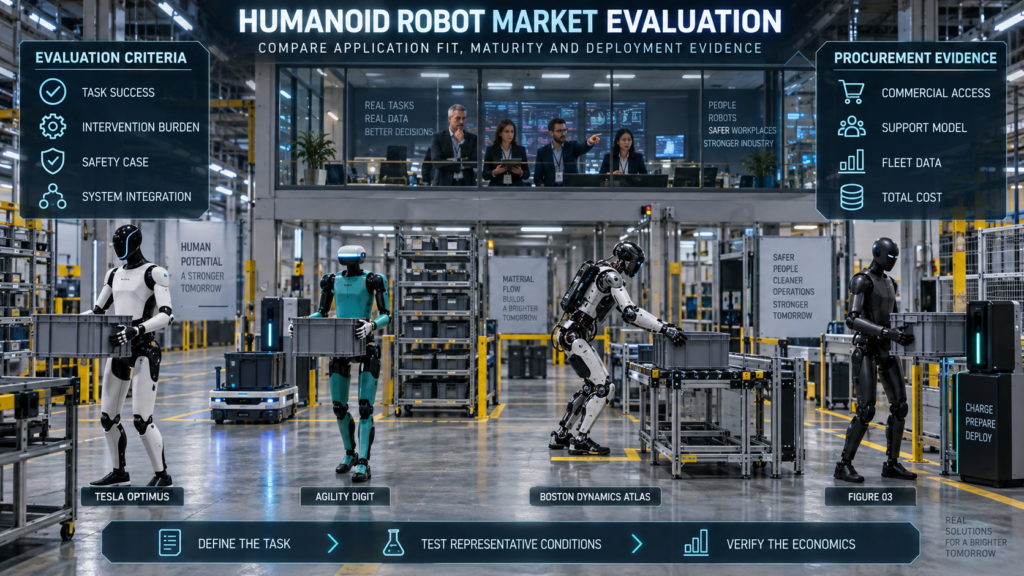
The humanoid market is moving quickly, but maturity is uneven. Vendor claims below are treated as reported capabilities or status, not independent guarantees.
| Platform | Public 2026 position | Best-fit starting work | Commercial evidence | Price and procurement status | Main buyer risk |
| Tesla Optimus | General-purpose autonomous humanoid in development; production preparation underway | Structured factory handling and workstation support | Tesla demonstrations, development hiring, manufacturing disclosures | Tesla robot price and general ordering terms not confirmed | Limited external production and support data |
| Agility Digit | Commercially deployed logistics humanoid with Arc fleet software | Tote movement and logistics material handling | Vendor reports live commercial operations and production experience | Enterprise engagement; configuration pricing | Narrower initial task scope and evolving safety features |
| Boston Dynamics Atlas | Enterprise humanoid entering selected customer deployments | Part sequencing, machine tending, order building | Product specifications and early deployment roadmap published | Qualified-prospect and early-adopter process | Limited history at broad production scale |
| Figure 03 | General-purpose humanoid designed for Helix, home use, and manufacturing scale | Manipulation research and emerging household/industrial workflows | Product and AI demonstrations; production investment described | General enterprise pricing not public | Broad ambition exceeds independently verified deployment evidence |
Agility states that Digit has commercial deployments and pairs with its Arc cloud platform, while Boston Dynamics publishes Atlas specifications and a staged adoption route.[9][10] Figure positions Figure 03 around its Helix AI system and high-volume design, but buyers still need application-specific proof.[11][12]
Why the Tesla robot price is not the business case
Executive commentary about an eventual target price is not a quote, and the Tesla robot price has not been confirmed in a public ordering program. A procurement model should therefore use a range and clearly label it as an internal scenario, not a factual product price.
The denominator that matters is productive, accepted output. A lower-cost robot with frequent interventions, uncertain support, limited uptime, or expensive integration can cost more per valid cycle than a higher-priced specialized system.
Total cost of ownership model
- Robot hardware, task tooling, grippers, charging equipment, batteries, spares, and site preparation.
- Industrial automation software, robotics fleet management, data storage, APIs, identity services, and observability.
- Integration with MES, WMS, quality, maintenance, and safety systems.
- Application engineering, data collection, policy training, simulation, validation, and change control.
- Operator, maintainer, engineering, cybersecurity, safety, and supervisor labor.
- Preventive maintenance, calibration, wear items, repairs, updates, support, and lifecycle replacement.
- Exception handling, production disruption, recovery, incident investigation, and insurance review.
Until commercial terms exist, the Tesla robot price should remain one variable among many. The model should test whether the project survives when integration, intervention, and ramp costs exceed the optimistic case.
A six-gate deployment framework
Gate 1: Choose one bounded task
Start with one object family, one route, one handoff, and one accountable process owner. Reject pilots framed as proving “general labor” or replacing several unrelated roles.
Gate 2: Compare simpler alternatives
Price the best fixed robot, cobot, autonomous mobile robot, lift-assist, conveyor, and process redesign. A humanoid robot deployment should win because flexibility creates measurable value, not because it attracts attention.
Gate 3: Define the operating envelope
Record load, dimensions, surfaces, lighting, floor condition, aisle clearance, human traffic, required reach, takt time, contamination, network coverage, and prohibited states. Test the edges of that envelope.
Gate 4: Design integration and governance
Establish task authority, data fields, asset identifiers, authentication, retention, software approval, rollback, alert ownership, and recovery procedures before connecting production systems.
Gate 5: Run representative trials
Include normal, peak, degraded, and fault conditions. Test missed grasps, moved fixtures, dropped objects, blocked paths, lost connectivity, bad labels, low battery, emergency stops, and restart behavior.
Gate 6: Enforce pass, remediate, and stop criteria
Define thresholds before the demonstration. A project should not proceed because stakeholders are impressed; it should proceed because safety, task quality, availability, integration, and economics meet written acceptance criteria.
IV. Business Outcomes and Strategic ROI Takeaways
Capacity without rebuilding every workstation
The strategic promise of Tesla Optimus is reusable mobility and manipulation in spaces already designed for people. If the same platform can support several validated tasks, organizations may avoid some dedicated automation engineering and recover capacity during product or volume changes.
That “if” carries the investment risk. Skill transfer, tooling, safety validation, and exception handling may remain task-specific even when the body is reusable.
Reduced ergonomic exposure
Moving totes, components, and supplies can create repetitive lifting, carrying, bending, and walking exposure. A bounded humanoid robot deployment may reduce that exposure when the robot handles the physical segment and workers control exceptions and higher-judgment work.
Safety value should be measured through exposure minutes, lifts, travel distance, ergonomic assessment, and near-miss data. It should not be converted into guaranteed injury savings without actuarial or historical support.
Production resilience
Robots can add capacity during difficult shifts and standardize repetitive handling, but resilience depends on recovery. One failure that blocks a workstation can cost more than many fast cycles create.
Track mean time to recover, operator assists, spare availability, and whether production can continue manually. Robotics fleet management should expose these measures alongside successful task counts.
Scenario-Based Net Benefit and Payback
Annual net cash benefit = incremental contribution from additional accepted output + verified annual cash savings − incremental annual operating and support costs.
Simple payback period in years = total upfront deployment investment ÷ positive annual net cash benefit.
These calculations are planning scenarios, not verified Tesla Optimus customer returns. Express all amounts in the same currency and avoid counting overlapping benefits. Value additional output using its incremental contribution after associated costs, rather than total sales revenue. Convert avoided downtime into a supported financial amount before including it.
Include hardware, tooling, installation, integration, initial training and safety validation in upfront investment. Simple payback assumes a stable positive annual benefit; use cumulative cash flow where deployment costs and benefits change during the ramp-up period.
Build low, base, and high cases for utilization, success rate, intervention, cycle time, service cost, energy, integration, ramp, and labor convertibility. Do not claim labor savings unless the budget is removed, avoided, or converted into measured additional output.
Strategic takeaways for buyers
- Tesla Optimus is a development and production-preparation program, not a generally purchasable enterprise fleet with public service terms.
- Structured factory handling is more defensible than household, healthcare, retail, or emergency-response claims.
- The Tesla robot price remains unconfirmed and should never anchor a published ROI claim.
- Industrial automation software and robotics fleet management are core system components, not optional add-ons.
- Production evidence requires distributions, failures, interventions, and recovery—not a successful video clip.
- Readiness work can create value before purchase by improving data, work instructions, interfaces, and safety controls.
V. Risk Mitigation and Regulatory Framework
Mechanical and workplace safety
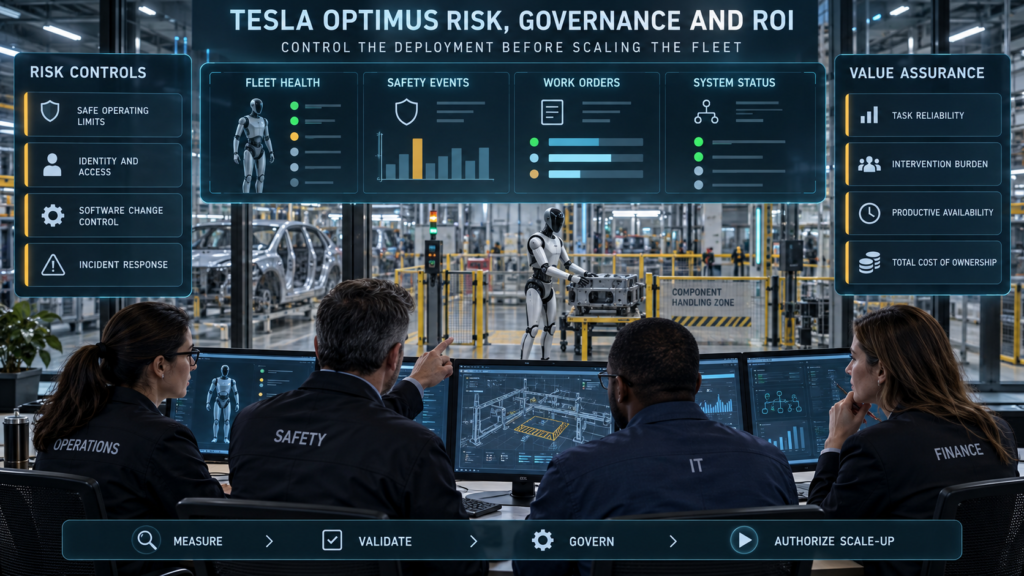
OSHA identifies robot risks across normal operation, programming, testing, setup, and maintenance.[13] A mobile humanoid expands the number of states and locations that the safety assessment must cover.
ISO 10218-1:2025 addresses industrial robot design, while ISO 10218-2:2025 addresses integration and industrial robot applications.[14][15] Applicability depends on the final product, task, and jurisdiction; citing a standard is not equivalent to demonstrating conformity.
Safety checklist
- Assign a qualified integrator and document the intended use and foreseeable misuse.
- Assess walking, reaching, carrying, falling, pinching, crushing, dropping, charging, and thermal hazards.
- Validate speed, force, separation, stopping distance, protective zones, and safe restart.
- Control teaching, remote operation, maintenance, override, and recovery permissions.
- Test sensor, actuator, power, network, localization, grasp, and software faults.
- Preserve a manual production path and safe object-recovery procedure.
- Revalidate after changes to policy, hardware, tooling, layout, load, or work instruction.
Cybersecurity and operational technology
A connected humanoid bridges cameras, sensors, learned policies, robotics fleet management, and production systems. Compromise can affect confidentiality, integrity, availability, and physical behavior.
IEC 62443-2-1:2024 specifies security-program requirements for industrial automation and control-system asset owners.[16] Its lifecycle approach is useful for defining zones, identities, supplier obligations, patching, incident response, backups, and compensating controls.
Cybersecurity checklist
- Inventory robots, controllers, tooling, chargers, software, models, certificates, APIs, and dependencies.
- Segment robot networks from business and safety-critical systems using documented conduits.
- Require unique identities, least privilege, strong administrative authentication, and rapid revocation.
- Sign and approve software, model, and configuration releases; preserve rollback capability.
- Encrypt management and data flows; monitor remote access and privileged actions.
- Test loss of cloud service, expired credentials, corrupt tasks, unavailable integration, and bad time synchronization.
- Define vendor notification, vulnerability response, evidence retention, and recovery objectives.
AI, privacy, and workforce governance
The NIST AI Risk Management Framework organizes work around Govern, Map, Measure, and Manage.[17] For Tesla Optimus, that means documenting intended tasks, affected people, data sources, performance limits, oversight, incident escalation, and change control.
The EU AI Act may apply depending on where and how a system is placed on the market or used, and employment-related or safety-component uses can carry heightened obligations.[18] Organizations should obtain jurisdiction-specific legal advice rather than treating a generic checklist as a compliance opinion.
Governance checklist
- Identify every camera, microphone, tactile, location, production, and worker-related data stream.
- Set purpose limits, retention, access, deletion, and cross-border transfer rules.
- Prohibit unapproved productivity scoring, biometric inference, or secondary surveillance.
- Validate policies on representative conditions and record false actions, misses, and interventions.
- Give workers clear operating rules, stop authority, training, and a non-retaliatory incident channel.
- Document accountability across Tesla, integrators, software providers, site owners, and operators.
Preparing a Tesla Optimus Readiness Assessment
Create a vendor-neutral readiness dossier before entering a humanoid procurement discussion. Include one task baseline, alternative-automation comparison, site operating envelope, integration architecture, safety concept, cybersecurity requirements, pilot matrix, TCO range, and pre-approved stop criteria.
Recheck Tesla’s official disclosures before making a procurement decision. If commercial access becomes available, require written specifications, support terms and application-specific acceptance criteria. Until then, use the assessment to improve automation readiness and compare currently available alternatives.
VI. Appendix and Research Integrity
Appendix A: Academic and Primary-Source Footnotes
- Tesla, “AI & Robotics.” Official statement of the Optimus program’s general-purpose, bipedal, autonomous objective. https://www.tesla.com/AI Accessed September 22, 2026.
- Tesla, Inc., 2025 Annual Report on Form 10-K. Describes Optimus as a general-purpose autonomous humanoid robot in development. https://ir.tesla.com/_flysystem/s3/sec/000162828026003952/tsla-20251231-gen.pdf Accessed September 22, 2026.
- Tesla, Inc., Form 10-Q for the quarter ended March 31, 2026. Describes preparation and investment for large-scale Optimus production. https://ir.tesla.com/_flysystem/s3/sec/000162828026026673/tsla-20260331-gen.pdf Accessed September 22, 2026.
- Tesla, Inc., July 2026 investor update. States that first-generation Optimus production lines were being installed in anticipation of 2026 production. https://ir.tesla.com/_flysystem/s3/sec/000162828026049213/tsla-20260722-gen.pdf Accessed September 22, 2026.
- Tesla Careers, “AI Engineer, Manipulation, Optimus.” Primary evidence of Tesla’s learned manipulation development work. https://www.tesla.com/careers/search/job/ai-engineer-manipulation-optimus-224501 Accessed September 22, 2026.
- Tesla Careers, “Reinforcement Learning Engineer, Policy, Optimus.” Primary evidence of work on general robot-learning systems for complex physical tasks. https://www.tesla.com/careers/search/job/reinforcement-learning-engineer-policy-optimus-222416 Accessed September 22, 2026.
- Tesla Careers, Optimus engineering and validation listings. Primary evidence of tactile sensing, hand validation, manufacturing tests, integration, and reliability work. https://www.tesla.com/careers Accessed September 22, 2026.
- Agility Robotics, “The Realistic Pathway to Home.” Industry-developer assessment that current humanoid capability remains below household requirements. https://www.agilityrobotics.com/content/the-realistic-pathway-to-home Accessed September 22, 2026.
- Agility Robotics, “Humanoid Solutions.” Vendor-reported Digit deployment position, payload, battery, and fleet-platform information. https://www.agilityrobotics.com/solutions Accessed September 22, 2026.
- Boston Dynamics, “Atlas.” Official specifications and staged enterprise deployment information. https://bostondynamics.com/products/atlas/ Accessed September 22, 2026.
- Figure, “Introducing Figure 03.” Official description of Figure 03’s hardware and scale objectives. https://www.figure.ai/news/introducing-figure-03 Accessed September 22, 2026.
- Figure, “Helix.” Official description of the company’s vision-language-action system. https://www.figure.ai/helix Accessed September 22, 2026.
- U.S. Occupational Safety and Health Administration, “Robotics.” Federal robot-safety resources and hazard guidance. https://www.osha.gov/robotics Accessed September 22, 2026.
- International Organization for Standardization, ISO 10218-1:2025. Safety requirements for industrial robots. https://www.iso.org/standard/73933.html Accessed September 22, 2026.
- International Organization for Standardization, ISO 10218-2:2025. Safety requirements for industrial robot applications and cells. https://www.iso.org/standard/73934.html Accessed September 22, 2026.
- International Electrotechnical Commission, IEC 62443-2-1:2024. Security-program requirements for industrial automation and control-system asset owners. https://webstore.iec.ch/en/publication/62883 Accessed September 22, 2026.
- National Institute of Standards and Technology, AI Risk Management Framework 1.0. Voluntary framework for managing AI risks. https://www.nist.gov/itl/ai-risk-management-framework Accessed September 22, 2026.
- European Union, Regulation (EU) 2024/1689 (Artificial Intelligence Act). Official legal text governing AI systems in the European Union. https://eur-lex.europa.eu/eli/reg/2024/1689/oj Accessed September 22, 2026.
Source-to-Claim Index
| Claim area | Footnotes |
| Tesla Optimus purpose and development status | [1], [2] |
| 2026 production preparation | [3], [4] |
| Manipulation, learning, validation, and integration priorities | [5], [6], [7] |
| Household-readiness caution | [8] |
| Competitor status and comparison | [9], [10], [11], [12] |
| Workplace robot safety | [13], [14], [15] |
| OT cybersecurity | [16] |
| AI governance and EU regulation | [17], [18] |
Research limitations
Tesla has not published the operating data required for an independent calculation of fleet uptime, task success, intervention burden, service cost, or customer ROI. This paper therefore avoids asserting a commercial performance level.
Competing-platform statements are vendor-reported and included to frame procurement questions, not rank vendors. Specifications, availability, legal obligations, and support terms must be rechecked during procurement.
Corporate Editorial Transparency and AI Usage Disclosure
AI-assisted tools were used to support research organization, drafting and language refinement. NezzHub retains editorial responsibility for the published article. Vendor inclusion does not constitute endorsement.
This article provides editorial analysis. Deployment decisions require application-specific engineering and safety assessment.
Author and Editorial Review
Author: Garikapati Bullivenkaiah
Technology research writer with LL.B., LL.M., M.A., and MBA qualifications. He writes about emerging technologies and their business, governance and legal implications. His multidisciplinary academic background informs his analysis of technology adoption, intellectual property, and organizational risk. His articles explain technical concepts and practical considerations for business owners, IT managers and technology decision-makers. LinkedIn Profile
Reviewed by: Chitikineni Ramadevi — Editor
Chitikineni Ramadevi holds an M.Sc. in Computers from Andhra University and has over 10 years of research experience in technology-related subjects. She reviews NezzHub articles for clarity, factual accuracy, source support and practical relevance.
Published by: NezzHub
Research approach: This article draws on primary sources, technical documentation and relevant industry research. References are provided within the article or its sources section.
Last reviewed: 09-22-2026
Corrections: To report a factual error or outdated information, please contact NezzHub.

Garikapati Bullivenkaiah is a seasoned entrepreneur with a rich multidisciplinary academic foundation—including LL.B., LL.M., M.A., and M.B.A. degrees—that uniquely blend legal insight, managerial acumen, and sociocultural understanding. Driven by vision and integrity, he leads his own enterprise with a strategic mindset informed by rigorous legal training and advanced business education. His strong analytical skills, honed through legal and management disciplines, empower him to navigate complex challenges, mitigate risks, and foster growth in diverse sectors. Committed to delivering value, Garikapati’s entrepreneurial journey is characterized by innovative approaches, ethical leadership, and the ability to convert cross-domain knowledge into practical, client-focused solutions.