

















Executive Summary
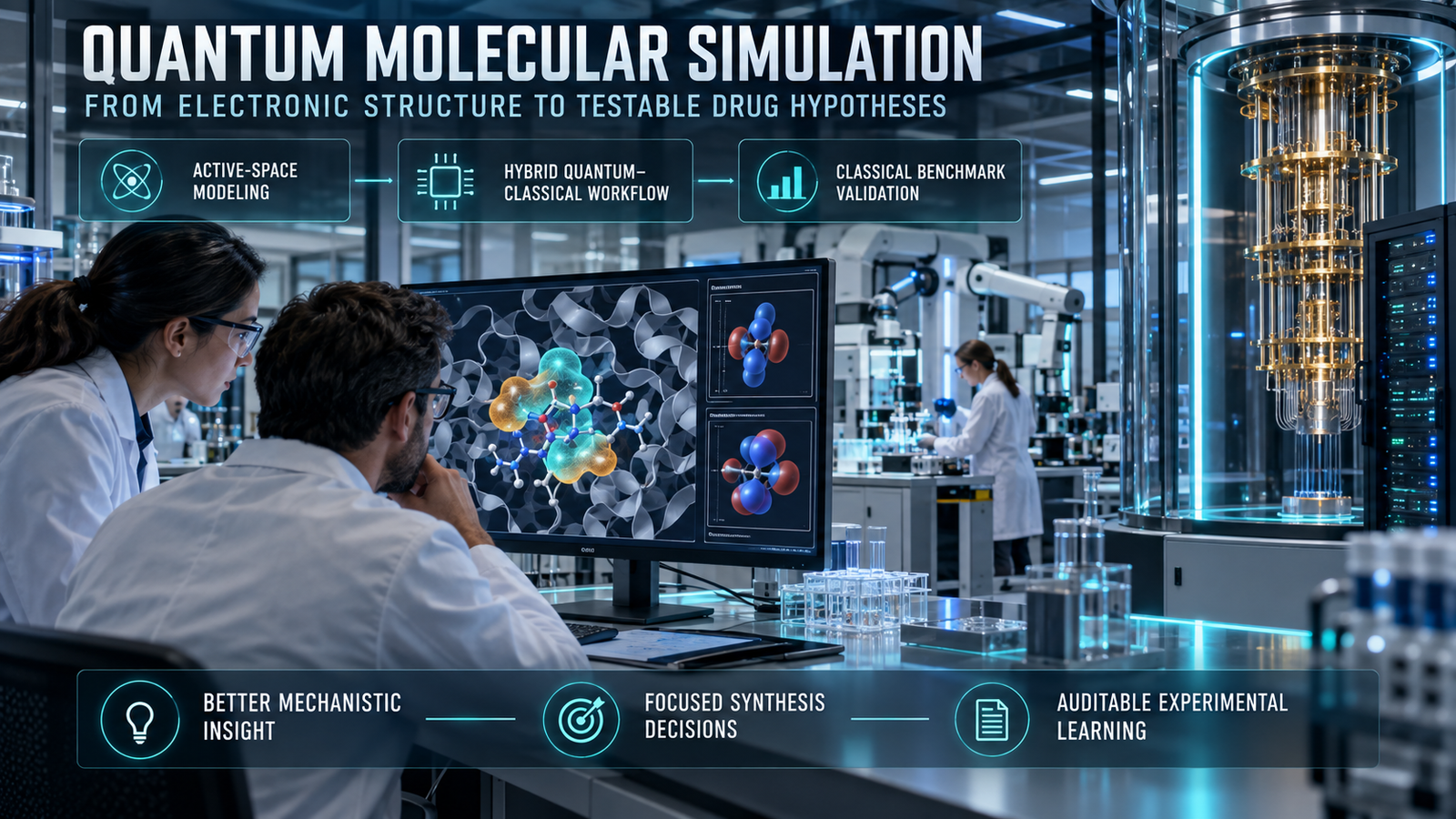
Quantum molecular simulation can improve a narrow but important part of drug discovery: reasoning about electronic structure when force fields, docking scores, or routine density-functional calculations leave a decision unresolved. It does not replace medicinal chemistry, molecular dynamics, high-performance computing, or laboratory evidence.
The commercial opportunity for quantum molecular simulation is therefore specific. A well-designed program uses quantum molecular simulation only after inexpensive methods have reduced a problem to a small active region, a contested mechanism, or a short list of compounds whose electronic differences could alter a synthesis decision.
Current quantum processors have not demonstrated routine, end-to-end pharmaceutical advantage. No responsible quantum molecular simulation business case should assume that a noisy quantum processing unit will screen a corporate compound library faster or more accurately than established classical infrastructure.
The defensible architecture is hybrid. Classical docking and molecular dynamics provide breadth; high-level classical quantum chemistry establishes a benchmark; quantum algorithms probe a deliberately restricted electronic problem; wet-lab measurements decide whether the result matters.
That distinction changes procurement. Buyers should evaluate a quantum molecular simulation platform on reproducibility, active-space controls, uncertainty reporting, workflow integration, data residency, and total cost per validated decision—not on qubit count or vendor roadmaps alone.
This Article supplies a deployment model, evaluation matrix, cost framework, risk controls, and visible primary-source footnotes. Its central conclusion is simple: quantum molecular simulation earns investment only when it beats an agreed classical baseline on a decision-relevant task under a capped budget.
I. The Current Market Landscape and the Real Bottleneck
In structure-based discovery, computational uncertainty can arise when models misrank close analogues, overlook protonation or tautomer changes, or inadequately represent metal centers. These limitations can affect compound-selection decisions, but they are only some of the scientific and operational reasons a drug-discovery program may fail.
Quantum molecular simulation addresses the electronic layer beneath those failures. Its potential value lies in cases where bond breaking, charge transfer, multireference character, polarization, or excited states dominate the answer.
That scope is narrower than much vendor marketing suggests. Proteins contain thousands of atoms, solvent sampling is expensive, and a biologically useful free energy is not obtained by calculating one small molecule’s ground-state energy.
The Cost of Inaction Is Not “Missing Quantum”
The real cost of inaction is continuing to make expensive chemistry decisions with poorly calibrated models. A misleading score can trigger unnecessary synthesis, assay work, animal studies, and schedule delay.
Yet premature adoption creates a second cost. Teams can spend heavily on scarce specialists, cloud quantum runtime, and bespoke integrations while producing results that a classical coupled-cluster, density-functional, or multireference calculation could match more cheaply.
Decision makers should therefore frame quantum computing for drug discovery as an R&D option, not a production entitlement. The first investment is a falsifiable benchmark program with a stop condition.
Where Electronic-Structure Error Actually Matters
High-value quantum molecular simulation candidates include metalloenzymes, covalent inhibitors, photochemical liabilities, redox chemistry, proton-coupled electron transfer, and competing spin states. These problems can expose the limits of fixed-charge force fields and single-reference approximations.
Quantum molecular simulation may also help when a medicinal-chemistry series shows discontinuous structure–activity relationships. The calculation must explain a measured discontinuity or improve prospective ranking; an attractive orbital image is not a business outcome.
For ordinary neutral ligands in a well-behaved pocket, mature free-energy methods may remain the better investment. The discipline to reject a quantum molecular simulation use case is part of pharmaceutical R&D optimization.
What DARPA Quantum Research Is Doing and Why It Matters
II. Deep-Dive Technical Analysis and Evidence
The phrase quantum molecular simulation is often used for two different activities. Classical computers already solve approximate quantum-mechanical equations, while quantum computers encode an electronic-structure problem into qubits and execute quantum circuits.
Both belong in a modern program, but they have different maturity, cost, and validation burdens. Conflating them makes vendor comparisons meaningless.
Architecture Overview: From Assay Question to Computable Hamiltonian
A production-grade workflow starts with a scientific decision, not a device. The team identifies the observable, acceptable error, reference method, and experimental test before choosing an algorithm.
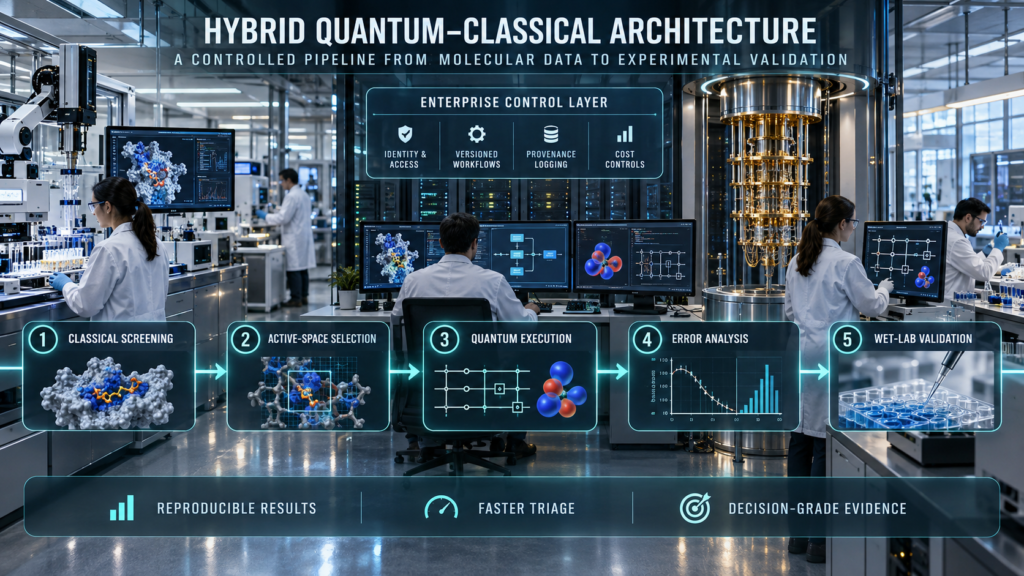
The technical path usually contains these layers:
- Scientific framing: Specify the compound decision, target state, environment, and uncertainty tolerance.
- Structural preparation: Resolve protonation, tautomerism, missing residues, metals, waters, and alternative conformations.
- Classical sampling: Use docking, molecular dynamics, enhanced sampling, or free-energy methods to identify representative geometries.
- Electronic reduction: Select orbitals and electrons for an active space while embedding the rest of the system classically.
- Hamiltonian mapping: Convert fermionic operators to qubit operators through a mapping such as Jordan–Wigner or Bravyi–Kitaev.
- Quantum execution: Run a variational or phase-estimation workflow on a simulator or quantum processor.
- Error treatment: Apply mitigation, symmetry checks, readout correction, or—eventually—fault-tolerant error correction.
- Decision integration: Compare against classical references and prospective wet-lab results before changing the compound plan.
Active-space selection is a scientific assumption, not a clerical preprocessing step. Excluding a chemically decisive orbital can produce a precise answer to the wrong problem.
Quantum Molecular Simulation with VQE, QPE, and the Maturity Gap
The variational quantum eigensolver, or VQE, combines a parameterized quantum circuit with a classical optimizer. In quantum molecular simulation, measurement volume, optimizer instability, circuit noise, and barren plateaus can dominate practical execution.[2][7]
Quantum phase estimation, or QPE, offers a clearer path to controlled energy precision. It generally requires deep circuits, high-quality state preparation, and error-corrected logical qubits that current commercial systems do not provide at pharmaceutical scale.[3][6]
That quantum molecular simulation maturity gap matters for budgeting. Near-term experiments test algorithms, encodings, and hybrid workflow mechanics; fault-tolerant resource studies estimate a future capability.
Quantum molecular simulation should never present a fault-tolerant projection as a current deployment result. Every performance claim must identify the hardware, noise model, basis set, active space, shots, mitigation, and classical comparator.
Integration Flowchart
flowchart TD
A[“Define the chemistry decision”] –> B[“Screen and sample classically”]
B –> C[“Select active region and references”]
C –> D[“Establish the classical benchmark”]
D –> E[“Encode and execute the quantum calculation”]
E –> F[“Evaluate errors and uncertainty”]
F –> G[“Validate prospectively in the laboratory”]
G –> H[“Review results: refine, scale or stop”]
The workflow includes a feedback loop: validation results can trigger changes to the active region, model assumptions or experimental design. Continue only when the evidence supports the predefined scientific and budget criteria. Preserve negative results and stop when further work is not justified.
The Classical Baseline Cannot Be Optional
Any serious comparison starts with the strongest affordable classical method, not a weak straw man. Depending on system size and chemistry, that may include coupled cluster, selected configuration interaction, density-matrix renormalization group, multireference perturbation theory, quantum Monte Carlo, or carefully validated density-functional methods.[3][4]
Classical computational chemistry software also benefits from decades of numerical optimization, GPU acceleration, and established quality controls. Quantum advantage must be measured against that moving target.
For binding problems, quantum molecular simulation supplies only one component. Entropy, solvation, protein motion, protonation equilibria, and assay context can overwhelm a sub-kilocalorie improvement in an isolated fragment calculation.

Performance Evaluation Matrix
The matrix below separates quantum molecular simulation algorithm health from drug-discovery usefulness. A pilot should define thresholds before execution and report failed criteria alongside successful ones.
| Evaluation layer | Required metric | Minimum evidence | Commercial decision |
| Electronic accuracy | Absolute and relative energy error | Blind comparison with a high-level classical reference | Continue only if error is competitive for the chosen chemistry |
| Circuit feasibility | Logical/physical qubits, two-qubit gates, depth | Compiled circuit and device-specific resource estimate | Reject workloads that exceed the funded execution envelope |
| Sampling cost | Shots, variance, repeated-run stability | Multiple seeds, days, and calibration windows | Price the result per confidence interval, not per circuit |
| Chemical ranking | Rank correlation and pairwise order | Held-out congeneric compounds | Continue only if ranking changes are reproducible |
| Operational speed | Queue plus execution plus post-processing time | End-to-end timestamped run | Compare with classical wall-clock time and scientist effort |
| Prospective validity | Pre-registered prediction versus assay | New compounds not used during tuning | Require a material decision improvement before scale-up |
| Reproducibility | Code, environment, device, calibration metadata | Versioned workflow and immutable result record | Block production use when provenance is incomplete |
“Chemical accuracy” is often summarized as roughly 1 kcal/mol, but that slogan is not a universal acceptance test. The required tolerance depends on the observable, reference uncertainty, and whether the program needs absolute energies or a reliable ordering.
Report statistical uncertainty from finite measurements and variability across repeated optimization runs. Assess geometry, active-space, embedding and model assumptions separately through sensitivity tests and reference comparisons. A confidence interval for measurement noise alone does not establish the total accuracy of a molecular prediction.
Deployment Challenges That Appear After the Demo
Small quantum molecular simulation demonstrations conceal most enterprise friction. A pilot may run on hydrogen chains or tiny molecules, while a drug program needs charged fragments, heterogeneous environments, conformational ensembles, and traceable transformations.
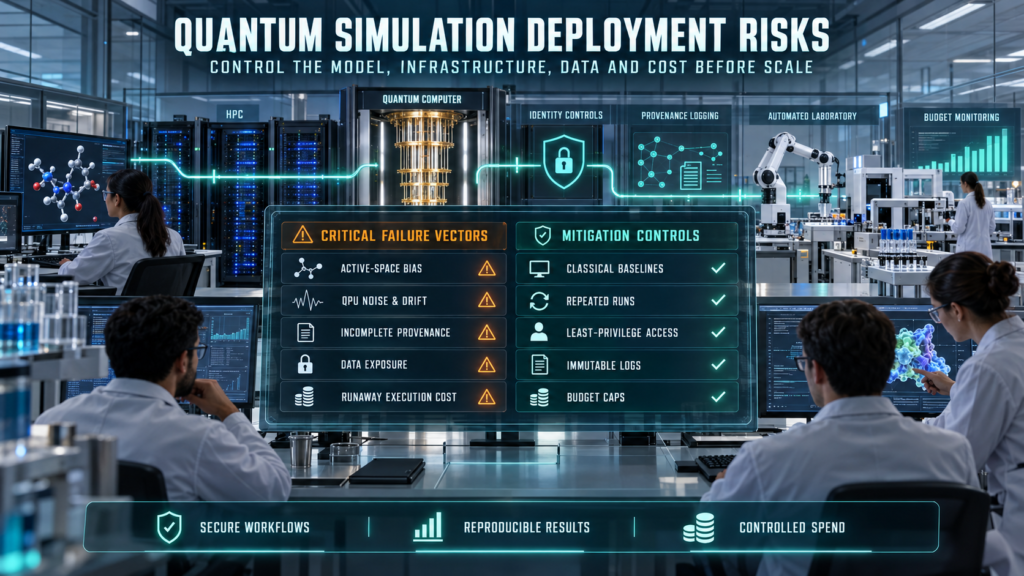
The most persistent deployment challenges are organizational as well as computational.
Active Spaces, Embedding, and Boundary Error
Embedding restricts quantum molecular simulation to a difficult region and treats the environment with cheaper methods. This is the most plausible near-term architecture, but the boundary can distort polarization, charge transfer, and orbital occupation.[5]
Teams must test multiple active spaces and embedding choices. If the conclusion reverses under a reasonable boundary change, the model is not decision-ready.
Automated orbital selection can improve consistency, yet domain review remains essential. Drug-like molecules do not arrive with an objectively correct active space attached.
Noise, Measurements, and Optimizer Instability
Expectation-value estimation may require many circuit executions. Grouping observables, reducing variance, and reusing information can help, but each technique adds assumptions and software complexity.
Quantum molecular simulation hardware calibrations also drift. Two nominally identical runs can differ because gate errors, readout errors, queue conditions, or compiler choices changed.
For that reason, quantum molecular simulation records need device identifiers, calibration context, transpiler settings, shot counts, seeds, and mitigation parameters. Without them, a result cannot support regulated R&D evidence.
Data Movement and Pipeline Integration
Quantum cloud services sit inside a larger data path. Molecular structures may move from an electronic lab notebook to HPC storage, a workflow orchestrator, a QPU service, an analysis notebook, and a compound-registration system.
Each quantum molecular simulation transition introduces identity, encryption, retention, and provenance requirements. The quantum circuit may not expose a proprietary structure directly, but basis choices, coefficients, job labels, and output patterns can still reveal sensitive research context.
A molecular simulation platform should integrate through controlled APIs, service identities, signed artifacts, and versioned schemas. Copying structures into unmanaged notebooks is not a scalable architecture.
III. Commercial Solutions and Best Practices
The market contains hardware providers, cloud brokers, open-source frameworks, and chemistry-focused application layers. These categories solve different problems and should not be ranked as interchangeable products.
The table reflects publicly available information checked on September 19, 2026. Prices and device availability change, so procurement teams must revalidate them before contracting.[9–12]
Feature and Cost Comparison Table
| Solution | Access and workflow fit | Public cost signal | Best-fit buyer | Material limitation |
| IBM Quantum with Qiskit | Direct fleet access, circuit tooling, managed functions, simulators, and enterprise plans | Free open allocation; pay-as-you-go listed from $96 per QPU minute; contract tiers list lower starting rates | Team building Qiskit-native prototypes and device-specific controls | QPU-minute price does not include all classical engineering, validation, or integration cost |
| Amazon Braket | Multi-provider QPU access, managed simulators, notebooks, reservations, and hybrid jobs | No upfront fee; on-demand charges combine per-task and per-shot fees; listed device prices vary | AWS-centered organization testing multiple hardware modalities | The bill spans QPU tasks, shots, simulators, storage, notebooks, and classical instances |
| Microsoft Azure Quantum | Cloud brokerage, resource estimation, partner hardware, and Azure integration | Provider- and plan-specific metering; published pricing must be checked by target and region | Azure enterprise needing identity, billing, and workflow alignment | Comparable price/performance requires normalizing different provider units and queues |
| Quantinuum InQuanto | Chemistry-focused algorithm and workflow layer with hardware-agnostic development options | Enterprise access is commercially negotiated; obtain a workload-specific quote | Computational chemistry group seeking domain abstractions and professional support | Software convenience does not remove active-space, hardware-noise, or scientific-validation risk |
No quantum molecular simulation table can identify a universal winner. A procurement score should weight chemistry coverage, reproducibility, integration, support, security, and exit portability against the exact benchmark set.
A Stage-Gated Buying Framework
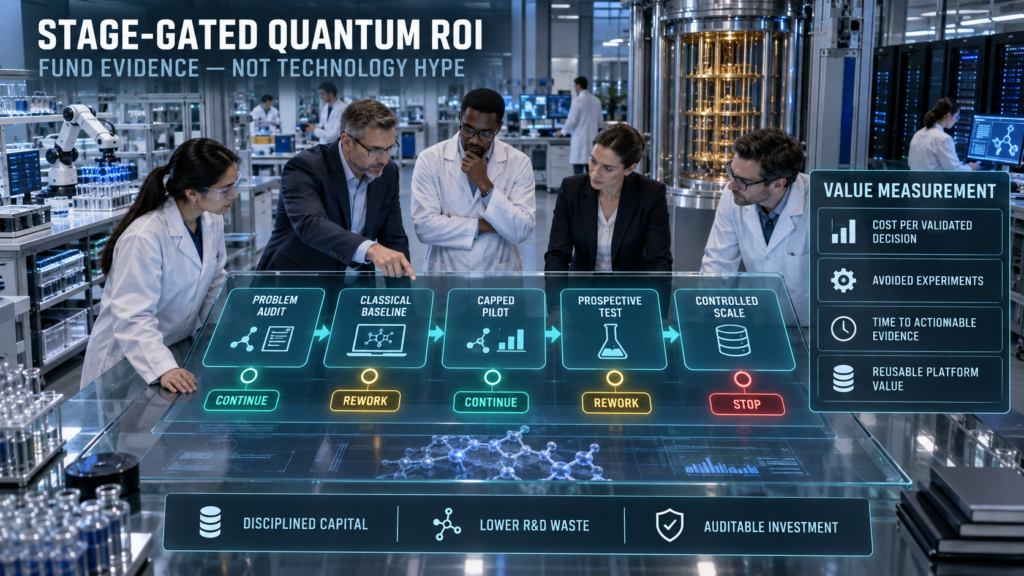
Stage one is a classical-only problem audit. Select one scientifically difficult decision, document existing error, and estimate the cost of the wrong decision.
Stage two is quantum molecular simulation development. Build circuits on local or managed simulators, establish resource scaling, and reproduce small cases before purchasing scarce QPU capacity.
Stage three is a capped hardware experiment. Fix the device budget, preregister the comparator and success thresholds, and repeat runs across calibration windows.
Stage four is prospective validation. Ask medicinal chemists to make or prioritize compounds without using the future assay result, then measure whether the workflow improved the decision.
Stage five is controlled integration. Only after prospective success should the organization connect production data, automate submissions, or negotiate reserved quantum capacity.
Build, Buy, or Partner
Building quantum molecular simulation capabilities offers maximum control but requires rare expertise across quantum algorithms, electronic structure, cloud engineering, and medicinal chemistry. The staffing cost can exceed QPU charges.
Buying a chemistry layer accelerates prototyping and support. It can also introduce proprietary workflow formats, opaque heuristics, and switching costs.
A partnership with a university, national laboratory, or specialized vendor may be best for first use. Contracts must still define background intellectual property, compound confidentiality, publication review, reproducibility artifacts, and ownership of trained surrogate models.
Quantum molecular simulation procurement should include an exit test. The organization must be able to export structures, Hamiltonians, parameters, circuit descriptions, measurements, and provenance in documented formats.
IV. Business Outcomes and Strategic ROI Takeaways
The appropriate quantum molecular simulation financial unit is cost per validated decision. Counting circuits, qubits, or generated molecular energies rewards activity without proving value.
A pilot can create value in four ways: avoid a synthesis cycle, clarify a mechanism, improve compound ranking, or retire an unproductive hypothesis earlier. Each outcome must be linked to actual program economics.
An ROI Model That Finance Can Audit
Estimating the Expected Net Value of a Pilot:
Expected net pilot value = probability of achieving the specified cost-saving outcome × avoidable cost if that outcome occurs − total pilot cost.
Estimate the probability against a predefined outcome, such as avoiding a particular synthesis campaign. Use costs that can actually be avoided, and compare the quantum-assisted workflow with the best affordable classical alternative.
Total pilot cost includes specialist labor, classical HPC, software licensing, QPU usage, security review, data engineering, validation assays, and opportunity cost. Excluding internal labor can make a technically elegant pilot look artificially attractive.
For example, suppose a team estimates a 20% probability that quantum molecular simulation will prevent a $500,000 unnecessary chemistry campaign. The gross expected benefit is $100,000, so a $250,000 pilot is not justified on that hypothesis alone.
The numbers must come from the organization’s portfolio history, not an industry-wide slogan. Drug-development averages cannot price a specific lead-optimization decision.
Portfolio Value Versus Project Value
One quantum molecular simulation project may not recover platform investment. Reusable active-space workflows, secure cloud patterns, benchmark libraries, and trained staff can create option value across multiple programs.
That portfolio value should be discounted for obsolescence. Hardware interfaces, compiler behavior, error-mitigation methods, and commercial pricing may change before a reusable capability reaches production.
Quantum molecular simulation can also generate negative knowledge. A rigorous result showing no improvement over classical methods prevents larger speculative spending and should be counted as a successful governance outcome.
Strategic Takeaways for Executives
- Fund a benchmark portfolio, not a corporate “quantum transformation.”
- Require classical parity before claiming quantum value.
- Reserve QPU spending until simulator scaling and measurement budgets are understood.
- Tie expansion to prospective chemistry decisions, not retrospective curve fitting.
- Treat talent, provenance, and secure integration as first-class costs.
- Publish limitations internally so failed experiments remain reusable evidence.
Risk Mitigation and Regulatory Framework
Scientific validation, data protection and traceable records should be defined before the pilot begins. The required controls depend on how simulation results will be used, including whether they support exploratory research, compound-selection decisions or regulated development records.
Scientific and Model-Risk Controls
- Define the intended use, observable, system boundary, and prohibited uses.
- Version structures, basis sets, pseudopotentials, active spaces, ansätze, optimizers, and mappings.
- Establish independent classical baselines and documented reference uncertainty.
- Run sensitivity tests for geometry, protonation, active space, noise, and mitigation.
- Separate retrospective tuning data from held-out and prospective validation sets.
- Require human scientific review before a result changes compound progression.
- Record negative results and threshold failures without selective reporting.
These controls align with good modeling practice even when no single regulation prescribes a quantum workflow. They also prevent a vendor demonstration from becoming unreviewed decision infrastructure.
Security and Data-Governance Checklist
- Classify molecular structures, target identities, coefficients, and result metadata.
- Use federated identity, least privilege, short-lived credentials, and separated service accounts.
- Encrypt data in transit and at rest; restrict exports and unmanaged notebook storage.
- Log submissions, transformations, device selection, results, and administrative actions.
- Review provider subprocessors, data regions, retention, deletion, and incident obligations.
- Maintain software bills of materials and scan classical orchestration components.
- Test recovery when a provider, device, region, or proprietary SDK becomes unavailable.
NIST cybersecurity guidance can structure cloud and software controls, but it does not validate chemistry. Security assurance and scientific validity are separate evidence tracks.
FDA, GxP, Part 11, and AI Applicability
FDA’s model-informed drug development program demonstrates regulatory interest in quantitative models, but it does not confer acceptance on a quantum calculation.[8] Sponsors remain responsible for context, assumptions, validation, and evidence supporting a submission.
When electronic records or signatures fall within 21 CFR Part 11, systems must support trustworthy records, access controls, audit trails, and appropriate validation.[13] Applicability depends on intended use and record context, so quality and legal teams should decide scope.
If machine-learning surrogates learn from quantum molecular simulation outputs, additional model-governance duties arise. The EU AI Act may become relevant to an AI component depending on its use, geography, and risk classification; it should not be cited as automatically governing every chemistry calculation.[14]
Commercial and Operational Failure Vectors
Vendor lock-in can occur at the SDK, circuit, data, identity, or contract layer. Portability tests should be executed during the pilot rather than promised for later.
Queue latency and calibration drift can destroy a planned service level. Contracts should avoid treating best-effort research access as deterministic production capacity.
Cost can also scale nonlinearly through shots, error mitigation, parameter sweeps, and repeated geometries. Procurement must cap spend and require alerts before automatic retries consume the budget.
Designing a Testable Drug-Discovery Pilot
Select one electronic-structure question that creates measurable uncertainty in your discovery program. Define the classical comparator, benchmark compounds, acceptable error, budget ceiling and prospective validation plan before choosing a provider.
Set review milestones according to computational resources, compound availability and laboratory timelines. Expand only when reproducible results demonstrate a meaningful improvement over the comparator. If the criteria are not met, preserve the findings and decide whether to revise the experiment or stop.
Assess the pilot by the scientific decision it improves and the evidence it produces.
V. Appendix and Research Integrity
Appendix A: Research Papers and Primary Sources
- Richard P. Feynman, “Simulating Physics with Computers,” International Journal of Theoretical Physics 21, 467–488 (1982), https://doi.org/10.1007/BF02650179.
- Alberto Peruzzo et al., “A Variational Eigenvalue Solver on a Photonic Quantum Processor,” Nature Communications 5, 4213 (2014), https://doi.org/10.1038/ncomms5213.
- Sam McArdle et al., “Quantum Computational Chemistry,” Reviews of Modern Physics 92, 015003 (2020), https://doi.org/10.1103/RevModPhys.92.015003.
- Yudong Cao et al., “Quantum Chemistry in the Age of Quantum Computing,” Chemical Reviews 119, 10856–10915 (2019), https://doi.org/10.1021/acs.chemrev.8b00803.
- Róbert Izsák et al., “Quantum Computing in Pharma: A Multilayer Embedding Approach for Near Future Applications,” arXiv:2202.04460 (2022), https://doi.org/10.48550/arXiv.2202.04460.
- Nick S. Blunt et al., “A Perspective on the Current State-of-the-Art of Quantum Computing for Drug Discovery Applications,” arXiv:2206.00551 (2022), https://doi.org/10.48550/arXiv.2206.00551.
- John Preskill, “Quantum Computing in the NISQ Era and Beyond,” Quantum 2, 79 (2018), https://doi.org/10.22331/q-2018-08-06-79.
Regulatory and Commercial Primary Sources
- U.S. Food and Drug Administration, “Model-Informed Drug Development Paired Meeting Program,” primary agency resource, https://www.fda.gov/science-research/about-science-research-fda/model-informed-drug-development-paired-meeting-program.
- IBM, “Quantum Computing Products and Services,” including current access-plan pricing, https://www.ibm.com/quantum/products.
- Amazon Web Services, “Amazon Braket Pricing,” including task, shot, simulator, and reservation pricing, https://aws.amazon.com/braket/pricing/.
- Microsoft Azure, “Azure Quantum Pricing,” provider-specific access and pricing information, https://azure.microsoft.com/en-us/pricing/details/azure-quantum/.
- Quantinuum, “InQuanto: Quantum Computational Chemistry,” product and workflow information, https://www.quantinuum.com/products-solutions/inquanto.
- Electronic Code of Federal Regulations, “21 CFR Part 11—Electronic Records; Electronic Signatures,” https://www.ecfr.gov/current/title-21/chapter-I/subchapter-A/part-11.
- European Union, Regulation (EU) 2024/1689, Artificial Intelligence Act, Official Journal of the European Union, https://eur-lex.europa.eu/eli/reg/2024/1689/oj.
Appendix B: Claim-to-Evidence Citation Index
| Article claim | Supporting footnotes | Evidence boundary |
| Quantum systems can naturally represent quantum physics | [1], [3], [4] | Foundational motivation, not proof of pharmaceutical advantage |
| VQE enables hybrid variational energy estimation | [2], [3] | Demonstrated on small systems; scaling and noise remain limiting |
| Current noisy devices face depth, measurement, and error constraints | [3], [6], [7] | Applies to current NISQ-era implementations |
| Embedding may restrict treatment to chemically difficult regions | [5] | Boundary selection and validation remain required |
| Fault-tolerant chemistry has promising resource projections | [3], [6] | Projection, not present commercial capability |
| FDA supports structured model-informed development engagement | [8] | Does not imply automatic acceptance of quantum outputs |
| Commercial access and pricing differ by platform | [9]–[12] | Public information changes; verify before purchase |
| Electronic records may trigger Part 11 controls | [13] | Applicability depends on regulated use and record context |
| AI surrogates may introduce EU AI Act considerations | [14] | Applicability depends on system role, geography, and classification |
Appendix C: Editorial and Commercial Disclosure
Generative AI assisted with restructuring, language editing, and consistency checks. It did not perform laboratory experiments, vendor certification, legal analysis, or independent replication of cited studies.
Pricing was checked against public provider pages on September 19, 2026. Readers must confirm current terms, regional availability, taxes, minimum commitments, and enterprise-contract conditions directly with each provider.
No vendor paid for placement or received preferential ranking. Product inclusion reflects representative access models and does not constitute endorsement, affiliate advice, or a warranty of suitability.
Appendix D: Author and Editorial Review
Author: Garikapati Bullivenkaiah
Technology research writer with LL.B., LL.M., M.A., and MBA qualifications. He writes about emerging technologies and their business, governance and legal implications. His multidisciplinary academic background informs his analysis of technology adoption, intellectual property, and organizational risk. His articles explain technical concepts and practical considerations for business owners, IT managers and technology decision-makers. LinkedIn Profile
Reviewed by: Chitikineni Ramadevi — Editor
Chitikineni Ramadevi holds an M.Sc. in Computers from Andhra University and has over 10 years of research experience in technology-related subjects. She reviews NezzHub articles for clarity, factual accuracy, source support and practical relevance.
Published by: NezzHub
Research approach: This article draws on primary sources, technical documentation and relevant industry research. References are provided within the article or its sources section.
Last reviewed: 09-19-2026
Corrections: To report a factual error or outdated information, please contact NezzHub.

Garikapati Bullivenkaiah is a seasoned entrepreneur with a rich multidisciplinary academic foundation—including LL.B., LL.M., M.A., and M.B.A. degrees—that uniquely blend legal insight, managerial acumen, and sociocultural understanding. Driven by vision and integrity, he leads his own enterprise with a strategic mindset informed by rigorous legal training and advanced business education. His strong analytical skills, honed through legal and management disciplines, empower him to navigate complex challenges, mitigate risks, and foster growth in diverse sectors. Committed to delivering value, Garikapati’s entrepreneurial journey is characterized by innovative approaches, ethical leadership, and the ability to convert cross-domain knowledge into practical, client-focused solutions.